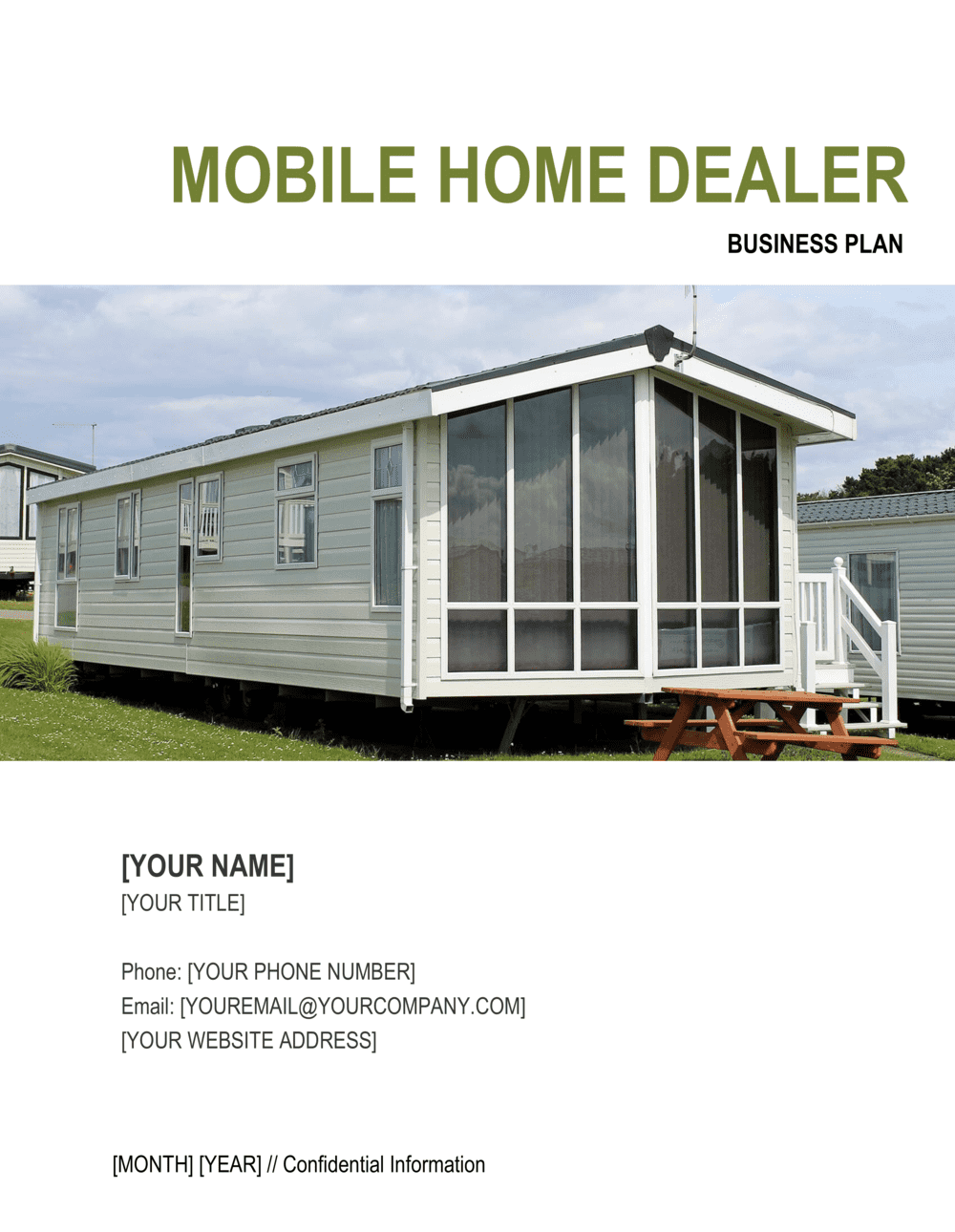
Mobile Home Dealer Business Plan Template

Free Word download β€’ Edit online β€’ Save & share with Drive β€’ Export to PDF

29 pagesβ€’2h 30m – 3h 20m to fillβ€’Difficulty: Expert
Learn more ↓
FreeMobile Home Dealer Business Plan Template

At a glance

What it is
A Mobile Home Dealer Business Plan is a structured operational document that outlines the strategy, market opportunity, inventory model, sales process, and financial projections for launching or growing a manufactured and mobile home dealership. This free Word download gives you a ready-to-edit framework you can customize for your location and manufacturer relationships, then export as PDF for lenders, investors, or licensing bodies.
When you need it
Use it when applying for a dealer license, seeking a floor-plan financing line from a lender, negotiating a manufacturer franchise agreement, or building an internal growth roadmap for an existing dealership. Most state licensing authorities and lenders require a written business plan before approving a new manufactured housing dealer.
What's inside
Executive summary, company overview, market and competitive analysis, inventory and manufacturer relationships, sales and marketing strategy, operations and staffing plan, regulatory compliance overview, and three-year financial projections including revenue per unit, gross margin, and floor-plan carrying costs.

What is a Mobile Home Dealer Business Plan?

A Mobile Home Dealer Business Plan is a structured operational document that maps the strategy, market opportunity, inventory model, manufacturer relationships, regulatory compliance obligations, and financial projections for launching or scaling a manufactured and mobile home dealership. Unlike a generic retail business plan, it addresses the mechanics specific to this industry β€” floor-plan financing structures, HUD-code compliance, state dealer licensing requirements, surety bond obligations, and the economics of carrying factory-built homes on a sales lot. The document functions as both an internal operating roadmap and the primary submission package for lenders, state licensing authorities, and manufacturer franchise programs.

Why You Need This Document

Without a formal business plan, a mobile home dealership cannot open its doors in most states β€” licensing authorities require written evidence of a viable operating model, adequate capitalization, and regulatory awareness before issuing a dealer license. Lenders who extend floor-plan credit lines use the plan to set credit limits and loan covenants; a missing or superficial plan typically results in a smaller line that constrains the inventory mix and limits first-year unit sales. Beyond compliance, the discipline of building the plan forces you to model the floor-plan carrying cost against your projected turn rate β€” the calculation most first-time dealers skip and then discover painfully at month six when curtailment payments arrive on unsold inventory. This template gives you the structure, section logic, and financial framework to produce a lender-ready plan in a fraction of the time it would take to build from scratch.

Which variant fits your situation?

If your situation is…Use this template
Launching a brand-new dealership from scratchMobile Home Dealer Business Plan (Startup)
Adding a manufactured housing division to an existing real estate firmReal Estate Business Plan
Operating a community land-lease park alongside the dealershipMobile Home Park Business Plan
Expanding to a second dealer locationBusiness Expansion Plan
Quick internal alignment for a small owner-operator dealershipOne-Page Business Plan
Seeking equity investment rather than debt financingInvestor Business Plan
Building a construction or modular home sales operationConstruction Company Business Plan

Common mistakes to avoid

❌ Using national HUD shipment data as the market size

Why it matters: A lender underwriting a single-county dealership has no use for national figures. Mismatched market data signals the operator has not done local due diligence.

Fix: Source county-level new manufactured home placements from your state housing agency or MHI's regional data, and tie market size directly to your trade area.

❌ Projecting gross margin without floor-plan carrying costs

Why it matters: A 20% gross margin on a $60,000 unit evaporates quickly if the unit sits on the lot for 120 days on a 10% floor-plan line β€” that is $2,000 in carrying cost, or 17% of gross profit.

Fix: Model floor-plan interest and curtailment as explicit expense lines below gross profit, not as a footnote, so lenders can see the true unit-level economics.

❌ Omitting the regulatory compliance section

Why it matters: State licensing officers reviewing plans for dealer license approval will reject an application that does not address surety bond, HUD compliance, and point-of-sale disclosure obligations.

Fix: Include the specific bond amount required by your state, the bonding company name, and cite the applicable state manufactured housing statute by section.

❌ No community partnership or off-lot lead strategy

Why it matters: A plan that relies entirely on lot walk-in traffic cannot support a credible unit sales projection β€” lenders will reduce the revenue forecast and tighten the credit line accordingly.

Fix: Identify at least two to three land-lease communities or lot-lease developers within 25 miles and include them in the marketing strategy with estimated annual unit referral volume.

The 10 key sections, explained

Executive Summary

Company Overview

Market Analysis

Competitive Analysis

Inventory and Manufacturer Relationships

Sales and Marketing Strategy

Operations and Staffing Plan

Regulatory and Compliance Overview

Financial Projections

Funding Requirements and Use of Funds

How to fill it out

  1. 1

    Complete the company overview and license status

    Enter your legal entity name, formation state, address, and the current status of your dealer license application. Note your manufacturer dealer agreement details if already executed.

    πŸ’‘ Confirm the exact license application requirements with your state housing agency before writing this section β€” requirements vary significantly between states.

  2. 2

    Build the local market analysis with county-level data

    Pull manufactured housing shipment data from MHI or your state housing finance agency, and supplement with U.S. Census Bureau American Community Survey data on local median incomes, housing costs, and household formation rates.

    πŸ’‘ Lenders want to see that the trade area supports the unit volume you are projecting β€” cite your sources explicitly and match the data vintage to the current year.

  3. 3

    Map competing dealerships and their inventory gaps

    Visit or call every competing dealership within 50 miles. Record their manufacturer affiliations, approximate lot size, price range, and any buyer segments they are not serving β€” such as Spanish-speaking buyers or retirees seeking park-model units.

    πŸ’‘ A two-column differentiation table (competitor weaknesses vs. your advantage) makes this section scannable for busy lenders.

  4. 4

    Define your inventory mix and model the floor-plan carrying cost

    List every unit type you plan to stock with retail price, cost, and projected days-to-sale. Multiply average inventory balance by your floor-plan rate and divide by 365 to calculate daily carrying cost per unit.

    πŸ’‘ If carrying cost exceeds 3% of the unit's retail price for your average turn time, reconsider stocking that price tier or negotiate a lower floor-plan rate.

  5. 5

    Outline your sales channels and community partnerships

    List each lead generation channel with an estimated monthly lead volume and conversion rate. Identify every land-lease community within your trade area and note how many available lots each has.

    πŸ’‘ A single partnership agreement with a local land-lease community operator can deliver 20–40% of first-year unit sales β€” prioritize this relationship early.

  6. 6

    Build the three-year financial model from unit economics up

    Start with units sold per month, multiply by average retail price, subtract cost of unit and floor-plan interest, then layer in operating expenses. Build Year 1 monthly and Years 2–3 annually.

    πŸ’‘ Run a downside scenario at 70% of projected unit sales to confirm the business remains solvent β€” lenders will test this before approving your application.

  7. 7

    State the funding ask with specific use-of-funds buckets

    Break the total capital request into at least five buckets: floor-plan line, lot costs, marketing, working capital, and licensing. Assign a dollar amount and percentage to each.

    πŸ’‘ Show a 3–6 month working capital reserve explicitly β€” lenders interpret its absence as a sign the operator expects zero delays or surprises.

  8. 8

    Write the executive summary last

    Pull the single most compelling data point from market analysis, competitive positioning, and financials. Compress into one to two pages that a lender or licensing officer can read in under five minutes.

    πŸ’‘ State the EBITDA breakeven month and total funding ask in the first paragraph β€” lenders skip to these numbers first.

Frequently asked questions

What is a mobile home dealer business plan?

A mobile home dealer business plan is a structured operational document that defines the strategy, market opportunity, inventory model, financing structure, and financial projections for a manufactured or mobile home dealership. It is used to satisfy state dealer licensing requirements, secure floor-plan financing from lenders, negotiate manufacturer dealer agreements, and guide internal operations. The plan typically covers company overview, market analysis, inventory strategy, sales approach, regulatory compliance, and a three-year financial model.

Do I need a business plan to get a mobile home dealer license?

Most state housing agencies require a written business plan as part of the dealer license application, along with a surety bond, a physical lot inspection, and a background check. The plan demonstrates to the licensing authority that the applicant understands the regulatory environment, has a viable operating model, and holds adequate capitalization. Requirements vary by state β€” confirm the specific format and financial detail required with your state's manufactured housing division before submitting.

What financial projections should a mobile home dealer business plan include?

At minimum: unit sales volume by year, average retail price and gross margin per unit, floor-plan financing costs (interest and curtailment), operating expenses (payroll, lot lease, marketing, insurance), and net income for three years with monthly detail for Year 1. A complete plan also includes a cash flow statement showing the timing of unit purchases, sales proceeds, and floor-plan paydowns, plus a funding requirements schedule with use-of-funds breakdown.

How is a mobile home dealer business plan different from a general retail business plan?

The key differences are floor-plan financing, HUD regulatory compliance, and the manufacturer dealer relationship β€” none of which appear in a standard retail plan. Floor-plan carrying costs are a major expense line unique to inventory-heavy dealerships and must be modeled explicitly. The plan must also address state dealer licensing, surety bond requirements, and HUD inspection tag compliance, which are specific to manufactured housing.

What is floor-plan financing and why does it matter for the business plan?

Floor-plan financing is a revolving credit line a lender provides to fund the purchase of inventory units held on the lot, with each unit serving as collateral. It is the primary capital tool for manufactured home dealers and one of the largest ongoing expense items. The business plan must model the interest rate, curtailment schedule, and average turn rate to show lenders that gross margin per unit exceeds carrying cost β€” otherwise the dealership loses money on slow-moving inventory.

How long should a mobile home dealer business plan be?

A complete plan suitable for a lender or licensing authority typically runs 15 to 25 pages plus a financial model appendix. The financial model itself β€” monthly P&L for Year 1 and annual for Years 2 and 3, plus a cash flow statement β€” is the section lenders scrutinize most. A plan shorter than 10 pages is rarely accepted for floor-plan credit lines above $250,000.

Which manufacturers require a dealer business plan before signing a dealer agreement?

Most major manufactured housing manufacturers β€” including Clayton Homes, Cavco Industries, Skyline Champion, and Legacy Housing β€” require applicants to submit a business plan, evidence of capitalization, and a lot inspection before executing a dealer agreement. The specific requirements vary by manufacturer and region. Independent dealers selling used inventory or multiple brands typically face less formal requirements from manufacturers but still need the plan for state licensing and floor-plan lenders.

Can I write this business plan myself without hiring a consultant?

Yes β€” a structured template handles the format and section logic, leaving you to supply the local market data, inventory model, and financial assumptions. The sections most likely to require outside help are the three-statement financial model and the floor-plan carrying cost analysis. Consider engaging a business advisor or accountant for a model review if you are seeking a floor-plan line above $500,000 or an SBA loan, where lenders apply stricter underwriting standards.

What is the difference between a mobile home dealer business plan and a mobile home park business plan?

A dealer business plan covers the sales operation β€” buying inventory from manufacturers, carrying units on a lot, and selling them to individual buyers. A mobile home park or land-lease community business plan covers the real estate operation β€” acquiring or developing land, leasing pads to homeowners, and managing community infrastructure. Some operators run both businesses, but they require separate plans because the revenue models, capital requirements, and regulatory frameworks are fundamentally different.

How this compares to alternatives

vs Mobile Home Park Business Plan

A mobile home park business plan covers land acquisition, pad lease revenue, and community infrastructure for a land-lease community. A dealer business plan covers unit sales, floor-plan financing, and manufacturer relationships. The two businesses are often co-located but operate under entirely different financial models and regulatory frameworks, requiring separate plans.

vs General Retail Business Plan

A general retail business plan addresses product sourcing, sales channels, and operating expenses but does not account for floor-plan financing, HUD compliance, dealer licensing, or manufacturer dealer agreements. Using a generic retail template for a manufactured housing dealership will produce a plan that lenders and licensing officers in the industry will immediately identify as inadequate.

vs Construction Company Business Plan

A construction company business plan focuses on project-based revenue, subcontractor management, and bonding for site-built work. A mobile home dealer plan is inventory-based, with recurring floor-plan credit cycles and manufacturer relationships rather than project pipelines. Operators who both sell and install homes will need elements of both document types.

vs One-Page Business Plan

A one-page plan is useful for early-stage ideation and internal alignment but lacks the financial depth, regulatory detail, and inventory modeling that manufactured housing lenders and licensing authorities require. Use a one-page plan to test the concept, then build the full dealer plan before applying for a license or credit line.

Industry-specific considerations

Manufactured Housing

HUD-code compliance, floor-plan financing structure, manufacturer dealer agreements, and state dealer licensing are all unique to this industry and must be addressed explicitly.

Real Estate and Property Development

Developers integrating a dealership into a land-lease community or subdivision use the plan to model the combined revenue stream from lot sales and home placements.

Financial Services and Lending

Floor-plan lenders and SBA preferred lenders review the plan's inventory turn model and carrying cost analysis to set credit line limits and covenants.

Retail and Consumer Sales

The dealership's sales funnel, lead conversion metrics, and community partnership strategy mirror multi-location retail planning, with the addition of on-site financing and delivery logistics.

Template vs pro β€” what fits your needs?

PathBest forCostTime
Use the templateFirst-time dealers applying for state licensing and floor-plan lines up to $500,000Free2–4 weeks (30–60 hours)
Template + professional reviewDealers seeking SBA financing, manufacturer franchise agreements, or floor-plan lines above $500,000$500–$2,000 for an accountant or manufactured housing advisor review3–5 weeks
Custom draftedMulti-location dealership groups, real estate developers integrating a dealership into a land-lease community, or complex manufacturer franchise negotiations$3,000–$8,000 for a professional business plan writer with manufactured housing experience4–8 weeks

Glossary

Floor-Plan Financing
A revolving credit line a lender extends to a dealership to fund the purchase of inventory units held on the lot, with each unit serving as collateral.
HUD Code
The federal construction and safety standard administered by the U.S. Department of Housing and Urban Development that all manufactured homes must meet.
Manufactured Home
A factory-built home constructed on a permanent chassis after June 15, 1976, in compliance with the HUD Code β€” the legal term for what is commonly called a mobile home.
Dealer License
A state-issued authorization required to sell manufactured or mobile homes to the public, typically involving a background check, surety bond, and lot inspection.
Single-Wide / Double-Wide
Manufactured home configurations: single-wide units are typically 14–18 feet wide; double-wide units are two sections joined on-site, typically 24–36 feet wide.
Land-Lease Community
A planned development where residents own their home but lease the land beneath it from a community operator, often the primary customer base for dealerships.
Surety Bond
A three-party financial guarantee required by most states before issuing a dealer license, protecting buyers if the dealer fails to perform contractual obligations.
Curtailment
A floor-plan lender's requirement that a dealer begin paying down the principal on an aging inventory unit after a defined period β€” typically 90 to 180 days β€” regardless of whether the unit has sold.
Chattel Loan
Personal property financing used when a manufactured home is not affixed to land, treated similarly to a vehicle loan rather than a traditional mortgage.
Turn Rate
The number of times per year a dealership sells and replaces its average inventory unit β€” a key metric for evaluating floor-plan carrying cost efficiency.

Part of your Business Operating System

This document is one of 3,000+ business & legal templates included in Business in a Box.

  • Fill-in-the-blanks β€” ready in minutes
  • 100% customizable Word document
  • Compatible with all office suites
  • Export to PDF and share electronically

Create your document in 3 simple steps.

From template to signed document β€” all inside one Business Operating System.
1
Download or open template

Access over 3,000+ business and legal templates for any business task, project or initiative.

2
Edit and fill in the blanks with AI

Customize your ready-made business document template and save it in the cloud.

3
Save, Share, Send, Sign

Share your files and folders with your team. Create a space of seamless collaboration.

Save time, save money, and create top-quality documents.

β˜…β˜…β˜…β˜…β˜…

"Fantastic value! I'm not sure how I'd do without it. It's worth its weight in gold and paid back for itself many times."

Managing Director Β· Mall Farm
Robert Whalley
Managing Director, Mall Farm Proprietary Limited
β˜…β˜…β˜…β˜…β˜…

"I have been using Business in a Box for years. It has been the most useful source of templates I have encountered. I recommend it to anyone."

Business Owner Β· 4+ years
Dr Michael John Freestone
Business Owner
β˜…β˜…β˜…β˜…β˜…

"It has been a life saver so many times I have lost count. Business in a Box has saved me so much time and as you know, time is money."

Owner Β· Upstate Web
David G. Moore Jr.
Owner, Upstate Web

Run your business with a system β€” not scattered tools

Stop downloading documents. Start operating with clarity. Business in a Box gives you the Business Operating System used by over 250,000 companies worldwide to structure, run, and grow their business.

Start freeΒ Β·Β No credit card required