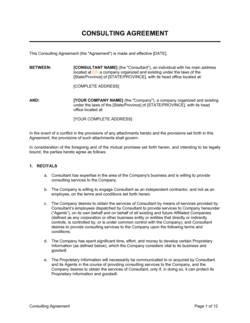
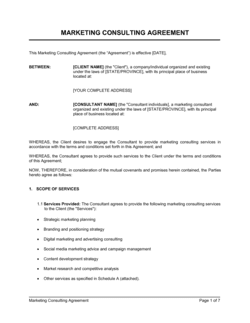
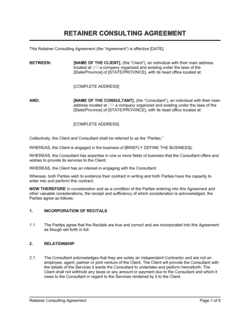
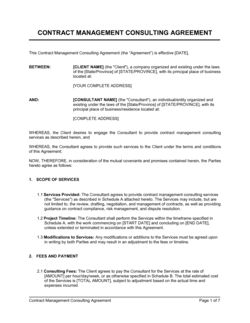
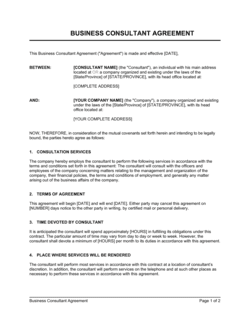
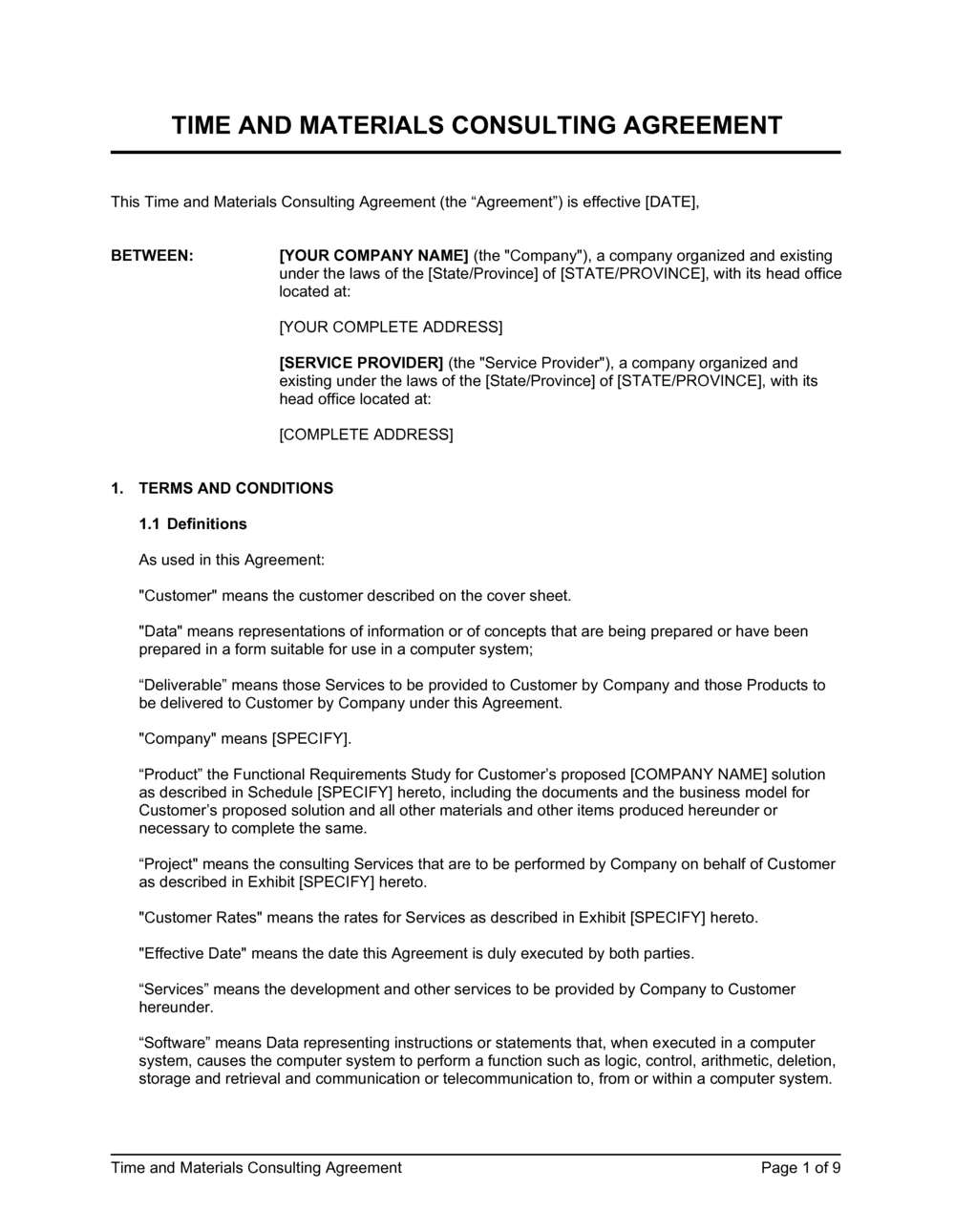
Time and Materials Consulting Agreement Template

Free Word download • Edit online • Save & share with Drive • Export to PDF

9 pages30–40 min to fillDifficulty: ComplexSignature requiredLegal review recommended
Learn more ↓
FreeTime and Materials Consulting Agreement Template

At a glance

What it is
A Time and Materials Consulting Agreement is a legally binding contract between a consultant (or consulting firm) and a client that sets the billing structure for engagements where the full scope of work cannot be defined in advance. Instead of a fixed fee, the client pays for actual hours worked at agreed hourly rates plus the direct cost of materials, travel, and third-party expenses. This free Word download gives you a fully editable, professional template you can tailor and export as PDF in under 30 minutes.
When you need it
Use it whenever you are engaging a consultant for work where the deliverables, timeline, or resource requirements are not yet fully known — such as IT implementations, engineering projects, management consulting engagements, or ongoing advisory relationships where scope evolves over time.
What's inside
The template covers parties and engagement details, services description and statement of work, hourly rate schedule and materials markup, invoicing cadence and payment terms, a not-to-exceed budget cap, change-order procedure, confidentiality, IP assignment, limitation of liability, termination rights, and governing law.

What is a Time and Materials Consulting Agreement?

A Time and Materials Consulting Agreement is a legally binding contract between a consultant and a client that structures billing around actual work performed rather than a fixed project price. The client pays for every hour worked at pre-agreed hourly rates per role or seniority level, plus the direct cost of approved materials, travel, and third-party expenses — often with a percentage markup for procurement overhead. Because the total contract value is not set in advance, a well-drafted T&M agreement includes a not-to-exceed cap, a formal change-order procedure, and detailed invoicing requirements so both parties can track spend against budget throughout the engagement. It also governs the ownership of work product, confidentiality of shared information, and the conditions under which either party may terminate the relationship.

Why You Need This Document

Without a signed T&M consulting agreement, both parties are exposed in ways that emerge only after the relationship runs into friction. Clients who rely on email threads and verbal rate discussions have no enforceable ceiling on total cost, no right to audit time records, and no clarity on who owns the deliverables once the project ends — a gap that routinely triggers ownership disputes when a consultant's work becomes commercially valuable. Consultants without a written agreement have no guaranteed right to payment for materials they pre-ordered or subcontractors they engaged when a client cancels mid-project. A properly executed T&M agreement closes all of these gaps before work begins: it establishes the rate schedule, caps total exposure, requires itemized invoicing, assigns IP on payment, and sets a clear exit path for both parties — turning an open-ended engagement into a commercially predictable and legally protected arrangement.

Which variant fits your situation?

If your situation is…Use this template
Consultant delivering a clearly defined project with a fixed priceFixed-Price Consulting Agreement
Ongoing advisory relationship billed as a monthly flat feeConsulting Retainer Agreement
Engaging an independent contractor rather than a consulting firmIndependent Contractor Agreement
IT development project with variable sprint-based hoursSoftware Development Agreement
Short engagement requiring only confidentiality and basic termsGeneral Service Agreement
Subcontracting T&M work to a second-tier vendorSubcontractor Agreement
Government or public sector T&M procurement contractGovernment Services Contract

Common mistakes to avoid

❌ No not-to-exceed cap or early-warning threshold

Why it matters: Without an NTE cap, clients face open-ended cost exposure that can exceed the original budget by multiples — especially on IT and engineering projects where scope evolves. Disputes over total contract cost are among the most litigated T&M issues.

Fix: Set a specific NTE dollar amount for each statement of work and require the consultant to notify you in writing at 80% of spend. Make any increase subject to a signed change order before additional work proceeds.

❌ Vague or missing change-order procedure

Why it matters: Verbal scope expansions on T&M contracts result in the consultant billing for additional hours the client did not knowingly authorize. Without a written change-order process, clients have limited recourse to dispute those charges.

Fix: Include a clause requiring all scope changes to be documented in a signed change order before the additional work begins. Specify who on each side has authority to approve change orders.

❌ No Background IP carve-out in the IP assignment clause

Why it matters: Assigning all work product without reserving pre-existing tools can transfer ownership of the consultant's core methodology to a single client — preventing the consultant from using those same tools for any future engagement.

Fix: List the specific frameworks, templates, and tools the consultant will use, carve them out of the assignment, and grant the client a perpetual non-exclusive license to use them within the delivered work product only.

❌ Lump-sum invoices with no line-level time logs

Why it matters: An invoice that states '40 hours — consulting services — $8,000' provides no basis for client verification, audit, or dispute resolution. Tax authorities and client finance teams both require itemized records.

Fix: Require invoices to include a line-level time log showing the date, personnel name or role, task description, and hours for every billing entry, along with receipts for all reimbursable materials.

❌ No limitation of liability clause

Why it matters: Without a liability cap, a consultant can be exposed to consequential damage claims — such as lost client revenue caused by a project delay — that dwarf the total contract value, making the engagement commercially unviable to insure or undertake.

Fix: Include a mutual limitation capping each party's total liability at the fees paid in the preceding three months and explicitly excluding indirect, consequential, and punitive damages.

❌ Signing after work has already begun

Why it matters: In common-law jurisdictions, courts may find that the consultant operated under an implied contract before execution, which can override key written terms — including the NTE cap, IP assignment, and limitation of liability clause.

Fix: Execute the agreement and all exhibits before the consultant performs any billable hours. If time pressure requires starting early, issue a written engagement letter referencing the pending agreement to preserve key protections.

The 10 key clauses, explained

Parties and engagement recitals

In plain language: Identifies the client and consultant as legal entities, states the nature of the consulting relationship, and establishes the effective date of the agreement.

Sample language
This Time and Materials Consulting Agreement ('Agreement') is entered into as of [DATE] by and between [CLIENT LEGAL NAME], a [STATE/PROVINCE] [ENTITY TYPE] ('Client'), and [CONSULTANT LEGAL NAME], a [STATE/PROVINCE] [ENTITY TYPE] ('Consultant').

Common mistake: Using a trade name or individual's name instead of the registered legal entity. If the named party does not match the entity holding bank accounts or signing invoices, enforcing payment or IP clauses against the right party becomes legally complicated.

Services and statement of work

In plain language: Describes the scope of consulting services and references the attached statement of work that details specific deliverables, timelines, and technical requirements for the engagement.

Sample language
Consultant shall perform the professional services described in Exhibit A (Statement of Work) attached hereto ('Services'). Consultant shall perform additional services only upon execution of a written Change Order signed by both parties.

Common mistake: Embedding detailed deliverable specifications directly in the body of the agreement rather than in a separate SOW exhibit. Updating scope then requires a full contract amendment rather than a simple exhibit replacement.

Hourly rate schedule and role classifications

In plain language: Lists each billing role or consultant classification with its corresponding hourly rate, and states whether overtime, weekend, or travel time is billed at the standard rate or a premium.

Sample language
Client shall pay Consultant for Services at the following rates: [ROLE 1]: $[X]/hour; [ROLE 2]: $[X]/hour. Rates apply to hours actually worked. Travel time is billed at [50% / 100%] of the applicable hourly rate. Rates are fixed for [12] months from the Effective Date.

Common mistake: Failing to specify whether travel time is billable and at what rate. Disputes over multi-day on-site engagements involving significant travel are among the most common T&M billing conflicts.

Materials, expenses, and markup

In plain language: Defines which categories of direct costs are reimbursable, the markup percentage applied to third-party materials or subcontractors, and the documentation required for reimbursement.

Sample language
Client shall reimburse Consultant for pre-approved out-of-pocket expenses including travel, lodging, and materials at cost plus a [X]% markup for handling. Expenses exceeding $[THRESHOLD] require Client's prior written approval. Receipts must be submitted with each invoice.

Common mistake: No approval threshold for individual expenses, resulting in the client receiving invoices for large equipment purchases or subcontractor fees they never authorized and cannot dispute effectively.

Not-to-exceed budget cap

In plain language: Sets a maximum total billable amount or hour ceiling that the consultant cannot exceed without written client approval, protecting the client from unlimited cost exposure.

Sample language
The total fees and expenses payable under this Agreement shall not exceed $[NTE AMOUNT] ('NTE Cap') without Client's prior written approval. Consultant shall notify Client in writing when cumulative billing reaches [80]% of the NTE Cap.

Common mistake: Setting an NTE cap without requiring the consultant to provide advance warning as the cap is approached. Clients discover the cap has been reached only when they receive an invoice requesting approval to continue — often mid-deliverable.

Invoicing, payment terms, and audit rights

In plain language: Establishes the invoicing frequency, required invoice contents (dates, hours, role, rate, materials detail), payment due date, late-fee rate, and the client's right to audit time records.

Sample language
Consultant shall submit itemized invoices [bi-weekly / monthly], detailing hours worked by role and date, materials costs with receipts, and cumulative spend against the NTE Cap. Payment is due within [30] days of invoice. Overdue balances accrue interest at [1.5]% per month. Client may audit Consultant's time records upon [5] business days' notice.

Common mistake: Invoices that list only total hours and a lump sum rather than itemized daily or weekly breakdowns. Clients cannot verify accuracy or dispute specific entries without line-level detail, and auditors will flag the lack of documentation.

Intellectual property assignment

In plain language: Assigns ownership of all work product, deliverables, and developments created by the consultant during the engagement to the client upon full payment, while carving out the consultant's pre-existing tools and methodologies.

Sample language
Upon receipt of full payment, Consultant irrevocably assigns to Client all right, title, and interest in all deliverables created specifically for Client under this Agreement ('Work Product'). Consultant retains ownership of pre-existing tools, frameworks, and methodologies ('Background IP'), and grants Client a perpetual, non-exclusive license to use Background IP embedded in the Work Product.

Common mistake: Assigning all IP without a Background IP carve-out. Consultants who inadvertently assign their reusable frameworks and proprietary methodologies to one client cannot legally use those tools for other clients — a clause that is routinely contested in disputes.

Confidentiality

In plain language: Prohibits both parties from disclosing the other's confidential information during and after the engagement, and defines what information qualifies as confidential.

Sample language
Each party shall hold the other's Confidential Information in strict confidence and shall not disclose or use it except as necessary to perform the Services. 'Confidential Information' means any non-public technical, financial, or business information disclosed under this Agreement, whether marked confidential or not.

Common mistake: Omitting a mutual confidentiality obligation and making it one-directional (protecting only the client). Consultants share proprietary methodologies, tools, and pricing structures that warrant equal protection.

Termination and wind-down

In plain language: States the notice period required to terminate the agreement, the client's obligation to pay for all work completed and materials committed up to the termination date, and any kill-fee or minimum commitment.

Sample language
Either party may terminate this Agreement with [30] days' written notice. Upon termination, Client shall pay Consultant for all hours worked and materials procured or committed through the termination date. Consultant shall deliver all completed work product and return Client's confidential materials within [10] business days.

Common mistake: No obligation to pay for materials already committed or subcontractors already engaged at termination. Consultants who ordered supplies or contracted labor based on the client's project can suffer significant uncompensated losses if the contract is silent.

Limitation of liability and governing law

In plain language: Caps the consultant's total liability for any claim arising from the engagement, excludes indirect and consequential damages, and specifies the governing jurisdiction and dispute resolution process.

Sample language
In no event shall Consultant's total liability under this Agreement exceed the total fees paid by Client in the [3] months preceding the claim. Neither party shall be liable for indirect, consequential, or punitive damages. This Agreement is governed by the laws of [STATE / PROVINCE]. Disputes shall be resolved by binding arbitration in [CITY].

Common mistake: No limitation of liability clause at all, leaving the consultant exposed to consequential damage claims — such as a client's lost profits from a delayed IT project — that could dwarf the total contract value.

How to fill it out

  1. 1

    Enter both parties' legal entity details

    Use each party's full registered legal name, not a trade name or individual's name. Include the state or province of incorporation and the entity type for both the client and consultant.

    💡 Cross-check against a business registry (e.g., your state's Secretary of State database) to confirm the exact legal name before the agreement is signed.

  2. 2

    Define the services in a separate statement of work

    Draft Exhibit A as a standalone SOW describing the specific services, expected deliverables, project timeline, and any key assumptions or exclusions. Reference Exhibit A in the main body rather than embedding scope details there.

    💡 List explicit exclusions in the SOW — what you will not do — to prevent scope creep from undefined tasks that each party assumed were included.

  3. 3

    Set the hourly rate schedule for each role

    List every billing role with its hourly rate, note whether rates apply to partial hours (most T&M agreements bill in 15-minute or 30-minute increments), and state the rate lock period.

    💡 If the engagement spans more than 12 months, include an annual rate escalation clause tied to CPI or a fixed percentage (e.g., 3–5%) to avoid renegotiating the entire agreement each year.

  4. 4

    Define reimbursable expenses and the approval threshold

    List which expense categories are reimbursable (travel, lodging, materials, software licenses), the markup percentage, and the dollar threshold above which individual purchases require pre-approval in writing.

    💡 Set the pre-approval threshold at a level your client's procurement process can realistically approve quickly — $500 or $1,000 works for most SMB clients; $5,000 for enterprise.

  5. 5

    Set the not-to-exceed cap and early-warning trigger

    Enter the total NTE amount for the engagement and the percentage of spend at which the consultant must notify the client in writing — typically 80%. Both figures should be agreed with the client before signing.

    💡 Break large engagements into phased SOWs each with their own NTE cap rather than one large NTE, so the client can reassess scope and budget at natural project milestones.

  6. 6

    Complete the invoicing and payment terms

    Set the invoicing frequency (bi-weekly is common for T&M work), the payment due date (Net 15 or Net 30), and the late-payment interest rate. Specify that each invoice must include a line-level time log and receipts for materials.

    💡 Attach a sample invoice format as Exhibit B so both parties agree upfront on the level of detail required — this prevents payment disputes over insufficient documentation.

  7. 7

    Tailor the IP assignment and Background IP carve-out

    List the consultant's pre-existing tools, templates, or proprietary frameworks that will be embedded in deliverables and must be carved out of the assignment. Grant the client a perpetual, non-exclusive license to use those tools within the delivered work product.

    💡 Be specific about Background IP — a general carve-out for 'all pre-existing materials' is routinely disputed. Name the specific tools or methodologies by category.

  8. 8

    Execute before work begins

    Both parties must sign the agreement and any attached exhibits before the consultant starts any billable work. Work performed before signature creates IP ownership ambiguity and weakens enforceability of the NTE cap.

    💡 Use a time-stamped electronic signature tool to create an audit trail of execution and store the fully signed agreement with your project records before issuing the first invoice.

Frequently asked questions

What is a time and materials consulting agreement?

A time and materials consulting agreement is a contract where the client pays for the actual hours a consultant works at pre-agreed hourly rates, plus the direct cost of approved materials and expenses. Unlike a fixed-price contract, the total cost is not set in advance — it depends on the work actually performed. T&M agreements are used when the full scope of an engagement cannot be defined upfront, such as in IT implementations, engineering studies, or ongoing advisory relationships.

What is the difference between a time and materials contract and a fixed-price contract?

A fixed-price contract sets a single total price for a defined scope of work regardless of actual hours or materials consumed — the consultant bears the risk of underestimating effort. A T&M contract shifts that risk to the client, who pays for actual time and materials. T&M is appropriate when scope is uncertain or likely to evolve; fixed-price works when deliverables are tightly defined and the consultant can accurately estimate cost. Many projects use T&M for early discovery phases and fixed-price for execution once scope is clear.

Should a T&M consulting agreement include a not-to-exceed cap?

Yes, a not-to-exceed (NTE) cap is strongly recommended for any T&M engagement. Without one, the client has no contractual ceiling on total cost exposure, which makes budget planning impossible and creates disputes when final invoices exceed expectations. A typical NTE cap is set 10–20% above the project estimate to allow for reasonable variance without requiring a change order for minor scope adjustments. The agreement should also require the consultant to notify the client when cumulative billing reaches 80% of the cap.

Who owns the work product created under a T&M consulting agreement?

Ownership depends on what the agreement says. Without an explicit IP assignment clause, copyright in the deliverables typically rests with the consultant who created them, not the client who paid for them — a result most clients do not expect. A well-drafted T&M agreement assigns all deliverables to the client upon full payment while carving out the consultant's pre-existing tools and methodologies, which are licensed rather than assigned.

What expenses are typically reimbursable under a T&M agreement?

Commonly reimbursable categories include travel (flights, accommodation, ground transport), on-site meals, materials and equipment purchased specifically for the project, software or tool licenses required for the engagement, and fees paid to approved subcontractors. The agreement should specify which categories are reimbursable, whether a markup applies, and the dollar threshold above which individual purchases require prior written approval from the client.

How should invoices be structured under a time and materials contract?

Each invoice should include the billing period, a line-level time log showing the date, consultant name or role, task description, and hours for every entry, the applicable hourly rate and resulting fee per line, an itemized list of materials and expenses with receipts, a subtotal and any applicable taxes, and the cumulative spend against the NTE cap. Lump-sum invoices without supporting detail create payment disputes and fail audit requirements.

Is a T&M consulting agreement enforceable without a statement of work?

The agreement can be enforceable as a framework contract, but without a signed statement of work defining what services will be performed, it provides very limited practical protection. Courts will struggle to evaluate scope disputes or determine whether a change order was required. Always execute a specific SOW before any billable work begins, even for short or straightforward engagements.

Do I need a lawyer to draft a time and materials consulting agreement?

For straightforward domestic engagements, a professionally drafted template is typically sufficient. Engage a lawyer when the engagement involves sensitive IP or proprietary technology, the contract value exceeds $100,000, the consultant will be working in a jurisdiction with complex employment or contractor classification rules, or the client is a government entity subject to procurement regulations. A one-hour template review typically costs $200–$400 and is worthwhile for high-value or high-risk engagements.

What happens if the client terminates a T&M agreement early?

The client is typically obligated to pay for all hours worked and materials procured or contractually committed up to the termination date, plus any applicable kill fee if one is specified. The agreement should require the consultant to deliver all completed work product and return the client's confidential materials within a defined window — typically 10 business days. Without a clear termination clause, clients have disputed responsibility for pre-ordered materials and pre-engaged subcontractors, leading to costly arbitration.

Can a T&M consulting agreement include a non-compete clause?

Yes, though enforceability varies significantly by jurisdiction. A non-compete restricting a consultant from working for competitors for a defined period after the engagement is generally more narrowly construed for independent contractors than for employees. Courts typically require that the restriction be reasonable in duration (3–12 months for consultants), limited in geographic or industry scope, and tied to a legitimate business interest such as protecting client relationships or confidential information. California and several other jurisdictions restrict or ban post-engagement non-competes entirely.

How this compares to alternatives

vs Fixed-Price Consulting Agreement

A fixed-price consulting agreement sets a single total fee for a defined scope of work — the consultant bears cost overrun risk. A T&M agreement shifts that risk to the client, who pays for actual hours and materials. Use fixed-price when deliverables and timelines are tightly defined; use T&M when scope is uncertain or expected to evolve during the engagement.

vs Consulting Retainer Agreement

A retainer agreement bills a fixed monthly fee for a set number of advisory hours — giving the client predictable cost and the consultant predictable income. A T&M agreement bills for actual hours worked with no monthly minimum or maximum. Retainers suit ongoing advisory relationships; T&M suits project-based work with variable weekly intensity.

vs Independent Contractor Agreement

An independent contractor agreement governs the general working relationship, classification, and obligations of a self-employed individual. A T&M consulting agreement is a project-level contract that specifies hourly rates, materials reimbursement, invoicing, and a not-to-exceed cap for a defined engagement. Many parties use both: the contractor agreement as a master document and a T&M agreement for each project.

vs Statement of Work (SOW)

A statement of work defines the specific deliverables, timeline, and technical requirements for a single engagement — it is typically an exhibit to a master consulting agreement. A T&M consulting agreement is the governing contract that sets billing structure, payment terms, IP rights, and legal protections. An SOW without a master agreement lacks the legal framework to resolve billing disputes or ownership questions.

Industry-specific considerations

Information Technology

IT consulting engagements billed on T&M commonly cover system implementations, infrastructure audits, and software customization — where sprint-level scope changes make fixed pricing impractical.

Engineering and Construction

Structural, civil, and mechanical engineering firms use T&M for site assessments, design iterations, and construction oversight where material quantities and labor hours depend on field conditions.

Management Consulting

Strategy and operations consulting engagements that evolve based on findings use T&M to bill for analyst and partner hours without committing to a fixed project price before the diagnostic phase is complete.

Marketing and Creative Services

Agencies and freelance consultants use T&M for brand strategy, content development, and campaign management engagements where client revision cycles and approval timelines make fixed fees unworkable.

Jurisdictional notes

United States

T&M consulting agreements are governed by state contract law — there is no federal standard. IP assignment must be explicit; absent a written assignment, the consultant retains copyright in deliverables under US copyright law. Non-compete enforceability varies sharply by state: California, Minnesota, and North Dakota restrict or ban post-engagement non-competes. Misclassification of consultants as independent contractors can trigger IRS and state labor agency audits and back-tax liability.

Canada

Canadian consulting agreements must comply with the provincial Employment Standards Act if there is any risk the relationship could be characterized as employment rather than independent contracting — a distinction courts assess based on control, integration, and economic dependence. Quebec requires contracts affecting provincially regulated businesses to be available in French. IP assignment clauses are generally enforceable, but must be explicit; implied assignments are not recognized under Canadian copyright law.

United Kingdom

UK consultants should confirm IR35 status before executing a T&M agreement — where a consultant works through a personal service company but is deemed an employee for tax purposes, the client may bear employer National Insurance obligations. IP in commissioned works does not automatically vest in the client under UK copyright law, making an explicit assignment clause essential. Post-engagement restrictive covenants are enforceable only if reasonable in scope and supported by a legitimate business interest.

European Union

EU member states have varying rules on independent contractor classification, and several — including France, Germany, and Spain — impose strict tests that can reclassify long-term consultants as dependent workers entitled to employment protections. GDPR applies whenever personal data is processed in delivering consulting services; the agreement should include a data processing addendum where relevant. Non-compete clauses in many EU jurisdictions require financial compensation to the consultant during the restricted period to be enforceable.

Template vs lawyer — what fits your deal?

PathBest forCostTime
Use the templateIndependent consultants and small consulting firms for domestic engagements under $75,000Free20–30 minutes
Template + legal reviewEngagements involving sensitive IP, contracts above $75,000, or consultants working across multiple US states or provinces$200–$5001–3 days
Custom draftedEnterprise consulting contracts, government procurement, cross-border engagements, or arrangements with material non-compete and IP licensing requirements$1,000–$4,000+1–2 weeks

Glossary

Time and Materials (T&M)
A contract structure where the client pays for actual hours worked at pre-agreed rates plus the direct cost of materials, travel, and approved expenses — with no fixed project price.
Not-to-Exceed (NTE) Cap
A contractual ceiling on total billable hours or total contract value that the consultant may not exceed without the client's prior written approval.
Statement of Work (SOW)
An exhibit or schedule attached to the agreement that describes the specific services, deliverables, timeline, and any technical requirements for a defined engagement.
Change Order
A written amendment to the statement of work that documents a mutually agreed change in scope, schedule, or rate schedule, and authorizes any resulting increase in billable time or materials.
Materials Markup
A percentage added to the cost of third-party materials, equipment, or subcontractor invoices to cover the consultant's handling and procurement overhead.
Milestone Billing
An invoicing structure tied to the completion of defined project phases rather than to calendar intervals, sometimes used alongside T&M tracking to improve cash-flow predictability.
Work for Hire
A doctrine under copyright law by which work created by a contractor within the scope of a contract is deemed owned by the client from creation, provided the agreement explicitly states this.
Limitation of Liability
A clause capping the consultant's financial exposure for claims arising from the engagement — typically limited to the total fees paid under the agreement or a fixed dollar amount.
Independent Contractor Status
A classification confirming that the consultant operates as a self-employed entity, not an employee, and is responsible for their own taxes, insurance, and benefits.
Audit Right
A contractual right allowing the client to inspect the consultant's time records, expense receipts, and materials invoices to verify that billed amounts are accurate.

Part of your Business Operating System

This document is one of 3,000+ business & legal templates included in Business in a Box.

  • Fill-in-the-blanks — ready in minutes
  • 100% customizable Word document
  • Compatible with all office suites
  • Export to PDF and share electronically

Create your document in 3 simple steps.

From template to signed document — all inside one Business Operating System.
1
Download or open template

Access over 3,000+ business and legal templates for any business task, project or initiative.

2
Edit and fill in the blanks with AI

Customize your ready-made business document template and save it in the cloud.

3
Save, Share, Send, Sign

Share your files and folders with your team. Create a space of seamless collaboration.

Save time, save money, and create top-quality documents.

★★★★★

"Fantastic value! I'm not sure how I'd do without it. It's worth its weight in gold and paid back for itself many times."

Managing Director · Mall Farm
Robert Whalley
Managing Director, Mall Farm Proprietary Limited
★★★★★

"I have been using Business in a Box for years. It has been the most useful source of templates I have encountered. I recommend it to anyone."

Business Owner · 4+ years
Dr Michael John Freestone
Business Owner
★★★★★

"It has been a life saver so many times I have lost count. Business in a Box has saved me so much time and as you know, time is money."

Owner · Upstate Web
David G. Moore Jr.
Owner, Upstate Web

Run your business with a system — not scattered tools

Stop downloading documents. Start operating with clarity. Business in a Box gives you the Business Operating System used by over 250,000 companies worldwide to structure, run, and grow their business.

Start free · No credit card required