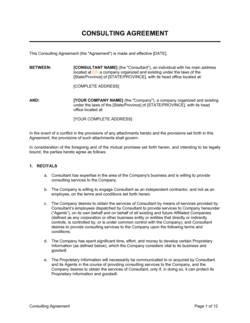
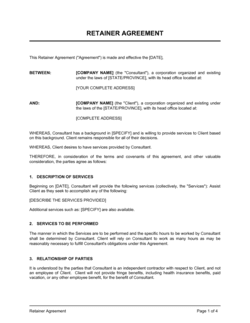
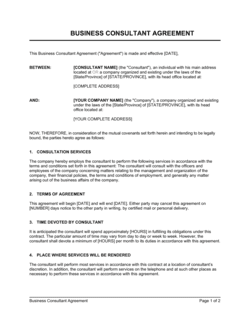
Retainer Consulting Agreement Template

Free Word download • Edit online • Save & share with Drive • Export to PDF

9 pages30–40 min to fillDifficulty: ComplexSignature requiredLegal review recommended
Learn more ↓
FreeRetainer Consulting Agreement Template

At a glance

What it is
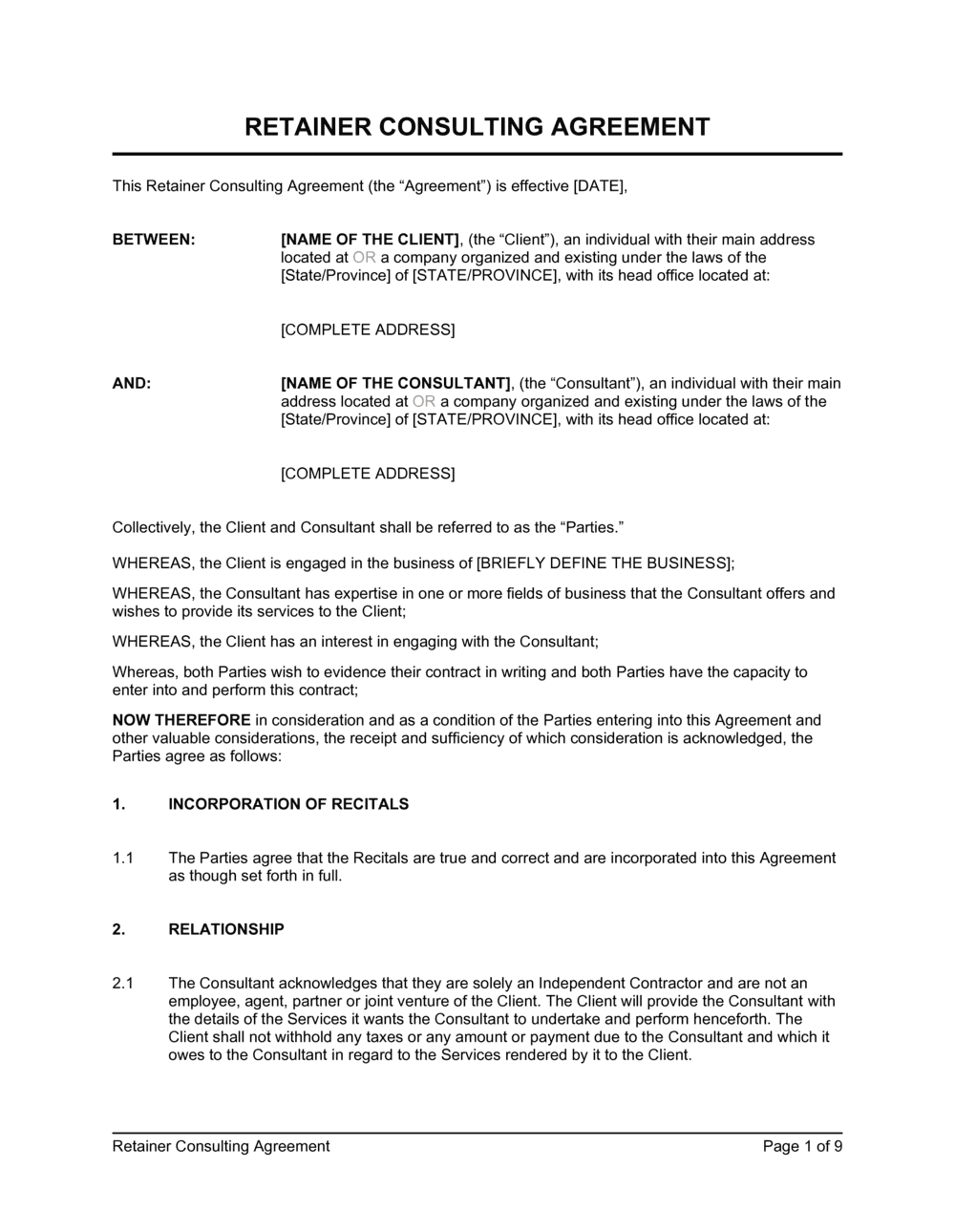
A Retainer Consulting Agreement is a legally binding contract between a client and an independent consultant that establishes an ongoing service relationship funded by a recurring monthly fee. This free Word download covers scope of services, retainer amount, payment terms, IP ownership, confidentiality, and termination in a single document you can edit online and export as PDF.
When you need it
Use it when engaging a consultant on an ongoing basis — rather than for a single project — where the client pays a fixed monthly fee to secure the consultant's availability and a defined set of deliverables or hours. It replaces informal email arrangements with enforceable written obligations.
What's inside
Parties and engagement details, scope of services, retainer fee and billing schedule, independent contractor status, IP assignment, confidentiality, non-solicitation, term and termination, and governing law.

What is a Retainer Consulting Agreement?

A Retainer Consulting Agreement is a legally binding contract between a client and an independent consultant that establishes an ongoing service relationship funded by a recurring monthly fee. Rather than engaging a consultant for a single project with a fixed deliverable, the retainer model reserves the consultant's time and expertise across a defined scope of services each billing period. The agreement governs the monthly fee, overage billing, IP assignment, confidentiality, independent contractor status, and termination rights — replacing informal email arrangements with enforceable written obligations on both sides.

Why You Need This Document

Without a signed retainer agreement, both parties are exposed in ways that typically surface only when the relationship deteriorates. The client has no enforceable claim over work product if the consultant walks away mid-project, no confidentiality protection for the business information shared during the engagement, and no clear basis to dispute inflated invoices. The consultant has no documented agreement on the monthly fee, no protection against a client who expands scope without paying overages, and no defined exit path if the relationship sours. A single undocumented retainer arrangement can result in an unpaid four-figure invoice, a disputed IP ownership claim, or a reclassification audit — any of which costs far more to resolve than the 20 minutes it takes to execute this template.

Which variant fits your situation?

If your situation is…Use this template
One-time project with a defined deliverable and end dateIndependent Contractor Agreement
Ongoing retainer with a named individual and hourly overage billingRetainer Consulting Agreement
Engaging a firm rather than an individual consultantConsulting Services Agreement
Executive-level advisor with equity compensationAdvisory Board Agreement
IT or software development services on a retainer basisIT Services Agreement
Legal services on a retained basis from outside counselLegal Services Retainer Agreement
Short-term consulting with a fixed deliverable and payment on completionConsulting Proposal

Common mistakes to avoid

❌ Leaving scope undefined or vague

Why it matters: Without a specific deliverable list or hour cap, clients expand scope continuously while expecting the retainer fee to cover all work — resulting in unpaid overages and burnout.

Fix: Write a concrete scope clause: named deliverables or a monthly hour cap, plus an explicit overage rate for work beyond the cap.

❌ No rollover policy in the agreement

Why it matters: Consultants assume unused hours expire; clients assume they accumulate. The mismatch surfaces at invoice time and can escalate into a fee dispute that ends the engagement.

Fix: Add a single sentence to the payment clause specifying whether unused hours expire at month-end or roll forward, and for how many periods.

❌ Independent contractor clause contradicted by operational terms

Why it matters: Mandatory hours, employer-provided equipment, or exclusivity requirements create the appearance of an employment relationship. Tax authorities use substance-over-form tests and will reclassify the arrangement regardless of the label in the contract.

Fix: Review every clause for terms that imply employer control. If exclusivity is required, price it separately and document the business reason in the recitals.

❌ IP assignment missing or limited to on-site work

Why it matters: Remote consultants produce deliverables on personal devices outside any location-based clause. Client-specific work product remains with the consultant if the assignment language does not reach it.

Fix: Draft the IP assignment to cover all work product created specifically for the client in connection with the engagement, regardless of location or device.

❌ No termination-for-convenience clause

Why it matters: Without one, either party is bound for the entire initial term even when the relationship has broken down — exit requires proving cause, which is costly and uncertain.

Fix: Include a mutual termination-for-convenience right with 30 days' written notice, effective at the end of the current billing period.

❌ Signing after services have already begun

Why it matters: In common-law jurisdictions, confidentiality, non-solicitation, and IP assignment clauses may be unenforceable without fresh consideration if the consultant has already been performing services.

Fix: Execute the agreement before day one of the engagement. If signing is delayed, provide a documented additional benefit — a signing bonus or rate increase — as fresh consideration.

The 10 key clauses, explained

Parties, recitals, and engagement date

In plain language: Identifies the client and consultant as legal entities, states the nature of the engagement, and records the effective date of the agreement.

Sample language
This Retainer Consulting Agreement ('Agreement') is entered into as of [EFFECTIVE DATE] between [CLIENT LEGAL NAME], a [STATE/PROVINCE] [ENTITY TYPE] ('Client'), and [CONSULTANT LEGAL NAME / FULL NAME], [a [STATE] [ENTITY TYPE] / an individual] ('Consultant').

Common mistake: Using a trade name instead of the consultant's or client's registered legal entity name. Enforcement and tax reporting both require the correct legal name, and mismatches can void indemnification provisions.

Scope of services

In plain language: Defines precisely what the consultant will deliver each month — specific tasks, deliverables, or a capped number of hours — and how changes to scope are handled.

Sample language
During each calendar month of the Term, Consultant shall provide the following services: [DESCRIPTION OF SERVICES] ('Services'), not to exceed [X] hours per month unless Client approves additional hours in writing under Section [X].

Common mistake: Describing scope in general terms like 'strategic advisory' with no hour cap or deliverable list. Vague scope leads to scope creep disputes, unpaid overages, and difficulty terminating for non-performance.

Retainer fee, invoicing, and payment terms

In plain language: States the fixed monthly retainer amount, the invoicing schedule, the payment due date, and the late-payment penalty.

Sample language
Client shall pay Consultant a monthly retainer of $[AMOUNT] ('Retainer Fee'), invoiced on the [1st / last] day of each month and due within [15 / 30] days of the invoice date. Overdue balances accrue interest at [1.5]% per month.

Common mistake: Setting payment terms to 'upon receipt' rather than a specific number of days. Clients interpret this inconsistently, and it provides no clear trigger for late-payment interest or suspension of services.

Overage billing and rollover policy

In plain language: Governs what happens when services exceed the monthly retainer allocation — the hourly overage rate — and whether unused hours carry forward or expire.

Sample language
Services in excess of the monthly hour cap shall be billed at $[OVERAGE RATE] per hour, invoiced separately within [5] business days of the month-end. Unused hours do not roll over and expire at the end of each calendar month.

Common mistake: Omitting the rollover policy entirely. Consultants often assume hours expire; clients often assume they accumulate. The resulting dispute can unwind an otherwise productive relationship.

Independent contractor status

In plain language: Confirms that the consultant is not an employee, clarifies that no benefits or tax withholding apply, and requires the consultant to pay their own self-employment taxes.

Sample language
Consultant is an independent contractor. Nothing in this Agreement creates an employment, partnership, or joint-venture relationship. Consultant is solely responsible for all taxes, insurance, and expenses arising from the performance of Services.

Common mistake: Including terms that create employer-level control — set hours, mandatory office presence, equipment provision — while still labeling the consultant a contractor. Regulators apply substance-over-form tests; misclassification triggers back taxes, penalties, and benefit liability.

Intellectual property assignment

In plain language: Assigns ownership of all work product and related IP created by the consultant during the engagement to the client, while optionally carving out pre-existing tools or background IP.

Sample language
All work product created by Consultant specifically for Client under this Agreement is the sole property of Client and is hereby assigned to Client. Consultant retains ownership of pre-existing tools, frameworks, and methodologies ('Background IP') listed in Schedule A.

Common mistake: No IP assignment clause, or one limited to deliverables created 'on Client premises.' Remote consultants produce IP on personal devices outside any location restriction — the assignment must be activity-based, not location-based.

Confidentiality

In plain language: Prohibits the consultant from disclosing or using the client's confidential information — trade secrets, financials, customer data — during and after the engagement.

Sample language
Consultant shall hold all Confidential Information of Client in strict confidence and shall not disclose or use it for any purpose other than performing the Services. This obligation survives termination of the Agreement for a period of [3] years.

Common mistake: Failing to define 'Confidential Information' and relying on an all-encompassing label. Courts apply a reasonableness standard — specifying the categories (customer lists, product roadmaps, financial data) makes the obligation clearer and more enforceable.

Non-solicitation

In plain language: Prevents the consultant from soliciting the client's employees or key customers for a defined period after the engagement ends.

Sample language
For [12] months following termination of this Agreement, Consultant shall not directly solicit, recruit, or hire any employee of Client, or solicit any customer or prospect of Client with whom Consultant had material contact during the engagement.

Common mistake: Using a mutual non-solicitation clause when only one direction is commercially meaningful. Asymmetric clauses — protecting only the client's workforce and customer base — are easier to enforce and less likely to be challenged as unreasonable.

Term and termination

In plain language: Sets the initial term of the agreement, automatic renewal terms, and the notice period required to terminate — both for convenience and for cause.

Sample language
This Agreement commences on [START DATE] and continues for an initial term of [12] months, renewing automatically for successive [30-day] periods unless either party provides [30] days' written notice. Either party may terminate for Cause immediately upon written notice.

Common mistake: No automatic renewal clause combined with a long initial term. If the client wants to exit at month 13 but the contract auto-renews for another 12 months without notice, a termination-for-convenience clause is the only exit — and many templates omit one.

Governing law and dispute resolution

In plain language: Specifies which jurisdiction's laws govern the agreement and how disputes are resolved — arbitration, mediation, or litigation — and where.

Sample language
This Agreement is governed by the laws of [STATE / PROVINCE / COUNTRY], without regard to conflict-of-law rules. Any dispute shall be resolved by binding arbitration administered by [AAA / JAMS] in [CITY, STATE], except that either party may seek injunctive relief in any court of competent jurisdiction.

Common mistake: Selecting a governing law that has no connection to either party's location. Several jurisdictions — notably California — apply their own mandatory employment and contractor laws regardless of the contractual choice of law.

How to fill it out

  1. 1

    Enter the legal names and effective date

    Use the full registered legal name for any entity client or consultant — not a brand name or DBA. Record the date both parties sign as the effective date, not the date the document was drafted.

    💡 Cross-reference the consultant's W-9 or business registration to confirm the correct legal name before execution.

  2. 2

    Define the scope of services precisely

    List specific tasks, deliverables, or a monthly hour cap in the scope clause. Attach a Schedule A if the description is longer than a paragraph. Vague scope is the single most common source of retainer disputes.

    💡 If services vary month to month, add a clause allowing scope amendments by mutual written agreement without requiring a full contract amendment.

  3. 3

    Set the retainer fee, overage rate, and payment timeline

    State the monthly dollar amount, the invoicing date, the payment due date (Net 15 or Net 30 from invoice date), and the overage hourly rate for hours beyond the cap.

    💡 Adding a late-payment interest clause of 1.5% per month gives you a contractual basis to charge interest without having to renegotiate — and motivates faster payment.

  4. 4

    Choose a rollover policy and document it

    Decide whether unused hours expire at month-end or accumulate. Enter the chosen policy explicitly in the overage and rollover clause — do not leave it ambiguous.

    💡 An expiry policy is simpler to administer and protects the consultant's cash flow. A rollover policy can increase client satisfaction but creates accrual tracking obligations.

  5. 5

    Confirm independent contractor status language

    Review the contractor status clause to ensure no terms in the rest of the agreement contradict it — no mandatory set hours, no equipment provision, no exclusivity requirement unless clearly labeled and compensated.

    💡 If the engagement requires exclusivity, add a separate exclusivity fee above the retainer to reflect the economic reality of restricting the consultant's other work.

  6. 6

    Complete the IP assignment and background IP schedule

    Confirm that the assignment clause covers all client-specific work product. List any pre-existing tools, templates, or methodologies the consultant retains in Schedule A — these are Background IP and excluded from the assignment.

    💡 Consultants who fail to carve out Background IP often unknowingly transfer ownership of tools they reuse across all clients. A short Schedule A prevents this.

  7. 7

    Set the term, notice period, and renewal terms

    Choose the initial term (commonly 3, 6, or 12 months), the renewal increment (30 or 60 days), and the notice period to prevent auto-renewal (typically 30 days). Confirm a termination-for-convenience clause is included.

    💡 A 30-day notice period to exit auto-renewal is the market standard. Anything longer than 60 days raises friction during client renewal reviews.

  8. 8

    Sign before services begin

    Both parties must execute the agreement before the first day of services. Services rendered without a signed contract leave the consultant without enforceable IP assignment, confidentiality, or non-solicitation protections.

    💡 Use an eSign tool to timestamp execution and store the fully executed copy in a shared location accessible to both parties.

Frequently asked questions

What is a retainer consulting agreement?

A retainer consulting agreement is a legally binding contract between a client and an independent consultant under which the client pays a recurring fixed fee — typically monthly — to secure a defined scope of services or a set number of consulting hours. Unlike a project-based contract, it establishes an ongoing relationship with predictable billing on both sides. It covers scope, fees, IP ownership, confidentiality, and termination in a single enforceable document.

What is the difference between a retainer consulting agreement and a consulting agreement?

A standard consulting agreement typically governs a one-time project with a fixed deliverable and end date. A retainer consulting agreement governs an ongoing relationship funded by a recurring monthly fee, where the consultant's availability is reserved in advance. The retainer model introduces additional terms — rollover policy, overage billing, and auto-renewal — that a project-based agreement does not require.

Is a retainer fee refundable?

Whether a retainer fee is refundable depends entirely on what the contract says. A classic retainer reserves the consultant's availability regardless of how much work is actually requested — making it non-refundable. A work-against retainer is a prepayment drawn down by completed work, with unused balances typically refundable. Your agreement should specify which model applies and what happens to any balance on termination.

Does a retainer consulting agreement make the consultant an employee?

No — a properly drafted retainer agreement maintains independent contractor status, provided the operational terms are consistent with that classification. If the agreement imposes mandatory hours, employer- provided equipment, or behavioral control over how work is performed, tax authorities may reclassify the arrangement as employment regardless of the contract's label. The key test is the degree of control the client exercises over the consultant's work.

Who owns the work product created under a retainer consulting agreement?

Ownership depends on the IP assignment clause. Without one, the consultant typically retains ownership of work product under copyright law in most jurisdictions. A well-drafted agreement explicitly assigns all client-specific work product to the client while carving out the consultant's pre-existing tools, frameworks, and methodologies as Background IP. Both parties should review the Schedule A carve-out before signing.

How should overage hours be handled in a retainer agreement?

The agreement should state a specific overage rate — typically an hourly rate agreed at signing — for any hours or deliverables beyond the monthly retainer cap. Overages should be invoiced separately at month-end with supporting time records. Without a documented overage rate, disputes over additional work are resolved without a contractual reference point, usually to the consultant's disadvantage.

Can a retainer consulting agreement be terminated early?

Yes, if the agreement includes a termination-for-convenience clause — which is standard practice. Either party provides the agreed notice period (commonly 30 days) and the agreement ends at the close of the current billing period. Without a termination-for-convenience right, early exit requires demonstrating cause — misconduct, material breach, or non-performance — which is harder to establish and often contested.

What governing law should I choose for a retainer consulting agreement?

Typically choose the law of the jurisdiction where the client is located or where the majority of services are performed. The governing law determines which rules fill gaps in the contract and which statutory protections apply. Consultants based in California should be aware that California courts apply local contractor classification rules regardless of what the contract says, making a California choice of law especially significant.

Do I need a lawyer to draft a retainer consulting agreement?

For straightforward domestic engagements with a single consultant, a high-quality template is typically sufficient. Engaging a lawyer is recommended when the engagement involves sensitive IP in a competitive market, when the consultant is located in a different country, when non-compete restrictions are commercially critical, or when the monthly retainer exceeds $10,000. A one-hour template review typically costs $200–$400 and is worthwhile for high-value or cross-border arrangements.

How this compares to alternatives

vs Independent Contractor Agreement

An independent contractor agreement governs a single project with a fixed deliverable and end date — payment is typically milestone- or completion-based. A retainer consulting agreement establishes an ongoing monthly relationship with a recurring fee, availability reservation, and rollover or expiry rules for unused hours. Use a contractor agreement for defined project work and a retainer agreement for ongoing advisory or support relationships.

vs Consulting Agreement

A consulting agreement is a broader document covering any consulting engagement, including one-time projects. A retainer consulting agreement is a specialized form that adds monthly billing mechanics, overage rates, rollover policies, and auto-renewal terms specific to the retainer model. If the engagement is ongoing and funded by a recurring fee, the retainer form is the more precise instrument.

vs Service Level Agreement (SLA)

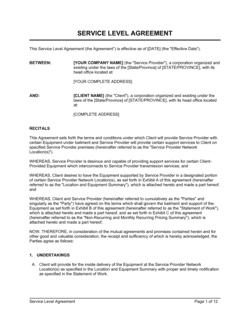
An SLA defines performance standards — response times, uptime commitments, resolution windows — for an ongoing service relationship. A retainer consulting agreement governs the commercial and legal terms of the relationship itself: fees, IP, confidentiality, and termination. The two documents are often used together, with the retainer agreement as the master contract and the SLA as an attached schedule.

vs Advisory Board Agreement

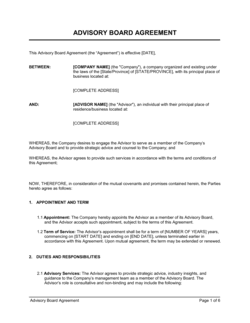
An advisory board agreement engages a named individual as a formal company advisor — often compensated with equity, a nominal cash stipend, or both — for strategic guidance on an informal or periodic basis. A retainer consulting agreement is a commercial contract for regular, substantive services at a market-rate fee. Use an advisory agreement for equity-compensated mentors and board advisors; use a retainer agreement for paid professional services delivered consistently each month.

Industry-specific considerations

Marketing and advertising

Monthly retainers covering campaign management, content production, and media buying, with deliverable schedules tied to editorial calendars and overage billing for ad-hoc requests.

Technology and SaaS

Fractional CTO or product advisor retainers covering architecture reviews, technical due diligence, and roadmap input, with IP assignment covering any code or technical documentation produced.

Professional services

Management consulting, financial advisory, and HR consulting retainers where the deliverable is strategic advice and reports, and confidentiality of client financials and organizational data is paramount.

Legal and compliance

Outside counsel or compliance consultant retainers covering regulatory monitoring, policy review, and board reporting, often with enhanced confidentiality provisions and attorney-client privilege considerations.

Healthcare and life sciences

Medical affairs, regulatory affairs, or clinical operations consultants engaged on a retainer basis, requiring HIPAA-aligned confidentiality provisions and careful contractor classification under healthcare labor rules.

Construction and real estate

Project management, engineering, or property advisory consultants retained across multiple projects, with scope tied to project phases and IP assignment covering design documents and site analysis reports.

Jurisdictional notes

United States

Contractor classification is governed by IRS common-law rules and, in some states, the ABC test (California, Massachusetts, New Jersey). California's AB5 applies a strict presumption of employment — retainer consultants in California should be reviewed carefully against the ABC test's B prong, which requires work outside the client's usual course of business. Non-solicitation clauses are enforceable in most states but void in California post-employment outside narrow exceptions.

Canada

Provincial employment standards acts set out factors distinguishing employees from independent contractors — retainer arrangements with significant control elements may be reclassified. Quebec's Civil Code applies distinct rules from common-law provinces, and contracts with Quebec-based parties may require a French version under the Charter of the French Language. IP assignment clauses are generally enforceable but should explicitly address moral rights waiver under the Copyright Act.

United Kingdom

IR35 (off-payroll working rules) applies when a consultant operates through a personal service company — HMRC may deem the engagement a deemed employment for tax purposes based on the level of supervision and control. The agreement should include a Status Determination Statement if the client is a medium or large business. Post-engagement non-solicitation clauses are enforceable if reasonable in scope and duration, but non-compete restrictions for contractors face greater scrutiny than for employees.

European Union

GDPR applies wherever the consultant processes personal data belonging to the client's customers or employees — a Data Processing Agreement or addendum is required in addition to the retainer contract. Member states vary on contractor classification: France's auto-entrepreneur regime and Germany's Scheinselbstständigkeit rules both impose risk of reclassification where economic dependence on a single client exceeds roughly 80% of income. Non-compete restrictions typically require financial compensation to be enforceable.

Template vs lawyer — what fits your deal?

PathBest forCostTime
Use the templateDomestic consultant engagements at standard market rates with clearly defined scope and a single jurisdictionFree20–30 minutes
Template + legal reviewHigh-value retainers above $5,000 per month, sensitive IP, or engagements spanning two jurisdictions$200–$600 for a one-hour lawyer review1–3 days
Custom draftedCross-border arrangements, regulated industries, material non-compete requirements, or executive fractional roles with equity$1,000–$3,500+1–2 weeks

Glossary

Retainer Fee
A recurring fixed payment — typically monthly — made by the client to secure the consultant's availability and a defined scope of services.
Independent Contractor
A self-employed individual engaged to perform services for a client without being classified as an employee, with no entitlement to employment benefits or tax withholding.
Scope of Services
A detailed description of the specific tasks, deliverables, or hours the consultant will provide under the retainer during each billing period.
Work Product
Any output — reports, strategies, designs, code, or other materials — created by the consultant in the course of performing services under the agreement.
IP Assignment
A clause transferring ownership of work product and related intellectual property created during the engagement from the consultant to the client.
Confidential Information
Non-public information belonging to the client — financials, customer data, trade secrets, and business strategies — that the consultant is prohibited from disclosing or using outside the engagement.
Non-Solicitation Clause
A restriction preventing the consultant from directly soliciting the client's employees, customers, or prospects for a defined period after the engagement ends.
Overage Rate
An agreed hourly or daily rate charged for services performed beyond the hours or deliverables included in the monthly retainer.
Rollover Policy
A provision specifying whether unused retainer hours or credits carry forward to the next billing period or expire at month-end.
Governing Law
The jurisdiction whose laws govern the interpretation and enforcement of the agreement, typically the state, province, or country where the client is based or the services are performed.

Part of your Business Operating System

This document is one of 3,000+ business & legal templates included in Business in a Box.

  • Fill-in-the-blanks — ready in minutes
  • 100% customizable Word document
  • Compatible with all office suites
  • Export to PDF and share electronically

Create your document in 3 simple steps.

From template to signed document — all inside one Business Operating System.
1
Download or open template

Access over 3,000+ business and legal templates for any business task, project or initiative.

2
Edit and fill in the blanks with AI

Customize your ready-made business document template and save it in the cloud.

3
Save, Share, Send, Sign

Share your files and folders with your team. Create a space of seamless collaboration.

Save time, save money, and create top-quality documents.

★★★★★

"Fantastic value! I'm not sure how I'd do without it. It's worth its weight in gold and paid back for itself many times."

Managing Director · Mall Farm
Robert Whalley
Managing Director, Mall Farm Proprietary Limited
★★★★★

"I have been using Business in a Box for years. It has been the most useful source of templates I have encountered. I recommend it to anyone."

Business Owner · 4+ years
Dr Michael John Freestone
Business Owner
★★★★★

"It has been a life saver so many times I have lost count. Business in a Box has saved me so much time and as you know, time is money."

Owner · Upstate Web
David G. Moore Jr.
Owner, Upstate Web

Run your business with a system — not scattered tools

Stop downloading documents. Start operating with clarity. Business in a Box gives you the Business Operating System used by over 250,000 companies worldwide to structure, run, and grow their business.

Start free · No credit card required