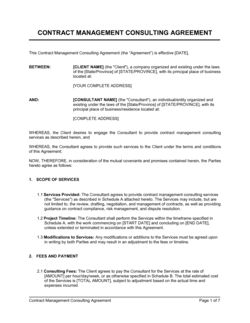
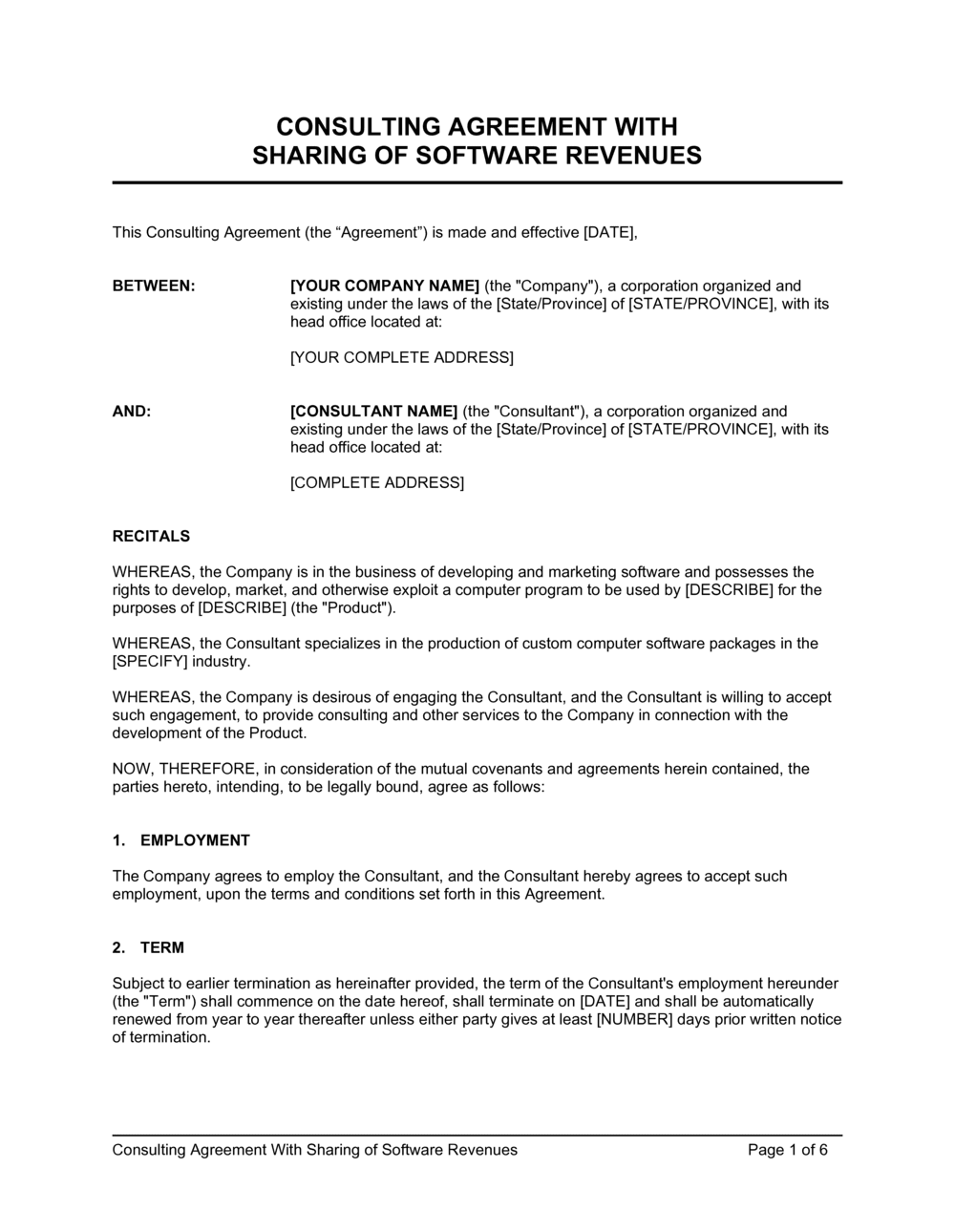
Consulting Agreement with Sharing of Software Revenues Template

Free Word download β€’ Edit online β€’ Save & share with Drive β€’ Export to PDF

6 pagesβ€’30–40 min to fillβ€’Difficulty: Complexβ€’Signature requiredβ€’Legal review recommended
Learn more ↓
FreeConsulting Agreement with Sharing of Software Revenues Template

At a glance

What it is
A Consulting Agreement With Sharing Of Software Revenues is a legally binding contract between a software company and an independent consultant that combines a traditional consulting engagement with a revenue-sharing arrangement tied to the software's commercial performance. This free Word download lets you define consulting scope, hourly or project fees, the revenue split formula, IP ownership, confidentiality obligations, and termination rights in a single enforceable document.
When you need it
Use it when engaging a consultant whose contribution β€” technical architecture, sales expertise, or market development β€” is integral enough to the software's success that a percentage of future revenues is offered in lieu of or in addition to standard fees. It replaces informal handshakes on revenue splits before any software generates income.
What's inside
Scope of consulting services, compensation structure (fees plus revenue share percentage), calculation and payment mechanics for the revenue share, IP ownership and license grants, confidentiality, non-solicitation, representations and warranties, term and termination, and governing law.

What is a Consulting Agreement With Sharing Of Software Revenues?

A Consulting Agreement With Sharing Of Software Revenues is a legally binding contract that combines two distinct commercial arrangements into a single enforceable document: a consulting engagement defining the scope, deliverables, and fees for professional services, and a revenue-sharing provision entitling the consultant to a defined percentage of the software's commercial income. It governs the entire relationship β€” from the first day of work through the final revenue-share payment β€” specifying IP ownership, confidentiality obligations, the revenue calculation methodology, and what happens to each party's rights upon termination. Companies use it when a consultant's contribution is integral enough to the software's success that future commercial upside is offered as part of their compensation, either in lieu of full market-rate fees or as an incentive layer on top of them.

Why You Need This Document

Without a written agreement that explicitly defines both the consulting terms and the revenue-share mechanics, two problems materialize quickly. First, IP ownership defaults to the creator under copyright law in most jurisdictions β€” meaning code and work product the consultant produces may legally belong to them, not the company, until a written assignment exists. Second, an informal verbal revenue-share arrangement is nearly impossible to enforce: disputes about what revenues are included, what deductions are permitted, and how long the obligation lasts are decided by whichever party has more leverage at the time, not by a clearly negotiated formula. A signed, dated agreement β€” executed before any work begins β€” resolves both problems simultaneously, gives investors and acquirers a clean IP chain of title to examine in due diligence, and gives the consultant a documented, enforceable economic right rather than a promise. This template provides the structure to get both sides protected in under an hour.

Which variant fits your situation?

If your situation is…Use this template
Engaging a consultant with no revenue share β€” fees onlyConsulting Agreement
Hiring an independent contractor for a defined projectIndependent Contractor Agreement
Sharing software revenues with a co-founder or equity partnerCo-Founder Agreement
Licensing software to a third party for a royalty feeSoftware License Agreement
Paying a referral fee on software sales rather than ongoing revenue shareReferral Agreement
Formalizing a joint venture to develop and commercialize softwareJoint Venture Agreement
Consultant contributes IP and receives equity instead of revenue shareEquity Compensation Agreement

Common mistakes to avoid

❌ Leaving 'net revenue' undefined or open-ended

Why it matters: Without a closed list of deductions, companies may subtract overhead, marketing costs, or platform fees that were never negotiated β€” reducing the consultant's actual share dramatically.

Fix: Define 'Net Software Revenues' with an explicit, exhaustive list of permitted deductions and attach a sample calculation as an exhibit.

❌ No cap or end date on the revenue share obligation

Why it matters: An open-ended revenue share survives product pivots, acquisitions, and management changes, creating long-term financial liability the company cannot accurately value or extinguish.

Fix: Set a specific end date, cumulative dollar cap, or both, and state that the obligation terminates upon acquisition unless explicitly assumed by the buyer.

❌ Omitting a background IP carve-out

Why it matters: A blanket work-product assignment clause can inadvertently capture tools, frameworks, and methods the consultant uses across all client engagements β€” making the clause overreaching and practically unenforceable.

Fix: Add a background IP schedule where the consultant lists all pre-existing IP they will use, explicitly retaining ownership while granting the company a limited license.

❌ Signing the agreement after work has already begun

Why it matters: In common-law jurisdictions, a consultant who has already started work has given nothing new in exchange for restrictive covenants β€” IP assignment and confidentiality obligations may be unenforceable without fresh consideration.

Fix: Execute the agreement before any services are performed or confidential information is disclosed. If circumstances require a later signature, provide documented additional compensation as consideration.

❌ Not specifying which revenue streams are included in the share

Why it matters: If the software is sold, licensed, white-labeled, and offered as SaaS, each stream may have different economics. Ambiguity leads to disputes about whether all, some, or none of these trigger the share.

Fix: List every included revenue type (e.g., SaaS subscriptions, perpetual licenses, white-label fees) and every excluded type (e.g., professional services, training, hardware) in the revenue share definition.

❌ Treating the consultant as an employee without the legal protections

Why it matters: Exercising excessive control over how the consultant performs work can trigger employee misclassification findings β€” resulting in back payroll taxes, benefits liability, and penalties regardless of what the contract says.

Fix: Draft the scope clause to define outcomes and deliverables, not methods and hours. Avoid setting fixed work schedules or requiring exclusive availability.

The 10 key clauses, explained

Parties, Recitals, and Effective Date

In plain language: Identifies the company and consultant as legal entities, states the purpose of the engagement, and records the date the agreement becomes binding.

Sample language
This Consulting Agreement is entered into as of [EFFECTIVE DATE] between [COMPANY LEGAL NAME], a [STATE] [ENTITY TYPE] ('Company'), and [CONSULTANT FULL NAME / ENTITY NAME] ('Consultant'). Company desires to engage Consultant to provide [DESCRIPTION OF SERVICES] in connection with the development and commercialization of [SOFTWARE PRODUCT NAME] ('Software').

Common mistake: Using a trade name instead of the registered legal entity name. Enforcement of IP assignment and revenue-share obligations becomes ambiguous if the contracting entity cannot be clearly identified.

Scope of Consulting Services

In plain language: Defines precisely what the consultant will do β€” technical deliverables, advisory functions, sales activities β€” and excludes everything else.

Sample language
Consultant shall provide the following services ('Services'): [DETAILED DESCRIPTION]. Services do not include [EXCLUDED ACTIVITIES]. Any material change to the scope requires a written amendment signed by both parties.

Common mistake: Defining scope so broadly that any business activity of the consultant could be claimed as work product owned by the company β€” creating IP disputes long after the engagement ends.

Compensation: Consulting Fees

In plain language: Sets the base consulting fee β€” hourly rate, project fee, or monthly retainer β€” payment schedule, and expense reimbursement policy.

Sample language
Company shall pay Consultant a [monthly retainer / hourly rate] of $[AMOUNT], payable on the [DAY] of each [month / upon milestone completion]. Expenses pre-approved in writing shall be reimbursed within [30] days of submission with receipts.

Common mistake: Omitting an expense pre-approval threshold. Without one, the consultant can incur substantial costs the company is obligated to reimburse regardless of budget.

Revenue Share: Calculation and Payment

In plain language: Defines the exact percentage of software revenues owed to the consultant, the revenue base (gross or net), deductions permitted, payment frequency, and reporting obligations.

Sample language
Company shall pay Consultant [X]% of Net Software Revenues, defined as gross revenues from [PRODUCT / LICENSE TYPE] less [REFUNDS, PAYMENT PROCESSING FEES, APPLICABLE TAXES]. Revenue share payments shall be made [monthly / quarterly] within [30] days of period close, accompanied by a revenue statement.

Common mistake: Failing to define 'net revenue' with an explicit, closed list of permitted deductions. Companies may otherwise deduct overhead, salaries, or marketing costs β€” eroding the consultant's share to near zero.

Revenue Share Period and Cap

In plain language: Specifies how long the revenue share obligation lasts β€” by calendar duration, total cumulative payout, or number of product versions β€” and any cap on total amounts payable.

Sample language
The revenue share obligation shall continue for [X] months from [FIRST COMMERCIAL SALE DATE / EFFECTIVE DATE] or until Consultant has received a cumulative total of $[CAP AMOUNT] in revenue share payments, whichever occurs first.

Common mistake: No defined end date or cap on the revenue share. An open-ended obligation can survive product pivots, acquisitions, and management changes β€” creating unexpected long-term liability for the company.

Intellectual Property Ownership

In plain language: Assigns all work product and new IP created under the engagement to the company, while carving out the consultant's background IP with a limited license grant to the company.

Sample language
All Work Product created by Consultant in connection with the Services is the sole property of Company and is hereby assigned to Company. Consultant retains ownership of Background IP and grants Company a non-exclusive, royalty-free license to use Background IP solely as incorporated in the Software.

Common mistake: No background IP carve-out. Without it, consultants may be forced to assign pre-existing tools, frameworks, or libraries they use with other clients β€” making the clause overreaching and practically unworkable.

Confidentiality

In plain language: Prohibits both parties from disclosing or using each other's confidential information β€” source code, roadmaps, revenue data, client lists β€” during and after the engagement.

Sample language
Each party ('Receiving Party') shall keep confidential all non-public information of the other party ('Disclosing Party') and shall not use it for any purpose other than performing obligations under this Agreement. Obligations survive termination for [3] years.

Common mistake: A one-way confidentiality clause that only protects the company. Revenue data and client identities shared with the consultant are sensitive; consultants also disclose methodologies and pricing that warrant protection.

Non-Solicitation

In plain language: Restricts each party from recruiting or soliciting the other's employees, contractors, and clients during the engagement and for a defined post-termination period.

Sample language
For the duration of this Agreement and [12] months thereafter, neither party shall directly or indirectly solicit or hire any employee, contractor, or client of the other party without prior written consent.

Common mistake: Applying non-solicitation to clients with whom the consultant had no contact during the engagement. Courts may void an overbroad clause, eliminating even the reasonable restrictions.

Term, Termination, and Effect on Revenue Share

In plain language: States the contract duration, termination rights for cause and convenience, notice period, and what happens to accrued and future revenue share upon termination.

Sample language
This Agreement commences on [EFFECTIVE DATE] and continues for [X] months unless terminated earlier. Either party may terminate for convenience with [30] days' written notice. Accrued revenue share through the termination date survives. [OPTION: Post-termination revenue share continues / terminates] upon [cause / convenience] termination.

Common mistake: Not specifying whether the revenue share survives termination. If silent, courts in some jurisdictions may treat accrued rights as vested β€” leaving the company paying revenue share on a product long after the consultant stopped contributing.

Governing Law, Dispute Resolution, and Entire Agreement

In plain language: Specifies the jurisdiction whose laws govern the contract, the dispute resolution mechanism (arbitration or litigation), and confirms the document supersedes all prior discussions.

Sample language
This Agreement is governed by the laws of [STATE / PROVINCE / COUNTRY]. Disputes shall be resolved by binding arbitration administered by [AAA / JAMS] in [CITY], except claims for injunctive relief. This Agreement constitutes the entire agreement between the parties and supersedes all prior representations, negotiations, and understandings.

Common mistake: Selecting a governing jurisdiction with no connection to either party's location. Some jurisdictions β€” particularly California β€” apply local law regardless of what the contract specifies, making a remote governing-law choice ineffective.

How to fill it out

  1. 1

    Identify both parties using their full legal names

    Enter the company's registered legal entity name and the consultant's full legal name or registered business name. Include entity type (LLC, corporation, sole proprietor) and state or province of formation.

    πŸ’‘ Cross-check the company name against the corporate registry filing. A mismatch between the contract name and the legal entity creates enforcement gaps for IP assignment.

  2. 2

    Define the scope of consulting services precisely

    List specific deliverables, activities, and responsibilities in Schedule A rather than embedding them in the body. Include what is explicitly excluded to prevent scope creep and IP overreach.

    πŸ’‘ Attach a separate Statement of Work as Schedule A β€” updating scope over time is easier when it lives outside the main agreement body.

  3. 3

    Set the consulting fee structure and payment schedule

    Choose between an hourly rate, project fee, or monthly retainer. State the payment date, invoice requirements, and an expense pre-approval threshold (e.g., expenses over $250 require written approval).

    πŸ’‘ If paying both a retainer and a revenue share, clarify explicitly that the retainer is not an advance against revenue share β€” otherwise the consultant may expect an offset.

  4. 4

    Define the revenue share percentage and the revenue base

    State the exact percentage and define 'Net Software Revenues' with a closed list of permitted deductions. Specify which products, licenses, or revenue streams are included and which are excluded.

    πŸ’‘ Attach a sample revenue statement as an exhibit so both parties agree on the reporting format before the first payment is due β€” this prevents calculation disputes.

  5. 5

    Set the revenue share period and any cumulative cap

    Choose a fixed duration (e.g., 24 months from first commercial sale), a cumulative dollar cap, or both. Specify the start event β€” effective date, product launch, or first paid customer.

    πŸ’‘ A cumulative cap protects the company if the software unexpectedly becomes a large commercial success; a floor (minimum payment before the share kicks in) protects the consultant.

  6. 6

    Complete the IP ownership and background IP sections

    Confirm that all work product created under the engagement is assigned to the company. List any tools, libraries, or pre-existing materials the consultant will use that remain their property, and grant the company a license to use them.

    πŸ’‘ Have the consultant disclose all background IP in writing before signing β€” an undisclosed background IP claim can invalidate the assignment after the product ships.

  7. 7

    Set termination terms and revenue share survival

    Choose notice period lengths (30 days is standard for convenience termination) and explicitly state whether the revenue share continues, terminates, or is capped at a final payment upon termination for cause versus convenience.

    πŸ’‘ Include a wind-down period β€” even 30 days β€” during which the consultant completes in-progress deliverables rather than stopping immediately on notice.

  8. 8

    Sign before any work begins

    Both parties must execute the agreement before the consultant performs any services or shares any confidential information. Post-commencement signatures raise fresh-consideration problems for IP assignment and confidentiality in common-law jurisdictions.

    πŸ’‘ Use a timestamped eSignature tool and store the fully executed copy with both parties immediately β€” revenue share disputes years later often hinge on what was signed and when.

Frequently asked questions

What is a consulting agreement with software revenue sharing?

A consulting agreement with software revenue sharing is a legally binding contract that combines a standard consulting engagement with a provision entitling the consultant to a percentage of the software's commercial revenues. It defines the consulting scope, fees, the revenue share formula, IP ownership, and termination rights in a single document. Companies use it to attract senior consultants when upfront cash is limited, offering future upside instead of β€” or in addition to β€” standard fees.

How is the revenue share percentage typically determined?

The percentage is negotiated based on the consultant's contribution relative to total development cost, the risk they are taking by accepting deferred compensation, and the expected revenue trajectory. Typical ranges run from 2% to 15% of net revenues for consultants who contribute meaningfully to product development or go-to-market. Percentages above 20% are uncommon unless the consultant is effectively a co-founder contributing without salary.

Should the revenue share be based on gross or net revenues?

Net revenue β€” gross revenue minus a defined list of deductions such as refunds, chargebacks, and payment processing fees β€” is the more common and fairer base. Gross revenue is simpler to calculate but can overstate the economic benefit to the company. Whichever base you choose, define it precisely with a closed list of deductions; leaving it open invites disputes about what costs can be subtracted.

Who owns the intellectual property created under this agreement?

Under a standard consulting agreement with revenue sharing, all work product created during the engagement is assigned to the company. The consultant typically retains ownership of background IP β€” tools, frameworks, and methods developed independently β€” and grants the company a license to use that IP as incorporated in the software. Without a clear IP clause, ownership defaults to the creator under copyright law in most jurisdictions.

What happens to the revenue share if the company is acquired?

The contract should explicitly address this. If silent, accrued revenue share obligations may transfer to the acquirer as a liability, and future obligations may survive under successor-in-interest principles in most jurisdictions. Common approaches include a lump-sum buyout of the revenue share right at acquisition, a cap triggered by a change-of-control event, or an explicit clause stating the revenue share terminates upon acquisition.

Is a consulting agreement with revenue sharing different from an employment contract?

Yes. A consulting agreement engages an independent contractor β€” the consultant pays their own taxes, receives no benefits, and retains control over how they perform the work. An employment contract creates an employer-employee relationship with payroll tax obligations, statutory benefits, and termination protections. Offering revenue share does not change the classification; what matters legally is the degree of control the company exercises over the consultant's methods and schedule.

Can the revenue share be capped?

Yes, and for most companies it should be. A cumulative cap β€” for example, a maximum total payout of $[AMOUNT] β€” gives the company a defined maximum liability it can account for and value. A time-based cap (e.g., 24 months from first sale) is also common. Many agreements combine both: the share ends when the cap is reached or the period expires, whichever comes first.

Does this agreement need to be reviewed by a lawyer?

For straightforward domestic engagements with a clear scope and a simple revenue-share formula, a high-quality template is a strong starting point. Legal review is strongly recommended when the revenue share obligation is material in dollar value, the consultant is contributing significant IP, either party operates in multiple jurisdictions, or the software has acquisition potential. A 1–2 hour review typically costs $300–$600 and can prevent disputes worth multiples of that cost.

What notice period is standard for terminating this type of agreement?

Thirty days written notice for convenience termination is the most common standard for consulting agreements. Cause-based termination β€” misconduct, material breach, or IP misappropriation β€” typically allows immediate termination with written notice of the specific cause. The agreement should state explicitly whether accrued revenue share survives each type of termination and, if so, for how long.

How this compares to alternatives

vs Standard Consulting Agreement

A standard consulting agreement compensates the consultant with fees only β€” hourly, project-based, or retainer. There is no revenue participation, no IP assignment complexity related to future commercial success, and no need to define revenue bases or share periods. Use a standard consulting agreement when the consultant's role is advisory or time-limited and commercial upside sharing is not part of the deal.

vs Independent Contractor Agreement

An independent contractor agreement covers project-based or ongoing work for a fixed fee with no revenue-sharing component. It is simpler, shorter, and appropriate when the contractor is delivering defined outputs rather than contributing to a product's commercial trajectory. The consulting agreement with revenue sharing adds a second compensation layer and significantly more complexity around IP, revenue definitions, and termination.

vs Software License Agreement

A software license agreement grants a third party the right to use software in exchange for a royalty or license fee paid to the owner. The consulting agreement with revenue sharing runs in the opposite direction β€” the consultant receives a share of revenues generated by software they helped create. These are complementary documents, not substitutes; a company may need both when the consultant's background IP is licensed into the product.

vs Joint Venture Agreement

A joint venture agreement creates a separate legal entity or formal co-ownership structure for a shared commercial project, with both parties contributing capital, IP, or labor in exchange for equity-like participation. A consulting agreement with revenue sharing is simpler β€” the consultant remains an independent party with no equity or governance rights, just a contractual claim on defined revenues. Use a joint venture when the parties want shared control and equity upside; use this agreement when the company retains full ownership and the consultant receives only a revenue percentage.

Industry-specific considerations

SaaS / Technology

Revenue share tied to MRR or ARR with a defined subscription base; IP assignment covers all software code, algorithms, and training data created under the engagement.

Fintech

Revenue share calculations must account for payment processing fee deductions and chargeback reserves; regulatory compliance obligations on the consultant may be included as representations.

Healthcare / MedTech

HIPAA confidentiality obligations incorporated by reference; revenue share scope must distinguish between software licensing revenue and separate professional services or implementation fees.

Professional Services

Consultants in law, accounting, or management advisory roles may contribute sales relationships rather than technical IP β€” the revenue share is tied to closed deals they originate rather than software they help build.

Jurisdictional notes

United States

IP assignment clauses are generally enforceable but California Labor Code Β§2870 limits assignment of inventions developed entirely on the consultant's own time using their own resources. Non-compete clauses are unenforceable in California, Minnesota, and Oklahoma β€” remove or limit them for consultants working in those states. Revenue share arrangements are treated as ordinary income to the consultant and must be reported on a 1099 form for payments over $600 per year.

Canada

Independent contractor status is determined by a multi-factor test in Canada; revenue-share arrangements can complicate classification by implying an ongoing economic relationship resembling employment. IP assignment is generally enforceable but Quebec civil law applies distinct rules for consultants performing work in the province. Revenue share payments must be included in the consultant's income and are subject to GST/HST registration requirements if the consultant exceeds the $30,000 annual threshold.

United Kingdom

Under UK copyright law, a consultant β€” not the commissioning company β€” owns IP created independently unless the contract explicitly assigns it; this makes a written IP assignment clause essential, not optional. IR35 rules apply if the engagement resembles disguised employment, which a revenue-share model may exacerbate; HMRC may reclassify the consultant as an employee. Post-termination non-solicitation clauses are enforceable if reasonable in scope and duration.

European Union

GDPR obligations apply if the consultant accesses personal data of EU data subjects during the engagement β€” a data processing addendum should be attached. IP assignment enforceability varies by member state; Germany and France have specific rules around moral rights and creator protections that can limit the scope of an assignment. Revenue-share income may trigger VAT registration obligations in the consultant's home member state above applicable thresholds.

Template vs lawyer β€” what fits your deal?

PathBest forCostTime
Use the templateEarly-stage software companies engaging a single consultant with a straightforward revenue-share formula in a single domestic jurisdictionFree30–45 minutes
Template + legal reviewRevenue share obligations above $50K expected value, consultants contributing significant proprietary IP, or engagements spanning multiple states or provinces$300–$7002–4 days
Custom draftedComplex multi-party arrangements, acquisition-sensitive IP, cross-border engagements with EU or UK counsel required, or material revenue-share obligations that will appear on a cap table or in due diligence$1,500–$5,000+1–3 weeks

Glossary

Revenue Share
A contractually specified percentage of defined software revenues paid to the consultant as part of their total compensation.
Net Revenue
Gross software revenues minus specifically defined deductions such as refunds, chargebacks, payment processing fees, and applicable taxes.
Gross Revenue
The total amount received from software sales or licenses before any deductions β€” often the base used when the parties agree to a simpler calculation.
Consulting Retainer
A fixed monthly or project-based fee paid to the consultant independent of software revenue performance.
IP Assignment
A clause transferring ownership of work product, code, and inventions created by the consultant during the engagement to the hiring company.
Background IP
Intellectual property owned by the consultant prior to or independently of the engagement, which is typically licensed β€” not assigned β€” to the company.
Revenue Share Period
The defined duration during which the consultant is entitled to receive a percentage of software revenues β€” often tied to a number of months, product versions, or a cumulative revenue cap.
Clawback
A provision requiring the consultant to repay previously distributed revenue-share amounts if a triggering event occurs, such as a customer refund or early contract termination.
Work Product
All deliverables, code, documentation, designs, and other materials produced by the consultant in connection with the engagement.
Milestone Payment
A fee installment triggered when the consultant completes a defined deliverable or the software reaches a specified development or commercial stage.
Non-Solicitation
A restriction preventing either party from poaching the other's employees, clients, or contractors during and for a defined period after the engagement.
Indemnification
A contractual obligation by one party to cover the other's losses, legal fees, or damages arising from a specified breach or third-party claim.

Part of your Business Operating System

This document is one of 3,000+ business & legal templates included in Business in a Box.

  • Fill-in-the-blanks β€” ready in minutes
  • 100% customizable Word document
  • Compatible with all office suites
  • Export to PDF and share electronically

Create your document in 3 simple steps.

From template to signed document β€” all inside one Business Operating System.
1
Download or open template

Access over 3,000+ business and legal templates for any business task, project or initiative.

2
Edit and fill in the blanks with AI

Customize your ready-made business document template and save it in the cloud.

3
Save, Share, Send, Sign

Share your files and folders with your team. Create a space of seamless collaboration.

Save time, save money, and create top-quality documents.

β˜…β˜…β˜…β˜…β˜…

"Fantastic value! I'm not sure how I'd do without it. It's worth its weight in gold and paid back for itself many times."

Managing Director Β· Mall Farm
Robert Whalley
Managing Director, Mall Farm Proprietary Limited
β˜…β˜…β˜…β˜…β˜…

"I have been using Business in a Box for years. It has been the most useful source of templates I have encountered. I recommend it to anyone."

Business Owner Β· 4+ years
Dr Michael John Freestone
Business Owner
β˜…β˜…β˜…β˜…β˜…

"It has been a life saver so many times I have lost count. Business in a Box has saved me so much time and as you know, time is money."

Owner Β· Upstate Web
David G. Moore Jr.
Owner, Upstate Web

Run your business with a system β€” not scattered tools

Stop downloading documents. Start operating with clarity. Business in a Box gives you the Business Operating System used by over 250,000 companies worldwide to structure, run, and grow their business.

Start freeΒ Β·Β No credit card required