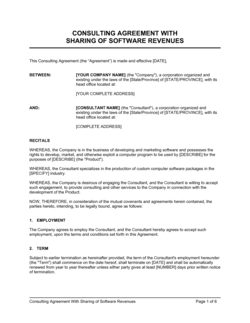
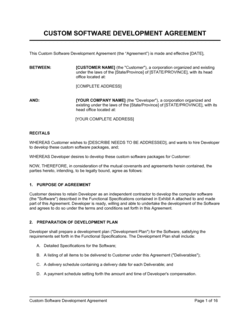
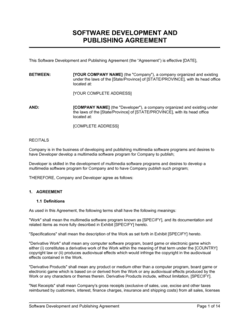
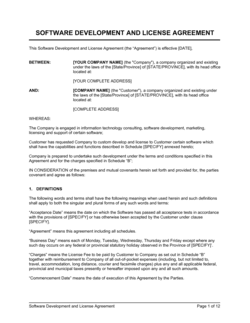
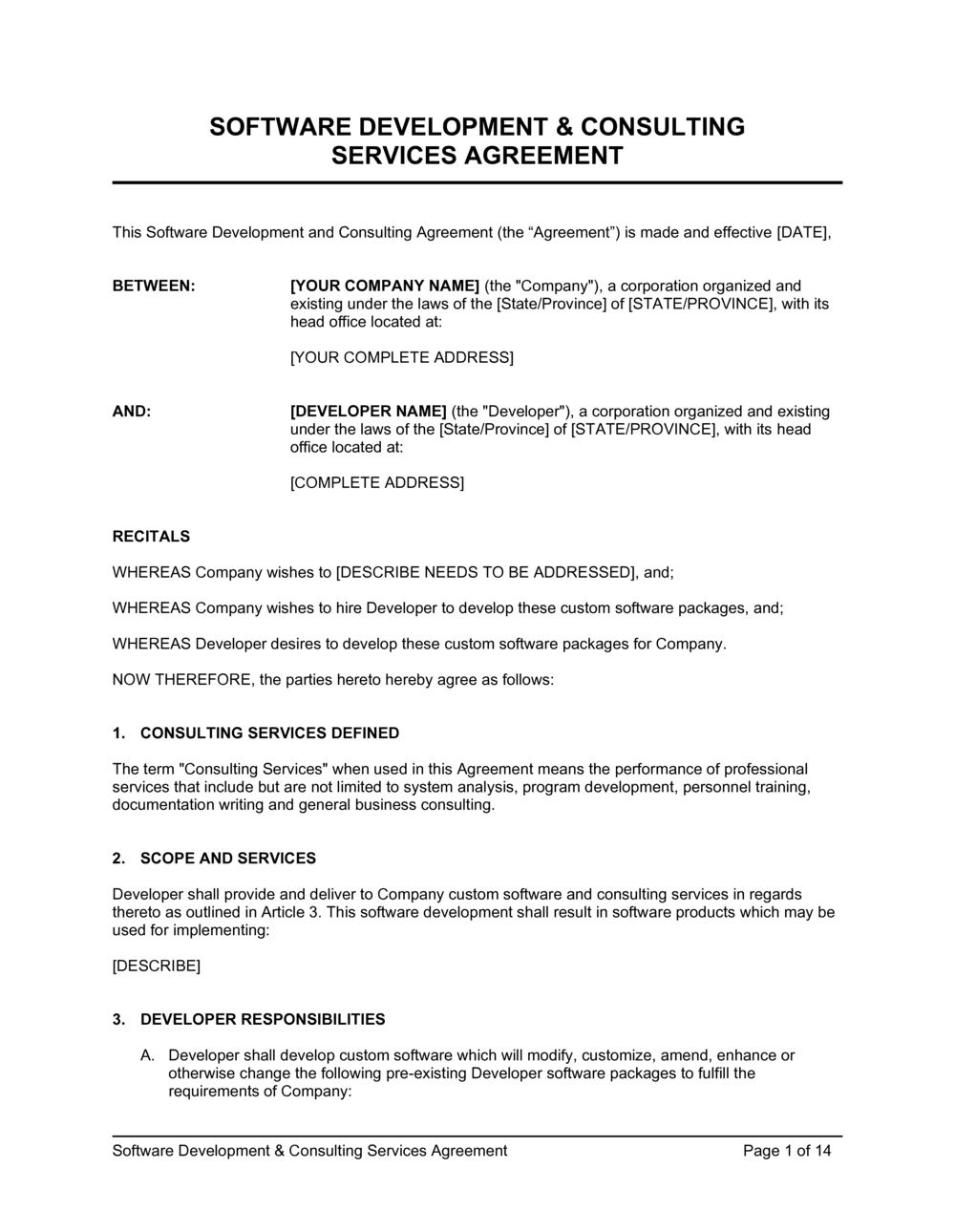
Software Development and Consulting Services Agreement Template

Free Word download • Edit online • Save & share with Drive • Export to PDF

14 pages35–45 min to fillDifficulty: ComplexSignature requiredLegal review recommended
Learn more ↓
FreeSoftware Development and Consulting Services Agreement Template

At a glance

What it is
A Software Development and Consulting Services Agreement is a legally binding contract between a client and a developer or IT consultant that defines the scope of work, deliverables, payment structure, IP ownership, confidentiality, and termination rights. This free Word download gives you a structured, attorney-informed starting point you can edit online and export as PDF before any development engagement begins.
When you need it
Use it whenever you engage an external developer, development agency, or IT consultant to build, customize, or advise on software — whether for a fixed-price project, time-and-materials engagement, or ongoing retainer. It is equally necessary when you are the developer or consultant being hired and need enforceable protections around payment and IP.
What's inside
Scope of work and deliverables, project timeline and milestones, payment terms and invoicing schedule, intellectual property assignment and licensing, confidentiality obligations, warranties and limitation of liability, change order procedures, and termination rights with post-termination obligations.

What is a Software Development and Consulting Services Agreement?

A Software Development and Consulting Services Agreement is a legally binding contract between a client and an external developer or IT consulting firm that governs the creation, delivery, and ownership of custom software or technology advisory services. It defines the scope of work and acceptance criteria for each deliverable, establishes the milestone-based payment schedule, assigns intellectual property ownership to the client upon full payment while protecting the developer's pre-existing tools, and sets out the confidentiality, warranty, liability, and termination terms that apply throughout the engagement. Unlike a general contractor agreement, this document is purpose-built for technology projects where IP ownership, scope creep, and deliverable quality are the primary legal and commercial risks.

Why You Need This Document

Without a signed software development agreement in place before work begins, you have no enforceable claim to the code that gets written. Under US, UK, and Canadian copyright law, IP created by an independent contractor belongs to the developer by default — not the client who paid for it. The absence of a formal agreement also leaves you exposed to scope disputes, refused milestone payments, and a stranded project if the developer disappears mid-build with no contractual obligation to hand over work in progress. For the developer, working without a contract means no enforceable payment terms, no protection against unlimited scope expansion, and no clear limit on liability if the software has defects. This template closes all of those gaps in under an hour, giving both parties a clear written record of what was agreed before anyone writes a line of code.

Which variant fits your situation?

If your situation is…Use this template
Hiring a solo freelance developer for a fixed-price projectIndependent Contractor Agreement
Engaging a consultant on an ongoing hourly or monthly retainerConsulting Services Agreement
Sharing sensitive technical information before signing a full contractNon-Disclosure Agreement
Licensing software you have already built to a clientSoftware License Agreement
Subcontracting development work to another agency or developerSubcontractor Agreement
Defining a long-term managed services or SaaS support relationshipManaged Services Agreement
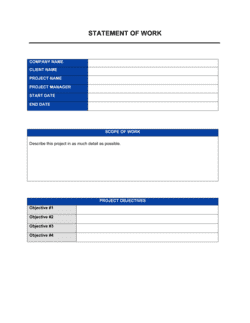
Issuing a statement of work under an existing master services agreementStatement of Work

Common mistakes to avoid

❌ Starting work without a signed agreement

Why it matters: IP created before a written assignment clause is signed may legally remain with the developer under US and UK copyright law, regardless of subsequent agreements. The client risks losing ownership of the work they paid for.

Fix: Execute the agreement and attached SOW before any work begins. If circumstances require starting early, sign a short interim agreement covering IP assignment and payment while the full contract is finalized.

❌ Defining scope in the contract body instead of a separate SOW

Why it matters: When scope inevitably evolves, amending the main contract body requires both parties to re-execute the entire agreement, creating version-control problems and renegotiation friction.

Fix: Move all deliverable details, acceptance criteria, and timelines to a Schedule A Statement of Work. Amend only the SOW when scope changes, leaving the main contract intact.

❌ No background IP carve-out for the developer

Why it matters: A blanket IP assignment clause without a pre-existing IP reservation may give the client a claim over the developer's reusable frameworks, open-source contributions, or internal tools — and may constitute a breach of open-source licenses.

Fix: List all pre-existing tools, libraries, and frameworks in a schedule. Grant the client a perpetual, non-exclusive license to use them as incorporated into the deliverables, while the developer retains ownership.

❌ Omitting a formal change order procedure

Why it matters: Verbal or email-only scope changes are the leading cause of payment disputes on software projects. Without a signed change order process, developers absorb unpaid work and clients dispute final invoices.

Fix: Require all scope changes to be documented in a written change order signed by both parties before work begins. Include a clause stating that out-of-scope work performed without a signed change order is uncompensated.

❌ No deemed-acceptance clause for deliverables

Why it matters: Without a deadline for the client to accept or reject a deliverable, the client can delay acceptance indefinitely, blocking milestone payments and stalling the project without any contractual consequence.

Fix: Include a deemed-acceptance clause: if the client does not accept or reject a deliverable in writing within a specified period (typically 10 business days), the deliverable is automatically deemed accepted.

❌ Applying a blanket liability cap without fraud or IP carve-outs

Why it matters: A liability cap with no exceptions can shield a developer who deliberately infringes third-party IP or commits fraud — leaving the client with no practical legal remedy beyond the capped amount.

Fix: Carve out fraud, willful misconduct, gross negligence, IP indemnification obligations, and confidentiality breaches from the limitation of liability clause. These carve-outs are standard commercial practice and rarely contested.

The 10 key clauses, explained

Parties, recitals, and effective date

In plain language: Identifies the client and the developer or consulting firm as legal entities, states the nature of the engagement, and records the date the agreement takes effect.

Sample language
This Software Development and Consulting Services Agreement ('Agreement') is entered into as of [DATE] between [CLIENT LEGAL NAME], a [STATE/COUNTRY] [ENTITY TYPE] ('Client'), and [DEVELOPER/CONSULTANT LEGAL NAME], a [STATE/COUNTRY] [ENTITY TYPE] ('Consultant').

Common mistake: Using trade names or personal names instead of registered legal entity names. If the contracting party doesn't match the entity that holds the bank account or corporate registration, enforcing payment obligations or IP assignment becomes complicated.

Scope of work and deliverables

In plain language: Defines exactly what the consultant will build or deliver, referencing a detailed Statement of Work (SOW) attached as a schedule, including acceptance criteria for each deliverable.

Sample language
Consultant shall provide the services and deliverables described in Schedule A (Statement of Work), attached hereto and incorporated by reference. Any services not expressly described in Schedule A require a written Change Order signed by both parties.

Common mistake: Embedding scope details directly in the contract body instead of a separate SOW schedule. When scope changes — and it always does — you need to amend only the SOW without reopening the main agreement.

Project timeline, milestones, and acceptance

In plain language: Sets the project start date, key milestone dates, and the acceptance testing procedure the client uses to approve or reject each deliverable.

Sample language
The project shall commence on [START DATE] and proceed according to the milestone schedule in Schedule B. Client shall have [10] business days to accept or reject each deliverable in writing. Deliverables not rejected within that period are deemed accepted.

Common mistake: No deemed-acceptance provision. Without it, a client who simply fails to respond can hold up milestone payments indefinitely, giving the developer no recourse.

Compensation, invoicing, and payment terms

In plain language: States the total contract price or hourly rate, the invoicing schedule tied to milestones or time periods, and the payment due date and late-fee terms.

Sample language
Client shall pay Consultant [FIXED FEE OF $X / at the rate of $X per hour], invoiced [upon milestone completion / monthly]. Invoices are due within [30] days of receipt. Balances unpaid after [30] days accrue interest at [1.5]% per month.

Common mistake: No late-payment interest clause. Without it, a developer has no financial lever to accelerate overdue payments short of suspending work or suing — both of which damage the relationship.

Intellectual property ownership and assignment

In plain language: Assigns ownership of all custom-developed work product to the client upon full payment, while carving out the developer's pre-existing tools, libraries, and background IP.

Sample language
Upon receipt of full payment, Consultant hereby irrevocably assigns to Client all right, title, and interest in and to the Deliverables, including all intellectual property rights therein. Consultant retains ownership of all Pre-Existing IP and grants Client a non-exclusive, perpetual license to use any Pre-Existing IP incorporated into the Deliverables.

Common mistake: No carve-out for pre-existing IP or open-source libraries. If the developer assigns 'all IP' without a background IP reservation, the client inadvertently claims ownership of reusable tools the developer needs for other clients — and the developer may be in breach of open-source licenses.

Confidentiality

In plain language: Prohibits both parties from disclosing each other's non-public technical, business, and financial information during and after the engagement.

Sample language
Each party agrees to hold the other's Confidential Information in strict confidence, not to disclose it to any third party without prior written consent, and to use it solely for the purposes of this Agreement. This obligation survives termination for [3] years.

Common mistake: A one-sided confidentiality clause that only protects the client. Developers share proprietary methodologies and tooling with clients — a mutual clause protects both parties and is more likely to be signed without negotiation.

Warranties and representations

In plain language: States what each party promises about their qualifications, ownership of background IP, and the quality of the deliverables — including a defect-correction warranty period.

Sample language
Consultant warrants that: (a) the Deliverables will conform to the specifications in Schedule A for [90] days after acceptance; (b) the Deliverables will not infringe any third-party IP rights; and (c) Consultant has the right to enter into this Agreement.

Common mistake: Omitting an IP non-infringement warranty. If the developer incorporates unlicensed code or a copyrighted library without disclosure, the client inherits the infringement risk. The warranty creates a contractual remedy and shifts indemnification obligation back to the developer.

Limitation of liability

In plain language: Caps each party's total liability under the contract — typically at the total fees paid — and excludes consequential, indirect, and punitive damages.

Sample language
In no event shall either party's aggregate liability exceed the total fees paid or payable by Client in the [12] months preceding the claim. Neither party shall be liable for indirect, incidental, consequential, or punitive damages, even if advised of the possibility of such damages.

Common mistake: No carve-outs for the limitation of liability. Courts and commercial practice typically exclude fraud, gross negligence, willful misconduct, and IP indemnification obligations from the liability cap — without explicit carve-outs, a developer could be shielded even for deliberate wrongdoing.

Change order procedure

In plain language: Establishes a written process for requesting, pricing, and approving changes to the scope of work, preventing scope creep from expanding the project without additional compensation.

Sample language
Either party may request changes to the scope by submitting a written Change Order Request. Consultant shall provide a written impact assessment within [5] business days. No change is effective until both parties sign a Change Order. Consultant is not obligated to perform unauthorized changes.

Common mistake: Verbal change approvals that are never documented. Scope creep is the single most common source of billing disputes on software projects — a formal written change order process is the only reliable defense.

Termination and post-termination obligations

In plain language: States the conditions under which either party may terminate — for cause immediately or for convenience with notice — and what happens to deliverables, data, and payment upon termination.

Sample language
Either party may terminate for convenience with [30] days' written notice. Either party may terminate immediately for material breach not cured within [15] days of written notice. Upon termination, Client shall pay for all work performed to date; Consultant shall deliver all completed and in-progress work product.

Common mistake: No obligation on the developer to deliver in-progress work upon termination. Without it, a client who terminates for cause may have no practical way to recover partially built code or design assets, leaving the project stranded.

How to fill it out

  1. 1

    Identify both parties with full legal entity names

    Enter the registered legal name of both the client and the developer or consulting firm, along with entity type, state or country of formation, and principal address.

    💡 Cross-check each party's name against their corporate registry or business license before execution — a mismatch creates enforcement problems later.

  2. 2

    Draft a detailed Statement of Work as Schedule A

    List every feature, module, and deliverable with acceptance criteria specific enough to determine whether each item passes or fails review. Reference wireframes, technical specifications, or user stories by name and version.

    💡 Vague scope is the primary driver of billing disputes on software projects. If you cannot define done, you cannot enforce the contract.

  3. 3

    Set the milestone schedule and payment triggers

    Break the project into 3–6 milestones with specific dates and payment amounts. Tie each payment directly to an accepted deliverable — not to calendar dates alone.

    💡 A kickoff deposit of 25–30% of the fixed fee before work begins protects the developer against client non-payment and gives the client a cost to recoup if the developer underperforms.

  4. 4

    Define the IP ownership and background IP carve-out

    Confirm that all custom deliverables are assigned to the client upon full payment. List any developer-owned tools, frameworks, or libraries that will be incorporated, and grant the client a perpetual license to use them.

    💡 Have the developer disclose all open-source components at the time of contracting — GPL-licensed code in a commercial product can void proprietary IP claims.

  5. 5

    Set the liability cap and carve-outs

    Enter the liability cap amount (typically the total contract value or 12 months of fees). Confirm that fraud, willful misconduct, IP indemnification, and confidentiality breaches are excluded from the cap.

    💡 For large engagements, consider requiring the developer to carry professional indemnity (errors and omissions) insurance and name the client as an additional insured.

  6. 6

    Complete the change order procedure

    Specify the written format for change requests, the developer's turnaround time for impact assessments, and the signature requirement before any out-of-scope work begins.

    💡 Include a clause stating that work performed without a signed change order is at the developer's risk — this eliminates the 'I thought you approved it verbally' dispute pattern.

  7. 7

    Set termination notice periods and post-termination obligations

    Enter notice periods for convenience termination (typically 15–30 days) and the cure period for material breach (typically 10–15 days). Confirm the developer's obligation to deliver all in-progress work product upon any termination.

    💡 Include a payment obligation for work completed to the termination date — without it, a client who terminates mid-project may refuse to pay for partially completed work the developer can no longer use.

  8. 8

    Execute before any work begins

    Both parties must sign the agreement and any attached SOW before the developer writes a single line of code. Post-start execution weakens IP assignment and change-order protections.

    💡 Use a dated e-signature platform to create a timestamped execution record. Store the fully signed agreement alongside the final SOW in a shared secure location both parties can access.

Frequently asked questions

What is a software development and consulting services agreement?

A software development and consulting services agreement is a legally binding contract between a client and an external developer or IT consultant that governs a software project or advisory engagement. It defines the scope of work, deliverables, project milestones, payment schedule, IP ownership, confidentiality obligations, warranties, and termination rights. It is the primary document that determines who owns the code and what happens when things go wrong.

Who owns the intellectual property in a software development contract?

IP ownership depends entirely on what the contract says. Without an explicit written IP assignment, the developer typically retains copyright under US and UK law, even if the client paid for the work. A properly drafted agreement assigns all custom deliverables to the client upon full payment, while preserving the developer's ownership of pre-existing tools and open-source components through a background IP carve-out and license grant.

What is the difference between a fixed-price and time-and-materials contract?

A fixed-price contract sets a total fee for a defined scope of work — the developer bears the risk if the project takes longer than estimated. A time-and-materials contract bills the client for actual hours worked and approved expenses — the client bears the risk of scope expansion. Most agreements use fixed pricing for well-defined phases and time-and-materials for ongoing consulting, change orders, or exploratory work.

Do I need a separate NDA if I have a confidentiality clause in the agreement?

Not necessarily. A well-drafted confidentiality clause within the services agreement provides the same legal protection as a standalone NDA for the duration of the engagement and a defined post-termination period. A separate NDA is useful when you need to share sensitive information during pre-contract discussions — before the services agreement is signed. Once the main agreement is executed, its confidentiality clause governs.

What should a Statement of Work include?

A complete SOW covers the project description and objectives, a detailed list of deliverables with acceptance criteria, the milestone schedule with due dates, the development environment and technical requirements, the testing and quality assurance approach, and any client responsibilities (content, APIs, access credentials). The more specific the SOW, the less room there is for scope disputes. Generic descriptions like "build a web app" are not sufficient.

Is this agreement suitable for hiring an offshore or international developer?

The template provides a solid foundation for cross-border engagements, but the governing law and dispute resolution clauses require careful attention. Specify the jurisdiction whose law governs and the location and rules for any arbitration. Consider whether the chosen jurisdiction's courts have practical authority over a developer based abroad. For high-value international engagements, legal review is recommended to ensure enforceability in the developer's home country.

What happens if the developer delivers work that doesn't meet the specifications?

The warranty clause requires the developer to correct defects at no charge during the warranty period — typically 60 to 90 days after acceptance. If the developer refuses or cannot fix a material defect, the client may terminate for cause, withhold milestone payments tied to that deliverable, and seek damages. Specific acceptance criteria in the SOW are essential — without them, determining whether a deliverable meets specifications becomes a subjective dispute.

Can the client terminate the agreement if the project is taking too long?

Yes, if the agreement includes a termination for convenience clause, the client can terminate with the required notice period — typically 15 to 30 days. Upon termination, the client is obligated to pay for all work performed to the termination date, and the developer must deliver all completed and in-progress work product. If the delay constitutes a material breach of the timeline provisions, the client may also have grounds to terminate for cause after giving the developer a written cure period.

Do I need a lawyer to use this template?

For straightforward domestic engagements with a defined scope and a reputable developer, a high-quality template is often sufficient. Legal review is recommended when the project involves sensitive IP in a competitive market, the contract value exceeds $50,000, the developer is located in a different country, or the software will be used in a regulated industry such as healthcare or financial services. A 1–2 hour attorney review typically costs $300–$800 and is worthwhile for any engagement where the deliverables have material business value.

How this compares to alternatives

vs Independent Contractor Agreement

An independent contractor agreement establishes the working relationship and classification of a freelance developer but typically lacks detailed IP assignment, milestone-based payment structures, acceptance testing, and change order procedures. A software development agreement is purpose-built for technology projects where deliverable quality, IP ownership, and scope management are the primary risks. Use the contractor agreement for simple, short-term engagements; use this agreement for any project with defined deliverables and milestone payments.

vs Consulting Agreement

A general consulting agreement covers advisory and professional services but is not structured around software deliverables, acceptance testing, or code ownership. When the consultant's output is advice or strategy rather than working software, a consulting agreement suffices. When the output includes code, designs, or a deployed application, a software development agreement is required to properly assign IP and define acceptance criteria.

vs Statement of Work

A statement of work is a project-specific document that defines scope, deliverables, and timeline for a single engagement under a master services agreement. It is not a standalone contract — it relies on an MSA or services agreement for legal terms around IP, confidentiality, liability, and termination. Use a statement of work as a schedule attached to this agreement, not as a replacement for it.

vs Software License Agreement

A software license agreement governs the ongoing use of software that already exists — granting usage rights without transferring ownership. A software development agreement governs the creation of new or custom software, including IP assignment upon completion. If you are buying a license to use an existing platform, you need a license agreement. If you are commissioning custom development, you need this agreement.

Industry-specific considerations

SaaS / Technology

IP assignment for core product code is critical; background IP carve-outs must specifically address open-source dependencies and reusable framework components the developer uses across clients.

Financial Services

Data security obligations, regulatory compliance requirements (PCI-DSS, SOC 2), and vendor risk management clauses are typically added alongside the standard services terms.

Healthcare / MedTech

HIPAA Business Associate Agreement requirements, audit rights, and FDA software development lifecycle compliance obligations must be addressed when the software handles protected health information.

E-commerce / Retail

Payment gateway integration and PCI compliance obligations, performance SLAs for uptime and page-load speed, and seasonal delivery windows tied to peak trading periods are common additions.

Jurisdictional notes

United States

IP ownership defaults to the creator under US copyright law unless a written assignment or work-for-hire agreement exists. The work-for-hire doctrine applies to contractor-created software only when there is a written agreement designating it as such in one of the nine statutory categories — custom software typically does not qualify automatically, making an explicit assignment clause essential. Non-compete and non-solicit clauses in independent contractor agreements are subject to significant state-by-state variation; California effectively bans them.

Canada

Canadian copyright law vests ownership in the creator by default for independent contractors — unlike employees, whose work product is typically owned by the employer. A written IP assignment is required to transfer ownership to the client. Quebec-based developers may require French-language contracts for provincially regulated matters. Non-compete restrictions in contractor agreements are enforceable only if reasonable in scope, duration, and geography.

United Kingdom

Under the Copyright, Designs and Patents Act 1988, IP created by an independent contractor belongs to the contractor unless a written assignment transfers it. The IR35 rules may reclassify a contractor as a deemed employee for tax purposes if the working relationship resembles employment — this affects tax obligations but does not automatically transfer IP. A clear written assignment clause is essential for any UK software development engagement.

European Union

IP ownership rules vary by member state, but most EU jurisdictions vest copyright in the creator for independent contractors, requiring a written assignment for client ownership. GDPR obligations apply when the developer processes personal data on behalf of the client — a Data Processing Agreement (DPA) must be executed alongside the services agreement. Non-compete clauses for contractors are generally enforceable if limited in time and scope, but Germany, France, and the Netherlands each impose specific requirements.

Template vs lawyer — what fits your deal?

PathBest forCostTime
Use the templateDomestic fixed-price or time-and-materials projects under $50,000 with a reputable developer and a clearly defined scopeFree30–60 minutes
Template + legal reviewProjects over $50,000, cross-border engagements, regulated industries, or sensitive IP in a competitive market$300–$8002–4 days
Custom draftedEnterprise software development, multi-party platform builds, heavily regulated sectors, or agreements requiring custom SLAs and indemnification structures$2,000–$8,000+1–3 weeks

Glossary

Scope of Work
The documented list of tasks, features, and deliverables the developer or consultant is contracted to produce.
Deliverable
A specific, measurable output — such as a working software module, technical specification, or deployed application — due by an agreed date.
Milestone
A defined checkpoint in the project timeline at which a set of deliverables is reviewed and a corresponding payment is triggered.
IP Assignment
A clause transferring ownership of all custom code, designs, and work product created under the contract from the developer to the client.
Work for Hire
A US copyright doctrine under which work created by a contractor within the scope of a written agreement is owned by the commissioning party, not the creator.
Time and Materials
A billing model in which the client pays for actual hours worked plus any approved direct expenses, rather than a fixed project price.
Change Order
A written amendment to the original scope of work that documents new or modified requirements and adjusts the price and timeline accordingly.
Limitation of Liability
A clause capping the maximum damages one party can recover from the other — typically set at the total fees paid under the contract.
Acceptance Testing
A formal review process by which the client evaluates whether delivered software meets the agreed specifications before final payment is released.
Warranty Period
A defined period after delivery during which the developer is obligated to fix defects or bugs at no additional charge.
Indemnification
An obligation by one party to compensate the other for specific losses — commonly used to protect the client if the developer's code infringes a third-party patent or copyright.

Part of your Business Operating System

This document is one of 3,000+ business & legal templates included in Business in a Box.

  • Fill-in-the-blanks — ready in minutes
  • 100% customizable Word document
  • Compatible with all office suites
  • Export to PDF and share electronically

Create your document in 3 simple steps.

From template to signed document — all inside one Business Operating System.
1
Download or open template

Access over 3,000+ business and legal templates for any business task, project or initiative.

2
Edit and fill in the blanks with AI

Customize your ready-made business document template and save it in the cloud.

3
Save, Share, Send, Sign

Share your files and folders with your team. Create a space of seamless collaboration.

Save time, save money, and create top-quality documents.

★★★★★

"Fantastic value! I'm not sure how I'd do without it. It's worth its weight in gold and paid back for itself many times."

Managing Director · Mall Farm
Robert Whalley
Managing Director, Mall Farm Proprietary Limited
★★★★★

"I have been using Business in a Box for years. It has been the most useful source of templates I have encountered. I recommend it to anyone."

Business Owner · 4+ years
Dr Michael John Freestone
Business Owner
★★★★★

"It has been a life saver so many times I have lost count. Business in a Box has saved me so much time and as you know, time is money."

Owner · Upstate Web
David G. Moore Jr.
Owner, Upstate Web

Run your business with a system — not scattered tools

Stop downloading documents. Start operating with clarity. Business in a Box gives you the Business Operating System used by over 250,000 companies worldwide to structure, run, and grow their business.

Start free · No credit card required