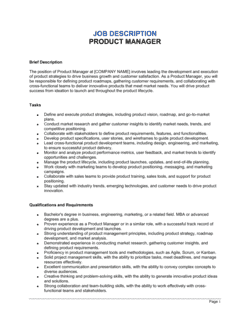
The Skills You Need To Be A Succesful Product Manager Template

Free to read • Save or share with one click

FreeThe Skills You Need To Be A Succesful Product Manager Template

At a glance

What it is
The Skills You Need To Be A Successful Product Manager is a structured professional development reference document that maps the core competencies, strategic capabilities, and interpersonal skills required to perform effectively in a product management role. This free Word download gives managers, HR teams, and aspiring PMs a clear, editable framework they can customize for hiring, self-assessment, or structured onboarding.
When you need it
Use it when hiring a product manager, conducting a PM performance review, building a career ladder for a product organization, or creating a personal development plan for an existing or aspiring product manager.
What's inside
The document covers strategic thinking and vision, customer discovery and research methods, data analysis and metrics ownership, cross-functional collaboration, roadmap planning, prioritization frameworks, communication and stakeholder management, technical literacy, and leadership competencies — each defined with observable behaviors and measurable outcomes.

What is a Product Manager Skills Framework?

A Product Manager Skills Framework is a structured professional reference document that defines the core competencies, observable behaviors, and measurable outcomes expected of a product manager at each level of seniority. It maps skills across domains including strategic vision, customer discovery, data analysis, cross-functional collaboration, technical literacy, and go-to-market execution — providing a single, shared standard that HR teams, hiring managers, engineering leads, and PMs themselves can use to evaluate performance, guide development, and make promotion decisions consistently. This free Word download gives you a customizable starting point for any organization building or scaling a product management function.

Why You Need This Document

Without a documented skills framework, PM hiring decisions rely on interviewer intuition, performance reviews default to subjective impressions, and career conversations stall because no one can agree on what "senior" actually means. The cost of this ambiguity is concrete: mis-hires that take 6–12 months to surface, promotion disputes that become retention risks, and new PMs who spend their first 90 days guessing what success looks like. A well-constructed skills framework closes all three gaps at once — it attracts better-fit candidates by being specific about expectations, gives managers defensible criteria for performance and promotion decisions, and gives PMs a clear map for their own development. This template provides the structure so your team can focus on calibrating the bar rather than inventing the framework from scratch.

Which variant fits your situation?

If your situation is…Use this template
Hiring a first-time junior PM from a non-technical backgroundJunior Product Manager Job Description
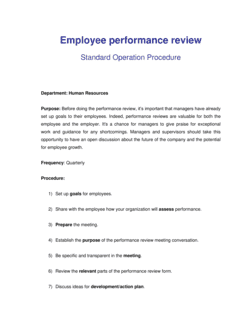
Conducting a mid-year performance review for an existing PMEmployee Performance Review Template
Building a full career ladder from Associate PM to VP of ProductCareer Development Plan Template
Creating a 30-60-90 day onboarding plan for a new PM hire30-60-90 Day Plan Template
Defining role expectations before an employment offer is extendedJob Description Template
Assessing PM skills as part of a structured interview loopInterview Evaluation Form
Setting professional development goals for a PM in a growth-stage companyProfessional Development Plan

Common mistakes to avoid

❌ Listing outputs instead of outcomes as core competencies

Why it matters: A competency framework built around 'shipping features on time' rewards execution velocity, not product thinking. This attracts PMs who optimize for story points closed rather than customer value delivered.

Fix: Rewrite every competency using an outcome framing: instead of 'manages the roadmap,' write 'makes prioritization decisions that move [METRIC] by [TARGET] within [TIMEFRAME].'

❌ Treating the document as a static hiring artifact

Why it matters: A skills framework used only for job postings and then filed away does not improve team performance, inform performance reviews, or guide professional development decisions.

Fix: Reference the document in every PM performance review and career conversation. Update it annually to reflect changes in company strategy, product maturity, and team size.

❌ Omitting technical literacy requirements for non-engineering PMs

Why it matters: PMs who cannot engage meaningfully with architecture discussions get bypassed by engineers making consequential product decisions. The result is a product shaped by technical convenience rather than user need.

Fix: Specify the minimum technical literacy bar for each role level — not 'writes code' but 'can read an ERD, understand API contracts, and articulate the impact of technical debt on user experience.'

❌ Defining stakeholder management as a soft skill rather than a structured accountability

Why it matters: When stakeholder communication is listed as a personality trait rather than a documented process, it is impossible to evaluate objectively — in hiring interviews, performance reviews, or promotion decisions.

Fix: Attach specific artifacts to the competency: written update cadence, decision log ownership, escalation protocol. Evaluate candidates and PMs against the artifact, not the trait.

❌ Not calibrating the competency bar to the actual seniority of the role

Why it matters: A junior PM job description that requires 'owning the product vision and influencing executive strategy' will attract senior candidates who will be bored and leave within 12 months, or junior candidates who overstate their experience to get the role.

Fix: Create explicit level definitions (L1–L4 or Associate / Mid / Senior / Principal) and map each competency to the level at which it becomes a core expectation versus an aspirational stretch goal.

❌ Excluding go-to-market and launch competencies from the skills framework

Why it matters: PMs who are not accountable for launch readiness consistently produce features that ship without sales enablement, support documentation, or user communications — resulting in underperformance against projected impact.

Fix: Add a dedicated GTM and launch execution section with specific sign-off responsibilities, lead times, and cross-functional coordination requirements for each product launch tier.

The 10 key clauses, explained

Strategic thinking and product vision

In plain language: Defines the PM's responsibility to articulate a clear product vision aligned to company strategy and to make decisions that optimize for long-term user and business outcomes.

Sample language
[PM NAME] is expected to articulate a product vision for [PRODUCT AREA] that serves [TARGET USER] and advances [COMPANY STRATEGIC GOAL] over a [1/2/3]-year horizon, updated [QUARTERLY / ANNUALLY].

Common mistake: Conflating roadmap execution with strategic thinking. PMs who only manage backlogs without owning a forward-looking vision are operating as project managers, not product managers — and are usually the first eliminated in a reorganization.

Customer discovery and user research

In plain language: Establishes the expectation that the PM owns ongoing qualitative and quantitative research to deeply understand customer problems before defining solutions.

Sample language
[PM NAME] will conduct a minimum of [X] user interviews per [QUARTER], synthesize findings into documented insights, and validate at least [Y]% of new feature hypotheses through discovery before entering the build queue.

Common mistake: Treating discovery as a one-time activity at project kick-off. Customer problems evolve; PMs who stop researching after launch build products that drift from user needs within 12–18 months.

Data analysis and metrics ownership

In plain language: Assigns the PM clear ownership of defining success metrics for their product area and the responsibility to monitor, report on, and act on those metrics.

Sample language
[PM NAME] owns the following success metrics for [PRODUCT AREA]: [METRIC 1], [METRIC 2], [METRIC 3]. A written metrics review will be shared with [STAKEHOLDER GROUP] on a [WEEKLY / MONTHLY] cadence.

Common mistake: Defining output metrics (features shipped, stories closed) instead of outcome metrics (retention, activation rate, revenue per user). Output metrics create the illusion of progress while hiding whether the product is actually improving.

Roadmap planning and prioritization

In plain language: Describes the PM's process for building and maintaining the product roadmap, including the prioritization framework used and the cadence for updating stakeholders.

Sample language
[PM NAME] will maintain a [ROLLING X-QUARTER] roadmap for [PRODUCT AREA], prioritized using [RICE / MoSCoW / ICE] scoring. Roadmap updates will be communicated to [STAKEHOLDERS] at least [X DAYS] before each planning cycle.

Common mistake: Building a roadmap driven by the loudest internal voice — typically sales or the CEO — rather than by a consistent, documented prioritization framework. This produces a reactive feature factory rather than a strategically coherent product.

Cross-functional collaboration

In plain language: Sets expectations for how the PM partners with engineering, design, marketing, sales, and customer success to move features from concept to production.

Sample language
[PM NAME] is the primary liaison between [ENGINEERING TEAM] and [BUSINESS STAKEHOLDERS] for [PRODUCT AREA]. Decisions requiring input from more than two functions will be documented in [DECISION LOG TOOL] within [X BUSINESS DAYS].

Common mistake: Acting as a requirements translator rather than a collaborative partner. PMs who hand off specs and disappear produce lower-quality software and lose the trust of engineering teams.

Communication and stakeholder management

In plain language: Outlines the PM's obligation to keep all relevant parties informed, manage expectations proactively, and escalate risks before they become blockers.

Sample language
[PM NAME] will distribute a written product update to [STAKEHOLDER LIST] every [CADENCE], covering progress against OKRs, upcoming milestones, active risks, and any changes to scope or timeline.

Common mistake: Communicating only when something goes wrong. Stakeholders who receive no news assume good news, then react badly to surprises. Regular structured updates build the trust that earns PMs the autonomy they need.

Technical literacy and engineering partnership

In plain language: Specifies the level of technical understanding expected — system architecture, API design, technical debt trade-offs — so the PM can make informed build vs. buy decisions and write meaningful acceptance criteria.

Sample language
[PM NAME] is expected to understand the high-level architecture of [SYSTEM / PRODUCT], participate meaningfully in technical design reviews, and author acceptance criteria that engineering can execute without ambiguity.

Common mistake: Assuming technical depth is optional for PMs in consumer or B2B SaaS roles. PMs who cannot engage meaningfully in architecture discussions are routinely bypassed by engineers making product-shaping decisions in their absence.

Leadership and team development

In plain language: Defines the PM's accountability for developing junior team members, running effective rituals, and modeling the behaviors expected of the broader product organization.

Sample language
[PM NAME] will mentor [ASSOCIATE PM / JUNIOR PM NAME], conduct monthly 1:1s, and provide written feedback at each performance review cycle. Meeting facilitation quality for [RITUALS] will be assessed during [REVIEW PERIOD].

Common mistake: Treating leadership as a senior-level-only competency. PMs at every level influence team culture through how they run meetings, how they give feedback, and how they respond to failure — neglecting this shapes culture by default.

Go-to-market and launch execution

In plain language: Assigns the PM responsibility for coordinating the cross-functional launch checklist, ensuring sales, support, and marketing are ready before a feature ships.

Sample language
[PM NAME] owns the GTM checklist for all [PRODUCT AREA] launches rated [TIER 1 / TIER 2]. Checklist sign-off from [MARKETING / SALES / SUPPORT] is required a minimum of [X DAYS] before the target launch date.

Common mistake: Declaring a feature 'done' at engineering sign-off without confirming go-to-market readiness. Features that ship without sales enablement, support documentation, or user communication consistently underperform against their potential impact.

Continuous learning and professional development

In plain language: Establishes the expectation that the PM actively maintains currency in product methodology, industry trends, and competitive landscape, and shares learning with the broader team.

Sample language
[PM NAME] will complete [X HOURS / COURSES / CERTIFICATIONS] of formal product management development per [YEAR] and share at least [X] structured learning summaries with the product team annually.

Common mistake: Treating professional development as a box to check rather than a structured habit. Product management practices evolve fast — PMs who stopped learning after their first role quickly fall behind peers who read, experiment, and iterate on their own methods.

How to fill it out

  1. 1

    Define the scope and seniority level

    Before editing the template, decide whether you are writing for a junior, mid-level, or senior PM role. This determines which competencies are mandatory versus aspirational and sets the bar for each section.

    💡 Label each competency with a level indicator (e.g., L1–L4) from the outset — this makes the document usable as a leveling rubric, not just a job description.

  2. 2

    Customize the strategic vision section for your product context

    Replace the placeholder product area and strategic goal references with your company's actual product lines and OKRs. The vision statement should be specific enough that a candidate can evaluate whether the role fits their interests.

    💡 Avoid generic language like 'drive growth.' Replace it with the actual metric you are trying to move — 'increase 30-day activation from 42% to 60%' is both more honest and more compelling to strong candidates.

  3. 3

    Specify the discovery and research expectations

    Fill in the minimum interview cadence, the tools your team uses for user research (e.g., UserTesting, Maze, Dovetail), and any required documentation format for research synthesis.

    💡 If your organization has no existing research practice, use this section to define the minimum viable process rather than leave it aspirational.

  4. 4

    List the actual metrics the PM will own

    Enter the specific KPIs for the product area — not generic 'engagement' or 'retention' but the actual metric names, current baselines, and target ranges used in your OKR cycle.

    💡 A PM who sees real metrics in a job posting self-selects based on experience with those specific measurement challenges — this improves the quality of applicants.

  5. 5

    Define the cross-functional interfaces

    Name the specific teams the PM will work with daily — iOS engineering, data science, enterprise sales, customer success — and describe the collaboration model (embedded, advisory, or matrix).

    💡 Vague 'works cross-functionally' language attracts PMs who have operated in clean org structures. Specificity attracts candidates experienced in the ambiguity your organization actually has.

  6. 6

    Set the go-to-market and launch process

    Fill in the GTM tier system your company uses, the sign-off stakeholders, and the required lead time before launch. If no tier system exists, use this document as the opportunity to create one.

    💡 Attach your existing launch checklist as an appendix to the template — this gives candidates and new hires a concrete picture of what 'launch ownership' actually means.

  7. 7

    Add development expectations and review cadence

    Specify the professional development budget, any required certifications or training programs, and the frequency of formal skill reviews. Connect these to the career ladder levels defined in Step 1.

    💡 Including a development budget figure (e.g., '$1,500/year for courses, conferences, or books') significantly increases offer acceptance rates among strong candidates.

  8. 8

    Review and validate with engineering and design leads

    Share the completed document with the engineering and design partners who will work directly with this PM. Confirm that the technical literacy, collaboration, and communication expectations reflect how those teams actually operate.

    💡 A PM skills document signed off only by the hiring manager will produce misalignment. The day-one experience of a new PM is shaped by engineering and design expectations, not HR expectations.

Frequently asked questions

What are the most important skills for a product manager?

The highest-impact skills for a product manager are customer discovery, data-driven prioritization, cross-functional communication, and strategic thinking — in that order. Customer discovery ensures you are solving real problems; data skills ensure you measure whether your solutions work; communication skills ensure alignment across engineering, design, and business stakeholders; and strategic thinking ensures each decision compounds toward a coherent product vision rather than a pile of disconnected features.

Does a product manager need to know how to code?

No, but a PM needs sufficient technical literacy to participate meaningfully in architecture discussions, evaluate build vs. buy trade-offs, and write acceptance criteria that engineers can execute without ambiguity. The practical bar is the ability to read an entity-relationship diagram, understand how REST APIs work, and articulate the user impact of technical debt — not the ability to ship production code. PMs who lack this baseline are routinely excluded from consequential engineering decisions.

How is a product manager different from a project manager?

A project manager owns the delivery of a defined scope on time and on budget — they manage execution. A product manager owns the definition of what to build and why — they own outcomes. A PM's primary accountability is moving a business or user metric; a project manager's primary accountability is hitting a milestone. Many companies blur these roles, but the distinction matters for hiring, performance evaluation, and organizational design.

What data skills does a product manager need?

At minimum, a PM should be able to write basic SQL queries to pull their own data, define and instrument success metrics for new features, run or interpret A/B test results, and identify whether a metric movement is statistically meaningful. Advanced PMs can build cohort analyses, funnel models, and retention curves independently. The goal is not to replace the data analyst but to be a sophisticated consumer of data so that analysis informs decisions rather than justifying them after the fact.

How should a product manager handle conflicting stakeholder priorities?

The most effective approach is to document the conflict explicitly, map each competing priority to a strategic objective, and escalate the trade-off decision to the appropriate level of the organization — with a recommendation. PMs who try to satisfy every stakeholder simultaneously produce roadmaps with no coherent strategy. The PM's job is to make the trade-off visible and provide a principled recommendation, not to absorb the conflict silently.

What is the difference between a senior PM and a principal PM?

A senior PM owns a defined product area, operates independently, and influences decisions within their pod or squad. A principal PM typically owns a product domain spanning multiple teams, sets methodology and prioritization standards for the broader product organization, and influences company strategy directly. The key differentiator is scope of influence — a senior PM executes strategy; a principal PM shapes it.

Can you use this template for a PM performance review?

Yes. The competency sections map directly to performance review dimensions — strategic thinking, discovery, data, communication, technical literacy, leadership, and launch execution. For each review cycle, the PM and their manager can assess performance against each competency using the observable behaviors and artifact expectations defined in the template, producing a structured and defensible evaluation rather than a subjective impression.

How often should a product manager skills framework be updated?

Review it annually at minimum, and trigger an out-of-cycle update whenever the company undergoes a significant shift in strategy, product maturity, or team structure. A PM skills framework written for a 10-person startup in year one will actively misalign expectations at 150 employees. The discovery, leadership, and go-to-market competencies in particular evolve significantly as the organization scales from founding team to multi-product company.

What is the best way to assess PM skills in an interview?

Use structured behavioral questions tied directly to the competencies in the framework — one question per competency, evaluated against a four-point rubric. Ask for specific examples with measurable outcomes: 'Tell me about a prioritization decision you made that you later concluded was wrong — what data changed your view?' Supplement with a take-home product case study calibrated to the seniority level of the role. Avoid abstract brainteasers; they measure pattern-matching, not product thinking.

How this compares to alternatives

vs Job Description Template

A job description defines the role's responsibilities, required qualifications, and reporting structure for a specific open position. A skills framework goes deeper — it defines observable competencies, measurable outcomes, and leveling criteria that persist across multiple hires and review cycles. Use the job description to attract candidates; use the skills framework to evaluate and develop them.

vs Employee Performance Review Template

A performance review template structures the evaluation conversation and documents ratings and development goals. A skills framework provides the competency vocabulary and standards against which the performance review is conducted. The skills framework is upstream — without it, performance reviews default to subjective impressions rather than role-specific criteria.

vs 30-60-90 Day Plan Template

A 30-60-90 day plan defines what a new PM will learn, decide, and deliver in their first three months. A skills framework defines the permanent competency expectations for the role regardless of tenure. The two are complementary: the 30-60-90 plan operationalizes onboarding; the skills framework governs career progression after the new-hire period ends.

vs Interview Evaluation Form

An interview evaluation form captures structured interviewer feedback for a single candidate conversation. A skills framework is the source document that should drive the design of the evaluation form — each interview question maps to a competency, and each rating rubric reflects the behavioral indicators defined in the skills template. One is the instrument; the other is the measurement standard.

Industry-specific considerations

SaaS / Technology

PLG motion requires PMs to own activation and expansion metrics directly; technical literacy bar is higher due to API-first architectures and data pipeline dependencies.

Financial Services / Fintech

Regulatory compliance awareness is a mandatory competency; PM must coordinate with legal and compliance teams before every launch and understand how product decisions interact with licensing obligations.

Healthcare / MedTech

FDA or CE-mark pathway understanding is required for device or software-as-a-medical-device products; user research must include clinical stakeholders and evidence of patient safety consideration.

E-commerce / Retail

Conversion funnel ownership, inventory and fulfillment system literacy, and seasonal launch cadence management are core competencies not typically addressed in generic PM frameworks.

Professional Services

PMs in services-led organizations must balance product scalability goals with client-specific customization pressure; stakeholder management skills are unusually critical given the influence of large-account sales teams.

Manufacturing

Industrial IoT and hardware-software integration require PMs to understand long release cycles, safety certification processes, and supply chain constraints that have no equivalent in pure software environments.

Jurisdictional notes

United States

Competency frameworks used in hiring and performance management must comply with EEOC guidelines — criteria must be job-related and consistently applied to avoid disparate impact claims. In states like California, documented performance criteria are important evidence in wrongful termination disputes. Non-compete clauses sometimes referenced in PM employment agreements are unenforceable in California and several other states regardless of what the employment contract states.

Canada

Competency frameworks used in hiring must not include criteria that have an adverse effect on protected groups under the Canadian Human Rights Act or provincial equivalents. In Ontario and British Columbia, documented performance standards play a central role in just-cause termination defenses. Quebec employers must provide French-language documentation to employees under the Charter of the French Language.

United Kingdom

Under the Equality Act 2010, competency frameworks used in hiring or promotion decisions must be demonstrably job-related to avoid indirect discrimination claims. The UK's IR35 rules may affect how PM competencies are documented when engaging contract product managers through personal service companies. Written performance criteria are expected by Employment Tribunals in unfair dismissal cases.

European Union

GDPR applies to any personal data collected during competency assessments, interviews, or performance reviews — including scoring rubrics and evaluator notes, which may be subject to data subject access requests. EU employment law in France, Germany, and the Netherlands requires works council consultation before implementing new performance management frameworks that affect working conditions. Competency criteria must comply with the EU Employment Equality Directive.

Template vs lawyer — what fits your deal?

PathBest forCostTime
Use the templateStartups and small product teams defining their first PM competency framework or hiring their first PMFree2–4 hours to customize and validate
Template + legal reviewGrowth-stage companies building a formal PM career ladder or linking competencies to compensation bands$500–$2,000 for an HR consultant or organizational design advisor review1–2 weeks
Custom draftedEnterprise organizations implementing a multi-level PM competency framework tied to regulated performance management systems or collective agreements$5,000–$20,000 for a specialized organizational design or HR consulting engagement6–12 weeks

Glossary

Product Roadmap
A prioritized, time-sequenced plan that communicates what a product team will build, when, and why — used to align stakeholders and guide engineering execution.
Discovery
The ongoing research process through which a PM identifies customer problems, validates assumptions, and reduces the risk of building the wrong thing.
Prioritization Framework
A structured method — such as RICE, MoSCoW, or ICE scoring — for ranking features and initiatives by impact, effort, and strategic fit.
OKRs (Objectives and Key Results)
A goal-setting framework in which a qualitative objective is paired with two to five measurable key results that define what success looks like.
Stakeholder Management
The practice of identifying, communicating with, and aligning the expectations of all internal and external parties who have an interest in the product.
Technical Literacy
A PM's ability to understand how software is built — system architecture, APIs, technical debt, and build vs. buy trade-offs — without necessarily writing code.
North Star Metric
The single metric that best captures the core value a product delivers to its customers and that the entire team is optimized to move.
Go-to-Market (GTM) Strategy
The plan for how a new product or feature will be launched to customers, covering positioning, pricing, channels, and sales or marketing enablement.
Agile / Scrum
An iterative software development methodology that organizes work into short cycles called sprints, with daily standups, retrospectives, and a prioritized backlog.
Customer Journey Map
A visual diagram that traces the steps a customer takes from first awareness to purchase and ongoing use, used to identify pain points and improvement opportunities.
A/B Testing
A controlled experiment in which two versions of a feature or page are shown to different user segments simultaneously to determine which drives better outcomes.

Part of your Business Operating System

This document is one of 3,000+ business & legal templates included in Business in a Box.

  • Fill-in-the-blanks — ready in minutes
  • Compatible with all office suites
  • Export to PDF and share electronically

Create your document in 3 simple steps.

From template to signed document — all inside one Business Operating System.
1
Download or open template

Access over 3,000+ business and legal templates for any business task, project or initiative.

2
Edit and fill in the blanks with AI

Customize your ready-made business document template and save it in the cloud.

3
Save, Share, Send, Sign

Share your files and folders with your team. Create a space of seamless collaboration.

Save time, save money, and create top-quality documents.

★★★★★

"Fantastic value! I'm not sure how I'd do without it. It's worth its weight in gold and paid back for itself many times."

Managing Director · Mall Farm
Robert Whalley
Managing Director, Mall Farm Proprietary Limited
★★★★★

"I have been using Business in a Box for years. It has been the most useful source of templates I have encountered. I recommend it to anyone."

Business Owner · 4+ years
Dr Michael John Freestone
Business Owner
★★★★★

"It has been a life saver so many times I have lost count. Business in a Box has saved me so much time and as you know, time is money."

Owner · Upstate Web
David G. Moore Jr.
Owner, Upstate Web

Run your business with a system — not scattered tools

Stop downloading documents. Start operating with clarity. Business in a Box gives you the Business Operating System used by over 250,000 companies worldwide to structure, run, and grow their business.

Start free · No credit card required