Management Skills Affirmations Template

Free Word download • Edit online • Save & share with Drive • Export to PDF

2 pages20–30 min to fillDifficulty: StandardSignature requiredLegal review recommended
Learn more ↓
FreeManagement Skills Affirmations Template

At a glance

What it is
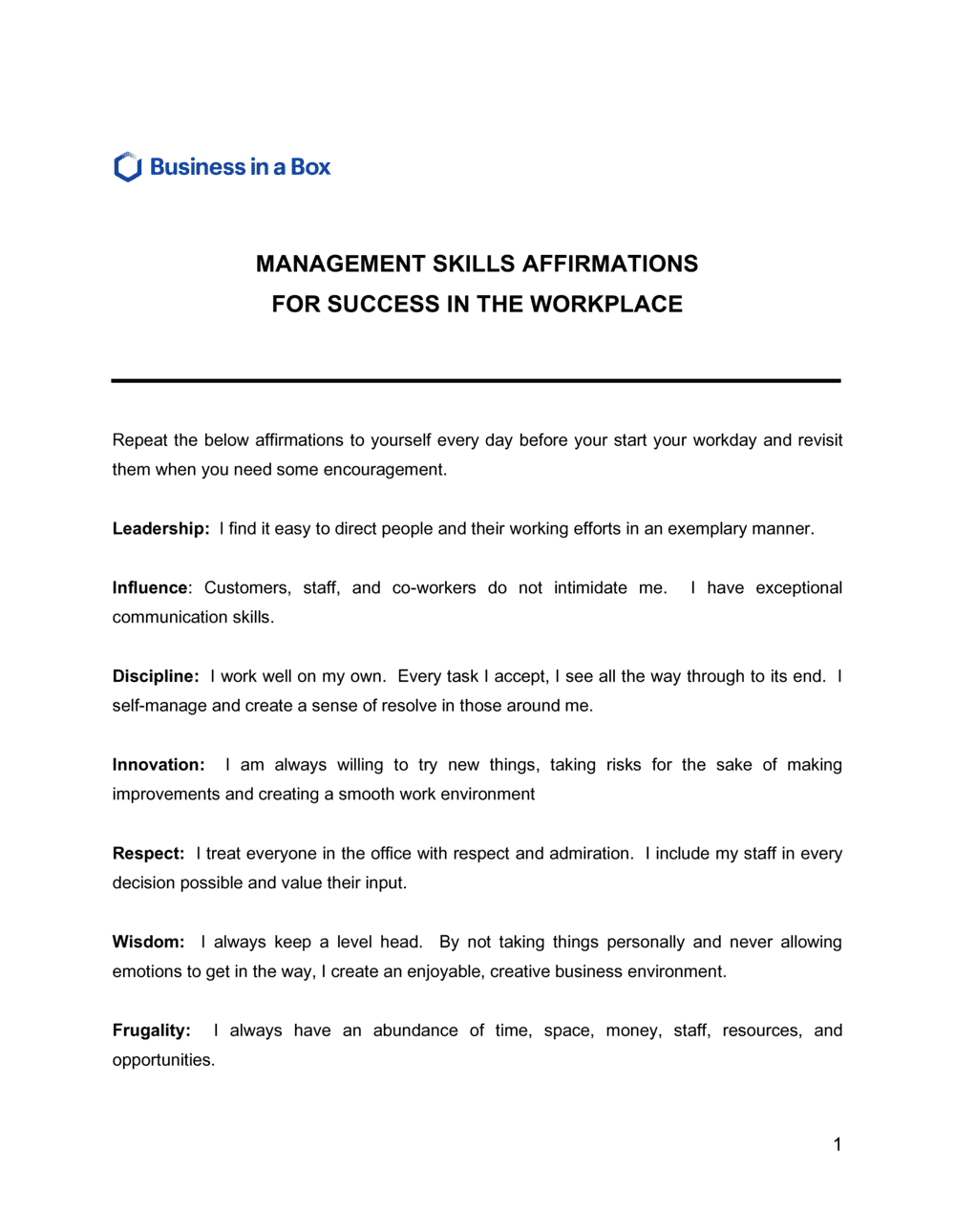
A Management Skills Affirmations document is a structured written record in which an employee or manager formally affirms their commitment to developing and demonstrating specific managerial competencies. This free Word download gives HR teams and managers a ready-to-use framework for documenting skill commitments, linking them to performance expectations, and creating a signed record for personnel files.
When you need it
Use it during performance reviews, leadership development programs, or onboarding of newly promoted managers who need a documented baseline of the competencies they are committing to develop or maintain. It is also useful when placing an underperforming manager on a structured improvement path that requires a written acknowledgment of skill gaps and corrective intent.
What's inside
Party identification, competency definitions and affirmation statements, goal-setting and development commitments, acknowledgment of performance standards, review timeline, consequences of non-fulfillment, and signatures from both the employee and their HR representative or direct supervisor.

What is a Management Skills Affirmations Document?

A Management Skills Affirmations document is a signed written record in which a manager formally commits to developing or demonstrating specific managerial competencies over a defined review period. It identifies the skills to be developed, links each affirmation to measurable development actions and KPIs, sets a review timeline with interim check-ins, and is co-signed by the employee and an HR representative or supervisor. Unlike a general career development conversation, a properly executed affirmations document creates a durable personnel record that establishes what was expected, what support was offered, and that the manager acknowledged both — in writing, with a date.

Why You Need This Document

Without a signed affirmations document, development conversations remain informal, expectations stay ambiguous, and the employer has no written record of what was communicated or agreed if performance later becomes a disciplinary matter. In jurisdictions including Canada, the UK, and EU member states, employment tribunals and labor boards routinely ask whether the employer demonstrated procedural fairness by communicating expectations clearly and offering documented development support — an unsigned or vague record typically fails both tests. For newly promoted managers, the document creates a structured onboarding baseline that accelerates competency development and reduces the risk of early-tenure failure. For HR teams managing a leadership pipeline, it produces consistent, auditable records across cohorts. This template provides a ready-to-use framework that covers every essential clause — from competency affirmations and KPIs to voluntary participation acknowledgments and co-signatures — so HR teams and managers can focus on the development conversation rather than the document structure.

Which variant fits your situation?

If your situation is…Use this template
Documenting broad leadership skills for a senior managerManagement Skills Affirmations
Placing an underperforming employee on a formal improvement trackPerformance Improvement Plan
Setting measurable development goals during an annual reviewEmployee Performance Review
Onboarding a newly hired manager with defined role expectationsEmployment Contract
Confirming training completion after a leadership development programTraining Acknowledgment Form
Documenting coaching goals between a manager and an executive coachCoaching Agreement
Capturing a 360-degree leadership feedback summary with action itemsEmployee Evaluation Form

Common mistakes to avoid

❌ Writing affirmations in abstract language

Why it matters: Statements like 'be a more effective communicator' cannot be measured at review, making it impossible to determine whether the commitment was met. If the document is used in a disciplinary process, vague language is routinely dismissed.

Fix: Write every affirmation as a specific, observable behavior with a frequency or deadline — for example, 'conduct weekly one-on-one meetings with each direct report and document outcomes within 24 hours.'

❌ Omitting the consequences of non-fulfillment clause

Why it matters: Without stated consequences, the document is aspirational rather than binding. Employees and their representatives may argue it creates no compliance obligation, undermining its use as a performance record.

Fix: Include a clear consequences clause referencing the company's progressive discipline policy and specifying at minimum that non-fulfillment may result in a formal performance improvement plan.

❌ Collecting only the employee's signature

Why it matters: A document signed only by the employee cannot demonstrate that the employer communicated expectations in good faith. Employment tribunals and labor boards typically require evidence that the employer also acknowledged and agreed to support the development commitments.

Fix: Always collect dated signatures from the supervisor and an HR representative alongside the employee's signature before the document enters the personnel file.

❌ Setting no interim check-in schedule

Why it matters: Without midpoint reviews, small deviations from the development plan go unaddressed until the final review, at which point the documented record of employer support is absent — a significant liability if the matter escalates to dismissal.

Fix: Schedule at least two interim check-ins (typically 30 and 60 days) with dates written into the document at signing. Document the outcome of each check-in in writing.

❌ Using the document interchangeably with a performance improvement plan

Why it matters: An affirmations document is a development tool; a PIP is a disciplinary one. Conflating them creates legal ambiguity about the employee's standing and may trigger unjust-dismissal arguments if the situation escalates.

Fix: Keep the two documents distinct. Use affirmations for proactive development and a formal PIP — drafted with HR and legal review — when the situation involves documented underperformance requiring disciplinary record-keeping.

❌ Skipping the voluntary participation acknowledgment

Why it matters: If an employee later claims they were coerced into signing, the absence of a voluntary-participation clause leaves the employer with no written evidence that the employee agreed willingly — a particularly serious gap when the document is used in the context of a disciplinary process.

Fix: Include an explicit acknowledgment that the employee has read the document, had the opportunity to seek advice, and is signing voluntarily. Give the employee at least 24 hours to review before the signing meeting.

The 10 key clauses, explained

Parties and Role Identification

In plain language: Names the employer entity, the employee, their current job title and department, and the HR representative or supervisor administering the document.

Sample language
This Management Skills Affirmations document is entered into on [DATE] between [EMPLOYER LEGAL NAME] ('Company') and [EMPLOYEE FULL NAME] ('Manager'), currently serving as [JOB TITLE] in the [DEPARTMENT] department, supervised by [SUPERVISOR NAME AND TITLE].

Common mistake: Using an informal name or nickname instead of the employee's legal name. If the document is later referenced in a disciplinary proceeding, a name mismatch creates an enforceability challenge.

Purpose and Scope of Affirmations

In plain language: States why the document is being used — whether for routine development, post-promotion onboarding, or a skills improvement program — and defines which competencies it covers.

Sample language
The purpose of this document is to affirm [EMPLOYEE NAME]'s commitment to developing the following managerial competencies: [LIST COMPETENCIES]. This document forms part of the Company's [PROGRAM NAME] leadership development initiative.

Common mistake: Leaving the purpose vague so it reads as purely aspirational. A stated purpose — especially one tied to a formal HR program — strengthens the document's standing as a performance record.

Competency Affirmation Statements

In plain language: The core of the document — a series of individually signed or initialed affirmations in which the manager commits to demonstrating specific, observable skills.

Sample language
I, [EMPLOYEE NAME], affirm my commitment to: (a) providing direct and timely feedback to direct reports at least [FREQUENCY]; (b) completing [TRAINING PROGRAM] by [DATE]; (c) resolving team conflicts within [X] business days of escalation.

Common mistake: Writing affirmations in abstract language like 'be a better communicator.' Each affirmation must describe a specific, observable behavior tied to a measurable standard so progress can be evaluated.

Development Action Plan

In plain language: A structured list of concrete actions — courses, coaching sessions, stretch assignments, or reading — the employee commits to completing within the review period.

Sample language
Manager agrees to complete the following development activities by [DATE]: (1) Enroll in [TRAINING COURSE] by [DATE]; (2) attend [X] coaching sessions with [COACH NAME]; (3) lead [PROJECT/INITIATIVE] as a stretch assignment.

Common mistake: Listing training activities with no completion deadlines. Without dates, a development action plan is unenforceable and impossible to evaluate at review.

Performance Standards and KPIs

In plain language: Links each affirmation to a measurable performance benchmark so both parties understand what 'successful fulfillment' looks like.

Sample language
Success for each affirmation will be measured by the following indicators: [KPI 1] — target [METRIC] by [DATE]; [KPI 2] — evidenced by [MEASUREMENT METHOD]; [KPI 3] — verified through [REVIEW METHOD].

Common mistake: Setting KPIs without stating how they will be measured. An affirmation to 'improve team engagement' requires a defined measurement method — such as a team survey score — or it cannot be assessed at review.

Review Timeline and Check-In Schedule

In plain language: Defines when progress will be formally reviewed — typically at 30, 60, and 90-day intervals — and who is responsible for scheduling each check-in.

Sample language
Progress against these affirmations will be reviewed at: 30-day check-in on [DATE], 60-day check-in on [DATE], and final review on [DATE]. [SUPERVISOR NAME] is responsible for scheduling each session and documenting outcomes.

Common mistake: Scheduling only a final review with no interim check-ins. Without midpoint assessments, minor deviations compound and the final review becomes a disciplinary conversation rather than a development one.

Consequences of Non-Fulfillment

In plain language: Sets out what happens if the employee does not meet the affirmation commitments within the review period — ranging from extended development plans to formal disciplinary action.

Sample language
Failure to fulfill the commitments set out in this document by [DATE] may result in: (a) extension of the development period by [X] days; (b) formal performance improvement plan; or (c) disciplinary action up to and including [CONSEQUENCE], consistent with Company policy.

Common mistake: Omitting this clause entirely to keep the document 'positive.' Without stated consequences, the document lacks any compliance mechanism and courts may view it as non-binding.

Voluntary Participation and Non-Coercion Acknowledgment

In plain language: Confirms the employee is signing willingly, has had the opportunity to ask questions and seek advice, and was not coerced or misled about the document's purpose.

Sample language
I, [EMPLOYEE NAME], confirm that I have read this document in full, have had the opportunity to ask questions and seek independent advice, and am signing voluntarily and without coercion. I understand the purpose of this document and the expectations it sets out.

Common mistake: Skipping this clause when the document is used as part of a disciplinary process. Without a voluntary-participation acknowledgment, employees may later claim they signed under duress, weakening the document's standing.

Confidentiality of Performance Records

In plain language: Specifies that the contents of this document are confidential to the employer and employee and will not be shared beyond those with a legitimate HR or supervisory need.

Sample language
The contents of this document are confidential and will be maintained in [EMPLOYEE NAME]'s personnel file. Access is restricted to [EMPLOYEE NAME], their direct supervisor, and HR personnel with a legitimate need. Disclosure outside these parties requires written authorization.

Common mistake: Not including a confidentiality clause when the document references specific performance deficiencies. Without it, employees may share the document in ways that create discrimination or defamation claims.

Signatures, Date, and Witness

In plain language: Collects signed, dated acknowledgments from the employee, their supervisor, and an HR witness, confirming mutual understanding and voluntary agreement.

Sample language
Employee Signature: _________________________ Date: _________ | Supervisor Signature: _________________________ Date: _________ | HR Representative Signature: _________________________ Date: _________

Common mistake: Collecting only the employee's signature. Without a co-signature from a supervisor or HR representative, the document cannot be used to demonstrate that the employer communicated expectations clearly and in good faith.

How to fill it out

  1. 1

    Identify the parties and the context

    Enter the employer's full legal entity name, the employee's legal name, their current job title, department, and the name and title of their direct supervisor. Note whether this document is part of routine development or a formal improvement process.

    💡 Confirm the employee's legal name against their employment record before the signing meeting — mismatches create administrative friction if the document is referenced in later proceedings.

  2. 2

    Define the competencies to be affirmed

    Select four to eight specific managerial competencies relevant to the employee's role — such as delegation, performance feedback, conflict resolution, or team coaching. Write each in plain language that describes a behavior, not a trait.

    💡 Competencies derived from a published framework (such as your company's leadership model or a recognized standard) carry more weight in performance proceedings than competencies invented ad hoc.

  3. 3

    Write specific, observable affirmation statements

    For each competency, draft an affirmation statement that describes what the employee is committing to do, how often, and by when. Each statement should be testable — meaning a third party could observe and confirm whether it was met.

    💡 Use the format 'I commit to [ACTION] [FREQUENCY or DEADLINE] as evidenced by [MEASUREMENT]' to keep every affirmation concrete and auditable.

  4. 4

    Build the development action plan

    List the specific activities — training courses, coaching sessions, reading, or stretch assignments — that will support each affirmation. Assign a completion deadline to every item.

    💡 Limit the action plan to no more than six items per review period. More than six activities creates an unrealistic workload and reduces completion rates significantly.

  5. 5

    Set KPIs and measurement methods

    For each affirmation, define the metric that will be used to assess progress — survey scores, completion certificates, 360 feedback ratings, or direct observation — and state how and when measurement will occur.

    💡 Baseline the KPI before the document is signed where possible. Showing a starting point makes progress measurable and reduces disputes at review.

  6. 6

    Schedule review check-ins

    Set specific calendar dates for 30-, 60-, and 90-day reviews and name the person responsible for scheduling each. Enter these dates in the document before signing so they are agreed, not negotiated later.

    💡 Calendar the check-ins immediately after signing and send calendar invitations to all parties. Check-ins that aren't scheduled at signing rarely happen.

  7. 7

    Review the document together before signing

    Walk through the document with the employee before the signing meeting so they have an opportunity to ask questions. Note any agreed changes in writing before execution.

    💡 Give the employee at least 24 hours to review the document before the signing meeting. This supports the voluntary participation clause and reduces the risk of a later coercion claim.

  8. 8

    Execute with all required signatures

    Collect dated signatures from the employee, their direct supervisor, and an HR representative. File the fully executed copy in the employee's personnel file and provide the employee with their own copy.

    💡 Use a digital signing tool to timestamp execution and store the signed copy automatically — a missing or undated signature is the most common reason these documents fail in employment disputes.

Frequently asked questions

What is a management skills affirmations document?

A management skills affirmations document is a signed written record in which a manager formally commits to developing or demonstrating specific managerial competencies over a defined review period. It identifies the competencies, sets measurable development actions and KPIs, schedules review check-ins, and is co-signed by the employee and an HR representative or supervisor. It functions both as a development tool and as a performance record in the employee's personnel file.

When should a management skills affirmations document be used?

It is most commonly used during annual performance reviews, after a promotion to a management role, at the start of a formal leadership development program, or when a manager is placed on a structured skills improvement track. It is distinct from a performance improvement plan — affirmations are used proactively to develop capability, while a PIP is a disciplinary document used when performance has already fallen below acceptable standards.

Is a management skills affirmations document legally binding?

When properly executed — with specific, measurable commitments, stated consequences, and signatures from both the employee and the employer — the document is generally enforceable as a workplace performance record in most jurisdictions. It should be consistent with the employer's HR policies and any applicable employment standards legislation. A legal review is recommended when the document will be used as part of a formal disciplinary process or where the applicable jurisdiction has strong employment protections.

What competencies should be included in a management skills affirmations document?

Select competencies that are directly relevant to the manager's role and observable in their day-to-day work. Common examples include performance feedback delivery, delegation and task management, conflict resolution, team coaching, decision-making under uncertainty, and cross-functional communication. Limit affirmations to four to eight competencies per review period — more than eight creates an unrealistic development workload and reduces completion rates.

What is the difference between a management skills affirmations document and a performance improvement plan?

A management skills affirmations document is a proactive development tool used to build or reinforce managerial competencies. A performance improvement plan (PIP) is a formal disciplinary document used when an employee has already failed to meet documented performance standards and the employer is creating a record for potential progressive discipline or termination. Using affirmations as a substitute for a PIP creates legal ambiguity about the employee's standing and may undermine a subsequent disciplinary process.

Does a management skills affirmations document need to be signed?

Yes. For the document to function as a reliable performance record, it requires dated signatures from the employee, their direct supervisor, and an HR representative. An employee-only signature cannot demonstrate that the employer communicated expectations clearly and agreed to provide development support — both elements that employment tribunals and labor boards typically look for if the matter escalates to a dispute.

How long should the review period be for a management skills affirmations document?

A 90-day review period with 30- and 60-day interim check-ins is the most common structure for a first-cycle affirmations document. For newly promoted managers, a 180-day period aligned to the end of a probationary phase may be more appropriate. The period should be long enough for meaningful development to occur but short enough that progress can be assessed and documented while the affirmations remain current.

Can management skills affirmations be used as evidence in an employment dispute?

A properly executed affirmations document — with specific commitments, measurable KPIs, review check-in records, and co-signatures — can support an employer's position in an employment dispute by demonstrating that expectations were communicated clearly, development support was offered, and the employee acknowledged both. However, documents with vague language, missing signatures, or no documented review outcomes carry significantly less weight. Engaging HR counsel before using such documents in a disciplinary context is strongly recommended.

Should employees be given time to review the document before signing?

Yes — providing at least 24 to 48 hours for the employee to review the document before the signing meeting materially strengthens the voluntary participation clause and reduces the risk of a later coercion claim. Employers in the UK, EU, and Canada are particularly exposed to claims of constructive dismissal or procedural unfairness when employees can demonstrate they were pressured into signing HR documents without adequate opportunity for review.

How this compares to alternatives

vs Performance Improvement Plan

A performance improvement plan is a formal disciplinary document used after documented performance failures, creating a record for potential termination. A management skills affirmations document is a proactive development tool used before performance has fallen below standard. Confusing the two creates legal ambiguity about the employee's standing. Use affirmations for development; use a PIP for documented underperformance requiring a disciplinary paper trail.

vs Employee Performance Review

A performance review is a retrospective evaluation of what the employee has already done over a prior period. A management skills affirmations document is forward-looking — it documents commitments the manager is making about future development. The two are complementary: review outcomes often generate the development gaps that an affirmations document then formalizes.

vs Employment Contract

An employment contract governs the entire employment relationship — compensation, duties, IP, and termination. A management skills affirmations document is a narrower, role-specific record focused on competency development within an existing employment relationship. Affirmations documents do not override or modify employment contract terms and should be explicitly scoped to development and performance documentation only.

vs Employee Evaluation Form

An employee evaluation form collects structured ratings and comments on past performance across a range of criteria. A management skills affirmations document creates signed, forward-looking commitments to specific behaviors. Evaluation forms look backward; affirmations documents look forward. Both belong in the personnel file and are most useful when used together as part of a continuous performance management cycle.

Industry-specific considerations

Technology / SaaS

Engineering managers and product leads are frequently promoted from individual contributor roles with limited prior management experience, making structured affirmations documents a standard onboarding tool for new people-managers in fast-scaling teams.

Financial Services

Regulated environments require documented evidence of manager competency in compliance, risk communication, and team oversight; affirmations documents create an auditable development record that satisfies FCA, FINRA, and internal governance requirements.

Healthcare

Clinical managers overseeing patient-care teams need documented commitments to safety communication, staff supervision standards, and incident escalation protocols — competencies where failure to develop carries direct patient-safety implications.

Professional Services

Client-facing managers at consulting, accounting, and law firms use affirmations documents to formalize commitments to business development activity, team utilization management, and client feedback integration — competencies directly tied to billable performance.

Jurisdictional notes

United States

Employment documentation requirements vary by state, but federal at-will employment doctrine means employers have broad latitude to create performance records. However, documents used in the context of a disciplinary process should be consistent with company policy to avoid discrimination claims under Title VII or the ADA. California, New York, and New Jersey have heightened procedural requirements for employment documentation used in dismissal proceedings.

Canada

Canadian employment law requires employers to demonstrate procedural fairness in performance management, including clear communication of expectations and documented support opportunities. An affirmations document that meets these criteria can significantly strengthen an employer's position if a matter proceeds to a wrongful dismissal claim. Quebec employers must ensure all HR documentation provided to French-speaking employees is available in French under the Charter of the French Language.

United Kingdom

ACAS guidance requires employers to follow a clear and fair process before taking disciplinary action, which includes documenting performance expectations and providing support. A properly executed affirmations document supports compliance with this requirement. Employees with two or more years of service have the right to claim unfair dismissal, making documented development processes particularly important when managing underperforming managers.

European Union

EU member states generally impose strong employee protections requiring employers to demonstrate good-faith efforts to support underperforming employees before termination. A signed affirmations document with recorded review check-ins supports this requirement in countries including Germany, France, and the Netherlands. GDPR applies to performance records — documents containing personal data about an employee's development must be stored securely and retained only for as long as necessary.

Template vs lawyer — what fits your deal?

PathBest forCostTime
Use the templateHR teams using affirmations documents as part of routine leadership development programs for mid-level managersFree30–60 minutes per document
Template + legal reviewEmployers using affirmations documents in the context of formal disciplinary processes or in jurisdictions with strong employment protections$200–$500 for an HR counsel review1–3 days
Custom draftedSenior executives, regulated industries, cross-border employment arrangements, or cases where the document will be used as the primary record in an employment tribunal$800–$2,500+1–2 weeks

Glossary

Affirmation Statement
A written declaration in which an individual formally commits to demonstrating or developing a specific skill or behavior.
Managerial Competency
A defined, observable skill or behavior — such as delegation, conflict resolution, or coaching — that a manager is expected to demonstrate in their role.
Performance Standard
A measurable benchmark that defines the minimum acceptable level of performance for a given competency or role expectation.
Development Action Plan
A documented list of specific activities, training, or milestones the employee commits to completing in order to build a targeted skill.
Review Period
The defined timeframe — typically 30, 60, or 90 days — over which progress against affirmation commitments will be assessed.
Acknowledgment Clause
A section in which the employee confirms they have read, understood, and voluntarily agree to the terms and expectations set out in the document.
Progressive Discipline
A formal HR process in which increasingly serious consequences are applied to performance or conduct issues that are not corrected after documented warnings.
KPI (Key Performance Indicator)
A quantifiable metric used to evaluate whether a manager is meeting a specific performance or development objective within the review period.
Witness or Co-Signatory
An HR representative, supervisor, or third party who signs the document to confirm that the affirmation was made knowingly and voluntarily.
Personnel File
The official employer-maintained record containing employment documents, performance reviews, disciplinary records, and signed agreements for a specific employee.

Part of your Business Operating System

This document is one of 3,000+ business & legal templates included in Business in a Box.

  • Fill-in-the-blanks — ready in minutes
  • 100% customizable Word document
  • Compatible with all office suites
  • Export to PDF and share electronically

Create your document in 3 simple steps.

From template to signed document — all inside one Business Operating System.
1
Download or open template

Access over 3,000+ business and legal templates for any business task, project or initiative.

2
Edit and fill in the blanks with AI

Customize your ready-made business document template and save it in the cloud.

3
Save, Share, Send, Sign

Share your files and folders with your team. Create a space of seamless collaboration.

Save time, save money, and create top-quality documents.

★★★★★

"Fantastic value! I'm not sure how I'd do without it. It's worth its weight in gold and paid back for itself many times."

Managing Director · Mall Farm
Robert Whalley
Managing Director, Mall Farm Proprietary Limited
★★★★★

"I have been using Business in a Box for years. It has been the most useful source of templates I have encountered. I recommend it to anyone."

Business Owner · 4+ years
Dr Michael John Freestone
Business Owner
★★★★★

"It has been a life saver so many times I have lost count. Business in a Box has saved me so much time and as you know, time is money."

Owner · Upstate Web
David G. Moore Jr.
Owner, Upstate Web

Run your business with a system — not scattered tools

Stop downloading documents. Start operating with clarity. Business in a Box gives you the Business Operating System used by over 250,000 companies worldwide to structure, run, and grow their business.

Start free · No credit card required