The Seven Wealth Accelerators For Business Success Template

Free Word download • Edit online • Save & share with Drive • Export to PDF

3 pages25–30 min to fillDifficulty: StandardSignature requiredLegal review recommended
Learn more ↓
FreeThe Seven Wealth Accelerators For Business Success Template

At a glance

What it is
The Seven Wealth Accelerators For Business Success is a structured legal and strategic document that codifies the seven core pillars proven to accelerate wealth creation in a business: vision, capital formation, systems and processes, talent leverage, marketing and sales velocity, legal and asset protection, and scalable exit planning. This free Word download gives business owners and their advisors a binding framework to align stakeholders, define responsibilities, and establish enforceable commitments around each accelerator — editable online and exportable as PDF.
When you need it
Use it when formalizing a growth-acceleration agreement between business partners, advisors, or equity stakeholders — particularly when committing to specific financial targets, operational milestones, or restructuring initiatives tied to each of the seven accelerators. It is also appropriate when onboarding a business coach, strategic consultant, or advisory board member whose scope of work maps to the seven pillars.
What's inside
The document covers party identification and roles, a binding articulation of each of the seven wealth accelerators with owner assignments and measurable targets, capital and asset protection provisions, IP and systems ownership clauses, exit-readiness commitments, dispute resolution, and governing law.

What is The Seven Wealth Accelerators For Business Success?

The Seven Wealth Accelerators For Business Success is a structured legal agreement that transforms an informal growth strategy into a binding, multi-party accountability framework. It codifies seven proven pillars of business wealth creation — vision, capital formation, systems and processes, talent leverage, marketing and sales velocity, legal and asset protection, and scalable exit planning — into enforceable clauses with assigned responsibilities, measurable milestones, and defined consequences. Unlike a generic partnership or consulting agreement, this document addresses the full arc of wealth-building in a business: from articulating a quantified vision to documenting the systems, protecting the assets, and preparing for a high-value exit.

The agreement is designed for use between business owners and the advisors, coaches, co-founders, or investors who share accountability for executing the growth plan. It operates as both a strategic alignment tool and a legally binding contract, ensuring that every party's commitments — financial, operational, and IP-related — are documented before work begins.

Why You Need This Document

Operating a growth plan on verbal commitments and informal agreements exposes every party to four concrete risks simultaneously. First, IP created by advisors or consultants during the engagement may not legally belong to the business owner without an explicit written assignment — courts have routinely found that advisory deliverables remain the property of their author when no contract says otherwise. Second, capital deployed without a reinvestment floor or withdrawal restriction can be legally redirected by any party, derailing the funding the growth plan depends on. Third, missed revenue milestones with no defined remediation process leave both parties in legal limbo — unsure whether the agreement is still operative and unable to enforce any remedy. Fourth, exit-preparation obligations deferred until the final months of an agreement term consistently produce lower valuations and longer, more expensive transaction timelines.

This template closes all four gaps with a single signed document, executed before any capital moves or proprietary information is shared. For business owners, advisors, and investors who are serious about accountability and wealth creation, it replaces ambiguity with enforceable structure.

Which variant fits your situation?

If your situation is…Use this template
Engaging a business coach under the seven-accelerator frameworkBusiness Coaching Agreement
Formalizing roles between co-founders using the accelerator pillarsCo-Founder Agreement
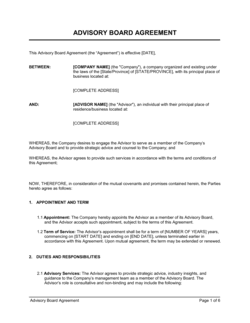
Onboarding an advisory board member tied to strategic milestonesAdvisory Board Agreement
Documenting a partnership's growth and profit-sharing strategyBusiness Partnership Agreement
Protecting business IP and systems developed under the accelerator planIntellectual Property Assignment Agreement
Establishing an exit-readiness plan and succession commitmentsBusiness Succession Plan
Documenting a consulting engagement tied to growth KPIsConsulting Agreement

Common mistakes to avoid

❌ Vague vision clause with no quantified Schedule A

Why it matters: An unenforceable vision clause turns the agreement into a statement of intent rather than a binding contract. Neither party has a legal basis to claim breach if targets are never defined.

Fix: Attach a Schedule A at execution that states specific, time-bound revenue, valuation, or EBITDA targets for each year of the agreement term, signed by both parties.

❌ No IP assignment for advisor-created systems

Why it matters: Advisors and consultants who author process documentation, playbooks, or software tools may retain copyright under default law if no written assignment exists — leaving the business owner without clear ownership of assets they paid to develop.

Fix: Include an explicit IP assignment clause covering all work product created in connection with the agreement, regardless of which party authored it, and list existing contributions in an IP schedule at signing.

❌ Omitting a survival clause for key obligations

Why it matters: Without a survival clause, confidentiality, non-solicitation, and IP assignment obligations may be interpreted as expiring with the agreement — exposing the owner's systems and trade secrets to unauthorized use the moment the contract ends.

Fix: Explicitly designate which clauses survive termination and for how long — confidentiality and IP assignment should survive indefinitely; non-solicit typically for 12–24 months post-termination.

❌ Setting revenue milestones with no remediation or cure process

Why it matters: A missed milestone with no defined consequence or cure period leaves both parties uncertain about their rights and obligations, often leading to disputes over whether the agreement is still in force.

Fix: Attach a Schedule D that pairs each milestone with a 30-day cure window and a defined consequence — fee adjustment, renegotiation trigger, or termination right — so both parties know exactly what happens if a target is missed.

❌ Treating asset protection as a one-time setup obligation

Why it matters: An entity that lapses in good standing mid-agreement, or an insurance policy that expires without renewal, removes the legal shield the agreement was built around — often without either party noticing until a claim arises.

Fix: Add an ongoing compliance obligation requiring Owner to certify entity good standing and insurance coverage annually, with supporting documentation provided to Advisor or a designated third party.

❌ Signing after advisory work or capital deployment has already begun

Why it matters: In common-law jurisdictions, a party who has already begun performing may not have provided new consideration for restrictive covenants signed after the fact — potentially voiding IP assignment, non-solicit, and confidentiality provisions.

Fix: Execute the agreement before any work begins, any capital is transferred, or any proprietary information is shared. If circumstances require a late signature, provide documented additional consideration at signing.

The 10 key clauses, explained

Parties, Roles, and Effective Date

In plain language: Identifies all signatories by legal name and role — owner, advisor, co-founder, or investor — and establishes the date from which obligations take effect.

Sample language
This Agreement is entered into as of [DATE] by and between [BUSINESS OWNER FULL NAME] ('Owner'), a [STATE/COUNTRY] resident, and [ADVISOR/PARTNER FULL NAME] ('Advisor'), a [ENTITY TYPE] organized under the laws of [JURISDICTION].

Common mistake: Using trade names or nicknames instead of legal names for each party. If a dispute arises, courts require precise identification of the contracting entity — informal names create standing ambiguity.

Vision and Strategic Objective Clause

In plain language: Documents the shared business vision and the measurable 3–5 year wealth targets each party is committing to pursue under this agreement.

Sample language
The parties agree that the primary strategic objective is to grow [BUSINESS NAME] to $[REVENUE TARGET] in annual revenue by [DATE], as further detailed in Schedule A, and to operate in alignment with the Seven Wealth Accelerators framework set out herein.

Common mistake: Stating aspirational language without attaching a Schedule A that quantifies the targets. Vague vision clauses cannot be enforced and give neither party a basis to measure breach.

Capital Formation and Funding Obligations

In plain language: Sets out each party's financial commitments — capital contributions, funding timelines, reinvestment ratios, and restrictions on capital withdrawal — to support the growth plan.

Sample language
Owner shall contribute $[AMOUNT] to the [FUND/ACCOUNT NAME] by [DATE] and shall reinvest no less than [X]% of net monthly profit into growth activities, as defined in Schedule B, until [MILESTONE] is achieved.

Common mistake: Omitting a reinvestment floor or withdrawal restriction. Without one, a party can legally drain capital needed for growth while remaining technically compliant with the agreement.

Systems and Intellectual Property Ownership

In plain language: Assigns ownership of all business systems, documented processes, software, and operational IP created under the agreement, and restricts unauthorized reproduction or transfer.

Sample language
All systems, playbooks, process documentation, and intellectual property developed by either party in connection with this Agreement shall be owned by [OWNER ENTITY] and are hereby irrevocably assigned to [OWNER ENTITY] upon creation.

Common mistake: Leaving IP ownership undefined when a consultant or advisor contributes to system development. Without a written assignment, the advisor may retain copyright in deliverables they authored.

Talent and Delegation Accountability

In plain language: Defines each party's hiring authority, delegation responsibilities, and accountability for the performance of team members operating under the wealth acceleration plan.

Sample language
Owner retains sole authority to hire and terminate employees. Advisor may recommend candidates for roles identified in Schedule C. Both parties agree to review team performance against accelerator KPIs no less than [QUARTERLY/MONTHLY].

Common mistake: Giving an external advisor hiring authority without a written scope limitation. Unauthorized hires can create employment obligations the business owner did not intend to assume.

Marketing, Sales, and Revenue Milestone Commitments

In plain language: Establishes specific marketing channel commitments, revenue milestones, and the consequences — fee adjustments, equity triggers, or agreement termination — if milestones are not met within defined windows.

Sample language
Parties commit to deploying [CHANNEL 1] and [CHANNEL 2] as primary acquisition channels. Revenue milestones are set out in Schedule D. Failure to reach $[MILESTONE AMOUNT] by [DATE] shall trigger the remediation process in Section [X].

Common mistake: Setting revenue milestones without a remediation process. A missed milestone with no defined consequence leaves the agreement in legal limbo — neither party knows whether to cure, renegotiate, or terminate.

Legal and Asset Protection Requirements

In plain language: Requires each party to maintain specified legal structures, insurance coverage, and liability shields for the duration of the agreement, protecting both the business and its wealth-building assets.

Sample language
Owner shall maintain [ENTITY TYPE — LLC/Corporation] status in good standing, carry no less than $[AMOUNT] in general liability insurance, and register all trademarks identified in Schedule E within [X] days of execution.

Common mistake: Treating asset protection as a one-time setup rather than an ongoing obligation. An entity that lapses in good standing or an insurance policy that lapses mid-agreement can void the protection the clause was designed to provide.

Exit Planning and Succession Commitments

In plain language: Codifies each party's obligations to maintain exit-readiness — clean financials, documented systems, updated valuations, and succession plans — within the timeframe of the agreement.

Sample language
Owner commits to completing a business valuation by [DATE], maintaining GAAP-compliant financial records, and delivering an updated succession plan to Advisor no later than [DATE] each calendar year.

Common mistake: Deferring exit planning commitments to 'later in the agreement term.' Businesses that begin exit preparation less than 18 months before a target transaction consistently achieve lower valuations and longer deal timelines.

Dispute Resolution and Remediation

In plain language: Specifies how disputes are handled — mandatory negotiation, mediation, arbitration, or litigation — and the timeline each step must follow before escalating to the next.

Sample language
Any dispute shall first be subject to good-faith negotiation for [15] days. If unresolved, the parties shall submit to mediation administered by [ORGANIZATION] in [CITY, STATE]. If mediation fails, disputes shall be resolved by binding arbitration under [AAA/JAMS] rules.

Common mistake: Skipping mediation and going straight to arbitration or litigation. Mediation resolves the majority of business disputes at a fraction of the cost and preserves the working relationship.

Term, Termination, and Survival

In plain language: States the agreement's duration, how either party may terminate early with or without cause, and which clauses — IP assignment, confidentiality, non-solicit — survive termination.

Sample language
This Agreement commences on the Effective Date and continues for [X] years unless terminated earlier. Either party may terminate for cause with [30] days' written notice. Sections [IP, Confidentiality, Non-Solicit] survive termination indefinitely.

Common mistake: Omitting a survival clause. If no clauses are designated as surviving, IP assignment and confidentiality obligations arguably expire with the agreement — exposing the owner to unauthorized use of their systems and trade secrets.

How to fill it out

  1. 1

    Identify all parties and their legal roles

    Enter the full legal name of each party, their role in the agreement (owner, advisor, co-founder, investor), and their jurisdiction of residence or incorporation. Confirm that each name matches the relevant government registration or ID.

    💡 If a party is an entity rather than an individual, attach a certificate of good standing to the executed agreement to confirm the entity has authority to contract.

  2. 2

    Define the vision and quantified wealth targets in Schedule A

    Draft a one-paragraph vision statement and attach Schedule A listing specific, time-bound financial targets — revenue, EBITDA, valuation, or equity milestones — for each year of the agreement term.

    💡 Targets should be ambitious but grounded in the bottom-up financial model you have already stress-tested. Targets that are self-evidently unachievable undermine the agreement's enforceability.

  3. 3

    Complete the capital formation and reinvestment provisions

    Enter each party's capital contribution amount and deadline, the reinvestment percentage floor, and any restrictions on profit withdrawal during the growth phase. Reference Schedule B for the detailed reinvestment plan.

    💡 Set the reinvestment floor as a percentage of net profit, not gross revenue, to avoid cash-flow strain in high-revenue, low-margin months.

  4. 4

    Assign IP and systems ownership explicitly

    List all existing systems, playbooks, and IP each party is contributing, confirm which party owns each, and ensure the IP assignment clause covers all work product created during the agreement term.

    💡 Attach an IP schedule at execution listing existing contributions by each party — this prevents 'I built that before the agreement' disputes later.

  5. 5

    Set marketing and revenue milestones in Schedule D

    Define the two to three primary acquisition channels, the revenue milestone for each agreement year, and the remediation steps triggered by a missed milestone — renegotiation window, fee adjustment, or termination right.

    💡 Include a 30-day cure window before any termination right is triggered by a missed milestone. Courts look more favorably on agreements that provide a reasonable remedy period.

  6. 6

    Confirm asset protection structures are in place

    Verify that the required entity type is in good standing, identify the insurance policies and coverage amounts required, and list any trademark or patent registrations to be completed within the specified timeframe.

    💡 Check entity good-standing status in the relevant state or provincial registry before signing — a dissolved or administratively inactive entity cannot enforce or be bound by a contract.

  7. 7

    Execute before any work begins

    Both parties must sign the agreement before any capital is deployed, systems are shared, or advisory work commences. Post-commencement signatures create fresh-consideration issues that can void restrictive clauses.

    💡 Use a timestamped e-signature platform and store the fully executed copy in a shared, access-controlled location both parties can retrieve without requesting it from the other.

  8. 8

    Schedule a quarterly review cadence in the agreement

    Insert a provision requiring both parties to meet at least quarterly to review KPI performance against each accelerator, update Schedules as needed, and formally document any agreed amendments in writing.

    💡 Oral amendments to written contracts are generally unenforceable — any mid-term changes to targets or obligations must be signed by both parties to be binding.

Frequently asked questions

What is the Seven Wealth Accelerators For Business Success document?

The Seven Wealth Accelerators For Business Success is a structured legal agreement that codifies the seven strategic pillars — vision, capital formation, systems, talent leverage, marketing velocity, asset protection, and exit planning — into a binding framework. It creates enforceable obligations on each party around specific milestones, IP ownership, capital deployment, and accountability, replacing informal agreements and verbal commitments with a signed legal document.

Who should sign this agreement?

Any business owner, co-founder, strategic advisor, business coach, or investor who is formally committing to roles and responsibilities under a structured wealth-acceleration plan should be a signatory. The document is also appropriate when an advisory board member's compensation, equity, or IP contributions are tied to measurable performance against the seven accelerators. All parties with enforceable obligations under the plan should sign before work begins.

Is this document legally binding?

Yes — when properly executed by all parties with capacity to contract, supported by consideration (services, capital, or equity), and governed by an identified jurisdiction, this agreement is generally enforceable as a binding contract. Specific provisions such as non-solicitation and IP assignment may be subject to jurisdiction-specific enforceability rules. Legal review is recommended before execution, particularly for cross-border arrangements or agreements involving equity or significant capital.

What are the seven wealth accelerators covered by this document?

The seven accelerators are: (1) vision and strategic clarity, (2) capital formation and funding structure, (3) systems and documented processes, (4) talent leverage and delegation, (5) marketing and sales velocity, (6) legal and asset protection structures, and (7) scalable exit planning. The agreement assigns owner responsibility and measurable targets to each pillar and creates binding obligations to pursue each accelerator within the agreement term.

Do I need a lawyer to use this template?

For straightforward advisory or coaching engagements with no equity component, a well-completed template is often sufficient. Legal review is strongly recommended when the agreement involves equity grants, capital contributions above $50,000, IP of significant commercial value, or parties in multiple jurisdictions. A 1–2 hour review by a business attorney typically costs $300–$800 and substantially reduces enforcement risk.

What happens if a revenue milestone is missed?

The agreement should specify a remediation process — typically a 30-day cure window, followed by a renegotiation trigger or termination right. Without a defined consequence, a missed milestone creates ambiguity about whether the agreement is still in force. The template includes a milestone schedule (Schedule D) where parties define both targets and the specific consequences of missing them, so both sides know exactly what to expect.

How does this document protect my business IP and systems?

The systems and IP ownership clause explicitly assigns all work product, playbooks, process documentation, and intellectual property created during the agreement to the designated owner entity. This prevents advisors, coaches, or partners from retaining copyright in deliverables they contributed to under the engagement. An IP schedule attached at signing documents existing contributions by each party to avoid retroactive ownership disputes.

Can this agreement be amended after signing?

Yes, but any amendment must be in writing and signed by all parties to be enforceable. Oral amendments to written contracts are generally not recognized in common-law jurisdictions. The agreement should include a provision requiring a quarterly review meeting where any proposed amendments to targets or obligations are formally documented and co-signed before they take effect.

What jurisdictions does this template apply to?

The template is designed for use in the United States, Canada, the United Kingdom, and the European Union, with a governing law clause that lets parties specify the applicable jurisdiction. Because contract law, non-compete enforceability, and IP assignment rules vary significantly across these jurisdictions, parties operating across borders should have the agreement reviewed by counsel familiar with the laws of each relevant location before signing.

How this compares to alternatives

vs Business Coaching Agreement

A business coaching agreement defines the scope, fees, and deliverables of a coaching engagement without creating binding strategic or financial commitments on the client. The Seven Wealth Accelerators agreement goes further — it assigns enforceable milestones, IP ownership, capital obligations, and exit-readiness requirements to all parties. Use a coaching agreement for a service relationship; use this document when all parties are making binding commitments to a shared growth plan.

vs Business Partnership Agreement

A partnership agreement governs profit sharing, decision-making authority, and capital contributions between co-owners of a business entity. The Seven Wealth Accelerators agreement is not an entity-governance document — it is a strategic and operational accountability framework that can exist alongside a partnership agreement, binding parties to specific growth behaviors and milestones regardless of ownership structure.

vs Advisory Board Agreement

An advisory board agreement defines an advisor's compensation, equity, and confidentiality obligations in exchange for periodic strategic guidance. The Seven Wealth Accelerators document creates mutual, bilateral obligations — the owner commits to capital, systems, and exit-readiness actions alongside the advisor's commitments. It is appropriate when both parties are actively accountable to each other for outcomes, not when the advisor is simply providing guidance.

vs Business Succession Plan

A succession plan addresses the transfer of ownership and leadership at a specific transition event. The Seven Wealth Accelerators agreement includes exit planning as one of seven pillars and creates ongoing obligations to maintain exit-readiness throughout the agreement term. The succession plan handles the transaction itself; this document governs the preparation years in advance.

Industry-specific considerations

Professional Services

Advisors and consultants use this framework to formalize retainer engagements tied to measurable growth KPIs, IP deliverables, and client acquisition milestones.

SaaS / Technology

Founders and co-founders use it to assign system and codebase IP, define capital reinvestment obligations, and establish exit-readiness timelines tied to ARR milestones.

Financial Services

Wealth advisors and business coaches deploy the agreement to bind clients to capital protection structures, entity compliance obligations, and documented reinvestment strategies.

Retail / E-commerce

Operators formalize marketing velocity commitments, inventory reinvestment floors, and brand IP ownership when engaging growth advisors or bringing on investor partners.

Healthcare / Professional Practice

Practice owners use the agreement to document systems IP, talent delegation to practice managers, and exit-readiness obligations ahead of a practice sale or partnership buyout.

Manufacturing

Owners codify capital formation timelines, process documentation ownership, and succession planning milestones when formalizing growth partnerships with investors or strategic advisors.

Jurisdictional notes

United States

Contract enforceability is governed by state law, which varies significantly — particularly for non-solicitation and IP assignment clauses. California restricts post-employment non-competes and limits the scope of IP assignment under Labor Code §2870. Choose a governing law state with a meaningful connection to where the primary party operates. For agreements involving equity, securities law compliance at the federal and state level must also be considered.

Canada

Canadian contract law is provincially governed. Ontario, British Columbia, and Alberta each have distinct rules on enforceability of restrictive covenants and consideration requirements. Fresh consideration is required for any restrictive clause added after a working relationship has begun. Quebec contracts must comply with the Civil Code rather than common law, and French-language requirements apply to contracts with provincially regulated businesses in Quebec.

United Kingdom

UK contract law requires clear offer, acceptance, and consideration for enforceability. Post-termination non-solicitation clauses are enforceable only if reasonable in scope, duration, and geographic reach. IP created by an employee or contractor in the course of their engagement is typically owned by the employer under the Copyright, Designs and Patents Act 1988 — but this rule does not automatically extend to independent advisors, making an explicit IP assignment clause essential.

European Union

EU member states vary significantly in their treatment of restrictive covenants — several require financial compensation to the restricted party to make post-termination non-solicitation clauses enforceable. GDPR applies to any personal data processed in connection with the agreement, including employee and client data referenced in marketing velocity or talent provisions. Choice-of-law clauses must comply with the Rome I Regulation, which limits parties' ability to contract out of mandatory local law protections.

Template vs lawyer — what fits your deal?

PathBest forCostTime
Use the templateBusiness owners and advisors formalizing a growth engagement with no equity component and capital commitments under $50,000Free1–2 hours
Template + legal reviewEngagements involving IP of significant commercial value, cross-border parties, or milestone-triggered equity or fee adjustments$300–$8002–5 days
Custom draftedMulti-party arrangements with equity stakes, capital contributions above $100,000, or parties operating across multiple jurisdictions with divergent contract law$2,000–$6,000+2–4 weeks

Glossary

Wealth Accelerator
One of seven identified strategic pillars — vision, capital, systems, talent, marketing, legal protection, and exit planning — whose coordinated development drives accelerated business wealth creation.
Capital Formation
The process of accumulating and deploying financial resources — equity, debt, retained earnings, or investor capital — to fund business growth.
Systems and Processes
Documented, repeatable operational workflows that allow a business to deliver consistent results independent of any single individual.
Talent Leverage
The strategic hiring, delegation, and development of team members so that owner output is multiplied rather than simply added to.
Marketing Velocity
The rate at which a business converts market attention into qualified pipeline and closed revenue, measured by CAC, conversion rate, and sales cycle length.
Asset Protection
Legal structures — entity choice, insurance, IP registration, and contractual shields — that separate personal wealth from business liability.
Scalable Exit Planning
The advance preparation of a business for a high-value liquidity event — sale, merger, or succession — typically begun 3–5 years before the target exit date.
Binding Commitment Clause
A contractual provision that creates an enforceable legal obligation on a party to take specific actions or achieve specific outcomes within a defined timeframe.
Milestone Trigger
A predefined performance or completion event that activates a subsequent obligation — such as a payment, equity transfer, or role change — under the agreement.
Governing Law
The jurisdiction whose laws control how the agreement is interpreted and enforced, specified explicitly in the contract to avoid ambiguity across state or national lines.
Force Majeure
A clause excusing a party's non-performance when an extraordinary event outside their control — natural disaster, government action, or pandemic — makes performance impossible.

Part of your Business Operating System

This document is one of 3,000+ business & legal templates included in Business in a Box.

  • Fill-in-the-blanks — ready in minutes
  • 100% customizable Word document
  • Compatible with all office suites
  • Export to PDF and share electronically

Create your document in 3 simple steps.

From template to signed document — all inside one Business Operating System.
1
Download or open template

Access over 3,000+ business and legal templates for any business task, project or initiative.

2
Edit and fill in the blanks with AI

Customize your ready-made business document template and save it in the cloud.

3
Save, Share, Send, Sign

Share your files and folders with your team. Create a space of seamless collaboration.

Save time, save money, and create top-quality documents.

★★★★★

"Fantastic value! I'm not sure how I'd do without it. It's worth its weight in gold and paid back for itself many times."

Managing Director · Mall Farm
Robert Whalley
Managing Director, Mall Farm Proprietary Limited
★★★★★

"I have been using Business in a Box for years. It has been the most useful source of templates I have encountered. I recommend it to anyone."

Business Owner · 4+ years
Dr Michael John Freestone
Business Owner
★★★★★

"It has been a life saver so many times I have lost count. Business in a Box has saved me so much time and as you know, time is money."

Owner · Upstate Web
David G. Moore Jr.
Owner, Upstate Web

Run your business with a system — not scattered tools

Stop downloading documents. Start operating with clarity. Business in a Box gives you the Business Operating System used by over 250,000 companies worldwide to structure, run, and grow their business.

Start free · No credit card required