Business Succession Plan Template

Free Word download β€’ Edit online β€’ Save & share with Drive β€’ Export to PDF

12 pagesβ€’25–35 min to fillβ€’Difficulty: Complex
Learn more ↓
FreeBusiness Succession Plan Template

At a glance

What it is
A Business Succession Plan is a structured written document that defines who will take over ownership and leadership of a business when a founder, partner, or key executive exits β€” through retirement, death, disability, or voluntary departure. This free Word download walks you through every critical section, from identifying successors to establishing a business valuation method and funding mechanism, so the transition is planned rather than improvised.
When you need it
Use it when a founding owner is approaching retirement, when a co-owner wants a documented buyout framework before a dispute arises, or when a lender or investor asks for evidence that the business can survive a leadership change. The best time to write it is at least 3–5 years before the anticipated transition.
What's inside
Business overview and ownership structure, succession trigger events, successor identification and development roadmap, business valuation methodology, ownership transfer mechanism, funding strategy, contingency and emergency succession provisions, and a transition timeline with milestones.

What is a Business Succession Plan?

A Business Succession Plan is a structured written document that defines how ownership and leadership of a business will transfer when a founder, co-owner, or key executive exits β€” whether through planned retirement, death, disability, or voluntary departure. It identifies who the successor will be, how the business will be valued at the time of transfer, what legal mechanism moves ownership, and how the buyout will be funded. Unlike a generic exit strategy, a succession plan is equally concerned with business continuity as with owner compensation β€” ensuring the company survives the transition intact rather than simply maximizing the departing owner's payout.

Why You Need This Document

Businesses that operate without a succession plan expose themselves to a predictable set of crises: co-owners forced into partnership with a deceased owner's estate, bank loans called because a personal guarantor is gone, key staff who leave during the ownership vacuum, and family disputes that destroy decades of value in months. The Small Business Administration estimates that fewer than 30% of family businesses successfully transfer to a second generation β€” and the leading cause of failure is the absence of a formal, funded plan. A written succession plan, reviewed annually and backed by insurance or financing commitments, converts an unmanageable event into a managed process. This template gives you the structure to document every critical decision β€” successor, valuation, transfer mechanism, and contingency authority β€” so nothing is left to chance when the moment arrives.

Which variant fits your situation?

If your situation is…Use this template
Owner planning to retire and transfer to an internal managerBusiness Succession Plan
Two or more co-owners who need a buyout formulaBuy-Sell Agreement
Family business passing ownership to the next generationFamily Business Succession Plan
Owner selling to a third party or outside buyerBusiness Transition Plan
Ensuring operations continue if a key person is suddenly unavailableBusiness Continuity Plan
Documenting an ESOP or employee ownership transfer structureEmployee Ownership Transition Plan
Raising capital while planning a future exitExit Strategy Plan

Common mistakes to avoid

❌ Starting the plan too close to the transition date

Why it matters: A plan written 12 months before retirement cannot fund a buyout through insurance, develop a successor, or execute a tax-efficient ownership transfer β€” all of which require 3–5 years of lead time.

Fix: Begin the plan at least 3 years before the target transition date and treat the first milestone as the date the plan is signed off by all stakeholders.

❌ No funded buyout mechanism

Why it matters: A succession plan that says 'financing will be arranged at the time' gives the departing owner no certainty and often collapses when the trigger fires and funds aren't available.

Fix: Identify the primary funding source β€” key person insurance, seller note, bank financing, or a combination β€” and confirm it is in place before the plan is considered final.

❌ Naming a successor without a documented development plan

Why it matters: A successor named on paper but not prepared in practice causes an operational gap at the moment of transfer that can cost customers, staff, and revenue.

Fix: Attach a written development roadmap with specific milestones β€” role expansions, P&L responsibility, key relationship transfers β€” and review progress quarterly.

❌ Never updating the valuation methodology

Why it matters: A multiple or formula agreed during a high-growth year will over-value the business in a downturn, or under-value it after an acquisition β€” creating conflict between buyer and seller at the worst possible time.

Fix: Schedule an annual valuation check and a full third-party appraisal every 3 years, and update the plan to reflect any agreed methodology changes.

The 9 key sections, explained

Business overview and ownership structure

Succession goals and objectives

Succession trigger events

Successor identification and development plan

Business valuation methodology

Ownership transfer mechanism

Funding strategy

Contingency and emergency succession

Transition timeline and milestones

How to fill it out

  1. 1

    Document the current ownership structure

    Record the legal entity type, all owners with their exact ownership percentages, share classes, and any existing shareholder or operating agreements that restrict transfers.

    πŸ’‘ Pull your corporate registry filing and current cap table before filling this section β€” verbal understandings about ownership are often wrong when checked against documents.

  2. 2

    Define your succession goals

    Write down what a successful transition looks like in concrete terms: minimum sale price, target timeline, employees retained, family legacy preserved, or any combination. These goals govern every downstream decision.

    πŸ’‘ If there are multiple owners, each should write their goals independently before a joint session β€” hidden conflicts surface faster this way.

  3. 3

    Identify and list succession trigger events

    Specify each event β€” retirement date, death, disability, voluntary departure β€” with the precise conditions that constitute each trigger, including any certification or notice requirements.

    πŸ’‘ Have legal counsel review the disability definition before finalizing β€” courts have ruled on narrow vs. broad definitions in buyout disputes.

  4. 4

    Name your successor and document their development plan

    Identify the primary and backup successors by name. For each, list their current role, readiness gaps, and a milestone-based development plan with target dates for closing each gap.

    πŸ’‘ If the successor is a family member, consider having them serve in an operational role outside the family business for at least one year before the plan is finalized β€” it tests genuine readiness.

  5. 5

    Select and document the valuation methodology

    Choose the valuation method (EBITDA multiple, DCF, asset-based, or third-party appraisal) that fits your business type. Record the agreed multiple or approach and set a schedule for annual updates.

    πŸ’‘ For most SMBs, a third-party appraisal every 3 years with an EBITDA-multiple check annually is a practical and defensible approach.

  6. 6

    Specify the ownership transfer mechanism and funding source

    Document how ownership moves legally (sale, gift, installment, ESOP) and how the buyout is funded. Confirm that insurance policies are in force and that financing pre-approval has been obtained where applicable.

    πŸ’‘ If using key person insurance to fund the buyout, verify the policy benefit equals at least 80% of the current valuation β€” policies taken out years ago are often severely underinsured.

  7. 7

    Draft the contingency and interim authority provisions

    Name the interim manager for an emergency gap period. Define their authority ceiling for spending, contracts, and legal decisions, and ensure they are already an authorized signatory on key accounts.

    πŸ’‘ Inform your bank, accountant, and primary suppliers of the interim manager's identity now β€” not after a trigger event, when stress makes every delay worse.

  8. 8

    Build the transition timeline with checkpoints

    Create a milestone schedule from today through the final transfer date, with a checkpoint every quarter. Assign an owner to each milestone and set a review date for the plan itself β€” at least annually.

    πŸ’‘ Treat the annual plan review like a board meeting β€” put it on the calendar for the same month every year and use the current valuation update as the anchor agenda item.

Frequently asked questions

What is a business succession plan?

A business succession plan is a written document that defines who will take over ownership and leadership of a business when a founding owner or key executive exits β€” due to retirement, death, disability, or voluntary departure. It specifies the successor, the valuation method, the transfer mechanism, and how the buyout will be funded, so the transition is managed rather than improvised under pressure.

When should a business succession plan be created?

Ideally 3–5 years before the anticipated transition date. That window allows time to develop an internal successor, structure a tax-efficient ownership transfer, obtain or update key person insurance, and complete any required legal filings. Plans written under 12 months from the trigger date rarely have the funding or successor preparation to execute cleanly.

What is the difference between a succession plan and a business continuity plan?

A succession plan addresses the permanent or long-term transfer of ownership and leadership β€” it is primarily a strategic and financial document. A business continuity plan addresses the short-term operational response to a disruption β€” cyberattack, natural disaster, or sudden absence β€” without changing ownership. Most businesses need both: the continuity plan handles the first 30–90 days of a crisis; the succession plan handles the permanent outcome.

How is a business typically valued for succession purposes?

The most common method for small and mid-sized businesses is an EBITDA multiple β€” typically 3×–8Γ— trailing 12-month EBITDA depending on industry and growth rate. Asset-heavy businesses may use an asset-based approach; high-growth companies may use a discounted cash flow model. For clean execution, the plan should specify the agreed method and require a third-party appraisal within 90 days of the trigger event.

How is a buyout typically funded in a succession plan?

The four most common funding mechanisms are key person life or disability insurance (the business or co-owners hold a policy on the departing owner), seller financing (the departing owner accepts installment payments over 3–10 years), an SBA 7(a) loan (available for qualifying ownership transitions), and a combination of the above. The right structure depends on the business's cash flow, the buyer's capital, and the seller's tax and estate planning objectives.

What happens if a business owner dies without a succession plan?

Without a plan, ownership passes under the owner's will or intestacy laws β€” often to heirs who have no operational role in the business. Co-owners may be forced into a partnership with the deceased's estate. Banks may call loans with personal guarantee clauses. Key employees often leave during the uncertainty. Courts may be required to appoint an administrator. The business can lose significant value or fail entirely within 12–18 months of the owner's death.

Can a succession plan work for a family business?

Yes β€” and family businesses particularly benefit from a written plan because it removes ambiguity about which family member will inherit leadership, on what timeline, and at what price (if any). Unwritten family understandings about succession are the leading cause of family business disputes. A formal plan that addresses development milestones, fair compensation for non-participating siblings, and a clear valuation method prevents most of the conflicts that destroy family businesses across generations.

How often should a business succession plan be updated?

At a minimum, review it annually and update it whenever a material change occurs β€” a significant change in business value, a change in the named successor, an acquisition, or a shift in an owner's retirement timeline. The valuation methodology should be stress-tested against current financials every year. A plan that is more than 3 years old without review is likely misaligned with the business's current reality.

How this compares to alternatives

vs Buy-Sell Agreement

A buy-sell agreement is a legally binding contract between co-owners that sets the exact price and terms for a buyout when a trigger event occurs. A succession plan is the broader strategic document that informs what the buy-sell agreement should say. Most businesses need both β€” the succession plan guides the strategy; the buy-sell agreement enforces it.

vs Business Continuity Plan

A business continuity plan addresses short-term operational resilience during a disruption β€” keeping the lights on for the first 30–90 days of a crisis. A succession plan addresses permanent ownership and leadership transfer. The two documents complement each other: the continuity plan covers the emergency response; the succession plan covers the long-term outcome.

vs Exit Strategy Plan

An exit strategy plan focuses primarily on maximizing value at sale β€” timing, buyer types, deal structure, and post-sale obligations. A succession plan focuses on continuity and transfer mechanics, which may or may not involve an external sale. For owners planning a third-party sale, both documents are useful: the succession plan governs internal readiness and the exit plan governs the transaction.

vs Strategic Plan

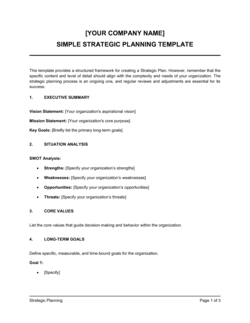
A strategic plan sets the 3–5 year operating direction for the business β€” goals, initiatives, KPIs, and resource allocation. A succession plan addresses what happens to ownership and leadership at the end of an owner's tenure. Businesses approaching a leadership transition benefit from aligning both documents so the strategic plan's milestones support the successor's readiness timeline.

Industry-specific considerations

Professional Services

Client relationship transfer is the critical variable β€” the plan must map which clients follow the successor and include a structured introduction period before the departing owner exits.

Manufacturing

Asset-heavy valuations require equipment appraisals alongside EBITDA multiples, and operational knowledge transfer must cover proprietary processes and supplier relationships.

Family Business / Retail

Balancing fair treatment of non-participating family members with the operational needs of the business requires explicit buy-sell pricing and a documented leadership development timeline.

Healthcare / Medical Practice

Licensing and credentialing requirements mean the successor must be qualified and credentialed before the transfer date, and patient notification timelines are often regulated by state law.

Template vs pro β€” what fits your needs?

PathBest forCostTime
Use the templateSingle-owner small businesses planning an internal handover or family transfer with a clear successor already identifiedFree4–8 hours over 1–2 weeks
Template + professional reviewBusinesses with multiple owners, a complex valuation, or a family transfer where estate planning coordination is needed$500–$2,500 for an attorney or business advisor review2–4 weeks
Custom draftedBusinesses valued above $2M, multi-owner partnerships, cross-border ownership, or where the succession triggers a significant tax event$3,000–$15,000 for a full succession planning engagement with legal and financial advisors4–12 weeks

Glossary

Succession Trigger
A defined event β€” retirement, death, disability, or voluntary exit β€” that activates the transfer of ownership or leadership under the plan.
Buy-Sell Agreement
A legally binding contract between co-owners that sets the price and terms for buying out a departing owner's interest.
Business Valuation
The process of determining the fair market value of a business, typically using income, asset, or market-comparable methods.
Key Person Insurance
A life or disability insurance policy taken out on a critical owner or executive, with the business as beneficiary, used to fund a buyout or cover transition costs.
Successor
The individual or entity β€” family member, internal manager, co-owner, or outside buyer β€” designated to assume ownership or leadership of the business.
Transition Timeline
A milestone-based schedule mapping the handover of responsibilities, relationships, and authority from the departing owner to the successor.
EBITDA Multiple
A common business valuation shorthand that multiplies annual EBITDA by an industry-specific factor (e.g., 4×–8Γ— for most SMBs) to estimate market value.
Cross-Purchase Agreement
A buy-sell structure in which surviving co-owners β€” rather than the business entity β€” purchase the departing owner's shares directly.
Earnout
A deferred payment structure where part of the purchase price is paid to the departing owner based on the business meeting future performance targets.
Probationary Leadership Period
A defined window β€” typically 6–24 months β€” during which the named successor operates in an expanded role under the outgoing owner's mentorship before full transfer.

Part of your Business Operating System

This document is one of 3,000+ business & legal templates included in Business in a Box.

  • Fill-in-the-blanks β€” ready in minutes
  • 100% customizable Word document
  • Compatible with all office suites
  • Export to PDF and share electronically

Create your document in 3 simple steps.

From template to signed document β€” all inside one Business Operating System.
1
Download or open template

Access over 3,000+ business and legal templates for any business task, project or initiative.

2
Edit and fill in the blanks with AI

Customize your ready-made business document template and save it in the cloud.

3
Save, Share, Send, Sign

Share your files and folders with your team. Create a space of seamless collaboration.

Save time, save money, and create top-quality documents.

β˜…β˜…β˜…β˜…β˜…

"Fantastic value! I'm not sure how I'd do without it. It's worth its weight in gold and paid back for itself many times."

Managing Director Β· Mall Farm
Robert Whalley
Managing Director, Mall Farm Proprietary Limited
β˜…β˜…β˜…β˜…β˜…

"I have been using Business in a Box for years. It has been the most useful source of templates I have encountered. I recommend it to anyone."

Business Owner Β· 4+ years
Dr Michael John Freestone
Business Owner
β˜…β˜…β˜…β˜…β˜…

"It has been a life saver so many times I have lost count. Business in a Box has saved me so much time and as you know, time is money."

Owner Β· Upstate Web
David G. Moore Jr.
Owner, Upstate Web

Run your business with a system β€” not scattered tools

Stop downloading documents. Start operating with clarity. Business in a Box gives you the Business Operating System used by over 250,000 companies worldwide to structure, run, and grow their business.

Start freeΒ Β·Β No credit card required