Thank You for Support During Illness Template

Free Word download β€’ Edit online β€’ Save & share with Drive β€’ Export to PDF

1 pageβ€’20–25 min to fillβ€’Difficulty: Standardβ€’Signature requiredβ€’Legal review recommended
Learn more ↓
FreeThank You for Support During Illness Template

At a glance

What it is
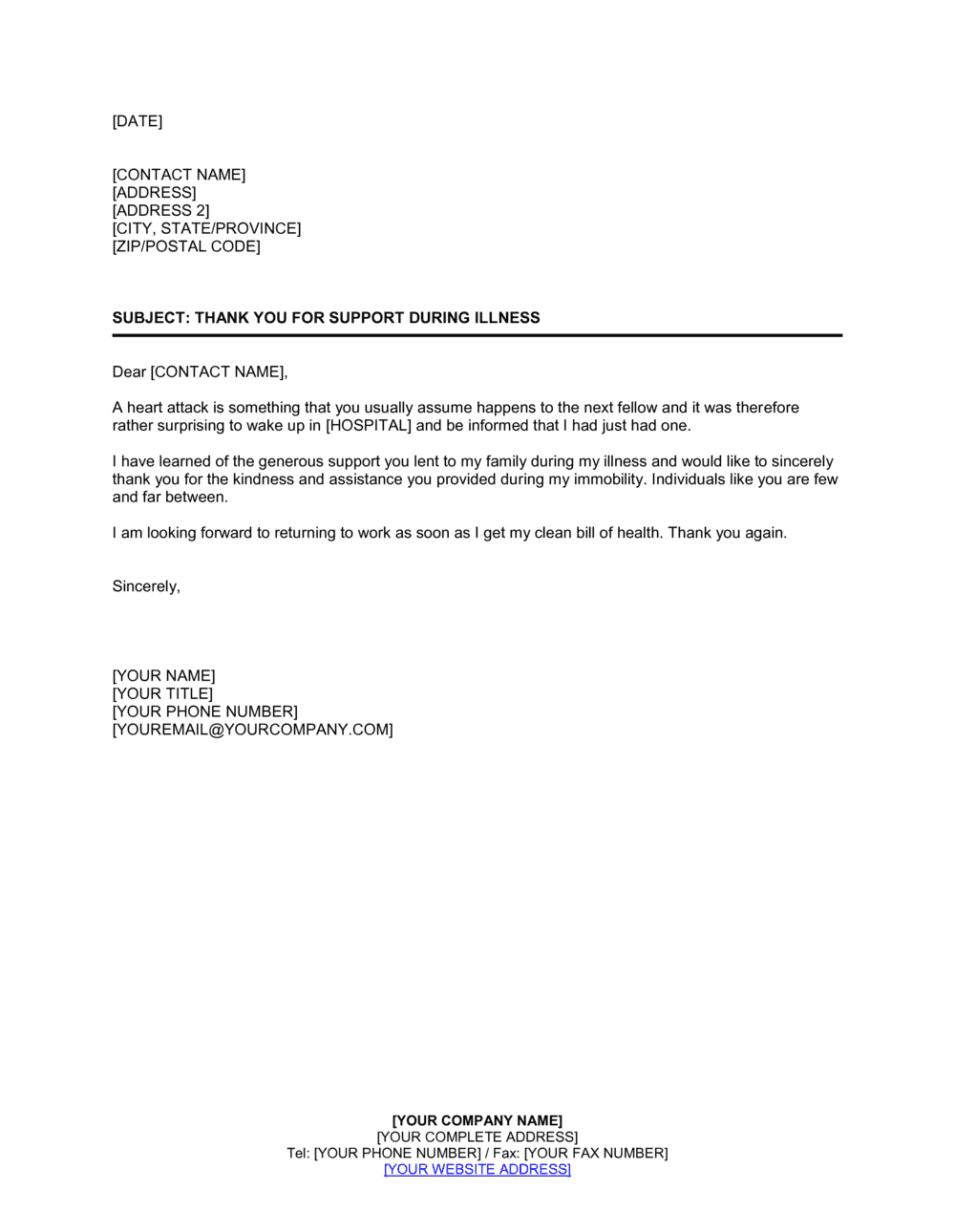
A Thank You For Support During Illness letter is a formal written communication acknowledging the assistance, accommodations, and goodwill extended to an employee or professional during a period of medical absence. This free Word download is fully editable online and can be exported as PDF, giving you a polished, professional letter ready to send to colleagues, managers, clients, or an organization.
When you need it
Use it when returning to work or wrapping up a medical leave, when formally closing out a period of illness-related absence, or when acknowledging specific workplace accommodations, flexible arrangements, or financial support received during recovery.
What's inside
Sender and recipient identification, a clear statement of gratitude, specific acknowledgment of support received, a forward-looking professional commitment, and a formal closing with signature block.

What is a Thank You For Support During Illness Letter?

A Thank You For Support During Illness letter is a formal written communication from an employee, professional, or individual to a manager, colleague, organization, or client, acknowledging the specific support, accommodations, and goodwill extended during a period of medical absence. It documents gratitude for concrete actions β€” workload coverage, flexible scheduling, deadline extensions, or personal outreach β€” and formally closes out a period of professional disruption. Unlike a casual verbal thank-you, a written letter creates a permanent record of the professional relationship and demonstrates the care and intentionality that sustains long-term working relationships.

Why You Need This Document

Returning to work after illness without formally acknowledging the support you received leaves a gap in the professional record and misses a meaningful opportunity to reinforce the behaviors that made your absence manageable. Colleagues who covered your responsibilities, managers who arranged accommodations, and clients who extended patience deserve specific, documented recognition β€” not because it is legally required, but because it is the professional standard that distinguishes people who invest in their relationships from those who do not. A well-crafted thank-you letter also provides an on-file record of the goodwill exchanged, which can matter in future HR conversations, performance reviews, or accommodation discussions. This template gives you the structure to write that letter correctly in under 30 minutes β€” specific, sincere, and professionally calibrated for the audience.

Which variant fits your situation?

If your situation is…Use this template
Returning to work after a short-term illnessThank You For Support During Illness (Brief)
Acknowledging extended leave under FMLA or statutory sick payThank You For Support During Illness
Thanking colleagues for covering duties during absenceThank You Letter To Colleagues
Formally closing out a medical leave accommodation agreementReturn to Work Agreement
Thanking clients for patience during a service disruptionApology Letter To Client
Acknowledging financial support or donations received during illnessThank You For Donation Letter
Responding formally to a wellness check or support from a boardGeneral Business Thank You Letter

Common mistakes to avoid

❌ Addressing a generic team rather than a named individual

Why it matters: A letter sent to 'The HR Team' or 'My Colleagues' reads as a broadcast, not a personal acknowledgment. It loses the goodwill-building impact that makes the letter worth writing.

Fix: Always address a primary named recipient. If acknowledging a team, send a personalized version to the team lead and CC the group, or list named individuals in the body.

❌ Disclosing unnecessary medical details

Why it matters: Oversharing a specific diagnosis can create awkward dynamics in the workplace, may be legally protected health information in some jurisdictions, and is simply not required for the letter to achieve its purpose.

Fix: Describe your absence in general terms β€” 'a medical condition requiring an extended period of rest and treatment' β€” without specifying diagnosis, prognosis, or treatment details.

❌ Sending the letter weeks after returning to work

Why it matters: A thank-you letter sent more than two weeks after returning loses its sincerity signal. Recipients may wonder why it took so long, and the emotional moment has passed.

Fix: Draft and send the letter within five business days of your return date, or before your return if you are sending it to prepare for your first day back.

❌ Using boilerplate language without personalizing any clause

Why it matters: A letter that reads identically to a template signals to the recipient that you did not invest genuine effort in acknowledging their specific contribution β€” defeating the entire purpose of writing it.

Fix: Replace every placeholder and add at least one sentence that could only have been written about this specific recipient, this specific period, and this specific support.

The 9 key clauses, explained

Sender and recipient identification

In plain language: Establishes who is writing the letter and to whom it is addressed, including full names, titles, and organizational affiliations.

Sample language
[SENDER FULL NAME] | [JOB TITLE] | [DEPARTMENT] | [COMPANY NAME] | [DATE] β€” To: [RECIPIENT FULL NAME], [TITLE], [ORGANIZATION]

Common mistake: Addressing the letter to a job title or team name rather than a specific individual β€” this reduces the personal impact and can make the letter appear impersonal or copied from a template without customization.

Opening statement of gratitude

In plain language: The first substantive paragraph that clearly states the purpose of the letter β€” to thank the recipient for their support β€” and names the specific period of illness.

Sample language
I am writing to express my sincere gratitude for the support extended to me during my absence from [START DATE] to [END DATE] due to [GENERAL DESCRIPTION OF ILLNESS / MEDICAL CONDITION].

Common mistake: Being vague about the period or reason for absence. Specificity demonstrates sincerity and ensures the letter is meaningful rather than generic.

Acknowledgment of specific support received

In plain language: Names the particular forms of support received β€” such as workload coverage, flexible arrangements, financial assistance, or personal outreach β€” to show the writer paid attention to what was done.

Sample language
Your efforts in [SPECIFIC SUPPORT β€” e.g., covering my client accounts / arranging a phased return schedule / organizing team coverage] during this period made a material difference to my recovery and peace of mind.

Common mistake: Using only general language like 'all your support' without identifying specific actions. Vague acknowledgment reads as a form letter and misses the opportunity to reinforce valued behaviors.

Impact statement

In plain language: Explains, in concrete terms, how the support positively affected the writer's recovery, workload transition, or professional standing.

Sample language
Knowing that [TASK / PROJECT / CLIENT] was in capable hands allowed me to focus fully on my recovery without the added stress of unresolved professional obligations.

Common mistake: Omitting the impact statement entirely. Without it, the letter reads as a transaction acknowledgment rather than a genuine expression of appreciation.

Professional commitment and forward-looking statement

In plain language: A brief statement of the writer's intention and readiness to resume full professional duties and contribute positively going forward.

Sample language
I am fully committed to returning to my responsibilities at [COMPANY NAME] and look forward to contributing to [TEAM / PROJECT / GOAL] as I resume my duties on [RETURN DATE].

Common mistake: Skipping the forward-looking statement. Without it, the letter closes on a passive note and misses the chance to reassure colleagues or managers of the writer's commitment.

Named individuals or teams

In plain language: Calls out by name any specific individuals or teams whose support was particularly notable, reinforcing the personal nature of the acknowledgment.

Sample language
I would like to specifically thank [NAME], [NAME], and the [TEAM NAME] team for their exceptional [EFFORT / KINDNESS / PROFESSIONALISM] throughout this period.

Common mistake: Listing names incorrectly or omitting key contributors. Overlooking someone who played a significant role can unintentionally cause offense β€” review carefully before sending.

Tone calibration to audience

In plain language: Adjusts the register of the letter β€” from formal to warm β€” depending on whether it is addressed to a line manager, senior executive, close colleagues, or a client.

Sample language
I value the professional relationship we have built and am grateful that it proved strong enough to withstand this period of disruption. [For formal: 'I remain, yours sincerely...'] [For collegial: 'I look forward to reconnecting in person soon.']

Common mistake: Using the same formal register for all audiences. A letter to a close team of colleagues that reads like a legal notice feels cold and misses the relationship-maintenance purpose of the document.

Reference to organizational policy or accommodation

In plain language: Where applicable, acknowledges specific workplace policies β€” such as flexible working, phased return agreements, or EAP services β€” that the organization extended.

Sample language
I am particularly grateful for the [FLEXIBLE WORK ARRANGEMENT / PHASED RETURN PLAN / EAP SERVICES] extended under [COMPANY NAME]'s employee wellbeing policy, which supported my recovery directly.

Common mistake: Omitting this clause when accommodations were formally granted. Acknowledging formal support on record helps document the goodwill and can be referenced in future performance or HR conversations.

Formal closing and signature block

In plain language: Closes the letter professionally with a sign-off appropriate to the register, followed by the sender's full name, title, and contact information.

Sample language
Yours sincerely, [SENDER FULL NAME] | [JOB TITLE] | [EMAIL ADDRESS] | [PHONE NUMBER] | [DATE]

Common mistake: Using an informal sign-off such as 'Thanks again' or 'Best' on a letter that is being placed in an HR file or sent to a senior executive β€” mismatched register undermines the letter's professional standing.

How to fill it out

  1. 1

    Enter the sender and recipient details

    Add your full name, job title, department, and company name at the top. Address the letter to a specific named individual β€” not a team or department β€” for maximum impact.

    πŸ’‘ Double-check the recipient's current title before sending; titles change and an incorrect one signals carelessness.

  2. 2

    State the period and general nature of the absence

    Insert the start and end date of your absence and a brief, non-clinical description of the illness or medical condition β€” enough to be clear without oversharing protected health information.

    πŸ’‘ You are not required to disclose a specific diagnosis. 'A medical condition requiring extended rest' is sufficient in most professional contexts.

  3. 3

    Name the specific support you received

    List the concrete actions taken by the recipient or their team β€” covering your accounts, rescheduling meetings, arranging a phased return, sending personal messages. Specificity transforms a generic letter into a meaningful one.

    πŸ’‘ Keep a note during your absence of what people did so you can reference it accurately here rather than relying on memory after recovery.

  4. 4

    Write the impact statement

    In one to two sentences, explain how the support affected your recovery or your ability to return to work. Connect the action to the outcome β€” this is the emotional core of the letter.

    πŸ’‘ Avoid hyperbole. 'It meant a great deal' is weaker than 'Knowing my client accounts were managed professionally allowed me to focus entirely on recovery.'

  5. 5

    Add the forward-looking professional commitment

    State your return date if known, and express genuine readiness to resume your responsibilities. If you are returning on a phased schedule, mention it briefly.

    πŸ’‘ If your return plan is still being negotiated, write 'I look forward to discussing my return schedule with you in the coming days' rather than leaving the section blank.

  6. 6

    Calibrate the tone to your audience

    If the letter is going to a formal senior executive, keep the register professional throughout. If it is going to a close colleague or team, allow slightly warmer language in the impact and closing sections.

    πŸ’‘ Read the letter aloud before sending β€” a mismatch in register is often easier to hear than to see on a screen.

  7. 7

    Sign and date the letter

    Sign above your printed name and include your full contact details in the signature block. If sending digitally, use a scanned signature or an eSign service.

    πŸ’‘ A handwritten signature on a printed letter carries more weight for senior recipients than a digital-only PDF signature β€” consider both options before choosing.

Frequently asked questions

What is a thank-you letter for support during illness?

A thank-you letter for support during illness is a formal written communication from an employee, professional, or individual to a manager, colleague, organization, or client, acknowledging the specific help, accommodations, or goodwill extended during a period of medical absence. It serves both a personal purpose β€” expressing genuine gratitude β€” and a professional one, formally closing out a period of disruption and signaling readiness to re-engage.

Is a thank-you letter for illness support legally required?

No. A thank-you letter is not legally required in any jurisdiction. However, where a formal return-to-work agreement or accommodation arrangement was put in place, acknowledging it in writing creates a documented record of goodwill and professional conduct that can be valuable in future HR or performance conversations. For senior roles or long absences, a written letter is considered professional best practice.

How much medical information should I include in the letter?

Include only a general description of your absence β€” the dates and a brief, non-clinical characterization such as 'a serious medical condition requiring extended treatment.' You are not obligated to disclose your diagnosis, treatment plan, or prognosis. In many jurisdictions, specific health information is legally protected and need not be shared with employers beyond what is required for leave administration.

Who should I address the letter to?

Address the letter to your direct manager or the person who had primary responsibility for managing your absence. If multiple individuals or teams provided meaningful support, you may send personalized versions to each key person, or address the letter to one primary recipient and name others within the body. HR departments that administered leave should also typically receive a copy.

When should I send the thank-you letter?

Send the letter within five business days of returning to work. Ideally, prepare it in advance and deliver it on your first day back or within the first week. If your return is phased, send it at the start of your official return rather than waiting until you are back to full hours. A prompt letter carries more weight than a delayed one.

Can I send this letter by email instead of in print?

Yes, for most workplace contexts an email is appropriate. For senior recipients β€” a CEO, board chair, or long-standing client β€” a printed, signed letter delivered in person or by post carries more weight. If sending by email, use a PDF attachment rather than plain-text email body to preserve the professional formatting and provide a document suitable for HR filing.

Does this letter affect my employment rights or any leave claims?

In general, a thank-you letter does not waive or alter your employment rights. It is an expression of gratitude, not a legal release or settlement. However, if your absence involved a formal accommodation, a disability claim, or a dispute about sick pay, consider having an employment lawyer or HR advisor review the letter before sending to ensure no clause inadvertently creates an admission or waiver. This is particularly relevant in the US (ADA/FMLA contexts) and Canada.

What tone is appropriate for this letter?

The tone should be warm but professional. Avoid excessive emotional language or overly casual phrasing in a letter that may be placed in an HR file. The goal is sincerity, clarity, and forward momentum β€” you are acknowledging what was done, stating its impact, and signaling your commitment to returning to full performance. Match the register to the recipient: more formal for senior executives, warmer for close colleagues.

Can a manager or HR professional write this letter on behalf of an employee?

Yes. An HR manager or line manager may draft the letter for an employee to review, personalize, and sign β€” particularly if the employee is still recovering and finds writing difficult. The letter must still be signed by the employee themselves and include personalized language reflecting their specific experience. An entirely manager-drafted, unsigned letter loses the personal acknowledgment that gives it value.

How this compares to alternatives

vs Return to Work Letter

A return-to-work letter is written by an employer or HR to the employee, outlining the terms, duties, and schedule for resuming work after medical leave. A thank-you for illness support letter is written by the employee to the employer, colleagues, or clients, acknowledging their support. The two documents are complements β€” one formal HR communication, one personal professional acknowledgment.

vs Sick Leave Letter

A sick leave letter notifies an employer of an employee's inability to work due to illness and requests authorized absence. A thank-you for illness support letter is sent at the end of that period to acknowledge the support received during the absence. They mark opposite ends of the same leave event β€” the sick leave letter opens the absence; the thank-you letter closes it.

vs Employee Reference Letter

An employee reference letter is written by an employer about an employee's performance and character, typically for a job application. A thank-you for illness support letter is written by the employee to acknowledge support. While both strengthen professional relationships, they serve entirely different directional purposes and audiences.

vs Apology Letter To Clients

An apology letter to clients acknowledges service disruption or delayed delivery and expresses regret for any negative impact. A thank-you for illness support letter acknowledges the client's patience and goodwill, shifting the focus from the disruption to the positive relationship that endured it. Both may be sent after an illness-related service disruption, but they serve different emotional registers.

Industry-specific considerations

Healthcare

Healthcare workers returning from medical leave often acknowledge both clinical team coverage and the administrative accommodations made by roster managers and HR during an absence that affects patient-care continuity.

Professional Services

Consultants and lawyers returning from illness typically write to both internal team leads and clients who granted deadline extensions or managed matters independently, preserving the client relationship through formal acknowledgment.

Technology / SaaS

Remote-first teams often rely on written letters more than in-person gestures; acknowledging asynchronous support β€” Slack check-ins, sprint coverage, async handoffs β€” is important for distributed teams where in-person gratitude is not possible.

Manufacturing

Shift-based environments require immediate coverage arrangements when an employee is absent; a thank-you letter acknowledging specific colleagues who absorbed workload reinforces team cohesion in high-turnover, safety-critical settings.

Jurisdictional notes

United States

In the US, employees on FMLA leave are protected from retaliation and have job-restoration rights. A thank-you letter does not waive these rights, but any language that could be read as releasing claims against the employer should be avoided. In ADA accommodation contexts, have an employment attorney review the letter before sending if any aspect of the accommodation is still in dispute.

Canada

Canadian employees are protected under provincial human rights codes and Employment Standards Acts during medical leave. Quebec employees working under French-language workplace obligations should ensure the letter is drafted in French or bilingual format where required. The letter should not include language that could be read as accepting reduced rights or waiving accommodation entitlements.

United Kingdom

UK employees returning from sickness absence are protected under the Equality Act 2010 if their condition qualifies as a disability. The thank-you letter is typically placed in the employee's HR file alongside return-to-work documentation. Ensure no language in the letter could be read as accepting changes to employment terms made during the absence without the employee's formal consent.

European Union

EU member states generally provide stronger statutory sick leave and non-discrimination protections than the US. GDPR applies to health-related data β€” avoid including specific medical information that could constitute special category data under Article 9 of the GDPR. The letter itself is not a data processing activity, but any medical disclosures within it should be minimized accordingly.

Template vs lawyer β€” what fits your deal?

PathBest forCostTime
Use the templateEmployees and professionals sending a personal thank-you for standard workplace or client support during routine medical absenceFree15–30 minutes
Template + legal reviewSituations involving a formal disability accommodation, FMLA or statutory leave dispute, or ongoing HR proceedings where the letter may be placed on file$150–$400 (employment lawyer or HR advisor review)1–2 business days
Custom draftedExecutive-level absences involving complex severance, equity implications, or employment litigation where written communications carry legal risk$500–$1,5003–5 business days

Glossary

Medical Leave
A period of authorized absence from work due to a personal health condition, governed by employer policy and applicable employment law.
FMLA (Family and Medical Leave Act)
A US federal law granting eligible employees up to 12 weeks of unpaid, job-protected leave per year for qualifying medical or family reasons.
Reasonable Accommodation
A modification to job duties, schedule, or work environment that enables an employee with a health condition to continue working without undue hardship to the employer.
Statutory Sick Pay (SSP)
A UK government-mandated minimum payment employers must make to qualifying employees who are too ill to work, currently for up to 28 weeks.
Return-to-Work Plan
A documented agreement between employer and employee outlining phased duties, hours, or accommodations as the employee transitions back from medical leave.
Duty of Care
An employer's legal and ethical obligation to take reasonable steps to protect the health, safety, and wellbeing of employees in the workplace.
Wellbeing Support
Employer-provided programs, resources, or informal gestures β€” such as employee assistance programs (EAPs), flexible hours, or team coverage β€” that help an employee during a health absence.
ADA (Americans with Disabilities Act)
A US federal law prohibiting discrimination against qualified individuals with disabilities and requiring employers with 15 or more employees to provide reasonable accommodations.
Sick Leave Entitlement
The number of paid or unpaid days an employee is entitled to take for personal illness, as defined by employment law, a collective agreement, or an employment contract.
Goodwill Gesture
A voluntary act of support β€” such as sending flowers, covering shifts, or extending a deadline β€” that is not contractually required but strengthens the professional relationship.

Part of your Business Operating System

This document is one of 3,000+ business & legal templates included in Business in a Box.

  • Fill-in-the-blanks β€” ready in minutes
  • 100% customizable Word document
  • Compatible with all office suites
  • Export to PDF and share electronically

Create your document in 3 simple steps.

From template to signed document β€” all inside one Business Operating System.
1
Download or open template

Access over 3,000+ business and legal templates for any business task, project or initiative.

2
Edit and fill in the blanks with AI

Customize your ready-made business document template and save it in the cloud.

3
Save, Share, Send, Sign

Share your files and folders with your team. Create a space of seamless collaboration.

Save time, save money, and create top-quality documents.

β˜…β˜…β˜…β˜…β˜…

"Fantastic value! I'm not sure how I'd do without it. It's worth its weight in gold and paid back for itself many times."

Managing Director Β· Mall Farm
Robert Whalley
Managing Director, Mall Farm Proprietary Limited
β˜…β˜…β˜…β˜…β˜…

"I have been using Business in a Box for years. It has been the most useful source of templates I have encountered. I recommend it to anyone."

Business Owner Β· 4+ years
Dr Michael John Freestone
Business Owner
β˜…β˜…β˜…β˜…β˜…

"It has been a life saver so many times I have lost count. Business in a Box has saved me so much time and as you know, time is money."

Owner Β· Upstate Web
David G. Moore Jr.
Owner, Upstate Web

Run your business with a system β€” not scattered tools

Stop downloading documents. Start operating with clarity. Business in a Box gives you the Business Operating System used by over 250,000 companies worldwide to structure, run, and grow their business.

Free Forever PlanΒ Β·Β No credit card required