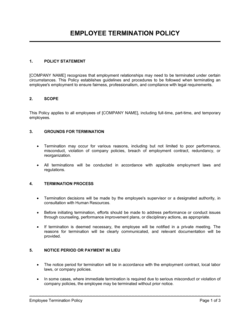
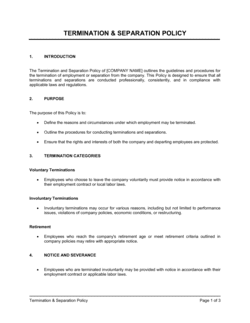
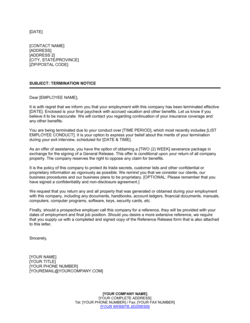
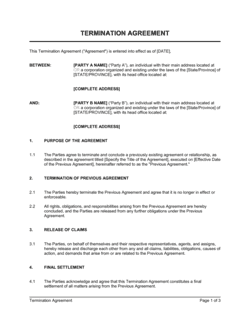
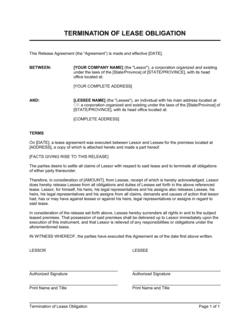
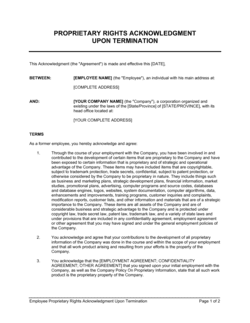
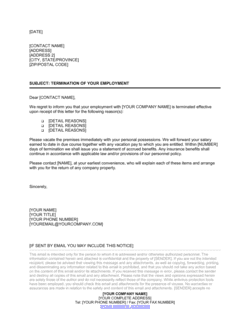
Termination Certification Template

Free Word download • Edit online • Save & share with Drive • Export to PDF

1 page20–30 min to fillDifficulty: StandardSignature requiredLegal review recommended
Learn more ↓
FreeTermination Certification Template

At a glance

What it is
A Termination Certification is a binding legal document signed by a departing employee at the close of their employment, confirming they have returned all company property, deleted confidential data from personal devices, and acknowledged that their ongoing obligations — confidentiality, non-compete, IP assignment, and non-solicitation — remain in full force. This free Word download is editable online and exports as a ready-to-sign PDF for use on or before an employee's last day.
When you need it
Use it whenever an employee separates from the company — whether through resignation, layoff, or termination for cause — to close the offboarding loop and create a signed record that all post-employment obligations were communicated and acknowledged before departure.
What's inside
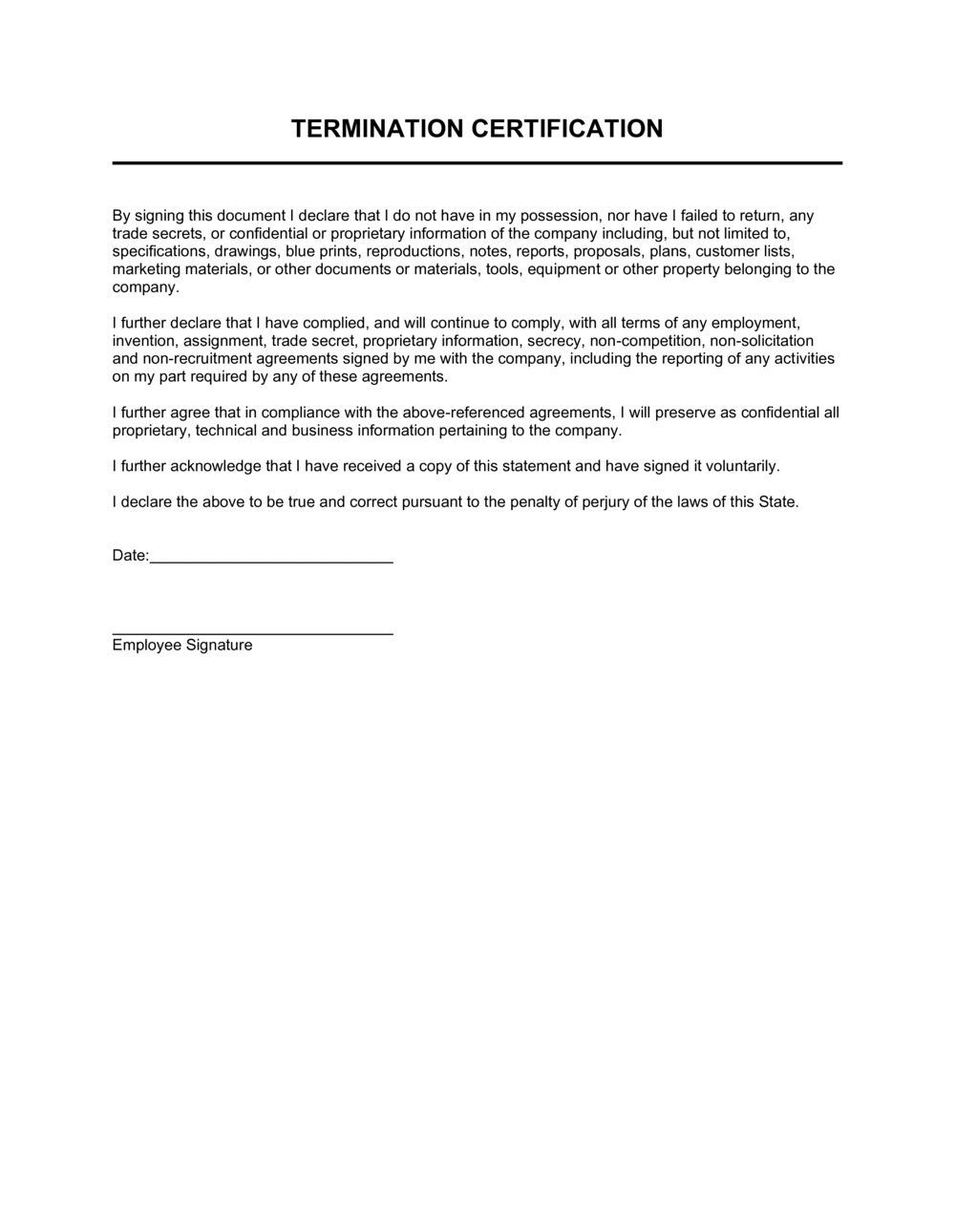
Identification of the parties and separation date, confirmation of property return and data deletion, acknowledgment of surviving contractual obligations (confidentiality, IP, non-compete, non-solicitation), a representation that no confidential information has been retained, and a final signature block with date.

What is a Termination Certification?

A Termination Certification is a legally binding document signed by a departing employee on or before their last day of employment, confirming that they have returned all company property, permanently deleted confidential information from personal devices and accounts, and acknowledged that key post-employment obligations — confidentiality, intellectual property assignment, non-compete, and non-solicitation restrictions — remain in full force after separation. Unlike a severance agreement, it does not grant new rights or compensation; it creates a dated, signed evidentiary record that all surviving obligations under the original employment agreement were communicated, understood, and accepted at the precise moment the employment relationship ended.

Why You Need This Document

Without a signed termination certification, an employer's ability to enforce post-employment restrictions depends entirely on what the original employment agreement says — with no documentation that the departing employee was reminded of those obligations at exit. Employees who leave without signing frequently claim they were unaware of specific restrictions, didn't retain confidential files intentionally, or believed their non-compete lapsed on separation. Those disputes are expensive to litigate and difficult to win without contemporaneous evidence. A termination certification closes that evidentiary gap in 20 minutes: it puts the employee on record acknowledging property return, data deletion, and all continuing obligations on the day they walk out the door. For companies in IP-intensive industries — software, financial services, healthcare, or professional services — the certification is the last line of defense before a former employee joins a competitor, calls your clients, or publishes your trade secrets.

Which variant fits your situation?

If your situation is…Use this template
Employee resigning voluntarily after standard tenureTermination Certification
Employee terminated for cause with disputed IP or data issuesTermination Certification (For Cause)
Executive departing with equity, clawback, or garden leave provisionsExecutive Separation Agreement
Layoff affecting multiple employees in a single reduction in forceEmployee Termination Letter
Independent contractor completing a project engagementIndependent Contractor Agreement (with termination clause)
Employee receiving severance in exchange for a release of claimsSeverance Agreement and Release
Remote employee returning access credentials and equipmentRemote Work Offboarding Checklist

Common mistakes to avoid

❌ Presenting the certification after the employee has already left

Why it matters: Once an employee has departed, they have no practical obligation to return for a signature and frequently don't. An unsigned certification provides no evidentiary protection against IP theft or solicitation.

Fix: Build the certification into the exit interview as a mandatory final step before the employee's access is revoked and their final check or direct deposit is confirmed.

❌ Omitting personal email and cloud storage from the data-deletion clause

Why it matters: The most common post-departure IP disputes involve files forwarded to personal Gmail or Dropbox accounts, not missing laptops. A certification that only references the return of hardware misses the real risk.

Fix: Explicitly name personal email, personal cloud storage, personal USB drives, and any third-party SaaS tool the employee used for company work in the non-retention clause.

❌ Including unenforceable non-compete language without jurisdiction-specific carve-outs

Why it matters: Asking an employee in California or Minnesota to acknowledge a non-compete that is void under local law does not make it enforceable — and including facially unenforceable clauses can undermine the credibility of the entire document if challenged.

Fix: Maintain jurisdiction-specific versions of the certification or include a severability clause confirming that unenforceable provisions are severed without affecting the remainder.

❌ Conflating the termination certification with a severance release of claims

Why it matters: A release of claims waiving age discrimination rights (under the ADEA in the US) requires 21 days for consideration and 7 days to revoke. Bundling a release into a certification signed at exit meeting voids the ADEA waiver and potentially taints the whole document.

Fix: Keep the termination certification and any severance release as separate documents. The certification covers operational offboarding obligations; the release covers legal claims and requires its own consideration period.

❌ No cooperation time limit or expense reimbursement provision

Why it matters: An open-ended cooperation obligation with no compensation creates resentment, non-compliance, and potential claims that the company is requiring unpaid labor — which violates wage laws in many jurisdictions.

Fix: Cap the cooperation period at 12–24 months post-separation and include a clause requiring the company to reimburse out-of-pocket expenses such as travel, legal counsel, or lost wages for time spent cooperating.

❌ Using the wrong legal entity name for the employer

Why it matters: If the certification names a trade name or subsidiary rather than the contracting legal entity, enforcing post-employment obligations — especially non-competes or IP claims — may require additional steps to establish standing, adding cost and delay.

Fix: Cross-reference the employer name against the original employment agreement and the corporate registry before finalizing the document.

The 10 key clauses, explained

Parties and separation date

In plain language: Identifies the employer's legal entity and the employee by full name and states the official last day of employment.

Sample language
This Termination Certification is entered into as of [SEPARATION DATE] between [EMPLOYER LEGAL NAME], a [STATE/PROVINCE] [ENTITY TYPE] ('Company'), and [EMPLOYEE FULL NAME] ('Employee'). Employee's employment with the Company ended on [SEPARATION DATE].

Common mistake: Using a trade name instead of the employer's registered legal entity. If the name on the certification doesn't match the original employment agreement, enforcing surviving obligations against the right entity becomes procedurally complicated.

Return of company property

In plain language: Confirms the employee has returned all physical and digital property — devices, access cards, keys, documents, and proprietary materials — on or before the separation date.

Sample language
Employee represents that, as of the Separation Date, Employee has returned to the Company all property belonging to the Company, including but not limited to: laptops, mobile devices, access cards, keys, company credit cards, files, and any copies thereof, whether in physical or electronic form.

Common mistake: Omitting cloud-stored documents and third-party accounts from the property list. An employee who returned a laptop but retained files in personal cloud storage has not fully complied — and the certification won't reflect that gap without explicit language.

Deletion and non-retention of confidential information

In plain language: Requires the employee to confirm they have permanently deleted any company confidential information stored on personal devices, personal email accounts, or cloud services not owned by the company.

Sample language
Employee represents that Employee has permanently deleted and not retained any Confidential Information of the Company from any personal computer, personal device, personal email account, or personal cloud storage account, and has not transmitted any such information to any third party.

Common mistake: Failing to specifically reference personal email and cloud storage accounts. Employees who forward work files to a personal Gmail account before leaving are the most common source of post-departure IP disputes, and a generic 'deleted all company data' representation won't squarely cover that scenario.

Acknowledgment of confidentiality obligations

In plain language: States explicitly that the employee's obligation to protect the company's confidential information continues after separation and is not limited to the employment period.

Sample language
Employee acknowledges that the confidentiality obligations set forth in Section [X] of Employee's Employment Agreement dated [DATE] ('Employment Agreement') survive termination of employment and remain in full force and effect indefinitely [or for [X] years following the Separation Date].

Common mistake: Referencing the original agreement without attaching or reciting the key terms. If the employee's copy of the employment agreement is lost, the certification alone — without the referenced section — may be insufficient evidence of the specific obligations acknowledged.

Acknowledgment of IP assignment

In plain language: Reaffirms that all work product, inventions, and developments created by the employee during the employment period are owned by the company, and that the employee has no claim to them after departure.

Sample language
Employee acknowledges that all work product, inventions, software, designs, and other intellectual property created by Employee in the course of employment are the sole property of the Company pursuant to Section [X] of the Employment Agreement and are irrevocably assigned to the Company.

Common mistake: Not accounting for work in progress at the time of separation. If the employee was developing something that isn't yet complete, the certification should confirm that partial work product is also assigned — leaving it ambiguous invites ownership disputes later.

Acknowledgment of non-compete and non-solicitation restrictions

In plain language: Reminds the employee of any post-employment non-compete or non-solicitation restrictions, their duration and geographic scope, and confirms the employee has read and understood them.

Sample language
Employee acknowledges that for a period of [X months] following the Separation Date, Employee remains bound by the non-competition and non-solicitation restrictions set out in Section [X] of the Employment Agreement, covering [GEOGRAPHIC AREA / INDUSTRY DESCRIPTION].

Common mistake: Including non-compete language in jurisdictions where post-employment non-competes are banned or unenforceable — such as California or Minnesota — without jurisdiction-specific carve-outs. Including an unenforceable clause can weaken the certification's overall credibility if challenged in court.

No pending claims or disputes

In plain language: The employee represents that, to their knowledge, they have not withheld any information about a workplace claim, complaint, or dispute that has not already been disclosed to the company.

Sample language
Employee represents that Employee is not aware of any pending or threatened legal claims, complaints, grievances, or regulatory filings against the Company that have not been disclosed in writing to the Company's [HR Department / Legal Department] prior to the Separation Date.

Common mistake: Conflating this representation with a full release of claims. A no-pending-claims representation is a factual statement; a release of claims is a waiver of rights. Combining them without proper consideration — typically a severance payment — renders the release unenforceable under the ADEA and similar statutes.

Cooperation with ongoing matters

In plain language: Requires the former employee to cooperate reasonably with any legal, regulatory, or audit matter arising from the period of their employment, without requiring ongoing employment.

Sample language
Employee agrees to cooperate reasonably with the Company, at the Company's request and expense, in connection with any litigation, investigation, regulatory inquiry, or audit relating to matters within Employee's knowledge during the period of employment.

Common mistake: No time limit or compensation provision for post-separation cooperation. Asking a former employee to cooperate indefinitely for free creates resentment and non-compliance — include a reasonable time cap and provide for reimbursement of out-of-pocket costs.

Governing law and entire agreement

In plain language: Specifies which jurisdiction's law governs the certification and confirms that it, together with the employment agreement, constitutes the entire agreement between the parties on the matters covered.

Sample language
This Certification is governed by the laws of [STATE / PROVINCE / COUNTRY]. Together with the Employment Agreement dated [DATE], this Certification constitutes the entire agreement between the parties regarding Employee's post-employment obligations and supersedes all prior oral or written representations on the subject.

Common mistake: Choosing a governing law that differs from the employment agreement's governing law without explaining the reason. Inconsistent governing-law clauses between related documents invite disputes about which law applies to which obligation.

Signature block and date

In plain language: Both parties — or the company representative and the employee — sign and date the document to confirm execution and acknowledge that the employee had an opportunity to review and ask questions before signing.

Sample language
By signing below, Employee certifies that the representations above are true and correct to the best of Employee's knowledge, that Employee has had an opportunity to review this Certification and ask questions, and that Employee signs voluntarily. Employee Signature: _________________________ Date: _____________ Printed Name: [EMPLOYEE FULL NAME] On behalf of [EMPLOYER LEGAL NAME]: Signature: _________________________ Date: _____________ Printed Name/Title: [NAME], [TITLE]

Common mistake: Having only the employee sign. A unilateral signature may limit the document's evidentiary weight in some jurisdictions and creates ambiguity about whether the company accepted the representations made. Both parties should execute the document.

How to fill it out

  1. 1

    Enter legal entity names and the separation date

    Use the employer's full registered corporate name — not a brand or trade name — and the employee's legal name as it appears on their employment agreement. Enter the official last day as the separation date.

    💡 Cross-check the separation date against your HRIS termination record before signing — discrepancies between documents create timeline disputes in litigation.

  2. 2

    List all company property to be returned

    Enumerate every category of property relevant to the specific employee: hardware, access credentials, physical keys, corporate credit cards, printed files, and any proprietary materials. Adapt the list based on the employee's role and access level.

    💡 For senior employees or those with system administrator access, attach a separate property checklist as Exhibit A rather than trying to enumerate everything in the body clause.

  3. 3

    Confirm deletion of confidential data from personal accounts

    Include explicit language covering personal email accounts, personal cloud storage (Google Drive, Dropbox, iCloud), and any third-party tools the employee may have used to access company information outside official channels.

    💡 Ask IT to run a data-loss prevention scan before the exit meeting — if flagged files were sent to personal accounts, address the issue before the certification is signed rather than after.

  4. 4

    Reference the surviving obligations from the employment agreement

    Identify the specific sections of the original employment agreement that contain confidentiality, IP assignment, non-compete, and non-solicitation provisions. Include the agreement's date so the reference is unambiguous.

    💡 Attach a copy of the relevant sections of the employment agreement to the certification as an exhibit — this eliminates the 'I didn't know what I was agreeing to' defense.

  5. 5

    Tailor or remove the non-compete acknowledgment for the jurisdiction

    If the employee works in a jurisdiction that bans post-employment non-competes — such as California, Minnesota, or most EU member states — remove or replace that clause with language limited to what is legally permissible in that location.

    💡 When in doubt about enforceability in a specific location, have a local employment lawyer review the non-compete language before asking the employee to sign.

  6. 6

    Complete the cooperation and governing-law clauses

    Set a reasonable time cap on the cooperation obligation (12–24 months is typical) and confirm the governing law matches the employment agreement. Ensure the governing law has a meaningful connection to where the employee actually worked.

    💡 For remote employees who worked in a different state or country from the employer's headquarters, use the employee's work location as the governing jurisdiction — not the employer's home state.

  7. 7

    Sign on or before the last day of employment

    Present the certification to the employee at the exit interview, allow time to read it, and execute both signatures before the employee leaves the premises. Provide the employee with a fully signed copy immediately.

    💡 Never email the certification after the employee has left and expect a return signature — response rates drop sharply, and the document's evidentiary value diminishes if signed weeks after departure.

  8. 8

    Store the executed certification with the employment file

    File the signed certification alongside the original employment agreement, the offer letter, and the termination letter in the employee's personnel file. Retain for at least the length of the longest applicable statute of limitations.

    💡 In most US jurisdictions, employment records should be retained for at least 7 years. For employees with access to trade secrets, retain indefinitely — trade secret claims have no universal statute of limitations in all states.

Frequently asked questions

What is a termination certification?

A termination certification is a legal document signed by a departing employee on or near their last day of employment. It confirms that the employee has returned all company property, deleted confidential information from personal devices and accounts, and acknowledges that post-employment obligations — confidentiality, IP assignment, non-compete, and non-solicitation — remain binding after separation. It creates a signed evidentiary record that the company communicated and the employee acknowledged all ongoing restrictions at the point of departure.

Is a termination certification legally binding?

Yes, a termination certification is generally enforceable as a contract when properly executed by both parties. It typically does not create new obligations — instead, it reaffirms obligations already agreed to in the original employment agreement. Courts in most jurisdictions treat a signed certification as strong evidence that the employee was aware of and acknowledged their surviving obligations at the time of separation. Consider having a lawyer review the document before use in any jurisdiction with specific employment law requirements.

When should a termination certification be signed?

The certification should be signed on the employee's last day of employment — ideally at the exit interview before access is revoked. Signing before departure ensures the employee still has an opportunity to ask questions and eliminates the practical problem of chasing a signature after the person has left. In common-law jurisdictions, signing after separation raises no fresh-consideration issues because the certification does not create new obligations — it acknowledges existing ones.

What is the difference between a termination certification and a severance agreement?

A termination certification documents operational offboarding compliance — property return, data deletion, and acknowledgment of surviving contractual obligations. A severance agreement grants additional compensation in exchange for a legal release of claims the employee might otherwise bring against the company. The two serve different purposes and should always be kept as separate documents. Combining them risks voiding the severance release under statutes like the ADEA, which impose specific procedural requirements on releases of age-discrimination claims.

Does the termination certification replace the employment agreement?

No. The termination certification works alongside the employment agreement, not in place of it. The employment agreement is the source document for confidentiality, IP assignment, and restrictive covenant obligations. The certification reaffirms those obligations at the point of separation and creates a dated acknowledgment that the employee reviewed and accepted them on exit. Both documents should be retained in the employee's personnel file.

What happens if an employee refuses to sign the termination certification?

A refusal to sign does not void the employee's post-employment obligations, which arise from the original employment agreement, not the certification. However, an unsigned certification means the company lacks a clean evidentiary record of acknowledgment. Document the refusal in writing, deliver the certification to the employee by email so there is a record of receipt, and consult an employment lawyer before taking further action — especially if sensitive IP or a non-compete is involved.

Should the termination certification include a non-compete acknowledgment?

Only if the non-compete is enforceable in the jurisdiction where the employee worked. California, Minnesota, North Dakota, and Oklahoma ban most post-employment non-competes, as do many EU member states unless financial compensation is provided. Including language acknowledging an unenforceable restriction does not make it enforceable and can undermine the document's credibility. Maintain jurisdiction-specific versions or include a severability clause and tailor accordingly.

How long should a company retain a signed termination certification?

Retain the certification for at least as long as the applicable statute of limitations for employment claims in the relevant jurisdiction — typically 3–7 years in the US and Canada. For employees who had significant access to trade secrets, retain indefinitely: trade secret misappropriation claims can arise years after departure, and the certification is primary evidence of the obligations that were in effect at separation. Store it alongside the original employment agreement and the termination letter.

Can a termination certification be used for contractors and temps?

Yes, a version adapted for contractors — referencing the independent contractor agreement rather than an employment agreement, and omitting employment-specific provisions like garden leave or FLSA classifications — is appropriate and common, particularly for contractors who had extended access to confidential systems or client relationships. Staffing agencies often require contractors to sign a certification at the end of each placement as a standard offboarding step.

How this compares to alternatives

vs Severance Agreement and Release

A severance agreement grants additional compensation — typically a lump sum — in exchange for the employee releasing legal claims against the company. A termination certification does not require consideration or create new rights; it simply documents compliance with existing obligations and reaffirms post-employment restrictions. These documents serve different legal functions and should never be merged into a single document.

vs Employee Dismissal Letter

An employee dismissal letter formally communicates the company's decision to terminate the employment relationship and states the separation date, final pay, and benefits information. A termination certification is signed by the employee to confirm they have fulfilled their offboarding obligations. The letter initiates separation; the certification closes it.

vs Non-Disclosure Agreement

An NDA establishes confidentiality obligations at the start or during a relationship. A termination certification reaffirms those obligations at the end of the employment relationship and documents acknowledgment at the point of departure. The NDA or employment agreement's confidentiality clause is the source of the obligation; the certification is the evidentiary record of ongoing acknowledgment.

vs Employment Contract

The employment contract creates all the substantive obligations — confidentiality, IP assignment, non-compete, and non-solicitation. The termination certification does not create new obligations; it references and reaffirms the employment contract's surviving provisions at the moment of separation. Both documents should be retained together in the employee's personnel file.

Industry-specific considerations

Technology / SaaS

Source code, API keys, and proprietary algorithms make data-deletion representations and IP assignment acknowledgments especially critical; IT-verified device wipes should accompany the signed certification.

Financial Services

Regulatory obligations under FINRA, FCA, or equivalent bodies may require additional disclosures at separation; the certification should reference compliance with applicable industry rules alongside standard confidentiality obligations.

Healthcare

HIPAA-covered entities must confirm that departing employees have no remaining access to protected health information; the certification should include an explicit PHI non-retention representation alongside standard confidentiality language.

Professional Services

Client relationships are the primary competitive asset; non-solicitation acknowledgment covering named clients or client categories — not just a generic restriction — is standard practice in legal, consulting, and accounting firms.

Jurisdictional notes

United States

Post-employment non-compete enforceability varies sharply by state — California, Minnesota, North Dakota, and Oklahoma ban most restrictions, while others require geographic and temporal reasonableness. Trade secret protections are governed federally by the Defend Trade Secrets Act (DTSA) and by state law under UTSA variants. ADEA requires that any release of age-discrimination claims in a severance context be kept strictly separate from the certification, with a 21-day review period and 7-day revocation window.

Canada

Post-employment non-competes are generally enforceable only if reasonable in scope, duration, and geography — courts apply a high standard, particularly in Ontario and British Columbia. Quebec employees may have additional protections under the Civil Code, and the certification should be provided in French for Quebec-based employees under the Charter of the French Language. Trade secret protection relies primarily on common law rather than a federal statute, making the certification's IP acknowledgment clause especially important.

United Kingdom

Post-termination restrictive covenants — including non-competes and non-solicitation clauses — are enforceable only if they go no further than is reasonably necessary to protect a legitimate business interest. Garden leave provisions are commonly used to displace non-competes and are generally more reliably enforced. The certification should be provided to the employee alongside a clear summary of which obligations survive and for how long, consistent with the original employment particulars statement.

European Union

In most EU member states, post-employment non-competes are only enforceable if the employer provides financial compensation to the employee — ranging from 25% of salary in some countries to 100% in others. GDPR requires that references to personal data processing in the certification comply with applicable data protection law; the non-retention of personal data clause should be carefully worded to avoid inadvertent controller obligations. Requirements vary significantly by member state — Germany, France, Italy, and the Netherlands each have distinct rules that may require local legal review.

Template vs lawyer — what fits your deal?

PathBest forCostTime
Use the templateStandard domestic employee separations where an employment agreement with surviving obligations already existsFree15–20 minutes per employee
Template + legal reviewSenior employees with significant IP access, cross-jurisdictional hires, or situations involving a disputed separation$300–$6001–3 days
Custom draftedExecutive departures with equity, garden leave, clawback provisions, or regulated-industry compliance requirements$1,000–$3,500+1–2 weeks

Glossary

Termination Certification
A signed document in which a departing employee confirms compliance with exit obligations and acknowledges that post-employment restrictions remain binding.
Surviving Obligations
Contractual duties that remain enforceable after the employment relationship ends, typically including confidentiality, IP assignment, and non-solicitation.
Confidential Information
Non-public information belonging to the employer — such as trade secrets, customer lists, financial data, and product roadmaps — that the employee is prohibited from disclosing or retaining.
IP Assignment
A contractual clause transferring ownership of work product, inventions, and developments created during employment to the employer, which persists after separation.
Non-Compete Clause
A post-employment restriction preventing the departing employee from joining a competitor or starting a competing business within a defined time period and geography.
Non-Solicitation Clause
A restriction prohibiting a former employee from recruiting the employer's staff or soliciting its clients or customers for a defined period after separation.
Garden Leave
A notice period during which the employee is paid but required to stay away from the workplace, preventing continued access to clients, systems, or confidential information.
Separation Date
The official last day of employment as recorded in the company's HR system, which triggers the start of any post-employment restriction periods.
Trade Secret
Information that derives economic value from not being generally known and is subject to reasonable efforts by the employer to maintain its secrecy — protected under statute independent of contract in most jurisdictions.
Release of Claims
A clause in which one or both parties waive the right to bring future legal claims arising from the employment relationship — distinct from a termination certification but sometimes combined with it.
Exit Interview
A structured conversation between HR and the departing employee covering the reasons for separation, feedback on the role, and confirmation of offboarding obligations — the termination certification is typically signed at this meeting.
Constructive Dismissal
A situation where an employer's conduct forces an employee to resign, which is treated legally as a termination — the certification should reflect the actual circumstances of departure.

Part of your Business Operating System

This document is one of 3,000+ business & legal templates included in Business in a Box.

  • Fill-in-the-blanks — ready in minutes
  • 100% customizable Word document
  • Compatible with all office suites
  • Export to PDF and share electronically

Create your document in 3 simple steps.

From template to signed document — all inside one Business Operating System.
1
Download or open template

Access over 3,000+ business and legal templates for any business task, project or initiative.

2
Edit and fill in the blanks with AI

Customize your ready-made business document template and save it in the cloud.

3
Save, Share, Send, Sign

Share your files and folders with your team. Create a space of seamless collaboration.

Save time, save money, and create top-quality documents.

★★★★★

"Fantastic value! I'm not sure how I'd do without it. It's worth its weight in gold and paid back for itself many times."

Managing Director · Mall Farm
Robert Whalley
Managing Director, Mall Farm Proprietary Limited
★★★★★

"I have been using Business in a Box for years. It has been the most useful source of templates I have encountered. I recommend it to anyone."

Business Owner · 4+ years
Dr Michael John Freestone
Business Owner
★★★★★

"It has been a life saver so many times I have lost count. Business in a Box has saved me so much time and as you know, time is money."

Owner · Upstate Web
David G. Moore Jr.
Owner, Upstate Web

Run your business with a system — not scattered tools

Stop downloading documents. Start operating with clarity. Business in a Box gives you the Business Operating System used by over 250,000 companies worldwide to structure, run, and grow their business.

Start free · No credit card required