Guaranty Agreement Template

Free Word download β€’ Edit online β€’ Save & share with Drive β€’ Export to PDF

3 pagesβ€’25–30 min to fillβ€’Difficulty: Standardβ€’Signature requiredβ€’Legal review recommended
Learn more ↓
FreeGuaranty Agreement Template

At a glance

What it is
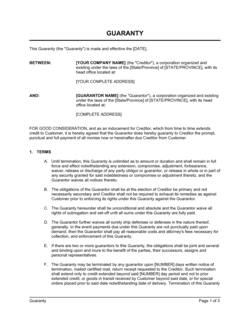
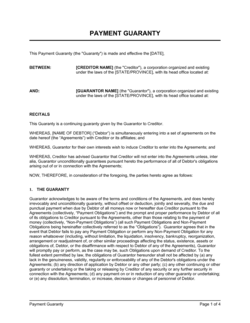
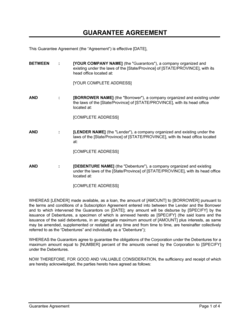
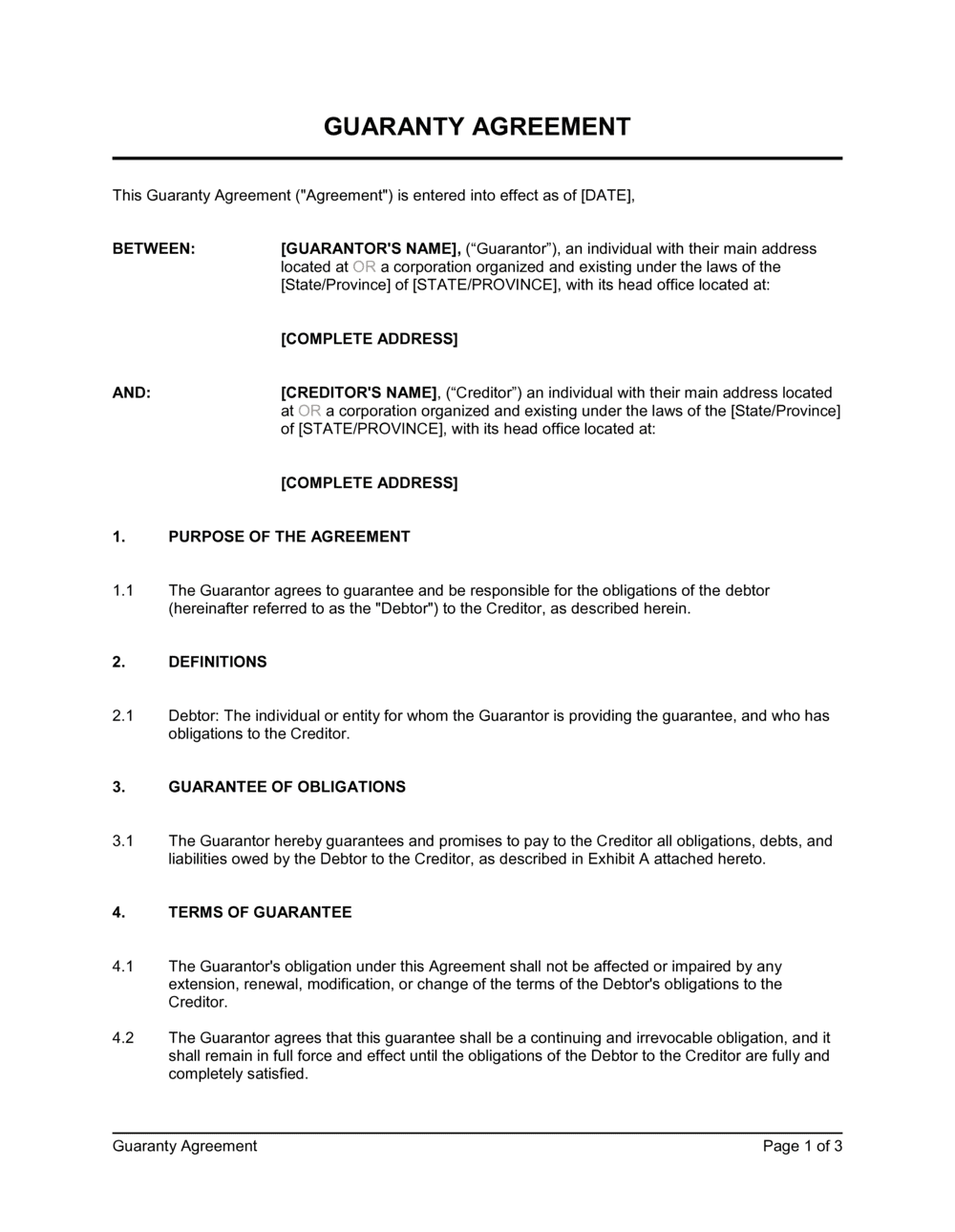
A Guaranty Agreement is a legally binding contract in which a guarantor promises to satisfy a debtor's financial obligation to a creditor if the debtor defaults. This free Word download provides a structured, editable template covering guarantor liability, scope, waivers, and default conditions β€” ready to export as PDF and execute with all parties.
When you need it
Use it when a lender, landlord, or vendor requires a creditworthy third party β€” typically a business owner, parent company, or investor β€” to back a loan, lease, or supply agreement before extending credit to the primary obligor. It is commonly required when the borrowing entity lacks a sufficient credit history or collateral on its own.
What's inside
Identification of all parties, the guaranteed obligation, the scope and limit of the guarantor's liability, representations and warranties, default triggers and remedies, waiver of defenses, and governing law. The template also includes optional provisions for limited versus continuing guaranties and notice requirements.

What is a Guaranty Agreement?

A Guaranty Agreement is a legally binding contract in which a third party β€” the guarantor β€” unconditionally promises to satisfy a borrower's or tenant's financial obligation to a creditor if the primary obligor fails to perform. Unlike a co-signer arrangement, a guaranty creates a secondary obligation: the guarantor steps in when the principal obligor defaults, giving the creditor a creditworthy backstop beyond whatever collateral or assets the borrower can offer. Guaranties are among the most commonly required documents in commercial lending, commercial real estate leasing, and trade credit β€” and among the most consequential contracts an individual or company can sign, because they expose the guarantor's personal or corporate assets to direct enforcement.

Why You Need This Document

Without a properly drafted guaranty agreement, creditors extending credit to entities with limited track records or thin balance sheets have no enforceable recourse beyond the borrower itself. For guarantors, an unsigned or informally drafted guaranty offers no protection β€” courts have voided guaranty enforcement attempts where the document was ambiguous about scope, lacked a termination clause, or used trade names instead of registered legal entity names. A precise, written guaranty protects both sides: the creditor gets a clear, enforceable secondary obligation it can act on immediately at default; the guarantor gets defined limits β€” a dollar cap, a termination date, and a subrogation right β€” that prevent open-ended personal exposure. This template gives you a complete, jurisdiction-aware starting point that covers every essential clause, reduces the most common drafting errors, and is ready for attorney review or direct execution on standard transactions.

Which variant fits your situation?

If your situation is…Use this template
Business owner personally backing a company loan or leasePersonal Guaranty Agreement
Parent company backing a subsidiary's debt or performance obligationCorporate Guaranty Agreement
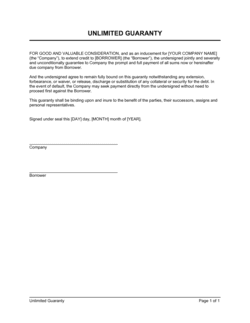
Guaranty covering all present and future obligations indefinitelyContinuing Guaranty Agreement
Guaranty capped at a fixed dollar amount or specific transactionLimited Guaranty Agreement
Multiple guarantors each liable for the full obligationJoint and Several Guaranty Agreement
Guarantor liable only for remaining balance after primary obligor paysConditional Guaranty Agreement
Guaranty supporting a commercial real estate leaseLease Guaranty Agreement

Common mistakes to avoid

❌ Guaranty of collection instead of guaranty of payment

Why it matters: A guaranty of collection requires the creditor to obtain a judgment against the borrower and exhaust all remedies before turning to the guarantor β€” often making the guaranty commercially worthless.

Fix: Use unconditional guaranty-of-payment language that allows the creditor to demand performance from the guarantor immediately upon a defined default, without first pursuing the borrower or collateral.

❌ Omitting a dollar cap on a continuing guaranty

Why it matters: Without a cap, a guarantor who signed to back a $200,000 loan can find themselves liable for $2 million in subsequent advances the borrower takes years later under the same credit facility.

Fix: Negotiate a maximum liability cap expressed as a specific dollar amount or a percentage of the original obligation, and ensure the cap is stated clearly in the scope-of-guaranty clause.

❌ No termination provision in a continuing guaranty

Why it matters: A guarantor who exits a business β€” through a share sale, retirement, or buyout β€” can remain personally liable for obligations incurred by the company years after their departure if no revocation mechanism exists.

Fix: Include a clause allowing the guarantor to revoke the continuing guaranty on 60 to 90 days' written notice, with liability limited to obligations incurred before the revocation effective date.

❌ Executing after the underlying transaction closes

Why it matters: In most jurisdictions, a guaranty signed after the underlying obligation was already incurred may lack consideration, potentially voiding the guaranty or requiring proof of independent consideration.

Fix: Execute the guaranty simultaneously with or before closing on the underlying loan, lease, or contract. If post-closing execution is unavoidable, document a separate consideration payment or benefit provided to the guarantor.

❌ Using a trade name or assumed name instead of the legal entity name

Why it matters: A guaranty naming 'ABC Services' instead of 'ABC Services, LLC, a Delaware limited liability company' creates ambiguity about which legal entity is bound β€” and courts have dismissed enforcement actions on this basis.

Fix: Confirm the guarantor's and obligor's exact registered legal names from their formation documents or a current certificate of good standing before drafting the agreement.

❌ No cross-reference to the underlying agreement's default definitions

Why it matters: If the guaranty defines default differently from the underlying loan or lease, the creditor may be able to demand payment from the guarantor based on a technical default that would not trigger remedies under the primary agreement β€” or vice versa.

Fix: Expressly incorporate the default definitions from the underlying agreement by reference, or reproduce them verbatim, so that both documents use identical trigger language.

The 10 key clauses, explained

Parties and Recitals

In plain language: Identifies the guarantor, the principal obligor, and the creditor by full legal name, and describes the underlying transaction that the guaranty supports.

Sample language
This Guaranty Agreement ('Agreement') is entered into as of [DATE] by [GUARANTOR FULL NAME] ('Guarantor') in favor of [CREDITOR LEGAL NAME] ('Creditor') in connection with that certain [LOAN AGREEMENT / LEASE / CONTRACT] dated [DATE] between [PRINCIPAL OBLIGOR NAME] ('Borrower') and Creditor.

Common mistake: Using trade names instead of registered legal entity names. If the guarantor is an individual, omitting their full legal name and address makes enforcement β€” especially cross-state β€” significantly harder.

Guaranty of Payment

In plain language: The operative clause where the guarantor unconditionally promises to pay or perform the principal obligor's obligations if the obligor defaults.

Sample language
Guarantor unconditionally and irrevocably guarantees to Creditor the full and prompt payment and performance of all Obligations of Borrower under the [UNDERLYING AGREEMENT], including principal, interest, fees, costs, and expenses (collectively, 'Obligations').

Common mistake: Drafting a guaranty of collection rather than a guaranty of payment. A guaranty of collection requires the creditor to exhaust remedies against the borrower first β€” dramatically limiting the guaranty's practical value to the creditor.

Scope of Guaranty (Limited vs. Continuing)

In plain language: Defines whether the guaranty covers only a specific obligation or all present and future obligations, and states any applicable dollar cap or time limit.

Sample language
This is a [continuing / limited] guaranty. Guarantor's liability shall not exceed $[MAXIMUM AMOUNT] in the aggregate. This guaranty [shall / shall not] extend to future advances or modifications of the Obligations without separate written consent of Guarantor.

Common mistake: Failing to specify whether the guaranty is continuing or limited. An ambiguous scope leads to disputes β€” guarantors assume they are only on the hook for a single transaction while creditors claim coverage for every subsequent advance.

Representations and Warranties of Guarantor

In plain language: The guarantor's sworn statements that they have the legal capacity, authority, and financial standing to enter the guaranty, and that no undisclosed liabilities impair their ability to perform.

Sample language
Guarantor represents and warrants that: (a) Guarantor has full legal capacity to enter into this Agreement; (b) this Agreement constitutes a valid and binding obligation of Guarantor; (c) no litigation, judgment, or lien is pending against Guarantor that would materially impair performance hereunder.

Common mistake: Omitting financial condition representations. Without them, a guarantor who was insolvent at signing can later argue the creditor knew β€” or should have known β€” the guaranty was worthless, complicating enforcement.

Waivers of Defenses

In plain language: The guarantor gives up specific legal defenses β€” such as requiring the creditor to first sue the borrower or to notify the guarantor of a default β€” that would otherwise delay or limit enforcement.

Sample language
Guarantor hereby waives: (a) notice of acceptance of this Guaranty; (b) presentment, demand, protest, and notice of dishonor; (c) any right to require Creditor to proceed against Borrower or any collateral before proceeding against Guarantor; and (d) any defense based on modification of the Obligations.

Common mistake: Including only partial waivers and leaving out the waiver of suretyship defenses. Courts in many jurisdictions will apply statutory suretyship protections unless they are explicitly waived β€” rendering the guaranty effectively conditional.

Default and Remedies

In plain language: Specifies what constitutes a default by the principal obligor, what triggers the creditor's right to demand performance from the guarantor, and what remedies the creditor may pursue.

Sample language
Upon default by Borrower under the [UNDERLYING AGREEMENT], Creditor may, at its option and without prior notice to Guarantor, demand immediate payment of all Obligations from Guarantor. Creditor's rights hereunder are cumulative and in addition to any other rights or remedies available at law or equity.

Common mistake: Linking the default trigger exclusively to a court judgment against the borrower. Requiring a judgment first defeats the purpose of a guaranty β€” include a cross-default provision that triggers the guaranty on any material default under the underlying agreement.

Subrogation and Indemnification

In plain language: After the guarantor pays the creditor, this clause grants the guarantor the right to pursue the borrower for reimbursement and defines any indemnification obligations running between the parties.

Sample language
Upon full payment of the Obligations by Guarantor, Guarantor shall be subrogated to the rights of Creditor against Borrower. Borrower agrees to indemnify and hold harmless Guarantor from any amounts paid under this Guaranty, plus interest at [RATE]% per annum from the date of payment.

Common mistake: Omitting any subrogation clause β€” or subordinating the guarantor's subrogation rights to the creditor's remaining claims. Without this, a guarantor who pays in full has no clear legal path to recover from the borrower.

Amendments and Modifications

In plain language: States that changes to the underlying obligation β€” such as loan extensions, payment deferrals, or rate changes β€” do not release the guarantor without their express written consent, and specifies how modifications must be documented.

Sample language
Creditor may, without notice to or consent of Guarantor, modify, extend, renew, or accelerate the Obligations without releasing Guarantor from liability hereunder, unless Guarantor provides prior written objection within [X] days of receiving notice of the modification.

Common mistake: No modification clause at all. When the lender later grants the borrower a 90-day forbearance or restructures the loan, the guarantor argues the change released their obligation β€” a dispute this clause prevents.

Governing Law and Dispute Resolution

In plain language: Identifies which jurisdiction's law governs interpretation and enforcement of the guaranty, and specifies the forum β€” court or arbitration β€” for resolving disputes.

Sample language
This Agreement shall be governed by the laws of [STATE / PROVINCE / COUNTRY], without regard to conflict-of-law principles. Any dispute shall be resolved by [binding arbitration in [CITY] / the courts of [JURISDICTION]], and Guarantor hereby consents to personal jurisdiction therein.

Common mistake: Choosing a governing state with no connection to either party or the underlying transaction. Courts may decline to apply foreign governing law if the choice was made solely to avoid consumer-protection or anti-waiver statutes in the guarantor's home jurisdiction.

Termination and Release

In plain language: Defines the conditions under which the guaranty expires β€” full payment of the underlying obligation, expiration of a fixed term, or written release by the creditor β€” and what documentation confirms the guaranty is discharged.

Sample language
This Guaranty shall terminate upon full and final payment and discharge of all Obligations. Creditor shall provide Guarantor with a written release within [30] days of such discharge. A continuing guaranty may be revoked by Guarantor on [90] days' written notice, but such revocation shall not affect liability for Obligations incurred prior to the effective date of revocation.

Common mistake: No termination clause in a continuing guaranty. Without one, a guarantor who sold their shares in the business years ago can remain liable for obligations incurred long after their departure.

How to fill it out

  1. 1

    Identify all parties with full legal names

    Enter the guarantor's full legal name and address, the principal obligor's registered entity name and jurisdiction, and the creditor's legal name. For individual guarantors, use the name exactly as it appears on government-issued ID.

    πŸ’‘ For corporate guarantors, confirm the exact registered entity name against a current certificate of good standing before execution.

  2. 2

    Describe the underlying obligation with precision

    Reference the specific loan agreement, lease, or contract being guaranteed by name, date, and dollar amount. Attach the underlying agreement as an exhibit if the creditor requires it.

    πŸ’‘ Avoid broad language like 'all obligations of any kind.' Specify the instrument β€” the guarantor needs to know exactly what they are backing.

  3. 3

    Choose limited or continuing coverage and set a cap if applicable

    Decide whether the guaranty covers only this specific transaction or all present and future obligations. If limited, enter the maximum dollar liability the guarantor is accepting.

    πŸ’‘ Guarantors should always push for a limited guaranty with a dollar cap. Creditors will often accept a cap equal to 12–24 months of the underlying obligation's value.

  4. 4

    Complete the representations and warranties section

    Confirm the guarantor's legal capacity, authority, and financial condition. For corporate guarantors, attach a board resolution authorizing execution of the guaranty.

    πŸ’‘ Individual guarantors should also confirm that no undisclosed liens or judgments exist against them β€” omitting this is the most common source of enforcement challenges.

  5. 5

    Review and customize the waivers block

    Read each waiver carefully. Standard creditor-friendly templates waive all suretyship defenses. Guarantors negotiating for themselves should consider retaining the right to notice of default and the right to require the creditor to first exhaust collateral.

    πŸ’‘ A carve-out preserving the guarantor's right to receive notice of default β€” even if not required before enforcement β€” creates a practical early-warning mechanism with minimal cost to the creditor.

  6. 6

    Define default triggers and remedies

    Cross-reference the default definitions in the underlying agreement so both documents are consistent. Specify whether any cure period applies before the creditor can demand payment from the guarantor.

    πŸ’‘ If the underlying loan has a 30-day cure period for payment defaults, replicate that period in the guaranty β€” otherwise the creditor can demand from the guarantor before the borrower has had a chance to cure.

  7. 7

    Execute with required formalities

    Both parties must sign in the spaces provided, with witnesses or notarization as required by the applicable jurisdiction. Date the signature block on or before the closing date of the underlying transaction.

    πŸ’‘ Several states and Canadian provinces require guaranties to be notarized or witnessed to be enforceable against an individual β€” confirm local requirements before execution.

  8. 8

    Retain executed copies and calendar the termination date

    Each party should retain a fully executed original or certified copy. If the guaranty has a fixed term, calendar the expiration date and the 90-day notice window for any renewal or revocation.

    πŸ’‘ Store executed guaranties with the underlying loan file β€” courts have voided guaranty enforcement attempts where the original signed document could not be produced.

Frequently asked questions

What is a guaranty agreement?

A guaranty agreement is a legally binding contract in which a third party β€” the guarantor β€” agrees to satisfy the debt or obligation of a primary borrower if that borrower defaults. It gives the creditor a secondary source of repayment beyond the borrower's own assets or collateral. Guaranties are commonly required in commercial lending, commercial real estate leases, and supply agreements where the primary obligor lacks sufficient creditworthiness on its own.

What is the difference between a guaranty and a co-signer?

A co-signer is jointly and primarily liable alongside the borrower from day one β€” the creditor can pursue them simultaneously with the borrower without any prior default. A guarantor is a secondary obligor whose liability is typically triggered only by the borrower's default. In practice, many commercial guaranties waive this distinction by making the guarantor's obligation independent of the borrower's performance, effectively creating primary liability.

What is the difference between a limited and a continuing guaranty?

A limited guaranty applies to a specific transaction, dollar amount, or time period. Once that obligation is paid or the period expires, the guaranty terminates. A continuing guaranty covers all present and future obligations of the borrower to the creditor β€” including new advances, renewals, and modifications β€” until formally revoked or the entire credit relationship ends. Continuing guaranties carry significantly more risk for the guarantor and should always include a cap and a revocation mechanism.

Can a guaranty agreement be revoked?

A limited guaranty terminates automatically when the specified obligation is discharged. A continuing guaranty can typically be revoked by the guarantor on written notice β€” commonly 60 to 90 days β€” but revocation only terminates liability for future obligations; the guarantor remains bound for amounts already outstanding at the time of revocation. Revocability must be explicitly addressed in the agreement, as courts in some jurisdictions treat a silent continuing guaranty as irrevocable.

Does a personal guaranty expose the guarantor's personal assets?

Yes. A personal guaranty signed by an individual means the creditor can pursue the guarantor's personal bank accounts, real property, investments, and other assets if the business defaults. This is precisely why lenders require it β€” it removes the liability shield that an LLC or corporation would otherwise provide. Guarantors should carefully evaluate their personal balance sheet and negotiate a dollar cap before signing.

Is a guaranty agreement enforceable without notarization?

In most US states, a guaranty signed by two parties and supported by consideration is generally enforceable without notarization. However, some states β€” and most Canadian provinces β€” require notarization or witnessing for a personal guaranty to be enforceable against an individual. Real estate-related guaranties often follow the formality requirements of the underlying lease or mortgage. Confirming local requirements before execution is strongly recommended.

What is a bad boy carve-out in a guaranty?

A bad boy carve-out converts an otherwise non-recourse loan into a personal recourse obligation if the borrower commits specified wrongful acts β€” such as fraud, unauthorized asset transfers, filing for bankruptcy in bad faith, or environmental violations. It is common in commercial real estate financing and protects the lender against deliberate misconduct without imposing full personal liability for ordinary business losses.

What happens to a personal guaranty when a business is sold?

Unless the creditor expressly releases the guarantor in writing, a personal guaranty typically survives the sale of the business. The new owner may assume the underlying debt, but the original guarantor remains liable until the obligation is fully discharged or the creditor provides a written release. Guarantors negotiating the sale of a business should make creditor release of the personal guaranty a condition of closing.

Do I need a lawyer to draft a guaranty agreement?

For a straightforward personal guaranty on a standard commercial loan or lease, a high-quality template provides a solid starting point. Legal review is strongly recommended when the guaranteed amount is material, the guaranty is continuing rather than limited, the transaction is cross-border, or the guarantor is a corporate entity with complex authority and capacity considerations. A 1–2 hour attorney review typically costs $300–$700 and is worthwhile for any guaranty exposing the guarantor to more than six months of the underlying obligation's value.

How this compares to alternatives

vs Indemnity Agreement

An indemnity agreement obligates one party to compensate another for specified losses or damages β€” it is a forward-looking risk allocation tool between parties to a transaction. A guaranty agreement creates a secondary obligation to pay a third party's debt. The guarantor backs someone else's obligation to a creditor; the indemnitor compensates the protected party directly for covered losses.

vs Surety Bond

A surety bond is a three-party instrument in which a licensed surety company guarantees a principal's performance to an obligee in exchange for a premium. A guaranty agreement is a direct contractual promise β€” the guarantor is personally liable and receives no premium. Surety bonds are regulated financial products; guaranty agreements are private contracts that require no insurance license.

vs Promissory Note

A promissory note is the primary debt instrument β€” the borrower's direct promise to repay. A guaranty agreement is a secondary document in which a third party backs that promise. The note creates the obligation; the guaranty secures it with a creditworthy backstop. Both documents are typically executed simultaneously at loan closing.

vs Letter of Credit

A letter of credit is a bank's irrevocable payment commitment to a beneficiary upon presentation of specified documents, independent of the underlying transaction. A guaranty agreement is a contingent personal or corporate promise triggered by default β€” the creditor must establish the default before demanding payment. Letters of credit are faster and more certain to pay; guaranties are less expensive to obtain.

Industry-specific considerations

Commercial Real Estate

Landlords routinely require personal guaranties from principals of newly formed LLCs before executing commercial leases, with burn-down provisions reducing the guaranty cap as the tenant demonstrates payment history.

Banking and Commercial Lending

SBA 7(a) and 504 loans require personal guaranties from any owner holding 20% or more of the borrowing entity β€” the guaranty form and scope are heavily regulated by SBA standard operating procedures.

Construction and Contracting

General contractors require performance guaranties or payment guaranties from subcontractors' principals on projects above threshold values to protect against default mid-project.

Manufacturing and Supply Chain

Suppliers extending credit terms to distributors or resellers often require a principal guaranty to secure open accounts, particularly for newer counterparties without a track record of on-time payment.

Jurisdictional notes

United States

Guaranty law is primarily state-law driven and varies significantly. The Statute of Frauds requires guaranties to be in writing in all US states to be enforceable. California has some of the most protective guaranty statutes, including mandatory anti-deficiency protections and one-action rules that limit creditor remedies. SBA loans require personal guaranties from all 20%-or-greater owners using SBA-prescribed forms. Some states β€” including New York β€” require that continuing guaranties be explicitly labeled as such to be enforceable against individuals.

Canada

Each province governs guaranties under its own Mercantile Law Amendment Act or equivalent statute. Ontario, Alberta, and British Columbia all require personal guaranties to be in writing and signed by the guarantor. Ontario's Statute of Frauds applies to all guaranty agreements. In Quebec, guaranties are governed by the Civil Code and require a specific written form; suretyship rules impose additional protections on individual guarantors, including a right to be informed of the debtor's payment failures.

United Kingdom

Under the Statute of Frauds 1677, a guaranty must be in writing and signed by the guarantor or their authorized agent to be enforceable. English courts scrutinize undue influence claims when a guarantor has a close personal relationship with the borrower β€” lenders are required to advise individual guarantors to seek independent legal advice, and failure to do so can void enforcement. The Unfair Contract Terms Act 1977 and the FCA Consumer Credit Act may apply to guaranties involving individuals.

European Union

Guaranty law varies substantially across EU member states, with no harmonized framework. France governs guaranties under the Code Civil, which requires guaranties to include a handwritten statement of the amount guaranteed in words and figures β€” failure to comply voids the guaranty against an individual. Germany applies strict formality requirements for surety agreements under the BGB. Consumer guarantors across most EU member states receive enhanced protections under national implementations of consumer credit directives, including mandatory cooling-off periods and disclosure requirements.

Template vs lawyer β€” what fits your deal?

PathBest forCostTime
Use the templateStraightforward personal guaranties on standard commercial leases or loans under $250,000 in a single jurisdictionFree30–60 minutes
Template + legal reviewGuaranties on obligations above $250,000, continuing guaranties, cross-border transactions, or corporate guarantors requiring board authorization$300–$7001–3 days
Custom draftedComplex multi-party credit facilities, bad boy carve-out structures, SBA-regulated transactions, or guaranties governed by foreign law$1,500–$5,000+1–3 weeks

Glossary

Guarantor
The party who agrees to satisfy the debtor's obligation to the creditor if the debtor fails to perform.
Principal Obligor
The primary debtor or borrower whose obligation the guaranty secures β€” also called the obligor or borrower.
Creditor / Beneficiary
The party in whose favor the guaranty is given β€” typically a lender, landlord, or supplier extending credit.
Continuing Guaranty
A guaranty that covers all current and future obligations of the principal obligor until formally revoked or the underlying debt is fully discharged.
Limited Guaranty
A guaranty capped at a specific dollar amount or restricted to a defined transaction, time period, or type of obligation.
Joint and Several Liability
A guaranty structure where multiple guarantors are each individually liable for the full obligation β€” the creditor may pursue any one guarantor for the entire amount.
Subrogation
A guarantor's right, after paying the creditor, to step into the creditor's position and pursue the principal obligor for reimbursement.
Waiver of Presentment and Notice
A clause in which the guarantor gives up the right to be formally notified of the debtor's default before the creditor can demand payment from the guarantor.
Indemnification
An obligation by the principal obligor or a third party to reimburse the guarantor for any amounts paid under the guaranty.
Deficiency
The remaining unpaid balance after a creditor liquidates collateral β€” the guarantor is typically liable for this amount under an unconditional guaranty.
Bad Boy Carve-Out
A provision in an otherwise non-recourse loan that triggers personal guaranty liability if the borrower commits specified wrongful acts, such as fraud or unauthorized asset transfers.

Part of your Business Operating System

This document is one of 3,000+ business & legal templates included in Business in a Box.

  • Fill-in-the-blanks β€” ready in minutes
  • 100% customizable Word document
  • Compatible with all office suites
  • Export to PDF and share electronically

Create your document in 3 simple steps.

From template to signed document β€” all inside one Business Operating System.
1
Download or open template

Access over 3,000+ business and legal templates for any business task, project or initiative.

2
Edit and fill in the blanks with AI

Customize your ready-made business document template and save it in the cloud.

3
Save, Share, Send, Sign

Share your files and folders with your team. Create a space of seamless collaboration.

Save time, save money, and create top-quality documents.

β˜…β˜…β˜…β˜…β˜…

"Fantastic value! I'm not sure how I'd do without it. It's worth its weight in gold and paid back for itself many times."

Managing Director Β· Mall Farm
Robert Whalley
Managing Director, Mall Farm Proprietary Limited
β˜…β˜…β˜…β˜…β˜…

"I have been using Business in a Box for years. It has been the most useful source of templates I have encountered. I recommend it to anyone."

Business Owner Β· 4+ years
Dr Michael John Freestone
Business Owner
β˜…β˜…β˜…β˜…β˜…

"It has been a life saver so many times I have lost count. Business in a Box has saved me so much time and as you know, time is money."

Owner Β· Upstate Web
David G. Moore Jr.
Owner, Upstate Web

Run your business with a system β€” not scattered tools

Stop downloading documents. Start operating with clarity. Business in a Box gives you the Business Operating System used by over 250,000 companies worldwide to structure, run, and grow their business.

Free Forever PlanΒ Β·Β No credit card required