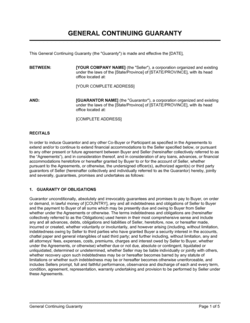
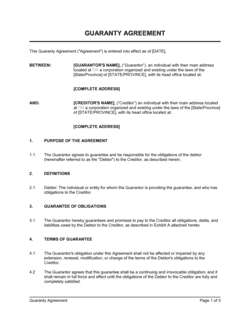
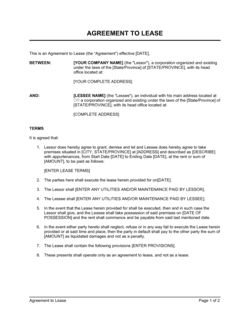
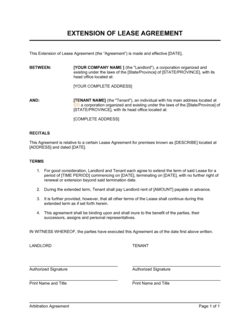
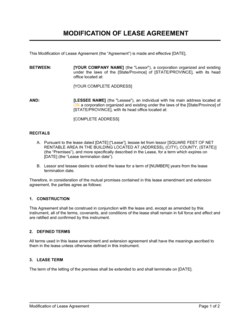
Guaranty of a Lease Template

Free Word download • Edit online • Save & share with Drive • Export to PDF

3 pages25–30 min to fillDifficulty: ComplexSignature requiredLegal review recommended
Learn more ↓
FreeGuaranty of a Lease Template

At a glance

What it is
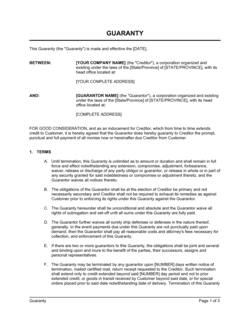
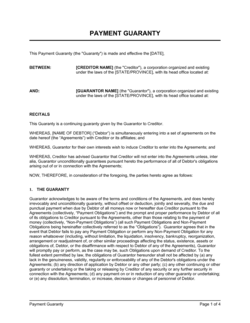
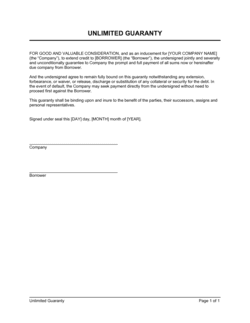
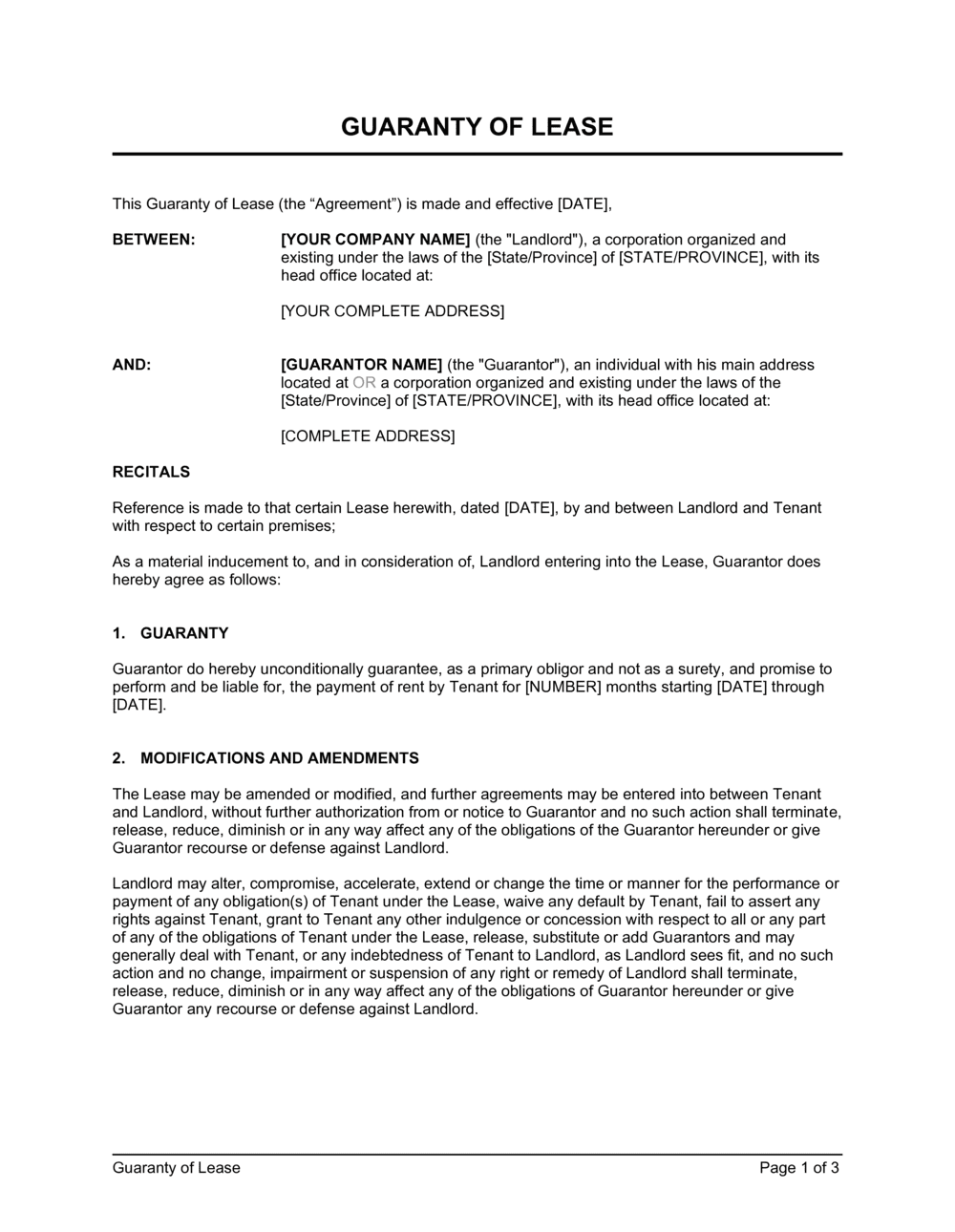
A Guaranty of a Lease is a legally binding agreement in which a third party — the guarantor — personally or corporately undertakes to fulfill a tenant's obligations under a lease if the tenant defaults. This free Word download gives landlords and tenants a structured, attorney-reviewed starting point covering full and limited guaranty structures, default triggers, and guarantor liability caps, exportable as PDF and ready to execute alongside any commercial or residential lease.
When you need it
Use it when a landlord requires additional security before executing a lease with a new business, a startup with limited credit history, or an individual tenant with insufficient income verification. It is also required when a parent company or principal of a business entity is asked to back the tenant's obligations personally.
What's inside
Parties and recitals identifying the guarantor, tenant, and landlord; the scope of the guaranteed obligations including rent, damages, and attorney fees; default and notice conditions; guarantor liability limits and duration; waiver of defenses; and governing law and signature blocks for all parties.

What is a Guaranty of a Lease?

A Guaranty of a Lease is a legally binding agreement in which a third party — the guarantor — unconditionally promises to fulfill a tenant's obligations under a lease if the tenant defaults. The guarantor can be an individual business owner providing a personal guarantee or a parent corporation backing a subsidiary's lease obligations. Unlike the underlying lease, which creates the tenancy between landlord and tenant, the guaranty creates a direct, independent obligation running from the guarantor to the landlord — one the landlord can typically enforce without first exhausting remedies against the tenant. The document specifies the scope of the guaranteed obligations (rent, damages, restoration costs, attorney fees), the duration of the guaranty, any cap on the guarantor's liability, and the conditions under which the guaranty can be called upon or released.

Why You Need This Document

Without a properly executed lease guaranty, a landlord leasing to a newly formed LLC or undercapitalized business has only the tenant entity to pursue if rent goes unpaid — and that entity may have no assets worth recovering. For landlords, a signed guaranty from a creditworthy individual or parent corporation transforms a high-risk lease into a secured transaction. For tenants and guarantors, a well-drafted guaranty with clear caps, burn-off conditions, and notice-and-cure rights limits personal exposure to a defined amount and provides a mechanism to exit the obligation once the tenant demonstrates financial stability. Disputes over informal or absent guaranty terms are among the most common and most expensive commercial lease litigation matters — the cost of a template or a brief attorney review is a fraction of what a contested guaranty enforcement action costs either party.

Which variant fits your situation?

If your situation is…Use this template
A business owner providing an unlimited personal guarantee for all lease obligationsFull Personal Guaranty of Lease
Guarantor limiting liability to a fixed dollar amount or number of months' rentLimited Guaranty of Lease
Parent corporation backing a subsidiary tenant's commercial leaseCorporate Lease Guaranty
Multiple co-guarantors each bearing joint and several liabilityJoint and Several Lease Guaranty
Guaranty that terminates upon tenant achieving a defined creditworthiness thresholdBurn-Off Guaranty of Lease
Residential landlord requiring a guarantor for a tenant with insufficient incomeResidential Lease Guaranty
Sublease where the original tenant guarantees the subtenant's performanceSublease Guaranty Agreement

Common mistakes to avoid

❌ Signing the guaranty after the tenant takes possession

Why it matters: In common-law jurisdictions, a guaranty executed after the lease is already in effect may be voided for lack of fresh consideration — the guarantor gave nothing new in exchange for the promise.

Fix: Always execute the guaranty simultaneously with the lease, or provide documented additional consideration — a rent concession, a reduced security deposit, or a formal acknowledgment of benefit received — if it must be signed later.

❌ Not reading the underlying lease before signing the guaranty

Why it matters: The guarantor is backstopping every obligation in the lease. Unknown clauses — restoration requirements, percentage rent, operating expense escalations — become the guarantor's exposure.

Fix: Attach the complete executed lease as an exhibit to the guaranty and include a representation that the guarantor has reviewed it in full before signing.

❌ Agreeing to an unlimited guaranty on a long-term lease

Why it matters: A 10-year lease at $15,000 per month represents $1.8M of potential guarantor liability. Without a cap or burn-off, the guarantor carries that exposure for the full term.

Fix: Negotiate a liability cap equal to 12–24 months' rent, or a burn-off provision that terminates the guaranty after the tenant demonstrates 24 consecutive months of on-time payment.

❌ Using a governing law that conflicts with the underlying lease

Why it matters: If the lease is governed by New York law and the guaranty is governed by Delaware law, a court will face conflicting enforcement rules and may apply the stricter standard to limit the landlord's recovery.

Fix: Confirm the governing law clause in both documents matches before execution — the guaranty and the lease must reference the same jurisdiction.

❌ Omitting notice-and-cure rights for the guarantor

Why it matters: Without a cure period in the guaranty, the landlord can proceed directly to litigation against the guarantor without warning, eliminating the possibility of a fast, out-of-court resolution.

Fix: Insert a clause requiring the landlord to deliver written notice of default to the guarantor with a cure window of at least 5–10 business days before commencing enforcement action.

❌ Failing to update or release the guaranty when the lease is assigned or the tenant changes

Why it matters: A guarantor who signed for a specific tenant entity may remain liable for the obligations of a successor tenant they never agreed to backstop if the guaranty was not formally released or replaced.

Fix: Include a clause stating the guaranty terminates upon an approved lease assignment, and require landlords to issue a written guaranty release upon assignment completion.

The 10 key clauses, explained

Parties and recitals

In plain language: Identifies the guarantor (by full legal name and address), the tenant, and the landlord, and recites the underlying lease being guaranteed.

Sample language
This Guaranty of Lease ('Guaranty') is entered into as of [DATE] by [GUARANTOR FULL LEGAL NAME] ('Guarantor') in favor of [LANDLORD LEGAL NAME] ('Landlord'), with respect to that certain Lease Agreement dated [LEASE DATE] between Landlord and [TENANT LEGAL NAME] ('Tenant') for the premises located at [PROPERTY ADDRESS] ('Lease').

Common mistake: Using a trade name or informal name for the guarantor instead of the full legal name. If the guarantor's name on the document doesn't match their legal identity, enforcement becomes complicated and potentially impossible.

Guaranty of payment and performance

In plain language: States that the guarantor unconditionally guarantees both payment of all monetary obligations and full performance of all non-monetary obligations under the lease.

Sample language
Guarantor hereby unconditionally and irrevocably guarantees to Landlord the full and punctual payment of all rent and other sums due under the Lease and the full performance of all obligations of Tenant under the Lease, including but not limited to [SPECIFIC OBLIGATIONS].

Common mistake: Guaranteeing payment only without addressing performance obligations. A tenant who fails to maintain the premises or violate use restrictions may cause damage that is not covered by a payment-only guaranty.

Scope and duration of liability

In plain language: Defines whether the guaranty is full or limited, the maximum dollar amount or time period of the guarantor's exposure, and any burn-off conditions that reduce or terminate the guaranty.

Sample language
Guarantor's liability under this Guaranty shall [not exceed $[AMOUNT] / be limited to [X] months' base rent / continue for the full term of the Lease and any renewals]. The Guaranty shall [terminate upon / reduce to $[AMOUNT] after] [CONDITION OR DATE].

Common mistake: Failing to define a cap or burn-off condition from the guarantor's perspective. An unlimited, open-ended guaranty for a 10-year lease can expose a guarantor to hundreds of thousands of dollars of liability with no exit mechanism.

Guaranty as independent obligation

In plain language: Clarifies that the guaranty is a separate, primary obligation — the landlord can pursue the guarantor directly without first exhausting remedies against the tenant.

Sample language
This Guaranty is an absolute and unconditional guaranty of payment and performance, and not a guaranty of collection only. Landlord may enforce this Guaranty against Guarantor without first proceeding against Tenant or any collateral securing Tenant's obligations.

Common mistake: Omitting this clause and allowing the guarantor to argue that the landlord must sue the tenant to judgment before calling on the guaranty. Without it, enforcement can be delayed by years of tenant litigation.

Waiver of defenses and notices

In plain language: Lists specific legal defenses the guarantor waives, including notice of tenant default, notice of lease modification, and the right to require the landlord to proceed against the tenant first.

Sample language
Guarantor hereby waives: (a) notice of Tenant's default; (b) notice of any modification, extension, or renewal of the Lease; (c) any right to require Landlord to proceed first against Tenant; and (d) all other defenses, offsets, and counterclaims that Guarantor may have against Landlord.

Common mistake: Agreeing to waivers without understanding their breadth. Guarantors who sign broad waiver clauses give up the right to contest the landlord's version of events if the guarantor was never notified a default was occurring.

Lease modifications and extensions

In plain language: States that the guaranty continues to apply even if the landlord and tenant modify the lease, extend the term, or grant the tenant additional accommodations, without requiring the guarantor's consent.

Sample language
This Guaranty shall remain in full force and effect notwithstanding any amendment, modification, extension, or renewal of the Lease agreed to by Landlord and Tenant, whether or not Guarantor receives notice of or consents to such change.

Common mistake: Not obtaining the guarantor's consent to material modifications that increase the guarantor's exposure — such as adding square footage or extending the term — even when the guaranty document waives notice. Courts in some jurisdictions void guaranty obligations for modifications that materially increase risk without consent.

Default, notice, and demand

In plain language: Defines what constitutes a default under the guaranty, how the landlord must deliver a demand to the guarantor, and the timeframe within which the guarantor must cure.

Sample language
Upon Tenant's failure to pay any sum due under the Lease within [X] days of its due date, or upon any other default under the Lease that remains uncured after [X] days' written notice to Tenant, Landlord may deliver written demand to Guarantor at [ADDRESS], and Guarantor shall cure such default within [X] days of receipt.

Common mistake: Omitting a notice-and-cure period for the guarantor entirely. Without one, the guarantor has no warning before the landlord files suit, reducing the chance of a quick resolution and driving up legal costs for all parties.

Subrogation and reimbursement

In plain language: Preserves the guarantor's right to seek reimbursement from the tenant after satisfying the landlord's claim, while deferring that right until the landlord has been made whole.

Sample language
Upon payment by Guarantor of any amounts due hereunder, Guarantor shall be subrogated to Landlord's rights against Tenant to the extent of such payment; provided, however, that Guarantor shall not exercise any such right of subrogation until all obligations of Tenant to Landlord have been fully satisfied.

Common mistake: Exercising subrogation rights against the tenant while the landlord is still owed money. Premature subrogation claims can put the guarantor in breach of this clause and void their reimbursement rights.

Representations and warranties of guarantor

In plain language: The guarantor confirms they have read the lease, have the legal capacity to enter the guaranty, and are entering it voluntarily and for valid consideration.

Sample language
Guarantor represents and warrants that: (a) Guarantor has reviewed the Lease in its entirety; (b) Guarantor has the legal capacity and authority to execute this Guaranty; (c) this Guaranty constitutes the legal, valid, and binding obligation of Guarantor; and (d) Guarantor is entering this Guaranty voluntarily and for adequate consideration.

Common mistake: Not confirming the guarantor actually reviewed the lease. If a guarantor later claims they were unaware of specific lease obligations, the representation that they read the lease forecloses that defense.

Governing law, venue, and entire agreement

In plain language: Specifies which state or jurisdiction's law governs the guaranty, where disputes must be litigated, and that the written document is the complete agreement between the parties.

Sample language
This Guaranty shall be governed by and construed in accordance with the laws of the State of [STATE]. Any dispute arising hereunder shall be resolved exclusively in the courts of [COUNTY], [STATE]. This Guaranty constitutes the entire agreement of Guarantor with respect to the subject matter hereof and supersedes all prior discussions and representations.

Common mistake: Choosing a governing law that differs from the governing law of the underlying lease. If the lease and guaranty are subject to different jurisdictions, courts may apply conflicting rules to the same transaction.

How to fill it out

  1. 1

    Identify all parties with full legal names

    Enter the guarantor's full legal name and address, the tenant's registered entity name, and the landlord's legal name exactly as they appear in the underlying lease and the guarantor's government-issued identification or corporate formation documents.

    💡 For corporate guarantors, confirm the exact legal entity name from the state's business registry — using a trade name instead of the registered name can make the guaranty unenforceable.

  2. 2

    Reference the underlying lease precisely

    Insert the lease's execution date, the property address, and the lease term. If the lease has been amended, reference the base lease and all amendments by date so the guaranty clearly covers the full document set.

    💡 Attach a copy of the executed lease as Exhibit A to the guaranty so there is no ambiguity about which document is being guaranteed.

  3. 3

    Choose full, limited, or burn-off guaranty structure

    Decide whether the guaranty is unlimited in scope, capped at a dollar amount or number of months' rent, or subject to automatic reduction or termination upon defined conditions. Fill in the scope and duration fields in the liability clause accordingly.

    💡 A guarantor should always push for a burn-off or cap — a 12-to-24-month cap equal to the landlord's re-leasing exposure is a defensible negotiating position for most commercial leases.

  4. 4

    Define default, notice, and cure periods

    Set the number of days after a missed payment or lease breach that the landlord must wait before delivering a demand to the guarantor, and the number of days the guarantor has to cure after receiving that demand.

    💡 Align cure periods in the guaranty with cure periods in the underlying lease — mismatched timelines can inadvertently create shorter notice periods than intended.

  5. 5

    Review and tailor the waiver of defenses clause

    Go through each listed defense waiver carefully. Guarantors should negotiate to retain notice of default and notice of material lease modifications — courts in some jurisdictions have voided guaranties where waivers were found to be unconscionable.

    💡 In California and New York, courts scrutinize waiver-of-defenses clauses closely; legal review is strongly recommended before signing a broad waiver in those states.

  6. 6

    Add governing law that matches the lease

    Enter the state or jurisdiction whose law governs the guaranty, and confirm it matches the governing law clause in the underlying lease. Set the venue to the county where the property is located.

    💡 If the landlord and guarantor are in different states, the governing law should follow the property location — this is where disputes will most likely be litigated.

  7. 7

    Execute with proper signatures and consideration

    Both the guarantor and an authorized representative of the landlord must sign. For corporate guarantors, obtain a board resolution or officer certificate confirming the signatory's authority to bind the entity.

    💡 Execute the guaranty simultaneously with or before the lease execution — a guaranty signed after the tenant takes possession may lack consideration and be voidable.

  8. 8

    Store executed copies with the lease file

    Retain the original or a fully executed copy of the guaranty alongside the lease, all amendments, and any correspondence related to defaults. Both landlord and guarantor should hold executed counterparts.

    💡 Note the guaranty's termination date or burn-off milestone in your lease tracking system so you are reminded to request a replacement guaranty if the lease is renewed.

Frequently asked questions

What is a guaranty of a lease?

A guaranty of a lease is a legally binding agreement in which a third party — the guarantor — promises to fulfill a tenant's obligations under a lease if the tenant defaults. It gives the landlord a secondary source of recovery beyond the tenant entity itself, reducing the landlord's risk when leasing to new businesses, startups, or tenants with limited credit history. The guarantor can be an individual (personal guaranty) or another business entity (corporate guaranty).

When is a lease guaranty required?

Landlords typically require a lease guaranty when the tenant is a newly formed LLC or corporation with no operating history, when the tenant's financials do not meet the landlord's underwriting criteria, when the lease term is long and the landlord's re-leasing risk is high, or when a franchisor contractually requires franchisees to provide a personal guarantee for their location lease. In commercial real estate, personal guaranties from business principals are standard practice for tenants that cannot demonstrate two to three years of audited financials.

What is the difference between a full guaranty and a limited guaranty?

A full guaranty makes the guarantor responsible for every dollar of the tenant's obligations under the lease for its entire term, with no cap on exposure. A limited guaranty caps the guarantor's liability at a defined dollar amount or a specified number of months' rent — often 12 to 24 months. A burn-off guaranty is a subset of the limited structure that automatically terminates or reduces once the tenant satisfies a creditworthiness milestone, such as completing two years of uninterrupted on-time payment.

Can a landlord sue the guarantor without first suing the tenant?

Yes, in most cases — if the guaranty includes an independent obligation clause and a waiver of the right to require the landlord to proceed against the tenant first. This is standard in commercial lease guaranties and means the landlord can pursue the guarantor directly and immediately upon tenant default, without waiting for a judgment against the tenant. Guarantors who want to limit this exposure should negotiate a notice-and-cure period and, where permitted, retain the right to require the landlord to first demand payment from the tenant.

Does a lease guaranty survive a lease assignment?

Whether the guaranty survives a lease assignment depends on the specific language of the guaranty. If the guaranty covers the lease and all approved assignments without limit, the guarantor may remain liable for the successor tenant's obligations. Guarantors should negotiate a clause providing that the guaranty terminates automatically upon an approved lease assignment to a creditworthy successor, and should request a written release from the landlord whenever the lease is assigned.

What is a 'good guy' clause in a lease guaranty?

A good guy clause caps the guarantor's liability at the date the tenant vacates the premises, gives written notice of surrender, and is current on all rent and obligations through that date. Once those conditions are met, the guarantor is released from liability for future rent and obligations — even if the lease term has not expired. Good guy clauses are most common in New York City commercial leases and give the guarantor a clear exit strategy that is not available under a standard full guaranty.

Is a personal lease guaranty enforceable against the guarantor's personal assets?

Yes. A personal guaranty is specifically designed to reach the guarantor's personal assets — bank accounts, real estate, and other property — beyond the tenant entity. This is the primary reason landlords require a personal guaranty from a business owner: it bypasses the limited liability protection of an LLC or corporation. Guarantors should understand that signing a personal guaranty effectively waives the liability shield their business structure would otherwise provide.

Can a lease guaranty be released before the lease expires?

A guaranty can be released early only with the landlord's written consent or if the guaranty itself contains a burn-off, cap, or termination trigger that has been satisfied. Landlords are not required to release guarantors early unless the guaranty document specifically provides for it. Guarantors seeking early release should negotiate burn-off conditions at the time of signing, as landlords rarely agree to voluntary early releases once the lease is in place.

Do I need a lawyer to sign a lease guaranty?

For standard commercial lease guaranties, using a well-drafted template reviewed by a real estate attorney is advisable — particularly for guarantors assuming more than 12 months of rent exposure. The legal and financial stakes are significant: a personal guaranty on a five-year commercial lease can represent hundreds of thousands of dollars of personal liability. Attorney review typically costs $300–$600 and is worthwhile for any guaranty covering more than $50,000 of exposure or containing broad waiver-of-defenses language.

How this compares to alternatives

vs Commercial Lease Agreement

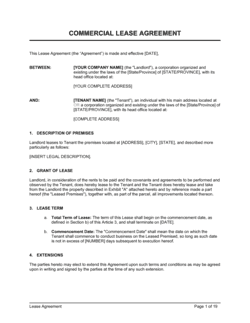
The commercial lease agreement is the primary contract between landlord and tenant defining rent, term, and use. A guaranty of a lease is a separate, ancillary document in which a third party agrees to back the tenant's obligations under that lease. The two documents are executed together but serve entirely different legal functions — one creates the tenancy; the other secures it.

vs Security Deposit Agreement

A security deposit is a fixed cash amount held by the landlord to cover limited losses — typically one to three months' rent. A lease guaranty is an ongoing promise by a creditworthy third party to cover unlimited or capped obligations for the full lease term. Guaranties provide broader and more durable protection than a deposit, but require a willing guarantor and may be subject to legal challenge if poorly drafted.

vs Personal Guarantee (General)

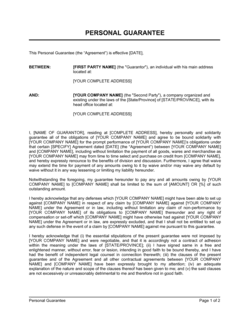
A general personal guarantee can back any business obligation — a loan, a vendor contract, or a line of credit. A guaranty of a lease is specifically structured for real property lease obligations, incorporating lease-specific concepts like holdover, surrender, restoration costs, and operating expense escalations. Using a general guarantee form for a lease often leaves material lease obligations uncovered.

vs Indemnity Agreement

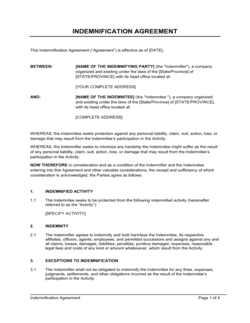
An indemnity agreement requires one party to compensate another for defined losses arising from a specific event or condition. A lease guaranty is broader — it is an ongoing, unconditional backstop for the full range of a tenant's lease obligations, not limited to a defined category of loss. Indemnity agreements are reactive; a lease guaranty is proactive security for the full term.

Industry-specific considerations

Retail

Retail landlords almost universally require personal guaranties from small business owners signing multi-year leases, particularly for flagship or anchor locations with significant tenant improvement allowances.

Food and Beverage

Restaurant leases typically involve significant landlord investment in build-out and long terms of 5–10 years, making full personal guaranties from operators standard — and burn-off provisions difficult to negotiate.

Professional Services

Law firms, accounting practices, and consulting firms often provide corporate guaranties backed by the managing partners personally, particularly when the leasing entity is a professional corporation with limited capitalization.

Technology and SaaS

Early-stage tech companies frequently face personal guaranty requirements from founders for office leases, with burn-off provisions tied to funding milestones or revenue thresholds replacing the guaranty once the company demonstrates financial stability.

Jurisdictional notes

United States

Lease guaranty enforceability is governed by state law and varies significantly. California courts scrutinize waiver-of-defenses clauses and may limit enforcement of guaranties that were modified without guarantor consent. New York recognizes 'good guy' clauses as a standard commercial practice. Several states require guaranties to be in writing and signed by the guarantor to be enforceable under the Statute of Frauds. The FTC's new rule on personal financial liability disclosures may affect how guaranty terms are presented in franchise contexts.

Canada

In Canada, lease guaranties are governed by provincial law under general contract and guarantee statutes. Ontario's Limitations Act sets a two-year limitation period on guarantee claims from the date the landlord knew or ought to have known of the default. Quebec's Civil Code treats guaranties (called suretyships) differently from common-law provinces — the surety has the right to require the creditor to first pursue the debtor. British Columbia and Alberta require guaranties to be written and executed with consideration.

United Kingdom

In England and Wales, lease guaranties must comply with the Landlord and Tenant (Covenants) Act 1995, which limits the ability to bind former tenants or original guarantors to obligations arising after a lease assignment. Authorized Guarantee Agreements (AGAs) are the standard mechanism for preserving guarantor liability on assignment. Scottish law follows similar principles but under separate statutory provisions. Guaranties on commercial leases of over three years must be executed as deeds to be enforceable.

European Union

EU member states treat commercial lease guaranties under national contract law, which varies considerably. French law requires a handwritten acknowledgment of the guaranteed amount for personal guaranties signed by individuals. German law distinguishes between a Bürgschaft (guaranty) and a Schuldbeitritt (assumption of debt), each carrying different rights for the guarantor against the landlord. Under GDPR, landlords collecting and processing personal financial data from individual guarantors must comply with applicable data protection requirements, including providing a privacy notice at the time of signing.

Template vs lawyer — what fits your deal?

PathBest forCostTime
Use the templateShort-term leases under 24 months or low-value leases where guaranty exposure is under $25,000Free20–30 minutes
Template + legal reviewCommercial leases over 24 months, any personal guaranty with exposure exceeding $50,000, or leases with broad waiver-of-defenses language$300–$6002–5 business days
Custom draftedHigh-value commercial leases, multi-location corporate guaranties, regulated industries, or guaranties involving cross-border or multi-jurisdictional enforcement$1,000–$3,500+1–2 weeks

Glossary

Guarantor
The individual or entity who agrees to fulfill the tenant's lease obligations if the tenant fails to do so.
Guaranty
A contractual promise by a third party to answer for another party's debt or performance obligation if that party defaults.
Full Guaranty
A guaranty with no cap on the guarantor's liability — the guarantor is responsible for all of the tenant's obligations under the lease for its entire term.
Limited Guaranty
A guaranty capped at a defined dollar amount or a specified number of months' rent, beyond which the guarantor has no further obligation.
Burn-Off Guaranty
A guaranty that automatically terminates or reduces once the tenant satisfies a defined condition, such as operating for 24 months without default.
Joint and Several Liability
A liability structure where multiple guarantors are each individually responsible for the full amount owed, not just their proportionate share.
Waiver of Defenses
A clause in which the guarantor gives up the right to assert certain legal defenses — such as the landlord's failure to pursue the tenant first — before the landlord can call on the guaranty.
Subrogation
The guarantor's right, after paying the landlord, to step into the landlord's shoes and pursue the tenant for reimbursement of amounts paid.
Default
A tenant's failure to meet a lease obligation — most commonly non-payment of rent — that triggers the landlord's right to demand performance from the guarantor.
Indemnification
A guarantor's agreement to compensate the landlord for losses, costs, and attorney fees incurred as a result of the tenant's default.
Good Guy Clause
A provision that caps the guarantor's liability on the date the tenant surrenders possession of the premises and gives written notice, even if the lease term has not expired.

Part of your Business Operating System

This document is one of 3,000+ business & legal templates included in Business in a Box.

  • Fill-in-the-blanks — ready in minutes
  • 100% customizable Word document
  • Compatible with all office suites
  • Export to PDF and share electronically

Create your document in 3 simple steps.

From template to signed document — all inside one Business Operating System.
1
Download or open template

Access over 3,000+ business and legal templates for any business task, project or initiative.

2
Edit and fill in the blanks with AI

Customize your ready-made business document template and save it in the cloud.

3
Save, Share, Send, Sign

Share your files and folders with your team. Create a space of seamless collaboration.

Save time, save money, and create top-quality documents.

★★★★★

"Fantastic value! I'm not sure how I'd do without it. It's worth its weight in gold and paid back for itself many times."

Managing Director · Mall Farm
Robert Whalley
Managing Director, Mall Farm Proprietary Limited
★★★★★

"I have been using Business in a Box for years. It has been the most useful source of templates I have encountered. I recommend it to anyone."

Business Owner · 4+ years
Dr Michael John Freestone
Business Owner
★★★★★

"It has been a life saver so many times I have lost count. Business in a Box has saved me so much time and as you know, time is money."

Owner · Upstate Web
David G. Moore Jr.
Owner, Upstate Web

Run your business with a system — not scattered tools

Stop downloading documents. Start operating with clarity. Business in a Box gives you the Business Operating System used by over 250,000 companies worldwide to structure, run, and grow their business.

Start free · No credit card required