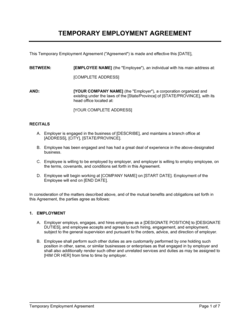
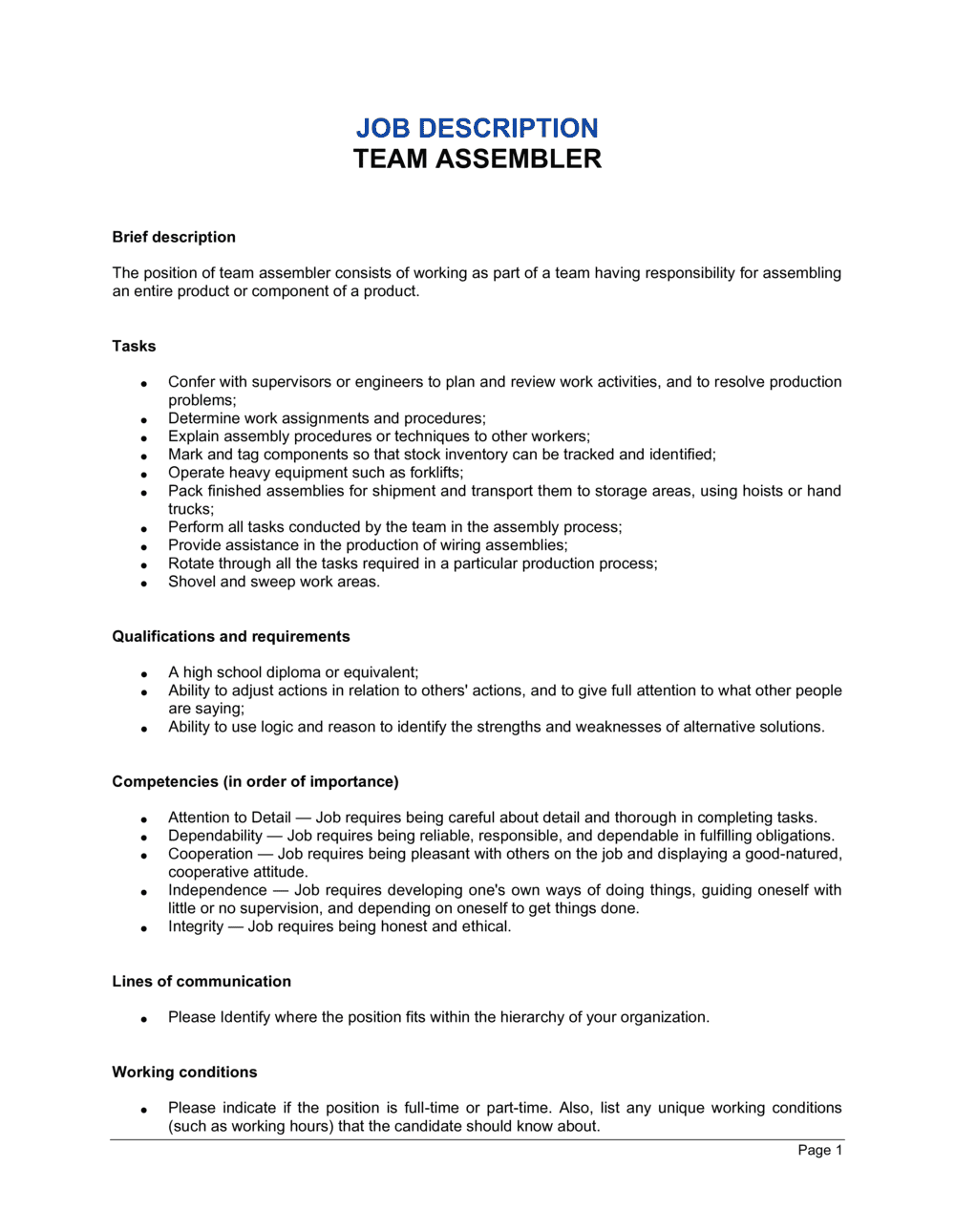
Team Assembler Job Description Template

Free Word download • Edit online • Save & share with Drive • Export to PDF

2 pages20–30 min to fillDifficulty: StandardSignature requiredLegal review recommended
Learn more ↓
FreeTeam Assembler Job Description Template

At a glance

What it is
A Team Assembler Job Description is a formal employment document that defines the role, responsibilities, physical requirements, qualifications, and working conditions for a team assembler position in a manufacturing, production, or warehouse environment. This free Word download gives you a structured, legally defensible starting point you can edit online and export as PDF to attach to offer letters, employment contracts, or internal HR records.
When you need it
Use it when posting a new team assembler vacancy, onboarding a production hire, or updating an existing role description to reflect changed duties, safety requirements, or shift structures. It is also required when making classification decisions under FLSA or equivalent legislation.
What's inside
Job title and department, reporting structure, core duties and responsibilities, physical demands and working conditions, required and preferred qualifications, compensation range, shift schedule, safety compliance obligations, and equal-opportunity language. Together these clauses create an auditable record of what was communicated to the candidate before hire.

What is a Team Assembler Job Description?

A Team Assembler Job Description is a formal HR and compliance document that defines the duties, physical demands, qualifications, safety requirements, compensation terms, and equal-opportunity obligations for a production worker who builds, fits, or finishes products as part of a coordinated manufacturing team. Unlike a job advertisement, it is the internal authoritative record of the role — used in ADA accommodation analysis, FLSA classification decisions, performance management proceedings, and workers' compensation hearings. This template is a free Word download you can edit online, attach to an offer letter or employment contract, and export as a signed PDF for permanent HR file retention.

Why You Need This Document

Without a documented, signed job description, four operational and legal risks materialize simultaneously. First, performance management becomes unenforceable — you cannot discipline or terminate an employee for failing to meet standards that were never written down. Second, ADA accommodation requests cannot be evaluated against genuine essential functions if those functions were never defined, leaving the employer exposed to claims of unreasonable denial. Third, FLSA misclassification audits and overtime disputes turn on whether the written role description accurately reflects non-exempt duties — a missing or vague document defaults against the employer. Fourth, workplace injury and workers' compensation proceedings rely on the physical demands statement to determine whether the injury falls within the scope of the described role. A complete, signed team assembler job description, collected before the employee's first shift, closes all four gaps and costs less than 30 minutes to complete using this template.

Which variant fits your situation?

If your situation is…Use this template
Hiring a single assembler who works independently without team coordination dutiesProduction Assembler Job Description
Hiring an assembler who will also lead a small shift teamAssembly Team Lead Job Description
Posting a role for a fully automated or CNC machine operatorMachine Operator Job Description
Engaging an assembly contractor rather than a direct employeeIndependent Contractor Agreement
Hiring a quality control inspector alongside assembly staffQuality Control Inspector Job Description
Documenting a temporary or seasonal assembly roleTemporary Employment Contract
Filling a warehouse picker-packer role with similar physical demandsWarehouse Worker Job Description

Common mistakes to avoid

❌ Omitting the pay range in states that require it

Why it matters: California, Colorado, New York, Washington, and several Canadian provinces mandate pay transparency in job postings. Non-compliant postings attract regulatory fines and signal to candidates that the employer is behind on compliance.

Fix: Check current pay transparency laws for every jurisdiction where the role will be posted and include a good-faith pay band even in states where it is not yet required — it reduces negotiation friction and improves offer acceptance rates.

❌ Listing physical demands that exceed actual job requirements

Why it matters: Overstated lifting or standing requirements that cannot be tied to genuine operational necessity expose the employer to ADA discrimination claims from otherwise qualified candidates who are screened out unnecessarily.

Fix: Conduct a brief physical demands analysis on the actual workstation — measure lift weights, standing time, and environmental conditions — and document the data source in your HR file before publishing the description.

❌ Using an identical job description for every assembler role regardless of product line

Why it matters: A one-size-fits-all description fails to capture role-specific safety hazards, tooling requirements, and output standards — undermining its use in discipline, accommodation, and termination proceedings.

Fix: Maintain a base template and require each department or line supervisor to complete a role-specific addendum covering the product, machinery, and production standards unique to their cell.

❌ Skipping the acknowledgment signature before the start date

Why it matters: An unsigned job description cannot be introduced as a binding exhibit in a termination or workers' compensation hearing. Post-start-date signatures also raise fresh-consideration questions in common-law jurisdictions.

Fix: Present the signed job description as part of the pre-employment offer package — require signature alongside the offer letter, background check authorization, and employment contract before day one.

❌ Failing to update the job description after role changes

Why it matters: A description that no longer reflects actual duties creates mismatches in performance reviews, invalidates discipline based on duties not listed, and can support a constructive dismissal claim if the real role is substantially different from what was signed.

Fix: Build a formal review trigger into your HR calendar — any change in machinery, product line, shift structure, or safety requirements should prompt a description update with a new signed acknowledgment.

❌ Using protected-class language from an older template

Why it matters: EEO language that omits gender identity, sexual orientation, or veteran status — now protected in many jurisdictions — exposes the employer to discrimination claims and disqualifies the company from federal contracts.

Fix: Use a current EEO boilerplate that includes all federally and state-protected categories, and have your legal or HR team review it annually against changes in applicable law.

The 10 key clauses, explained

Job Title, Department, and Reporting Line

In plain language: Names the position exactly as it will appear in payroll and HR systems, identifies the department or production cell, and states who the assembler reports to.

Sample language
Position: Team Assembler | Department: [DEPARTMENT NAME] | Reports To: [SUPERVISOR TITLE] | Location: [FACILITY ADDRESS OR SITE NAME]

Common mistake: Using a generic title like 'Production Worker' instead of 'Team Assembler.' Mismatched titles create FLSA classification inconsistencies and complicate workers' compensation claims.

Position Summary

In plain language: A two-to-four sentence overview of the role's primary purpose — what the assembler builds, what team they work within, and the performance standard expected.

Sample language
The Team Assembler is responsible for assembling [PRODUCT TYPE] components in accordance with [COMPANY NAME]'s quality standards and production schedules. Working as part of a [X]-person assembly cell, the incumbent rotates through [NUMBER] stations and is expected to meet a daily output target of [X UNITS].

Common mistake: Writing a position summary that could apply to any factory role. A vague summary weakens the legal defensibility of discipline or termination decisions tied to job performance.

Core Duties and Responsibilities

In plain language: An itemized list of the essential functions the assembler is required to perform, written specifically enough to anchor performance reviews, discipline, and ADA accommodation analysis.

Sample language
Essential functions include: (a) assembling [COMPONENT] using hand tools and power tools per work instructions; (b) inspecting completed units against specifications in the BOM; (c) reporting defects, shortages, or safety hazards to the shift supervisor within [X] minutes of identification; (d) maintaining a clean and organized workstation in compliance with 5S standards.

Common mistake: Listing 'other duties as assigned' as the only catch-all without specifying genuine essential functions first. Courts and labor boards look to the written duties list when evaluating wrongful termination or accommodation claims.

Physical Demands and Working Conditions

In plain language: Describes the physical requirements of the role — lifting weight, standing duration, repetitive motion, noise levels, and temperature — necessary for ADA compliance and candidate transparency.

Sample language
This position requires: standing and walking for up to [X] hours per shift; regularly lifting and carrying items weighing up to [X] lbs; repetitive hand and wrist motions; exposure to noise levels requiring hearing protection; and working in a temperature range of [X°F–X°F].

Common mistake: Overstating physical demands (e.g., claiming '75 lbs lift' when the actual maximum is 40 lbs) to screen out candidates. Inflated requirements create ADA liability if they cannot be tied to genuine operational necessity.

Required Qualifications

In plain language: States the minimum education, experience, certifications, and skills a candidate must possess to be considered for the role.

Sample language
Minimum qualifications: High school diploma or GED; [X] months of production or assembly experience; ability to read work orders, blueprints, or assembly diagrams; basic mechanical aptitude; and a demonstrated safety record in a prior manufacturing role.

Common mistake: Requiring a high school diploma for a role where it has no demonstrated relationship to job performance. Credential requirements that screen out protected classes without business necessity invite EEOC scrutiny.

Preferred Qualifications

In plain language: Lists additional skills, certifications, or experience that strengthen a candidate's application but are not mandatory for hire.

Sample language
Preferred qualifications include: forklift certification; experience with [SPECIFIC MACHINERY OR PRODUCT TYPE]; bilingual proficiency in [LANGUAGE]; or completion of a vocational manufacturing program.

Common mistake: Treating preferred qualifications as de facto requirements during the hiring process. Documented hiring decisions that consistently reject candidates lacking 'preferred' credentials can be challenged as unlawful screening.

Compensation, Shift Schedule, and Benefits

In plain language: States the hourly wage range, applicable shift (day, swing, or night), shift differential if any, and a brief reference to benefits eligibility.

Sample language
Hourly rate: $[X.XX]–$[X.XX] per hour, depending on experience. Shift: [DAY / SWING / NIGHT] — [START TIME] to [END TIME], [DAYS OF WEEK]. Shift differential: [X]% for swing shift; [X]% for night shift. Benefits: eligible for [COMPANY NAME]'s standard benefits package after [X]-day introductory period.

Common mistake: Omitting the pay range entirely. Several US states and Canadian provinces now require pay transparency in job postings; non-compliance results in fines and reputational exposure on job boards.

Safety, PPE, and Compliance Obligations

In plain language: Specifies OSHA or equivalent safety requirements, required PPE, drug and alcohol testing conditions, and the employee's obligation to report unsafe conditions.

Sample language
The Team Assembler must comply with all OSHA / [PROVINCIAL / NATIONAL] workplace safety regulations, wear required PPE at all times on the production floor (including steel-toed boots, safety glasses, and hearing protection), and report any workplace injury or near-miss to [SUPERVISOR TITLE] within [X] minutes of occurrence.

Common mistake: Referencing 'all applicable safety regulations' without naming the specific standard (OSHA 29 CFR 1910, for example). Vague safety clauses are harder to enforce in disciplinary proceedings and offer weaker protection in workers' compensation disputes.

Equal Opportunity and Accommodation Statement

In plain language: Affirms the employer's commitment to non-discriminatory hiring and the availability of reasonable accommodation for qualified candidates with disabilities.

Sample language
[COMPANY NAME] is an equal opportunity employer. We do not discriminate on the basis of race, color, religion, sex, national origin, age, disability, genetic information, or any other status protected by applicable law. Candidates requiring reasonable accommodation to participate in the application or hiring process should contact [HR CONTACT / EMAIL].

Common mistake: Using outdated protected-class language that omits categories added by more recent legislation — such as gender identity or sexual orientation — exposing the employer to discrimination claims in jurisdictions that have expanded protections.

Acknowledgment and Signature Block

In plain language: A section where the candidate or newly hired employee signs to confirm they have read, understood, and received a copy of the job description before or on their start date.

Sample language
I acknowledge that I have received and reviewed this job description and understand that it describes the general nature and level of work assigned to this position. Employee Signature: _______________ Date: ________ | Supervisor Signature: _______________ Date: ________

Common mistake: Skipping the signature block entirely or collecting the signature weeks after the start date. An unsigned or late-signed job description cannot be used as an exhibit in performance management or termination proceedings.

How to fill it out

  1. 1

    Enter the job title, department, and reporting structure

    Use the exact job title that will appear in payroll and HR systems. Confirm the department name and the direct supervisor's title — not their personal name — so the document remains valid if management changes.

    💡 Cross-check the job title against your FLSA classification records before publishing. 'Team Assembler' is almost always non-exempt; confirm overtime eligibility is correctly flagged in your HRIS.

  2. 2

    Write a specific position summary

    Draft two to four sentences that identify what product or component is assembled, the size and structure of the team, and the key performance standard (output rate, quality target, or cycle time).

    💡 Anchor at least one metric in the summary — 'daily output target of 150 units' is more defensible in a performance review than 'meets production goals.'

  3. 3

    List essential functions with enough specificity for ADA analysis

    Itemize at least six to eight core duties using action verbs. For each duty, consider whether it is truly essential — meaning the role exists primarily to perform it — or merely marginal. Only essential functions need to appear here.

    💡 If a duty accounts for less than 5% of the shift and could be reassigned, it is likely marginal. Including marginal duties as 'essential' weakens your position in accommodation disputes.

  4. 4

    Complete the physical demands section accurately

    Measure or estimate actual lifting weights, standing durations, and environmental exposures on your production floor. Document the source (e.g., time-study data or supervisor estimate) in your HR file even if not on the form.

    💡 Have your EHS manager or a supervisor on the relevant line review the physical demands statement before you post the role — inaccurate data is the single most common source of ADA accommodation disputes.

  5. 5

    Set qualification thresholds with documented business justification

    For each required credential or experience threshold, document internally why it is necessary for the role. This file note becomes critical evidence if a rejected candidate files an EEOC charge.

    💡 If your current top performers lack a credential you are considering requiring, that credential likely cannot be defended as a business necessity.

  6. 6

    Enter the pay range, shift details, and differential

    Include the full hourly pay band, the specific shift hours and days, and any applicable differential. Reference the benefits package by category rather than listing specific plan details that may change annually.

    💡 Check your state or province's pay transparency requirements before posting — California, Colorado, New York, and British Columbia all mandate disclosure of the pay range in job postings as of 2025.

  7. 7

    Review safety and PPE requirements with your EHS team

    Specify the exact OSHA standard (or provincial equivalent) that applies, name every required PPE item, and include the reporting obligation for injuries and near-misses.

    💡 Referencing the specific CFR section (e.g., OSHA 29 CFR 1910.132 for PPE) makes the safety clause enforceable as a workplace rule, not just aspirational language.

  8. 8

    Collect a signed acknowledgment before or on day one

    Present the completed job description to the candidate at the offer stage or at the latest on the first day. Retain the signed copy in the employee's permanent HR file alongside the employment contract.

    💡 Use Business in a Box eSign to timestamp execution and store the acknowledged copy securely — a timestamped digital signature is as enforceable as a wet signature in all major jurisdictions.

Frequently asked questions

What is a team assembler job description?

A team assembler job description is a formal HR document that defines the duties, physical requirements, qualifications, safety obligations, and compensation terms for a production worker who builds or assembles products as part of a manufacturing team. It serves as the authoritative record of what was communicated to the candidate before hire and is used in performance management, workers' compensation, and ADA accommodation proceedings.

Is a job description a legally binding contract?

A job description is not an employment contract on its own, but it carries significant legal weight. Courts and labor agencies treat a signed job description as evidence of what the employer and employee mutually understood the role to require. In ADA, FLSA, and EEOC proceedings, the written duties and physical demands list is frequently the central exhibit. An unsigned or outdated description weakens the employer's position in every one of those contexts.

Does a team assembler job description need to be signed?

Legally, no signature is universally required — but best practice and practical enforceability demand one. A signed acknowledgment confirms the employee received and understood the description before starting work. In termination and discipline proceedings, an acknowledged job description establishes the baseline expectations against which performance was measured. Obtain the signature before or on the first day of employment.

What physical demands should I include for a team assembler role?

Include lifting weight (typically 25–50 lbs for most assembly roles), duration of standing or walking per shift, repetitive motion (hand, wrist, and arm actions), environmental conditions (noise levels, temperature range, dust or fume exposure), and any vision or dexterity requirements. Base these on actual workstation measurements, not assumptions. Accurate physical demands data is your primary defense against ADA claims from candidates who were screened out of a role they could have performed with minor accommodation.

How is a team assembler different from a general production worker?

A team assembler specifically rotates through multiple stations within an assembly cell or line, coordinating output with adjacent team members to maintain flow and quality. A general production worker may perform a single repetitive task with no cross-training or rotation requirement. The distinction matters for FLSA classification, training investment, and job posting accuracy — misclassifying the role affects candidate expectations and turnover rates.

What qualifications should a team assembler job description require?

Minimum qualifications typically include a high school diploma or GED, basic mechanical aptitude, and the ability to read work orders or assembly diagrams. Experience requirements commonly range from zero to 12 months depending on product complexity. Every required credential must have a documented business necessity — requirements that cannot be tied to job performance risk EEOC challenge as disparate-impact discrimination.

Do I need to include pay transparency information in the job description?

In a growing number of jurisdictions, yes. California, Colorado, New York, Washington, Illinois, and British Columbia require employers to disclose a good-faith pay range in job postings. Federal contractors are subject to additional disclosure rules. Even where not legally required, including the pay band reduces time-to-hire and signals transparency to candidates in a competitive labor market.

How often should a team assembler job description be updated?

Update it any time the role's duties, machinery, product line, shift structure, or safety requirements change materially. At minimum, conduct an annual review aligned to your performance management cycle. Each update should result in a new signed acknowledgment from affected employees — a description that no longer matches actual duties is worse than no description at all because it creates a misleading paper trail.

Can I use the same job description for temporary and permanent assemblers?

You can use the same base description, but you should add a clause specifying the temporary or fixed-term nature of the role, the expected duration, and whether the position is benefit-eligible. Temporary roles placed through a staffing agency require additional clarity on which entity is the employer of record for workers' compensation, payroll tax, and benefits purposes.

How this compares to alternatives

vs Employment Contract

An employment contract governs the legal relationship between employer and employee — compensation, IP, non-compete, termination, and severance. A job description defines the operational content of the role — duties, qualifications, and physical demands. Both documents are needed: the contract creates enforceable obligations; the job description defines the standard against which performance is measured. Relying on only one leaves critical gaps.

vs Offer Letter

An offer letter confirms the role, compensation, and start date to secure candidate acceptance. A job description provides the detailed duties, physical requirements, and compliance language the offer letter omits. The job description should be attached to or referenced in the offer letter so the candidate acknowledges both documents before their first day.

vs Independent Contractor Agreement

An independent contractor agreement engages a self-employed individual for project-based assembly work with no employment entitlements. A team assembler job description is designed for a direct employee. Using a job description format with a contractor signals an employer-employee relationship and can trigger misclassification liability for payroll taxes, overtime, and workers' compensation.

vs Job Posting / Job Advertisement

A job advertisement is a public-facing marketing document designed to attract applicants — it typically summarizes duties and compensation in 200–400 words. A job description is the full internal HR document used for compliance, performance management, and legal proceedings. The posting is derived from the description, not the other way around. Writing the description first ensures the posting is accurate and legally defensible.

Industry-specific considerations

Automotive Manufacturing

Assembly descriptions must reference specific torque specifications, quality gate checkpoints, and ergonomic rotation schedules to comply with OEM supplier standards and UAW or equivalent collective bargaining requirements.

Electronics and Consumer Products

ESD (electrostatic discharge) handling requirements, clean-room protocols, and microscopic component assembly dexterity standards must be documented to meet ISO 9001 and IPC certification audit expectations.

Food and Beverage Processing

FDA, USDA, or CFIA food safety compliance obligations — including hairnet, glove, and sanitation protocols — must be specified as essential safety functions alongside standard PPE requirements.

Medical Device Manufacturing

FDA 21 CFR Part 820 and ISO 13485 quality management requirements mandate that job descriptions document training qualifications, lot-traceability responsibilities, and documented competency sign-offs for each assembly station.

Jurisdictional notes

United States

Team assemblers are almost universally classified as non-exempt under the FLSA, entitling them to overtime at 1.5× for hours exceeding 40 per week. ADA requires that physical demands reflect genuine essential functions — overstated requirements invite disparate-impact claims. California, Colorado, New York, and Washington require pay range disclosure in job postings. OSHA 29 CFR 1910 sets the federal floor for PPE and hazard communication obligations that must appear in the safety clause.

Canada

Each province's Employment Standards Act governs minimum wage, overtime thresholds, and rest periods that must be consistent with stated shift terms. Ontario's Accessibility for Ontarians with Disabilities Act (AODA) and equivalent provincial accessibility legislation require that job descriptions accurately reflect genuine requirements to support accommodation analysis. British Columbia, Ontario, and Prince Edward Island have enacted pay transparency requirements for posted roles. Quebec employers must ensure all workplace documents, including job descriptions, are available in French.

United Kingdom

Under the Equality Act 2010, physical requirements and qualifications must be justified as proportionate means of achieving a legitimate aim — vague or overstated requirements can constitute indirect discrimination. The Health and Safety at Work Act 1974 and associated regulations require that PPE and safety obligations described in the role are consistent with the employer's formal risk assessment for the workstation. Manual handling regulations (1992) set specific training and assessment obligations for roles involving repetitive lifting, which must be referenced in the physical demands clause.

European Union

The EU Pay Transparency Directive (2023/970) requires member states to implement pay disclosure obligations for job postings by June 2026 — employers operating across the EU should include pay ranges now to prepare for compliance. The Employment Equality Directive prohibits qualification requirements that produce unjustified disparate impact on protected groups. GDPR applies to any personal data collected during the application process referenced in the job description, requiring a privacy notice linked from the posting. Manual handling and workplace safety directives (89/391/EEC framework) require role-specific risk assessments that underpin the physical demands statement.

Template vs lawyer — what fits your deal?

PathBest forCostTime
Use the templateSMEs and HR teams hiring standard assembly roles in a single jurisdiction with no collective bargaining agreementFree30–60 minutes per role
Template + legal reviewEmployers operating in multiple states or provinces, heavily regulated industries, or roles with complex physical demands and ADA exposure$200–$500 per description (employment counsel or HR consultant review)1–3 business days
Custom draftedUnionized environments, federal contractors subject to OFCCP requirements, or medical device and food manufacturers with ISO/FDA documentation mandates$500–$2,000+ (employment attorney with manufacturing sector experience)1–2 weeks

Glossary

Team Assembler
A production worker who collaborates with others on an assembly line or in a cell to build, fit, or finish a product — rotating through multiple stations as needed.
FLSA Classification
The determination under the US Fair Labor Standards Act of whether a role is exempt or non-exempt from overtime pay requirements — most assembler roles are non-exempt.
Essential Functions
The core duties a position must perform, as defined for ADA compliance purposes — omitting genuine essential functions exposes the employer to discrimination claims.
Physical Demands Statement
A documented description of the lifting, standing, repetitive motion, and environmental conditions required by a role, used to assess reasonable accommodation requests.
Reasonable Accommodation
A modification to the work environment or job duties that enables a qualified individual with a disability to perform essential functions without undue hardship to the employer.
Non-Exempt Employee
An employee who is entitled to overtime pay at 1.5 times the regular rate for all hours worked beyond 40 in a workweek under the FLSA.
Job Hazard Analysis (JHA)
A safety procedure that identifies the hazards associated with each step of a job task, used to develop training and protective measures for assembly roles.
At-Will Employment
An employment arrangement — common in most US states — in which either party may end the relationship at any time for any lawful reason, not limited to cause.
PPE (Personal Protective Equipment)
Safety gear — gloves, safety glasses, steel-toed boots, ear protection — required for a role to comply with OSHA or equivalent workplace safety standards.
Bill of Materials (BOM)
A structured list of components, parts, and quantities required to build a product, which team assemblers reference to verify completeness and accuracy of their work.
Shift Differential
Additional pay provided to employees who work evening, overnight, or weekend shifts, often expressed as a percentage above the base hourly rate.

Part of your Business Operating System

This document is one of 3,000+ business & legal templates included in Business in a Box.

  • Fill-in-the-blanks — ready in minutes
  • 100% customizable Word document
  • Compatible with all office suites
  • Export to PDF and share electronically

Create your document in 3 simple steps.

From template to signed document — all inside one Business Operating System.
1
Download or open template

Access over 3,000+ business and legal templates for any business task, project or initiative.

2
Edit and fill in the blanks with AI

Customize your ready-made business document template and save it in the cloud.

3
Save, Share, Send, Sign

Share your files and folders with your team. Create a space of seamless collaboration.

Save time, save money, and create top-quality documents.

★★★★★

"Fantastic value! I'm not sure how I'd do without it. It's worth its weight in gold and paid back for itself many times."

Managing Director · Mall Farm
Robert Whalley
Managing Director, Mall Farm Proprietary Limited
★★★★★

"I have been using Business in a Box for years. It has been the most useful source of templates I have encountered. I recommend it to anyone."

Business Owner · 4+ years
Dr Michael John Freestone
Business Owner
★★★★★

"It has been a life saver so many times I have lost count. Business in a Box has saved me so much time and as you know, time is money."

Owner · Upstate Web
David G. Moore Jr.
Owner, Upstate Web

Run your business with a system — not scattered tools

Stop downloading documents. Start operating with clarity. Business in a Box gives you the Business Operating System used by over 250,000 companies worldwide to structure, run, and grow their business.

Free Forever Plan · No credit card required