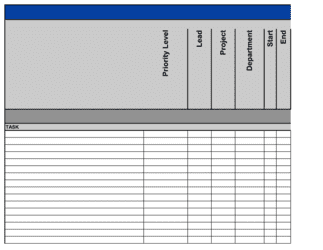
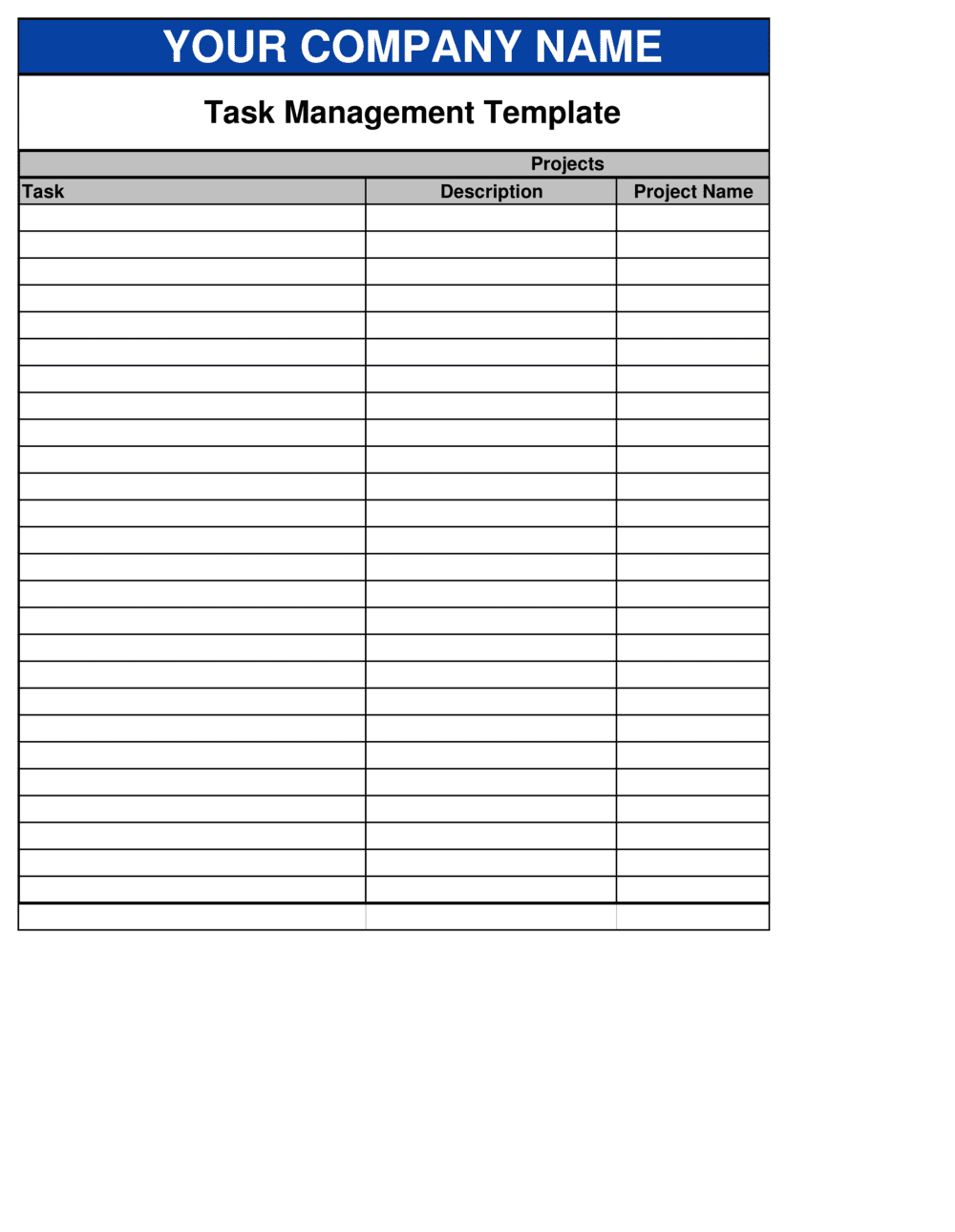
Task Management Template

Free Excel download β€’ Edit online β€’ Save & share with Drive β€’ Export to PDF

1 pageβ€’20–30 min to fillβ€’Difficulty: Standardβ€’Signature requiredβ€’Legal review recommended
Learn more ↓
FreeXLSTask Management Template

At a glance

What it is
A Task Management Template is a structured document that formally assigns work tasks to named individuals or teams, defines deliverables, sets deadlines, and establishes accountability within a project or ongoing operation. This free Word download gives you a ready-to-use framework you can edit online and export as PDF to distribute to your team or attach to a broader project or service agreement.
When you need it
Use it when launching a new project, onboarding a contractor, delegating work across departments, or whenever you need a written record of who is responsible for what and by when. It is especially valuable when tasks span multiple parties whose obligations need to be formally documented.
What's inside
Scope of work and task definitions, assignee and owner identification, priority levels and deadlines, dependency mapping, status tracking fields, escalation procedures, and sign-off requirements β€” all in a single structured document that serves as both an operational tool and a formal record of agreed responsibilities.

What is a Task Management Template?

A Task Management Template is a structured document that formally defines, assigns, and tracks discrete work tasks within a project, team, or ongoing operation. It records each task's description and deliverable, the named owner responsible for completing it, the priority level, the deadline, any predecessor dependencies, and the current status β€” creating a single, auditable source of truth for who is accountable for what and by when. When used in contractor, agency, or multi-party contexts, it includes signed acknowledgment fields and an amendment procedure, converting a simple task list into a binding record of agreed responsibilities.

Unlike a generic to-do list or project management software export, a formalized task management template establishes the acceptance criteria, escalation procedures, and sign-off requirements that make accountability enforceable rather than assumed. It functions both as an operational coordination tool and as a legal record that can be attached to or referenced by a master service agreement, employment contract, or statement of work.

Why You Need This Document

Without a formalized task management document, accountability rests entirely on memory, email threads, and verbal agreements β€” none of which hold up when a deadline is missed, a deliverable is disputed, or a contractor claims they were never informed of a specific obligation. The cost of this ambiguity is concrete: projects stall when upstream tasks are not completed because no one was formally assigned, invoices are disputed because there is no agreed acceptance record, and contractors or employees contest performance reviews because the original task scope was never documented in writing.

A signed task management template eliminates these gaps by establishing a clear baseline of what was agreed before work begins. It gives managers a documented basis for escalating overdue tasks, enforces a review-and-acceptance process that triggers payment milestones cleanly, and protects both parties if a scope dispute reaches a legal or HR process. For cross-border or multi-contractor arrangements, the governing law and confidentiality clauses ensure the document functions as part of a coherent legal framework rather than an administrative afterthought. This template gives you everything you need to build that framework in under an hour.

Which variant fits your situation?

If your situation is…Use this template
Managing tasks across a complex multi-phase projectProject Plan Template
Assigning recurring operational tasks to a team on a weekly cycleAction Plan Template
Tracking tasks tied to a specific client deliverable or contractWork Order Template
Delegating tasks to a contractor with binding milestone obligationsIndependent Contractor Agreement
Managing tasks and accountability during a team meetingMeeting Minutes Template
Tracking onboarding tasks for a new hire with HR sign-offEmployee Onboarding Checklist
Assigning tasks with budget tracking across a departmentProject Budget Template

Common mistakes to avoid

❌ Vague or output-free task descriptions

Why it matters: Without a named deliverable and acceptance criteria, there is no shared definition of 'done' β€” disputes about whether a task was completed are almost impossible to resolve objectively.

Fix: Rewrite every task to name the specific output, the format it must be in, and the standard it must meet. If the acceptance criteria cannot be written in two sentences, the task is too broad.

❌ No formal assignee acknowledgment

Why it matters: A task list that was never formally acknowledged gives the assignee grounds to claim they were not aware of specific responsibilities or deadlines β€” undermining your ability to enforce accountability.

Fix: Require a signature or recorded electronic acknowledgment from every named assignee before work begins, and retain a copy with the project record.

❌ Undefined review and acceptance window

Why it matters: Without a stated review window, completed tasks remain in limbo indefinitely β€” blocking payment triggers, stalling downstream work, and incentivizing procrastination on review.

Fix: State a specific review period (e.g., three business days) and include a deemed-acceptance clause that treats non-response within the window as approval.

❌ No escalation or blocked-task procedure

Why it matters: Assignees who hit a blocker and have no documented escalation path may do nothing until the deadline passes β€” by which point the impact on dependent tasks and milestones is already locked in.

Fix: Name a specific escalation contact, set a maximum notification window of four to eight business hours from the time a blocker is identified, and require a proposed resolution with the escalation notice.

❌ Allowing verbal scope changes without written amendments

Why it matters: Undocumented verbal additions are the primary driver of scope creep β€” once a task is completed under a verbal instruction, recovering the cost or adjusting the timeline is difficult without a written record.

Fix: Insert a clause requiring that any task addition, removal, or material modification be approved in writing by a named authority before work begins, and enforce it consistently from the first change request.

❌ Omitting governing law when contractors are in different jurisdictions

Why it matters: Without a governing law clause, a dispute between parties in different states or countries can trigger competing legal claims about which jurisdiction's rules apply, significantly increasing resolution cost and time.

Fix: Always specify a governing jurisdiction in the agreement header and confirm it is the same jurisdiction referenced in any master service or employment agreement between the parties.

The 10 key clauses, explained

Parties and scope identification

In plain language: Identifies the parties bound by the task management document β€” the assigning party and the assignee β€” and defines the high-level scope of work to which the tasks relate.

Sample language
This Task Management Agreement is entered into between [ASSIGNING PARTY NAME] ('Manager') and [ASSIGNEE NAME / TEAM NAME] ('Assignee') in connection with [PROJECT / ENGAGEMENT NAME] commencing [START DATE].

Common mistake: Omitting the legal entity name of the assigning party and using only a department name β€” this creates ambiguity about who bears accountability if a task-related dispute arises.

Task definitions and deliverables

In plain language: Lists each task in specific, measurable terms with a named deliverable, so both parties agree on what 'done' means before work begins.

Sample language
Task ID [T-001]: [TASK DESCRIPTION]. Deliverable: [SPECIFIC OUTPUT]. Acceptance criteria: [CRITERIA]. Assigned to: [ASSIGNEE NAME]. Due: [DATE].

Common mistake: Describing tasks in outcome-free language such as 'work on the website' rather than 'deliver a reviewed homepage wireframe approved by the client' β€” vague definitions make it impossible to determine whether a task was completed.

Priority levels and sequencing

In plain language: Assigns a formal priority rating to each task and documents any sequencing dependencies so the order of execution is unambiguous.

Sample language
Priority: [CRITICAL / HIGH / MEDIUM / LOW]. Dependencies: Task [T-001] must be completed before Task [T-002] begins. Blocking condition: [CONDITION IF APPLICABLE].

Common mistake: Marking every task as High or Critical β€” when all tasks carry the same priority, the designation is meaningless and teams cannot make informed trade-off decisions when capacity is constrained.

Deadlines and milestone dates

In plain language: States specific calendar deadlines for each task and identifies milestone dates that trigger review, payment, or the start of the next phase.

Sample language
Task due date: [DATE]. Milestone: Completion of Phase [X] tasks by [DATE] constitutes the '[MILESTONE NAME]' milestone and triggers [PAYMENT / REVIEW / NEXT PHASE COMMENCEMENT].

Common mistake: Setting deadlines without accounting for task dependencies β€” a downstream task with a hard deadline becomes impossible if an upstream dependency is not tracked and managed.

Assignee responsibilities and acceptance

In plain language: Defines what the assignee is expected to do, the standard of work required, and the process by which they formally accept the assigned tasks.

Sample language
Assignee acknowledges receipt of the tasks listed in Schedule A and agrees to perform each task in accordance with the specifications and deadlines set out herein. Acceptance is confirmed by Assignee's signature below or electronic acknowledgment by [DATE].

Common mistake: Distributing task lists without any formal acknowledgment mechanism β€” without a record of acceptance, an assignee can credibly claim they were not aware of a task or its deadline.

Status reporting and progress updates

In plain language: Establishes the frequency and format of progress updates the assignee must provide, and who receives them.

Sample language
Assignee shall submit a status update for all open tasks every [FREQUENCY β€” e.g., Monday by 9:00 AM] using the format set out in Schedule B. Updates shall be sent to [MANAGER NAME / ROLE] at [EMAIL / PLATFORM].

Common mistake: Leaving status reporting frequency undefined β€” without a cadence, managers discover task delays only at the deadline rather than early enough to intervene.

Escalation and blocked-task procedures

In plain language: Documents the steps the assignee must follow when a task is blocked, at risk, or requires a decision outside their authority, and identifies who must be notified and within what timeframe.

Sample language
If a task is blocked or at risk of missing its deadline, Assignee shall notify [ESCALATION CONTACT] within [X] business hours of identifying the issue, describing the blocker and proposed resolution.

Common mistake: No escalation clause at all β€” assignees who encounter a blocker may wait until the deadline passes before raising the issue, by which point the downstream impact is already locked in.

Task modification and scope change process

In plain language: Establishes how tasks can be added, removed, or modified after the document is signed, including who has authority to approve changes and how they are documented.

Sample language
No task may be added, removed, or materially modified without written approval from [AUTHORIZED APPROVER NAME / ROLE]. Approved changes shall be recorded in a revised Schedule A signed by both parties.

Common mistake: Allowing verbal task changes without any written amendment β€” scope creep begins with undocumented verbal additions, and the original agreed scope becomes unenforceable as the baseline.

Sign-off and acceptance of completed tasks

In plain language: Defines the review and approval process for completed tasks, including who reviews, how long the review window is, and what constitutes acceptance or rejection.

Sample language
Upon Assignee's notification of task completion, Manager shall review the deliverable within [X] business days and provide written acceptance or a detailed rejection notice. Failure to respond within [X] business days constitutes deemed acceptance.

Common mistake: No defined review window β€” open-ended review periods allow a manager to delay acceptance indefinitely, which blocks payment milestones and stalls downstream tasks.

Governing terms, confidentiality, and termination

In plain language: States the governing law, any confidentiality obligations that apply to task-related information, and the conditions under which the task management arrangement can be terminated by either party.

Sample language
This Agreement is governed by the laws of [JURISDICTION]. All task-related information, data, and deliverables are deemed Confidential Information subject to the confidentiality obligations in [MASTER AGREEMENT / SECTION X]. Either party may terminate this Agreement on [X] days' written notice.

Common mistake: Omitting a governing law clause in arrangements involving remote workers or contractors in different jurisdictions β€” without it, a dispute can trigger competing claims about which legal system applies.

How to fill it out

  1. 1

    Identify the parties and link to the governing engagement

    Enter the full legal names of the assigning party and each assignee. Reference the master contract, project agreement, or employment relationship that this task document sits under.

    πŸ’‘ If this template is used standalone rather than under a master agreement, add a short scope-of-engagement paragraph so the document is self-contained.

  2. 2

    Define each task in specific, measurable terms

    Write each task as a discrete, completable unit with a named deliverable and clear acceptance criteria. Avoid bundling multiple outcomes into a single task line.

    πŸ’‘ Apply the 'done means what, exactly?' test to each task before finalizing β€” if you cannot answer in one sentence, split or rewrite the task.

  3. 3

    Assign priority levels and map dependencies

    Rate each task Critical, High, Medium, or Low and document any predecessor tasks that must be complete before a downstream task can start.

    πŸ’‘ Reserve 'Critical' for tasks whose delay directly blocks a client deliverable, payment milestone, or regulatory deadline β€” use it sparingly so it retains meaning.

  4. 4

    Set specific calendar deadlines for every task

    Enter a due date for each task, not just the final project deadline. Work backward from milestone dates to set realistic intermediate deadlines.

    πŸ’‘ Build in a one-to-two-business-day review buffer before each milestone date so late completions do not automatically blow the milestone.

  5. 5

    Define the status reporting cadence

    Choose a specific update frequency β€” daily, twice weekly, or weekly β€” and name the platform or format for reporting. Tie the cadence to task risk level: higher-priority tasks warrant more frequent check-ins.

    πŸ’‘ A brief standing weekly update table (Task ID, Status, Blocker Y/N, ETA) is faster to complete and read than a narrative progress report.

  6. 6

    Document the escalation path

    Name the specific individual (by role and contact) who must be notified when a task is blocked, and state the notification window β€” typically within four to eight business hours of identifying a blocker.

    πŸ’‘ Test the escalation path before the project starts β€” confirm the named contact is reachable and authorized to unblock the most common categories of task risk.

  7. 7

    Obtain signed acknowledgment from each assignee

    Have every named assignee sign or electronically acknowledge the document before work begins. For contractors, obtain this alongside or immediately after their service agreement.

    πŸ’‘ Signature before day one is the standard β€” post-start acknowledgments create the same enforceability gap as post-start-date employment contracts in common-law jurisdictions.

  8. 8

    Establish the amendment and change-request process

    Name who is authorized to approve task additions or scope changes and confirm that all changes require a written amendment to Schedule A before work on the modified task begins.

    πŸ’‘ Use a sequential amendment numbering system (Amendment 001, 002) so the document history is traceable if a dispute arises about what was agreed and when.

Frequently asked questions

What is a task management template?

A task management template is a structured document that defines, assigns, and tracks discrete units of work within a project or operational workflow. It records the task description, the named owner, the priority level, the deadline, any dependencies, and the status at each review point. When used in a formal business or contractual context, it also includes sign-off fields and amendment procedures that create an auditable record of agreed responsibilities.

Why does a task management document need a signature?

A signature converts a task list from an informal communication into a binding record of acknowledged responsibilities. In contractual or employment contexts, it establishes that the assignee was aware of specific tasks and deadlines β€” which is critical if a dispute arises about whether an obligation was met. Without a signed acknowledgment, an assignee can credibly claim they did not receive or agree to the tasks as documented.

What is the difference between a task management template and a project plan?

A project plan is a high-level document covering scope, phases, budget, risk, and overall timeline for an entire project. A task management template operates at a granular level β€” it breaks work down into individual, assignable units with specific deadlines, owners, and acceptance criteria. Most projects use both: the project plan defines the strategy, while the task management template drives daily and weekly execution accountability.

How detailed should task descriptions be?

Each task description should be specific enough that someone unfamiliar with the project can determine whether it has been completed correctly. Best practice is to include the action, the output format, the acceptance criteria, and the deadline in each task entry. A description like 'Deliver a reviewed first draft of the Q3 marketing report in Google Docs format, incorporating client feedback from the May 5 brief, by May 20' is actionable; 'work on marketing report' is not.

How often should task status be updated?

Update frequency should match task risk level and project pace. For high-priority or time-sensitive tasks, daily or every-other-day updates are standard. For lower-priority ongoing tasks, weekly updates are typically sufficient. The template's status reporting clause should specify the cadence explicitly rather than leaving it to individual judgment β€” inconsistent reporting is one of the most common causes of undetected task delays.

What should happen when a task is blocked?

The assignee should notify the named escalation contact within four to eight business hours of identifying the blocker, describe the nature of the issue, and propose at least one resolution option. The escalation contact should respond within a defined window β€” typically one business day. The blocked status should be logged in the task tracker with a timestamp so the delay is documented if it affects a milestone or downstream dependency.

How should scope changes and task additions be handled?

All task additions, removals, or material modifications should be documented in a written amendment to the original task schedule and approved by the designated authority before work on the changed task begins. Verbal approvals are insufficient in a formal project or contractual context β€” they are the primary source of scope disputes. Number amendments sequentially and retain each version so the evolution of agreed scope is traceable.

Does the governing law matter for a task management document?

It matters most when assignees and managers are in different jurisdictions. In cross-border contractor or remote-team arrangements, the absence of a governing law clause can trigger disputes about which legal system determines enforceability, liability, and dispute resolution. Specifying the governing jurisdiction in the document header eliminates this ambiguity and ensures both parties know which rules apply if a task obligation is disputed.

How this compares to alternatives

vs Project Plan Template

A project plan defines the overall scope, phases, budget, risk register, and timeline for an entire project. A task management template operates at the execution level β€” it assigns individual tasks to named owners with specific deadlines and acceptance criteria. Project plans answer 'what are we building and how?'; task management templates answer 'who does what and by when?' Most projects require both.

vs Action Plan Template

An action plan defines the steps needed to achieve a single strategic goal or resolve a specific problem. A task management template is broader β€” it tracks all active tasks across a project or team, regardless of the goal they serve. Use an action plan for targeted initiatives; use a task management template for ongoing operational or project-level accountability.

vs Work Order Template

A work order is a client-facing authorization document for a specific job, typically used in trades, maintenance, and field services. A task management template is an internal coordination tool that tracks multiple tasks and owners within a team or organization. Work orders define external obligations; task management templates organize internal execution against those obligations.

vs Independent Contractor Agreement

An independent contractor agreement is the master binding contract governing the entire engagement β€” payment, IP, confidentiality, and termination. A task management template documents the specific work tasks within that engagement. The contractor agreement sets the legal framework; the task management template operationalizes it. Both should be signed before work begins, and the task template should reference the contractor agreement.

Industry-specific considerations

Technology / SaaS

Sprint-level task tracking with dependency mapping, definition-of-done criteria, and sign-off gates that integrate with agile release milestones and contractual delivery obligations.

Professional Services

Client-facing task assignments tied to billable milestones require formal acceptance sign-offs to trigger invoices and document scope boundaries for dispute prevention.

Construction and Trades

Subcontractor task assignments linked to site phases, safety sign-offs, and inspection milestones where incomplete tasks can create regulatory liability and payment holdbacks.

Healthcare

Compliance-critical task assignments β€” credentialing, training completions, audit remediation β€” require dated sign-offs and escalation procedures to satisfy regulatory and accreditation requirements.

Creative and Marketing Agencies

Deliverable-based task tracking across designers, copywriters, and strategists with client approval gates built into the sign-off clause to protect against scope disputes.

Manufacturing

Production task assignments with shift-level deadlines, quality-check sign-offs, and escalation procedures tied to line-stoppage thresholds and supplier SLA obligations.

Jurisdictional notes

United States

Task management documents used in contractor contexts should align with the independent contractor vs. employee classification rules enforced by the IRS and the DOL. California AB5 applies additional restrictions on contractor task assignments. Where task completion triggers payment, the document should comply with applicable state prompt-payment statutes, which vary in deadline requirements from 7 to 45 days.

Canada

In Canada, task management documents attached to contractor agreements must avoid language that implies an employment relationship β€” particularly terms like 'shift', 'schedule', or 'supervision' β€” to maintain contractor status under CRA guidelines. Quebec task documents for provincially-regulated work must be available in French. Provincial employment standards acts impose minimum obligations for employees performing assigned tasks that cannot be waived by contract.

United Kingdom

Under UK employment law, task assignments to workers classified as 'workers' (as opposed to employees or independent contractors) trigger minimum wage, holiday pay, and working time obligations regardless of the label used in the document. IR35 rules apply when a contractor performs tasks through a personal service company and those tasks resemble employment. Sign-off and status reporting clauses should be drafted to avoid implying a mutuality of obligation that could establish worker status.

European Union

The EU Platform Work Directive and member-state labor laws impose strict tests for distinguishing employment from independent contractor status β€” task management documents that specify detailed work methods, fixed schedules, or continuous supervision increase the risk of reclassification. GDPR applies to any personal data processed in task tracking systems, including assignee names, performance records, and communication logs. Member states including France, Germany, and the Netherlands impose additional formality requirements for contractor task documentation.

Template vs lawyer β€” what fits your deal?

PathBest forCostTime
Use the templateInternal team task tracking, employee assignments, and straightforward contractor engagements in a single jurisdictionFree30–60 minutes to complete per project
Template + legal reviewContractor arrangements with payment milestones, cross-departmental accountability obligations, or tasks with regulatory sign-off requirements$200–$500 for a legal or contracts professional review1–2 business days
Custom draftedHigh-value contractor engagements, cross-border task obligations, or task documents that form part of a regulated service delivery framework$800–$2,500+3–7 business days

Glossary

Task Owner
The named individual or role responsible for completing a specific task and accountable for its outcome.
Deliverable
A specific, tangible output or result that a task is expected to produce by a defined deadline.
Task Dependency
A relationship where one task cannot begin or be completed until another task reaches a defined state.
Priority Level
A ranking β€” typically Critical, High, Medium, or Low β€” that determines the order in which tasks should be addressed when resources are constrained.
Status
The current stage of a task in its lifecycle β€” commonly Not Started, In Progress, Under Review, Blocked, or Complete.
Milestone
A significant checkpoint in a project or workflow that marks the completion of a defined phase or group of tasks.
Escalation Path
The defined chain of individuals to notify when a task is blocked, overdue, or at risk of missing its deadline.
Sign-Off
A formal acknowledgment β€” by signature or recorded approval β€” that a task or deliverable has been reviewed and accepted.
Scope Creep
The gradual expansion of a task's or project's requirements beyond what was originally defined and agreed, often without corresponding adjustment to deadlines or resources.
Accountability Matrix
A structured table mapping tasks to roles using categories such as Responsible, Accountable, Consulted, and Informed β€” commonly known as a RACI matrix.

Part of your Business Operating System

This document is one of 3,000+ business & legal templates included in Business in a Box.

  • Fill-in-the-blanks β€” ready in minutes
  • 100% customizable Word document
  • Compatible with all office suites
  • Export to PDF and share electronically

Create your document in 3 simple steps.

From template to signed document β€” all inside one Business Operating System.
1
Download or open template

Access over 3,000+ business and legal templates for any business task, project or initiative.

2
Edit and fill in the blanks with AI

Customize your ready-made business document template and save it in the cloud.

3
Save, Share, Send, Sign

Share your files and folders with your team. Create a space of seamless collaboration.

Save time, save money, and create top-quality documents.

β˜…β˜…β˜…β˜…β˜…

"Fantastic value! I'm not sure how I'd do without it. It's worth its weight in gold and paid back for itself many times."

Managing Director Β· Mall Farm
Robert Whalley
Managing Director, Mall Farm Proprietary Limited
β˜…β˜…β˜…β˜…β˜…

"I have been using Business in a Box for years. It has been the most useful source of templates I have encountered. I recommend it to anyone."

Business Owner Β· 4+ years
Dr Michael John Freestone
Business Owner
β˜…β˜…β˜…β˜…β˜…

"It has been a life saver so many times I have lost count. Business in a Box has saved me so much time and as you know, time is money."

Owner Β· Upstate Web
David G. Moore Jr.
Owner, Upstate Web

Run your business with a system β€” not scattered tools

Stop downloading documents. Start operating with clarity. Business in a Box gives you the Business Operating System used by over 250,000 companies worldwide to structure, run, and grow their business.

Free Forever PlanΒ Β·Β No credit card required