Property Management Policy Template

Free Word download β€’ Edit online β€’ Save & share with Drive β€’ Export to PDF

3 pagesβ€’20–30 min to fillβ€’Difficulty: Standard
Learn more ↓
FreeProperty Management Policy Template

At a glance

What it is
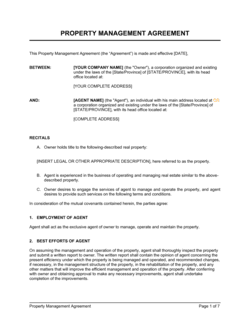
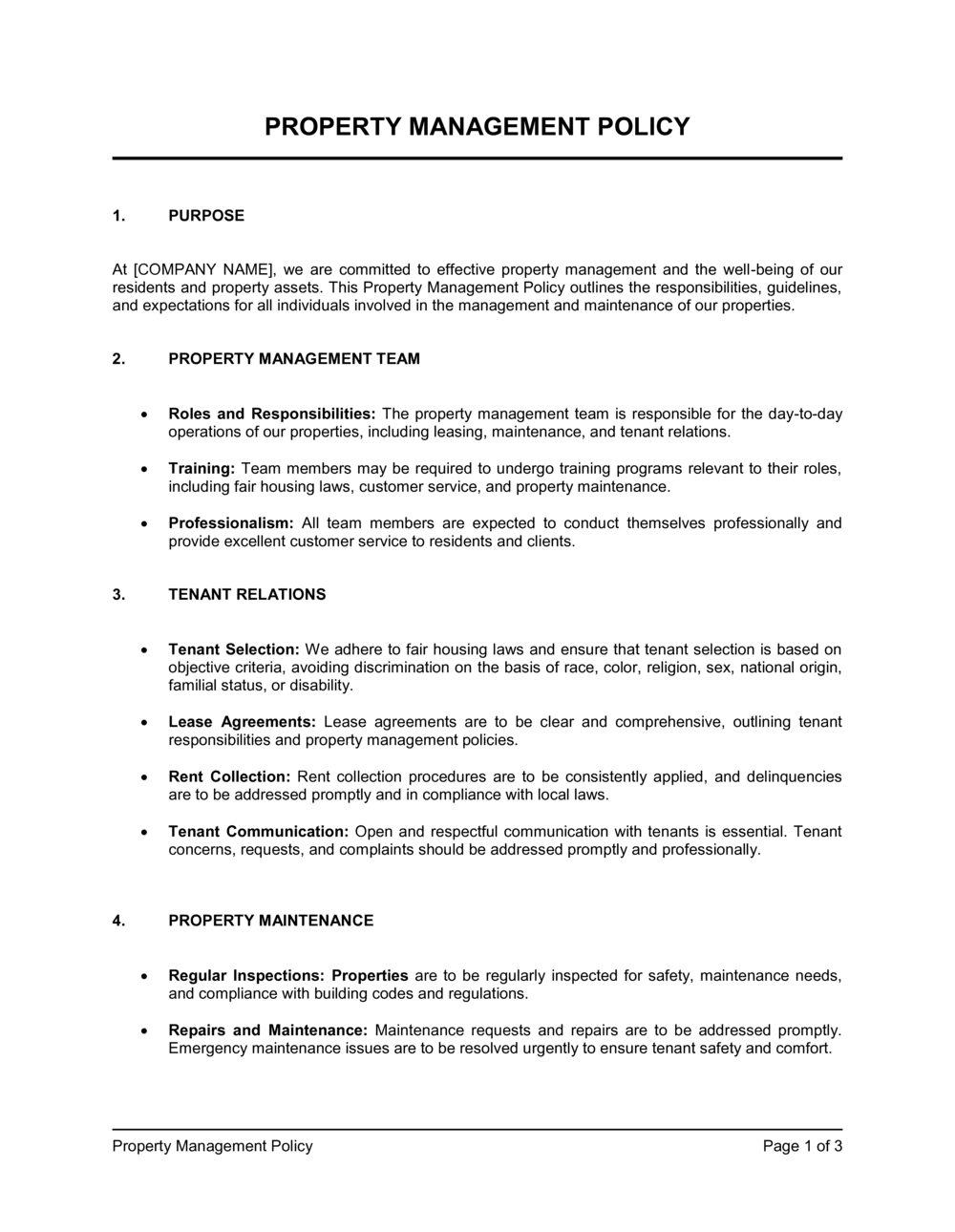
A Property Management Policy is an operational document that defines the rules, procedures, and responsibilities governing the day-to-day management of residential or commercial rental properties. This free Word download gives property managers and landlords a structured, editable starting point they can customize for their portfolio and export as PDF to share with staff, owners, and tenants.
When you need it
Use it when onboarding a new property management team, standardizing operations across multiple units or buildings, or responding to recurring issues caused by inconsistent procedures. It is also essential when a property owner delegates day-to-day management responsibilities to a third-party manager or in-house coordinator.
What's inside
Tenant screening and onboarding standards, rent collection and late-payment procedures, maintenance request handling and response time targets, property inspection schedules, lease enforcement guidelines, vendor and contractor management rules, and emergency response protocols.

What is a Property Management Policy?

A Property Management Policy is an operational document that defines the procedures, standards, and responsibilities governing the day-to-day management of residential or commercial rental properties. It covers every recurring management function β€” tenant screening, rent collection, maintenance request handling, property inspections, vendor management, and financial reporting β€” and establishes the rules staff must follow consistently across all units in a portfolio. Rather than leaving procedures to individual judgment, the policy creates a single written standard that anyone in the management operation can follow and that property owners can hold managers accountable to.

Why You Need This Document

Without a written property management policy, every manager handles the same situation differently β€” one charges a late fee on day three, another waits two weeks; one documents move-out conditions with photos, another fills out a handwritten note. Those inconsistencies create fair housing exposure, security deposit disputes, unpaid maintenance bills, and owner relations problems that are entirely avoidable. A clearly written policy protects the management company by documenting that standards were applied equally; it protects the property owner by ensuring rent is collected on a defined schedule and reserves are maintained; and it protects tenants by guaranteeing maintenance requests receive a timely, trackable response. This template gives you a professionally structured starting point you can customize to your portfolio in a few hours β€” far faster than drafting from scratch and far more consistent than managing by memory.

Which variant fits your situation?

If your situation is…Use this template
Managing a portfolio of residential rental unitsProperty Management Policy (Residential)
Delegating management to a third-party companyProperty Management Agreement
Documenting tenant move-in and move-out proceduresTenant Move-In / Move-Out Checklist
Setting rules for a homeowners associationHOA Rules and Regulations Policy
Defining procedures for a commercial office buildingFacility Management Policy
Outlining maintenance request and work-order trackingMaintenance Request Policy and Log
Creating a tenant-facing handbookTenant Welcome Handbook

Common mistakes to avoid

❌ Applying screening criteria inconsistently

Why it matters: Inconsistent application of income, credit, or background standards β€” even unintentionally β€” creates fair housing liability and exposes the property owner to discrimination complaints.

Fix: Document every screening decision with the criteria used and retain records for a minimum of three years. Use a standardized scoring sheet for every applicant.

❌ No pre-authorized emergency spending limit

Why it matters: Without a threshold, managers must locate a property owner before authorizing urgent repairs β€” delays that can turn a $300 fix into a $5,000 remediation.

Fix: Define a per-incident emergency spending cap (e.g., $500–$1,500 depending on portfolio size) that the manager can authorize without owner approval, with notification within 24 hours.

❌ Using informal text messages for tenant communications

Why it matters: Text threads are deleted, phones are lost, and messages are rarely preserved in a searchable system β€” leaving no documentation trail for lease enforcement or eviction proceedings.

Fix: Mandate a formal channel β€” email or a property management portal β€” for all substantive tenant communications, and log every interaction in the system of record.

❌ Disbursing owner funds before monthly expenses are reconciled

Why it matters: Early disbursement creates negative reserve balances when late invoices arrive, requiring the manager to request a refund or advance from the owner β€” damaging the relationship.

Fix: Set a hard cut-off date for expense submission β€” typically the 25th of the month β€” and disburse only after all invoices for the period have been processed and reconciled.

❌ Skipping photo documentation at inspections

Why it matters: Verbal or text-only inspection reports are nearly impossible to use as evidence in a security deposit dispute β€” the tenant's word against the manager's.

Fix: Require time-stamped photos of every room at every inspection, stored against the unit record in the property management system.

❌ Allowing unlisted or uninsured contractors on-site

Why it matters: An uninsured contractor injured on the property or who causes damage may have no policy to cover the claim β€” leaving the property owner directly liable.

Fix: Enforce a hard rule: no contractor enters the property without appearing on the Approved Vendor Register with a valid, current certificate of insurance on file.

The 10 key sections, explained

Purpose and scope

Tenant screening and approval standards

Lease administration

Rent collection and late-payment procedures

Maintenance request and work-order management

Property inspections

Vendor and contractor management

Tenant communication standards

Financial reporting and owner disbursements

Emergency procedures

How to fill it out

  1. 1

    Identify the properties and staff covered

    List all properties, addresses, and unit counts the policy governs. Name the roles β€” property manager, maintenance coordinator, leasing agent β€” that the policy applies to. Define any exclusions explicitly.

    πŸ’‘ If your portfolio spans multiple property types (residential and commercial), create separate policy documents for each rather than a single hybrid policy.

  2. 2

    Set tenant screening criteria

    Enter your minimum income multiplier, credit score threshold, and background check requirements. Confirm the criteria are consistent with fair housing laws in your jurisdiction before publishing.

    πŸ’‘ Document your screening criteria in writing before the first application is received β€” retroactively defining standards after a rejection creates fair housing exposure.

  3. 3

    Define rent collection timelines and late fees

    Specify the due date, grace period length, late fee amount and trigger date, and the escalation sequence leading to formal notice. Confirm the fee amounts comply with local landlord-tenant statutes.

    πŸ’‘ Cross-reference your lease agreement to ensure the policy and the lease state identical fees and timelines β€” any inconsistency defaults to whichever term benefits the tenant in most jurisdictions.

  4. 4

    Set maintenance response time targets by priority

    Classify maintenance issues into at least three priority levels β€” emergency, urgent, and routine β€” and assign a response and resolution target for each. Name the vendor contact for each category.

    πŸ’‘ Include a 24/7 emergency contact number in this section. A policy that only operates during business hours exposes the property to liability for unremedied emergencies.

  5. 5

    Build the approved vendor list and spending thresholds

    List current approved vendors by trade, their insurance expiry dates, and any preferred rates. Set the dollar threshold above which competitive quotes and owner approval are required.

    πŸ’‘ Review vendor insurance certificates at least annually β€” an expired certificate is as bad as no insurance when a claim is filed.

  6. 6

    Define inspection schedules and documentation requirements

    Set the frequency and notice period for routine inspections, and specify the form and photo documentation standard for move-in and move-out inspections.

    πŸ’‘ Attach a blank condition report form as an appendix so the policy and the form are distributed together and stay in sync.

  7. 7

    Specify the financial reporting and disbursement schedule

    Set the date monthly owner statements are issued, the date proceeds are disbursed, and the minimum reserve balance required per unit. Name who prepares and reviews the reports.

    πŸ’‘ State the reserve minimum in dollar-per-unit terms rather than a fixed total β€” this scales automatically as the portfolio grows.

  8. 8

    Distribute to staff, owners, and relevant tenants

    Share the completed policy with all property management staff as part of onboarding. Provide relevant sections β€” maintenance request procedures, communication standards β€” to tenants in their welcome packet.

    πŸ’‘ Version-control the document with a revision date in the footer. When the policy is updated, replace the file everywhere it is distributed and notify all recipients of the change.

Frequently asked questions

What is a property management policy?

A property management policy is an operational document that defines the procedures, rules, and responsibilities a property manager follows when managing rental properties. It covers tenant screening, rent collection, maintenance, inspections, vendor management, and financial reporting. It functions as the operating manual for a rental portfolio, ensuring consistency regardless of which staff member handles a given task.

Who should use a property management policy?

Property management companies, independent landlords with multiple units, real estate investors who delegate management, HOA boards, and commercial property operators all benefit from a written policy. Any situation where more than one person is responsible for a property's day-to-day operations warrants a formal document to eliminate inconsistency and reduce disputes.

What is the difference between a property management policy and a property management agreement?

A property management policy is an internal operational document defining how a manager runs a property β€” procedures, standards, and responsibilities. A property management agreement is a contract between a property owner and a management company defining the legal relationship, fees, authority, and termination terms. The policy governs operations; the agreement governs the commercial relationship.

Does a property management policy need to comply with landlord-tenant law?

Yes β€” certain policy provisions, particularly rent collection procedures, late fees, inspection notice periods, and security deposit handling, must align with the landlord-tenant statutes of the applicable jurisdiction. Requirements vary significantly by state and province. While a template provides a solid starting structure, confirm jurisdiction-specific requirements before finalizing and distributing the policy.

How often should a property management policy be updated?

Review the policy annually at minimum, and immediately following any change in local landlord-tenant law, a significant portfolio change such as adding a new property type, or a recurring operational problem that the current policy failed to prevent. Each revision should be dated and version-controlled, with prior versions archived.

What response times should a property management policy set for maintenance requests?

A widely accepted standard is: emergency issues (no heat, flooding, security breach) within 2–4 hours; urgent issues (appliance failure, plumbing leak) within 1–2 business days; routine issues (minor repairs, cosmetic work) within 5–7 business days. The policy should classify which issues fall into each category and name the vendor contact for each priority level.

Should tenants receive a copy of the property management policy?

Tenants generally do not receive the full internal policy, but the sections that directly affect them β€” maintenance request procedures, communication standards, and inspection notice requirements β€” should be summarized in the tenant welcome packet or lease addendum. Providing tenants with clear procedures reduces calls, complaints, and disputes.

Can a property management policy be used as evidence in a dispute?

Yes β€” a written policy with documented compliance is strong supporting evidence in security deposit disputes, eviction proceedings, and fair housing complaints. The policy demonstrates that the manager applied consistent standards. Logs showing the policy was followed β€” inspection reports, payment records, maintenance tickets β€” are the actual evidence; the policy establishes the standard against which that evidence is measured.

How this compares to alternatives

vs Property Management Agreement

A property management agreement is a binding contract between a property owner and a management company that defines fees, authority, term, and termination rights. A property management policy is an internal operational document governing how the manager's team executes daily tasks. The agreement defines the commercial relationship; the policy defines how the work gets done.

vs Lease Agreement

A lease agreement is a legally binding contract between a landlord and a tenant defining occupancy terms, rent, and obligations. A property management policy is an internal operations document for the management team β€” not a tenant-facing contract. The policy governs how the landlord's obligations under the lease are fulfilled, but it does not replace or modify the lease.

vs Tenant Welcome Handbook

A tenant welcome handbook is a tenant-facing document summarizing house rules, maintenance request procedures, and contact information in plain language. A property management policy is an internal staff document with full procedural detail, spending authorities, and escalation paths. The handbook communicates to tenants what the policy operationalizes internally.

vs Facility Management Policy

A facility management policy governs the physical operation and maintenance of buildings β€” HVAC, utilities, access control, safety compliance β€” typically in a commercial or institutional context. A property management policy encompasses facility concerns but also covers tenant relations, rent collection, leasing, and financial reporting. The facility policy is a subset of what a property management policy addresses.

Industry-specific considerations

Residential real estate

Tenant screening standards, rent collection escalation, and security deposit documentation are the highest-priority sections given high tenant turnover and fair housing compliance requirements.

Commercial real estate

Lease administration, vendor management, and financial reporting sections are more complex due to triple-net leases, common area maintenance reconciliations, and multi-tenant billing.

HOA and community management

Enforcement procedures, common area maintenance schedules, and owner communication standards are the critical sections, with HOA-specific escalation paths replacing standard eviction procedures.

Short-term and vacation rentals

Turnover inspection checklists, platform-specific communication standards, and dynamic pricing governance replace standard long-term lease administration sections.

Template vs pro β€” what fits your needs?

PathBest forCostTime
Use the templateIndependent landlords, small property management companies, and investors managing fewer than 50 unitsFree2–4 hours to customize and distribute
Template + professional reviewCompanies managing 50–200 units, portfolios with mixed property types, or operations in multiple jurisdictions$300–$800 for a property management consultant or real estate attorney review3–5 business days
Custom draftedLarge property management companies, institutional landlords, or operators subject to specific regulatory or lender requirements$1,500–$5,000 for a fully custom operations manual2–4 weeks

Glossary

Property Management Policy
A written document that defines the operational rules, procedures, and responsibilities a property manager follows when managing rental properties on behalf of an owner.
Tenant Screening
The process of evaluating a prospective tenant's credit history, income, rental history, and background before approving a lease application.
Rent Roll
A schedule listing all rental units, current tenants, monthly rent amounts, lease end dates, and payment status β€” used to track income across a property portfolio.
Preventive Maintenance
Scheduled, routine upkeep performed to prevent equipment failure or property deterioration before a problem occurs β€” such as annual HVAC servicing or gutter cleaning.
Maintenance Request
A formal written or digital submission from a tenant or staff member reporting a repair need or property deficiency that requires a manager's response.
Lease Enforcement
The process of monitoring tenant compliance with lease terms and taking defined corrective action β€” notices, fines, or eviction proceedings β€” when violations occur.
Security Deposit
A sum of money collected from a tenant at move-in, held in trust, and returned after move-out minus documented deductions for damage beyond normal wear and tear.
Notice to Cure
A formal written notice given to a tenant requiring them to remedy a specific lease violation within a defined period before further legal action is taken.
Vendor Vetting
The process of evaluating contractors and service providers for insurance, licensing, pricing, and quality before adding them to an approved vendor list.
Cap Rate
Net operating income divided by property value β€” a metric used to evaluate a rental property's return on investment and compare assets across a portfolio.

Part of your Business Operating System

This document is one of 3,000+ business & legal templates included in Business in a Box.

  • Fill-in-the-blanks β€” ready in minutes
  • 100% customizable Word document
  • Compatible with all office suites
  • Export to PDF and share electronically

Create your document in 3 simple steps.

From template to signed document β€” all inside one Business Operating System.
1
Download or open template

Access over 3,000+ business and legal templates for any business task, project or initiative.

2
Edit and fill in the blanks with AI

Customize your ready-made business document template and save it in the cloud.

3
Save, Share, Send, Sign

Share your files and folders with your team. Create a space of seamless collaboration.

Save time, save money, and create top-quality documents.

β˜…β˜…β˜…β˜…β˜…

"Fantastic value! I'm not sure how I'd do without it. It's worth its weight in gold and paid back for itself many times."

Managing Director Β· Mall Farm
Robert Whalley
Managing Director, Mall Farm Proprietary Limited
β˜…β˜…β˜…β˜…β˜…

"I have been using Business in a Box for years. It has been the most useful source of templates I have encountered. I recommend it to anyone."

Business Owner Β· 4+ years
Dr Michael John Freestone
Business Owner
β˜…β˜…β˜…β˜…β˜…

"It has been a life saver so many times I have lost count. Business in a Box has saved me so much time and as you know, time is money."

Owner Β· Upstate Web
David G. Moore Jr.
Owner, Upstate Web

Run your business with a system β€” not scattered tools

Stop downloading documents. Start operating with clarity. Business in a Box gives you the Business Operating System used by over 250,000 companies worldwide to structure, run, and grow their business.

Start freeΒ Β·Β No credit card required