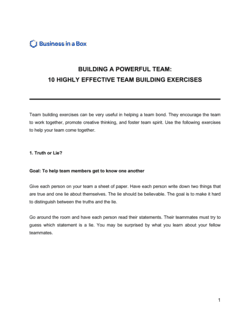
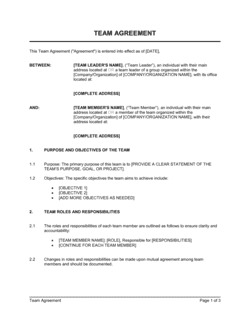
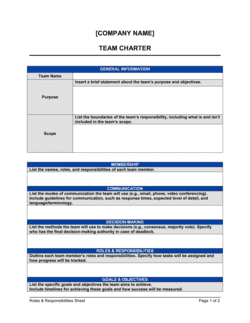
Building A Powerful Team Guide

Free to read β€’ Save or share with one click

FreeBuilding A Powerful Team Guide Template

At a glance

What it is
A Building A Powerful Team Guide is a structured operational document that walks managers and leaders through the deliberate steps required to recruit, align, develop, and retain a high-performing team. This free Word download gives you an editable, section-by-section framework you can adapt to your organization's size and culture, then export as PDF to share with HR partners or leadership.
When you need it
Use it when assembling a new team from scratch, rebuilding an underperforming unit, scaling a department rapidly, or standardizing how managers across the business approach team development.
What's inside
Team purpose and objectives, role definition and hiring criteria, onboarding structure, communication norms, individual development plans, performance expectations, conflict resolution approach, and team health metrics β€” all organized into a single reference document managers can act on immediately.

What is a Building A Powerful Team Guide?

A Building A Powerful Team Guide is a structured operational document that gives managers a step-by-step framework for recruiting, aligning, developing, and retaining a high-performing team. It translates leadership intent into concrete working systems β€” defining each role's outcomes, how new members are onboarded, what communication norms govern day-to-day work, how individual development is tracked, and which metrics signal whether the team is healthy over time. Rather than relying on a manager's intuition alone, it creates a repeatable, transferable approach that works whether you are building a team from scratch or stabilizing one that has lost its footing.

Why You Need This Document

Teams without a documented operating framework default to informal norms that vary by manager, produce inconsistent onboarding experiences that slow new hires' ramp time, and leave performance expectations implicit until something goes wrong. The cost is concrete: high voluntary attrition, role confusion that generates duplicated work, and communication breakdowns that consume manager time that should be spent on output. A structured team guide forces clarity on purpose, roles, and norms before those gaps become expensive β€” and gives every team member a shared reference point rather than a set of assumptions that diverge the moment pressure hits. This template gives you that structure in a format you can complete in an afternoon and adapt as the team evolves.

Which variant fits your situation?

If your situation is…Use this template
Building a new department from the ground upBuilding A Powerful Team Guide
Planning annual goals and KPIs for an existing teamTeam Performance Plan
Structuring onboarding for multiple new hires at onceEmployee Onboarding Plan
Defining individual employee growth paths within the teamEmployee Development Plan
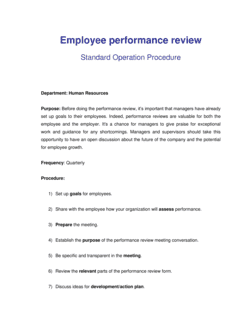
Conducting structured quarterly or annual team reviewsEmployee Performance Review
Documenting repeatable team processes and workflowsStandard Operating Procedure (SOP)
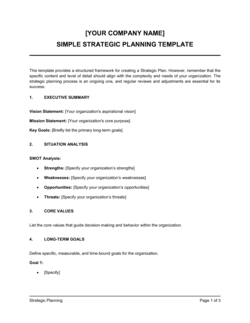
Setting a strategic direction for the broader organizationStrategic Planning Template

Common mistakes to avoid

❌ Defining roles by tasks rather than outcomes

Why it matters: Task-based role definitions breed micromanagement and leave high performers with no room to grow beyond the job description.

Fix: Rewrite each role with two to three outcome statements β€” what the person will produce and how it will be measured β€” and use tasks only as examples, not the definition.

❌ Skipping the onboarding milestone structure

Why it matters: New hires without a defined ramp plan take two to three times longer to reach full productivity and are significantly more likely to leave within the first 90 days.

Fix: Add a 30-60-90 day plan with one specific deliverable per phase and a check-in meeting scheduled on day 30 and day 60 before the hire's first day.

❌ Leaving team norms unstated

Why it matters: Unwritten norms are inconsistently applied β€” what one person calls 'normal' another experiences as disrespect, creating friction that managers must resolve repeatedly.

Fix: Run a 30-minute team session to draft norms collaboratively, then document them in the guide and revisit them at the first sign of communication breakdown.

❌ Measuring only output and ignoring team health signals

Why it matters: Output metrics lag team health by three to six months β€” by the time throughput drops, engagement problems are already causing flight risk.

Fix: Add at least one leading indicator β€” a monthly pulse survey score, voluntary attrition rate, or 1:1 sentiment rating β€” to the team dashboard alongside output metrics.

❌ Treating IDPs as an annual compliance exercise

Why it matters: An individual development plan reviewed once a year delivers almost none of its value β€” skills development requires regular feedback loops and adjusted targets.

Fix: Shorten the IDP review cycle to quarterly and tie at least one development activity to the team's current work so progress is visible in real time.

❌ Building the guide without team input

Why it matters: A team guide created entirely by the manager and handed down is perceived as a policy document, not a shared agreement β€” adoption is low and resentment is common.

Fix: Involve team members in drafting the communication norms, conflict resolution process, and team health metrics sections before finalizing the document.

The 9 key sections, explained

Team purpose and objectives

Role definitions and hiring criteria

Recruitment and selection process

Onboarding structure

Communication norms and meeting cadence

Individual development plans

Performance expectations and accountability

Conflict resolution and team health

Team metrics and continuous improvement

How to fill it out

  1. 1

    Define the team's purpose and success metrics

    Write a one-to-two sentence purpose statement that names the team's primary business outcome and the stakeholders it serves. Then list two to four measurable KPIs that define success over the next 12 months.

    πŸ’‘ If you cannot name a single metric that proves the team delivered value this year, the purpose statement is too vague.

  2. 2

    Map every role to outcomes, not tasks

    List each position with its primary accountabilities, required skills, and reporting line. Use outcome language β€” 'owns pipeline growth to $[X]M' β€” rather than task language like 'makes sales calls.'

    πŸ’‘ Test each role definition by asking: could someone use this document to make a hiring decision without talking to you? If not, add specificity.

  3. 3

    Document the end-to-end hiring process

    Write out each stage of your hiring process for a representative role β€” sourcing, screening, interview stages, assessment, and offer. Note who is involved at each step and what criteria they evaluate.

    πŸ’‘ Cap the interview process at four to five touchpoints for most roles. Longer processes increase candidate drop-off without meaningfully improving hire quality.

  4. 4

    Build a 30-60-90 day onboarding plan

    For each phase, define the key relationships to establish, tools and processes to learn, and one concrete deliverable that signals the new hire is ramping well.

    πŸ’‘ Assign a specific onboarding buddy β€” not the direct manager β€” to handle day-to-day process questions. This frees the manager for strategic coaching.

  5. 5

    Set explicit communication norms

    List the team's primary channels, expected response times, meeting types with cadence and duration, and the escalation path for urgent issues. Write these as statements the whole team agrees to, not suggestions.

    πŸ’‘ Send a draft of the communication norms to the team before finalizing them β€” norms adopted collectively are followed far more consistently than ones handed down.

  6. 6

    Create individual development plan templates for each role

    For each role, pre-populate the IDP template with the two to three skills most critical to success in that position. Leave fields for personal goals and a quarterly review date.

    πŸ’‘ Schedule IDP reviews on a calendar recurring event at the time you create the template β€” if it is not on the calendar, it will not happen.

  7. 7

    Establish the team health metrics and review cadence

    Choose three to five metrics that track both output and team health β€” for example, output per sprint, voluntary attrition rate, and monthly engagement pulse score. Set targets and a monthly review owner.

    πŸ’‘ Run a short retrospective on the metrics quarterly. If a metric is not driving a decision or a conversation, replace it with one that does.

Frequently asked questions

What is a building a powerful team guide?

A building a powerful team guide is a structured operational document that helps managers and leaders create, align, and sustain a high-performing team. It covers everything from role definition and hiring criteria to communication norms, individual development plans, and team health metrics. Rather than leaving team-building to intuition, it provides a repeatable framework that any manager can follow regardless of experience level.

Who should use a team-building guide?

New managers assembling their first team, HR teams standardizing practices across departments, startup founders scaling from a founding group to a structured organization, and operations directors rebuilding underperforming units all benefit from a structured team guide. It is equally useful for cross-functional project teams that need to establish working norms quickly without a formal reporting structure.

How is a team-building guide different from an employee handbook?

An employee handbook documents company-wide policies β€” leave, conduct, benefits, and legal compliance. A team-building guide is specific to a single team or department and focuses on how that team recruits, onboards, communicates, develops its people, and measures its own health. The handbook applies universally; the team guide is operational and contextual.

What sections should a team-building guide include?

At minimum: team purpose and objectives, role definitions, recruitment and onboarding process, communication norms, individual development plans, performance expectations, conflict resolution steps, and team health metrics. The most effective guides also include a RACI matrix for recurring decisions and a meeting cadence chart so every team member knows what to expect week to week.

How long should a team-building guide be?

For most teams of 5 to 15 people, a guide of 8 to 15 pages is practical β€” detailed enough to be actionable but short enough to be read. Very large departments or complex cross-functional teams may need 20 or more pages to cover all roles and processes. Avoid the temptation to document every edge case; a guide that covers 80% of situations clearly is more valuable than a 50-page document no one opens.

How often should the guide be updated?

Review the guide whenever the team structure changes significantly β€” new hires in senior roles, department reorgs, or a major shift in team objectives. At minimum, conduct a full review annually aligned to the performance review cycle. Communication norms and team health metrics often need more frequent updates in fast-growing teams.

Can this guide be used for remote or hybrid teams?

Yes, and it is arguably more important for remote and hybrid teams than for co-located ones. When team members cannot observe norms organically in an office, written documentation of communication expectations, escalation paths, and meeting cadence becomes the primary alignment tool. Add a section on asynchronous work expectations and time-zone protocols for fully distributed teams.

What is the difference between a team-building guide and a performance management plan?

A performance management plan focuses specifically on evaluating and improving individual output β€” goal-setting, review cycles, improvement plans, and ratings. A team-building guide covers the full lifecycle of the team: hiring, onboarding, development, communication, conflict, and health β€” with performance management as one section rather than the entire document. Use both together for a complete team management system.

Do I need an HR background to write a team-building guide?

No. This template is designed for working managers without specialized HR training. The guide's value comes from the manager's direct knowledge of the team's purpose, roles, and working context β€” not from HR expertise. For sections that touch formal policy (disciplinary processes, formal performance improvement plans), loop in HR to ensure alignment with company-wide procedures.

How this compares to alternatives

vs Employee Handbook

An employee handbook documents company-wide HR policies β€” conduct, benefits, leave, and legal compliance β€” that apply to every employee. A team-building guide is operational and team-specific, covering how a particular team hires, communicates, develops people, and measures its own performance. Most organizations need both: the handbook sets the floor; the guide sets the working system.

vs Strategic Planning Template

A strategic plan defines an organization's multi-year goals, competitive positioning, and resource allocation at the business or division level. A team-building guide operates at the team level, translating strategic direction into role clarity, working norms, and development plans. Strategic planning sets the destination; the team guide determines how the people doing the work are organized to get there.

vs Job Description Template

A job description is a single-role document used in recruiting to attract candidates. A team-building guide covers all roles in the team plus the systems, norms, and development frameworks that make those roles work together. Use a job description to fill a seat; use the team guide to make sure the person in that seat succeeds once hired.

vs Performance Review Template

A performance review template structures the periodic evaluation of an individual employee's output, behavior, and goals. A team-building guide is a living operational document that governs the entire team lifecycle β€” of which performance management is one section. The review is a recurring event; the guide is the standing framework that makes those reviews meaningful.

Industry-specific considerations

Technology / SaaS

Sprint cadences, async-first communication norms, and engineering hiring scorecards tied to specific technical competencies.

Professional Services

Utilization targets embedded in performance expectations, client staffing rotation norms, and billable-hour accountability structures.

Retail / Hospitality

High-turnover context means onboarding must be completable in under one week, with role norms written for shift-based rather than project-based work.

Healthcare

Credentialing prerequisites built into role definitions, shift-handoff communication protocols, and patient-safety accountability embedded in team metrics.

Manufacturing

Safety training milestones in the onboarding plan, shift-team communication norms, and output metrics tied to production targets per line.

Financial Services

Compliance training integrated into the 30-60-90 onboarding plan, and performance metrics that reflect both client outcomes and regulatory adherence.

Template vs pro β€” what fits your needs?

PathBest forCostTime
Use the templateManagers building or restructuring teams of up to 20 people without a dedicated HR business partnerFree3–5 hours to complete
Template + professional reviewLeaders scaling a department rapidly or aligning multiple team guides across a growing organization$300–$800 for an HR consultant or organizational design review1–2 weeks
Custom draftedLarge department builds, post-merger team integrations, or organizations implementing a formal management operating system$2,000–$8,000 for an organizational effectiveness consultant3–6 weeks

Glossary

Team Charter
A brief written agreement that defines a team's purpose, decision-making authority, working norms, and expected outcomes.
RACI Matrix
A responsibility-assignment framework that labels each task as Responsible, Accountable, Consulted, or Informed to eliminate role confusion.
Psychological Safety
A team environment where members feel safe to speak up, admit mistakes, and share ideas without fear of punishment or embarrassment.
Onboarding
The structured process of integrating a new hire into the team β€” covering tools, processes, relationships, and expectations β€” typically over 30 to 90 days.
Individual Development Plan (IDP)
A written plan co-created by a manager and employee that outlines skill gaps, learning goals, and milestones for professional growth over a defined period.
Team Norms
Explicit, agreed-upon rules about how a team communicates, makes decisions, runs meetings, and resolves disagreements.
High-Performance Team
A group that consistently delivers results above expectations because of strong alignment on goals, complementary skills, and mutual accountability.
Span of Control
The number of direct reports a single manager is responsible for β€” typically 5 to 8 for knowledge workers, fewer for highly complex roles.
Retention Rate
The percentage of team members who remain employed over a defined period, used as a proxy for team health and manager effectiveness.
360-Degree Feedback
A performance input method that collects assessments from a team member's peers, direct reports, and manager, not just from the manager alone.

Part of your Business Operating System

This document is one of 3,000+ business & legal templates included in Business in a Box.

  • Fill-in-the-blanks β€” ready in minutes
  • Compatible with all office suites
  • Export to PDF and share electronically

Create your document in 3 simple steps.

From template to signed document β€” all inside one Business Operating System.
1
Download or open template

Access over 3,000+ business and legal templates for any business task, project or initiative.

2
Edit and fill in the blanks with AI

Customize your ready-made business document template and save it in the cloud.

3
Save, Share, Send, Sign

Share your files and folders with your team. Create a space of seamless collaboration.

Save time, save money, and create top-quality documents.

β˜…β˜…β˜…β˜…β˜…

"Fantastic value! I'm not sure how I'd do without it. It's worth its weight in gold and paid back for itself many times."

Managing Director Β· Mall Farm
Robert Whalley
Managing Director, Mall Farm Proprietary Limited
β˜…β˜…β˜…β˜…β˜…

"I have been using Business in a Box for years. It has been the most useful source of templates I have encountered. I recommend it to anyone."

Business Owner Β· 4+ years
Dr Michael John Freestone
Business Owner
β˜…β˜…β˜…β˜…β˜…

"It has been a life saver so many times I have lost count. Business in a Box has saved me so much time and as you know, time is money."

Owner Β· Upstate Web
David G. Moore Jr.
Owner, Upstate Web

Run your business with a system β€” not scattered tools

Stop downloading documents. Start operating with clarity. Business in a Box gives you the Business Operating System used by over 250,000 companies worldwide to structure, run, and grow their business.

Free Forever PlanΒ Β·Β No credit card required