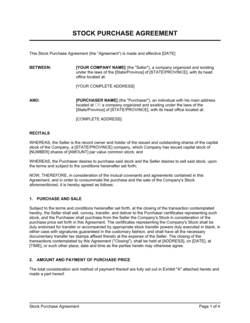
Preferred Stock Purchase Agreement Template

Free Word download • Edit online • Save & share with Drive • Export to PDF

20 pages35–50 min to fillDifficulty: ComplexSignature requiredLegal review recommended
Learn more ↓
FreePreferred Stock Purchase Agreement Template

At a glance

What it is
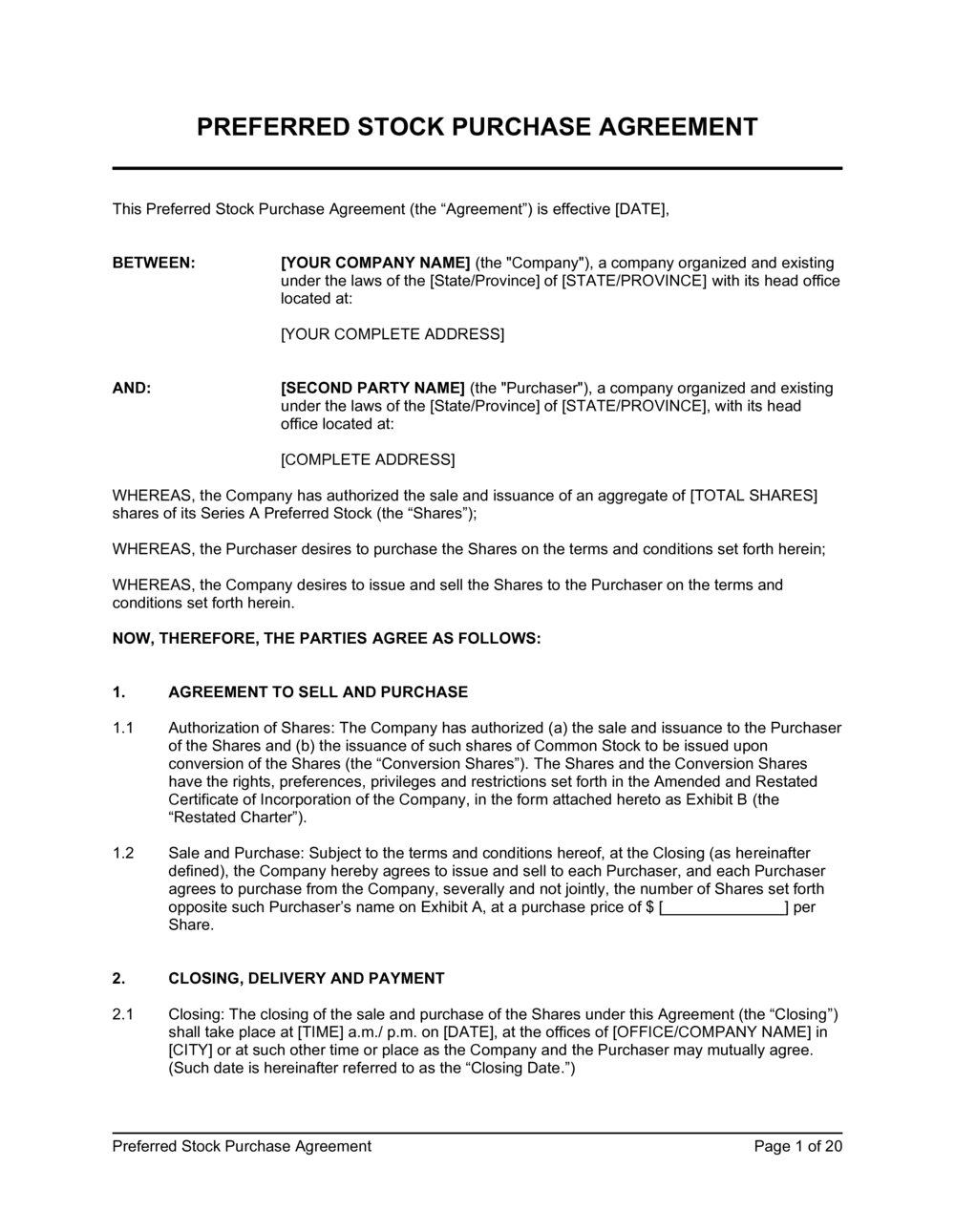
A Preferred Stock Purchase Agreement (PSPA) is a binding contract between a company and one or more investors governing the sale of preferred shares in an equity financing round. This free Word download captures the essential terms of the transaction — share class, purchase price, investor rights, representations and warranties, and closing mechanics — in a single investor-ready document you can edit online and export as PDF.
When you need it
Use it when raising a priced equity round from angel investors, venture capital funds, or strategic investors in exchange for preferred shares with special rights not attached to common stock. It is the primary transaction document for Series Seed, Series A, and later priced rounds.
What's inside
Share class definition and purchase price per share, total investment amount and investor schedule, representations and warranties from both company and investors, conditions to closing, post-closing covenants, indemnification provisions, and governing law. Related schedules covering the capitalization table, disclosed exceptions, and investor accreditation are typically attached as exhibits.

What is a Preferred Stock Purchase Agreement?

A Preferred Stock Purchase Agreement (PSPA) is a binding contract between a company and one or more investors that governs the issuance and sale of preferred shares in a priced equity financing round. It records the agreed share price, total investment amount, and the rights attached to the new share class — including liquidation preference and anti-dilution protection — while establishing the representations, warranties, and post-closing obligations that protect both sides of the transaction. Unlike a convertible note or SAFE, a PSPA closes a defined round at a fixed valuation and gives investors immediate preferred stockholder status, making it the standard instrument for Series Seed, Series A, and subsequent institutional financing rounds.

Why You Need This Document

Raising equity capital without a properly executed preferred stock purchase agreement exposes both founders and investors to serious legal and financial risk. Without documented representations and warranties, investors have no contractual basis to seek recourse if material facts about the company turn out to be false. Without a completed investor schedule, there is no enforceable record of each party's commitment or share count — disputes over round size and ownership percentage become credibility contests instead of contract questions. Beyond the immediate round, a poorly drafted or missing PSPA creates a broken cap table that complicates every subsequent financing, acquisition due diligence, and equity compensation grant. This template gives you a structured, attorney-reviewable starting point that captures the essential mechanics of the transaction in the format institutional investors and their counsel expect to see.

Which variant fits your situation?

If your situation is…Use this template
Raising the first institutional priced round (Series Seed or Series A)Preferred Stock Purchase Agreement (Series A)
Issuing convertible preferred shares with no fixed liquidation preferenceConvertible Note Agreement
Selling common shares to co-founders or early team membersCommon Stock Purchase Agreement
Selling shares back from a departing founder or employeeStock Repurchase Agreement
Bridging to the next priced round with a simple instrumentSAFE Agreement (Simple Agreement for Future Equity)
Transferring existing shares between parties rather than issuing new sharesStock Transfer Agreement
Granting options to employees rather than issuing shares directlyStock Option Agreement

Common mistakes to avoid

❌ Incomplete or unsigned investor schedule

Why it matters: An unsigned or incomplete Exhibit A leaves the total round size, individual commitments, and share counts legally unspecified — any investor can argue they committed to a different amount.

Fix: Finalize Exhibit A before circulating the agreement for signature and confirm every investor's figures with their own counsel before the closing date.

❌ No disclosure schedule for company representations

Why it matters: If the company makes an unqualified representation that turns out to be false — even inadvertently — investors can assert fraud or material breach and seek indemnification for the full loss.

Fix: Attach a Schedule of Exceptions listing every known exception to each representation, no matter how minor it seems. Scheduled exceptions are disclosed; unscheduled ones create liability.

❌ Omitting accredited investor confirmations

Why it matters: Selling unregistered securities to non-accredited investors in the US violates SEC Regulation D, exposing the company to SEC enforcement, state securities law violations, and investor rescission rights.

Fix: Require each investor to complete a written accreditation questionnaire before closing and retain the documentation for at least three years.

❌ Signing the agreement before the amended charter is filed

Why it matters: Preferred shares cannot legally exist until the Amended and Restated Certificate of Incorporation creating the new share class is filed with the Secretary of State — shares issued before filing are legally invalid.

Fix: Make filing of the amended charter an explicit closing condition and confirm the Secretary of State filing number before releasing funds and issuing shares.

❌ Agreeing to financial reporting obligations the company cannot meet

Why it matters: A startup that promises audited annual financials and then fails to deliver is technically in breach of the PSPA from its first fiscal year end, giving investors grounds to accelerate other rights.

Fix: Negotiate reporting obligations tied to your actual financial infrastructure — unaudited quarterly statements are standard for early-stage companies; audited financials are typically a Series B or later requirement.

❌ No indemnification cap or survival period

Why it matters: Without a cap, a single misrepresentation claim is theoretically unlimited; without a survival period, claims remain open permanently and cloud future financing and M&A transactions.

Fix: Negotiate an indemnification cap equal to the total investment amount and a survival period of 18–36 months from closing for general representations, with a carve-out for fraud that survives indefinitely.

The 10 key clauses, explained

Purchase and sale of preferred shares

In plain language: Establishes the core transaction — the company agrees to sell, and each investor agrees to buy, a specified number of preferred shares at a defined price per share.

Sample language
Subject to the terms of this Agreement, the Company shall issue and sell to each Investor, and each Investor shall purchase from the Company, the number of shares of [SERIES] Preferred Stock set forth opposite such Investor's name on Exhibit A at a purchase price of $[PRICE PER SHARE] per share.

Common mistake: Failing to attach or finalize the investor schedule (Exhibit A) before signing. An unsigned or incomplete schedule creates ambiguity about each investor's commitment and share count.

Representations and warranties of the company

In plain language: The company confirms a defined set of facts as true at closing — including its legal existence, authority to issue shares, capitalization, absence of undisclosed liabilities, and compliance with applicable law.

Sample language
The Company represents and warrants to each Investor that: (a) the Company is duly organized and validly existing under the laws of [STATE]; (b) the Shares, when issued, will be duly authorized, fully paid, and non-assessable; and (c) no material litigation is pending or, to the Company's knowledge, threatened against the Company.

Common mistake: Using generic boilerplate representations that do not reflect actual company circumstances. If a listed representation is false at closing, it creates immediate indemnification exposure — undisclosed exceptions must be scheduled.

Representations and warranties of the investors

In plain language: Each investor confirms they are legally authorized to invest, are purchasing for their own account, are aware of the risks, and meet accredited investor requirements.

Sample language
Each Investor represents and warrants that: (a) it has full power and authority to execute this Agreement; (b) it is acquiring the Shares for its own account, not with a view to distribution; and (c) it is an 'accredited investor' as defined in Rule 501 of Regulation D.

Common mistake: Omitting the accredited investor representation for US-based raises. Selling unregistered securities to non-accredited investors triggers securities law violations regardless of whether a formal disclosure was made.

Conditions to closing

In plain language: Lists everything that must happen before the company can issue shares and investors must wire funds — such as board approval, restated articles, and execution of related agreements.

Sample language
The obligations of each Investor to purchase Shares at the Closing are conditioned upon: (a) execution of this Agreement by the Company and all Investors; (b) filing of the Amended and Restated Certificate of Incorporation with the [STATE] Secretary of State; and (c) execution of the Investor Rights Agreement and Voting Agreement.

Common mistake: Setting conditions that are already completed or impossible to satisfy, or omitting conditions that are actually needed. Either creates a closing risk or an unnecessary escape hatch for a party who changes their mind.

Closing mechanics and wire instructions

In plain language: Specifies the closing date, location (or remote closing process), how funds are transferred, and when share certificates or electronic ledger entries are delivered.

Sample language
The closing shall take place remotely via exchange of documents and wire transfer on [DATE] ('Closing Date'), or at such other time as the Company and Investors shall agree. Each Investor shall deliver its purchase price by wire transfer to the account designated by the Company no later than [TIME] on the Closing Date.

Common mistake: Omitting wire instructions or leaving the closing date blank. An indefinite closing date allows either party to delay indefinitely, giving leverage to the side that changes its mind.

Use of proceeds

In plain language: Describes, at least at a high level, how the company intends to deploy the investment capital — product development, sales, operations, or general working capital.

Sample language
The Company shall use the proceeds from the sale of Shares primarily for [PRODUCT DEVELOPMENT / SALES AND MARKETING / WORKING CAPITAL / GENERAL CORPORATE PURPOSES] as described in the budget attached as Exhibit [X].

Common mistake: Leaving the use-of-proceeds section entirely blank or excessively vague. While not always legally binding, investors expect a stated purpose and courts may consider it evidence of fraudulent misrepresentation if funds are used contrary to representations.

Post-closing covenants

In plain language: Ongoing obligations the company undertakes after closing — such as delivering financial statements, maintaining insurance, and complying with investor information rights.

Sample language
Following the Closing, the Company shall: (a) deliver unaudited quarterly financial statements to each Major Investor within 45 days of quarter end; (b) maintain directors' and officers' liability insurance of at least $[AMOUNT]; and (c) promptly notify each Major Investor of any material adverse change in the Company's business.

Common mistake: Agreeing to audit-level financial reporting requirements the company cannot practically deliver. Startups that promise audited annual financials and then fail to deliver them are technically in breach from year one.

Indemnification

In plain language: Requires each party to compensate the other for losses caused by a breach of their representations, warranties, or covenants, subject to defined caps and survival periods.

Sample language
The Company shall indemnify and hold harmless each Investor from and against any losses arising out of any material breach of the Company's representations or warranties, provided that the Company's total indemnification liability shall not exceed $[CAP AMOUNT] and claims must be brought within [X] years of the Closing Date.

Common mistake: No indemnification cap or survival period. Without a cap, a single misrepresentation claim could theoretically exceed the round size; without a survival period, claims remain open indefinitely.

Transfer restrictions and right of first refusal

In plain language: Restricts investors from freely transferring preferred shares to third parties and gives the company or other investors the right to purchase shares before they can be sold externally.

Sample language
No Investor shall transfer any Shares without first offering the Company the right to repurchase such Shares at the proposed transfer price. The Company shall have [30] days to exercise its right of first refusal. Permitted transfers to affiliates are excepted from this restriction.

Common mistake: Omitting permitted transfer carve-outs for affiliated funds or co-investors. Institutional investors routinely need to transfer shares between fund vehicles — blocking all transfers without exceptions makes the agreement unworkable for professional investors.

Governing law and dispute resolution

In plain language: Specifies which jurisdiction's law governs the agreement and how disputes are resolved — litigation in a named court or binding arbitration.

Sample language
This Agreement shall be governed by the laws of the State of [DELAWARE / CALIFORNIA / OTHER], without regard to conflict-of-law principles. Any dispute arising under this Agreement shall be resolved by binding arbitration before [AAA / JAMS] in [CITY, STATE], except that either party may seek injunctive relief in any court of competent jurisdiction.

Common mistake: Choosing a governing law different from the company's state of incorporation without legal advice. Delaware is standard for US corporations — using a different state may produce unexpected results on shareholder rights, fiduciary duties, and appraisal rights.

How to fill it out

  1. 1

    Identify the company and each investor

    Enter the company's full legal name, state of incorporation, and principal office address. List every investor by legal name or entity name as it appears on their formation documents, along with each investor's address and intended share count.

    💡 For fund investors, confirm whether the investing entity is the fund itself, a special purpose vehicle, or a carry vehicle — the wrong entity name can complicate tax and transfer compliance later.

  2. 2

    Define the share class and price per share

    Name the series (e.g., Series Seed Preferred Stock or Series A Preferred Stock), specify the price per share derived from the agreed pre-money valuation divided by the fully diluted share count, and state the total round size.

    💡 Calculate price per share using the fully diluted cap table — including any option pool expansion agreed in the term sheet — before entering the number here.

  3. 3

    Complete the investor schedule (Exhibit A)

    List each investor, their investment amount in dollars, the resulting share count at the stated price per share, and their pro rata percentage of the round. Confirm the total column matches the stated round size.

    💡 Build the exhibit in a spreadsheet and cross-check it against your cap table software before pasting into the agreement — arithmetic errors in Exhibit A have caused closing delays on real rounds.

  4. 4

    Review and schedule the company's representations

    Read each company representation carefully and attach a disclosure schedule (Exhibit B or Schedule of Exceptions) listing any exceptions. If the company is a party to undisclosed litigation, has IP ownership questions, or has previously issued shares outside a formal process, disclose it here.

    💡 Investors will conduct due diligence and discover undisclosed issues anyway — proactive disclosure in the schedule protects the company from fraud claims; omission does not.

  5. 5

    Confirm accredited investor status for each investor

    Collect and retain investor questionnaires or third-party accreditation verification for each investor before closing. The investor representations clause requires each investor to confirm accredited status — this is a legal prerequisite for a Regulation D exempt offering in the US.

    💡 Third-party accreditation verification services (e.g., VerifyInvestor) provide defensible documentation for $20–$50 per investor and are worth the cost for rounds with five or more participants.

  6. 6

    Set the closing date and wire instructions

    Enter a specific closing date, the company's bank account wiring instructions, and any conditions that must be satisfied on or before that date. Identify which conditions have already been met and note them as satisfied.

    💡 Schedule the closing for the middle of a business week — Friday closings frequently slip to the following Monday due to bank wire cut-off times.

  7. 7

    Attach and cross-reference all related agreements

    A PSPA is almost always signed alongside an Investor Rights Agreement, Voting Agreement, and Right of First Refusal and Co-Sale Agreement. List each as a condition to closing and confirm all are executed simultaneously.

    💡 Number the exhibits consistently across all transaction documents — mismatched exhibit references are the most common source of ambiguity in post-closing disputes.

  8. 8

    Execute before funds are transferred

    All parties must sign the agreement before any wire is sent. Collect counterpart signatures from every investor and obtain the company's board authorization. File the Amended and Restated Certificate of Incorporation with the relevant Secretary of State before or simultaneously with closing.

    💡 Use a closing checklist shared with all parties at least five business days before the closing date so no item is discovered missing on the day funds are due to transfer.

Frequently asked questions

What is a preferred stock purchase agreement?

A preferred stock purchase agreement is a binding contract between a company and one or more investors that governs the issuance and sale of preferred shares in an equity financing round. It sets the purchase price per share, total investment amount, the rights attached to the new share class, representations and warranties from both sides, conditions to closing, and post-closing obligations. It is the primary transaction document for Series Seed, Series A, and later priced rounds.

What is the difference between preferred stock and common stock?

Preferred stock carries rights that common stock does not — typically a liquidation preference (the right to get invested capital back before common holders in a sale or wind-down), dividend priority, anti-dilution protection, and sometimes board representation rights. Common stock is held by founders and employees; preferred stock is issued to institutional investors in priced rounds. In a below-valuation exit, preferred holders are made whole before common holders receive anything.

What other documents are typically signed alongside a preferred stock purchase agreement?

A PSPA is almost always executed as part of a suite of transaction documents that includes an Investor Rights Agreement (covering information rights, registration rights, and pro rata), a Voting Agreement (governing board composition and drag-along provisions), and a Right of First Refusal and Co-Sale Agreement (governing share transfers). All four are typically conditions to closing in the PSPA itself, and all are signed simultaneously.

Do I need a lawyer to complete a preferred stock purchase agreement?

Legal review is strongly recommended for any priced equity round. A PSPA creates enforceable rights that persist for the life of the company — anti-dilution adjustments, liquidation preferences, and indemnification obligations can have multimillion-dollar consequences in a future exit. For seed rounds under $500K with a small number of sophisticated angel investors, a template with counsel review is typically sufficient. Series A and larger rounds almost universally involve law firms on both sides.

What is a liquidation preference and how does it work?

A liquidation preference gives preferred stockholders the right to receive their invested capital — and sometimes a multiple of it — before common stockholders receive any proceeds in a sale, merger, or wind-down. A 1x non-participating preference returns exactly the investment amount before common participates. A participating preferred also receives its preference and then shares pro rata in remaining proceeds alongside common — a more investor-friendly term that founders should negotiate carefully.

What is anti-dilution protection in a preferred stock agreement?

Anti-dilution protection adjusts the conversion ratio of preferred shares if the company issues new shares at a lower price than the preferred investors paid. Broad-based weighted average anti-dilution is the most common and least punitive form — it adjusts the conversion price based on a formula that accounts for the size of the down round. Full ratchet anti-dilution, which adjusts the price to match the lowest subsequent issuance price, is heavily investor-favorable and rare in founder-friendly term sheets.

What is Regulation D and why does it matter for a preferred stock offering?

Regulation D is a set of SEC rules that exempt private companies from the full registration requirements of the Securities Act of 1933 when they sell securities to accredited investors. Rule 506(b) allows sales to up to 35 sophisticated non-accredited investors alongside unlimited accredited investors; Rule 506(c) allows general solicitation but requires all investors to be verified accredited. Companies must file a Form D with the SEC within 15 days of the first sale and comply with applicable state blue sky laws.

What happens if a representation in the agreement turns out to be false?

A false representation at closing gives the affected party the right to seek indemnification for resulting losses, and in some cases to rescind the transaction. The severity depends on whether the breach was material, whether it was scheduled as an exception, and the terms of the indemnification clause. Intentional misrepresentation can support a fraud claim with no cap on damages. This is why a thorough Schedule of Exceptions is essential — disclosed exceptions are contractually accepted; undisclosed ones create liability.

What is a closing condition and what happens if one is not met?

A closing condition is a requirement that must be satisfied before the parties are obligated to complete the transaction — for example, filing the amended charter or obtaining board approval. If a condition is not met by the closing date, the party benefiting from that condition can waive it in writing or terminate the agreement without liability. Parties should distinguish between conditions that can be waived and those that are legal prerequisites — filing the amended charter to create the preferred share class cannot be waived.

How this compares to alternatives

vs Convertible Note Agreement

A convertible note is debt that converts into equity at a future priced round — it defers valuation and closes faster with less documentation than a PSPA. A preferred stock purchase agreement sets a fixed valuation and issues shares immediately, creating a formal cap table entry at closing. Convertible notes suit very early-stage companies where valuation is contested; PSPAs are standard once a company has enough traction to support a negotiated price.

vs Common Stock Purchase Agreement

A common stock purchase agreement issues ordinary shares with no special rights — used for founder stock, early co-founder grants, and employee purchases. A PSPA issues preferred shares with liquidation preferences, anti-dilution protections, and investor rights that common stock does not carry. Institutional investors almost always require preferred shares; common stock sales to investors create tax and structural complications.

vs SAFE Agreement

A Simple Agreement for Future Equity (SAFE) is a non-debt, non-equity instrument that grants the right to receive shares at a future priced round. It is the fastest and simplest instrument for pre-seed fundraising and creates no immediate cap table entry. A PSPA is a priced instrument that closes a defined round, issues shares at a fixed valuation, and gives investors immediate preferred stockholder rights. SAFEs defer complexity; PSPAs resolve it.

vs Stock Option Agreement

A stock option agreement grants an employee or advisor the right to purchase common shares at a fixed exercise price after vesting — it is a compensation instrument, not an investment document. A PSPA governs the purchase of preferred shares by investors for cash consideration. Options create contingent equity obligations managed through an equity plan; a PSPA closes an actual financing transaction.

Industry-specific considerations

Technology / SaaS

IP assignment confirmations and source code ownership representations are critical given that software IP is typically the company's primary asset at the time of the round.

Life Sciences / Biotech

Regulatory approvals, clinical trial milestone triggers, and FDA pathway representations are standard additions; investors often require milestone-based tranche funding tied to specific development events.

Fintech / Financial Services

Money transmitter licenses, broker-dealer registrations, and banking charter status must be accurately represented; regulatory compliance failures are the most common source of indemnification claims in fintech rounds.

Consumer Goods / E-commerce

Inventory ownership, supplier contract assignment rights, and brand trademark registrations are key representations; international rounds often require additional IP licensing schedules.

Jurisdictional notes

United States

Delaware is the standard state of incorporation for venture-backed companies — its General Corporation Law provides the most developed body of case law on preferred stock rights, fiduciary duties, and stockholder appraisal. Federal securities law requires a Form D filing with the SEC within 15 days of the first sale under Regulation D. State blue sky law filings are also required in each state where investors reside, though most states have Regulation D preemption for 506(b) and 506(c) offerings.

Canada

Canadian preferred share issuances are governed by provincial corporate statutes — the Canada Business Corporations Act (CBCA) for federally incorporated companies, or provincial equivalents such as Ontario's Business Corporations Act. Preferred share rights must be set out in the articles of incorporation, and an articles amendment is required to create a new series. Securities law exemptions vary by province; most rely on the accredited investor exemption, which has a different income and net worth threshold than the US SEC definition.

United Kingdom

UK companies issue preference shares governed by the Companies Act 2006. Share rights must be set out in the articles of association, and a special resolution is typically required to create or amend a share class. The Financial Conduct Authority regulates securities offerings; most early-stage rounds rely on the High Net Worth Individual or Sophisticated Investor exemption under the Financial Services and Markets Act 2000. EIS and SEIS tax relief schemes significantly affect preferred share structuring — shares must qualify under the relevant scheme, which may restrict certain investor-protective terms.

European Union

Preferred share rights and investor protections in EU member states are governed by national corporate law, which varies significantly — German GmbH and AG structures, French SAS structures, and Dutch BV structures each have distinct rules on share class creation, minority protections, and shareholder agreements. The EU Prospectus Regulation exempts small offerings (under €8M in most member states) from full prospectus requirements, but private placement rules differ by country. GDPR obligations also apply to investor data collected during the accreditation and KYC process.

Template vs lawyer — what fits your deal?

PathBest forCostTime
Use the templatePre-seed rounds under $250K with a small number of known angel investors who agree to simplified termsFree1–2 days to complete and circulate
Template + legal reviewSeed rounds of $250K–$2M with professional angel investors or a lead investor requiring standard NVCA-style documents$1,500–$5,000 for counsel review on both sides1–2 weeks
Custom draftedSeries A and later rounds, institutional VC leads, complex cap tables, or international investors requiring cross-border legal coordination$10,000–$40,000+ for full transaction legal fees on both sides3–8 weeks

Glossary

Preferred Stock
A class of equity with rights superior to common stock, typically including a liquidation preference, dividend priority, and anti-dilution protection.
Liquidation Preference
The right of preferred stockholders to receive their investment back — sometimes at a multiple — before common stockholders receive anything in a sale or wind-down.
Anti-Dilution Protection
A provision adjusting the conversion ratio of preferred shares downward if the company later issues shares at a lower price, protecting early investors from dilution.
Representations and Warranties
Factual statements made by each party as of the closing date — if they turn out to be false, the deceived party may have grounds for indemnification or rescission.
Cap Table (Capitalization Table)
A spreadsheet listing all equity owners, their share classes, ownership percentages, and the post-closing dilution resulting from the current financing.
Closing Conditions
Specific requirements — board approval, regulatory filings, or investor accreditation confirmation — that must be satisfied before shares are issued and funds are transferred.
Accredited Investor
An individual or entity meeting SEC-defined wealth or income thresholds (net worth over $1M excluding primary residence, or annual income over $200K) that is legally permitted to purchase unregistered securities.
Pre-Money Valuation
The agreed value of the company immediately before new investor capital is added, used to calculate the price per share in the round.
Pro Rata Rights
The contractual right of an existing investor to participate in future funding rounds at their pro rata ownership percentage to avoid dilution.
Drag-Along Rights
A provision allowing a majority of stockholders to compel minority holders to approve and participate in a sale of the company on the same terms.
Indemnification
The obligation of one party to compensate the other for losses arising from a breach of representations, warranties, or covenants in the agreement.

Part of your Business Operating System

This document is one of 3,000+ business & legal templates included in Business in a Box.

  • Fill-in-the-blanks — ready in minutes
  • 100% customizable Word document
  • Compatible with all office suites
  • Export to PDF and share electronically

Create your document in 3 simple steps.

From template to signed document — all inside one Business Operating System.
1
Download or open template

Access over 3,000+ business and legal templates for any business task, project or initiative.

2
Edit and fill in the blanks with AI

Customize your ready-made business document template and save it in the cloud.

3
Save, Share, Send, Sign

Share your files and folders with your team. Create a space of seamless collaboration.

Save time, save money, and create top-quality documents.

★★★★★

"Fantastic value! I'm not sure how I'd do without it. It's worth its weight in gold and paid back for itself many times."

Managing Director · Mall Farm
Robert Whalley
Managing Director, Mall Farm Proprietary Limited
★★★★★

"I have been using Business in a Box for years. It has been the most useful source of templates I have encountered. I recommend it to anyone."

Business Owner · 4+ years
Dr Michael John Freestone
Business Owner
★★★★★

"It has been a life saver so many times I have lost count. Business in a Box has saved me so much time and as you know, time is money."

Owner · Upstate Web
David G. Moore Jr.
Owner, Upstate Web

Run your business with a system — not scattered tools

Stop downloading documents. Start operating with clarity. Business in a Box gives you the Business Operating System used by over 250,000 companies worldwide to structure, run, and grow their business.

Start free · No credit card required