Soliciting Testimonials from Clients Template

Free Word download • Edit online • Save & share with Drive • Export to PDF

1 page20–30 min to fillDifficulty: StandardSignature requiredLegal review recommended
Learn more ↓
FreeSoliciting Testimonials from Clients Template

At a glance

What it is
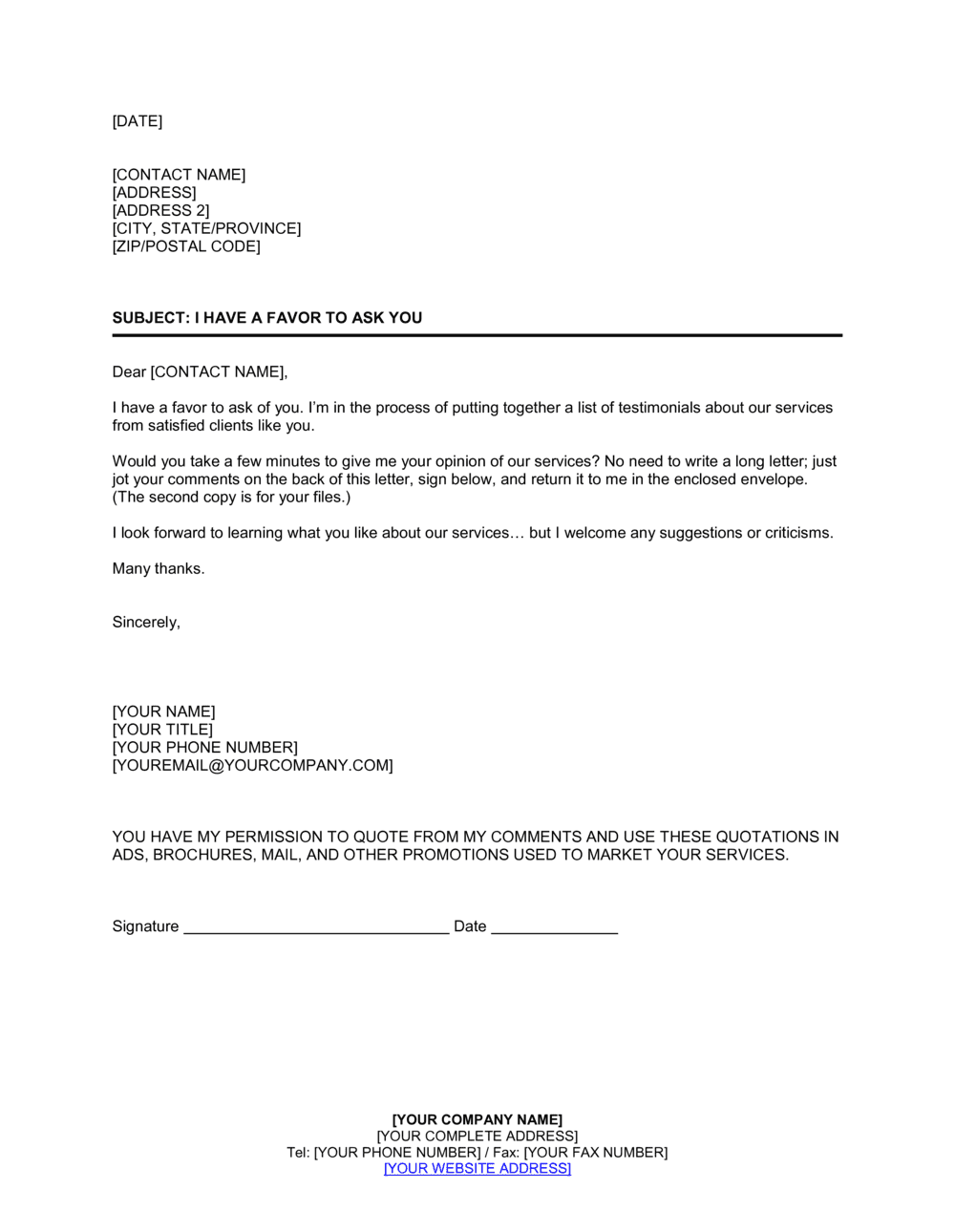
A Soliciting Testimonials From Clients letter is a formal written request a business sends to a satisfied client asking for a testimonial, along with a consent and release clause authorizing the business to publish and use that testimonial in marketing materials. This free Word download provides a structured, legally sound starting point you can edit online and export as PDF — covering usage rights, approval steps, disclosure obligations, and revocation terms in a single document.
When you need it
Use it whenever you intend to publish a client's name, likeness, company affiliation, or quoted words in any promotional context — website, social media, case studies, press releases, or paid advertising. Without signed consent, using a client's testimonial exposes you to privacy, defamation, and FTC disclosure liability.
What's inside
A formal testimonial request, a consent and release clause granting usage rights, a description of permitted publication channels, a client approval step, a disclosure and accuracy obligation, a term and revocation clause, and a governing law provision.

What is a Soliciting Testimonials From Clients letter?

A Soliciting Testimonials From Clients letter is a formal written request a business sends to a satisfied client asking them to provide an endorsement, paired with a legally binding consent and release clause authorizing the business to publish and use that testimonial in promotional materials. It defines exactly where the testimonial may appear, requires client approval of any edited version before publication, addresses FTC disclosure obligations, and grants the client the right to revoke consent — all in a single document. Without this agreement, publishing a client's name, quote, or likeness for commercial purposes exposes the business to right-of-publicity claims, FTC enforcement action, and relationship damage with the client.

Why You Need This Document

Every testimonial published without signed consent is a liability waiting to surface. A client who discovers their name in a paid advertising campaign they never authorized can demand removal, file an FTC complaint, and seek civil damages — all while the campaign is live and generating results you cannot now legally use. Beyond individual client relationships, the FTC's 2023 updates to its Endorsement Guides impose civil penalties of up to $51,744 per violation for undisclosed material connections, and regulators have begun enforcing against brands of all sizes. A signed testimonial agreement closes these risks for the cost of 20 minutes of setup: it creates documented proof of consent, locks in the approval workflow that prevents editing disputes, and gives both parties clarity on what happens if the client changes their mind. This template gives you the structure to collect that consent professionally — in a form that signals to clients that you take their trust seriously.

Which variant fits your situation?

If your situation is…Use this template
Requesting a short written quote for a website or social mediaSoliciting Testimonials From Clients
Producing a full written case study featuring client resultsCase Study Authorization Letter
Recording a video testimonial for use in advertisingVideo Release and Consent Form
Featuring a client logo alongside a testimonialLogo and Brand Usage Authorization
Referencing a client's name in a press releasePress Release Quote Approval Letter
Publishing a detailed client success story in a trade publicationCo-Marketing Agreement
Collecting aggregate ratings and reviews for a product listingCustomer Review Solicitation Form

Common mistakes to avoid

❌ Publishing before obtaining signed consent

Why it matters: Using a client's name or quote without written authorization can constitute misappropriation of likeness or false endorsement — both of which carry FTC enforcement risk and civil liability.

Fix: Obtain a fully executed agreement before the testimonial goes live on any channel. Build the signing step into your content-approval workflow, not as an afterthought.

❌ Editing the testimonial without client re-approval

Why it matters: Altering a client's words — even to improve grammar — without resubmitting for approval can change meaning, create a false impression, and violate FTC endorsement guidelines.

Fix: Send every edited version back to the client for written confirmation before publication. Keep an email or eSign record of each approval.

❌ Omitting required FTC disclosure

Why it matters: The FTC requires clear disclosure of any material connection between the endorser and the brand. Violations can result in civil penalties up to $51,744 per violation as of 2024.

Fix: Audit every published testimonial for material connections — discounts, referral fees, free products, or business partnerships — and add 'Client received a [DISCOUNT/BENEFIT] in connection with this review' where applicable.

❌ Using a blanket 'all purposes' license without listing channels

Why it matters: Clients who consent to a website quote are often surprised and upset to find their name in a paid television or digital ad campaign — leading to public disputes and legal demands.

Fix: Enumerate every specific channel in the agreement. For any use outside the listed channels, obtain a written amendment signed by both parties.

❌ No revocation right in the agreement

Why it matters: A perpetual, irrevocable license to use a person's name and words is unenforceable in several jurisdictions and is treated as an unfair term under consumer protection law in the EU and UK.

Fix: Include a 30-day written revocation right with a practical wind-down clause that exempts already-printed materials while requiring removal from digital channels within the notice period.

❌ Addressing the letter to the wrong individual at a corporate client

Why it matters: A testimonial consent signed by an employee without authority to bind their employer cannot license the company's name or trademark — making the signed agreement worthless.

Fix: Confirm before sending whether the individual has authority to grant reputational consent on behalf of their organization. For enterprise clients, route to legal or marketing leadership.

The 10 key clauses, explained

Identification of parties and context

In plain language: Names the business requesting the testimonial and the client being asked, and briefly describes the product or service the testimonial relates to.

Sample language
This agreement is entered into between [BUSINESS LEGAL NAME] ('Company') and [CLIENT FULL NAME / ENTITY NAME] ('Client') regarding Client's experience with [PRODUCT OR SERVICE DESCRIPTION].

Common mistake: Using a trade name instead of the registered legal entity for the business. If a dispute arises, the contract must bind the correct legal person — a mismatch creates an enforceability gap.

Testimonial request and description

In plain language: States what the business is asking the client to provide — a written quote, a specific word count, subject matter focus — and the process for submitting it.

Sample language
Company respectfully requests that Client provide a written testimonial of approximately [WORD COUNT] words describing Client's experience with [PRODUCT/SERVICE], to be submitted to [CONTACT NAME] at [EMAIL] by [DATE].

Common mistake: Leaving the request open-ended with no format or topic guidance. Vague requests produce vague testimonials that cannot be used effectively in marketing materials.

Consent and license grant

In plain language: The core release clause in which the client grants the business a license to use the testimonial — including the client's name, title, company, and likeness if applicable — for promotional purposes.

Sample language
Client grants Company a non-exclusive, royalty-free, worldwide license to use, reproduce, publish, and display Client's testimonial, including Client's name, job title, and company name, in connection with Company's marketing and promotional activities.

Common mistake: Omitting 'non-exclusive' — without it, some courts interpret the grant as exclusive, preventing the client from ever using their own words about their experience elsewhere.

Permitted publication channels

In plain language: Specifies exactly where the business is allowed to use the testimonial — website, social media platforms, email campaigns, print materials, paid advertisements, or any other channels.

Sample language
Permitted channels include: Company's official website, LinkedIn, Instagram, Facebook, email newsletters, printed brochures, press releases, and paid digital advertising. Any use outside these channels requires separate written consent from Client.

Common mistake: Writing 'all marketing materials' without listing specific channels. Courts and clients interpret this phrase differently — a specific list prevents disputes about whether a Super Bowl ad was covered.

Client approval and accuracy obligation

In plain language: Requires the business to submit the final version of the testimonial — after any editing — to the client for approval before publication, and obligates the business not to alter the meaning of the client's words.

Sample language
Company shall submit the final edited version of the testimonial to Client for written approval prior to first publication. Company agrees not to alter Client's words in any manner that changes the intended meaning or creates a false impression.

Common mistake: Skipping the approval step entirely. Clients who see their words edited and published without review frequently demand removal and sometimes file FTC complaints about inaccurate representations.

Disclosure and FTC compliance

In plain language: Obligates the business to include any required disclosure of a material connection between the client and the business — such as a discount, referral fee, or partnership — whenever the testimonial is published.

Sample language
Where required by applicable law or regulation, including the FTC's Guides Concerning the Use of Endorsements and Testimonials (16 CFR Part 255), Company shall include a clear and conspicuous disclosure of any material connection between Company and Client adjacent to the published testimonial.

Common mistake: Assuming that because no money changed hands, no disclosure is needed. The FTC requires disclosure of any material connection, including free products, discounts, or a business-partner relationship.

Term and revocation

In plain language: States how long the license lasts and gives the client the right to revoke consent on written notice, specifying a reasonable wind-down period for removing the testimonial from live materials.

Sample language
This license shall remain in effect until revoked by Client upon [30] days' written notice to Company. Upon receipt of a valid revocation notice, Company shall remove the testimonial from all new publications within [30] days, but is not required to recall printed materials already in circulation.

Common mistake: No revocation right at all. Several jurisdictions — and the FTC — view an irrevocable, perpetual testimonial license as an unfair term, particularly for individual consumers.

Intellectual property ownership

In plain language: Clarifies that the client retains authorship and ownership of the testimonial content while granting only a usage license — not an assignment — to the business.

Sample language
Client retains all intellectual property rights in the testimonial content. Nothing in this agreement shall be construed as an assignment of copyright or other IP rights to Company. Company's rights are limited to the license granted in Section [X] above.

Common mistake: Drafting the clause as an assignment rather than a license. An assignment strips the client of ownership of their own words, which courts in several jurisdictions will void as unconscionable when dealing with consumers.

Indemnification

In plain language: The client represents that the testimonial content is truthful, does not infringe third-party rights, and indemnifies the business against claims arising from the content itself.

Sample language
Client represents that the testimonial is truthful, based on genuine experience, and does not infringe any third-party intellectual property or privacy rights. Client agrees to indemnify and hold harmless Company from any claims, losses, or damages arising from the content of the testimonial.

Common mistake: Making indemnification mutual without limiting the business's exposure. A mutual indemnity clause can expose the business to liability for editorial decisions it makes after receiving the client's content.

Governing law and entire agreement

In plain language: Specifies which jurisdiction's law governs disputes and confirms that this document is the complete agreement between the parties on the subject of the testimonial.

Sample language
This agreement is governed by the laws of [STATE / PROVINCE / COUNTRY]. This agreement constitutes the entire understanding between the parties regarding Client's testimonial and supersedes all prior discussions, representations, or informal approvals.

Common mistake: Omitting the entire-agreement clause when testimonial terms were originally discussed by email. Without it, prior email exchanges can be introduced as additional contractual terms — expanding the scope of permitted use.

How to fill it out

  1. 1

    Identify the parties using legal names

    Enter your business's full registered legal name and the client's full legal name or entity name. For individuals, use the name as it appears on government ID. For corporate clients, confirm the legal entity before sending.

    💡 For corporate clients, address the letter to the specific individual authorized to give consent — a project manager may not have authority to license their company's name.

  2. 2

    Describe the product or service the testimonial covers

    Be specific about which product, service, or project the testimonial will relate to. This scopes the license and ensures the client knows exactly what experience they are being asked to endorse.

    💡 A narrow description — 'our Q4 2025 brand strategy engagement' — is far more defensible than 'our services generally' if the client later disputes the scope of what they endorsed.

  3. 3

    Specify the format and submission deadline

    Tell the client exactly what you need — a written quote of 50–100 words, specific themes to address, and the date by which it should be submitted. Include the name and email address of the person receiving it.

    💡 Providing two or three guiding questions (e.g., 'What problem did we help you solve?' and 'What measurable result did you see?') doubles response rates and produces more usable quotes.

  4. 4

    Define the permitted publication channels

    List every channel where you intend to publish the testimonial — website, LinkedIn, email, printed collateral, paid ads. If your plans are not finalized, list broadly but include a catch-all requiring separate consent for any channel not listed.

    💡 Revisit this list annually. If you launch a new channel after signing, get a brief written amendment rather than assuming the original consent extends.

  5. 5

    Include the approval and accuracy obligation

    Confirm that you will send the client a final edited version for written sign-off before first publication. This step is non-negotiable for FTC compliance and client relationship management.

    💡 Build a 5-business-day approval window into your publishing timeline. Clients who feel rushed in the approval step often retract consent entirely.

  6. 6

    Add any required disclosure language

    If there is any material connection between you and the client — a referral arrangement, discount, partnership, or free trial — draft the disclosure text you will include adjacent to the published testimonial and reference it in this clause.

    💡 Even a 10% loyalty discount given after the testimonial is submitted can constitute a material connection requiring disclosure — when in doubt, disclose.

  7. 7

    Set the revocation terms

    Enter the notice period (30 days is standard) and specify the wind-down timeline for removing the testimonial from active use. Note that printed materials already in circulation are typically exempt from immediate recall.

    💡 For digital channels where removal is instant, consider a shorter wind-down period — 14 days is increasingly standard for web and social media.

  8. 8

    Obtain signatures before publishing

    Both parties should sign and date the agreement before the testimonial is submitted or published. Use a digital signature tool to timestamp execution and retain a fully signed copy for your records.

    💡 Store signed testimonial agreements alongside your marketing asset files so you can produce proof of consent instantly if an FTC inquiry or client dispute arises.

Frequently asked questions

What is a testimonial solicitation letter?

A testimonial solicitation letter is a formal written request a business sends to a satisfied client asking them to provide a testimonial, combined with a consent and release clause authorizing the business to publish and use that testimonial in marketing materials. It documents the client's permission, defines where the testimonial may appear, and establishes the process for client approval before publication — protecting both parties from legal and regulatory risk.

What do FTC endorsement guidelines require for testimonials?

The FTC's Guides Concerning the Use of Endorsements and Testimonials (16 CFR Part 255) require that any material connection between the endorser and the brand be clearly and conspicuously disclosed to consumers. Material connections include free products, discounts, referral fees, employment relationships, and business partnerships. The FTC updated these guidelines in 2023 to strengthen disclosure requirements — civil penalties for violations reach $51,744 per occurrence as of 2024.

Is a testimonial agreement legally binding?

A signed testimonial consent and release agreement is generally enforceable as a contract when it meets the basic requirements of offer, acceptance, and consideration. Consideration is typically the mutual benefit of the professional relationship — no payment is required. However, enforceability depends on the governing jurisdiction, the clarity of the license grant, and whether the client had authority to sign. Always execute the agreement before publishing any testimonial.

What is the difference between a testimonial release and a case study agreement?

A testimonial release covers a short quote or endorsement — typically one to three sentences — used in standard marketing contexts such as a website or social media. A case study agreement covers a detailed narrative describing the client's problem, your solution, and measurable results, and typically includes additional controls over how the client's brand, data, and proprietary information are represented. Case studies require a more comprehensive agreement with confidentiality and approval obligations beyond those in a testimonial release.

Can I edit a client's testimonial before publishing?

You may make minor edits for clarity, grammar, or length, but only with the client's written re-approval before publication. The FTC prohibits publishing a testimonial that has been altered to create a false or misleading impression. Structurally, a client approval clause requiring sign-off on the final edited version protects both parties and is considered best practice under FTC guidelines.

Do I need a separate agreement for video testimonials?

Yes. Video testimonials involve additional rights — likeness, voice, and performance — that typically require a broader release than a written testimonial. A video release form should address recording consent, editing rights, permitted distribution platforms, and compensation (or confirmation that no compensation is given, for FTC purposes). The written testimonial template is a starting point, but a standalone video release is advisable for any recorded content.

How this compares to alternatives

vs Non-Disclosure Agreement

An NDA restricts what a client can disclose about your business. A testimonial solicitation letter does the opposite — it creates a framework for the client to speak about your business publicly. The two documents address the same relationship from opposite directions and are sometimes used together when a case study involves both confidential information and public endorsement.

vs Co-Marketing Agreement

A co-marketing agreement governs a broader mutual promotional arrangement where both parties share marketing activities, costs, and audiences. A testimonial solicitation letter is narrower — it covers only the client's one-directional endorsement of the business. Use a co-marketing agreement when both parties are promoting each other; use this template when only the client's endorsement is being solicited.

vs Model Release Form

A model release form grants consent specifically for the use of a person's photographic image or likeness in commercial contexts. A testimonial solicitation letter covers written or verbal endorsements and may include likeness only as a secondary element. For video testimonials or campaigns built primarily around a client's image, a model release form is required in addition to or instead of this template.

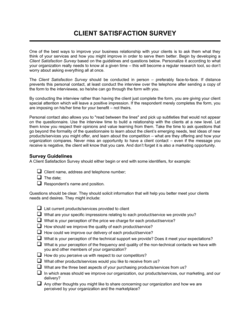
vs Customer Satisfaction Survey

A customer satisfaction survey collects structured feedback for internal improvement — responses are typically anonymous or confidential and not intended for publication. A testimonial solicitation letter specifically requests content for public promotional use with explicit consent and usage rights. Feedback from a satisfaction survey cannot be published as a testimonial without a separate consent agreement.

Industry-specific considerations

Professional Services

Law firms, consulting practices, and accounting firms use named testimonials from clients and executives, requiring explicit consent to attribute quotes to individuals who may have confidentiality obligations of their own.

SaaS / Technology

Software companies routinely feature customer logos and quotes in paid ad campaigns and G2 or Capterra profiles, where FTC material-connection disclosure and formal consent documentation are essential.

Marketing and Creative Agencies

Agencies use client testimonials in award submissions, new-business pitches, and case-study content, where the client's brand reputation is directly implicated and approval workflows must be documented.

Healthcare and Wellness

Patient or client testimonials in healthcare marketing are subject to HIPAA in the US and strict data protection rules in the EU, requiring consent forms that address both marketing use and privacy obligations simultaneously.

Education and Coaching

Coaches, trainers, and online educators feature student outcomes and personal transformation stories, where FTC guidelines require disclosure of any free access or reduced-rate arrangements given in exchange for a review.

Retail and E-commerce

Product brands soliciting reviews for Amazon, Google, or their own site must comply with FTC guidelines on incentivized reviews and platform-specific terms that prohibit certain forms of compensated endorsement.

Jurisdictional notes

United States

The FTC's Endorsement Guides (16 CFR Part 255), updated in 2023, require clear disclosure of material connections between endorsers and brands. Most states also have right-of-publicity statutes — New York, California, and Texas among the strictest — requiring written consent for commercial use of a person's name or likeness. Testimonials making specific performance claims in regulated industries (finance, health, legal) face additional scrutiny from the FTC and sector-specific regulators such as the SEC and FDA.

Canada

Canada's Anti-Spam Legislation (CASL) and the Personal Information Protection and Electronic Documents Act (PIPEDA) govern consent for personal data used in commercial communications. Quebec's Law 25 (Bill 64) imposes stricter consent requirements for processing personal information, including names used in marketing. The Competition Act prohibits misleading endorsements and testimonials that create a false impression about a product or service.

United Kingdom

UK GDPR and the Data Protection Act 2018 require a lawful basis for processing personal data in marketing — consent is the most appropriate basis for publishing a named testimonial. The Advertising Standards Authority (ASA) and CAP Code require that advertorials and paid endorsements be clearly identified. The Consumer Protection from Unfair Trading Regulations 2008 prohibit using fake or misleading testimonials, and the Competition and Markets Authority (CMA) actively enforces against undisclosed incentivized reviews.

European Union

GDPR Article 6 requires a specific lawful basis — typically freely given, informed written consent — to publish an individual's personal data (including name and employer) in marketing materials. Consent must be specific, granular, and revocable. The EU Omnibus Directive, effective across member states from 2022 onward, requires businesses to disclose whether consumer reviews have been incentivized. Member states including Germany and France have additional personality rights protections that can limit testimonial use even where GDPR consent is obtained.

Template vs lawyer — what fits your deal?

PathBest forCostTime
Use the templateSmall businesses and freelancers collecting written testimonials for standard digital marketing useFree15–20 minutes per client
Template + legal reviewBusinesses running paid ad campaigns featuring client names, or operating in regulated industries such as healthcare or financial services$200–$500 for a lawyer to review and tailor the template2–5 business days
Custom draftedEnterprise marketing programs featuring named executives, international testimonial campaigns, or situations where FTC or GDPR exposure is material$800–$2,500+1–2 weeks

Glossary

Testimonial
A statement — written, verbal, or visual — by a real customer or client affirming their experience with a product or service, used for promotional purposes.
Release clause
A contractual provision in which the client grants the business a license or permission to use their name, words, or likeness for defined purposes.
FTC endorsement guidelines
US Federal Trade Commission rules requiring that any material connection between an endorser and a brand be clearly disclosed to consumers, including when endorsers receive compensation or free products.
Likeness
A person's recognizable image, photograph, or visual representation — its commercial use typically requires explicit written consent.
Usage rights
The specific channels, formats, and duration for which a business is authorized to publish or display the testimonial after the client consents.
Revocation
The client's right to withdraw their consent and require removal of their testimonial from all marketing materials, typically on written notice.
Approval clause
A provision requiring the business to submit the final edited version of the testimonial to the client for review and written sign-off before publication.
Material connection
Any relationship — financial, personal, or professional — between the endorser and the brand that could affect how the endorsement is perceived and that must be disclosed under FTC rules.
Governing law
The jurisdiction whose laws apply to the interpretation and enforcement of the testimonial agreement in the event of a dispute.
Intellectual property assignment
A clause specifying who owns the testimonial content itself — typically the client retains authorship while granting the business a non-exclusive license to use it.
Indemnification
A contractual obligation by which one party agrees to compensate the other for specific losses or liabilities — here, typically the client indemnifying the business against claims that the testimonial content is false or infringes third-party rights.

Part of your Business Operating System

This document is one of 3,000+ business & legal templates included in Business in a Box.

  • Fill-in-the-blanks — ready in minutes
  • 100% customizable Word document
  • Compatible with all office suites
  • Export to PDF and share electronically

Create your document in 3 simple steps.

From template to signed document — all inside one Business Operating System.
1
Download or open template

Access over 3,000+ business and legal templates for any business task, project or initiative.

2
Edit and fill in the blanks with AI

Customize your ready-made business document template and save it in the cloud.

3
Save, Share, Send, Sign

Share your files and folders with your team. Create a space of seamless collaboration.

Save time, save money, and create top-quality documents.

★★★★★

"Fantastic value! I'm not sure how I'd do without it. It's worth its weight in gold and paid back for itself many times."

Managing Director · Mall Farm
Robert Whalley
Managing Director, Mall Farm Proprietary Limited
★★★★★

"I have been using Business in a Box for years. It has been the most useful source of templates I have encountered. I recommend it to anyone."

Business Owner · 4+ years
Dr Michael John Freestone
Business Owner
★★★★★

"It has been a life saver so many times I have lost count. Business in a Box has saved me so much time and as you know, time is money."

Owner · Upstate Web
David G. Moore Jr.
Owner, Upstate Web

Run your business with a system — not scattered tools

Stop downloading documents. Start operating with clarity. Business in a Box gives you the Business Operating System used by over 250,000 companies worldwide to structure, run, and grow their business.

Start free · No credit card required