Entrepreneurs - Planning Your Escape From Your Job Template

Free to read • Save or share with one click

FreeEntrepreneurs - Planning Your Escape From Your Job Template

At a glance

What it is
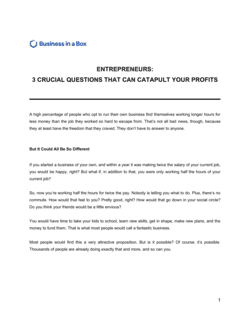
The Entrepreneurs Planning Your Escape From Your Job template is a structured legal planning document that guides a working professional through the steps, obligations, and risk-mitigation measures required to leave employment and launch an independent business. This free Word download covers the full transition lifecycle — from reviewing existing employment restrictions and protecting newly created IP, to formalizing a launch timeline and structuring the new venture — in a single document you can edit online and export as PDF.
When you need it
Use it when you are actively preparing to resign from a salaried role to start a business and need a clear record of your transition timeline, a review of existing contractual obligations (non-compete, IP assignment, confidentiality), and a framework for ensuring your new venture does not inadvertently breach your current employment agreement. It is equally valuable for any professional who has already resigned and needs to document the legal and operational groundwork laid before departure.
What's inside
Key sections cover the entrepreneur's current employment obligations and restriction review, IP ownership boundaries, venture formation milestones, financial runway planning, client and employer communication protocols, transition timeline, and post-departure restrictive covenant compliance. Each section uses bracketed placeholders so the document can be customized quickly to reflect the individual's employment terms and business type.

What is the Entrepreneurs Planning Your Escape From Your Job Template?

The Entrepreneurs Planning Your Escape From Your Job template is a structured legal planning document that guides a working professional through every step required to leave employment and launch an independent business without breaching existing contractual obligations. It combines a systematic review of the current employment contract's restrictive covenants — non-compete, non-solicit, IP assignment, and confidentiality — with a documented transition timeline, financial runway assessment, IP ownership confirmation, and post-departure compliance plan. Unlike a general business plan, it focuses specifically on the legal and logistical prerequisites to a clean departure: what you can and cannot do before you resign, how to document independent IP development, and how to communicate the exit professionally while protecting the new venture.

Why You Need This Document

Launching a business without a documented exit strategy exposes you to three concrete risks simultaneously. First, an employer who discovers the new venture before your resignation date may terminate you for cause, eliminating any severance and potentially accelerating the start of restrictive covenant obligations in a jurisdiction-specific way. Second, without timestamped IP development records, anything you created during employment — code, designs, client acquisition frameworks — can be claimed by the employer as work product subject to the IP assignment clause, leaving your venture's core assets in dispute at the moment you need them most. Third, a founder who inadvertently solicits employer clients or colleagues during a non-solicitation period can face an emergency injunction that halts the business within weeks of launch, at maximum reputational and financial cost. This template provides the written record that your departure was legally clean, your IP was independently developed, and your transition followed every contractual and statutory obligation — turning the riskiest phase of entrepreneurship into a documented, defensible process.

Which variant fits your situation?

If your situation is…Use this template
Leaving employment to launch a sole proprietorship or freelance practiceEntrepreneurs Planning Your Escape From Your Job
Forming a new LLC or corporation before resigningLLC Operating Agreement
Entering a formal partnership with a co-founder at launchPartnership Agreement
Consulting back for your former employer after departureIndependent Contractor Agreement
Protecting a business idea created before or during employmentNon-Disclosure Agreement (NDA)
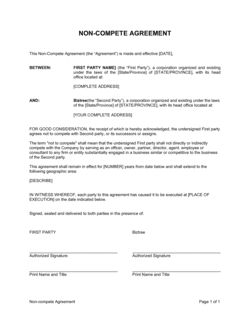
Reviewing and documenting an existing non-compete restrictionNon-Compete Agreement
Securing the first client or customer before leaving employmentService Agreement

Common mistakes to avoid

❌ Copying employer files before resignation

Why it matters: Even copying materials for personal reference — pricing spreadsheets, client lists, or product specs — constitutes misappropriation of confidential information. Employers routinely obtain forensic imaging of departing employees' devices and can identify copied files by timestamp.

Fix: Complete all pre-resignation work using only publicly available information and materials you created independently. Return or delete all employer materials before your last day and document that you have done so.

❌ Assuming the non-compete is unenforceable without legal review

Why it matters: Founders routinely launch directly into the restricted market believing their non-compete 'won't hold up in court,' only to face an emergency injunction that freezes operations at precisely the moment the business is most vulnerable — first clients, first funding round.

Fix: Pay an employment lawyer $300–$600 to review the specific non-compete clause in your jurisdiction before finalizing your venture's market focus. The cost is negligible compared to litigation.

❌ Resigning verbally before submitting written notice

Why it matters: The start date of the contractual notice period — and therefore the start date of all post-employment restrictions — is ambiguous when notice is given verbally. This can shorten your effective restriction window or, conversely, expose you to a claim that your restrictions started earlier than you believed.

Fix: Submit written resignation notice on the same day you inform your manager, with a clear effective date. Email with a read receipt creates a timestamped record.

❌ Building the venture using employer time, devices, or systems

Why it matters: Any work product created on employer hardware, during work hours, or using employer-licensed software may trigger an IP assignment clause — even if the work is unrelated to your current role. This is the single most common basis for employer IP claims against founder startups.

Fix: Use personal devices, personal accounts, and personal time exclusively. If you need to work on the venture during a lunch break, do so on a personal phone with mobile data — never on the office network.

❌ Soliciting employer clients before the non-solicitation period expires

Why it matters: Courts have found that informal LinkedIn messages, casual social encounters, and 'coincidental' coffee meetings constitute solicitation when they occur in the weeks surrounding a departure. A single provable solicitation can convert a time-limited restriction into a full injunction.

Fix: Document every contact with former employer clients during the restriction period. If a client contacts you, record the date, method, and content of the communication and respond only with neutral acknowledgment until the restriction expires.

❌ Underestimating the true cost of leaving employment

Why it matters: Founders who calculate runway based on their take-home salary routinely run out of cash within 6 months because they have not accounted for self-employment taxes (15.3% in the US), individual health insurance ($400–$800/month), loss of employer retirement contributions, and irregular income timing.

Fix: Build a post-resignation personal budget that includes every employer-subsidized benefit at its full self-pay cost. Add a 20% contingency buffer to the total and recalculate your runway before setting a resignation date.

The 10 key clauses, explained

Employment Contract Review and Restriction Summary

In plain language: Identifies and lists every restrictive covenant in the current employment agreement — non-compete, non-solicit, IP assignment, confidentiality, and moonlighting restrictions — with their scope, duration, and geographic reach.

Sample language
Employee confirms review of the Employment Agreement dated [DATE] with [EMPLOYER NAME]. Applicable restrictions include: (a) non-compete for [DURATION] within [GEOGRAPHIC AREA]; (b) non-solicitation of customers and employees for [DURATION]; (c) IP assignment covering [SCOPE]; (d) confidentiality with no expiry.

Common mistake: Reviewing only the main employment contract and missing restrictions buried in a separately signed IP agreement, equity plan, or employee handbook — each of which can impose independent obligations.

IP Ownership and Clean-Room Development Confirmation

In plain language: Documents that the venture's core IP — code, designs, processes, and business concepts — was developed independently, on personal time and devices, without using employer data or resources.

Sample language
[FOUNDER NAME] confirms that [VENTURE NAME]'s core intellectual property, including [DESCRIPTION OF IP], was developed exclusively on personal time using personal equipment and does not incorporate any confidential information or work product belonging to [EMPLOYER NAME].

Common mistake: Failing to log the dates and tools used during IP development. Without timestamped evidence — version control commits, personal device logs, or dated notes — an employer can claim ownership of anything created during employment.

Venture Formation Milestones

In plain language: Records the legal steps taken to form the new business entity before or after departure — entity type chosen, state or jurisdiction of incorporation, filing date, and equity structure.

Sample language
[VENTURE NAME] was incorporated as a [ENTITY TYPE] in [STATE / PROVINCE / COUNTRY] on [DATE], with [FOUNDER NAME] holding [X]% of founding equity. A separate co-founder agreement / LLC operating agreement is attached as Schedule [X].

Common mistake: Incorporating the new entity in the employer's registered state using the employer's registered agent, which creates a discoverable paper trail that may trigger an employer's moonlighting policy review.

Financial Runway and Personal Liability Assessment

In plain language: Documents the founder's personal financial position — savings runway in months, committed personal expenses, and any personal guarantees or debts that must be managed through the transition period.

Sample language
Based on current personal savings of $[AMOUNT] and estimated monthly personal expenses of $[AMOUNT], [FOUNDER NAME] has approximately [X] months of personal financial runway as of [DATE]. No personal guarantees currently exist beyond [DESCRIBE ANY EXISTING OBLIGATIONS].

Common mistake: Calculating runway based on current salary without accounting for the loss of employer-paid benefits — health insurance, retirement contributions, and payroll taxes alone can add $500–$1,500 per month to personal costs.

Transition Timeline and Resignation Date

In plain language: Sets out the planned resignation date, the required notice period, and the key milestone events between now and departure — including client acquisition, product development, and funding milestones.

Sample language
Planned resignation date: [DATE]. Required notice period per employment contract: [X weeks / months]. Key pre-resignation milestones: [MILESTONE 1] by [DATE]; [MILESTONE 2] by [DATE]. Post-resignation venture launch target: [DATE].

Common mistake: Setting a resignation date before achieving minimum financial runway or securing the first client or revenue source, which forces the founder into premature dependence on the new venture and reduces negotiating leverage.

Employer Communication and Resignation Protocol

In plain language: Documents the approach for notifying the employer of resignation — written notice format, who receives it first, what information will and will not be disclosed about the new venture, and how existing work will be handed over.

Sample language
Resignation will be communicated in writing to [MANAGER TITLE / NAME] on [DATE], with a copy to [HR CONTACT]. The resignation letter will not disclose the nature of [VENTURE NAME]. Work handover will cover [KEY PROJECTS] over [X weeks].

Common mistake: Verbally announcing the resignation before submitting written notice — verbal notices are harder to date precisely, which creates ambiguity about when the contractual notice period and post-employment restrictions officially commence.

Client and Contact Protocol During Transition

In plain language: Defines which employer clients, suppliers, or contacts the founder plans to approach after departure — and confirms the timing and method will respect non-solicitation obligations.

Sample language
Following expiry of the non-solicitation period on [DATE], [FOUNDER NAME] may approach former clients including [CATEGORIES / NAMES IF PERMITTED]. No client contact will occur prior to that date except through the employer's standard handover process.

Common mistake: Sending informal 'keeping in touch' messages to employer clients before the non-solicitation period expires. Courts have found that even casual contact, if timed to coincide with departure, constitutes solicitation.

Confidential Information Quarantine

In plain language: Confirms that no confidential employer data — customer lists, pricing models, product roadmaps, or financial records — has been copied, retained, or will be used in the new venture.

Sample language
[FOUNDER NAME] confirms that no confidential information belonging to [EMPLOYER NAME] has been retained in any form, including digital copies, printed materials, or personal notes, and that no such information will be used in the operation of [VENTURE NAME].

Common mistake: Copying 'reference materials' from employer systems to a personal device before departure, even with no immediate intent to use them. Possession alone is sufficient grounds for an injunction in most jurisdictions.

Post-Departure Restrictive Covenant Compliance Plan

In plain language: Outlines the specific steps the founder will take during the restriction period — geography and industry avoided, clients not contacted, former colleagues not recruited — to ensure full compliance.

Sample language
During the [X]-month non-compete period ending [DATE], [FOUNDER NAME] will not engage in [RESTRICTED ACTIVITIES] within [GEOGRAPHIC AREA]. The initial venture target market — [DESCRIBE TARGET MARKET] — is outside the restriction scope for the following reasons: [REASONS].

Common mistake: Assuming the restriction is unenforceable without getting legal advice specific to the jurisdiction. Founders who rely on industry rumor that 'non-competes are never enforced' in their state risk injunctions that halt the new business at launch.

Governing Law and Dispute Resolution

In plain language: States which jurisdiction's law governs the transition plan and how disputes with the former employer will be handled, including any arbitration clause in the original employment contract.

Sample language
This transition plan is governed by the laws of [STATE / PROVINCE / COUNTRY]. Any dispute with [EMPLOYER NAME] arising from employment obligations shall be resolved pursuant to the dispute resolution provision in the Employment Agreement dated [DATE], or by [ARBITRATION / MEDIATION / COURT] in [CITY].

Common mistake: Ignoring the governing law clause from the original employment contract. If that contract specifies New York law and arbitration, a California founder cannot unilaterally substitute California law — the employer's clause typically controls.

How to fill it out

  1. 1

    Gather and read every employment document you have signed

    Collect your employment contract, any separately signed IP or confidentiality agreements, equity plan documents, and the employee handbook. Identify every clause that restricts post-employment activity and list them in the restriction summary section.

    💡 Requests to HR for copies of all signed documents are standard and do not trigger employer suspicion — you are entitled to your own signed agreements.

  2. 2

    Document your IP development timeline and tools

    List every element of your venture's core IP — product, code, brand, business model — and for each, record the date created, the device used, and confirm it does not incorporate employer resources or data.

    💡 Enable version control (Git, Notion history, or Google Docs revision history) from day one so you have a timestamped record that predates your resignation.

  3. 3

    Complete the venture formation milestones section

    Enter the entity type, incorporation jurisdiction, filing date, and founding equity split. Attach any co-founder agreement or LLC operating agreement as a schedule.

    💡 Use a different registered agent and a personal address — not your current employer's city or building — to minimize the chances of the filing appearing in an employer compliance search.

  4. 4

    Calculate your financial runway honestly

    Add up all personal monthly fixed expenses including health insurance (at self-pay rates), taxes (add 15% for self-employment taxes in the US), and any debt payments. Divide your liquid savings by this number to get true runway in months.

    💡 Target a minimum of 12 months of personal runway before resigning — 6 months is fragile for any venture with a sales cycle longer than 30 days.

  5. 5

    Set a resignation date tied to a specific milestone

    Choose your resignation date based on reaching a defined trigger — a signed first client, a completed product MVP, or a minimum cash reserve — rather than a calendar date alone.

    💡 Commit the milestone to writing here so that date-creep (perpetually deferring resignation) is visible and you can hold yourself accountable.

  6. 6

    Draft the resignation and handover protocol

    Write the resignation letter separately and plan the handover for active projects. Record in this section who receives written notice, on what date, and what the handover covers.

    💡 A professional, complete handover is your best insurance against an employer claiming you caused harm during departure — courts weigh this favorably in any subsequent dispute.

  7. 7

    Map the client and contact timeline against non-solicitation expiry

    List the employer clients or contacts you intend to pursue after departure, then confirm the earliest date you can approach them legally. Enter that date in the client protocol section.

    💡 If a target client reaches out to you first during the restriction period, document the inbound contact immediately — it significantly weakens any solicitation claim.

  8. 8

    Sign, date, and store the completed document

    Sign and date the completed transition plan. Store the original with your other founding documents. If you engage an employment lawyer for a review, have them countersign or provide a separate review memo.

    💡 Store a timestamped copy in cloud storage with access logs — if a dispute arises, the metadata proving when you completed each section is part of your evidence.

Frequently asked questions

What is an entrepreneur job escape plan?

An entrepreneur job escape plan is a structured legal and operational document that guides a working professional through the steps required to leave employment and launch an independent business without breaching existing contractual obligations. It covers restriction review, IP ownership confirmation, venture formation, financial runway planning, and a resignation and transition protocol — providing a written record that the departure was legally clean and strategically planned.

Can I start a business while still employed?

In most jurisdictions, yes — but with significant caveats. Many employment contracts include moonlighting restrictions that require disclosure or prohibit outside business activity, especially in competing fields. IP assignment clauses can vest ownership of side-project work in the employer if the work was done on employer time or equipment. Review your employment contract carefully before taking any steps to form or operate a new venture while still employed.

When should I resign from my job to start a business?

The strongest position is to resign after reaching a defined milestone — a signed first client, a completed MVP, or a minimum of 12 months of personal financial runway. Resigning on a calendar date alone, without a business milestone to anchor it, increases the risk of premature cash pressure that forces bad decisions in the new venture's earliest weeks. Use the transition plan to define and commit to your specific resignation trigger.

Does my employer own the IP I create for my new business?

Potentially, yes — if the IP was created using employer time, equipment, or data, or if it falls within the scope of your role. Most employment contracts include a broad IP assignment clause. Under California Labor Code §2870 and similar statutes in some other jurisdictions, employees retain rights to inventions developed entirely on personal time with personal resources and unrelated to the employer's business. Documenting the clean-room development of your venture's core IP — with timestamps and device records — is essential to establishing independent ownership.

What happens if I breach my non-compete by launching a competing business?

The former employer can seek an emergency injunction to stop the new business from operating, claim damages for lost business, and pursue legal costs. In high-stakes situations — senior executives, heavily funded startups, or competitive markets — employers do enforce non-competes aggressively. The appropriate response is to get the restriction reviewed by an employment lawyer before launching, and to structure the new venture's initial market focus outside the restricted scope if possible.

Do I have to tell my employer about my new business before I resign?

Generally, no — unless your employment contract includes a specific disclosure obligation for outside business activities. You are not required to reveal your post-employment plans in a resignation letter or exit interview. However, you must not actively deceive your employer or use employer resources to advance the new venture before departing. Saying nothing is legally safe; lying about your plans in an exit interview is not.

How much notice do I need to give when resigning to start a business?

The required notice period is whatever is specified in your employment contract, subject to statutory minimums in your jurisdiction. In the US, two weeks is standard but often not legally required. In Canada, the UK, and the EU, contractual notice periods of one to three months are common, and statutory minimums may apply regardless of what the contract says. Providing less than the contractual notice period can expose you to a claim for damages equal to the pay that would have been earned during the missed notice period.

Can I take my employer's clients with me when I leave?

Only after any non-solicitation restriction has expired and, even then, only by allowing the client to come to you rather than by actively soliciting their business. During the restriction period, any proactive outreach to former employer clients — even socially framed contact — can constitute solicitation. After the restriction expires, clients are free to choose any vendor, and you are free to respond to their inquiries. Document all inbound client contact to establish that you did not solicit.

Do I need a lawyer to use this transition plan template?

For most straightforward transitions — resigning to launch in a different market with a modest non-compete — completing this template carefully and running a one-hour employment law review is sufficient. Engage a lawyer when your non-compete is broad or in a jurisdiction that enforces them aggressively, when your employer has a history of IP litigation, when you are a senior executive with material equity or fiduciary duties, or when your new venture will directly compete with your current employer from day one. A template review costs $300–$600 and is rarely optional for high-stakes departures.

How this compares to alternatives

vs Non-Compete Agreement

A non-compete agreement is a standalone document that creates or documents post-employment competition restrictions. The entrepreneur escape plan references and works around an existing non-compete — it does not create one. Use the non-compete template when you are the employer protecting your business; use the escape plan when you are the employee navigating an existing restriction.

vs Employment Contract

An employment contract governs the active employment relationship from the employer's side. The entrepreneur escape plan is the departing employee's planning document for exiting that contract cleanly. The two documents work in sequence: the employment contract defines the obligations; the escape plan maps a legally compliant path through and past them.

vs Independent Contractor Agreement

An independent contractor agreement is used after the transition — when the founder begins providing services to clients as a self-employed professional. The escape plan covers the steps required to reach that point legally. Many founders use both: the escape plan to manage the departure, and the contractor agreement to formalize their first post-departure client relationship.

vs Business Plan

A business plan maps the market opportunity, competitive strategy, and financial projections for the new venture. The entrepreneur escape plan focuses on the legal and logistical prerequisites to launching that venture — restriction compliance, IP ownership, and resignation protocol. The escape plan should be completed before the full business plan is finalized, since non-compete scope may constrain the initial market focus.

Industry-specific considerations

Technology / SaaS

IP assignment clauses are extremely broad in tech employment contracts, often covering any software written during employment; clean-room documentation and a source-code audit are essential before launch.

Financial Services

FINRA registration, broker-dealer licensing, and client non-solicitation windows of 12–24 months are common; regulatory approval for the new entity may need to precede or run parallel to resignation.

Professional Services

Client relationships are the core asset, making non-solicitation clauses the highest-stakes restriction; mapping client ownership and timing the departure around natural contract renewals reduces friction.

Healthcare / Life Sciences

Proprietary research data, clinical trial information, and regulatory filings are subject to strict IP assignment and confidentiality obligations; patent inventorship and data ownership disputes are frequent for founders leaving research roles.

Jurisdictional notes

United States

Non-compete enforceability varies dramatically by state. California, Minnesota, North Dakota, and Oklahoma ban most post-employment non-competes. In other states, courts apply a reasonableness test based on duration, geography, and the employee's access to competitive information. The FTC's 2024 proposed ban on non-competes was blocked in federal court as of 2025 — check current status. IP assignment clauses in California are limited by Labor Code §2870, which protects inventions developed entirely on personal time with no employer resources.

Canada

Non-compete clauses are enforceable in Canada only if narrowly scoped and reasonable — courts apply a higher standard than most US jurisdictions and routinely void overbroad restrictions. Ontario's Employment Standards Act, 2000 prohibits non-competes for most non-executive employees as of October 2021. Quebec employment law requires French-language contracts for provincially regulated employers. Common-law notice obligations on the employer's side can extend the effective departure timeline significantly.

United Kingdom

Post-termination restrictive covenants are enforceable in the UK if reasonable and protecting a legitimate business interest — courts apply a 'blue pencil' approach and may sever an overbroad clause rather than void it entirely. Garden leave provisions are frequently used by UK employers to manage senior departures, effectively consuming the restriction period while keeping the employee away from clients. IP created by employees in the course of their employment belongs to the employer under the Patents Act 1977 and the Copyright, Designs and Patents Act 1988.

European Union

Non-compete enforceability and requirements vary by member state. Germany, France, and the Netherlands require financial compensation to the employee during the restriction period — typically 50–100% of the last salary — for the clause to be enforceable. The EU Trade Secrets Directive (2016/943) harmonizes confidential information protections across member states but leaves non-compete regulation to national law. Founders departing employment in EU jurisdictions should obtain local counsel for the specific member state, as a clause enforceable in Germany may be void in Italy.

Template vs lawyer — what fits your deal?

PathBest forCostTime
Use the templateProfessionals resigning to launch in a different market with a standard non-compete and straightforward IP situationFree2–4 hours to complete
Template + legal reviewAny founder whose new venture overlaps with the employer's market, or who works in a jurisdiction with aggressively enforced non-competes$300–$600 for a 1-hour employment law review2–5 days including lawyer turnaround
Custom draftedSenior executives with equity, fiduciary duties, or material non-competes; founders in heavily regulated industries; departures involving disputed IP ownership$1,500–$5,000+ for full employment transition counsel1–3 weeks

Glossary

Employment Restriction Review
The process of systematically reading and documenting every clause in an existing employment contract that could limit post-employment activities, including non-compete, non-solicit, IP assignment, and confidentiality obligations.
Non-Compete Clause
A contractual restriction preventing a former employee from working for competitors or running a competing business within a defined time period and geographic area after leaving employment.
IP Assignment
A clause in an employment contract that transfers ownership of inventions, code, designs, or other work product created by the employee to the employer — sometimes including work done outside of office hours.
Moonlighting Policy
An employer policy that restricts or requires disclosure of outside business activities undertaken by an employee while still employed — violations can justify termination for cause.
Constructive Dismissal
A legal claim arising when an employer's conduct forces an employee to resign — relevant to entrepreneurs who reduce their hours or shift focus to a side business in ways the employer may characterize as abandonment.
Notice Period
The contractually or statutorily required advance notice an employee must give before their last day of employment — typically 2 weeks in the US, and potentially months in Canada, the UK, or the EU.
Financial Runway
The number of months a founder can sustain personal expenses and venture operating costs from savings or early revenue before needing additional income or investment.
Venture Formation
The legal steps of incorporating or registering a new business entity — choosing a structure (LLC, corporation, partnership), filing with the relevant authority, and issuing founding equity.
Garden Leave
A notice period during which the departing employee is paid their full salary but asked not to work, preventing them from accessing clients or confidential information before their restrictions begin.
Clean-Room IP Development
The practice of developing a new product, system, or invention entirely from non-employer resources — personal time, personal devices, and no employer data — to establish independent ownership.
Post-Employment Obligations
Continuing duties that survive termination of employment, including confidentiality, non-solicitation of clients or colleagues, and compliance with non-compete restrictions.
Restrictive Covenant
Any contractual provision that limits what a former employee can do after leaving — most commonly non-compete, non-solicit, and confidentiality obligations.

Part of your Business Operating System

This document is one of 3,000+ business & legal templates included in Business in a Box.

  • Fill-in-the-blanks — ready in minutes
  • Compatible with all office suites
  • Export to PDF and share electronically

Create your document in 3 simple steps.

From template to signed document — all inside one Business Operating System.
1
Download or open template

Access over 3,000+ business and legal templates for any business task, project or initiative.

2
Edit and fill in the blanks with AI

Customize your ready-made business document template and save it in the cloud.

3
Save, Share, Send, Sign

Share your files and folders with your team. Create a space of seamless collaboration.

Save time, save money, and create top-quality documents.

★★★★★

"Fantastic value! I'm not sure how I'd do without it. It's worth its weight in gold and paid back for itself many times."

Managing Director · Mall Farm
Robert Whalley
Managing Director, Mall Farm Proprietary Limited
★★★★★

"I have been using Business in a Box for years. It has been the most useful source of templates I have encountered. I recommend it to anyone."

Business Owner · 4+ years
Dr Michael John Freestone
Business Owner
★★★★★

"It has been a life saver so many times I have lost count. Business in a Box has saved me so much time and as you know, time is money."

Owner · Upstate Web
David G. Moore Jr.
Owner, Upstate Web

Run your business with a system — not scattered tools

Stop downloading documents. Start operating with clarity. Business in a Box gives you the Business Operating System used by over 250,000 companies worldwide to structure, run, and grow their business.

Start free · No credit card required