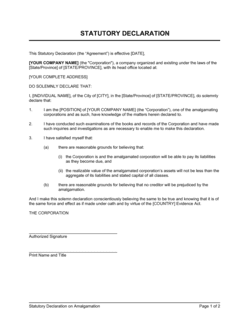
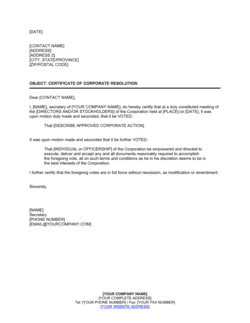
Solemn Declaration Template

Free Word download • Edit online • Save & share with Drive • Export to PDF

1 page20–30 min to fillDifficulty: StandardSignature requiredLegal review recommended
Learn more ↓
FreeSolemn Declaration Template

At a glance

What it is
A Solemn Declaration is a formal written statement in which an individual or authorized representative declares specific facts to be true, typically before a commissioner of oaths, notary public, or other authorized official. This free Word download gives you a structured, legally compliant starting point you can edit online and export as PDF for submission to government bodies, courts, financial institutions, or regulatory agencies.
When you need it
Use it when a government agency, regulator, court, or financial institution requires a sworn written statement of facts in lieu of oral testimony — such as confirming identity, ownership, compliance status, or the accuracy of submitted records. It is commonly required during business registration, estate administration, licensing applications, and customs declarations.
What's inside
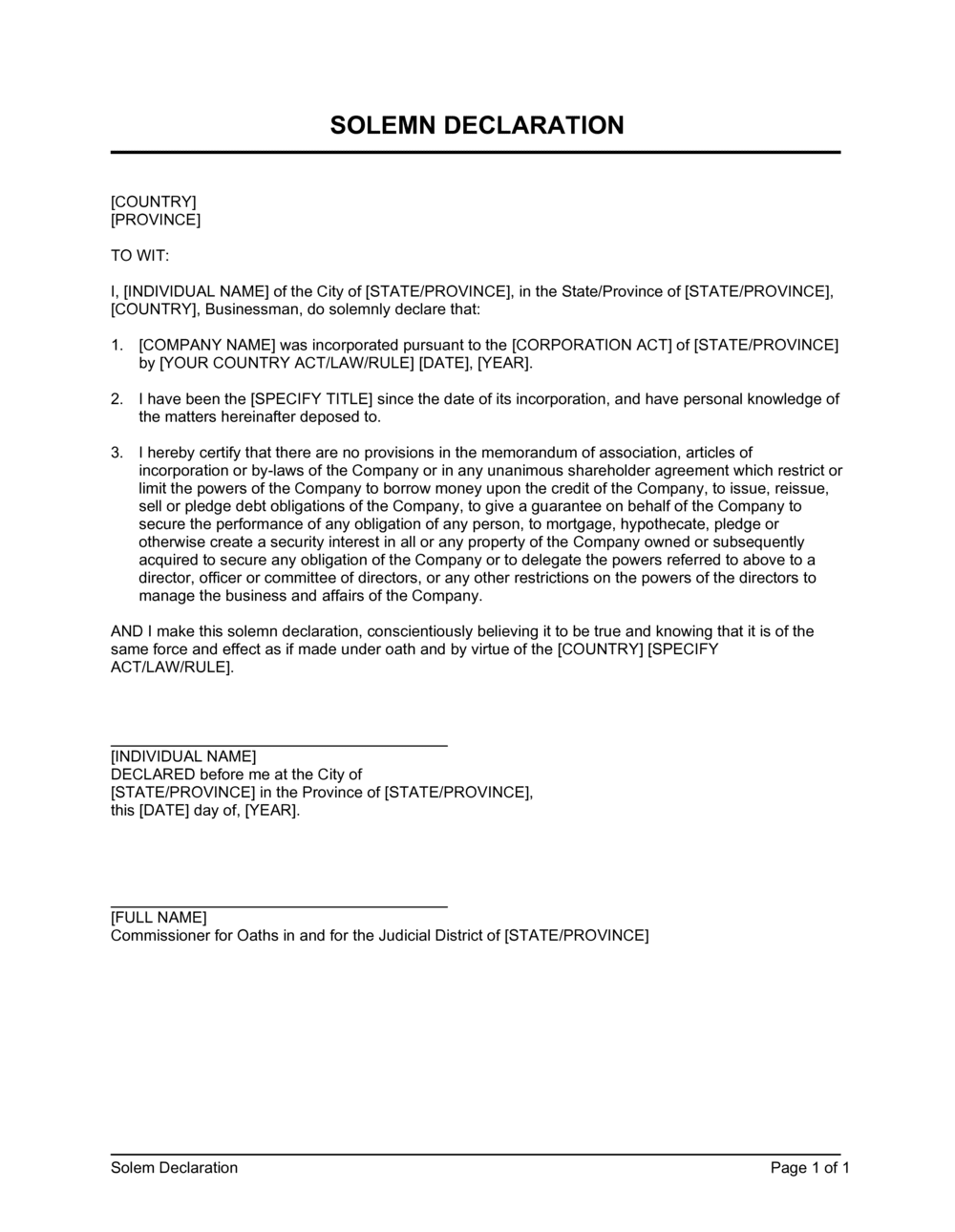
Declarant identification and capacity, statement of facts in numbered paragraphs, affirmation of truth, declaration date and location, declarant signature block, and the administering official's acknowledgment and seal.

What is a Solemn Declaration?

A Solemn Declaration is a formal written statement in which an individual swears or affirms before an authorized official — such as a commissioner of oaths, notary public, or justice of the peace — that specific facts stated in the document are true. Unlike an ordinary signed letter, a solemn declaration carries the full force of a sworn statement: knowingly providing false information constitutes perjury, a criminal offence in every major jurisdiction. It is the standard instrument in Canada and Commonwealth jurisdictions for attesting to facts in administrative, regulatory, and business contexts where an oral oath is impractical or where a receiving body requires written sworn evidence.

Why You Need This Document

Without a properly executed solemn declaration, government agencies, financial institutions, courts, and regulators may refuse to process filings that depend on sworn confirmation of facts. A missing or defective declaration can stall a business registration, delay an estate transfer, block a customs clearance, or trigger non-compliance findings under anti-money-laundering regulations. The consequences of re-execution are not merely inconvenient — they can cause missed statutory deadlines, invalidated transactions, or reputational damage with a regulator. This template gives you a complete, jurisdiction-aware starting point that incorporates every required element — declarant identification, numbered fact paragraphs, governing statute citation, and the jurat — so the document is accepted on first submission rather than returned for correction.

Which variant fits your situation?

If your situation is…Use this template
Declaring facts before a government agency or court in CanadaSolemn Declaration (Canada)
Swearing to facts before a notary public in the United StatesAffidavit
Certifying facts under the UK Statutory Declarations Act 1835Statutory Declaration (UK)
Attesting to corporate authorization for a contract or transactionCorporate Resolution
Confirming identity and authority for an estate or probate matterAffidavit of Identity
Certifying the accuracy of financial statements for a regulatorCertificate of Compliance
Verifying the source of funds for an anti-money-laundering requirementBeneficial Ownership Declaration

Common mistakes to avoid

❌ Pre-signing before appearing before the official

Why it matters: A solemn declaration signed outside the presence of the administering official is legally invalid — it has no force as a sworn statement and will be rejected by courts, regulators, and government agencies.

Fix: Leave the signature line blank until you are physically present before the commissioner of oaths or notary. Bring all exhibits and ID to the appointment and sign only when instructed by the official.

❌ Using an unauthorized or expired administering official

Why it matters: If the official's commission has expired or they are not authorized to administer oaths in the relevant jurisdiction, the entire declaration is void and must be re-sworn — sometimes causing missed filing deadlines.

Fix: Verify the official's current authorization before the appointment. Law firms, banks, and municipal offices maintain in-house commissioners; notary directories can confirm standing in most jurisdictions.

❌ Citing the wrong governing statute

Why it matters: Many receiving bodies — particularly Canadian government agencies and courts — specify the statute under which a declaration must be made. Citing the wrong statute, or omitting it entirely, can cause the declaration to be rejected as non-compliant.

Fix: Confirm the required statutory citation with the receiving body before drafting. For federal Canadian matters, the Canada Evidence Act applies; provincial matters typically cite the applicable provincial Evidence Act or Oaths Act.

❌ Omitting corporate authorization for company-representative declarations

Why it matters: A director or officer signing on behalf of a company without referencing the board resolution or authority document leaves the receiving body unable to confirm the declarant's authority — the declaration may be rejected or challenged.

Fix: Attach a copy of the relevant board resolution or signing authority as a numbered exhibit and reference it explicitly in the body of the declaration before execution.

❌ Grouping unrelated facts in a single paragraph

Why it matters: A paragraph containing multiple distinct facts is harder to rely upon, challenge, or update. If any single fact in the paragraph is incorrect, the paragraph as a whole may be discredited.

Fix: Assign each material fact its own numbered paragraph — even where the facts are closely related. Use sub-paragraphs (a), (b), (c) only where the facts are components of a single proposition.

❌ Attaching uncertified photocopies as exhibits

Why it matters: Courts, regulators, and government agencies routinely reject exhibits that are not originals or certified true copies — the declaration may be accepted but the exhibits disregarded, undermining the purpose of the filing.

Fix: Obtain certified true copies of all documents before the appointment. The administering official can certify copies at the time of execution; ask in advance if this service is available.

The 10 key clauses, explained

Declarant identification and capacity

In plain language: States the full legal name, address, occupation, and the capacity (personal, corporate officer, executor, etc.) in which the declarant is making the statement.

Sample language
I, [FULL LEGAL NAME], of [ADDRESS], [OCCUPATION], in my capacity as [TITLE / ROLE] of [COMPANY / ESTATE NAME], do solemnly declare that:

Common mistake: Using a nickname or trade name instead of the declarant's full legal name as it appears on government-issued ID — regulators and courts may reject the declaration or require re-execution.

Numbered statement of facts

In plain language: The substantive core of the document: each material fact is stated in a separate numbered paragraph, in plain language, in the first person.

Sample language
1. [COMPANY NAME] was incorporated on [DATE] under the laws of [JURISDICTION]. 2. I have been a director of [COMPANY NAME] since [DATE] and am authorized to make this declaration on its behalf. 3. To the best of my knowledge and belief, the information set out in Schedule A attached hereto is true and accurate.

Common mistake: Grouping multiple unrelated facts into a single paragraph. Each distinct factual assertion should occupy its own numbered paragraph to make the declaration easy to challenge or rely upon point-by-point.

Qualification of knowledge and belief

In plain language: Where the declarant cannot personally verify every fact, specific paragraphs are qualified as being made 'to the best of my knowledge and belief' or 'based on records I have reviewed' — limiting the scope of the sworn statement.

Sample language
4. The facts stated in paragraphs 1 to 3 are within my personal knowledge. 5. The facts stated in paragraphs 4 to 6 are stated to the best of my knowledge and belief, having reviewed the records of [COMPANY NAME].

Common mistake: Applying a blanket knowledge-and-belief qualification to the entire declaration when some facts are directly within the declarant's personal knowledge — this weakens the evidential value of the strongest statements.

Reference to exhibits and attached documents

In plain language: Formally introduces any documents attached to the declaration, identifies them by exhibit label, and confirms the declarant has reviewed them.

Sample language
6. Attached hereto and marked as Exhibit A is a true copy of the [DOCUMENT TYPE] dated [DATE], which I have reviewed and which accurately reflects [DESCRIPTION].

Common mistake: Mentioning an attached document in the body without labelling it as a formal exhibit or having the administering official initial it — the document may be inadmissible or treated as unverified.

Declaration of truth and acknowledgment of consequences

In plain language: The declarant formally affirms that the contents are true and acknowledges the legal consequences — including criminal liability for perjury — of making a false declaration.

Sample language
And I make this solemn declaration conscientiously believing it to be true, and knowing that it is of the same force and effect as if made under oath, and by virtue of the Canada Evidence Act [or applicable statute].

Common mistake: Omitting the reference to the applicable statute or legal authority. Without it, the declaration may not be recognized as a statutory declaration and could be treated as an unsworn statement.

Declarant signature block

In plain language: The line on which the declarant signs in the presence of the administering official, after the statement of facts and affirmation have been read and understood.

Sample language
DECLARED before me at [CITY], in the [PROVINCE / STATE] of [JURISDICTION], this [DAY] day of [MONTH], [YEAR]. ________________________________ [DECLARANT FULL NAME]

Common mistake: Pre-signing the declaration before appearing before the administering official. The signature must be made in the official's presence — a pre-signed declaration is invalid.

Administering official's jurat and seal

In plain language: The commissioner of oaths, notary, or justice of the peace signs below the declarant, states their name and authority, and affixes their official seal or stamp.

Sample language
________________________________ [NAME], Commissioner of Oaths / Notary Public for [JURISDICTION] My commission expires: [DATE OR 'at pleasure']

Common mistake: Using an administering official whose commission or appointment has expired, or who is not authorized in the jurisdiction where the declaration is made — the declaration will be invalid and must be re-sworn.

Exhibit schedule (if applicable)

In plain language: Attached pages labeled and initialled by both the declarant and the administering official, forming part of the sworn declaration.

Sample language
EXHIBIT A to the Solemn Declaration of [DECLARANT NAME] sworn before me on [DATE]. ________________________________ Commissioner of Oaths / Notary Public

Common mistake: Attaching photocopies of exhibits without the official marking them as certified true copies. Original documents or certified copies should be used; uncertified photocopies are frequently rejected.

Corporate authorization reference (if applicable)

In plain language: Where the declarant signs in a corporate capacity, a reference to the resolution, bylaw, or power of attorney that authorizes them to bind the company.

Sample language
I am authorized to make this declaration on behalf of [COMPANY NAME] pursuant to a resolution of the board of directors dated [DATE], a copy of which is attached hereto as Exhibit [LETTER].

Common mistake: Omitting the corporate authorization reference when signing as a director or officer — the receiving body cannot confirm the declarant had authority to bind the company, and the declaration may be rejected.

Governing statute citation

In plain language: An explicit reference to the federal or provincial/state statute under which the declaration is made, establishing its legal force and the penalties for false declaration.

Sample language
This declaration is made pursuant to the Canada Evidence Act, R.S.C. 1985, c. C-5, s. 41 [or applicable provincial statute / UK Statutory Declarations Act 1835].

Common mistake: Citing the wrong statute for the jurisdiction or omitting the citation entirely — some receiving bodies will only accept declarations that expressly identify the governing statute.

How to fill it out

  1. 1

    Identify the declarant and their capacity

    Enter the declarant's full legal name exactly as it appears on government-issued ID, their current address, occupation, and the capacity in which they are making the declaration — personal, corporate officer, executor, or authorized agent.

    💡 If signing in a corporate capacity, locate the board resolution or signing authority document before drafting — you will need to reference it as an exhibit.

  2. 2

    Draft numbered factual paragraphs

    State each material fact in its own numbered paragraph, written in the first person, in plain language. Separate facts that are within personal knowledge from those based on records reviewed or information received.

    💡 Write each paragraph as if a judge will read it in isolation — it should be self-contained and unambiguous without reference to surrounding paragraphs.

  3. 3

    Identify and label all exhibits

    List every document you are attaching, assign each a sequential exhibit letter (A, B, C), and reference each exhibit in the relevant numbered paragraph. Prepare certified true copies where originals are not available.

    💡 Arrange exhibits in the same order they are referenced in the body — this speeds review by the administering official and the receiving body.

  4. 4

    Insert the governing statute citation

    Add the correct statutory citation for the jurisdiction in which the declaration will be administered — for example, the Canada Evidence Act for federal Canadian matters, or the relevant provincial statute for provincial proceedings.

    💡 Confirm the citation with the receiving body before execution — some agencies specify which statute the declaration must be made under.

  5. 5

    Review for completeness before appearing before the official

    Read every paragraph aloud before your appointment with the administering official. Confirm every exhibit is attached and labelled, all names match government ID, and the corporate authorization is ready if required.

    💡 Do not sign the document before appearing before the official — a pre-signed declaration is invalid in every major jurisdiction.

  6. 6

    Appear before an authorized administering official

    Bring the unsigned declaration, all exhibits, and your government-issued photo ID to a commissioner of oaths, notary public, or justice of the peace who is authorized in the jurisdiction. The official will read the declaration, administer the oath or affirmation, witness your signature, and complete the jurat.

    💡 Confirm the official's commission is current and that they are authorized to administer oaths for your specific type of declaration — financial institution and court submissions sometimes require a notary public rather than a commissioner of oaths.

  7. 7

    Have the official seal each exhibit

    Ask the administering official to initial or stamp each exhibit page as well as the jurat. This binds the exhibits to the sworn declaration and prevents substitution.

    💡 Request two certified copies at the time of execution — keep one for your records and submit the other. Re-execution is time-consuming and sometimes requires tracking down the same official.

  8. 8

    Submit and retain a certified copy

    Deliver the executed declaration to the receiving body as instructed — some require the original, others accept a certified copy. Store your retained copy in a secure location with any related correspondence confirming receipt.

    💡 Note the submission date and request written acknowledgment of receipt, particularly for regulatory or government filings where a deadline applies.

Frequently asked questions

What is a solemn declaration?

A solemn declaration is a formal written statement in which a person swears or affirms before an authorized official — such as a commissioner of oaths or notary public — that specific facts are true. It carries the same legal weight as an oath and exposes the declarant to criminal liability for perjury if the stated facts are knowingly false. It is widely used in Canada, the UK, and Commonwealth jurisdictions for government filings, regulatory submissions, estate matters, and business transactions.

What is the difference between a solemn declaration and an affidavit?

Both are sworn written statements of fact, but an affidavit is the terminology used primarily in US court proceedings, while a solemn declaration is the standard term in Canada and many Commonwealth jurisdictions. In Canada, solemn declarations made under the Canada Evidence Act are used for administrative and regulatory purposes; court proceedings typically use affidavits. The legal consequences for false statements are the same under both forms.

Who can administer a solemn declaration?

In Canada, commissioners of oaths, notaries public, and justices of the peace are all authorized to administer solemn declarations, depending on the province and the type of matter. In the UK, solicitors, notaries, and authorized individuals under the Oaths Act 1978 can administer statutory declarations. In the US, notaries public administer the equivalent affidavits. Always confirm with the receiving body which type of official they require — some agencies specify a notary public rather than a commissioner of oaths.

Is a solemn declaration legally binding?

Yes. A solemn declaration made before an authorized official is generally legally binding in the sense that the declarant is criminally liable for knowingly making a false statement — perjury charges can result. It is also accepted as formal evidence of the stated facts by courts, government agencies, and regulators in most Commonwealth jurisdictions. However, consult a lawyer if the declaration will be used in adversarial court proceedings, as the rules of evidence may impose additional requirements.

Do I need a lawyer to prepare a solemn declaration?

Not always. For straightforward administrative declarations — confirming identity, business ownership, or the accuracy of a filed document — a well-drafted template is typically sufficient. A lawyer is advisable when the declaration will be used in litigation, involves complex corporate authority questions, will be filed in a foreign jurisdiction, or relates to matters where the legal consequences of any error are significant, such as immigration, estate disputes, or regulatory enforcement.

Can a company make a solemn declaration?

A company cannot itself make a solemn declaration — only an individual can swear or affirm to personal knowledge of facts. However, an authorized officer or director can make a declaration in their personal capacity on behalf of the company, stating facts about the company's status, records, or actions. The declaration should identify the declarant's capacity and reference the corporate authorization that permits them to bind the company.

What happens if I make a false solemn declaration?

Knowingly making a false solemn declaration constitutes perjury in most jurisdictions, which is a criminal offence. In Canada, perjury under section 131 of the Criminal Code carries a maximum sentence of 14 years imprisonment. In the UK, a false statutory declaration under the Perjury Act 1911 can result in up to 7 years' imprisonment. Beyond criminal liability, a false declaration can invalidate any transaction, filing, or approval that relied on it.

How long is a solemn declaration valid?

There is no universal expiry date, but in practice a solemn declaration reflects facts as of the date it was made. Many receiving bodies — banks, government agencies, and regulators — require declarations made within the past 30, 60, or 90 days and will reject older declarations as stale. Always check the currency requirements of the receiving body before executing the declaration, and plan to re-execute if significant time passes before submission.

Can a solemn declaration be used internationally?

A declaration executed in one jurisdiction may need to be apostilled or notarized for use in another country. An apostille — issued under the Hague Convention — authenticates a public document for use in signatory countries without further legalization. For countries not party to the Hague Convention, a chain of authentication (notarization, then government certification) is typically required. Consult the receiving body's specific requirements before executing a declaration intended for cross-border use.

How this compares to alternatives

vs Affidavit

An affidavit and a solemn declaration are functionally similar — both are sworn written statements of fact made before an authorized official, carrying criminal liability for false statements. The key difference is terminology and jurisdiction: affidavits are the standard form in US court proceedings and are sworn under religious oath, while solemn declarations are the standard in Canada and Commonwealth jurisdictions and may be made by affirmation without an oath. When submitting to a US court, use an affidavit; for Canadian or Commonwealth filings, use a solemn declaration.

vs Statutory Declaration

A statutory declaration is a solemn declaration made specifically under the authority of a named statute — such as the Canada Evidence Act or the UK Statutory Declarations Act 1835. The two terms are often used interchangeably, but 'statutory declaration' emphasizes the specific legislative authority and is typically the term used in formal filings. When a receiving body specifies a 'statutory declaration,' use that label and include the governing statute citation explicitly.

vs Notarized Letter

A notarized letter is a signed document whose authenticity is certified by a notary — the notary confirms the signatory's identity and that they signed willingly, but does not attest to the truth of the contents. A solemn declaration goes further: the declarant swears to the truth of the stated facts under penalty of perjury. Use a solemn declaration when the receiving body requires a sworn attestation of facts, not merely a verified signature.

vs Statutory Compliance Certificate

A compliance certificate is issued by a regulatory body or auditor confirming that a company meets specific legal or operational requirements — it is a third-party certification, not a personal sworn statement. A solemn declaration is a first-person attestation by an authorized individual. Some regulatory regimes accept either; others require both — a company officer's declaration plus an independent compliance certificate.

Industry-specific considerations

Financial Services

Anti-money-laundering regulations require beneficial ownership declarations and source-of-funds attestations from clients — solemn declarations satisfy these requirements in most Commonwealth jurisdictions.

Real Estate

Title transfers, foreign buyer compliance declarations, and property ownership confirmations commonly require solemn declarations before land registries and notaries.

Import / Export and Customs

Customs authorities accept solemn declarations to certify the origin, value, and classification of goods when formal certificates of origin are unavailable or insufficient.

Healthcare and Life Sciences

Regulatory submissions to Health Canada and equivalent bodies often require solemn declarations from authorized signatories attesting to the accuracy of clinical, safety, or labelling data.

Professional Services

Law firms, accounting firms, and HR professionals frequently prepare solemn declarations for clients in connection with licensing applications, employment eligibility, and professional standing confirmations.

Government and Public Sector

Government procurement, grant applications, and citizenship or immigration filings routinely require solemn declarations from businesses attesting to eligibility, ownership, or compliance status.

Jurisdictional notes

United States

The US equivalent of a solemn declaration is an affidavit, typically sworn before a notary public. The term 'solemn declaration' is not commonly used in US legal practice. Some US federal agencies — including USCIS for immigration matters — accept declarations made under 28 U.S.C. § 1746 without a notary, using the formula 'I declare under penalty of perjury that the foregoing is true and correct.' State requirements vary, and court submissions almost universally require notarization.

Canada

Solemn declarations in Canada are governed by the Canada Evidence Act (federal) and equivalent provincial statutes such as the Ontario Evidence Act and the Alberta Evidence Act. They must be made before a commissioner of oaths, notary public, or justice of the peace authorized in the relevant province. Quebec notaries follow the Civil Code of Quebec, which imposes additional formality requirements. Federal agencies typically require declarations under the Canada Evidence Act specifically — confirm the required statutory citation before execution.

United Kingdom

In the UK, the equivalent document is a statutory declaration governed by the Statutory Declarations Act 1835. It must be made before a solicitor, commissioner for oaths, or notary public. Knowingly making a false statutory declaration is a criminal offence under the Perjury Act 1911, carrying up to seven years' imprisonment. The declarant must use the prescribed form of words: 'I solemnly and sincerely declare and affirm....' Statutory declarations are commonly required for company house filings, lost deed declarations, and name change records.

European Union

There is no uniform EU equivalent to the solemn declaration; requirements vary significantly by member state. France uses the 'déclaration sur l'honneur,' Germany uses the 'eidesstattliche Erklärung' (sworn affidavit), and the Netherlands uses a 'verklaring onder ede.' Documents executed in one EU member state for use in another typically require an apostille under the Hague Convention. For cross-border EU regulatory submissions, confirm the specific form required with the relevant national authority, as GDPR-related data processing attestations have their own standard formats.

Template vs lawyer — what fits your deal?

PathBest forCostTime
Use the templateStraightforward administrative declarations confirming identity, ownership, or document accuracy for government filings and standard business transactionsFree (plus commissioner of oaths fee, typically $20–$75 CAD)30–60 minutes to draft; 15–30 minutes with the administering official
Template + legal reviewCorporate declarations involving board authority, complex factual records, or submissions to regulated industries such as financial services or healthcare$200–$500 for a brief legal review1–2 business days
Custom draftedDeclarations for litigation, cross-border regulatory filings requiring apostille or legalization, or matters with significant financial or criminal exposure$500–$2,000+2–5 business days

Glossary

Declarant
The individual who makes the solemn declaration — the person swearing to the truth of the stated facts.
Commissioner of Oaths
A person authorized by law to administer oaths and take sworn declarations — common in Canada and Commonwealth jurisdictions.
Notary Public
A licensed official empowered to witness signatures, administer oaths, and certify documents — the US equivalent of a commissioner of oaths for most declaration purposes.
Statutory Declaration
A declaration made under a specific statute, such as the Canada Evidence Act or the UK Statutory Declarations Act 1835, carrying defined legal consequences for false statements.
Affidavit
A written sworn statement of facts used primarily in court proceedings; functionally similar to a solemn declaration but more common in US litigation contexts.
Perjury
The criminal offence of knowingly making a false statement under oath or affirmation — the legal consequence of providing false information in a solemn declaration.
Administering Official
The commissioner of oaths, notary, justice of the peace, or other authorized person before whom the declaration is made and signed.
Jurat
The certification block at the end of a declaration or affidavit that records where, when, and before whom the document was sworn — typically includes the official's signature and seal.
Exhibit
A document attached to and referenced within a declaration to support the stated facts — labelled sequentially (Exhibit A, Exhibit B) and initialled by the declarant and official.
Capacity
The legal authority or role in which the declarant makes the statement — for example, as an individual, a company director, or an estate executor.
Affirmation
A non-religious alternative to swearing an oath; carries identical legal weight and may be used by declarants who object to religious oaths on conscientious or other grounds.

Part of your Business Operating System

This document is one of 3,000+ business & legal templates included in Business in a Box.

  • Fill-in-the-blanks — ready in minutes
  • 100% customizable Word document
  • Compatible with all office suites
  • Export to PDF and share electronically

Create your document in 3 simple steps.

From template to signed document — all inside one Business Operating System.
1
Download or open template

Access over 3,000+ business and legal templates for any business task, project or initiative.

2
Edit and fill in the blanks with AI

Customize your ready-made business document template and save it in the cloud.

3
Save, Share, Send, Sign

Share your files and folders with your team. Create a space of seamless collaboration.

Save time, save money, and create top-quality documents.

★★★★★

"Fantastic value! I'm not sure how I'd do without it. It's worth its weight in gold and paid back for itself many times."

Managing Director · Mall Farm
Robert Whalley
Managing Director, Mall Farm Proprietary Limited
★★★★★

"I have been using Business in a Box for years. It has been the most useful source of templates I have encountered. I recommend it to anyone."

Business Owner · 4+ years
Dr Michael John Freestone
Business Owner
★★★★★

"It has been a life saver so many times I have lost count. Business in a Box has saved me so much time and as you know, time is money."

Owner · Upstate Web
David G. Moore Jr.
Owner, Upstate Web

Run your business with a system — not scattered tools

Stop downloading documents. Start operating with clarity. Business in a Box gives you the Business Operating System used by over 250,000 companies worldwide to structure, run, and grow their business.

Start free · No credit card required