Statutory Declaration on Amalgamation Template

Free Word download • Edit online • Save & share with Drive • Export to PDF

2 pages20–30 min to fillDifficulty: StandardSignature requiredLegal review recommended
Learn more ↓
FreeStatutory Declaration on Amalgamation Template

At a glance

What it is
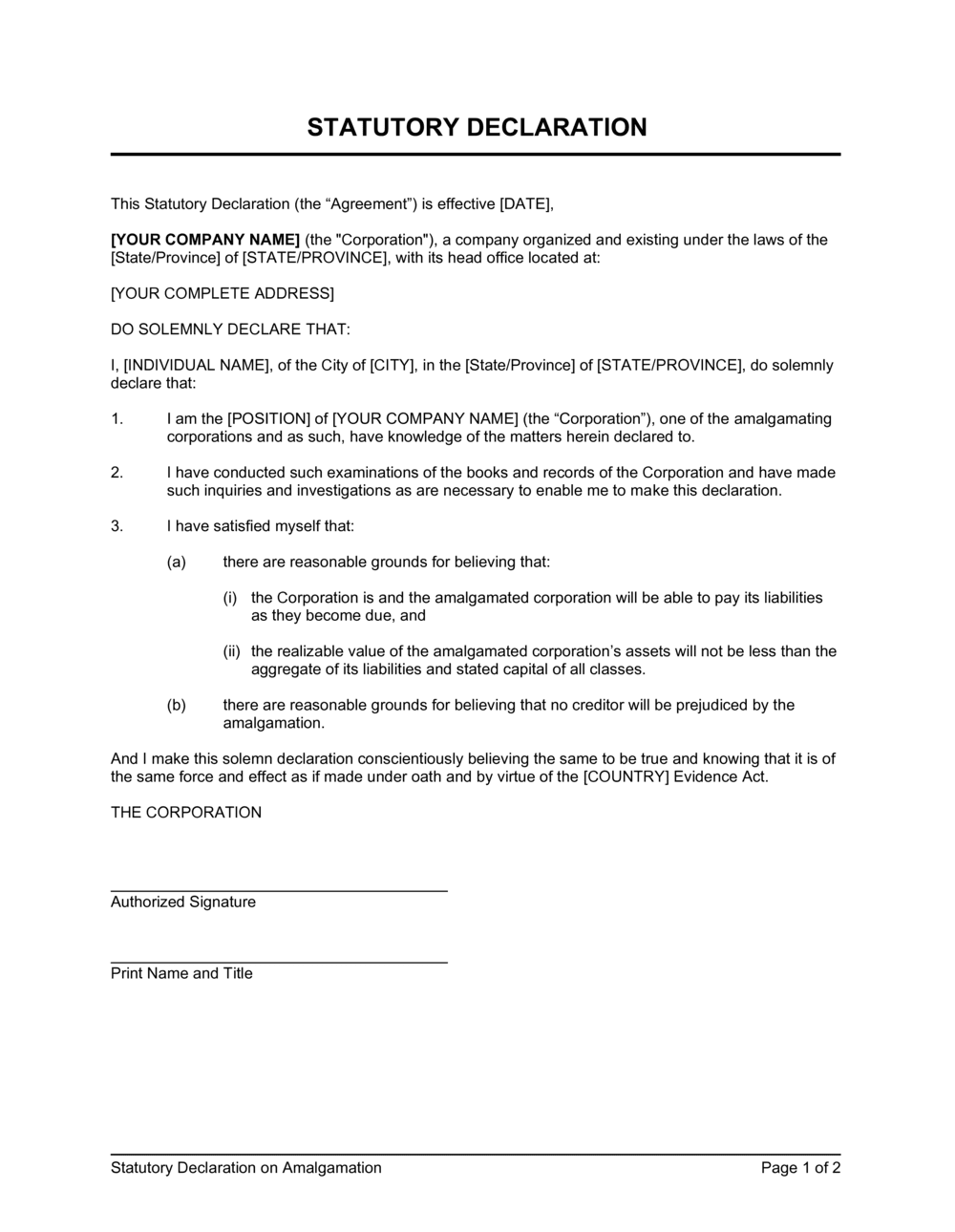
A Statutory Declaration on Amalgamation is a sworn legal document executed by a director or officer of each amalgamating corporation, confirming that the proposed merger satisfies all statutory conditions — including solvency, creditor protection, and regulatory compliance — required before the amalgamation can be registered and take legal effect. This free Word download gives you a professionally structured template you can edit online and export as PDF for submission to the relevant corporate registry.
When you need it
Use it when two or more corporations are merging into a single continuing entity and the governing corporate statute requires a sworn officer declaration as part of the amalgamation filing package. It is typically executed immediately before or concurrently with the submission of amalgamation articles to the corporate registry.
What's inside
Declarant and corporation identification, recitals of the amalgamation agreement, solvency and going-concern confirmations, creditor and shareholder notice declarations, compliance with statutory conditions, officer signature blocks, and a commissioner or notary jurat.

What is a Statutory Declaration on Amalgamation?

A Statutory Declaration on Amalgamation is a sworn legal instrument executed by a director or officer of each corporation participating in an amalgamation, certifying to the corporate registry that all conditions required by the governing statute have been satisfied before the merger takes legal effect. Unlike an internal board resolution or shareholder vote, this declaration is a formal sworn statement — carrying the same legal weight as testimony under oath — that the amalgamating entities are solvent, that creditors have been properly notified, that regulatory approvals are in hand, and that the transaction has been authorized in compliance with the applicable corporate statute and each corporation's own constitutional documents. The completed declaration is filed alongside the Articles of Amalgamation and, once accepted, enables the registry to issue a Certificate of Amalgamation confirming the merger's effective date.

Why You Need This Document

Without a properly executed statutory declaration, the corporate registry will not process the amalgamation filing — meaning the merger cannot take legal effect, contracts remain held by separate entities, and any planned restructuring or financing that depends on the amalgamated entity's existence stalls entirely. Beyond the registry requirement, the declaration protects directors personally: by requiring each declarant to confirm solvency and compliance under oath, the document creates a documented basis for the officer's reasonable belief at the time of filing, reducing personal exposure to claims from creditors or shareholders who challenge the transaction later. Executing this declaration without a thorough review of current financials and regulatory clearances, however, exposes the declarant to liability for a false statutory declaration — a criminal offence in most jurisdictions. This template gives you a professionally structured starting point that covers every mandatory element, with placeholder language and guidance that makes the review process faster and the filing more likely to be accepted on first submission.

Which variant fits your situation?

If your situation is…Use this template
Amalgamating two or more Canadian corporations under the CBCAStatutory Declaration on Amalgamation (Federal — CBCA)
Short-form amalgamation of a parent corporation with its wholly-owned subsidiaryShort-Form Amalgamation Declaration
Amalgamation under Ontario Business Corporations ActStatutory Declaration on Amalgamation (Ontario — OBCA)
Documenting shareholder approval of the amalgamation agreementShareholder Resolution Approving Amalgamation
Recording the board's authorization to proceed with the amalgamationDirector Resolution Approving Amalgamation
Finalizing the terms between the amalgamating corporationsAmalgamation Agreement
Notifying creditors of a pending amalgamationNotice to Creditors of Amalgamation

Common mistakes to avoid

❌ Executing the declaration before all approvals are in writing

Why it matters: Signing the regulatory approval confirmation before written clearances are received makes the declaration inaccurate at the time of swearing — which constitutes a false statutory declaration and can void the amalgamation filing.

Fix: Hold execution until every required consent, approval, or clearance has been received in writing and reviewed by counsel. Prepare the declaration in advance but do not swear it until all conditions are satisfied.

❌ Mismatched details between the declaration and Articles of Amalgamation

Why it matters: Registry examiners compare the declaration against the articles line by line. Discrepancies in the continuing corporation's name, registered office, or share structure cause the entire filing to be returned, delaying the effective date and potentially triggering third-party notice obligations again.

Fix: Complete the Articles of Amalgamation first, then populate the declaration's continuing-corporation section directly from the finalized articles. Run a side-by-side comparison before execution.

❌ Signing the solvency confirmation without a supporting financial review

Why it matters: A declarant who signs without reviewing current financials is personally exposed to civil liability and, in some jurisdictions, regulatory penalties if the amalgamated corporation proves insolvent at or shortly after closing.

Fix: Obtain a current balance sheet and cash flow projection for the amalgamated entity, reviewed by an accountant or CFO, and retain them in the deal file as documentary support for the solvency confirmation.

❌ Using a single declaration for multiple amalgamating corporations

Why it matters: Each amalgamating corporation must have its own sworn declaration executed by a director or officer of that specific entity. A combined declaration does not satisfy the statutory requirement and will be rejected at filing.

Fix: Prepare a separate statutory declaration for each amalgamating corporation, each executed by a duly authorized officer of that entity, and include all declarations in the filing package.

❌ Overlooking a unanimous shareholder agreement

Why it matters: A USA may impose consent thresholds or veto rights on amalgamation that exceed the statutory minimum. Proceeding without required USA consent exposes the transaction to challenge by shareholders and potential personal liability for directors who authorized the filing.

Fix: Review all shareholder agreements, including USA provisions, before drafting the compliance confirmation clause. If the USA requires additional consent, obtain and document it before execution.

❌ Failing to retain the executed declaration in the minute book

Why it matters: The executed declaration is a primary corporate record. Losing it creates a gap in the corporation's legal history that complicates future due diligence, share sales, and regulatory inquiries for years.

Fix: File an original or certified copy of the executed declaration, together with the Certificate of Amalgamation, in the continuing corporation's minute book immediately after the registry issues the certificate.

The 10 key clauses, explained

Declarant identification and authority

In plain language: Identifies the individual making the declaration — full name, title, and the corporation they represent — and confirms their authority to swear on that corporation's behalf.

Sample language
I, [FULL NAME], [TITLE] of [CORPORATION NAME], a corporation incorporated under the laws of [JURISDICTION], do solemnly declare that I am duly authorized to make this declaration on behalf of [CORPORATION NAME].

Common mistake: Using a title that does not correspond to a recognized officer position under the governing statute. If the statute requires a director or officer to sign and the declarant is merely a manager, the declaration may be rejected by the registry.

Recital of the amalgamation agreement

In plain language: Confirms that an amalgamation agreement was entered into by all amalgamating corporations, states its date, and confirms it was approved in accordance with the applicable corporate statute.

Sample language
THAT on [DATE], [CORPORATION A] and [CORPORATION B] entered into an Amalgamation Agreement (the 'Agreement'), a copy of which is attached as Schedule A, which was approved by the shareholders of each amalgamating corporation by special resolution on [DATE].

Common mistake: Failing to attach the amalgamation agreement as a schedule. Most registries require the agreement to accompany the declaration; its absence causes the filing to be returned.

Shareholder approval confirmation

In plain language: Declares that the amalgamation agreement received the required shareholder approval — typically a special resolution passed by the required supermajority — at a duly called meeting or by written resolution.

Sample language
THAT the Amalgamation Agreement was approved by special resolution of the shareholders of [CORPORATION NAME] at a meeting duly called and held on [DATE] / by written resolution dated [DATE], in accordance with section [X] of the [STATUTE].

Common mistake: Citing the wrong approval threshold. Many statutes require a two-thirds supermajority; citing a simple majority renders the declaration inaccurate and can void the approval.

Solvency declaration

In plain language: Confirms that immediately after the amalgamation takes effect, the amalgamated corporation will be solvent — able to pay its liabilities as they fall due, and with realizable assets exceeding its liabilities.

Sample language
THAT, to the best of my knowledge, information, and belief, immediately after the amalgamation becomes effective: (a) [AMALGAMATED CORPORATION NAME] will be able to pay its liabilities as they become due; and (b) the realizable value of the assets of [AMALGAMATED CORPORATION NAME] will not be less than the aggregate of its liabilities and stated capital.

Common mistake: Signing the solvency declaration without reviewing current financial statements of all amalgamating entities. A declarant who cannot substantiate the solvency confirmation is personally exposed to liability if the amalgamated entity is insolvent at closing.

Creditor protection and notice

In plain language: Confirms that creditors of each amalgamating corporation have been given adequate notice of the amalgamation as required by statute, or alternatively that notice was not required because the amalgamation satisfies a short-form exemption.

Sample language
THAT notice of the proposed amalgamation was given to all known creditors of [CORPORATION NAME] with claims exceeding $[THRESHOLD] in accordance with [STATUTE/SECTION], and that no creditor has objected within the prescribed period.

Common mistake: Stating that no notice was required without confirming the short-form exemption actually applies. If the amalgamation is not a qualifying short-form, omitting creditor notice can expose the amalgamated entity to successful creditor challenges.

Regulatory and third-party approval confirmation

In plain language: Declares that all required regulatory approvals, consents, and third-party authorizations — including competition clearances and industry-specific licenses — have been obtained prior to filing.

Sample language
THAT all consents, approvals, and authorizations required from regulatory authorities or third parties in connection with the amalgamation, including [LIST SPECIFIC APPROVALS], have been obtained and remain in full force and effect.

Common mistake: Declaring regulatory clearance before all approvals are formally issued in writing. Verbal confirmation from a regulator does not satisfy this clause — wait for written approval before executing the declaration.

No adverse material change

In plain language: Confirms that between the date of the amalgamation agreement and the date of this declaration, there has been no material adverse change in the financial condition, assets, or liabilities of any amalgamating corporation.

Sample language
THAT, to the best of my knowledge, information, and belief, since the date of the Amalgamation Agreement, there has been no material adverse change in the financial condition, business, assets, or liabilities of [CORPORATION NAME].

Common mistake: Treating this as a boilerplate recital without reviewing intervening financial events. If a significant liability arose between signing and filing and the declarant fails to disclose it, personal liability for a false statutory declaration follows.

Compliance with articles and by-laws

In plain language: Confirms that the amalgamation has been carried out in compliance with each amalgamating corporation's articles of incorporation, by-laws, and any unanimous shareholder agreements.

Sample language
THAT the amalgamation has been effected in compliance with the articles of incorporation and by-laws of [CORPORATION NAME] and with any unanimous shareholder agreement applicable to [CORPORATION NAME].

Common mistake: Overlooking a unanimous shareholder agreement that restricts amalgamation without specific consent. USA provisions can require supermajority or unanimous shareholder consent beyond what the statute requires.

Continuing corporation particulars

In plain language: Identifies the name, registered office, share structure, and first directors of the amalgamated continuing corporation, confirming they align with the filed Articles of Amalgamation.

Sample language
THAT the amalgamated corporation shall continue as [AMALGAMATED CORPORATION NAME], with its registered office at [ADDRESS], the share structure as set out in the Articles of Amalgamation, and the following first directors: [NAMES AND ADDRESSES].

Common mistake: Inconsistency between the continuing corporation's details in the declaration and the Articles of Amalgamation. Any mismatch triggers a rejection from the registry and requires re-execution of the declaration.

Jurat and commissioner certification

In plain language: The closing certification block where the declarant signs before a commissioner of oaths or notary public, who then certifies the time, date, place, and their authority to administer the oath.

Sample language
DECLARED before me at [CITY], [PROVINCE/STATE], on [DATE]. [DECLARANT SIGNATURE] | [COMMISSIONER OF OATHS / NOTARY PUBLIC NAME, QUALIFICATION, AND EXPIRY DATE]

Common mistake: Having the declaration signed by the declarant and notarized on different dates without an explanation. The jurat must reflect the actual date of the sworn declaration — backdating is perjury.

How to fill it out

  1. 1

    Confirm the governing statute and required form

    Identify the corporate statute that governs each amalgamating corporation — CBCA, OBCA, ABCA, BCBCA, or equivalent — and confirm whether the statute prescribes a specific form or allows a free-form declaration. Federal and provincial requirements differ in content and filing fee.

    💡 Where corporations in multiple jurisdictions are amalgamating, you may need separate declarations tailored to each governing statute.

  2. 2

    Identify the declarant for each amalgamating corporation

    Designate a current director or officer of each amalgamating corporation as the declarant. Confirm their title matches a recognized officer position under the statute. Collect their full legal name and signing authority documentation.

    💡 Where both corporations share the same sole director — common in subsidiary amalgamations — that individual executes a separate declaration for each entity, not one combined declaration.

  3. 3

    Attach and cross-reference the amalgamation agreement

    Attach the fully executed amalgamation agreement as Schedule A. Enter the agreement's execution date in the recital clause and confirm the schedule reference in the body of the declaration.

    💡 Confirm that the amalgamation agreement attached to the declaration is the final executed version — not a draft. Registry staff will check execution dates for consistency.

  4. 4

    Complete the shareholder approval details

    Enter the date of the shareholder meeting or written resolution, the approval threshold achieved, and the statutory provision authorizing the amalgamation. Confirm the threshold meets or exceeds the statutory minimum for a special resolution.

    💡 For closely held corporations using written resolutions in lieu of a meeting, confirm the statute permits written resolutions for this purpose before relying on them.

  5. 5

    Review financials before signing the solvency declaration

    Obtain current financial statements for all amalgamating corporations — ideally reviewed by an accountant. Confirm the amalgamated entity's projected balance sheet shows realizable assets exceeding liabilities and that cash flow can service debts as they fall due.

    💡 If solvency is borderline, have an accountant prepare a pro-forma balance sheet for the amalgamated entity before the declarant signs — this provides a documented basis for the confirmation.

  6. 6

    Document creditor notice compliance

    Assemble evidence that creditor notice was given as required — copies of notices sent, registered mail receipts, and a record of the notice period expiry. Enter the threshold claim amount and confirm no objection was received within the prescribed period.

    💡 For short-form amalgamations that are exempt from creditor notice, cite the specific statutory exemption in the declaration rather than leaving the clause blank.

  7. 7

    Execute before a commissioner of oaths or notary

    The declarant must sign in the physical presence of a commissioner of oaths or notary public, who then completes the jurat. Confirm the commissioner's authority has not expired and that they are authorized in the jurisdiction where the declaration is sworn.

    💡 Do not pre-sign the declaration before presenting it to the commissioner. A pre-signed declaration is defective and most registries will reject it on inspection.

  8. 8

    File with the Articles of Amalgamation and required fee

    Submit the executed declaration alongside the Articles of Amalgamation, the amalgamation agreement, shareholder resolutions, and the prescribed filing fee to the applicable corporate registry. Keep certified copies for each amalgamating corporation's minute book.

    💡 File a certified copy of the Certificate of Amalgamation in the minute book of the continuing corporation as soon as it is issued — it is the definitive proof that the amalgamation took effect.

Frequently asked questions

What is a statutory declaration on amalgamation?

A statutory declaration on amalgamation is a sworn legal document executed by a director or officer of each corporation participating in a merger, confirming that all statutory conditions for the amalgamation have been met — including solvency, shareholder approval, creditor notice, and regulatory compliance. It is typically a mandatory component of the amalgamation filing package submitted to the corporate registry, and it carries the same legal weight as sworn testimony.

Who must sign a statutory declaration on amalgamation?

In most jurisdictions, a current director or officer of each amalgamating corporation must execute the declaration. The declarant must hold a recognized officer title under the governing statute — typically president, secretary, or a named director. The declaration must be sworn before a commissioner of oaths or notary public; a declaration that is signed but not properly commissioned is defective and will be rejected by the registry.

Is a statutory declaration on amalgamation required for all amalgamations?

Requirements vary by jurisdiction and amalgamation type. Under the Canada Business Corporations Act and most provincial statutes, a statutory declaration is required for a standard amalgamation. Short-form amalgamations — where a parent merges with a wholly-owned subsidiary — typically require a simplified declaration or director resolution rather than the full form. Always check the specific requirements of the governing statute before preparing the filing package.

What is the solvency test in a statutory declaration on amalgamation?

The solvency test requires the declarant to confirm two things: first, that the amalgamated corporation will be able to pay its liabilities as they become due in the ordinary course of business; and second, that its realizable assets will not be less than its total liabilities plus stated capital immediately after the amalgamation takes effect. The test is forward-looking — it applies to the amalgamated entity, not to the individual corporations before the merger. Failing to substantiate this confirmation with financial evidence exposes the declarant to personal liability.

What happens if a statutory declaration on amalgamation contains an error?

If the error is identified before filing, the declaration should be re-executed before a commissioner with the corrected information — do not alter a sworn declaration after execution. If the error is identified after filing but before the Certificate of Amalgamation is issued, contact the registry immediately to determine whether a corrected declaration can be substituted. If the certificate has already been issued, correcting a material error may require a court application or a correcting amalgamation, depending on the jurisdiction. Consult corporate counsel as soon as the error is identified.

Can a statutory declaration on amalgamation be signed electronically?

Electronic execution of statutory declarations is governed by the electronic commerce legislation of each jurisdiction and the specific requirements of the corporate registry. Several Canadian provinces and the federal CBCA registry now accept electronically executed declarations under their electronic filing systems, provided the commissioner of oaths requirement is also met electronically. The UK Companies House similarly accepts digital filings in most circumstances. Confirm current registry requirements before proceeding with remote or electronic execution, as practices have evolved significantly since 2020.

What is the difference between a statutory declaration on amalgamation and an amalgamation agreement?

An amalgamation agreement is the contract between the amalgamating corporations that sets out the terms of the merger — share exchange, governance, officer appointments, and treatment of liabilities. A statutory declaration on amalgamation is a sworn confirmation by an officer of each corporation that the conditions required by statute have been met. The agreement drives the commercial terms; the declaration provides the regulatory certification. Both documents are typically filed together as part of the amalgamation package.

How long does it take for a corporate registry to process an amalgamation filing?

Processing times vary significantly by jurisdiction. Corporations Canada typically processes CBCA amalgamation filings within 5–10 business days for standard filings, with expedited same-day or next-day service available for an additional fee. Provincial registries in Ontario, British Columbia, and Alberta have broadly comparable timelines. UK Companies House amalgamation-equivalent filings (schemes of arrangement) follow court timelines rather than registry timelines and can take several months. Always confirm current processing times with the registry before committing to a transaction closing date.

Do I need a lawyer to prepare a statutory declaration on amalgamation?

For a straightforward short-form subsidiary amalgamation within a single jurisdiction, a well-structured template is a solid starting point. However, given that the declaration is a sworn legal instrument, that the declarant bears personal liability for its accuracy, and that errors can void a filing or expose directors to liability, legal review is strongly recommended for any amalgamation involving third-party creditors, multiple jurisdictions, material assets, or regulatory approvals. The cost of a lawyer reviewing and supervising execution is small relative to the cost of a rejected filing or a challenged amalgamation.

How this compares to alternatives

vs Amalgamation Agreement

An amalgamation agreement is the commercial contract between the merging corporations that governs the terms of the transaction — share exchange ratio, governance of the continuing entity, and treatment of liabilities. A statutory declaration on amalgamation is a sworn regulatory certification that the statutory conditions have been met. The agreement creates the deal; the declaration certifies compliance with the law. Both are required and filed together.

vs Articles of Amalgamation

Articles of Amalgamation are the constitutional document filed with the registry that establishes the continuing corporation's name, share structure, directors, and registered office. The statutory declaration is the sworn officer certification that accompanies the articles. Articles define what the amalgamated corporation looks like; the declaration confirms the merger was carried out lawfully. Neither document substitutes for the other.

vs Director Resolution Approving Amalgamation

A director resolution authorizes the corporation to enter into and proceed with the amalgamation — it is a board-level governance document passed before the transaction closes. A statutory declaration is executed after the amalgamation conditions are satisfied, as sworn confirmation for the registry. The resolution is an internal authorization; the declaration is an external sworn certification.

vs Certificate of Amalgamation

A Certificate of Amalgamation is issued by the corporate registry after the filing is accepted and confirmed — it is the official proof that the amalgamation took legal effect on a specific date. The statutory declaration is submitted before the certificate is issued; it is a precondition to receiving the certificate. The declaration is an input to the filing; the certificate is the output confirming success.

Industry-specific considerations

Financial Services

Regulatory approvals from OSFI, FINTRAC, or equivalent authorities must be confirmed in writing before the declaration is sworn; capital adequacy must be confirmed for the amalgamated entity.

Technology / SaaS

IP ownership and software license assignment to the amalgamated entity must be addressed in the amalgamation agreement before the compliance confirmation clause can be accurately sworn.

Healthcare

Professional licensing and regulatory permits — including clinic licenses and controlled substance authorizations — do not automatically transfer on amalgamation and must be addressed before the regulatory approval clause is executed.

Real Estate

Property transfer obligations and land title registration consequences of the amalgamation must be resolved; title insurance and lender consents affect the creditor notice and regulatory approval clauses.

Manufacturing

Environmental permits and operating licenses typically require regulatory notification or re-issuance on amalgamation, affecting the regulatory approval confirmation in the declaration.

Professional Services

Law societies, engineering associations, and other self-regulatory bodies may require advance consent to amalgamation; professional liability insurance continuity must be confirmed before execution.

Jurisdictional notes

United States

US corporate law uses 'merger' rather than 'amalgamation' as the operative term, governed by state statutes such as the Delaware General Corporation Law or the Model Business Corporation Act. A sworn officer certificate or officer's certificate of merger — functionally equivalent to a statutory declaration — is required in most states. Solvency and board approval requirements are broadly similar, but the specific form, filing fee, and registry vary by state of incorporation. Multi-state mergers may require filings in each state where the merging entities are qualified to do business.

Canada

Canada has the most prescriptive statutory declaration requirements for amalgamation in the common-law world. Under the Canada Business Corporations Act (CBCA), a statutory declaration by a director or officer of each amalgamating corporation is mandatory and must address solvency, creditor notice, and shareholder approval. Provincial statutes — including the OBCA, ABCA, and BCBCA — have parallel requirements with minor variations in form and threshold. Quebec amalgamations under the Business Corporations Act (BCQ) require a French-language declaration for provincially regulated entities. Short-form amalgamations under section 184 of the CBCA allow a simplified director declaration without a full amalgamation agreement.

United Kingdom

UK company law does not use the term 'amalgamation' in the same sense as Canadian or Commonwealth statutes. Corporate combinations in the UK are typically structured as mergers under Part 27 of the Companies Act 2006, schemes of arrangement under Part 26, or asset acquisitions. Schemes of arrangement require court approval and involve shareholder and creditor voting rather than a sworn statutory declaration. For cross-border mergers following Brexit, the European Cross-Border Merger Regulations no longer apply to UK companies; alternatives include UK domestic schemes or contractual structures. Consult UK corporate counsel for the appropriate mechanism.

European Union

EU cross-border mergers are governed by Directive 2017/1132 (the Company Law Directive), which requires a management report, an expert report, and a pre-merger certificate issued by the competent authority of each merging company's member state before the merger can be registered. The pre-merger certificate is functionally analogous to a statutory declaration, confirming completion of pre-merger procedures. GDPR implications arise where the amalgamation involves the transfer of personal data between entities in different member states. Member state implementation varies — Germany, France, and the Netherlands each have distinct procedural requirements under their national company laws.

Template vs lawyer — what fits your deal?

PathBest forCostTime
Use the templateShort-form parent-subsidiary amalgamations within a single jurisdiction where both entities share the same sole director and have no third-party creditorsFree1–2 hours to complete; execution same day
Template + legal reviewStandard two-corporation amalgamations with arms-length shareholders, trade creditors, and no regulatory approvals required$500–$1,500 for a corporate lawyer to review and supervise execution2–5 business days
Custom draftedMulti-party amalgamations, cross-border structures, regulated industries, material assets, or transactions requiring Competition Act clearance$3,000–$15,000+ depending on complexity and jurisdictions involved2–6 weeks

Glossary

Amalgamation
The statutory process by which two or more corporations merge to form a single continuing legal entity, with all assets, liabilities, and obligations vesting in the amalgamated corporation.
Statutory Declaration
A written statement of facts sworn or affirmed before a commissioner of oaths, notary public, or other authorized official, carrying legal weight equivalent to sworn testimony.
Declarant
The individual — typically a director or officer of an amalgamating corporation — who swears or affirms the statutory declaration and is personally liable for its accuracy.
Jurat
The certification clause at the end of a statutory declaration, signed by the commissioner of oaths or notary public, confirming when, where, and before whom the declaration was sworn.
Solvency Test
A statutory requirement confirming that the amalgamated corporation will be able to pay its liabilities as they come due, and that its realizable assets will exceed its liabilities immediately after amalgamation.
Short-Form Amalgamation
A simplified amalgamation procedure available when a parent corporation merges with one or more wholly-owned subsidiaries, requiring less documentation than a standard amalgamation.
Amalgamation Agreement
The contract between the amalgamating corporations setting out the terms of the merger, including the share exchange ratio, governance of the amalgamated entity, and treatment of outstanding options or warrants.
Certificate of Amalgamation
The official document issued by the corporate registry confirming that the amalgamation has taken legal effect and identifying the amalgamated corporation's registration details.
Vertical Amalgamation
An amalgamation between a parent corporation and one or more of its subsidiaries, typically used for group restructuring or simplification.
Horizontal Amalgamation
An amalgamation between two or more corporations that are subsidiaries of the same parent but are not in a direct parent-subsidiary relationship with each other.
Commissioner of Oaths
An individual authorized by statute to administer oaths and take statutory declarations, giving the sworn statement official legal standing.

Part of your Business Operating System

This document is one of 3,000+ business & legal templates included in Business in a Box.

  • Fill-in-the-blanks — ready in minutes
  • 100% customizable Word document
  • Compatible with all office suites
  • Export to PDF and share electronically

Create your document in 3 simple steps.

From template to signed document — all inside one Business Operating System.
1
Download or open template

Access over 3,000+ business and legal templates for any business task, project or initiative.

2
Edit and fill in the blanks with AI

Customize your ready-made business document template and save it in the cloud.

3
Save, Share, Send, Sign

Share your files and folders with your team. Create a space of seamless collaboration.

Save time, save money, and create top-quality documents.

★★★★★

"Fantastic value! I'm not sure how I'd do without it. It's worth its weight in gold and paid back for itself many times."

Managing Director · Mall Farm
Robert Whalley
Managing Director, Mall Farm Proprietary Limited
★★★★★

"I have been using Business in a Box for years. It has been the most useful source of templates I have encountered. I recommend it to anyone."

Business Owner · 4+ years
Dr Michael John Freestone
Business Owner
★★★★★

"It has been a life saver so many times I have lost count. Business in a Box has saved me so much time and as you know, time is money."

Owner · Upstate Web
David G. Moore Jr.
Owner, Upstate Web

Run your business with a system — not scattered tools

Stop downloading documents. Start operating with clarity. Business in a Box gives you the Business Operating System used by over 250,000 companies worldwide to structure, run, and grow their business.

Start free · No credit card required