Declaration of Doing Business Template

Free Word download • Edit online • Save & share with Drive • Export to PDF

1 page20–30 min to fillDifficulty: StandardSignature requiredLegal review recommended
Learn more ↓
FreeDeclaration of Doing Business Template

At a glance

What it is
A Declaration of Doing Business is a formal statement filed with a county clerk, state registry, or local authority disclosing that an individual or registered entity is conducting business under a trade name different from their legal name. This free Word download gives you a ready-to-complete form covering the declarant's legal identity, the fictitious name, the business address, and the scope of operations — formatted for most US county and state filing requirements.
When you need it
File it before opening a bank account under a trade name, entering contracts using a fictitious name, or accepting payments made out to a business name that is not your registered legal name. Most US states require the declaration before any public-facing use of the DBA name.
What's inside
Declarant's full legal name and entity type, the fictitious trade name being claimed, principal place of business, nature of business activities, commencement date, notarization or acknowledgment block, and the filing affidavit required by the receiving authority.

What is a Declaration of Doing Business?

A Declaration of Doing Business (also called a DBA filing, fictitious business name statement, or assumed name certificate) is a sworn public record filed with a county clerk or state registry in which an individual or business entity formally discloses that they are conducting business under a trade name that differs from their legal name. The declaration identifies the real owner behind the brand, the exact fictitious name in use, the principal place of business, and the nature of the business activities — creating the public record that banks, licensing agencies, and courts rely on to verify the connection between a trade name and its legal owner. In most US states, the filing is a legal prerequisite to opening a business bank account, signing contracts, or accepting payments under any name other than the owner's registered legal name.

Why You Need This Document

Operating under a trade name without a filed DBA is not just a technical oversight — it is a legal exposure that compounds over time. Banks will refuse to open a business account in the trade name without a file-stamped declaration, which means every payment made out to your brand name cannot be deposited. Contracts signed under an unregistered fictitious name are potentially voidable by the other party in several states, leaving you without legal recourse if they default. Most states also impose civil fines — typically $100 to $1,000 — for each month of unregistered operation. Beyond compliance, a filed DBA creates the public paper trail that establishes your priority claim to the trade name in your county, supports licensing applications, and satisfies vendor and supplier onboarding requirements that demand proof of business identity. This template gives you a correctly structured, jurisdiction-ready declaration you can complete in under an hour and file the same day.

Which variant fits your situation?

If your situation is…Use this template
Sole proprietor filing a DBA in a US stateDeclaration of Doing Business (Individual)
LLC or corporation adding a fictitious name to an existing entityDeclaration of Doing Business (Entity)
Partnership operating under a name different from all partners' surnamesPartnership DBA Statement
Registering a trade name in a Canadian provinceBusiness Name Registration (Canada)
Withdrawing or cancelling an existing DBA registrationDBA Abandonment / Cancellation Statement
Publishing a fictitious name notice in a local newspaper as required by state lawFictitious Name Publication Affidavit
Renewing an expired DBA registrationDBA Renewal Statement

Common mistakes to avoid

❌ Filing in the wrong county or state office

Why it matters: A DBA filed in the owner's residential county instead of the business's operating county is legally invalid and will not satisfy bank or licensing requirements.

Fix: File in the county where the business's principal place of business is located. If you operate in multiple counties, most states require a separate filing in each.

❌ Using the trade name before filing

Why it matters: Transacting business under an unregistered fictitious name exposes the owner to civil fines in most states and makes contracts entered under the name potentially voidable by the other party.

Fix: Complete the filing — and any required newspaper publication — before using the trade name on invoices, contracts, or bank accounts.

❌ Omitting co-owners from the ownership statement

Why it matters: An incomplete ownership statement is a misrepresentation on a sworn document; undisclosed co-owners can later challenge the registration or assert ownership of the trade name.

Fix: List every person with an ownership interest, including silent partners, and attach a separate sheet if space in the form is insufficient.

❌ Failing to publish the fictitious name notice when required

Why it matters: States including California, New York, and Arizona require newspaper publication as a condition of DBA validity. Skipping publication leaves the registration incomplete and unenforceable.

Fix: After filing, immediately identify the approved newspapers in your county and run the required notice for the full publication period — typically three to six consecutive weeks — then file the affidavit of publication.

❌ Not renewing the DBA registration before expiration

Why it matters: An expired DBA means you are no longer legally authorized to use the trade name, and a third party could register it during the lapse.

Fix: Calendar the renewal deadline — typically every 5 years in California, 10 years in Texas — and refile before expiration. Set a reminder 90 days in advance.

❌ Assuming a DBA registration protects the trade name as a trademark

Why it matters: A DBA is a public disclosure filing, not a trademark. It grants no exclusive rights to the name against businesses in other counties or states, and does not block federal trademark registration by a competitor.

Fix: If brand protection matters, file a state or federal trademark application in addition to the DBA. The two filings serve entirely different legal purposes.

The 9 key clauses, explained

Declarant identification

In plain language: States the full legal name and entity type of the person or business making the declaration — individual, sole proprietorship, LLC, corporation, or partnership.

Sample language
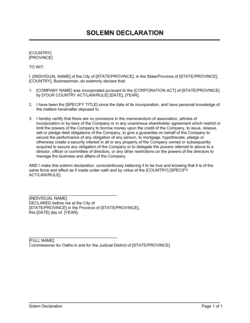
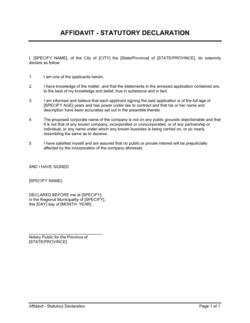
The undersigned, [FULL LEGAL NAME], a [individual / LLC / corporation] organized under the laws of [STATE], hereby declares and states as follows:

Common mistake: Using a nickname or trade name in the declarant field instead of the legal name. If the declarant name does not match government ID or entity registration records, the filing is rejected or deemed fraudulent.

Fictitious trade name

In plain language: Sets out the exact trade name being claimed — spelled and punctuated precisely as it will appear on signage, contracts, and bank accounts.

Sample language
Declarant is conducting, or intends to conduct, business in [COUNTY/STATE] under the fictitious business name: [TRADE NAME].

Common mistake: Spelling or punctuating the trade name inconsistently between the declaration and the bank or licensing application. Even a missing comma or abbreviation mismatch can cause a bank to reject the account application.

Principal place of business

In plain language: Provides the street address where the business primarily operates, which determines the county or state filing office.

Sample language
The principal place of business is located at [STREET ADDRESS], [CITY], [STATE], [ZIP CODE].

Common mistake: Using a P.O. box or UPS store address as the principal place of business. Most filing authorities require a physical street address; P.O. boxes are rejected.

Nature of business activities

In plain language: Describes, in general terms, the type of business the declarant is conducting under the trade name.

Sample language
The business to be conducted under the above fictitious name is: [DESCRIPTION OF BUSINESS ACTIVITIES, e.g., retail sale of handmade goods, graphic design services, residential property management].

Common mistake: Describing activities too narrowly — for example, listing 'web design' when the business also provides SEO and copywriting. If actual activities fall outside the stated scope, the DBA may not cover contracts for those services.

Commencement date

In plain language: States when the declarant began or will begin using the fictitious name in commerce.

Sample language
Declarant commenced, or will commence, transacting business under the above fictitious name on [DATE].

Common mistake: Entering a backdated commencement date that precedes the filing date by more than the jurisdiction's allowed window. Some states treat a retroactive date as a misrepresentation and void the filing.

Ownership and interest statement

In plain language: Confirms that the declarant owns the business being conducted under the trade name and discloses any co-owners or partners.

Sample language
The full name(s) and residence address(es) of all persons conducting business under the fictitious name are: [NAME(S) AND ADDRESS(ES)]. There are no other persons who have an ownership interest in this business.

Common mistake: Omitting a co-owner or silent partner. Undisclosed co-owners can later challenge the validity of contracts executed under the DBA name or claim ownership of the trade name itself.

Declaration and truth affirmation

In plain language: A sworn statement by the declarant that all information in the filing is true and correct under penalty of perjury.

Sample language
I declare under penalty of perjury under the laws of the State of [STATE] that the foregoing is true and correct. Executed on [DATE] at [CITY], [STATE].

Common mistake: Leaving the execution date blank and signing later. An undated sworn declaration is facially defective and may be rejected by the filing office or challenged in court.

Signatory and acknowledgment block

In plain language: The signature line for the declarant, with printed name, title (if entity), and — where required by local law — a notary public acknowledgment.

Sample language
Signature: ___________________________ | Printed Name: [FULL LEGAL NAME] | Title (if entity): [TITLE] | Date: [DATE] | Notary Acknowledgment: [NOTARY BLOCK IF REQUIRED]

Common mistake: Having an employee or agent sign without attaching a power of attorney or corporate resolution authorizing them. Unauthorized signatures give the filing authority grounds to reject or invalidate the declaration.

Filing fee and county designation

In plain language: References the applicable county or state filing office and acknowledges the required filing fee — typically $10–$50 depending on jurisdiction.

Sample language
This declaration is submitted for filing with the [COUNTY] County Clerk / [STATE] Secretary of State, together with the applicable filing fee of $[AMOUNT].

Common mistake: Filing in the wrong county — for example, filing where the owner lives instead of where the business operates. Most states require filing in the county of the principal place of business; a mismatched filing is invalid.

How to fill it out

  1. 1

    Confirm your filing jurisdiction

    Identify the county and state where your principal place of business is located. Most US states require filing with the county clerk where operations are based, not where the owner resides. Some states — including Texas and Delaware — also require a state-level filing.

    💡 Search '[your state] fictitious business name filing requirements' on the Secretary of State website before completing the form — requirements and fees vary significantly by state.

  2. 2

    Enter the declarant's full legal name and entity type

    Use your full legal name exactly as it appears on your government-issued ID or entity registration certificate. If filing on behalf of an LLC or corporation, enter the registered entity name and include your title.

    💡 Cross-reference your Articles of Organization or Incorporation to confirm the exact registered name — punctuation differences like 'LLC' vs. 'L.L.C.' matter.

  3. 3

    State the exact trade name

    Enter the fictitious business name precisely as you intend to use it on signage, bank accounts, invoices, and contracts. Any deviation between the declaration and your bank account application will cause the bank to reject the account.

    💡 Before finalizing the name, run a name availability search through your state's Secretary of State portal to confirm no identical or confusingly similar name is already registered.

  4. 4

    Provide the principal place of business address

    Enter a physical street address — not a P.O. box. This address determines the filing county. If you operate from a home address and prefer privacy, check whether your state allows a registered agent address for DBA filings.

    💡 Some counties allow a virtual office or shared workspace address as the principal place of business if you have a physical presence there on a regular basis.

  5. 5

    Describe your business activities

    Write a general description broad enough to cover all services or products you currently offer or plan to offer. Two to three sentences describing your industry and offering type is typically sufficient.

    💡 Use a slightly broader description than your current offering — for example, 'marketing and creative services' rather than 'logo design' — so you do not need to refile if your services expand.

  6. 6

    Enter the commencement date and list all owners

    State the date you began or will begin using the trade name. List every co-owner's full legal name and residential address. Omitting any owner is a misrepresentation on a sworn document.

    💡 If you have not yet used the name publicly, enter a future date — most jurisdictions accept a prospective commencement date.

  7. 7

    Sign, date, and notarize if required

    Sign the declaration on or before the commencement date. Check your county's requirements — some jurisdictions require notarization, others only require a self-sworn declaration under penalty of perjury.

    💡 UPS Store and bank branches frequently offer notary services for $5–$15. Some counties also accept remote online notarization.

  8. 8

    File and retain proof of filing

    Submit the completed declaration with the filing fee to the correct county clerk or state registry. Request a file-stamped copy. Some states also require newspaper publication within 30–45 days of filing.

    💡 Provide your file-stamped copy to your bank when opening the business account — most banks will not open a DBA account without it.

Frequently asked questions

What is a Declaration of Doing Business?

A Declaration of Doing Business is a sworn filing submitted to a county clerk or state registry in which an individual or entity formally discloses that they are conducting business under a name other than their legal name. It is commonly called a DBA, fictitious business name statement, or assumed name certificate depending on the state. The filing is a public record that allows customers, creditors, and government agencies to identify the real owner behind a trade name.

Who is required to file a DBA?

In most US states, any sole proprietor, partnership, LLC, or corporation that uses a name other than its registered legal name in commerce must file a DBA. For a sole proprietor, any name that does not include their legal surname triggers the requirement. For an LLC or corporation, any name other than the exact name on the formation documents requires a fictitious name filing. Requirements and penalties for non-compliance vary by state.

Where do I file a Declaration of Doing Business?

Filing location depends on your state. In California, Texas, Florida, and most other states, the filing is made with the county clerk of the county where your principal place of business is located. Some states — including Delaware and several New England states — route all fictitious name filings through the Secretary of State's office. Check your specific state's requirements before submitting.

How much does it cost to file a DBA?

Filing fees typically range from $10 to $50 at the county level, though fees in some California counties run up to $100. States that route filings through the Secretary of State charge $25–$75. If your state requires newspaper publication, budget an additional $50–$200 depending on the publication's advertising rates and the required run length.

Does a DBA protect my trade name from use by others?

No. A DBA registration is a disclosure filing — it tells the public who is behind a trade name, but it does not grant exclusive rights to the name. A competitor in another county or state can register the same name as their DBA, and a third party can still file a federal trademark that supersedes your local use. To protect a trade name exclusively, you need to register a state or federal trademark.

How long does a DBA registration last?

Renewal periods vary significantly by state. California DBAs expire after 5 years. Texas assumed name certificates typically expire after 10 years. Some states have no expiration. You must refile before expiration to maintain an uninterrupted registration — a lapsed DBA allows a competitor to claim the name in the interim.

Can an LLC or corporation file a DBA?

Yes. An existing LLC or corporation that wants to operate under a brand name different from its registered entity name must file a DBA in each state and county where it does business under that name. This is common for multi-brand companies that run several product lines under one legal entity without forming separate subsidiaries.

Do I need a lawyer to file a DBA?

For most straightforward filings — a sole proprietor or single-member LLC using one trade name in one county — a well-prepared template and a visit to the county clerk's office is sufficient. Consider consulting a lawyer if you are filing in multiple states, the name is close to an existing trademark, you have co-owners whose interests need to be documented, or your state has particularly complex publication and affidavit requirements.

What happens if I use a trade name without filing a DBA?

Operating under an unregistered fictitious name can result in civil fines, and in some states the owner is barred from enforcing contracts entered under the unregistered name until the DBA is filed. Banks will typically refuse to open an account under the trade name without a file-stamped DBA. Some states allow cure by filing retroactively, but fines and penalties for the period of non-compliance may still apply.

How this compares to alternatives

vs Articles of Organization (LLC)

Articles of Organization create a new legal entity — the LLC itself — with a registered name that is protected in the state of formation. A DBA does not create a new entity; it simply registers a trade name for an existing person or entity. If you want liability protection and a distinct legal identity, form an LLC. If you only need to operate under a different name without creating a new entity, file a DBA.

vs Business Name Registration

A Business Name Registration in Canada or the UK formally registers a trade name with a provincial or national registry and is roughly equivalent to a DBA in function. The Declaration of Doing Business is specifically a US county or state filing. Businesses operating in Canada or the UK should use the jurisdiction-appropriate registration form rather than this US-format declaration.

vs Trademark Registration

A trademark registration grants federal or state exclusive rights to a name, logo, or mark in connection with specific goods or services. A DBA is a disclosure filing that creates no exclusivity. These documents serve completely different purposes — a DBA is required to operate under a trade name; a trademark is required to prevent others from using it.

vs Certificate of Assumed Name

A Certificate of Assumed Name is the term used in Texas and several other states for the same document — the DBA filing. The underlying legal requirement is identical; only the form name differs by jurisdiction. This template is formatted to accommodate both naming conventions and the core fields required in either version.

Industry-specific considerations

Retail and e-commerce

E-commerce sellers routinely operate storefronts under a brand name distinct from their personal name or LLC, requiring a DBA to accept payments and sign merchant agreements.

Professional services

Consultants, accountants, and designers who brand their practice under a firm name rather than their personal surname must file a DBA before invoicing clients or opening a business account.

Real estate

Investors managing rental properties often file a DBA for each property or portfolio brand, keeping operations distinct from their personal name while avoiding the cost of multiple LLCs.

Food and beverage

Restaurant and catering operators typically hold a single LLC for liability purposes while operating multiple concepts under different trade names, each requiring a separate DBA filing.

Jurisdictional notes

United States

DBA requirements are governed at the state and county level — there is no federal registration. California requires county filing and newspaper publication for 4 consecutive weeks. New York requires county clerk filing plus 6 weeks of newspaper publication and an affidavit of publication. Texas accepts county-level filings (Assumed Name Certificate) for sole proprietors and state-level filings for LLCs and corporations. Most states impose civil fines of $100–$1,000 for unregistered use of a fictitious name.

Canada

Canada does not use the DBA system as structured in the US. Business name registration is required at the provincial level — Ontario uses the Business Names Act (ONBR), British Columbia uses BC Registry, and Alberta uses NUANS. Sole proprietors and partnerships must register any name that is not the legal name of all partners. Quebec imposes additional French-language naming requirements under the Charter of the French Language.

United Kingdom

There is no direct UK equivalent of a DBA filing. Sole traders and partnerships may trade under any name without formal registration, though the Business Names Act 1985 and the Companies Act 2006 require disclosure of the owner's legal name on business documents and at the place of business. Limited companies wishing to trade under a name other than their registered company name must register the trading name with Companies House.

European Union

Trade name registration requirements vary significantly by EU member state. Germany requires trade name registration with the Handelsregister for commercial traders. France requires registration of a nom commercial with the Registre du Commerce et des Sociétés. Many member states require that the owner's legal name appear on all commercial correspondence alongside the trade name. GDPR considerations apply when trade name registrations are published as public records containing personal address data.

Template vs lawyer — what fits your deal?

PathBest forCostTime
Use the templateSole proprietors and single-member LLCs filing one DBA in one county with straightforward ownershipFree (plus $10–$100 county filing fee)30–60 minutes plus filing time
Template + legal reviewMulti-owner businesses, entities with existing trademarks near the chosen name, or states with complex publication requirements$150–$400 for a one-hour attorney review1–3 days
Custom draftedMulti-state DBA filings, corporate entities operating under several trade names, or situations involving potential trademark conflicts$500–$1,500+1–2 weeks

Glossary

DBA (Doing Business As)
A fictitious or assumed name under which an individual or entity conducts business — distinct from their registered legal name.
Fictitious Business Name
Any name used in commerce that does not include the legal surname of every owner, or that implies the existence of additional owners.
Declarant
The individual or entity making the sworn statement in the declaration — who is legally responsible for its accuracy.
Trade Name
The name under which a business operates publicly, which may differ from the legal name of the owner or registered entity.
County Clerk Filing
The act of submitting the declaration to the county clerk's office where the principal place of business is located, as required in many US states.
Assumed Name Certificate
The term used in Texas and several other states for the document that registers a trade name with the county or state authority.
Principal Place of Business
The primary location where the business's operations or management are conducted, which determines the filing jurisdiction.
Publication Requirement
A state mandate in jurisdictions such as New York, California, and Arizona requiring the declarant to publish the fictitious name notice in a local newspaper for a set number of consecutive weeks.
Notarization
The process by which a notary public verifies the identity of the signatory and witnesses the signature on the declaration, required in some jurisdictions.
Abandonment Statement
A filing that formally terminates a previously registered fictitious name, required when the declarant stops using the trade name or dissolves the business.
Renewal Period
The interval — typically every 5 years in California, every 10 years in some other states — after which a DBA registration must be re-filed to remain active.

Part of your Business Operating System

This document is one of 3,000+ business & legal templates included in Business in a Box.

  • Fill-in-the-blanks — ready in minutes
  • 100% customizable Word document
  • Compatible with all office suites
  • Export to PDF and share electronically

Create your document in 3 simple steps.

From template to signed document — all inside one Business Operating System.
1
Download or open template

Access over 3,000+ business and legal templates for any business task, project or initiative.

2
Edit and fill in the blanks with AI

Customize your ready-made business document template and save it in the cloud.

3
Save, Share, Send, Sign

Share your files and folders with your team. Create a space of seamless collaboration.

Save time, save money, and create top-quality documents.

★★★★★

"Fantastic value! I'm not sure how I'd do without it. It's worth its weight in gold and paid back for itself many times."

Managing Director · Mall Farm
Robert Whalley
Managing Director, Mall Farm Proprietary Limited
★★★★★

"I have been using Business in a Box for years. It has been the most useful source of templates I have encountered. I recommend it to anyone."

Business Owner · 4+ years
Dr Michael John Freestone
Business Owner
★★★★★

"It has been a life saver so many times I have lost count. Business in a Box has saved me so much time and as you know, time is money."

Owner · Upstate Web
David G. Moore Jr.
Owner, Upstate Web

Run your business with a system — not scattered tools

Stop downloading documents. Start operating with clarity. Business in a Box gives you the Business Operating System used by over 250,000 companies worldwide to structure, run, and grow their business.

Free Forever Plan · No credit card required