Tax Compliance Policy Template

Free Word download β€’ Edit online β€’ Save & share with Drive β€’ Export to PDF

3 pagesβ€’20–30 min to fillβ€’Difficulty: Standard
Learn more ↓
FreeTax Compliance Policy Template

At a glance

What it is
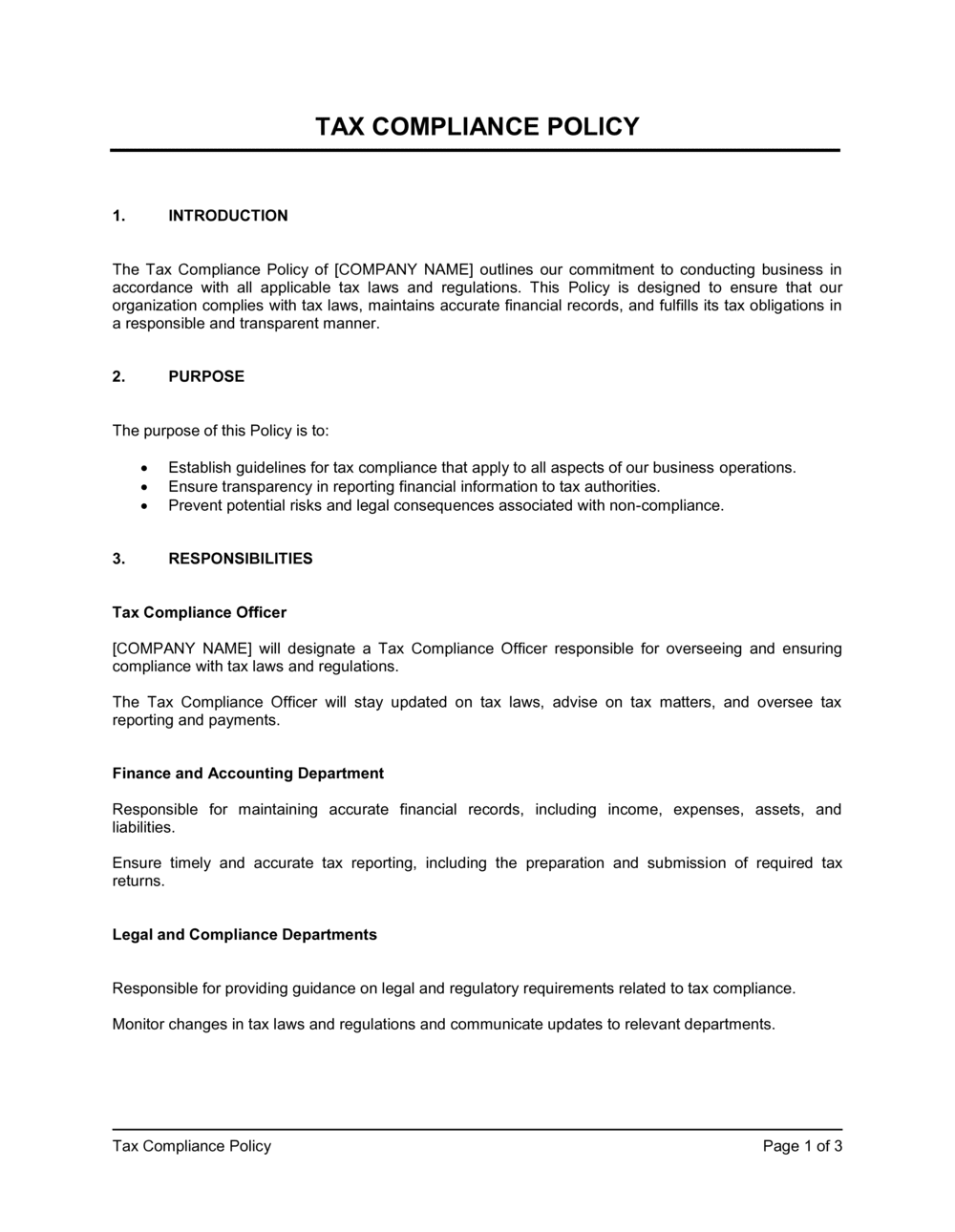
A Tax Compliance Policy is an internal governance document that defines how a business identifies, manages, and meets its tax obligations β€” covering filing deadlines, record-keeping standards, roles and responsibilities, and procedures for responding to audits or regulatory inquiries. This free Word download gives you a structured, editable template you can adapt to your entity type and jurisdiction, then export as PDF for board approval or staff distribution.
When you need it
Use it when formalizing your finance function, preparing for a board or investor review, onboarding a new CFO or controller, or responding to an audit finding that exposed gaps in your internal controls. It is also commonly required as part of a compliance framework when entering regulated industries or government contracting.
What's inside
Policy scope and objectives, roles and responsibilities, tax registration and filing obligations, record-keeping requirements, internal review and approval workflows, audit response procedures, training requirements, and a policy review schedule. Each section includes placeholder language you replace with your entity-specific details.

What is a Tax Compliance Policy?

A Tax Compliance Policy is an internal governance document that defines how a business identifies, manages, and meets its tax obligations on an ongoing basis. It specifies which tax types and jurisdictions the company is subject to, assigns ownership of each filing obligation to a named role, sets record-keeping retention standards, documents the internal review and sign-off workflow for every return, and establishes procedures for responding to audits or regulatory inquiries. Unlike a tax return β€” which reports a single period's activity β€” a tax compliance policy is a standing operational framework that governs the entire compliance function year-round.

Why You Need This Document

Without a written tax compliance policy, your business depends entirely on institutional knowledge held by one or two individuals. When that person leaves or is unavailable during a filing deadline, obligations are missed, penalties accrue, and estimated payments go uncalculated. Tax authorities treat the absence of documented internal controls as a signal of weak governance, which routinely results in broader and more intrusive audits than companies with demonstrable compliance frameworks face. A written policy also protects against a specific and common failure mode: staff making routine decisions β€” vendor 1099 classification, capital versus expense treatment, sales tax collection β€” without understanding their tax implications. This template gives your finance team a structured, accountable framework for managing every tax obligation from registration through audit response, at a fraction of the cost of discovering a gap through a penalty notice.

Which variant fits your situation?

If your situation is…Use this template
Setting overall tax governance for a mid-size or enterprise businessTax Compliance Policy
Documenting step-by-step procedures for preparing and filing returnsTax Filing Procedure
Managing sales tax collection and remittance across multiple statesSales Tax Compliance Checklist
Preparing the business for an IRS or CRA auditTax Audit Response Plan
Outlining an organization-wide financial controls frameworkInternal Controls Policy
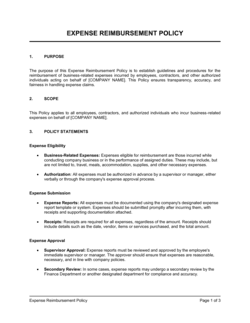
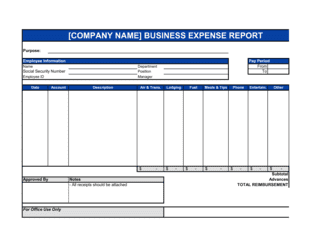
Documenting how business expenses are tracked for tax deductibilityExpense Reimbursement Policy
Establishing record-keeping rules across all financial documentsDocument Retention Policy

Common mistakes to avoid

❌ Omitting lesser-known tax obligations

Why it matters: Franchise taxes, gross receipts taxes, and county-level levies generate penalty notices that are disproportionate to the underlying liability and can trigger broader audits.

Fix: Cross-reference your state and local registrations against the filing obligations section and add every tax type for which you hold a permit or registration.

❌ Assigning tax compliance to a team rather than a named individual

Why it matters: Shared ownership means no individual is accountable for a deadline β€” filings slip, estimated payments are missed, and penalties accumulate before anyone flags the problem.

Fix: Name a specific role as owner of each filing type and a backup for vacations or turnover. Document both in the roles and responsibilities section.

❌ Using a single retention period for all record types

Why it matters: A blanket seven-year rule will be too short for fixed-asset records (which must be kept as long as the asset is held plus the audit window) and potentially longer than required for routine receipts, wasting storage resources.

Fix: Create a retention schedule table within the policy that lists each document category with its specific minimum retention period and cites the governing rule.

❌ Never updating the policy after it is approved

Why it matters: Tax law changes annually β€” a policy describing procedures that no longer match current law or business structure signals to auditors that internal controls are not functioning.

Fix: Embed a named owner and a specific annual review date in the policy itself, and add a trigger clause requiring an out-of-cycle update within 60 days of any material regulatory or structural change.

❌ Allowing operational staff to respond directly to tax notices

Why it matters: An unvetted response to a tax authority notice can inadvertently expand the audit scope, waive statute-of-limitations protections, or make admissions that increase the assessed liability.

Fix: The audit response section should require that all tax authority correspondence is routed to the CFO and external counsel before any substantive reply is sent.

❌ Calculating estimated payments using only the prior-year safe harbor

Why it matters: When current-year income significantly exceeds the prior year, the safe-harbor payment is insufficient to cover the actual liability β€” creating a large balance due and potential underpayment penalties at filing.

Fix: Require the Controller to compare the prior-year safe harbor to a current-year projection each quarter and escalate to the CFO if the gap exceeds a defined threshold.

The 10 key sections, explained

Policy scope and objectives

Roles and responsibilities

Tax registration and filing obligations

Record-keeping requirements

Internal review and approval workflow

Tax payments and cash management

Audit response procedures

Training and awareness

Tax risk assessment and materiality thresholds

Policy review and update schedule

How to fill it out

  1. 1

    Define the scope and list all applicable entities

    Identify every legal entity covered β€” parent company, subsidiaries, branches, and joint ventures. Note the jurisdictions each entity operates in and the tax types each is subject to.

    πŸ’‘ Pull your entity organization chart before starting β€” a missing subsidiary in the scope section is the single most common gap auditors find.

  2. 2

    Assign a named owner to every filing obligation

    List each tax type and due date, then assign a specific role β€” not just 'finance team' β€” as preparer and a separate role as reviewer. Document the escalation path to the CFO.

    πŸ’‘ Map each filing to a calendar and set recurring reminders in your project management or accounting system at the time you fill out this section.

  3. 3

    Build the filing calendar with all due dates

    Complete the tax registration and filing obligations section with every return type, the governing authority, the due date, and payment method. Include both annual and estimated payment deadlines.

    πŸ’‘ Cross-check your filing list against your EIN registration, state registrations, and any sales tax permits to catch obligations you may have overlooked.

  4. 4

    Set record-keeping retention periods by document type

    Specify the minimum retention period for each category β€” tax returns, payroll records, fixed-asset schedules, contracts, and correspondence β€” and the system or location where each is stored.

    πŸ’‘ Check the longer of the IRS general 3-year rule, the 6-year rule for omitted income, and any state-specific minimum before setting your retention periods.

  5. 5

    Document the three-step review and sign-off workflow

    Write out the preparer β†’ reviewer β†’ approver chain for each return type and specify how sign-off is recorded β€” a digital log, email confirmation, or accounting system workflow.

    πŸ’‘ Preparer and reviewer must be different people β€” if your team is too small, the external accountant can serve as the independent reviewer for high-risk filings.

  6. 6

    Define the materiality threshold for uncertain tax positions

    Set a dollar amount above which uncertain positions must be escalated to the CFO and external counsel, and specify how they are documented in the tax risk register.

    πŸ’‘ A threshold of 1–2% of pre-tax income is a common starting point for mid-size businesses; adjust based on your risk appetite and the complexity of your tax profile.

  7. 7

    Write the audit response protocol

    Name the roles to be notified within 48 hours of any tax authority contact, identify your external tax counsel, and specify that no response is sent without CFO and counsel review.

    πŸ’‘ Store your external counsel's contact information directly in this section so it is immediately accessible when a notice arrives.

  8. 8

    Set the annual review date and assign ownership

    Enter a specific calendar date for the annual policy review, name the owner, and set a trigger for out-of-cycle updates if tax law or business structure changes materially.

    πŸ’‘ Schedule the review 60–90 days before your fiscal year-end so updates are in place before the next filing season begins.

Frequently asked questions

What is a tax compliance policy?

A tax compliance policy is an internal governance document that defines how a business identifies and meets its tax obligations. It assigns responsibility for each filing type, sets record-keeping standards, documents internal review workflows, and establishes procedures for responding to audits or regulatory inquiries. Unlike a tax return or financial statement, it is a standing operational policy rather than a period-specific document.

Who needs a tax compliance policy?

Any business with more than one person involved in finance or accounting benefits from a written tax compliance policy. It is particularly important for companies with multiple entities or jurisdictions, those subject to government contracting requirements, businesses preparing for a financial audit, and organizations onboarding a new CFO or controller who needs to understand the existing compliance framework.

What should a tax compliance policy include?

A complete policy covers scope and objectives, roles and responsibilities, a catalog of all filing obligations with due dates, record-keeping retention periods by document type, an internal review and approval workflow, estimated tax payment procedures, an audit response protocol, a training requirement for relevant staff, a materiality threshold for uncertain tax positions, and an annual review schedule. Missing any of these sections leaves a gap that auditors or regulators will identify.

How is a tax compliance policy different from a tax return?

A tax return is a period-specific filing submitted to a tax authority reporting income, deductions, and tax owed. A tax compliance policy is an internal document that governs how the company prepares, reviews, approves, and files those returns β€” and how it maintains the records to support them. The policy is the process; the return is the output of that process.

Does a tax compliance policy need to be reviewed by a lawyer?

Legal review is not typically required for a standard internal tax compliance policy. However, if your policy includes provisions related to transfer pricing between related entities, tax indemnities, or uncertain positions with material exposure, having a tax attorney or CPA review those sections is worthwhile. Most businesses complete this document with their CFO or controller and their external accounting firm.

How often should a tax compliance policy be updated?

At minimum, review the policy annually β€” ideally 60 to 90 days before your fiscal year-end so updates are in place before the next filing season. Also trigger an out-of-cycle review when tax law changes materially, when the business adds a new entity or enters a new jurisdiction, or when an audit finding exposes a gap in the existing procedures.

What happens if a business does not have a tax compliance policy?

Without a written policy, tax obligations are managed through informal individual knowledge rather than documented procedures. This creates risk of missed filings when key staff turn over, inconsistent record keeping that cannot support an audit, and no clear escalation path when a tax authority makes contact. Regulators and auditors treat the absence of written controls as evidence of weak governance, which can expand the scope of an examination.

Can a small business use this template?

Yes. The template is designed to be scaled β€” a five-person business will have simpler role assignments and fewer filing types than a 50-person company, but the structure is the same. Fill in only the sections relevant to your entity type and tax profile, and note any sections that are not currently applicable so the document remains accurate rather than aspirational.

How does a tax compliance policy reduce audit risk?

Auditors assess internal controls before determining the depth of their examination. A written policy with documented review workflows, named owners, and a defined record-keeping standard signals that the business manages tax obligations systematically. Companies with no written controls typically receive broader, more intrusive audits than those that can demonstrate a functioning compliance framework.

How this compares to alternatives

vs Tax Audit Response Plan

A tax audit response plan is a reactive document activated when a tax authority initiates an examination β€” it covers document assembly, communication protocols, and timeline management for a specific audit. A tax compliance policy is a standing governance document that governs ongoing filing and record-keeping practices year-round. The compliance policy should reference and incorporate the audit response plan rather than duplicate it.

vs Accounting Policies and Procedures Manual

An accounting policies and procedures manual covers the full range of financial reporting decisions β€” revenue recognition, capitalization thresholds, depreciation methods, and month-end close procedures. A tax compliance policy is narrower, focusing specifically on tax filing obligations, record-keeping for tax purposes, and regulatory interactions. Large organizations need both; smaller businesses often embed tax procedures within the broader accounting manual.

vs Document Retention Policy

A document retention policy sets organization-wide rules for how long all business records are kept and how they are destroyed. A tax compliance policy includes a retention section specific to tax records but also covers filing workflows, roles, and audit response β€” areas a general retention policy does not address. The two documents should align on retention periods for tax-relevant records.

vs Internal Controls Policy

An internal controls policy establishes the broader framework of financial checks and authorization requirements across all business processes β€” purchasing, payroll, financial reporting, and fraud prevention. A tax compliance policy is a domain-specific subset of that framework, focused entirely on tax obligations. Organizations subject to SOX or investor audit requirements typically maintain both documents separately.

Industry-specific considerations

Professional Services

Multi-state nexus from remote client engagements requires careful tracking of filing obligations across jurisdictions where partners or employees work.

SaaS / Technology

Digital services trigger economic nexus and VAT/GST registration requirements in states and countries where the company has no physical presence.

Manufacturing

Capital asset depreciation schedules, sales and use tax on equipment purchases, and multi-state apportionment require detailed section-level procedures.

Retail / E-commerce

Post-Wayfair economic nexus rules mean sales tax registration and filing obligations may span 40-plus states, making a documented compliance calendar essential.

Healthcare

Nonprofit status, unrelated business income tax, and physician compensation arrangements each carry specific tax treatment that must be captured in the policy scope.

Financial Services

Transfer pricing between affiliated entities, withholding tax on cross-border payments, and FATCA reporting obligations require dedicated sections within the policy.

Template vs pro β€” what fits your needs?

PathBest forCostTime
Use the templateSmall to mid-size businesses formalizing their tax compliance process with an existing CPA or controllerFree3–6 hours to complete and review
Template + professional reviewBusinesses with multi-state or international filing obligations, or those preparing for an investor or lender audit$500–$1,500 for a CPA or tax advisor review1–2 weeks
Custom draftedLarge enterprises, regulated industries (financial services, healthcare), or organizations with transfer pricing or FATCA obligations$3,000–$10,000+ with a tax attorney or Big Four advisor4–8 weeks

Glossary

Tax Nexus
A sufficient connection between a business and a tax jurisdiction that creates an obligation to collect, report, or pay taxes in that jurisdiction.
Withholding Tax
An amount deducted from an employee's wages or a payment to a vendor and remitted directly to the tax authority on behalf of the payee.
Transfer Pricing
The pricing of goods, services, or intellectual property exchanged between related entities within the same corporate group, which tax authorities scrutinize to prevent profit shifting.
Tax Provision
An estimate of a company's current and deferred income tax liability recorded on the financial statements for a given accounting period.
Deferred Tax Liability
A tax obligation that arises when income is recognized in the financial statements before it is taxed, creating a future payment obligation.
Statute of Limitations
The legally defined window during which a tax authority can assess additional taxes or a taxpayer can claim a refund β€” typically three to seven years depending on jurisdiction and circumstances.
Permanent Establishment
A fixed place of business β€” such as an office, branch, or factory β€” that triggers corporate income tax obligations in a foreign jurisdiction.
Effective Tax Rate
Total income tax expense divided by pre-tax income, expressed as a percentage β€” used to evaluate how efficiently a business manages its overall tax burden.
Tax Indemnity
A contractual commitment by one party to cover another's tax liabilities arising from a specific transaction, commonly used in M&A agreements.
VAT / GST
Value Added Tax or Goods and Services Tax β€” a consumption tax collected at each stage of the supply chain and remitted to the government by registered businesses.

Part of your Business Operating System

This document is one of 3,000+ business & legal templates included in Business in a Box.

  • Fill-in-the-blanks β€” ready in minutes
  • 100% customizable Word document
  • Compatible with all office suites
  • Export to PDF and share electronically

Create your document in 3 simple steps.

From template to signed document β€” all inside one Business Operating System.
1
Download or open template

Access over 3,000+ business and legal templates for any business task, project or initiative.

2
Edit and fill in the blanks with AI

Customize your ready-made business document template and save it in the cloud.

3
Save, Share, Send, Sign

Share your files and folders with your team. Create a space of seamless collaboration.

Save time, save money, and create top-quality documents.

β˜…β˜…β˜…β˜…β˜…

"Fantastic value! I'm not sure how I'd do without it. It's worth its weight in gold and paid back for itself many times."

Managing Director Β· Mall Farm
Robert Whalley
Managing Director, Mall Farm Proprietary Limited
β˜…β˜…β˜…β˜…β˜…

"I have been using Business in a Box for years. It has been the most useful source of templates I have encountered. I recommend it to anyone."

Business Owner Β· 4+ years
Dr Michael John Freestone
Business Owner
β˜…β˜…β˜…β˜…β˜…

"It has been a life saver so many times I have lost count. Business in a Box has saved me so much time and as you know, time is money."

Owner Β· Upstate Web
David G. Moore Jr.
Owner, Upstate Web

Run your business with a system β€” not scattered tools

Stop downloading documents. Start operating with clarity. Business in a Box gives you the Business Operating System used by over 250,000 companies worldwide to structure, run, and grow their business.

Start freeΒ Β·Β No credit card required