Software Quality Assurance Manager Job Description Template

Free Word download • Edit online • Save & share with Drive • Export to PDF

2 pages20–30 min to fillDifficulty: StandardSignature requiredLegal review recommended
Learn more ↓
FreeSoftware Quality Assurance Manager Job Description Template

At a glance

What it is
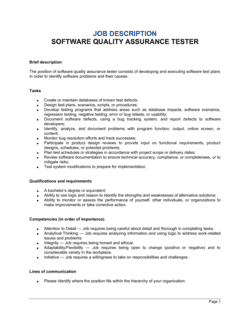
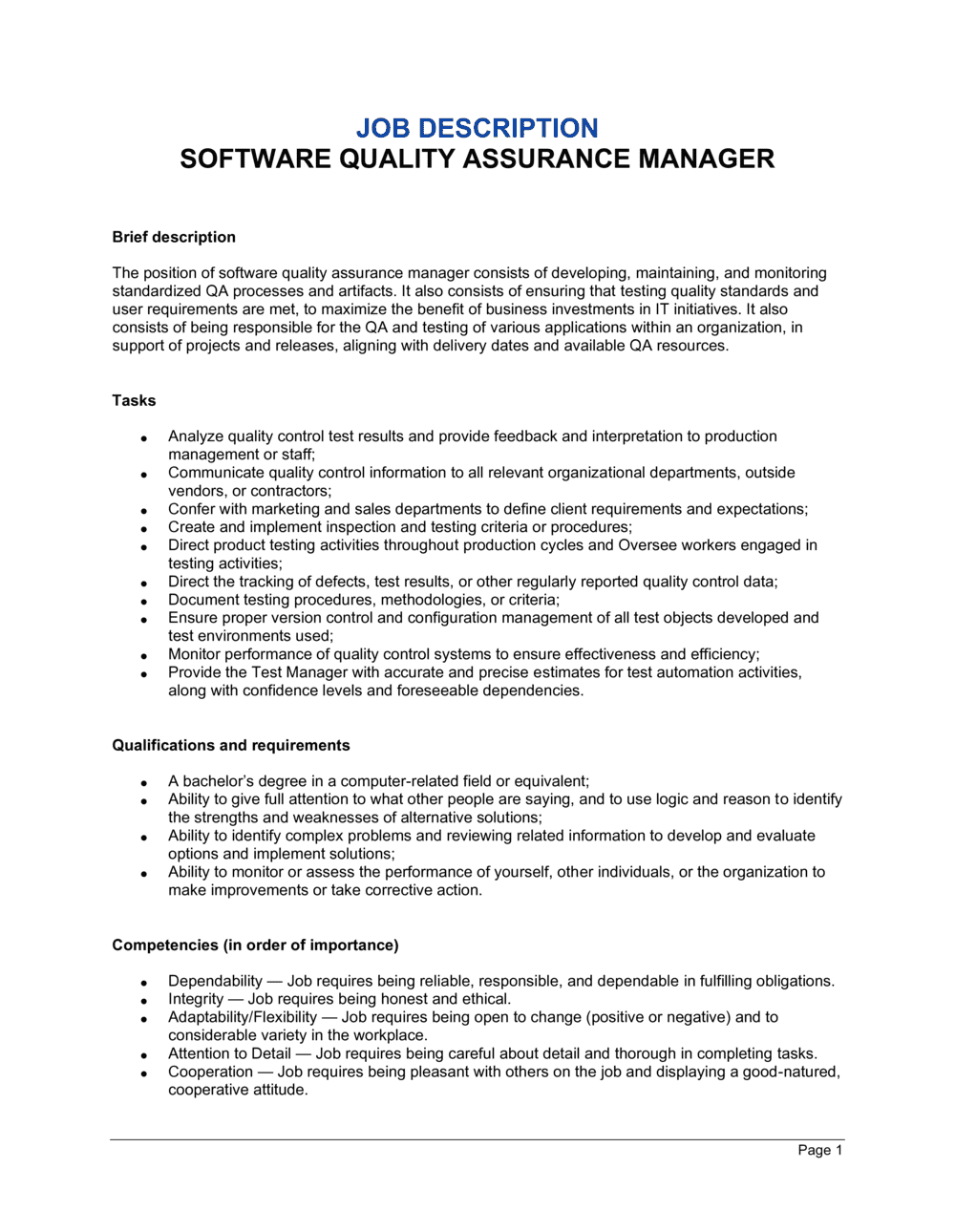
A Software Quality Assurance Manager Job Description is a formal employment document that defines the scope, responsibilities, reporting structure, required qualifications, and performance expectations for a QA leadership role within a software development organization. This free Word download can be edited online and exported as PDF for use in job postings, offer letters, and employment contracts.
When you need it
Use it when hiring a QA Manager for the first time, backfilling a vacant leadership role, or restructuring your testing and quality function after a team expansion or process overhaul. It is also essential when formalizing a role that has been performed informally without written expectations.
What's inside
Role summary, reporting structure, core responsibilities covering test planning and defect management, required technical skills and QA methodology expertise, education and certification requirements, KPIs and performance standards, compensation range, and equal employment compliance language.

What is a Software Quality Assurance Manager Job Description?

A Software Quality Assurance Manager Job Description is a formal employment document that defines the full scope of a QA leadership role within a software development organization — covering responsibilities, reporting structure, required technical skills, QA methodology expectations, team leadership scope, measurable performance standards, and compensation terms. It functions simultaneously as a recruitment tool, a legal reference document incorporated into offer letters and employment agreements, and an operational record of what the role is accountable for throughout its tenure. When properly drafted, it creates enforceable alignment between employer and employee on every material dimension of the working relationship before day one.

Why You Need This Document

Hiring a QA Manager without a written, signed job description leaves your organization exposed on multiple fronts at once. Without documented KPIs, performance management becomes subjective — making it legally difficult to act on underperformance and creating wrongful termination liability in most jurisdictions. Without a defined tool and methodology clause, a newly hired QA Manager may implement a testing process incompatible with your CI/CD pipeline, requiring a costly restructuring within the first quarter. In California, Colorado, New York, and Washington state, omitting a salary range from the posting now carries regulatory fines. And in the UK and Canada, vague or discriminatory qualification requirements invite human rights complaints before you even make an offer. This template gives you a complete, jurisdiction-aware starting point that closes all four gaps — structured to take 30 minutes to complete, with every clause built around the specific language patterns that hold up in practice.

Which variant fits your situation?

If your situation is…Use this template
Hiring a hands-on QA lead who still writes test casesQA Lead Job Description
Hiring a senior director overseeing multiple QA teams and budgetsDirector of Quality Assurance Job Description
Filling an individual-contributor automated testing roleQA Automation Engineer Job Description
Hiring for a regulated industry requiring compliance-specific QAQuality Assurance Manager (Regulated Industry) Job Description
Documenting a freelance or contract QA engagementIndependent Contractor Agreement
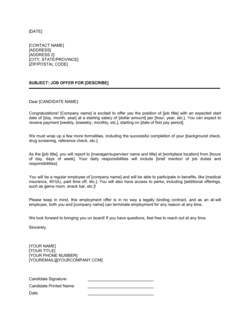
Formalizing the full employment relationship after posting is acceptedEmployment Contract
Adding performance standards after onboarding is completeEmployee Performance Review Template

Common mistakes to avoid

❌ Omitting salary range where pay transparency is required

Why it matters: California, Colorado, New York, and Washington state require salary ranges on job postings. Violations carry fines and reputational damage in a competitive QA hiring market.

Fix: Before publishing, check the pay transparency laws for every state or province where the role can be filled and include a compliant range in the compensation clause.

❌ Listing degree requirements that exclude qualified candidates

Why it matters: Requiring a four-year computer science degree for a QA Manager role with no genuine basis can expose the employer to adverse-impact discrimination claims, particularly in the UK and Canada.

Fix: Replace hard degree requirements with a skills-equivalent clause — 'Bachelor's degree in a related field or equivalent practical experience of [X] years.'

❌ Vague performance expectations with no measurable KPIs

Why it matters: Without documented, quantified standards, performance management becomes subjective — making it legally difficult to terminate a QA Manager for underperformance and leaving the company exposed to wrongful dismissal claims.

Fix: Insert specific, numeric KPIs for defect escape rate, test coverage, and cycle time into the performance standards clause before the document is executed.

❌ Conflating QA Manager duties with QA Lead or automation engineer tasks

Why it matters: A job description that mixes strategic leadership with hands-on test scripting attracts the wrong candidate pool and leads to misaligned expectations within the first 90 days.

Fix: Audit every responsibility bullet against the seniority level. Anything an individual contributor would own should be removed or flagged as a transitional duty during ramp-up.

❌ Ignoring jurisdiction-specific EEO and accommodation requirements

Why it matters: A US-centric EEO statement does not satisfy the Equality Act 2010 in the UK or the Canadian Human Rights Act — using a single boilerplate for all geographies creates compliance gaps.

Fix: Maintain separate EEO and accommodation clauses for each jurisdiction where the role is posted and confirm each version with a local HR or legal resource.

❌ Publishing the job description without a review for discriminatory language

Why it matters: Terms like 'rockstar,' 'ninja,' or 'recent graduate' can signal age or gender bias and invite regulatory scrutiny in most major jurisdictions.

Fix: Run the draft through an inclusion-focused language audit tool or a brief HR review before posting to identify and replace coded language.

The 10 key clauses, explained

Role Title, Grade, and Reporting Line

In plain language: States the official job title, seniority level or compensation band, and the position this role reports to within the organization.

Sample language
Job Title: Software Quality Assurance Manager | Grade: [LEVEL/BAND] | Reports to: [VP ENGINEERING / CTO / DIRECTOR OF PRODUCT] | Location: [CITY, STATE / REMOTE]

Common mistake: Listing a generic title without specifying the reporting relationship — candidates and hiring managers then disagree on decision-making authority, leading to misaligned expectations at offer stage.

Role Summary and Objective

In plain language: A 3–5 sentence overview of why the role exists, what it is accountable for, and how it contributes to business outcomes.

Sample language
[COMPANY NAME] is seeking a Software Quality Assurance Manager to lead our testing function and ensure that all software releases meet defined quality standards before reaching production. This role owns the end-to-end QA process across [NUMBER] product lines and is responsible for reducing post-release defect rates to below [X]% within [TIMEFRAME].

Common mistake: Writing a role summary that describes the team rather than the role — candidates need to understand their individual accountability, not just the department's purpose.

Core Responsibilities

In plain language: A prioritized list of the day-to-day and strategic duties the QA Manager is accountable for — test strategy, team leadership, process improvement, and stakeholder communication.

Sample language
Design and maintain a comprehensive test strategy covering functional, regression, performance, and security testing. Lead a team of [X] QA engineers, including goal-setting, mentoring, and performance reviews. Define and track QA KPIs including defect escape rate, test coverage, and mean time to resolution.

Common mistake: Listing more than 12 bullet-point responsibilities without grouping them — this makes the description unreadable and signals that the role is actually two or three roles bundled together.

Technical Skills and Tool Requirements

In plain language: Specifies the software testing tools, automation frameworks, and programming languages the candidate must demonstrate proficiency in.

Sample language
Required: [SELENIUM / CYPRESS / PLAYWRIGHT], [JIRA], [POSTMAN or equivalent API testing tool], and demonstrated experience with CI/CD pipelines ([JENKINS / GITHUB ACTIONS / CIRCLECI]). Preferred: proficiency in [PYTHON or JAVA] for test automation scripting.

Common mistake: Listing every tool the company currently uses as 'required' — this eliminates strong candidates who can learn secondary tools quickly and narrows the pool unnecessarily.

QA Methodology and Process Standards

In plain language: Defines the testing methodologies, frameworks, and process standards the role must apply — such as Agile, shift-left testing, or ISO 25010.

Sample language
The QA Manager will implement and maintain a shift-left testing strategy within our Agile/Scrum delivery model, ensuring test cases are authored during sprint planning and automated regression suites run on every pull request via the [CI/CD TOOL] pipeline.

Common mistake: Omitting methodology expectations entirely, which leads to a hired QA Manager implementing a process incompatible with the engineering team's Agile or DevOps workflow.

Team Leadership and Hiring Authority

In plain language: States the size of the team the QA Manager leads, their hiring and firing authority, and their responsibility for team development.

Sample language
The QA Manager directly manages [X] QA Engineers and [Y] Automation Specialists. This role has full hiring authority for QA headcount within approved budget, and is accountable for onboarding, performance management, and succession planning within the team.

Common mistake: Describing leadership responsibilities without specifying the number of direct reports — candidates cannot assess role scope, and compensation benchmarking becomes inaccurate.

Education, Certification, and Experience Requirements

In plain language: Sets the minimum and preferred academic qualifications, industry certifications (e.g., ISTQB), and years of relevant experience.

Sample language
Required: Bachelor's degree in Computer Science, Engineering, or a related field, or equivalent practical experience. Minimum [X] years in software quality assurance with at least [Y] years in a leadership role. Preferred: ISTQB Advanced Level certification or equivalent.

Common mistake: Setting a four-year degree as a hard requirement when the role can be equally well filled by candidates with equivalent hands-on experience — this may create adverse-impact exposure in jurisdictions that scrutinize degree requirements.

Performance Standards and KPIs

In plain language: Defines the measurable outcomes the QA Manager will be evaluated on — defect escape rate, test coverage targets, release cycle times, and team utilization.

Sample language
Success in this role will be measured against: (a) defect escape rate below [X]% per release cycle; (b) automated test coverage above [Y]% of critical user journeys; (c) mean time to defect resolution of [Z] business days; and (d) QA sign-off delivered within [N] days of code freeze.

Common mistake: Omitting KPIs from the job description entirely — this makes performance reviews subjective and exposes the company to wrongful termination claims when a QA Manager is let go for underperformance without documented standards.

Compensation, Benefits, and Employment Type

In plain language: States the salary range, bonus eligibility, equity if applicable, benefits summary, and whether the role is full-time, part-time, or contract.

Sample language
Compensation: $[MIN] – $[MAX] per year, commensurate with experience. Eligible for an annual discretionary performance bonus of up to [X]% of base salary. Benefits include [HEALTH/DENTAL/VISION], [401(k)/RRSP] with [X]% employer match, and [Y] days PTO.

Common mistake: Omitting the salary range entirely in jurisdictions where pay transparency is now legally required — failure to disclose can result in regulatory fines and reputational damage in competitive hiring markets.

Equal Employment Opportunity and Compliance Statement

In plain language: Includes the standard EEO declaration confirming the employer does not discriminate and, where required, confirms compliance with accommodation obligations.

Sample language
[COMPANY NAME] is an equal opportunity employer. All qualified applicants will receive consideration for employment without regard to race, color, religion, sex, national origin, disability, or veteran status. Reasonable accommodations will be provided upon request.

Common mistake: Using a boilerplate EEO statement that does not include accommodation language — in the US, Canada, and the UK, failure to reference reasonable accommodation can expose the employer to discrimination claims.

How to fill it out

  1. 1

    Define the reporting structure and headcount scope

    Confirm who the QA Manager reports to and how many direct reports the role will have from day one. Enter both clearly in the Role Title and Team Leadership clauses before drafting any responsibilities.

    💡 If headcount is expected to grow within 12 months, state the target team size explicitly — this signals growth opportunity to strong candidates.

  2. 2

    Write the role summary around business outcomes

    Draft a 3–5 sentence overview that explains why the role exists and what the company will be able to do once it is filled. Tie the summary to a concrete outcome — a release quality target, a compliance milestone, or a team scale goal.

    💡 Avoid starting with 'We are looking for...' — lead with the problem the role solves or the outcome it delivers.

  3. 3

    List responsibilities in priority order

    Write 8–12 responsibility statements grouped into strategic (test strategy, process design), managerial (team leadership, hiring), and operational (day-to-day test execution oversight, reporting). Order them from highest to lowest impact.

    💡 If a responsibility appears on every QA Manager job description on the internet, cut it — use the space to describe what is genuinely distinctive about your role.

  4. 4

    Specify tools as required versus preferred

    Separate your current toolchain into hard requirements (tools used daily in the role) and preferred skills (tools the team uses occasionally or that the company plans to adopt). Label each clearly.

    💡 Requiring proficiency in more than five specific tools typically reduces your candidate pool by 40% without meaningfully improving hire quality.

  5. 5

    Set the KPIs and performance standards

    Fill in the specific targets for defect escape rate, test coverage percentage, and mean time to resolution that the QA Manager will be held to in their first performance review cycle.

    💡 Use your current baseline metrics as the starting target, then agree internally on the improvement trajectory before publishing the JD.

  6. 6

    Enter the compensation range and benefits

    Research market salary data for a QA Manager in your geography using at least two sources (e.g., Levels.fyi, Radford/Mercer survey data). Enter a range no wider than 30% from floor to ceiling.

    💡 Salary transparency is legally required in California, Colorado, New York, and Washington state — check current requirements for each location where the role can be filled.

  7. 7

    Add the EEO statement and legal compliance language

    Insert the company's standard equal employment opportunity statement and confirm it includes reasonable-accommodation language. For roles that may be filled in multiple jurisdictions, have HR confirm the statement meets each location's requirements.

    💡 If your company is a federal contractor in the US, confirm whether OFCCP affirmative action language is required for this role.

  8. 8

    Have hiring manager and HR review before posting

    Send the completed description to both the hiring manager and an HR or legal reviewer before posting. Confirm that required experience thresholds, degree requirements, and tool lists do not create disparate-impact exposure.

    💡 A 30-minute review against your local employment discrimination checklist is far cheaper than a EEOC complaint or human rights tribunal proceeding.

Frequently asked questions

What is a Software Quality Assurance Manager job description?

A Software QA Manager job description is a formal document that defines the responsibilities, required skills, reporting structure, performance standards, and compensation expectations for a quality assurance leadership role within a software development organization. It serves as the basis for job postings, candidate evaluation, offer letters, and employment contracts — and creates a written record of what the role is accountable for.

What should a QA Manager job description include?

A complete QA Manager job description covers the role title and reporting line, a results-oriented role summary, 8–12 prioritized responsibilities, required and preferred technical skills and testing tools, QA methodology expectations, team leadership scope, education and certification requirements, measurable KPIs, compensation range, and an EEO compliance statement. Missing any of these creates gaps that lead to misaligned expectations after hire.

What qualifications does a Software QA Manager typically need?

Most organizations require a bachelor's degree in computer science, engineering, or a related field — or equivalent hands-on experience of 5–8 years in software QA, with at least 2–3 years in a leadership role. ISTQB Advanced Level certification is widely preferred. Proficiency in at least one automation framework (Selenium, Cypress, or Playwright) and experience managing QA within an Agile or DevOps workflow are typically expected.

Is a job description a legally binding document?

A job description is generally not a standalone employment contract, but it can be incorporated by reference into an offer letter or employment agreement — at which point its terms become binding. Courts in multiple jurisdictions have used job descriptions as evidence of the employer's stated expectations in wrongful termination, discrimination, and misclassification disputes. Keeping it accurate and current matters legally, not just operationally.

Do I need to include a salary range in a QA Manager job description?

In California, Colorado, New York, and Washington state, pay transparency laws require salary ranges on job postings as of 2023–2024. Similar requirements are in effect or pending in several other US states, some Canadian provinces, and under the EU Pay Transparency Directive. Check the specific requirements for every location where the role will be posted and include a compliant range — failure to do so carries fines and limits your candidate pool.

What KPIs should a QA Manager be measured on?

Common, measurable KPIs for a QA Manager include defect escape rate (percentage of bugs reaching production), automated test coverage as a percentage of critical user journeys, mean time to defect resolution, QA cycle time from code freeze to sign-off, and release readiness on-time rate. Setting these in the job description before hire gives both parties an objective baseline for the first performance review.

How is a QA Manager different from a QA Lead?

A QA Lead is typically a senior individual contributor who guides testing activities, writes test plans, and may mentor junior engineers — but does not own hiring, budget, or cross-functional strategy. A QA Manager owns the team's headcount, performance management, process design, and stakeholder communication at a leadership level. The job description should clearly distinguish which role you are hiring for to avoid attracting the wrong candidate profile.

What tools and methodologies should a QA Manager know?

A QA Manager in a modern software organization is typically expected to be fluent in Agile and Scrum testing practices, shift-left testing principles, and CI/CD pipeline integration for automated regression. Tool expectations vary by stack, but Selenium or Cypress for UI automation, Postman or similar for API testing, JIRA for defect tracking, and at least one CI tool (Jenkins, GitHub Actions, or CircleCI) are widely required. Leadership roles are not expected to write code daily but must be able to evaluate and direct automation strategy.

Should the job description be signed by the employee?

Yes — when incorporated into an offer letter or employment agreement, the job description should be acknowledged in writing by the employee before their start date. A signed acknowledgment creates a documented record of agreed expectations and supports the employer's position in any subsequent performance management or termination proceeding. In jurisdictions requiring fresh consideration for post-hire amendments, updating duties after day one without a signed addendum can create enforceability issues.

How this compares to alternatives

vs QA Lead Job Description

A QA Lead job description focuses on a senior individual contributor who guides testing execution, writes test plans, and mentors junior engineers without formal people-management authority. A QA Manager description adds team leadership, hiring authority, budget ownership, and cross-functional stakeholder accountability. Use the QA Lead template when you need an expert practitioner; use the QA Manager template when you need someone who owns the entire quality function.

vs Software Developer Job Description

A software developer job description defines responsibilities for building and shipping product features. A QA Manager job description defines responsibilities for independently evaluating the quality of those features and gatekeeping releases. The two roles should have separate, clearly delineated descriptions to preserve the independence of the QA function — a combined dev/QA role description typically undermines both functions.

vs Employment Contract

A job description defines the role scope, skills, and expectations used to recruit and evaluate a candidate. An employment contract is the binding legal agreement governing compensation, IP assignment, confidentiality, non-compete, termination, and severance once the candidate accepts. The job description is typically attached as a schedule to the employment contract, making both documents part of the enforceable agreement.

vs Independent Contractor Agreement

If you are engaging a QA Manager on a freelance or contract basis rather than as an employee, an independent contractor agreement is the appropriate governing document — not a job description. Misclassifying a QA Manager as a contractor when the engagement meets the legal tests for employment triggers back tax liability, benefit obligations, and penalties in most jurisdictions. Use the job description template only for employee roles.

Industry-specific considerations

SaaS / Technology

Emphasis on CI/CD-integrated automated testing, shift-left methodology, and ownership of quality gates across multiple concurrent sprint teams.

Healthcare / MedTech

FDA 21 CFR Part 11 and IEC 62304 compliance requirements, validation documentation, and risk-based testing protocols for regulated software devices.

Financial Services / Fintech

SOC 2 and PCI-DSS compliance testing, security regression suites, and audit-trail documentation for all QA sign-off activities.

E-commerce / Retail Technology

Performance and load testing for peak-traffic scenarios, cross-browser and cross-device coverage, and checkout-flow defect escape rate targets.

Jurisdictional notes

United States

Pay transparency laws requiring salary ranges on job postings are in effect in California, Colorado, New York, and Washington state as of 2024, with additional states pending. Degree requirements should include an equivalency clause to reduce adverse-impact exposure under EEOC guidelines. Federal contractors must comply with OFCCP affirmative action posting obligations. At-will employment status should be stated explicitly in the description or accompanying offer letter.

Canada

Pay transparency requirements vary by province — British Columbia and Prince Edward Island mandate salary ranges on postings; Ontario legislation is in effect as of 2026. The Canadian Human Rights Act prohibits discriminatory job requirements, including degree requirements that lack genuine occupational justification. Quebec postings must be in French for provincially regulated employers. Employment standards vary significantly by province and affect the benefit and PTO terms referenced in the JD.

United Kingdom

The Equality Act 2010 prohibits job requirements that create indirect discrimination on the basis of age, sex, race, or disability without objective justification. Blanket degree requirements for QA Manager roles have been challenged under indirect age discrimination case law. The description should reference reasonable adjustments in the EEO statement. Gender pay gap reporting obligations apply to employers with 250 or more employees — compensation data in the JD must be consistent with published pay gap reports.

European Union

The EU Pay Transparency Directive (2023/970) requires member states to implement salary disclosure obligations for job postings by June 2026 — most major economies are in active transposition. GDPR applies to candidate personal data collected through the application process; the JD or accompanying privacy notice should reference how applicant data is handled. Works council consultation may be required before publishing a new role definition in Germany, France, the Netherlands, and other co-determination jurisdictions.

Template vs lawyer — what fits your deal?

PathBest forCostTime
Use the templateStandard domestic QA Manager hires in a single US state or Canadian province without complex compliance requirementsFree30–60 minutes
Template + legal reviewRegulated industry hires (healthcare, fintech), multi-state or cross-border postings, or roles with significant IP and NDA exposure$200–$5001–2 business days
Custom draftedEnterprise organizations, government contractors, or roles requiring OFCCP affirmative action compliance and multi-jurisdiction pay transparency$500–$2,000+3–7 business days

Glossary

Test Plan
A document specifying the scope, approach, resources, and schedule for all testing activities on a given software project.
Defect Density
The number of confirmed defects divided by the size of the software module, used as a measure of software quality.
Regression Testing
Re-running previously passing tests after a code change to confirm that existing functionality has not been broken.
CI/CD Pipeline
A continuous integration and continuous delivery workflow that automatically builds, tests, and deploys code changes.
SDLC (Software Development Life Cycle)
The structured process covering planning, design, development, testing, deployment, and maintenance of a software product.
Shift-Left Testing
The practice of integrating testing activities earlier in the SDLC to catch defects before they become expensive to fix.
Test Coverage
The percentage of source code or requirements exercised by a defined set of test cases.
SLA (Service Level Agreement)
A contractual commitment between a service provider and a client specifying minimum performance and uptime standards.
KPI (Key Performance Indicator)
A measurable metric used to evaluate whether a role or team is achieving its defined objectives.
ISTQB
International Software Testing Qualifications Board — the body that administers globally recognized software testing certifications.

Part of your Business Operating System

This document is one of 3,000+ business & legal templates included in Business in a Box.

  • Fill-in-the-blanks — ready in minutes
  • 100% customizable Word document
  • Compatible with all office suites
  • Export to PDF and share electronically

Create your document in 3 simple steps.

From template to signed document — all inside one Business Operating System.
1
Download or open template

Access over 3,000+ business and legal templates for any business task, project or initiative.

2
Edit and fill in the blanks with AI

Customize your ready-made business document template and save it in the cloud.

3
Save, Share, Send, Sign

Share your files and folders with your team. Create a space of seamless collaboration.

Save time, save money, and create top-quality documents.

★★★★★

"Fantastic value! I'm not sure how I'd do without it. It's worth its weight in gold and paid back for itself many times."

Managing Director · Mall Farm
Robert Whalley
Managing Director, Mall Farm Proprietary Limited
★★★★★

"I have been using Business in a Box for years. It has been the most useful source of templates I have encountered. I recommend it to anyone."

Business Owner · 4+ years
Dr Michael John Freestone
Business Owner
★★★★★

"It has been a life saver so many times I have lost count. Business in a Box has saved me so much time and as you know, time is money."

Owner · Upstate Web
David G. Moore Jr.
Owner, Upstate Web

Run your business with a system — not scattered tools

Stop downloading documents. Start operating with clarity. Business in a Box gives you the Business Operating System used by over 250,000 companies worldwide to structure, run, and grow their business.

Free Forever Plan · No credit card required