1
Define the scope and applicable standards
Identify which products, services, sites, and departments the policy covers. Note any external standards — ISO 9001, industry-specific codes, or customer contractual requirements — that the policy must align with.
💡 A narrower, well-enforced scope is more credible to auditors than a broad scope with patchy compliance.
2
Set measurable quality objectives
Replace generic statements with specific, measurable targets — defect rate below a named percentage, complaint resolution within a defined number of days, supplier NCR rate below a threshold.
💡 Benchmark your targets against industry averages before committing — an unachievable target creates instant non-compliance.
3
Assign roles with named job titles
Map each quality duty to a specific job title, not a department. Specify who owns the NCR register, who approves product release, and who reports quality metrics to leadership.
💡 Avoid listing a person's name — titles remain accurate when personnel change; names require a policy amendment every time someone leaves.
4
Document inspection checkpoints and sampling rules
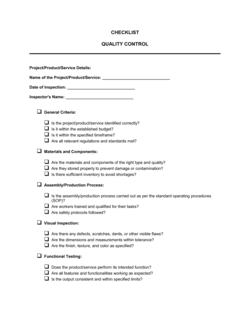
For each stage — incoming, in-process, and final — specify the inspection method, the acceptance quality level (AQL) or sampling size, the tools used, and the pass/fail threshold.
💡 Reference existing inspection checklists by form number rather than reproducing them in the policy body — this prevents the policy from needing an amendment every time a checklist is updated.
5
Define defect classes and disposition rules
Write out critical, major, and minor defect definitions with concrete examples from your product or service. Specify the exact disposition action for each class so inspectors make consistent decisions without escalating every case.
💡 Pilot the defect classification table with two or three inspectors on a live batch before finalizing — classification disagreements reveal ambiguous definitions.
6
Configure the CAPA process with timelines
Set specific deadlines for NCR initiation, root cause analysis completion, corrective action implementation, and effectiveness verification. Assign each step to a named role.
💡 A CAPA process without a defined closure deadline is never closed — build a hard cut-off and assign the Quality Manager escalation authority for overdue items.
7
Set document retention periods
Confirm the applicable product liability limitation period and any regulatory retention requirement for your industry. Set the policy retention period at the longer of the two, plus one year as a buffer.
💡 For products with a 10-year liability window, a 3-year retention period in your policy is a direct litigation risk — align them.
8
Schedule audits and management reviews in the calendar
Add the audit schedule and management review dates to the company calendar before the policy is approved. A policy that schedules events without booking them produces zero compliance.
💡 Set a recurring calendar reminder 30 days before each audit to allow preparation time — last-minute audits generate incomplete records.