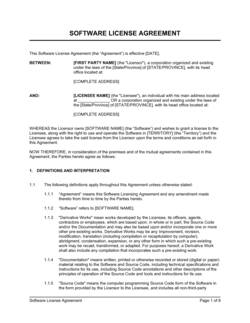
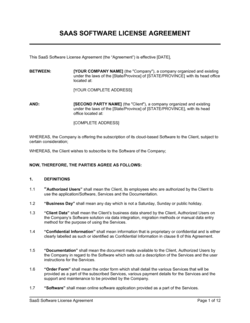
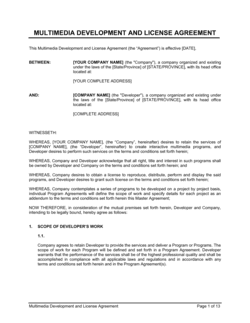
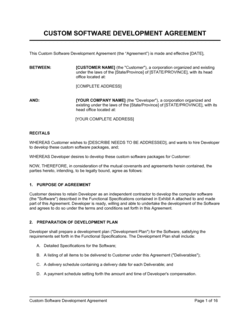
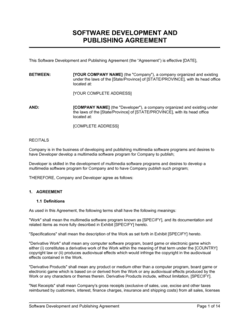
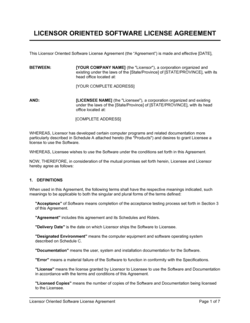
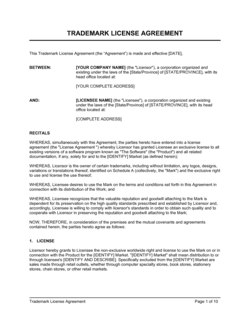
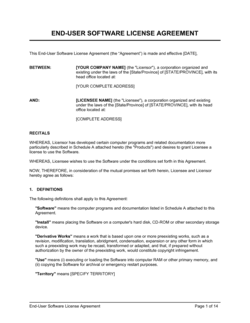
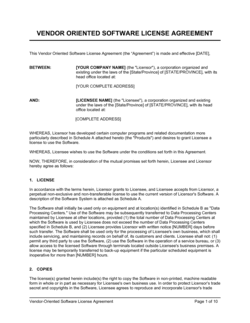
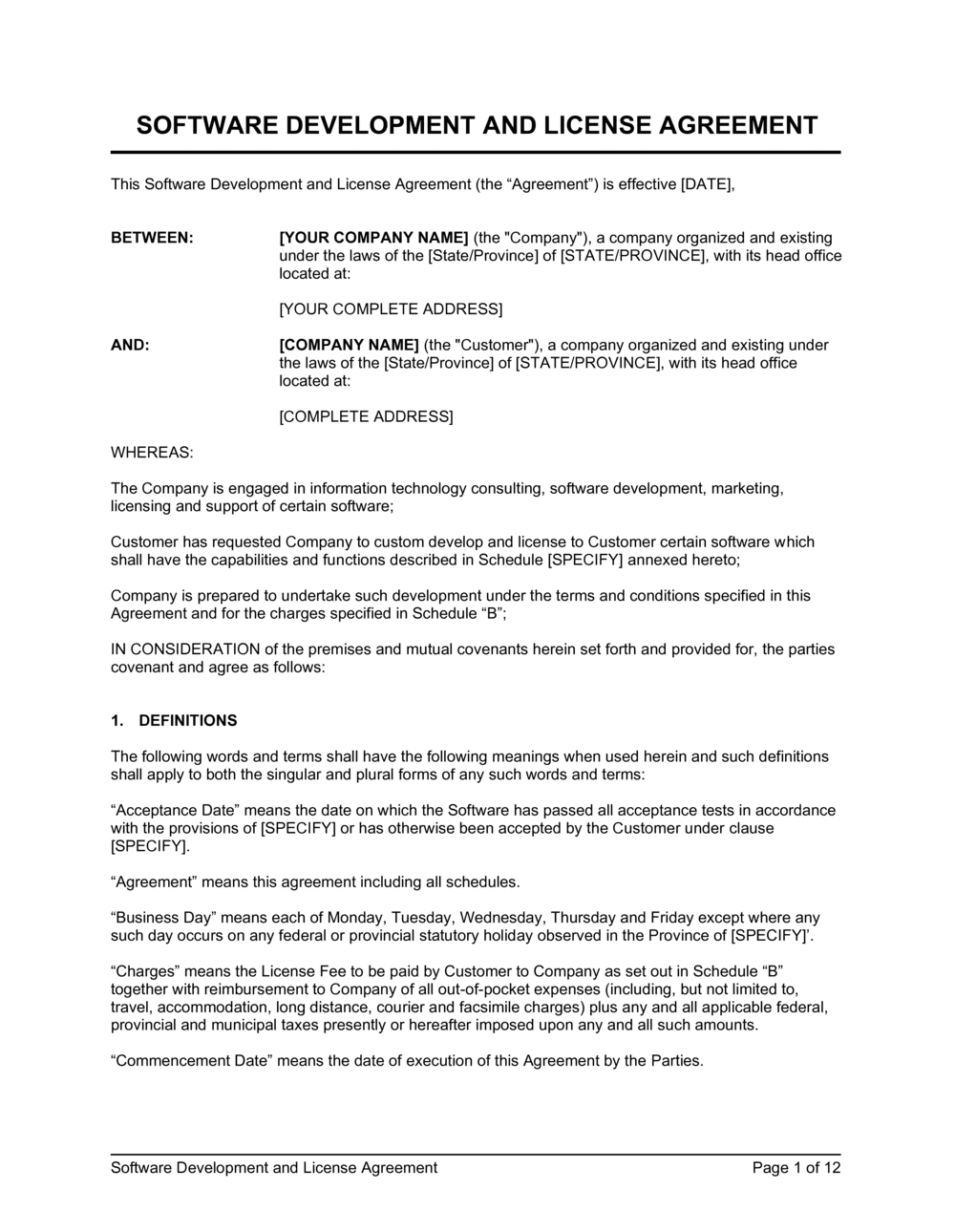
Software Development and License Agreement Template

Free Word download • Edit online • Save & share with Drive • Export to PDF

12 pages30–40 min to fillDifficulty: ComplexSignature requiredLegal review recommended
Learn more ↓
FreeSoftware Development and License Agreement Template

At a glance

What it is
A Software Development and License Agreement is a legally binding contract between a software developer or development firm and a client that governs both the creation of custom software and the terms under which the client may use the resulting product. This free Word download covers deliverables, milestones, IP ownership, license scope, payment, warranties, and termination in a single document you can edit online and export as PDF.
When you need it
Use it whenever a business commissions a developer or development firm to build custom software — a web application, SaaS platform, internal tool, or mobile app — and needs to establish who owns the code, how the client can use it, and what happens if the project goes off track.
What's inside
Project scope and deliverables schedule, payment milestones and rates, IP assignment and license grant, confidentiality, warranties and representations, limitation of liability, termination conditions, and governing law. The agreement combines a development services contract and a software license into a single enforceable document.

What is a Software Development and License Agreement?

A Software Development and License Agreement is a legally binding contract between a developer or development firm and a client that governs both the creation of custom software and the terms under which the finished product may be used. It combines two distinct legal instruments — a development services contract and a software license — into a single enforceable document. The agreement defines deliverables and milestones, sets payment terms, allocates intellectual property ownership, establishes acceptance testing procedures, and specifies the scope of the license the client receives once development is complete. Without it, the default rules of copyright law apply — and in most jurisdictions, that means the developer owns the code, regardless of who paid for it.

Why You Need This Document

The absence of a signed software development and license agreement exposes both parties to risks that are difficult and expensive to unwind after the fact. Clients who pay for custom software without an explicit IP assignment may discover they do not legally own the code they commissioned — a position courts have consistently upheld when no written transfer exists. Developers who begin work without a signed contract have no contractual basis to demand milestone payments, reject out-of-scope requests, or limit their liability if the software causes a downstream business loss. Acceptance criteria left undefined turn into subjective disputes; warranty obligations left unwritten disappear entirely. This template closes all four gaps in one document — protecting the client's IP investment, the developer's payment and liability position, and the project's timeline through defined milestones and a formal acceptance process.

Which variant fits your situation?

If your situation is…Use this template
Licensing existing off-the-shelf software without any custom developmentSoftware License Agreement
Hiring a freelance developer as an independent contractorIndependent Contractor Agreement
Engaging a developer on a fixed-scope, one-time projectSoftware Development Agreement
Sharing proprietary source code under defined access restrictionsSource Code Escrow Agreement
Protecting confidential project information before development beginsNon-Disclosure Agreement
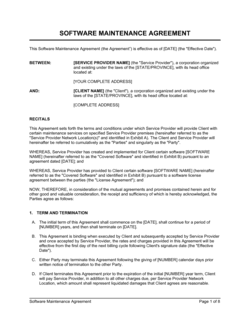
Providing ongoing software support and updates post-launchSoftware Maintenance Agreement
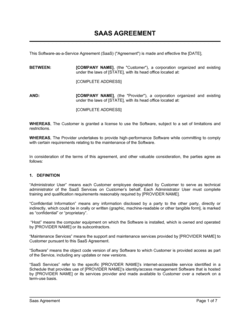
Commissioning a SaaS product to be delivered and hosted by the developerSaaS Agreement

Common mistakes to avoid

❌ Vague scope of work

Why it matters: Undefined scope leads to scope creep, payment disputes, and no contractual basis for either party to object when the project balloons in cost or timeline.

Fix: Attach a technical specification as Exhibit A that describes every feature to the level of user stories or screen-level wireframes, and include a change-order clause for anything outside it.

❌ No IP distinction between Background IP and Developed IP

Why it matters: An unlimited assignment clause can inadvertently transfer pre-existing developer tools, libraries, or frameworks — leaving the developer legally unable to use their own code on other projects.

Fix: List all Background IP the developer retains in a schedule, and grant the client a perpetual irrevocable license to use it as embedded in the delivered software.

❌ No deemed-acceptance provision

Why it matters: Without it, a client can reject deliverables indefinitely without specifying defects, trapping the developer in endless revision cycles with no contractual endpoint and no trigger for milestone payments.

Fix: Include a clause stating that if the client does not provide written rejection with specific defects within the testing window, the deliverable is deemed accepted and payment becomes due.

❌ Omitting a warranty period

Why it matters: Without a warranty period, the developer has no contractual obligation to fix defects that surface after acceptance — even bugs present at delivery that take days to manifest in production.

Fix: Include a 60–180 day post-acceptance warranty for material defects, with a defined remedy process (repair, replace, or refund).

❌ No termination-for-convenience clause

Why it matters: Projects get cancelled for business reasons unrelated to developer performance. Without a convenience exit, a client has no clean way out and may be forced to pay for work on a project it has abandoned.

Fix: Add a termination-for-convenience clause requiring the client to pay for all work completed through the termination date plus a defined kill fee — typically 10–20% of remaining fees.

❌ Signing after development has already begun

Why it matters: Any IP created before the agreement is signed may not be covered by the assignment clause, leaving ownership ambiguous for early code, prototypes, or design work.

Fix: Execute the agreement before any development work starts. If work has already begun, explicitly include a retroactive assignment covering all pre-execution work product in the agreement language.

The 10 key clauses, explained

Parties, recitals, and definitions

In plain language: Identifies the developer and the client as legal entities, explains the background and purpose of the agreement, and defines key terms used throughout the document.

Sample language
This Software Development and License Agreement ('Agreement') is entered into as of [DATE] by and between [DEVELOPER LEGAL NAME], a [STATE] [ENTITY TYPE] ('Developer'), and [CLIENT LEGAL NAME], a [STATE] [ENTITY TYPE] ('Client').

Common mistake: Using trade names instead of registered legal entity names. If the contracting entity differs from the operating brand, IP ownership and enforcement become legally ambiguous.

Scope of work and deliverables

In plain language: Describes exactly what the developer will build, organized into phases or milestones, with acceptance criteria for each deliverable.

Sample language
Developer shall design, develop, and deliver the Software described in Exhibit A ('Scope of Work'). Deliverables and milestone dates are set out in the Project Schedule attached as Exhibit B.

Common mistake: Describing scope in vague business terms rather than technical specifications. 'A mobile app with user login' is not a specification — it is a concept. Ambiguous scope leads to scope creep and payment disputes.

Payment terms and milestone schedule

In plain language: States the total contract value, payment structure — typically milestone-based installments — invoicing process, and late-payment consequences.

Sample language
Client shall pay Developer a total fee of $[AMOUNT], payable in installments as follows: [X]% upon execution ($[AMOUNT]); [X]% upon delivery of Milestone 1 ($[AMOUNT]); [X]% upon final acceptance ($[AMOUNT]). Invoices are due within [30] days.

Common mistake: Back-loading payments so the developer receives the majority only at final acceptance. This creates a cash-flow crisis for developers on long engagements and incentivizes clients to delay acceptance indefinitely.

Intellectual property ownership and assignment

In plain language: Determines who owns the finished software, source code, and related IP — the client, the developer, or both — and assigns rights accordingly.

Sample language
Upon receipt of full payment, Developer hereby irrevocably assigns to Client all right, title, and interest in and to the Developed Software, including all copyrights, patents, trade secrets, and other IP rights therein.

Common mistake: No clear distinction between Background IP and Developed IP. If the developer uses pre-existing libraries or frameworks in the build, an unlimited assignment clause could inadvertently transfer IP the developer needs for other clients.

License grant (for retained developer IP)

In plain language: Where the developer retains ownership of Background IP or frameworks embedded in the software, this clause grants the client a license to use them as part of the delivered product.

Sample language
To the extent the Software incorporates Developer's Background IP, Developer hereby grants Client a non-exclusive, irrevocable, royalty-free, perpetual license to use, modify, and distribute such Background IP solely as embedded in the Developed Software.

Common mistake: Omitting a license for Background IP entirely. Without it, a client who receives an IP assignment for the new code may still be unable to legally use the software because it depends on unlicensed third-party or developer-owned components.

Acceptance testing and change orders

In plain language: Establishes a defined testing window for the client to verify each deliverable against the agreed specifications, and sets out the process for requesting and pricing scope changes.

Sample language
Client shall have [14] business days following delivery of each Deliverable to accept or reject it in writing. Rejection must specify defects with reference to the Specifications. Any changes to Scope shall be documented in a Change Order signed by both parties.

Common mistake: No deemed-acceptance clause. If the client can reject indefinitely without specifying defects, the developer is exposed to unending revision cycles with no contractual endpoint.

Confidentiality

In plain language: Prohibits both parties from disclosing the other's confidential information — source code, business data, technical architecture, and client data — during and after the engagement.

Sample language
Each party agrees to hold in strict confidence all Confidential Information of the other party and not to disclose it to any third party or use it for any purpose other than performing this Agreement, for a period of [5] years following termination.

Common mistake: One-sided confidentiality that only protects the client. Developers share proprietary development methodologies and tooling with clients during engagements — mutual confidentiality is appropriate for both parties.

Warranties and representations

In plain language: The developer warrants that the software will conform to specifications for a defined period, is free from material defects, and does not infringe third-party IP.

Sample language
Developer warrants that for a period of [90] days following final acceptance ('Warranty Period'), the Software will perform materially in accordance with the Specifications. Developer further represents that the Software does not infringe any third-party intellectual property rights.

Common mistake: A warranty period of zero days — or none stated. Without a warranty period, clients have no contractual basis to require bug fixes after acceptance, even for defects that surface within days of launch.

Limitation of liability and indemnification

In plain language: Caps each party's maximum financial exposure under the contract and specifies which party indemnifies the other for defined categories of loss — typically IP infringement and data breaches.

Sample language
In no event shall either party's aggregate liability exceed the total fees paid by Client in the [12] months preceding the claim. Developer shall indemnify Client against any third-party claim alleging that the Software infringes a valid patent, copyright, or trade secret.

Common mistake: No cap on liability at all. Without a mutual cap, a contractor on a $50,000 project faces theoretically unlimited exposure for consequential losses if the software fails in production.

Termination, transition, and governing law

In plain language: States the conditions under which either party may terminate — for cause, for convenience, or on insolvency — and sets out what deliverables, source code, and payments are exchanged on exit.

Sample language
Either party may terminate this Agreement for cause upon [30] days' written notice if the other party materially breaches and fails to cure within that period. Upon termination, Developer shall deliver all completed work product to Client, and Client shall pay for work completed through the termination date. This Agreement is governed by the laws of [STATE / PROVINCE / COUNTRY].

Common mistake: No termination-for-convenience clause for the client. Projects get cancelled. Without a convenience termination right, a client locked into a failing engagement has no clean exit short of claiming breach — which is expensive and uncertain.

How to fill it out

  1. 1

    Enter the legal entity names and effective date

    Use the full registered legal name of the development firm or freelancer and the client company — not brand names or DBA names. Enter the date both parties will sign.

    💡 Cross-reference the developer's corporate registry or W-9 to confirm the exact entity name before execution — mismatches complicate IP enforcement.

  2. 2

    Attach a detailed scope of work as Exhibit A

    Write technical specifications for each feature and module — not business goals. Include wireframes, API requirements, tech stack, and any integrations. Reference this exhibit in the main agreement body.

    💡 The more specific Exhibit A is, the harder it is for either party to argue about what was or wasn't included. Screen-level user stories are better than paragraph descriptions.

  3. 3

    Set the milestone schedule and payment installments

    Divide the project into 3–5 phases with defined deliverables and dates. Tie each payment installment to a milestone completion, not a calendar date. Enter amounts and due dates in the payment schedule.

    💡 Structure payments so the developer receives roughly equal installments across phases — 30/30/40 is common — to keep incentives aligned throughout the project.

  4. 4

    Decide IP ownership and draft the assignment clause

    Determine whether the client will own the finished code outright (full assignment) or receive a license while the developer retains ownership. Enter the chosen structure and, if applicable, list all Background IP the developer is retaining.

    💡 If the developer uses open-source libraries, list them in an exhibit and confirm the licenses are compatible with the client's intended use — GPL code cannot be incorporated into proprietary commercial software without restrictions.

  5. 5

    Define the license grant for retained developer IP

    If the developer retains any Background IP embedded in the software, complete the license grant clause with scope (exclusive or non-exclusive), territory, duration, and permitted uses.

    💡 Negotiate for a perpetual, irrevocable license to Background IP — a revocable license means the developer could shut down the client's software by withdrawing consent.

  6. 6

    Set the acceptance testing window and change-order process

    Enter the number of business days the client has to test each deliverable (10–15 days is typical), the format for raising defects, and the process for requesting out-of-scope changes with pricing.

    💡 Include a deemed-acceptance provision: if the client does not respond within the testing window with specific written defects, the deliverable is deemed accepted and the milestone payment becomes due.

  7. 7

    Complete the warranty period and liability cap

    Enter a post-acceptance warranty period (60–180 days is standard), specify what the warranty covers (material defects, spec conformance), and set the liability cap — typically total fees paid in the prior 12 months.

    💡 Carve out IP indemnification from the general liability cap — an uncapped IP indemnity protects the client from the most financially catastrophic risk at no material added cost to the developer.

  8. 8

    Specify governing law and sign before work begins

    Choose the governing jurisdiction — typically where the client or developer is headquartered — and confirm dispute resolution method (arbitration or litigation). Both parties must sign before any development work starts.

    💡 Use Business in a Box eSign to timestamp execution and create an audit trail. A signed agreement before day one prevents disputes about which version of the scope was agreed.

Frequently asked questions

What is a software development and license agreement?

A software development and license agreement is a contract that combines two distinct legal relationships into one document: it governs the creation of custom software (development services) and the terms under which the client may use the finished product (license). It covers deliverables, payment, IP ownership, acceptance testing, warranties, confidentiality, and termination — making it the primary legal framework for any custom software engagement.

Who owns the software after a development project is completed?

Ownership depends entirely on what the contract says. If the agreement includes a full IP assignment, the client owns the finished code upon payment. If the developer retains ownership, the client receives only a license to use the software. Without a written agreement, default copyright rules in most jurisdictions assign ownership to the creator — meaning the developer owns the code even if the client paid for it. This makes a written IP clause non-negotiable.

What is the difference between a software development agreement and a software license agreement?

A software development agreement covers the services side — what the developer will build, on what timeline, and for what payment. A software license agreement covers the usage side — what rights the client has to use the finished product. A software development and license agreement combines both into a single contract, which is appropriate when the same developer is both building and licensing the software to the client.

What should a software development and license agreement include?

At minimum: legal entity names, a detailed scope of work by reference to a technical specification exhibit, milestone payment schedule, IP ownership and assignment or license grant, acceptance testing procedures, confidentiality, post-acceptance warranty period, limitation of liability, and termination conditions including what happens to source code and payment on exit. Missing any of these creates gaps that are expensive to litigate.

What is Background IP and why does it matter?

Background IP is intellectual property — code libraries, frameworks, methodologies, or tools — that a developer owned before the engagement began. It matters because a full IP assignment clause would technically transfer ownership of Background IP to the client along with the new code, which could prevent the developer from using their own tools on other projects. The agreement should explicitly carve out Background IP from the assignment and grant the client a license to use it as embedded in the delivered software.

What is a deemed-acceptance clause and why is it important?

A deemed-acceptance clause states that if the client does not formally reject a deliverable with written, specific defects within the acceptance testing window, the deliverable is automatically accepted and the corresponding milestone payment becomes due. Without this clause, clients can delay acceptance indefinitely — blocking milestone payments and exposing developers to open-ended revision obligations with no contractual endpoint.

Does a software development contract need to be reviewed by a lawyer?

For straightforward domestic engagements below $25,000, a well-drafted template with a detailed scope exhibit is often sufficient. Legal review is advisable when the engagement exceeds $50,000, involves proprietary algorithms or sensitive data, spans multiple jurisdictions, or requires custom IP structures such as co-ownership or field-of-use restrictions. A 1–2 hour attorney review typically costs $300–$700 and is worthwhile for any engagement where IP ownership is commercially critical.

What happens if the developer misses a milestone deadline?

The agreement should specify consequences for missed milestones — typically a defined cure period (10–15 business days) followed by the client's right to terminate for cause and recover payments made for undelivered work. Without explicit consequences, the client's only remedy is a general breach-of-contract claim, which requires proving damages and is costly to pursue. Include a cure period, a termination right, and a payment-recovery mechanism for incomplete milestones.

Can a software license in this agreement be exclusive?

Yes, and exclusivity has significant commercial implications. An exclusive license prevents the developer from licensing the same software to any other client — which typically commands a premium price and may require ongoing royalties. A non-exclusive license allows the developer to sell or license the software to others. Most custom development agreements grant an exclusive license or full assignment since the client is paying for a bespoke product, not a shared platform.

How this compares to alternatives

vs Software License Agreement

A standalone software license agreement covers only the right to use existing software — it assumes the product already exists and does not govern development services, milestones, or deliverable acceptance. A software development and license agreement is needed when the software is being built to order and the same contract must govern both the creation and the usage rights.

vs Independent Contractor Agreement

An independent contractor agreement governs the service relationship between a client and a self-employed individual — payment, deliverables, and worker classification — but does not address IP ownership, software licensing, acceptance testing, or warranty terms in the depth required for a software project. Use a dedicated software development agreement to properly address the IP and product-quality dimensions of a development engagement.

vs Software Maintenance Agreement

A software maintenance agreement governs ongoing support, bug fixes, and updates after the software has been delivered and accepted. A software development and license agreement covers the creation phase. Both documents are typically needed — the development agreement to build and deliver, the maintenance agreement to support the product post-launch.

vs SaaS Agreement

A SaaS agreement governs a client's subscription access to software hosted and operated by the vendor — the client never receives source code or owns the product. A software development and license agreement is appropriate when the client is commissioning a custom-built product and expects to own or control the code. If the developer will retain ownership and host the product as a service, a SaaS agreement is the correct vehicle.

Industry-specific considerations

SaaS / Technology

API integration requirements, multi-tenant architecture specifications, SLA uptime commitments, and cloud infrastructure cost allocation must all be addressed in the scope exhibit.

Financial Services

Regulatory compliance obligations (PCI-DSS, SOC 2, GLBA) must be written into the developer's warranties, and data handling requirements need dedicated security and audit clauses.

Healthcare / MedTech

HIPAA Business Associate Agreement obligations must be incorporated by reference, and the scope must specify whether the software qualifies as a medical device requiring FDA clearance.

E-commerce / Retail

Payment gateway integrations, PCI compliance scope, third-party platform API dependencies, and uptime requirements during peak sales periods require explicit coverage in the deliverables schedule.

Manufacturing / Industrial

Embedded software and firmware agreements require additional clauses covering hardware compatibility, version control for field-deployed units, and liability for physical damage caused by software defects.

Professional Services

Client data confidentiality, role-based access controls, and integration with existing practice management or billing systems are typically central to the scope and acceptance criteria.

Jurisdictional notes

United States

Copyright vests automatically in the creator under US law — without a written assignment, the developer owns the code even if the client paid for it. Work-for-hire doctrine applies only in narrow circumstances for independent contractors, making an explicit assignment clause essential. Non-compete restrictions on developers vary sharply by state; California effectively bans them. CCPA and state-specific data privacy laws may impose additional obligations when the software processes consumer data.

Canada

Copyright in software vests in the author under the Copyright Act unless assigned in writing. Moral rights — the creator's right to attribution and integrity — cannot be assigned but can be waived, and a waiver should be included in any full IP assignment. PIPEDA and provincial privacy laws (particularly Quebec's Law 25) impose obligations on software that processes personal information. Quebec contracts must be in French for provincially regulated entities.

United Kingdom

Under UK copyright law, the employer owns IP created by employees, but independent contractors own the IP they create unless a written assignment exists. Post-Brexit, UK GDPR applies separately from EU GDPR, requiring its own compliance analysis for software handling personal data. Assignment of future copyright is permitted under UK law, making pre-execution assignments enforceable for code written after signing.

European Union

EU GDPR imposes strict data protection requirements on software that processes personal data, and a Data Processing Agreement must accompany or be incorporated into any development contract involving such data. The EU Software Directive provides specific copyright protections for computer programs, including reverse-engineering rights that cannot be contracted away in consumer-facing software. Member states vary on enforceability of non-compete and non-solicitation clauses; France and Germany require financial compensation for post-employment restrictions on developers.

Template vs lawyer — what fits your deal?

PathBest forCostTime
Use the templateFreelancers and small agencies on domestic projects under $25,000 with straightforward IP ownershipFree30–60 minutes
Template + legal reviewProjects between $25,000 and $150,000, cross-border engagements, or deals involving sensitive client data$300–$7001–3 days
Custom draftedEnterprise custom software over $150,000, co-ownership structures, regulated industries, or multi-jurisdiction licensing$1,500–$6,000+1–3 weeks

Glossary

Deliverable
A specific, defined output the developer must produce — such as a feature, module, or version of the software — by an agreed date.
IP Assignment
A clause transferring ownership of all code, designs, and work product created during development from the developer to the client.
License Grant
The set of rights the licensor grants the licensee to use the software — specifying scope, exclusivity, territory, and duration.
Acceptance Testing
A formal process by which the client verifies that delivered software meets the agreed functional specifications before final payment is released.
Source Code
The human-readable programming instructions that make up the software, distinct from the compiled executable that end users run.
Escrow
An arrangement where source code is held by a neutral third party and released to the client only if the developer fails to maintain the software or goes out of business.
Milestone Payment
A payment installment tied to the completion and acceptance of a specific project phase rather than a calendar date.
Warranty
A contractual promise by the developer that the software will perform as specified for a defined period after delivery.
Limitation of Liability
A clause capping the maximum financial exposure either party faces under the contract — typically expressed as a multiple of fees paid.
Background IP
Intellectual property a party owned before the engagement began, which remains that party's property regardless of what the contract assigns.
Change Order
A written amendment to the original scope of work that documents additional features, revised timelines, or adjusted pricing.
Perpetual License
A license that grants the right to use the software indefinitely, as opposed to a subscription or time-limited license.

Part of your Business Operating System

This document is one of 3,000+ business & legal templates included in Business in a Box.

  • Fill-in-the-blanks — ready in minutes
  • 100% customizable Word document
  • Compatible with all office suites
  • Export to PDF and share electronically

Create your document in 3 simple steps.

From template to signed document — all inside one Business Operating System.
1
Download or open template

Access over 3,000+ business and legal templates for any business task, project or initiative.

2
Edit and fill in the blanks with AI

Customize your ready-made business document template and save it in the cloud.

3
Save, Share, Send, Sign

Share your files and folders with your team. Create a space of seamless collaboration.

Save time, save money, and create top-quality documents.

★★★★★

"Fantastic value! I'm not sure how I'd do without it. It's worth its weight in gold and paid back for itself many times."

Managing Director · Mall Farm
Robert Whalley
Managing Director, Mall Farm Proprietary Limited
★★★★★

"I have been using Business in a Box for years. It has been the most useful source of templates I have encountered. I recommend it to anyone."

Business Owner · 4+ years
Dr Michael John Freestone
Business Owner
★★★★★

"It has been a life saver so many times I have lost count. Business in a Box has saved me so much time and as you know, time is money."

Owner · Upstate Web
David G. Moore Jr.
Owner, Upstate Web

Run your business with a system — not scattered tools

Stop downloading documents. Start operating with clarity. Business in a Box gives you the Business Operating System used by over 250,000 companies worldwide to structure, run, and grow their business.

Start free · No credit card required