Checklist Software Development Contract

Free download β€’ Use as a template β€’ Print or share

3 pagesβ€’20–25 min to useβ€’Difficulty: Standard
Learn more ↓
FreeChecklist Software Development Contract Template

At a glance

What it is
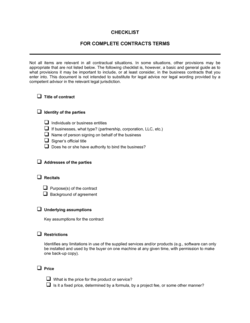
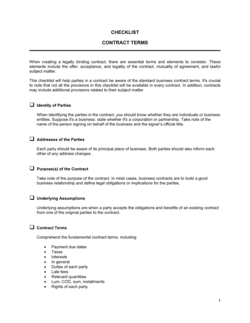
A Checklist Software Development Contract is a structured verification form used to confirm that every critical element of a software development agreement is present, accurate, and complete before signing. This free Word download gives project managers, procurement teams, and business owners a repeatable review tool they can complete in minutes and export as PDF.
When you need it
Use it any time you are about to sign β€” or issue β€” a software development contract, whether you are hiring a freelance developer, an agency, or an offshore development firm. It is equally useful when reviewing a contract sent to you by a vendor before you commit.
What's inside
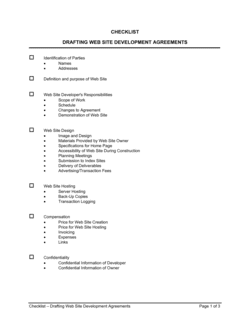
Sections covering scope and deliverables, IP ownership, payment milestones, acceptance criteria, confidentiality, change-order procedures, warranty terms, and termination rights β€” each as a checkable item with space for notes on gaps or required revisions.

What is a Checklist Software Development Contract?

A Checklist Software Development Contract is a structured verification form used to confirm that every critical clause of a software development agreement is present, accurate, and enforceable before either party signs. It walks through the contract section by section β€” scope and deliverables, IP assignment, payment milestones, acceptance criteria, confidentiality, change-order procedures, warranty, and termination rights β€” giving reviewers a consistent, repeatable process rather than relying on memory or ad hoc reading. It is a due-diligence tool, not a contract itself, and is used alongside the underlying software development agreement.

Why You Need This Document

Signing a software development contract with missing or vague clauses is one of the most common and costly mistakes in technology procurement. A scope of work without itemized deliverables turns every feature request into a negotiation. A payment schedule tied to delivery dates rather than accepted milestones means paying for work you have not approved. An IP assignment clause with a broad developer license-back can leave the core of your product partially owned by a vendor you no longer work with. This checklist surfaces each of those gaps in 20 to 40 minutes, before the contract is executed and before any money changes hands. For project managers, procurement teams, and founders without in-house legal counsel, it provides a structured safety net that replaces guesswork with a documented, auditable review process.

Which variant fits your situation?

If your situation is…Use this template
Reviewing a contract for a fixed-price, fully scoped projectChecklist Software Development Contract (Fixed Price)
Reviewing a time-and-materials or hourly engagementChecklist Software Development Contract (T&M)
Drafting the underlying agreement from scratchSoftware Development Agreement
Engaging an independent developer rather than an agencyIndependent Contractor Agreement
Adding a confidentiality layer to an existing development contractNon-Disclosure Agreement (NDA)
Reviewing a SaaS or software licensing deal rather than a custom buildSoftware License Agreement
Managing ongoing maintenance and support after deliverySoftware Maintenance Agreement

Common mistakes to avoid

❌ Reviewing only the main agreement body, not the schedules

Why it matters: Scope, acceptance criteria, and payment schedules are typically in attached exhibits. Approving the main contract without reviewing every schedule leaves the most operationally critical terms unchecked.

Fix: Begin every review by listing all referenced exhibits and confirming each one is attached before marking any checklist item complete.
❌ Treating 'delivery' and 'acceptance' as the same event

Why it matters: A developer who submits code has 'delivered' β€” but if acceptance criteria are not met, you are not obligated to pay. Conflating the two eliminates your leverage to withhold payment for defective work.

Fix: Confirm the checklist item for acceptance criteria is satisfied with specific, measurable conditions, and that payment is triggered by written acceptance, not submission.

❌ Skipping the change-order review item

Why it matters: Software projects almost always evolve. Without a documented change-order process, out-of-scope work proceeds on verbal agreement β€” and cost disputes follow.

Fix: Confirm the contract requires a written, signed change order before any out-of-scope work begins, with pricing and timeline impact stated explicitly.

❌ Assuming the developer's standard IP clause is sufficient

Why it matters: Many developer-issued contracts include a broad license-back provision or retain ownership of reusable components β€” potentially including core features of your product.

Fix: Use the IP checklist item to verify the assignment is unconditional and covers all work product, including third-party components licensed for your project specifically.

The 10 key fields, explained

Scope and deliverables confirmation

Project timeline and milestones

Payment schedule and terms

IP ownership and assignment

Confidentiality and NDA terms

Change-order process

Acceptance testing and approval process

Warranty and defect correction

Termination rights and consequences

Governing law and dispute resolution

How to fill it out

  1. 1

    Gather the contract and all attached schedules

    Collect the full contract package β€” main agreement, scope-of-work schedule, payment schedule, and any exhibits β€” before starting the checklist. Reviewing the main body without attachments leads to incomplete checks.

    πŸ’‘ Confirm the version you are reviewing matches the version the other party will sign β€” version-control mismatches are a common source of post-signing disputes.

  2. 2

    Work through each checklist section in order

    Check each item against the actual contract language. Where an item is present, mark it confirmed. Where it is missing or unclear, note the specific clause number and the gap.

    πŸ’‘ Use the notes column to record the exact page and clause reference for each confirmed item β€” this speeds up revision requests.

  3. 3

    Flag missing or vague items for revision

    Any unchecked item represents a gap that should be addressed before signing. List each gap as a specific revision request with proposed language rather than a general complaint.

    πŸ’‘ Prioritize IP assignment, acceptance criteria, and termination rights β€” these are the three most frequently litigated clauses in software contracts.

  4. 4

    Verify payment triggers align with acceptance, not delivery

    Confirm that each payment milestone is triggered by written acceptance of the deliverable, not by the date the developer submits it. Review the acceptance period length and deemed-acceptance language.

    πŸ’‘ A 5-business-day acceptance window is standard for most deliverables. Request an extension for complex integrations or compliance-sensitive features.

  5. 5

    Confirm IP assignment is unconditional on final payment

    Read the IP assignment clause to confirm ownership transfers fully and unconditionally upon final payment, with no retained developer license to client-specific code.

    πŸ’‘ Search the contract for the word 'license' β€” any license granted back to the developer should be narrow, non-exclusive, and limited to generic tools and frameworks, not client-specific logic.

  6. 6

    Document and share the completed checklist with stakeholders

    Once complete, export the checklist as PDF and share it with legal, finance, and the project sponsor. Include a summary of any open items and the proposed resolution for each.

    πŸ’‘ Archive the completed checklist alongside the fully executed contract β€” it documents your pre-signing due diligence if a dispute arises later.

Frequently asked questions

What is a checklist software development contract?

A checklist software development contract is a structured review form used to verify that a software development agreement contains all essential clauses before signing. It covers scope, deliverables, IP assignment, payment milestones, acceptance criteria, confidentiality, change-order procedures, warranty, and termination rights. It is not a contract itself β€” it is a due-diligence tool used alongside the actual agreement.

Who should use this checklist?

Anyone about to sign a software development contract should use it β€” clients hiring developers or agencies, procurement teams standardizing vendor review, and developers who want to self-audit their own contract templates before sending them to clients. It is particularly useful for small businesses and startups that do not have in-house legal counsel reviewing every agreement.

Does this checklist replace a software development contract?

No. The checklist is a review tool, not a binding agreement. You still need a signed software development contract that contains all the clauses the checklist verifies. Business in a Box also provides a Software Development Agreement template that you can use as the underlying contract alongside this checklist.

What is the most important item to verify on a software development contract?

IP assignment is consistently the highest-stakes item. Without a clear, unconditional assignment of all work product to the client upon payment, the developer may retain rights to code that forms the core of your product. Check that the assignment covers all deliverables, is effective upon final payment, and contains no broad license-back to the developer for client-specific functionality.

How long does it take to complete the checklist?

For a standard fixed-price software development contract of 10–20 pages, the checklist typically takes 20 to 40 minutes to complete. Larger or more complex contracts β€” with multiple schedules, SLAs, and multi-jurisdiction terms β€” may take 60 to 90 minutes. The time investment pays for itself by catching gaps before they become contract disputes.

What should I do if a checklist item is missing from the contract?

Document the gap with the specific clause reference (or absence thereof) and submit a written revision request to the other party with proposed language. Do not sign the contract with known gaps on the assumption they can be addressed later β€” post-signing amendments require mutual agreement and often face resistance once a party has already committed.

Is this checklist suitable for reviewing offshore development contracts?

Yes, with one additional step: verify the governing law and dispute resolution clause carefully for offshore arrangements. Some jurisdictions make IP assignment, confidentiality enforcement, and contract claims materially harder to pursue. For high-value offshore engagements, consider a lawyer review of the governing-law and arbitration clauses specifically.

Does the checklist cover SaaS or software licensing agreements?

This checklist is designed for custom software development engagements β€” fixed-price or time-and-materials builds. SaaS and software licensing agreements have different key terms (subscription rights, usage limits, data processing obligations, and SLA uptime commitments) that this checklist does not fully cover. A separate software license agreement checklist is better suited to those contract types.

How this compares to alternatives

vs Software Development Agreement

A software development agreement is the binding contract itself β€” it creates the legal obligations. This checklist is the review tool you use before signing that agreement to confirm every required clause is present and complete. Use both together: the checklist to audit, the agreement to execute.

vs Independent Contractor Agreement

An independent contractor agreement governs a broad freelance engagement and covers classification, tax, and general work terms. A software development contract is tailored specifically to code deliverables, acceptance criteria, IP assignment, and technical milestones. For software projects, the development-specific contract is more appropriate; the checklist applies to both.

vs Non-Disclosure Agreement (NDA)

An NDA covers confidentiality only. A software development contract includes confidentiality alongside scope, IP, payment, and termination β€” making a standalone NDA redundant once a full development contract is in place. The checklist verifies that the confidentiality clause within the development contract is sufficient so a separate NDA is not necessary.

vs Project Proposal

A project proposal outlines the scope, approach, and pricing at the pre-contract stage β€” it is not binding. The checklist is used after the proposal is accepted and a formal contract is being drafted or reviewed. The proposal informs what the contract should contain; the checklist verifies the contract actually contains it.

Industry-specific considerations

Technology / SaaS

Validates IP assignment for platform features, source code escrow for critical infrastructure, and SLA terms for hosted environments.

Financial Services

Emphasizes data security obligations, regulatory compliance warranties, and audit-right clauses required by financial regulators.

Healthcare / MedTech

Confirms HIPAA data-handling obligations, FDA-related compliance warranties for medical software, and post-delivery validation requirements.

Retail / E-commerce

Covers payment gateway integration acceptance criteria, PCI-DSS compliance obligations, and launch-readiness milestones tied to seasonal deadlines.

Template vs pro β€” what fits your needs?

PathBest forCostTime
Use the templateSmall businesses, startups, and project managers reviewing standard software development contracts under $50KFree20–40 minutes
Template + professional reviewContracts over $50K, offshore development, or projects involving sensitive IP or regulated data$200–$500 for a one-hour lawyer review focused on IP and termination clauses1–2 days
Custom draftedEnterprise software builds, multi-vendor arrangements, or contracts requiring custom SLA and escrow terms$1,000–$3,000+ for a technology lawyer to draft or fully review the underlying contract1–2 weeks

Glossary

Scope of Work
A written description of every feature, function, and deliverable the developer is contracted to produce.
Deliverable
A specific, tangible output β€” code, documentation, or deployment β€” that the developer must hand over by a defined date.
Acceptance Criteria
The measurable conditions a deliverable must satisfy before the client is obligated to approve it and release payment.
IP Assignment
A clause that transfers ownership of the developed software, code, and related work product from the developer to the client upon payment.
Change Order
A formal written amendment to the contract authorizing additional work outside the original scope, with agreed cost and timeline impact.
Milestone Payment
A scheduled payment tied to the completion and acceptance of a defined project phase rather than a fixed calendar date.
Warranty Period
A defined post-delivery window β€” typically 30 to 90 days β€” during which the developer must fix defects at no additional charge.
Source Code Escrow
An arrangement where source code is held by a neutral third party and released to the client if the developer fails to maintain the software or goes out of business.
SLA (Service Level Agreement)
A contractual commitment specifying uptime, response times, and remedies for performance failures β€” relevant for software with ongoing hosting or support obligations.
Liquidated Damages
A pre-agreed penalty amount payable if a specific contract breach occurs β€” such as missing a delivery deadline β€” rather than leaving damages to be calculated after the fact.

Part of your Business Operating System

This document is one of 3,000+ business & legal templates included in Business in a Box.

  • Fill-in-the-blanks β€” ready in minutes
  • 100% customizable Word document
  • Compatible with all office suites
  • Export to PDF and share electronically

Create your document in 3 simple steps.

From template to signed document β€” all inside one Business Operating System.
1
Download or open template

Access over 3,000+ business and legal templates for any business task, project or initiative.

2
Edit and fill in the blanks with AI

Customize your ready-made business document template and save it in the cloud.

3
Save, Share, Send, Sign

Share your files and folders with your team. Create a space of seamless collaboration.

Save time, save money, and create top-quality documents.

β˜…β˜…β˜…β˜…β˜…

"Fantastic value! I'm not sure how I'd do without it. It's worth its weight in gold and paid back for itself many times."

Managing Director Β· Mall Farm
Robert Whalley
Managing Director, Mall Farm Proprietary Limited
β˜…β˜…β˜…β˜…β˜…

"I have been using Business in a Box for years. It has been the most useful source of templates I have encountered. I recommend it to anyone."

Business Owner Β· 4+ years
Dr Michael John Freestone
Business Owner
β˜…β˜…β˜…β˜…β˜…

"It has been a life saver so many times I have lost count. Business in a Box has saved me so much time and as you know, time is money."

Owner Β· Upstate Web
David G. Moore Jr.
Owner, Upstate Web

Run your business with a system β€” not scattered tools

Stop downloading documents. Start operating with clarity. Business in a Box gives you the Business Operating System used by over 250,000 companies worldwide to structure, run, and grow their business.

Start freeΒ Β·Β No credit card required