Social Responsibility Policy Template

Free Word download β€’ Edit online β€’ Save & share with Drive β€’ Export to PDF

3 pagesβ€’20–25 min to fillβ€’Difficulty: Standard
Learn more ↓
FreeSocial Responsibility Policy Template

At a glance

What it is
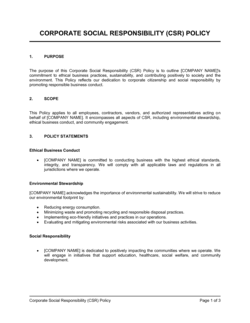
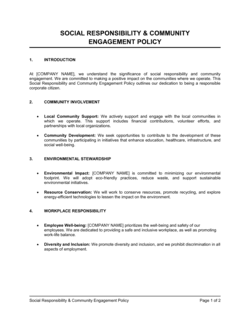
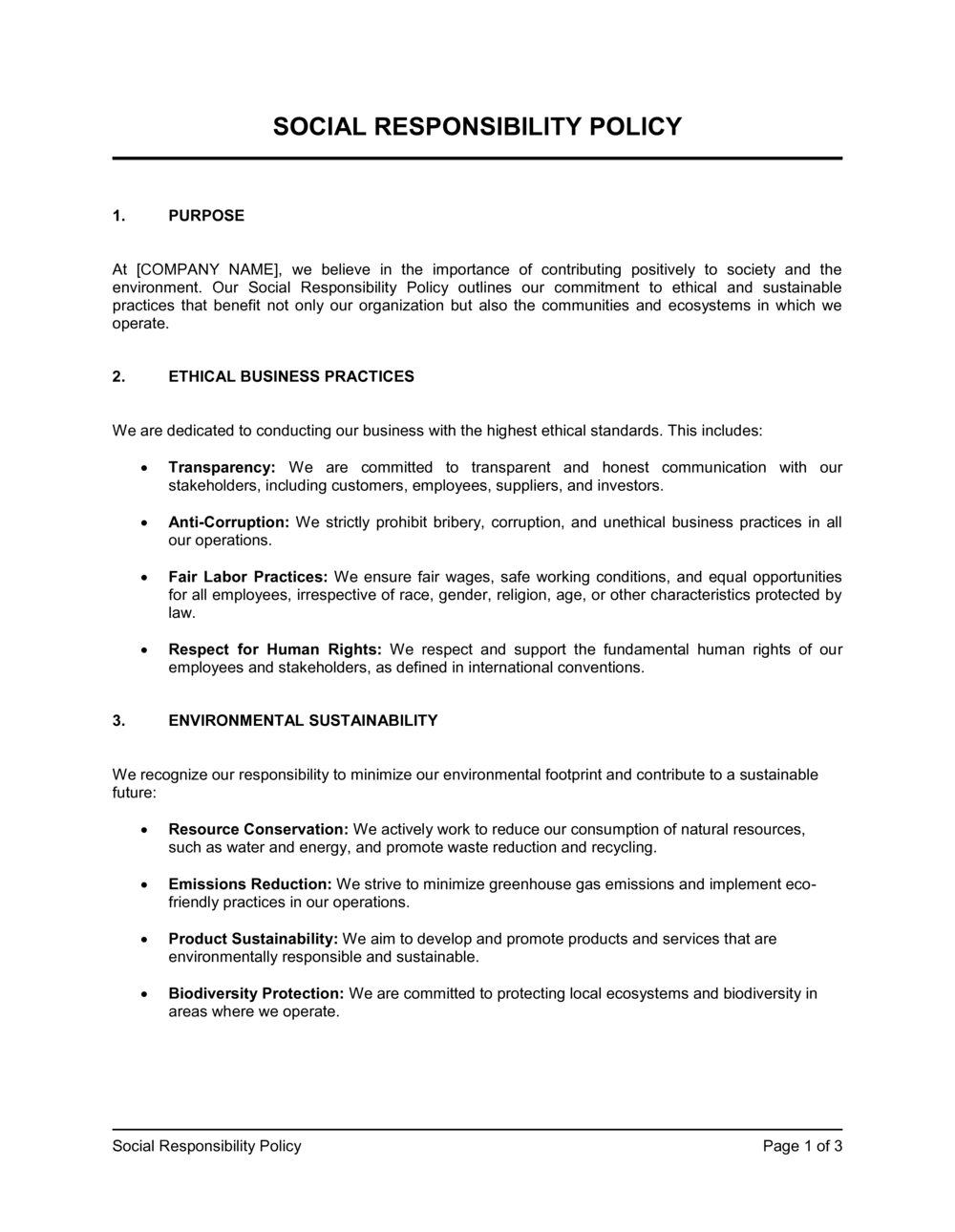
A Social Responsibility Policy is a formal operational document that defines a company's commitments to environmental stewardship, ethical business conduct, community investment, and employee well-being. This free Word download gives you a structured, ready-to-customize template you can edit online and export as PDF to share with employees, suppliers, investors, and customers.
When you need it
Use it when formalizing CSR commitments for an ESG report, responding to supplier or investor questionnaires, onboarding new staff to company values, or establishing a baseline policy before a stakeholder audit or certification process.
What's inside
A purpose statement, scope, environmental commitments, community and charitable engagement guidelines, ethical sourcing and supply chain standards, employee welfare commitments, governance and accountability structure, and a review and reporting schedule.

What is a Social Responsibility Policy?

A Social Responsibility Policy is a formal operational document that defines a company's commitments to conducting business in a way that is ethical, environmentally responsible, and beneficial to the communities and stakeholders it affects. It establishes measurable targets across four core dimensions β€” environmental stewardship, community investment, supply chain ethics, and employee welfare β€” and assigns clear accountability for achieving them. Unlike a mission statement or a values page on a website, a CSR policy is a structured governance document with specific commitments, named owners, and a review schedule that keeps the organisation accountable year over year.

Why You Need This Document

Without a written social responsibility policy, your CSR commitments exist only as informal intentions β€” unverifiable by customers, investors, or regulators, and unenforceable internally. Enterprise procurement teams increasingly require a documented CSR policy as a condition of supplier approval, and impact investors routinely request one during due diligence. Internally, the absence of a governing document means environmental and social targets shift with leadership priorities rather than anchoring to a consistent standard. A well-structured policy closes these gaps: it gives employees a clear framework for decision-making, gives suppliers a defined conduct baseline, and gives external stakeholders evidence that your commitments are substantive rather than decorative. This template lets you move from intention to documentation in hours, not weeks.

Which variant fits your situation?

If your situation is…Use this template
Reporting on ESG performance to investors or a boardESG Report
Outlining environmental commitments specificallyEnvironmental Policy
Setting standards for supplier conduct and ethical sourcingSupplier Code of Conduct
Defining expected employee behaviour and ethicsCode of Ethics
Documenting charitable giving and employee volunteering programsCorporate Giving Policy
Communicating sustainability goals in a marketing or investor contextSustainability Plan
Demonstrating CSR practices to meet enterprise procurement requirementsCorporate Social Responsibility Report

Common mistakes to avoid

❌ Vague commitments with no measurable targets

Why it matters: A policy that says 'we aim to reduce our environmental impact' cannot be tracked, reported on, or audited. Stakeholders β€” including investors and enterprise procurement teams β€” will dismiss it as greenwashing.

Fix: Attach a specific number, baseline year, and target year to every environmental and social commitment in the policy.

❌ Scoping out contractors and suppliers

Why it matters: For most businesses, the largest social and environmental risks sit in the supply chain, not in direct operations. A policy that only covers employees leaves the highest-risk relationships unaddressed.

Fix: Explicitly include all suppliers, contractors, and third parties operating on the company's behalf within the policy scope.

❌ No named owner or governance structure

Why it matters: Without a specific job title accountable for implementation, CSR commitments sit unexecuted. When something goes wrong, there is no clear escalation path.

Fix: Assign policy ownership to a named role β€” not 'management' or 'the company' β€” and specify the reporting frequency to the board or leadership team.

❌ Confusing a CSR policy with a CSR report

Why it matters: A policy sets forward-looking commitments; a report documents what was achieved against those commitments. Publishing a report without a governing policy means commitments can shift year to year with no accountability baseline.

Fix: Draft and approve the policy first, then use it as the accountability framework for the annual CSR or ESG report.

The 8 key sections, explained

Purpose and scope

Environmental commitments

Community engagement and charitable giving

Ethical sourcing and supply chain standards

Employee welfare and workplace standards

Governance and accountability

Stakeholder engagement

Review and update schedule

How to fill it out

  1. 1

    Define the scope and governing principles

    Identify every group the policy applies to β€” employees, contractors, suppliers, and subsidiaries. Write a two-sentence purpose statement that connects the policy to the company's core values.

    πŸ’‘ Broad scope is better than narrow scope; it is easier to grant documented exceptions than to retroactively expand a policy after an incident.

  2. 2

    Set measurable environmental targets

    For each environmental commitment, attach a specific number, a baseline year, and a target year. Reference a recognised framework such as GHG Protocol for emissions and Science Based Targets for climate commitments.

    πŸ’‘ Start with Scope 1 and 2 emissions before tackling Scope 3 β€” the data is more accessible and gives you a credible baseline to build on.

  3. 3

    Define community investment commitments with specific allocations

    State the minimum percentage of profits or a fixed budget for charitable giving, the number of paid volunteering days per employee, and any local procurement preferences with a dollar threshold.

    πŸ’‘ Anchoring charitable giving to a percentage of pre-tax profit rather than a fixed dollar amount ensures the commitment scales with business performance.

  4. 4

    Document supplier standards and the compliance mechanism

    List the minimum standards all suppliers must meet, then describe how you will verify compliance β€” self-assessment questionnaires, audits, or certifications β€” and set a contract-value threshold above which formal verification is required.

    πŸ’‘ A tiered approach (light-touch for low-risk, low-value suppliers; full audit for high-risk or high-value ones) keeps the process manageable without leaving material risks unaddressed.

  5. 5

    Specify employee welfare commitments by category

    Address fair pay, health and safety, diversity and inclusion, and learning and development in separate paragraphs. For each, include a measurable standard β€” hours of training per year, pay benchmark, or safety incident rate target.

    πŸ’‘ Reference the specific living-wage benchmark for your location by name β€” different bodies publish living-wage figures for different geographies.

  6. 6

    Assign governance ownership to a named role

    Enter the job title responsible for implementing and reporting on the policy, the frequency of board or executive reporting, and the escalation path if a commitment is at risk of not being met.

    πŸ’‘ If no dedicated sustainability role exists, assign ownership to the COO or CFO β€” someone with cross-functional authority to drive action across departments.

  7. 7

    Set the review date and publish the policy

    Enter the last review date, the next scheduled review date, and the version number. Publish the policy on your intranet and a summary version on your external website.

    πŸ’‘ A public-facing summary (one to two pages) builds stakeholder trust and can be shared with customers and procurement teams without disclosing internal governance details.

Frequently asked questions

What is a social responsibility policy?

A social responsibility policy is a formal document that defines a company's commitments to operating ethically and sustainably β€” covering environmental impact, community investment, supply chain standards, and employee welfare. It provides a written baseline against which performance can be measured, reported, and improved over time. Unlike a mission statement, it includes specific commitments and an accountability structure.

Do small businesses need a social responsibility policy?

Small businesses are increasingly expected to have one, particularly when supplying enterprise clients, applying for certain grants, or recruiting from a talent pool that prioritises purpose-driven employers. A concise, credible CSR policy β€” even one to two pages β€” signals that the business takes its social obligations seriously. It does not need to be as elaborate as a FTSE 100 company's, but it should include measurable commitments and a named owner.

What is the difference between a CSR policy and an ESG report?

A CSR policy is a governing document that sets forward-looking commitments β€” what the company will do, to what standard, and who is accountable. An ESG report documents what was actually achieved against those commitments over a given period. The policy should come first; the report measures performance against it. Publishing an ESG report without a governing policy creates credibility problems when targets shift year to year.

What commitments should a social responsibility policy include?

At minimum: environmental targets (emissions reduction, waste, energy), community engagement and charitable giving commitments, supplier and ethical sourcing standards, employee welfare standards (fair pay, safety, diversity, training), a governance structure with a named owner, and a review schedule. Optional additions include human rights commitments, data privacy and digital responsibility, and product safety standards depending on the industry.

How often should a social responsibility policy be reviewed?

Annual reviews are the standard for most businesses, aligned to the fiscal or calendar year. An out-of-cycle review should be triggered by a significant change in operations, a new regulatory requirement, a material supply chain incident, or the results of a stakeholder materiality assessment. Always record the review date and version number on the document itself.

Who should own the social responsibility policy?

In larger businesses, a dedicated sustainability manager or Chief Sustainability Officer typically owns the policy. In smaller organisations without that role, the COO or CFO is the most practical choice because they have cross-functional authority to drive implementation across departments. Board-level oversight β€” either through a dedicated committee or as a standing board agenda item β€” strengthens accountability significantly.

Can a social responsibility policy help win new business?

Yes, particularly in B2B contexts. Enterprise procurement teams routinely ask suppliers to complete CSR questionnaires as part of vendor approval processes, and a formal policy with measurable commitments makes those responses straightforward. Some public sector contracts and grant programs explicitly require a documented CSR or sustainability policy. A credible policy also reduces reputational risk that sophisticated buyers consider during due diligence.

What is greenwashing and how does the policy protect against it?

Greenwashing is the practice of making environmental or social claims that are exaggerated, vague, or unsupported by evidence. A well-structured policy protects against it by anchoring every commitment to a specific, measurable target with a defined baseline and timeline β€” making it possible to demonstrate progress objectively. Vague language like "we care about the environment" with no supporting data is the hallmark of greenwashing.

How this compares to alternatives

vs Code of Ethics

A Code of Ethics governs individual employee conduct β€” honesty, conflicts of interest, confidentiality, and professional behaviour. A Social Responsibility Policy governs the company's obligations to external stakeholders β€” the environment, communities, and suppliers. Both are needed; they operate at different levels. The Code of Ethics tells employees how to behave; the CSR policy tells the organisation what it will do.

vs Environmental Policy

An Environmental Policy focuses exclusively on the company's commitments to reducing ecological impact β€” emissions, waste, water, and biodiversity. A Social Responsibility Policy is broader, covering environmental, social, and governance dimensions in a single document. If your primary concern is environmental compliance, use a standalone Environmental Policy; if you need to address community, labour, and supply chain standards as well, a CSR policy is the right starting point.

vs Employee Handbook

An Employee Handbook is an internal operational document covering HR policies β€” leave, conduct, benefits, and workplace rules. A Social Responsibility Policy is an external-facing commitment document that sets standards for how the business operates relative to the wider world. The CSR policy can be referenced in the Employee Handbook, but the two serve fundamentally different audiences and purposes.

vs Supplier Code of Conduct

A Supplier Code of Conduct is a binding document sent to vendors that specifies the minimum standards they must meet to do business with the company. A Social Responsibility Policy is the internal governing document that defines why those standards exist and what the company itself commits to. The CSR policy should precede and inform the Supplier Code of Conduct β€” suppliers are held to standards consistent with the company's own declared values.

Industry-specific considerations

Manufacturing

Supply chain labour standards, Scope 3 emissions from raw materials, waste reduction targets, and factory safety commitments are all central to a manufacturing CSR policy.

Retail / E-commerce

Ethical sourcing and fair-trade product commitments, packaging and returns waste reduction, and community investment tied to store locations are the defining CSR concerns for retail businesses.

Professional Services

Carbon-neutral office operations, pro bono work commitments, diversity and inclusion targets, and training investment benchmarks are the primary CSR focus areas for service firms.

Technology / SaaS

Data centre energy use and renewable energy sourcing, digital inclusion initiatives, responsible AI practices, and employee mental health programs are the most material CSR issues for tech companies.

Template vs pro β€” what fits your needs?

PathBest forCostTime
Use the templateSmall and medium businesses formalising CSR commitments for the first time or responding to a supplier questionnaireFree2–4 hours
Template + professional reviewBusinesses preparing for an ESG audit, investor due diligence, or enterprise procurement qualification$500–$2,000 for a sustainability consultant review1–2 weeks
Custom draftedListed companies, regulated industries, or businesses pursuing formal certifications such as B Corp or ISO 14001$3,000–$10,000+4–8 weeks

Glossary

Corporate Social Responsibility (CSR)
A business framework in which a company integrates social, environmental, and ethical considerations into its operations and stakeholder relationships.
ESG (Environmental, Social, Governance)
Three categories of non-financial performance criteria used by investors and analysts to evaluate a company's long-term sustainability and risk profile.
Stakeholder
Any individual or group that is affected by or has an interest in a company's activities β€” including employees, customers, suppliers, investors, and the broader community.
Ethical Sourcing
Procurement practices that verify suppliers meet defined standards for labour rights, environmental performance, and business ethics throughout the supply chain.
Materiality Assessment
A process for identifying which social and environmental issues are significant enough to the business and its stakeholders to warrant inclusion in a CSR policy or ESG report.
Triple Bottom Line
A reporting framework that measures business performance across three dimensions β€” profit, people, and planet β€” rather than financial results alone.
Carbon Footprint
The total volume of greenhouse gases produced directly and indirectly by a company's operations, expressed in tonnes of CO2 equivalent.
Living Wage
A compensation level based on the actual cost of living in a given location, as distinct from the statutory minimum wage set by government.
Scope 1, 2, and 3 Emissions
A classification of greenhouse gas emissions: Scope 1 is direct emissions from owned sources, Scope 2 is indirect emissions from purchased energy, and Scope 3 covers all other indirect emissions across the value chain.
Greenwashing
The practice of making misleading or unsubstantiated claims about a company's environmental or social commitments, which can expose the business to reputational and regulatory risk.

Part of your Business Operating System

This document is one of 3,000+ business & legal templates included in Business in a Box.

  • Fill-in-the-blanks β€” ready in minutes
  • 100% customizable Word document
  • Compatible with all office suites
  • Export to PDF and share electronically

Create your document in 3 simple steps.

From template to signed document β€” all inside one Business Operating System.
1
Download or open template

Access over 3,000+ business and legal templates for any business task, project or initiative.

2
Edit and fill in the blanks with AI

Customize your ready-made business document template and save it in the cloud.

3
Save, Share, Send, Sign

Share your files and folders with your team. Create a space of seamless collaboration.

Save time, save money, and create top-quality documents.

β˜…β˜…β˜…β˜…β˜…

"Fantastic value! I'm not sure how I'd do without it. It's worth its weight in gold and paid back for itself many times."

Managing Director Β· Mall Farm
Robert Whalley
Managing Director, Mall Farm Proprietary Limited
β˜…β˜…β˜…β˜…β˜…

"I have been using Business in a Box for years. It has been the most useful source of templates I have encountered. I recommend it to anyone."

Business Owner Β· 4+ years
Dr Michael John Freestone
Business Owner
β˜…β˜…β˜…β˜…β˜…

"It has been a life saver so many times I have lost count. Business in a Box has saved me so much time and as you know, time is money."

Owner Β· Upstate Web
David G. Moore Jr.
Owner, Upstate Web

Run your business with a system β€” not scattered tools

Stop downloading documents. Start operating with clarity. Business in a Box gives you the Business Operating System used by over 250,000 companies worldwide to structure, run, and grow their business.

Start freeΒ Β·Β No credit card required