1
Define the scope and insert company-specific details
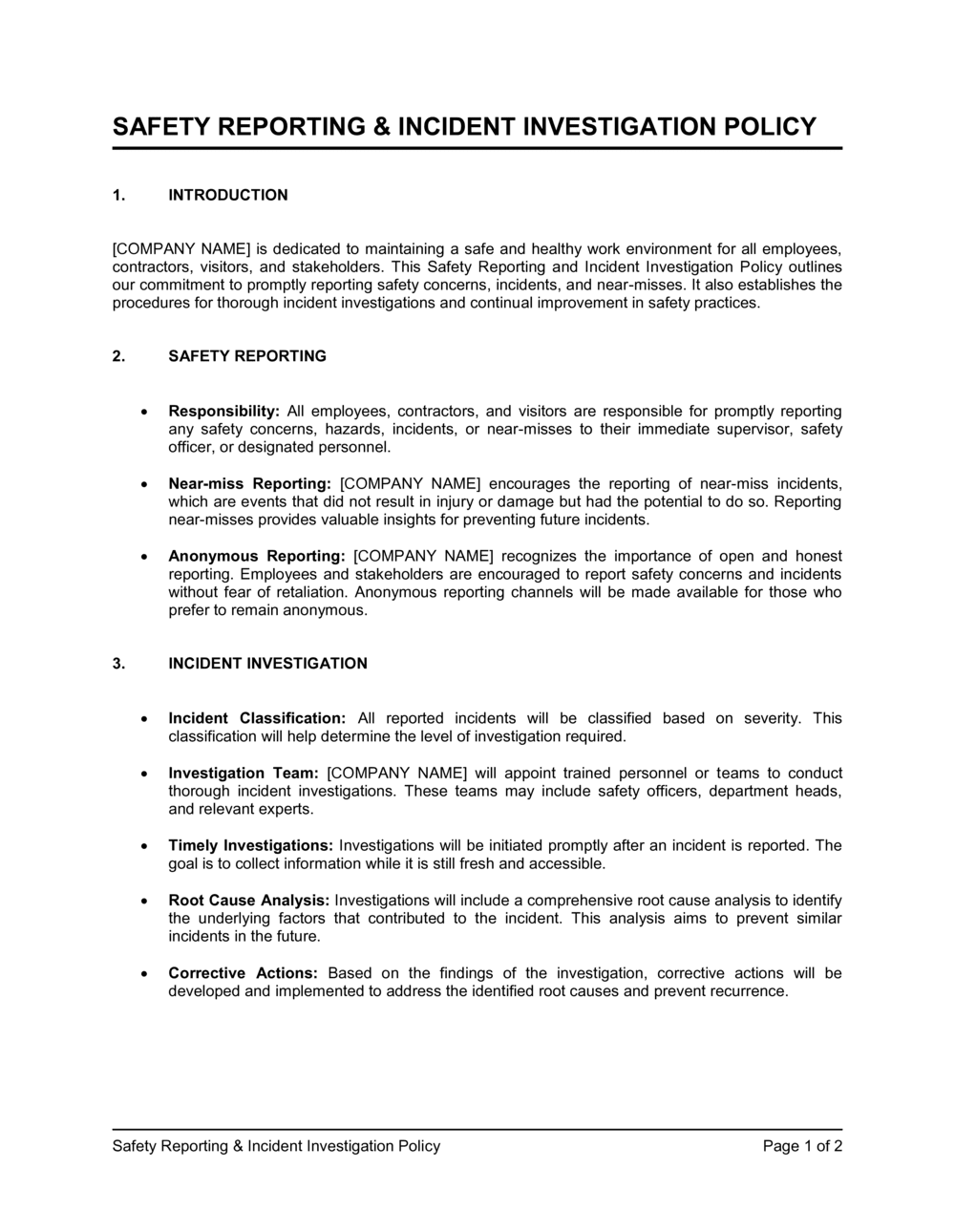
Replace all placeholders with your legal entity name, facility locations, and the specific worker categories covered — employees, contractors, subcontractors, and visitors.
💡 If you operate across multiple jurisdictions, note the applicable regulatory body for each location (OSHA, WorkSafeBC, HSE) directly in the scope section.
2
Customize the incident classification tiers
Review the default four-tier classification and adjust the descriptions to match your industry's hazard profile. A warehouse operation may add a 'vehicle collision' subcategory; an office may collapse Level 3 and 4 into a single tier.
💡 Align your classification language with the terminology your workers' compensation insurer uses — it simplifies claims processing significantly.
3
Set reporting timelines based on regulatory requirements
Enter the specific notification windows required by the applicable regulatory body for each incident level. Verify current OSHA, provincial, or national requirements before finalizing — timelines are subject to change.
💡 Post the regulatory notification timelines (e.g., 8 hours for fatalities) as a laminated quick-reference card at supervisor workstations.
4
Assign roles and responsibilities by name or job title
Replace generic role labels with specific job titles or names for your organization. Identify a primary and backup Safety Officer to ensure continuity when the primary is unavailable.
💡 Include a responsibility matrix table — roles down the left, process steps across the top — as an appendix for quick reference during an actual incident.
5
Select and document your RCA methodology
Choose a root-cause analysis method appropriate for your organization's capacity — the 5-Why method requires no special training; Fishbone diagrams suit more complex, multi-factor incidents.
💡 Train all supervisors on the chosen RCA method before the policy goes live. An untrained investigator defaults to surface-level causes regardless of what the policy requires.
6
Set up your CAPA tracking system
Decide whether CAPA items will be tracked in a spreadsheet, a safety management software platform, or your existing project management tool. Document the chosen system in the policy and ensure every open CAPA has a named owner and due date.
💡 A shared spreadsheet with color-coded status (open, in progress, verified closed) visible to all supervisors reduces overdue CAPA rates more effectively than a closed-access database.
7
Establish recordkeeping locations and retention schedules
Specify exactly where incident records are stored — naming the folder, software platform, or physical filing location — and confirm the retention period meets or exceeds your jurisdiction's minimum.
💡 Five years is the minimum retention period under most occupational safety regulations; store records in at least two locations (e.g., local drive plus cloud backup) to protect against loss.
8
Communicate the policy and obtain acknowledgment
Distribute the finalized policy to all employees, deliver a briefing session for supervisors, and collect signed acknowledgment forms confirming receipt and understanding.
💡 Translate the policy summary into any language spoken by a significant portion of your workforce — regulators consider language barriers a contributing factor in incidents and citations.