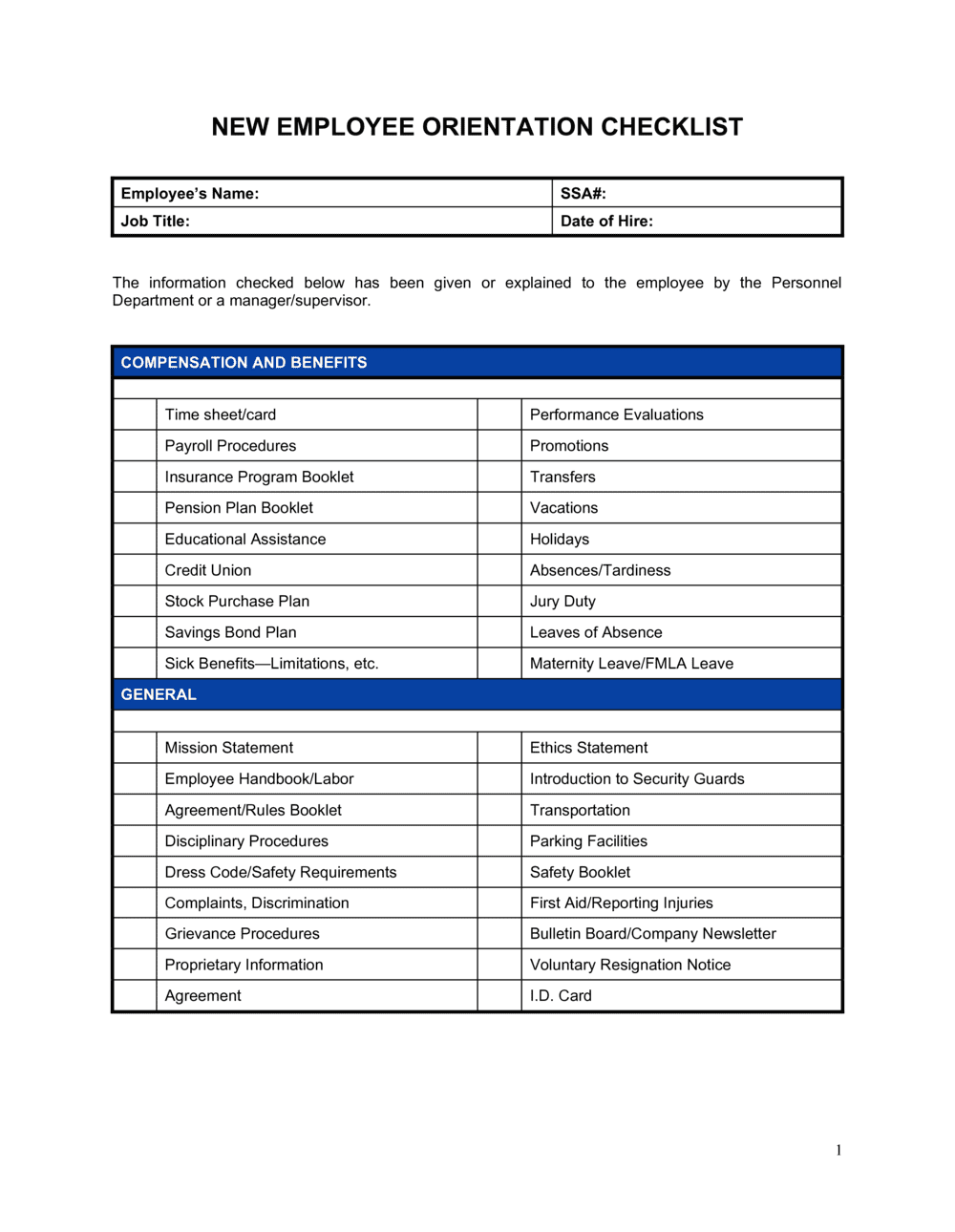
Checklist_New-Employee Orientation

Free download • Use as a template • Print or share

2 pages20–30 min to useDifficulty: StandardSignature requiredLegal review recommended
Learn more ↓
FreeChecklist_New-Employee Orientation Template

At a glance

What it is
A New Employee Orientation Checklist is a structured onboarding document that records every step an employer must complete — and every policy, procedure, and compliance item a new hire must acknowledge — before and during their first days of employment. This free Word download gives you an editable, signable checklist you can customize to your organization and export as PDF for your HR files.
When you need it
Use it for every new hire, whether full-time, part-time, or fixed-term, starting on or before their first day. It is especially critical when onboarding roles with access to confidential data, regulated equipment, or safety-sensitive environments where documented acknowledgment is a legal requirement.
What's inside
Pre-start administrative tasks, policy acknowledgment sign-offs, IT and equipment setup confirmation, health and safety briefings, role-specific training records, benefits enrollment steps, and a completion signature block for both the employee and the HR representative.

What is a New Employee Orientation Checklist?

A New Employee Orientation Checklist is a structured onboarding document that records every step an employer must complete — and every policy, compliance item, equipment issuance, and training acknowledgment a new hire must sign off on — during their first days of employment. Unlike an informal to-do list, a properly completed orientation checklist functions as a legal record: both the employee and an HR representative sign it, creating auditable proof that required obligations were communicated, documents were issued, and compliance steps were completed before substantive work began. This free Word download gives you an editable, signable checklist covering pre-start administrative tasks, identity verification, policy acknowledgments, safety induction, IT and equipment sign-off, benefits enrollment, and a dual-signature completion block.

Why You Need This Document

Without a completed, signed orientation checklist on file, you have no documentary evidence that a new employee was informed of company policies, trained on safety procedures, or acknowledged their confidentiality obligations — and in a dispute, that gap almost always works in the employee's favor. Regulatory exposure is equally concrete: I-9 violations in the US can trigger fines of over $2,500 per form; undocumented OSHA safety training leaves employers liable when a workplace incident occurs; and UK employers face fines of up to £20,000 per hire for inadequate right-to-work verification. Beyond compliance, the checklist protects you operationally — signed equipment receipts support offboarding asset recovery, benefits enrollment confirmation prevents coverage-gap disputes, and policy acknowledgment records are the foundation of defensible disciplinary proceedings. This template gives you a complete, jurisdiction-aware starting point that takes 30 minutes to customize and creates a personnel-file record that holds up years later.

Which variant fits your situation?

If your situation is…Use this template
Onboarding a remote employee with no physical office presenceRemote Employee Onboarding Checklist
Orienting a temporary or seasonal worker with a short tenureTemporary Employee Orientation Checklist
Onboarding an executive or senior manager with equity and benefits complexityExecutive Onboarding Checklist
Documenting the full employment terms alongside the orientation stepsEmployment Contract
Acknowledging confidentiality and IP policies as a standalone documentNon-Disclosure Agreement (NDA)
Recording health and safety induction for a construction or trades hireHealth and Safety Induction Checklist
Confirming the employee has received and read the company handbookEmployee Handbook Acknowledgment Form

Common mistakes to avoid

❌ Using a generic checklist not tailored to the role or jurisdiction

Why it matters: A warehouse hire has OSHA safety training requirements a software developer does not — and UK right-to-work checks differ entirely from US I-9 requirements. A one-size checklist creates compliance gaps that surface only during audits or incidents.

Fix: Maintain separate checklist variants for role types (office, field, remote) and jurisdictions. At minimum, flag jurisdiction-specific items with conditional notes so the HR representative knows which steps apply.

❌ Collecting a single blanket signature for all policy acknowledgments

Why it matters: In a disciplinary or termination dispute, the employee's lawyer will argue the blanket signature doesn't prove they read any specific policy. Courts have accepted this argument where individual policy sign-offs were not obtained.

Fix: Add a separate initials line for each policy document and record the date each was presented. This creates an itemized, auditable acknowledgment record.

❌ Completing orientation paperwork after the employee's first week

Why it matters: I-9 violations can attract fines of $252–$2,507 per form under current US federal enforcement guidelines. Beyond compliance fines, late acknowledgment of safety policies means work began before obligations were formally communicated.

Fix: Treat orientation paperwork as a prerequisite to starting substantive work, not an administrative afterthought. Block time on day one and hold it regardless of how busy the team is.

❌ Not retaining the completed checklist in the personnel file

Why it matters: If a former employee files a wrongful dismissal or harassment claim alleging they were never trained on the relevant policy, the only evidence in your favor is the signed, filed checklist. Without it, you cannot prove orientation occurred.

Fix: File the original signed checklist in the employee's personnel file immediately after the orientation session and back it up to a secure digital HR system. Retention periods vary by jurisdiction — 3 years minimum is standard, 7 years recommended.

❌ Treating the checklist as a formality rather than a legal record

Why it matters: Rushing through the checklist without the employee actually reading each policy — checking boxes to get through the morning — creates a false paper trail that undermines your position in any dispute where you claim the employee was informed.

Fix: Build adequate time into the orientation schedule: plan for 3–4 hours minimum on day one for paperwork. Brief managers that the employee is not available for role-specific work until orientation paperwork is complete.

❌ No equipment sign-off with asset details

Why it matters: Without asset tags, serial numbers, and a signed receipt, you cannot enforce return obligations at offboarding or attribute damage to a specific employee. This is the single most common gap discovered at termination.

Fix: Create a named equipment section in the checklist with pre-printed rows for each standard item issued. Complete it at the point of issue, not later in the day from memory.

The 10 key clauses, explained

Pre-start administrative tasks

In plain language: Documents all actions the employer must complete before the employee's first day — offer letter confirmation, background check completion, payroll setup, and workspace preparation.

Sample language
Pre-start tasks completed by [HR REPRESENTATIVE NAME] on [DATE]: offer letter signed [DATE], background check cleared [DATE], payroll account created [DATE], workstation prepared [DATE].

Common mistake: Leaving pre-start tasks off the checklist entirely and relying on informal email threads. When a step is missed — such as payroll setup — the employee's first paycheck is delayed, creating an immediate legal exposure.

Identity and work authorization verification

In plain language: Records completion of mandatory employment eligibility verification — I-9 in the US, SIN verification in Canada, right-to-work check in the UK — with document types and verification dates.

Sample language
I-9 / Right-to-Work verification completed by [VERIFIER NAME] on [DATE]. Documents reviewed: [DOCUMENT TYPE 1], [DOCUMENT TYPE 2]. Copies retained per [APPLICABLE LAW].

Common mistake: Completing the I-9 or right-to-work check after the employee's third day. Federal law in the US requires I-9 completion within three business days of the start date — late completion exposes the employer to fines per violation.

Company policies acknowledgment

In plain language: Lists each policy the employee must read and sign for — code of conduct, IT acceptable use, anti-harassment, social media, and confidentiality — with a checkbox and dated signature line for each.

Sample language
Employee acknowledges receipt and understanding of the following policies: Code of Conduct (initialed [DATE]), Anti-Harassment Policy (initialed [DATE]), IT Acceptable Use Policy (initialed [DATE]), Confidentiality Policy (initialed [DATE]).

Common mistake: Collecting a single blanket signature for all policies rather than individual acknowledgments per policy. In a disciplinary proceeding, a blanket signature is easier for the employee to dispute than a policy-specific initials line.

Employee handbook receipt

In plain language: Confirms the employee received the current version of the employee handbook, with the version number and date, and acknowledged that it does not constitute a contract.

Sample language
Employee confirms receipt of the [COMPANY NAME] Employee Handbook, Version [X.X], dated [DATE], and acknowledges that the handbook is a policy guide and does not constitute an employment contract.

Common mistake: Omitting the version number and date on the handbook acknowledgment. When policies are updated and an employee later claims ignorance of a rule, you need proof of exactly which version they received.

Health, safety, and emergency procedures

In plain language: Records completion of required health and safety induction, including emergency exits, first aid locations, incident reporting procedures, and any role-specific OSHA or WHMIS training.

Sample language
Safety induction completed by [TRAINER NAME] on [DATE]. Topics covered: emergency evacuation routes, first aid station locations, incident reporting procedure, [ROLE-SPECIFIC HAZARD] handling per [APPLICABLE STANDARD].

Common mistake: Treating safety induction as a checkbox with no trainer signature. Regulatory investigations after a workplace incident look for documented evidence of who conducted the training — an unsigned line is insufficient.

IT and equipment sign-off

In plain language: Documents every device, access credential, and software license issued to the employee, with serial numbers or asset tags, creating a chain of custody for company property.

Sample language
Equipment issued to [EMPLOYEE NAME] on [DATE]: Laptop — Asset Tag [NUMBER], Model [MODEL]; Access card — ID [NUMBER]; Software licenses: [LIST]. Employee acknowledges responsibility for items listed above.

Common mistake: Not recording asset tag numbers and serial numbers at the point of issue. When equipment is lost, stolen, or damaged and the employee denies receipt, an unspecific 'laptop issued' entry cannot support a claim or disciplinary action.

Benefits enrollment and payroll setup

In plain language: Confirms the employee has been informed of benefits options, enrollment deadlines, and payroll details — pay frequency, direct deposit, and tax withholding elections — and that all elections have been submitted.

Sample language
Benefits enrollment deadline communicated: [DATE]. Elections submitted by employee on [DATE]. Payroll: [BI-WEEKLY / SEMI-MONTHLY], direct deposit form received [DATE], tax withholding form (W-4 / TD1) completed [DATE].

Common mistake: Failing to document that the benefits enrollment deadline was communicated in writing. If the employee misses the deadline and loses coverage, the employer faces potential liability unless there is a signed record showing the deadline was given.

Role-specific training and system access

In plain language: Records job-specific training completed before the employee works independently — software walkthroughs, compliance certifications, role-based LMS modules — with completion dates and trainer or system confirmation.

Sample language
Role-specific training completed: [SYSTEM NAME] user training ([DATE], completed by [TRAINER / SYSTEM]), [COMPLIANCE MODULE] certification ([DATE], score [X]%), CRM access granted [DATE] by [IT CONTACT].

Common mistake: Recording only that training was 'completed' without specifying the module version, date, and who delivered it. In a negligence claim following an employee error, undated training records cannot establish that training preceded the incident.

Confidentiality and IP acknowledgment

In plain language: Confirms the employee has been informed of their obligations regarding confidential information and intellectual property, with a reference to the employment contract or standalone NDA covering these terms.

Sample language
Employee acknowledges that confidentiality and IP assignment obligations are governed by [EMPLOYMENT AGREEMENT / NDA] executed on [DATE], and that any work product created in connection with employment is the sole property of [COMPANY NAME].

Common mistake: Relying on the orientation checklist alone to establish confidentiality obligations without a separate signed NDA or IP assignment clause in the employment contract. Checklists acknowledge — they do not create — enforceable obligations.

Completion sign-off and HR certification

In plain language: A final signature block where both the employee and the HR representative certify that all orientation steps have been completed, all documents issued, and all acknowledgments obtained.

Sample language
I, [EMPLOYEE NAME], confirm that I have completed all orientation steps listed in this checklist and received all documents referenced herein. Signed: [EMPLOYEE SIGNATURE] Date: [DATE]. HR Representative: [NAME] Signature: [SIGNATURE] Date: [DATE].

Common mistake: Having only the employee sign the completion block. Dual signatures — employee and HR — establish that a qualified company representative verified completion, which is critical if the employee later disputes that any step occurred.

How to fill it out

  1. 1

    Customize the checklist header with company and employee details

    Enter the company's legal name, the employee's full legal name, job title, department, start date, and the name of the HR representative responsible for the orientation.

    💡 Use the employee's legal name exactly as it appears on their government ID — this must match your payroll and I-9 records.

  2. 2

    Complete the pre-start administrative tasks before day one

    Work through the pre-start section in the week before the employee's first day — confirm the offer letter is signed, background check is cleared, payroll account is created, and workspace is ready.

    💡 Assign each pre-start task a named owner and deadline. An uncompleted task with no named owner almost always gets missed.

  3. 3

    Verify identity and work authorization on day one

    Complete the I-9 (US), SIN confirmation (Canada), or right-to-work check (UK) within the legally required window. Record document types and verification date on the checklist.

    💡 In the US, the I-9 must be completed by the end of the employee's third business day — set a calendar reminder on day one to avoid the most common compliance failure.

  4. 4

    Walk through each policy acknowledgment individually

    Present each policy document separately, give the employee time to read it, and collect an initials or signature line for each policy rather than a single blanket acknowledgment.

    💡 For remote hires, use an e-signature tool that creates a time-stamped audit trail per document — a single PDF with multiple initials lines is harder to authenticate remotely.

  5. 5

    Complete and document the health and safety induction

    Walk the employee through emergency procedures, hazard identification, and any role-specific safety training. Record the trainer's name, topics covered, and completion date.

    💡 Have the trainer sign the checklist in addition to the employee — regulatory bodies look for both signatures when auditing safety training records.

  6. 6

    Issue equipment and record asset details

    Enter every device, access card, and software license issued with its asset tag or serial number. Have the employee sign the equipment section before leaving the room.

    💡 Photograph the equipment alongside the signed checklist if your organization issues high-value hardware — it eliminates condition disputes at offboarding.

  7. 7

    Confirm benefits enrollment and payroll elections

    Communicate the benefits enrollment deadline in writing on this checklist, confirm that all tax withholding forms are submitted, and record the direct deposit confirmation.

    💡 Send a follow-up email on day three reminding the employee of the benefits deadline and retain the sent email as a second layer of documentation.

  8. 8

    Obtain dual completion signatures and file the checklist

    Have both the employee and the HR representative sign and date the completion block. Retain the original in the employee's personnel file and provide the employee with a copy.

    💡 Store the signed checklist in a secure digital HR system with access controls — paper-only records are vulnerable to loss and make remote audit requests slow and error-prone.

Frequently asked questions

What is a new employee orientation checklist?

A new employee orientation checklist is a structured onboarding document that records every step the employer must complete and every policy, compliance item, and equipment issuance the employee must acknowledge during their first days of employment. It functions simultaneously as a process guide for HR and a legal record of what was communicated, issued, and signed — which is why it carries a signature block for both parties. Unlike an informal to-do list, a signed orientation checklist is admissible documentation in disciplinary proceedings, regulatory audits, and employment disputes.

Is a new employee orientation checklist legally required?

No single law mandates a specific orientation checklist format in most jurisdictions. However, several legal obligations — I-9 completion in the US, right-to-work verification in the UK, OSHA safety training documentation, WHMIS training records in Canada, and GDPR data-handling briefings in the EU — require documented evidence that specific steps occurred. A comprehensive orientation checklist is the most efficient way to satisfy all of these requirements in a single auditable document. Employers who lack records face fines and adverse inferences in disputes.

When should the orientation checklist be completed?

The majority of the checklist — identity verification, policy acknowledgments, safety induction, and equipment sign-off — should be completed on or before the employee's first day of substantive work. In the US, I-9 verification must be completed within three business days of the start date. Benefits enrollment typically has a 30-day window. Role-specific training items may extend into the first week, but they should be tracked on the checklist with target completion dates rather than left open-ended.

Does the employee need to sign the orientation checklist?

Yes — and so should the HR representative or manager who conducted the orientation. The employee's signature confirms they received and acknowledged each item listed. The HR representative's countersignature certifies that a qualified company representative verified completion. Dual signatures significantly strengthen the employer's position in any proceeding where an employee claims they were not informed of a policy, procedure, or obligation.

What is the difference between an orientation checklist and an employment contract?

An employment contract creates the legal obligations — compensation, IP assignment, non-compete, termination terms. An orientation checklist documents that the employee was informed of and acknowledged those obligations, plus all operational policies and compliance steps at hire. The checklist references the employment contract but does not replace it. Both documents are needed: the contract establishes the terms; the checklist proves they were communicated.

How long should a completed orientation checklist be retained?

Retention requirements vary by jurisdiction. In the US, I-9 forms must be retained for three years from the date of hire or one year after termination, whichever is later. Most employment law practitioners recommend retaining the full personnel file — including the orientation checklist — for at least seven years after separation to cover the statute of limitations for most employment claims. In the UK and EU, GDPR principles require retaining personnel records only as long as necessary, but employment tribunal claim windows (up to 6 years for contract claims in England and Wales) justify comparable retention periods.

Can I use the same orientation checklist for remote employees?

The same checklist structure applies, but several items require adaptation. Equipment sign-off should reference courier tracking numbers and condition-at-delivery confirmation rather than in-person receipt. Policy acknowledgments should use a time-stamped e-signature tool rather than wet signatures. Safety induction for remote workers should address home workspace ergonomics and emergency contacts rather than a physical office walkthrough. Add a remote-specific section to the checklist rather than repurposing an office-only version.

What happens if orientation steps are skipped or not documented?

Undocumented orientation creates two categories of risk. Compliance risk arises when regulators — USCIS, OSHA, the FCA, or a provincial labor board — request records of required steps and none exist, triggering fines or enforcement action. Litigation risk arises when a former employee claims they were never informed of a policy or trained on a procedure — without a signed checklist, the employer cannot rebut the claim. In wrongful dismissal and harassment cases, the absence of a training record is regularly used to support the employee's version of events.

Should the orientation checklist include sensitive HR information like salary?

The orientation checklist should reference the employment contract or offer letter for compensation details rather than restating salary figures. The checklist is a process and acknowledgment record — it may be reviewed by multiple HR staff, stored in shared systems, and produced in litigation. Keeping sensitive compensation data in the employment contract (which has stricter access controls) reduces the risk of confidential information being disclosed inadvertently through the broader orientation file.

How this compares to alternatives

vs Employment Contract

An employment contract creates the binding legal obligations governing the working relationship — compensation, IP assignment, non-compete, and termination terms. The orientation checklist documents that those obligations and all operational policies were communicated to and acknowledged by the employee at hire. Both are needed: the contract establishes the terms; the checklist proves they were delivered.

vs Employee Handbook

An employee handbook is the substantive policy document — it contains the rules, procedures, and expectations. The orientation checklist is the acknowledgment record proving the employee received and read the handbook. The checklist references the handbook by version number and date; the two documents work together but serve entirely different legal functions.

vs Non-Disclosure Agreement (NDA)

An NDA is a standalone enforceable contract creating confidentiality obligations with defined remedies for breach. An orientation checklist may include a confidentiality acknowledgment line, but that line confirms the employee was informed of their obligations — it does not create them. Where confidentiality and IP protection are critical, a separate signed NDA is required in addition to the checklist.

vs Probationary Period Review Form

The orientation checklist is a day-one document capturing what was issued, acknowledged, and completed at hire. A probationary period review form is used at 30, 60, or 90 days to evaluate performance against the role expectations established during orientation. They cover different points in the onboarding timeline and should both be retained in the personnel file.

Industry-specific considerations

Healthcare

Credentialing verification, HIPAA training acknowledgment, infection control procedures, and mandatory background check completion must all be documented before patient contact begins.

Construction and Trades

OSHA 10 or 30 certification confirmation, site-specific safety induction, PPE issue receipt, and hazard communication (WHMIS/GHS) training are legally required before the employee handles equipment or materials.

Financial Services

Regulatory licensing verification (FINRA, FCA), mandatory compliance training modules, conflicts-of-interest disclosure, and AML policy acknowledgment are standard orientation requirements subject to regulatory audit.

Retail and Hospitality

High turnover makes a fast, repeatable checklist critical — cash handling procedures, food safety certification confirmation, and loss prevention policy acknowledgment are the priority items for most retail and food-service hires.

Technology / SaaS

IT acceptable use policy, data classification training, VPN and device security setup, and IP assignment acknowledgment are the core orientation items for software and data-handling roles.

Manufacturing

Machine-specific safety certifications, lockout/tagout procedure training, PPE issue and fit-check, and shift-schedule acknowledgment are required at orientation and must be documented for OSHA inspection readiness.

Jurisdictional notes

United States

Federal law requires I-9 employment eligibility verification within three business days of hire — fines range from $252 to $2,507 per violation under current USCIS enforcement guidelines. OSHA mandates documented safety training for hazardous roles before work begins. State-specific requirements vary significantly: California requires specific harassment prevention training within six months of hire; New York mandates annual workplace violence prevention training acknowledgment.

Canada

Each province's Employment Standards Act sets minimum onboarding disclosure requirements, including written notice of pay rate, pay schedule, and overtime rules. WHMIS 2015 requires documented hazard communication training before employees handle controlled products. Quebec employers must ensure all orientation materials are available in French for provincially-regulated workplaces. Privacy law (PIPEDA federally, Law 25 in Quebec) requires new hires to be informed of how their personal data is collected and used.

United Kingdom

Employers must conduct a right-to-work check before employment begins — fines of up to £20,000 per illegal worker apply. The Employment Rights Act requires a written statement of employment particulars on or before day one. The Health and Safety at Work Act 1974 requires documented induction training covering site-specific risks. GDPR (UK) requires employees to be informed of data processing activities at hire, typically through a privacy notice acknowledged during orientation.

European Union

The EU Transparent and Predictable Working Conditions Directive requires employers to provide written information on employment terms within seven days of the start date. GDPR requires documented employee data-processing notifications at hire, and many member states treat this as a mandatory orientation item. Works council consultation requirements in Germany, France, and the Netherlands may affect the content and timing of orientation procedures. Member state-specific occupational health and safety laws — particularly in Germany and France — impose detailed induction documentation requirements for roles involving workplace hazards.

Template vs lawyer — what fits your deal?

PathBest forCostTime
Use the templateSmall businesses and startups hiring domestic employees in a single state or province for standard office, retail, or field rolesFree30 minutes to customize, 3–4 hours per orientation session
Template + legal reviewEmployers hiring in multiple jurisdictions, regulated industries (healthcare, financial services), or roles with safety-critical training requirements$300–$800 for an HR attorney or compliance consultant review3–5 days for review and customization
Custom draftedEnterprise employers with complex multi-jurisdiction onboarding, government contractors with FAR compliance requirements, or industries subject to union agreements$1,000–$4,000+1–3 weeks

Glossary

Orientation
The formal process of introducing a new employee to the organization's culture, policies, systems, and job expectations during their initial period of employment.
Onboarding
The broader multi-week or multi-month process of integrating a new hire into their role, team, and company — orientation is typically the first stage of onboarding.
Policy Acknowledgment
A signed confirmation that the employee has received, read, and understood a specific company policy, creating a documented record enforceable in disciplinary proceedings.
I-9 Verification
A US federal form (USCIS Form I-9) that verifies an employee's identity and legal authorization to work in the United States, which employers must complete within three business days of hire.
At-Will Employment
An employment relationship in which either party may end the arrangement at any time for any lawful reason — relevant context for what the orientation checklist formalizes at hire.
WHMIS / OSHA Compliance
Workplace Hazardous Materials Information System (Canada) and Occupational Safety and Health Administration (US) frameworks that require documented safety training before employees begin hazardous work.
Benefits Enrollment Period
The defined window — typically the first 30 days of employment — during which a new hire must elect health, dental, and other employer-sponsored benefits.
Probationary Period
A defined initial employment period, typically 30 to 90 days, during which performance is evaluated and during which termination formalities may be reduced.
IT Acceptable Use Policy
A written policy governing how employees may use company devices, networks, and software — acknowledgment of which is typically required at orientation.
Employee Handbook
A document setting out company policies, procedures, and expectations — new hires typically receive and sign for it during orientation as part of their policy acknowledgment record.
Chain of Custody
A documented record showing who received, handled, or signed for a specific asset or document — orientation checklists establish chain of custody for equipment and policy documents issued at hire.

Part of your Business Operating System

This document is one of 3,000+ business & legal templates included in Business in a Box.

  • Fill-in-the-blanks — ready in minutes
  • 100% customizable Word document
  • Compatible with all office suites
  • Export to PDF and share electronically

Create your document in 3 simple steps.

From template to signed document — all inside one Business Operating System.
1
Download or open template

Access over 3,000+ business and legal templates for any business task, project or initiative.

2
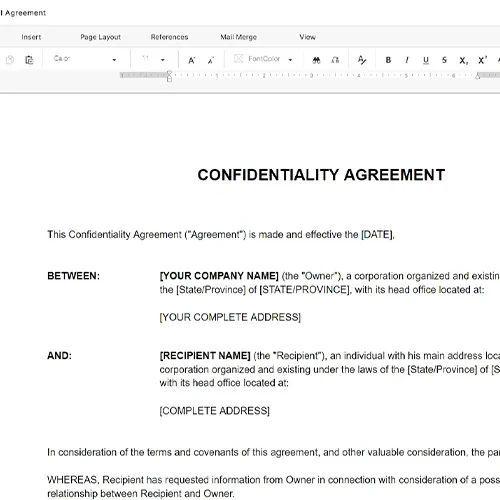
Edit and fill in the blanks with AI

Customize your ready-made business document template and save it in the cloud.

3
Save, Share, Send, Sign

Share your files and folders with your team. Create a space of seamless collaboration.

Save time, save money, and create top-quality documents.

★★★★★

"Fantastic value! I'm not sure how I'd do without it. It's worth its weight in gold and paid back for itself many times."

Managing Director · Mall Farm
Robert Whalley
Managing Director, Mall Farm Proprietary Limited
★★★★★

"I have been using Business in a Box for years. It has been the most useful source of templates I have encountered. I recommend it to anyone."

Business Owner · 4+ years
Dr Michael John Freestone
Business Owner
★★★★★

"It has been a life saver so many times I have lost count. Business in a Box has saved me so much time and as you know, time is money."

Owner · Upstate Web
David G. Moore Jr.
Owner, Upstate Web

Run your business with a system — not scattered tools

Stop downloading documents. Start operating with clarity. Business in a Box gives you the Business Operating System used by over 250,000 companies worldwide to structure, run, and grow their business.

Start free · No credit card required