Request for Information Template

Free Word download β€’ Edit online β€’ Save & share with Drive β€’ Export to PDF

1 pageβ€’15–25 min to fillβ€’Difficulty: Standard
Learn more ↓
FreeRequest for Information Template

At a glance

What it is
A Request for Information (RFI) is a formal business letter sent to vendors, suppliers, contractors, or agencies to gather specific details needed before making a procurement or project decision. This free Word download gives you a structured, professional starting point you can edit online and export as PDF to send to any recipient in minutes.
When you need it
Use it in the early stages of a procurement process β€” before issuing a Request for Proposal (RFP) or Request for Quotation (RFQ) β€” when you need to understand a vendor's capabilities, product specifications, or service offerings before committing to a formal bidding process.
What's inside
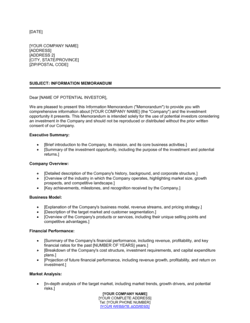
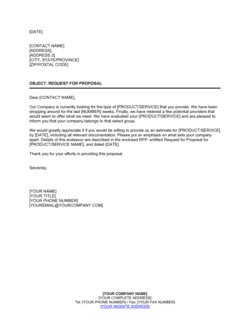
A professional header with sender and recipient details, a clear statement of purpose, a numbered list of specific information requested, response instructions with a deadline, and a closing that sets expectations for next steps in the procurement or evaluation process.

What is a Request for Information?

A Request for Information (RFI) is a formal business letter issued by a buyer to one or more vendors, suppliers, or contractors to gather details about their capabilities, products, services, or pricing structures before committing to a formal procurement process. It sits at the earliest stage of the buying cycle β€” after a need is identified but before an RFP or RFQ is issued β€” and serves as a structured market research tool. Because it carries no binding obligation on either side, an RFI gives buyers the freedom to explore the vendor landscape openly, and gives vendors a low-risk way to make themselves known to potential clients.

Why You Need This Document

Skipping the RFI stage and jumping straight to an RFP or purchase decision means you are writing specifications in a vacuum β€” without knowing what the market actually offers, what solutions exist, or which vendors have the credentials to deliver. The result is an RFP that either fits only one vendor or fails to capture the best available solution. Beyond procurement quality, an unstructured vendor outreach β€” an informal email chain or a phone call β€” leaves no paper trail, creates inconsistency across respondents, and exposes your organization to claims of favoritism or implied commitment. A properly formatted RFI with a non-binding disclaimer, numbered questions, and a firm response deadline gives every vendor the same information, generates comparable responses you can actually evaluate, and documents your due diligence at every step of the process. This template gives you that structure in under 30 minutes.

Which variant fits your situation?

If your situation is…Use this template
You need a firm price commitment from vendorsRequest for Quotation
You want vendors to propose a full solution to a defined problemRequest for Proposal
You are gathering information from a specific party during a dispute or auditInformation Request Letter
You need technical specifications for a defined product or serviceRequest for Quotation (Technical)
You are running a formal tender process requiring bid bondsInvitation to Tender
You want to pre-qualify vendors before a competitive solicitationRequest for Qualifications

Common mistakes to avoid

❌ No non-binding disclaimer

Why it matters: Vendors have pursued legal claims asserting that a detailed response to an RFI created an implied procurement obligation. Even one sentence of disclaimer language eliminates this exposure.

Fix: Include an explicit statement that the RFI is for market research purposes only and does not create any commitment to purchase, contract, or proceed with a formal solicitation.

❌ Unstructured or open-ended questions

Why it matters: Vague questions produce inconsistent responses that cannot be compared across vendors, forcing multiple follow-up rounds and delaying the procurement timeline by weeks.

Fix: Number every question and specify exactly what format or level of detail you expect β€” for example, 'provide a list of five current clients with annual contract values' rather than 'describe your client base.'

❌ Missing or vague response deadline

Why it matters: Without a firm deadline, responses arrive over weeks rather than days, making it impossible to start vendor evaluation on schedule.

Fix: State a specific date and time with a time zone, give vendors at least ten business days to respond, and communicate the deadline in both the subject line and the body of the letter.

❌ Sending to a company name rather than a named contact

Why it matters: RFIs addressed only to a company name are delayed while staff determine who should respond, and are more likely to be deprioritized or lost entirely.

Fix: Research and name the correct procurement, sales, or business development contact at each recipient organization before sending.

The 9 key clauses, explained

Header and sender identification

In plain language: Identifies the issuing organization, the date, and the recipient's name, title, and contact details at the top of the letter.

Sample language
[SENDER ORGANIZATION NAME] | [ADDRESS] | [CITY, STATE, ZIP] | [DATE] | Attn: [RECIPIENT NAME], [TITLE] | [RECIPIENT ORGANIZATION] | [ADDRESS]

Common mistake: Sending the RFI without a named individual recipient. Letters addressed only to a company name are routinely delayed or ignored while staff determine who should respond.

Subject line

In plain language: A brief, specific reference line identifying the RFI by project name or reference number so recipients can file and track it.

Sample language
RE: Request for Information β€” [PROJECT NAME / REFERENCE NUMBER] β€” [BRIEF DESCRIPTION]

Common mistake: Using a vague subject like 'Information Request.' A specific subject line with a project name and reference number makes the document trackable and signals a professional procurement process.

Purpose statement

In plain language: Opens the body of the letter by explaining why the RFI is being issued, what the project or initiative involves, and what the issuing organization is trying to accomplish.

Sample language
[ORGANIZATION NAME] is conducting a market survey to identify qualified vendors capable of providing [PRODUCT/SERVICE DESCRIPTION] in connection with [PROJECT NAME]. This RFI is issued for informational and planning purposes only and does not constitute a commitment to procure.

Common mistake: Omitting the disclaimer that the RFI is not a commitment to purchase. Vendors have pursued legal claims asserting that detailed RFI responses created an implied obligation β€” a single sentence prevents this.

Background and context

In plain language: Provides enough organizational and project context for the recipient to understand the scale, timeline, and objectives of the initiative they are being asked about.

Sample language
[ORGANIZATION NAME] is a [DESCRIPTION] serving [TARGET AUDIENCE]. We are evaluating solutions for [OBJECTIVE] with an anticipated project start of [QUARTER/YEAR] and a budget range of approximately $[AMOUNT].

Common mistake: Providing so little context that vendors cannot calibrate their responses. Vendors who don't understand the scale or objective send generic capability sheets that require multiple follow-up rounds.

Specific information requested

In plain language: The core of the RFI β€” a numbered or lettered list of the exact questions or information categories the issuing party wants the recipient to address.

Sample language
Please provide the following information: 1. Company overview and years in operation. 2. Relevant certifications and accreditations. 3. Description of [SPECIFIC PRODUCT/SERVICE] capabilities. 4. Current client references in [INDUSTRY]. 5. Typical lead time and delivery terms. 6. Pricing structure (indicative ranges acceptable).

Common mistake: Asking open-ended questions with no structure. Unstructured RFIs produce inconsistent responses that are impossible to compare across vendors β€” number each question and specify the format you want.

Non-binding statement and confidentiality

In plain language: Clarifies that the RFI is a market research exercise, that responses will not be scored as bids, and β€” where applicable β€” that submitted information will be treated as confidential.

Sample language
Responses to this RFI will be used solely for internal planning purposes. [ORGANIZATION NAME] will treat all submitted information as confidential and will not share it with third parties without prior written consent. Submission of a response does not create any rights or obligations on either party.

Common mistake: Skipping confidentiality language entirely. Vendors are often reluctant to share pricing structures, capacity details, or proprietary methods without an explicit commitment that the information will not be disclosed to competitors.

Response instructions and format

In plain language: States how, where, and in what format responses should be submitted β€” email, portal, or physical delivery β€” and any page or word limits.

Sample language
Please submit your response in PDF format to [CONTACT NAME] at [EMAIL ADDRESS] no later than [DATE] at [TIME] [TIME ZONE]. Responses should not exceed [X] pages. Questions regarding this RFI may be directed to [CONTACT NAME] at [PHONE/EMAIL].

Common mistake: Omitting a page limit or format requirement. Without constraints, vendors submit 40-page capability decks when a 5-page summary would serve the purpose β€” and reviewing them consistently becomes impractical.

Response deadline and next steps

In plain language: States the specific response deadline and briefly describes what will happen after responses are received β€” whether a shortlist will be developed, an RFP will follow, or responses will inform internal planning only.

Sample language
Responses are due no later than [DATE]. [ORGANIZATION NAME] anticipates issuing a formal Request for Proposal to shortlisted vendors in [MONTH/YEAR]. All respondents will be notified of next steps by [DATE].

Common mistake: Setting no deadline at all, or using language like 'respond at your earliest convenience.' Without a firm date, responses trickle in over weeks, stalling the procurement timeline.

Closing and authorized signature block

In plain language: A professional closing that thanks the recipient, restates the contact for questions, and includes the sender's name, title, and organization.

Sample language
Thank you for your time and consideration. We look forward to reviewing your response. Should you have any questions, please contact [NAME] at [PHONE] or [EMAIL]. Sincerely, [SENDER NAME] | [TITLE] | [ORGANIZATION NAME]

Common mistake: Closing with a generic 'regards' and no contact information. Recipients who have questions will abandon the process rather than hunt for a contact β€” a direct name and number increases response rates.

How to fill it out

  1. 1

    Complete the header with sender and recipient details

    Enter your organization's name, address, and the date at the top. Add the recipient's full name, title, company, and address. Sending to a named individual rather than a generic company address significantly improves response rates.

    πŸ’‘ Call the vendor's front desk in advance to confirm the correct name and title of their procurement or sales contact before sending.

  2. 2

    Write a specific subject line with a reference number

    Create a project or RFI reference number (e.g., RFI-2026-003) and include it in the subject line alongside the project name. This makes your RFI trackable in both your records and the recipient's inbox.

    πŸ’‘ Use the same reference number on all follow-up correspondence so responses are easy to match to the original document.

  3. 3

    Draft the purpose statement and non-binding disclaimer

    Explain in two to three sentences what the initiative involves and confirm that the RFI is for market research only. Include explicit language stating it does not constitute a commitment to procure.

    πŸ’‘ Keep the purpose statement factual and concise β€” one paragraph is sufficient. Save detail for the background and context section.

  4. 4

    Provide project background and scale

    Give vendors enough context to calibrate their response: your organization type, the project objective, the anticipated timeline, and an indicative budget range where disclosure is appropriate.

    πŸ’‘ Sharing a budget range β€” even a broad one β€” significantly improves response quality by filtering out vendors whose pricing is clearly out of range.

  5. 5

    List your specific questions in numbered format

    Write out each information request as a numbered item. Be as specific as possible β€” instead of 'describe your experience,' write 'provide two to three client references in the [INDUSTRY] sector with project values above $[AMOUNT].'

    πŸ’‘ Limit the list to eight to twelve questions. More than twelve signals a poorly scoped initiative and discourages thorough responses from busy vendors.

  6. 6

    Set the deadline, format, and submission instructions

    Specify the exact date and time by which responses must be received, the preferred file format (PDF is standard), the submission method (email to a named contact or upload to a procurement portal), and any page-length constraints.

    πŸ’‘ Give vendors at least ten business days to respond to a standard RFI β€” less than a week signals urgency that may reduce response quality and vendor participation.

  7. 7

    Describe next steps and send

    In one or two sentences, tell respondents what happens after the deadline β€” will an RFP follow, will a shortlist be announced, or will responses inform internal planning only? This context helps vendors decide whether the effort is worth their time.

    πŸ’‘ Send a brief acknowledgment email when each response is received β€” it builds goodwill with vendors and confirms their submission reached the right contact.

Frequently asked questions

What is a Request for Information (RFI)?

A Request for Information is a formal business letter or document issued to vendors, suppliers, or contractors to gather details about their capabilities, products, or services before a procurement decision is made. It is used in the early stages of a buying process β€” before an RFP or RFQ is issued β€” to conduct market research, narrow a vendor shortlist, or inform an internal business case. An RFI is not a commitment to purchase.

What is the difference between an RFI, an RFP, and an RFQ?

An RFI collects general capability and market information β€” it does not ask for a price or a proposed solution. An RFP asks vendors to propose a complete solution to a defined problem, including methodology, team, and pricing. An RFQ asks for a firm price on a specific product or service with defined quantities and delivery terms. The typical procurement sequence is RFI first, then RFP or RFQ once the field is narrowed.

Is a response to an RFI legally binding?

A response to an RFI is generally not legally binding β€” it is market research, not an offer or acceptance in contract law terms. However, the RFI itself should include an explicit non-binding disclaimer to confirm this. Vendors who invest significant effort in a detailed response have occasionally argued implied obligations; clear disclaimer language in the RFI prevents this from becoming a dispute.

How many vendors should receive an RFI?

There is no fixed rule, but three to ten vendors is a practical range for most procurement exercises. Sending to too few limits the market intelligence you gather; sending to more than ten generates a volume of responses that is difficult to review consistently. For government procurement, minimum competition requirements may set a floor on how many vendors must be contacted.

Should an RFI include a budget?

Sharing a budget range β€” even a broad one β€” generally improves the quality and relevance of vendor responses. It filters out vendors whose pricing is clearly misaligned and allows respondents to tailor their capability information to realistic scope. If budget disclosure is sensitive, you can phrase it as an indicative range or describe the scale of the initiative rather than a specific dollar figure.

How long should vendors be given to respond to an RFI?

Ten to fifteen business days is the standard for a straightforward RFI. Complex RFIs requiring detailed technical responses or multiple internal approvals on the vendor's side may warrant three to four weeks. Shorter deadlines reduce response quality and participation rates, particularly from larger vendors with formal bid-management processes.

What happens after an RFI is issued?

After the response deadline passes, the issuing organization reviews all submissions against the stated evaluation criteria, typically develops a shortlist of qualified vendors, and then issues a formal RFP or RFQ to the shortlisted parties. Not every procurement process requires an RFI β€” it is most valuable when the market is unfamiliar or when the solution space is not yet well defined.

Can an RFI be used for government procurement?

Yes. RFIs are a standard market research tool in government procurement at federal, state, and municipal levels. In US federal procurement, RFIs are used under FAR Part 15 to conduct pre-solicitation market research. Government RFIs typically include more formal language, procurement office contact details, and may be posted publicly on platforms such as SAM.gov rather than sent directly to vendors.

How this compares to alternatives

vs Request for Proposal (RFP)

An RFP asks vendors to propose a complete solution β€” including methodology, team, timeline, and pricing β€” in response to a defined scope of work. An RFI gathers general capability and market information with no commitment to proceed. The RFI typically comes first; once the field is narrowed, the RFP is issued to shortlisted vendors.

vs Request for Quotation (RFQ)

An RFQ requests a firm price for a specific product or service with defined quantities and delivery terms. An RFI asks no price question β€” it is purely informational. Use an RFQ when you already know what you want to buy and need a binding cost commitment; use an RFI when you are still defining the solution.

vs Purchase Order

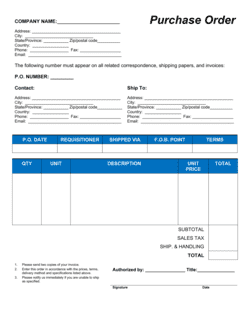
A purchase order is a binding commercial document that authorizes a specific purchase at an agreed price. An RFI is a non-binding market research letter that precedes any purchasing decision. The two documents sit at opposite ends of the procurement timeline β€” RFI at the start, purchase order at the close.

vs Business Proposal

A business proposal is a document a vendor submits to win a client's business β€” it originates from the seller. An RFI originates from the buyer and solicits information from potential sellers. The vendor's response to an RFI may eventually inform a formal proposal, but the two documents serve opposite roles in the buyer-seller dynamic.

Industry-specific considerations

Construction

Used to gather subcontractor capacity, bonding limits, safety records, and equipment availability before issuing a formal invitation to bid on a project.

Information Technology

Issued to software or infrastructure vendors to assess platform capabilities, integration requirements, security certifications, and SLA terms before drafting an RFP.

Healthcare

Used to evaluate medical equipment suppliers, EHR vendors, or service providers on regulatory compliance, clinical validation, and support infrastructure before a formal procurement.

Professional Services

Sent to consulting firms, law firms, or agencies to assess relevant sector experience, team credentials, and indicative fee structures before a competitive pitch process.

Template vs pro β€” what fits your needs?

PathBest forCostTime
Use the templateProcurement managers, project owners, and small business buyers issuing standard vendor research inquiriesFree15–30 minutes per RFI
Template + professional reviewOrganizations running formal multi-vendor procurement processes or issuing RFIs for high-value or regulated contracts$100–$300 for a procurement advisor or legal review1–2 days
Custom draftedGovernment agencies, large enterprises, or highly regulated industries where procurement documentation must meet specific compliance standards$500–$2,000+3–7 days

Glossary

Request for Information (RFI)
A formal document used to collect details, capabilities, or specifications from potential vendors or contractors before a procurement decision is made.
Request for Proposal (RFP)
A formal solicitation asking vendors to propose a complete solution and pricing for a defined scope of work β€” typically issued after an RFI narrows the field.
Request for Quotation (RFQ)
A document requesting a firm price from one or more vendors for a specific product or service with defined quantities and delivery requirements.
Procurement
The process of identifying, evaluating, and acquiring goods or services from external sources to meet an organization's operational needs.
Vendor Qualification
The process of assessing a supplier's capacity, credentials, financial stability, and compliance before awarding a contract.
Scope of Work
A detailed description of the tasks, deliverables, timelines, and expectations that define what a vendor or contractor is being asked to perform.
Response Deadline
The specific date and time by which a recipient must submit their reply to an RFI, RFP, or RFQ for it to be considered.
Market Research
In procurement contexts, the act of gathering information about available vendors, technologies, or solutions before formalizing a buying strategy.
Sole-Source Justification
A documented rationale explaining why a single vendor is being considered without competitive bidding β€” RFI responses sometimes inform this analysis.
Evaluation Criteria
The specific factors β€” such as experience, technical capability, pricing structure, and references β€” used to compare vendor responses and select a preferred supplier.

Part of your Business Operating System

This document is one of 3,000+ business & legal templates included in Business in a Box.

  • Fill-in-the-blanks β€” ready in minutes
  • 100% customizable Word document
  • Compatible with all office suites
  • Export to PDF and share electronically

Create your document in 3 simple steps.

From template to signed document β€” all inside one Business Operating System.
1
Download or open template

Access over 3,000+ business and legal templates for any business task, project or initiative.

2
Edit and fill in the blanks with AI

Customize your ready-made business document template and save it in the cloud.

3
Save, Share, Send, Sign

Share your files and folders with your team. Create a space of seamless collaboration.

Save time, save money, and create top-quality documents.

β˜…β˜…β˜…β˜…β˜…

"Fantastic value! I'm not sure how I'd do without it. It's worth its weight in gold and paid back for itself many times."

Managing Director Β· Mall Farm
Robert Whalley
Managing Director, Mall Farm Proprietary Limited
β˜…β˜…β˜…β˜…β˜…

"I have been using Business in a Box for years. It has been the most useful source of templates I have encountered. I recommend it to anyone."

Business Owner Β· 4+ years
Dr Michael John Freestone
Business Owner
β˜…β˜…β˜…β˜…β˜…

"It has been a life saver so many times I have lost count. Business in a Box has saved me so much time and as you know, time is money."

Owner Β· Upstate Web
David G. Moore Jr.
Owner, Upstate Web

Run your business with a system β€” not scattered tools

Stop downloading documents. Start operating with clarity. Business in a Box gives you the Business Operating System used by over 250,000 companies worldwide to structure, run, and grow their business.

Start freeΒ Β·Β No credit card required