Application for Zoning Variance Template

Free Word download β€’ Edit online β€’ Save & share with Drive β€’ Export to PDF

2 pagesβ€’15–20 min to fillβ€’Difficulty: Standard
Learn more ↓
FreeApplication for Zoning Variance Template

At a glance

What it is
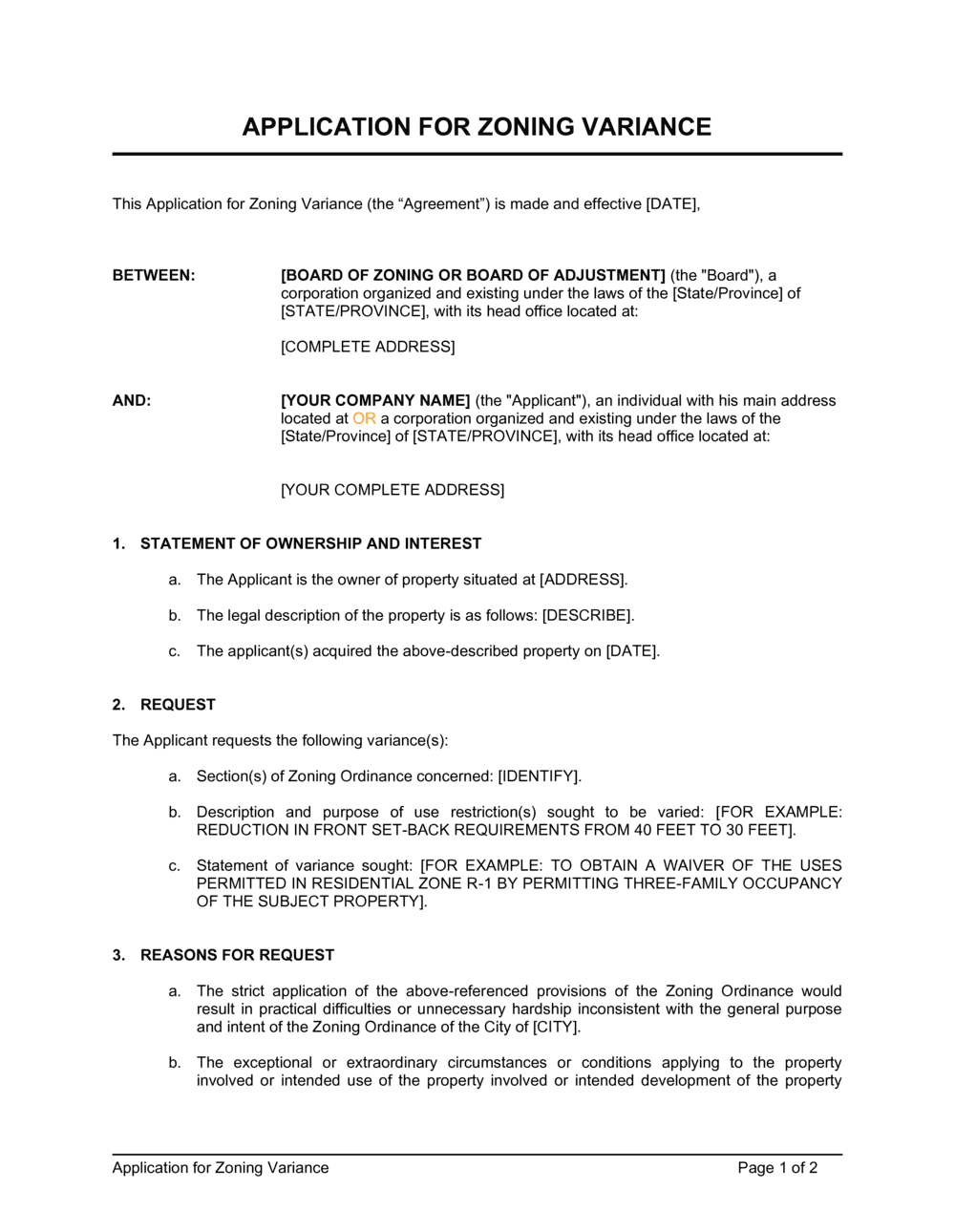
An Application for Zoning Variance is a structured form submitted to a local zoning board or planning commission requesting permission to deviate from a specific zoning regulation β€” such as setback distances, building height, lot coverage, or permitted use. This free Word download gives property owners, developers, and businesses a complete, editable form they can customize to their parcel and municipality, then export as PDF for official submission.
When you need it
Use it when a proposed construction project, building expansion, or land use does not conform to the applicable zoning code and requires board approval before permits can be issued. It is also needed when an existing nonconforming condition requires formal recognition by the municipality.
What's inside
Applicant and property owner contact details, parcel identification and zoning classification, description of the specific variance requested, written hardship justification, list of supporting documents, adjacent property owner notification record, and applicant certification.

What is an Application for Zoning Variance?

An Application for Zoning Variance is a structured form submitted to a local zoning board of appeals or planning commission requesting official permission to deviate from a specific requirement of the applicable zoning code for a defined parcel of land. Unlike a rezoning, which changes a property's classification permanently, a variance grants a narrow, property-specific exception β€” for example, building 8 feet from a rear lot line when 15 feet is required β€” based on a documented physical hardship unique to that parcel. Most municipalities require the application to identify the specific code section at issue, quantify the deviation, and provide a written hardship narrative supported by a site plan and survey before the request can be scheduled for a public hearing.

Why You Need This Document

Proceeding with construction or a change of use without a required variance is a serious compliance risk: building inspectors can issue stop-work orders, require demolition of unpermitted structures, and impose fines that accumulate daily until the violation is resolved. Many municipalities also require proof of variance approval before issuing a building permit, meaning the permit process stalls completely without it. A complete, well-organized application reduces the likelihood of being returned for missing information β€” which resets your hearing date by 4–8 weeks β€” and signals to the board that the hardship is genuine and the request is reasonable. This template gives you every required field in the correct order, with sample language and a supporting-documents checklist, so your first submission is your best submission.

Which variant fits your situation?

If your situation is…Use this template
Requesting relief from a dimensional standard such as setback, height, or lot coverageApplication for Zoning Variance (Dimensional)
Requesting permission to use a property in a way not allowed in the current zoneApplication for Use Variance
Challenging a zoning officer's interpretation of the codeZoning Appeal Application
Applying for a temporary exception to a zoning rule for a short-term projectTemporary Use Permit Application
Seeking approval for a use that is conditionally permitted under the zoning codeConditional Use Permit Application
Formally documenting an existing structure that predates current zoning regulationsNonconforming Use Certificate Application

Common mistakes to avoid

❌ Citing financial hardship instead of physical property hardship

Why it matters: Zoning boards are required by law to find a physical, property-specific hardship β€” not economic difficulty β€” as the basis for granting a variance. Applications that argue cost or inconvenience are routinely denied.

Fix: Frame the hardship around a measurable physical characteristic of the parcel: irregular geometry, existing encumbrances, utility easements, or natural topography that limits buildable area.

❌ Omitting the specific code section number

Why it matters: Without a code citation, staff cannot determine whether the request is a dimensional or use variance, which affects the notice requirements, hearing process, and approval standard.

Fix: Look up the exact section of the zoning ordinance that establishes the standard you cannot meet and cite it by chapter, article, and section number in the application.

❌ Submitting without a to-scale site plan

Why it matters: Board members cannot evaluate a setback or lot-coverage variance without a site plan that shows the proposed structure's dimensions and distance from all property lines.

Fix: Attach a site plan drawn to a stated scale showing the lot boundaries, existing structures, proposed construction, all setback distances, and the north arrow.

❌ Missing the notification deadline for adjacent property owners

Why it matters: Failure to notify neighbors within the required timeframe before the hearing is a procedural defect that forces postponement to the next hearing cycle, typically adding 4–6 weeks.

Fix: Check the municipality's notification rules immediately after your application is accepted as complete, calculate the deadline backward from the hearing date, and send certified mail with at least one day of buffer.

The 8 key fields, explained

Applicant and property owner information

Property description and parcel identification

Type of variance requested

Description of the variance requested

Hardship justification

Supporting documents checklist

Adjacent property owner notification record

Applicant certification and date

How to fill it out

  1. 1

    Confirm the applicable zoning code section

    Look up your property's current zoning district on your municipality's zoning map and identify the specific code section you need relief from before completing any field.

    πŸ’‘ Most municipal websites publish the zoning code and official zoning map online β€” search '[CITY NAME] zoning map' to find both in under five minutes.

  2. 2

    Enter applicant and property owner details

    Fill in the full legal name, address, and contact information for both the applicant and the record property owner. If they are the same person, state that explicitly.

    πŸ’‘ Use exactly the name that appears on the property deed β€” title companies and zoning staff cross-reference this against public records.

  3. 3

    Record the parcel identification number and legal description

    Find the PIN on your most recent property tax bill or the county assessor's website. Copy the legal description from the deed or survey.

    πŸ’‘ If the legal description is longer than one line, attach it as a separate exhibit rather than truncating it in the form field.

  4. 4

    Describe the specific variance with numbers

    State the required standard, the proposed deviation, and the exact difference in feet, percentage points, or other units. Be precise β€” vague descriptions are returned as incomplete.

    πŸ’‘ A one-sentence formula works well: 'Code requires X; proposed condition is Y; variance requested is the difference of Z.'

  5. 5

    Write the hardship justification

    Explain the physical characteristic of the property β€” lot shape, topography, existing easement, or other constraint β€” that makes compliance impossible or unreasonably burdensome. Keep it factual and property-specific.

    πŸ’‘ Review the board's past decisions (usually posted in meeting minutes) to see what hardship language has been accepted for similar requests.

  6. 6

    Assemble and label all required attachments

    Gather the survey, site plan, photographs, and any drawings required by local rules. Label each exhibit clearly and match the labels to the supporting-documents checklist on the form.

    πŸ’‘ Call the zoning office before submitting to confirm the current attachment requirements β€” some municipalities updated their checklists after COVID-era process changes and the published form may be outdated.

  7. 7

    Sign the certification and submit before the filing deadline

    Sign and date the certification block, then confirm the submission deadline for the next available hearing date β€” most boards meet monthly and have a cutoff 3–4 weeks before the hearing.

    πŸ’‘ Submit at least one week before the posted deadline to leave time for a completeness review and any minor corrections without losing your hearing slot.

Frequently asked questions

What is a zoning variance?

A zoning variance is official permission from a local zoning board to deviate from a specific requirement of the zoning code β€” such as a setback distance, building height limit, or lot coverage percentage β€” for a particular property. It does not change the zoning code itself; it grants an exception for one parcel based on documented hardship. Variances run with the land, meaning they transfer to future owners automatically.

What is the difference between a variance and a rezoning?

A rezoning changes the zoning classification of a parcel from one district to another β€” a legislative act that affects the land permanently and for all uses. A variance is a narrower, property-specific exception to one requirement within the existing zone and does not change the underlying zoning designation. Rezonings are decided by the city council or county commission; variances are typically decided by the zoning board of appeals.

What qualifies as a hardship for a zoning variance?

Most zoning codes define hardship as an unusual physical condition of the property β€” such as irregular lot shape, steep topography, an existing easement, or substandard lot size created before the current code took effect β€” that makes strict compliance with the zoning standard unreasonably burdensome. Economic difficulty, personal preference, and self-created hardship (such as a structure the owner already built without a permit) generally do not qualify.

How long does a zoning variance application take?

Processing time varies by municipality, but most zoning boards meet once a month with a submission deadline 3–4 weeks before the hearing. A complete, well-documented application is typically heard at the next available hearing after submission, making the minimum timeline 4–8 weeks. Applications returned for missing documents or neighbor notification errors reset to the following hearing cycle.

Do I need a lawyer to apply for a zoning variance?

For straightforward dimensional variances involving residential properties, most applicants complete the process without a lawyer using a standard application form and a clear hardship narrative. An attorney or land-use consultant adds value when the variance involves a use change, opposition from neighbors, a complex site, or when a prior denial must be overcome. Expect $500–$2,000 for professional assistance on a residential variance and $2,000–$10,000+ for commercial projects.

What happens if my zoning variance is denied?

A denial by the zoning board can typically be appealed to a higher administrative body or to the local circuit or district court within a defined window β€” often 30–45 days from the date of the decision. In some jurisdictions, you must wait 6–12 months before reapplying for the same variance unless conditions have materially changed. Check your local code for the exact appeal timeline and re-application waiting period.

Does a zoning variance transfer to a new owner if I sell the property?

Yes. A zoning variance is attached to the land, not the owner, and automatically transfers to subsequent buyers. The variance should be recorded with the local land records office so that it appears in a title search and is discoverable by future owners and their lenders.

Can I apply for a zoning variance before I own the property?

Many municipalities allow a prospective purchaser or contract holder to apply with written authorization from the current owner. This is common in real estate transactions where closing is contingent on variance approval. The application must typically identify both the current owner of record and the applicant, along with proof of the ownership interest such as a signed purchase agreement.

How this compares to alternatives

vs Conditional Use Permit Application

A conditional use permit (CUP) approves a use that is expressly listed in the zoning code as permissible with conditions β€” no hardship finding is required. A variance grants relief from a specific standard for a use that is already permitted but physically cannot comply with the code. Use a CUP when the code already anticipates your use; use a variance when a dimensional or physical constraint is blocking an otherwise permitted use.

vs Rezoning Application

A rezoning application asks the legislative body to change the zoning classification of a parcel to a new district β€” a permanent change affecting all future uses. A variance is a narrower, one-time exception to a specific requirement within the existing zone. Rezoning is appropriate when the current zone is fundamentally incompatible with intended use; a variance is appropriate when one technical standard is the only obstacle.

vs Building Permit Application

A building permit authorizes the physical construction of a structure that already conforms to all applicable codes and regulations. A zoning variance must be obtained before a building permit can be issued when the proposed construction does not meet current zoning standards. The variance comes first; the building permit follows once the variance is granted.

vs Special Exception Application

A special exception (or special use permit) grants approval for a use that the zoning code permits in a district subject to additional review β€” no hardship is required. A variance waives a specific numerical or use standard and does require a hardship finding. The distinction matters because the approval standard, required findings, and likelihood of approval differ between the two processes.

Industry-specific considerations

Real estate development

Developers routinely seek dimensional variances to maximize buildable area on infill lots where irregular geometry or legacy easements limit code-compliant designs.

Retail and hospitality

Restaurants and retailers in older commercial districts apply for parking, signage, or setback variances when historic building footprints predate current zoning standards.

Construction and trades

Contractors file variance applications on behalf of clients when site surveys reveal that a planned addition or accessory structure encroaches on required setback distances.

Professional services

Law firms, medical offices, and consulting practices converting residential properties to professional use often require use variances when the zoning district permits only residential occupancy.

Template vs pro β€” what fits your needs?

PathBest forCostTime
Use the templateResidential property owners seeking a standard dimensional variance with no neighbor oppositionFree (plus any municipal filing fee, typically $50–$500)2–4 hours to complete; 4–8 weeks for board review
Template + professional reviewSmall business owners, first-time applicants, or anyone with a complex site or anticipated neighbor objections$500–$2,000 for a land-use consultant or attorney review1–2 days to prepare with professional input; same 4–8 week board timeline
Custom draftedDevelopers, commercial projects, use variances, or reapplications after a prior denial$2,000–$10,000+ depending on project complexity and hearing representation1–3 weeks to prepare; 4–12 weeks for board review and potential appeal

Glossary

Zoning Variance
Official permission granted by a zoning board to deviate from a specific requirement of the local zoning code for a particular parcel.
Dimensional Variance
A variance that modifies a physical standard such as setback distance, building height, lot coverage percentage, or minimum lot size.
Use Variance
A variance that permits a land use not otherwise allowed in the applicable zoning district, such as a commercial use in a residential zone.
Hardship
An unusual condition of the property β€” such as irregular shape, topography, or lot size β€” that makes strict compliance with the zoning code unreasonably burdensome.
Setback
The minimum required distance between a structure and a property line, road, or other boundary established by the zoning code.
Parcel Identification Number (PIN)
A unique numeric code assigned by the local tax assessor to identify a specific piece of real property in the public record.
Zoning Board of Appeals (ZBA)
The municipal body authorized to hear variance requests, appeals of zoning decisions, and requests for special exceptions.
Nonconforming Use
A land use or structure that was legally established before the current zoning code took effect but does not comply with current regulations.
Lot Coverage
The percentage of a lot's total area that may be covered by impervious surfaces such as buildings, driveways, and patios under the applicable zoning code.
Adjacent Property Owner Notification
The formal process of notifying owners of properties within a defined radius β€” typically 100–300 feet β€” that a variance has been applied for, often required before a public hearing.

Part of your Business Operating System

This document is one of 3,000+ business & legal templates included in Business in a Box.

  • Fill-in-the-blanks β€” ready in minutes
  • 100% customizable Word document
  • Compatible with all office suites
  • Export to PDF and share electronically

Create your document in 3 simple steps.

From template to signed document β€” all inside one Business Operating System.
1
Download or open template

Access over 3,000+ business and legal templates for any business task, project or initiative.

2
Edit and fill in the blanks with AI

Customize your ready-made business document template and save it in the cloud.

3
Save, Share, Send, Sign

Share your files and folders with your team. Create a space of seamless collaboration.

Save time, save money, and create top-quality documents.

β˜…β˜…β˜…β˜…β˜…

"Fantastic value! I'm not sure how I'd do without it. It's worth its weight in gold and paid back for itself many times."

Managing Director Β· Mall Farm
Robert Whalley
Managing Director, Mall Farm Proprietary Limited
β˜…β˜…β˜…β˜…β˜…

"I have been using Business in a Box for years. It has been the most useful source of templates I have encountered. I recommend it to anyone."

Business Owner Β· 4+ years
Dr Michael John Freestone
Business Owner
β˜…β˜…β˜…β˜…β˜…

"It has been a life saver so many times I have lost count. Business in a Box has saved me so much time and as you know, time is money."

Owner Β· Upstate Web
David G. Moore Jr.
Owner, Upstate Web

Run your business with a system β€” not scattered tools

Stop downloading documents. Start operating with clarity. Business in a Box gives you the Business Operating System used by over 250,000 companies worldwide to structure, run, and grow their business.

Free Forever PlanΒ Β·Β No credit card required