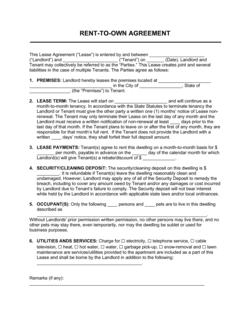
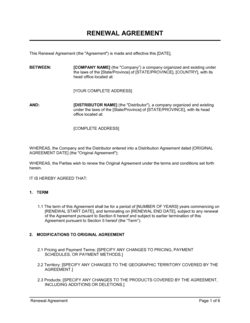
House Rental Agreement Template

Free Word download β€’ Edit online β€’ Save & share with Drive β€’ Export to PDF

2 pagesβ€’20–30 min to fillβ€’Difficulty: Standardβ€’Signature requiredβ€’Legal review recommended
Learn more ↓
FreeHouse Rental Agreement Template

At a glance

What it is
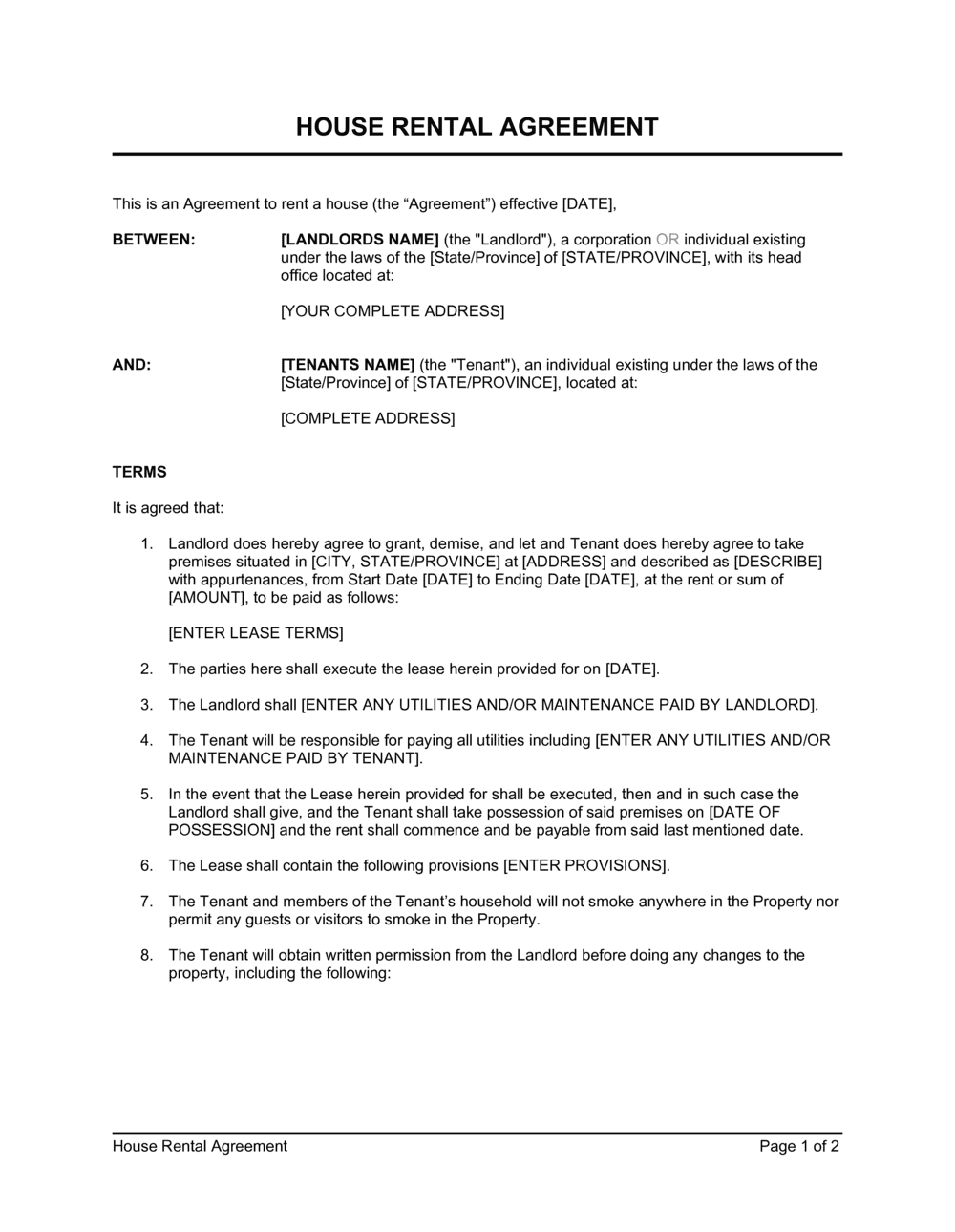
A House Rental Agreement is a legally binding contract between a landlord and a tenant that governs the rental of a residential property for a defined term. This free Word download covers rent amount and due date, security deposit, maintenance obligations, pet policies, and termination conditions in a single document you can edit online and export as PDF.
When you need it
Use it whenever you rent a house, single-family home, or private residence to a tenant β€” whether for a fixed 12-month term or on a month-to-month basis. Execute it before the tenant takes possession of the property.
What's inside
Parties and property description, lease term and rent payment schedule, security deposit terms, maintenance and repair responsibilities, permitted use and occupancy limits, pet and smoking policies, entry notice requirements, and termination and renewal conditions.

What is a House Rental Agreement?

A House Rental Agreement is a legally binding contract between a landlord and one or more tenants that governs the rental of a residential property β€” typically a single-family home β€” for a defined term. It records the rent amount and payment schedule, security deposit conditions, permitted occupants, maintenance responsibilities, pet and smoking policies, entry notice requirements, and the conditions under which either party may terminate the tenancy. Unlike an informal arrangement, a signed rental agreement creates enforceable obligations on both sides and serves as the authoritative document for resolving disputes, defending or pursuing deposit claims, and initiating eviction proceedings when necessary.

Why You Need This Document

Renting a home without a written agreement exposes both landlord and tenant to significant legal and financial risk. Without documented rent terms and a grace period, late fee disputes become credibility contests with no paper trail. Without a signed move-in inspection checklist attached to the agreement, deposit deductions at move-out are nearly impossible to defend β€” and in most jurisdictions, an unsupported deduction must be returned in full with penalties. For tenants, an unsigned or vague agreement provides no protection against mid-lease rent increases, unannounced landlord entry, or arbitrary eviction. Courts in every major jurisdiction apply local residential tenancy law to fill gaps in an informal arrangement β€” almost always in ways that neither party anticipated and neither may want. This template gives landlords a jurisdiction-adaptable starting point that covers every material term, and gives tenants a clear record of what they agreed to before they handed over a deposit.

Which variant fits your situation?

If your situation is…Use this template
Renting a house for a fixed 12-month termHouse Rental Agreement (Fixed Term)
Renting on a flexible month-to-month basisMonth-to-Month Rental Agreement
Renting a single apartment unit in a multi-unit buildingApartment Lease Agreement
Renting a furnished property for 30–90 daysShort-Term Rental Agreement
Renting a room within a shared occupied residenceRoom Rental Agreement
Renting commercial or mixed-use propertyCommercial Lease Agreement
Adding a new roommate to an existing tenancyRoommate Agreement

Common mistakes to avoid

❌ Setting a security deposit above the statutory cap

Why it matters: Most US states and Canadian provinces cap deposits at 1–2 months' rent. Overcharging exposes the landlord to statutory penalties β€” often double or triple the excess β€” and gives the tenant grounds to withhold rent.

Fix: Look up the specific deposit cap for the property's jurisdiction before finalizing the agreement and enter an amount at or below that limit.

❌ Failing to conduct a written move-in inspection

Why it matters: Without a signed baseline condition report, the landlord has no documented proof of pre-existing damage and cannot legally defend deposit deductions for items the tenant claims were present on arrival.

Fix: Attach a room-by-room move-in checklist with photos to the lease at signing, signed by both parties, and retain a copy for the full tenancy plus the applicable statute of limitations.

❌ No early termination clause

Why it matters: A tenant who breaks a fixed-term lease may only owe the landlord's actual re-letting costs β€” which are hard to prove and often far less than the remaining rent β€” unless the contract specifies a clear early termination fee.

Fix: Include a clause specifying the early termination fee (commonly 1–2 months' rent) and the notice period required, and confirm it is enforceable under local landlord-tenant law.

❌ Entering without proper notice

Why it matters: Landlord entry without the required advance notice violates the tenant's right to quiet enjoyment in every major jurisdiction and can give the tenant grounds to terminate the lease without penalty or pursue damages.

Fix: Always provide written notice β€” email with read receipt or a notice posted on the door β€” at least 24 to 48 hours before any non-emergency entry, and document each instance.

The 10 key clauses, explained

Parties, Property, and Lease Term

In plain language: Identifies the landlord and tenant by legal name, describes the rental property by full address, and states the start and end dates of the tenancy.

Sample language
This Residential Rental Agreement is entered into on [DATE] between [LANDLORD FULL NAME] ('Landlord') and [TENANT FULL NAME] ('Tenant'). Landlord agrees to rent to Tenant the property located at [PROPERTY ADDRESS] ('Premises') for the term commencing [START DATE] and ending [END DATE].

Common mistake: Using a nickname or trade name for the landlord entity instead of the registered legal owner. If the named landlord doesn't match title records, enforcing the lease or pursuing eviction can require additional court steps.

Rent Amount, Due Date, and Late Fees

In plain language: States the monthly rent, the date it is due each month, the grace period, and the late fee charged after the grace period expires.

Sample language
Tenant shall pay monthly rent of $[AMOUNT] on or before the [1st / 5th] day of each month. Rent not received by the [GRACE PERIOD] day shall incur a late fee of $[AMOUNT] or [X]% of monthly rent, whichever is greater.

Common mistake: Not specifying the grace period in writing. Without it, tenants dispute late fees as arbitrary, and courts in many jurisdictions require a reasonable grace period before fees apply.

Security Deposit

In plain language: Specifies the deposit amount, the conditions under which it can be withheld, and the deadline for returning it with an itemized statement after move-out.

Sample language
Tenant shall pay a security deposit of $[AMOUNT] upon execution of this Agreement. Landlord shall return the deposit, less any documented deductions for unpaid rent or damages beyond normal wear and tear, within [X] days of Tenant vacating the Premises.

Common mistake: Setting a deposit above the statutory cap. Most US states and Canadian provinces limit security deposits to 1–2 months' rent β€” exceeding the cap exposes the landlord to penalties equal to double or triple the excess.

Permitted Use and Occupancy

In plain language: Limits use of the property to residential purposes, names all authorized occupants, and restricts the number of persons who may reside on the premises.

Sample language
The Premises shall be used solely as a private residence by Tenant and the following occupants: [NAMES OF OCCUPANTS]. No additional occupants may reside at the Premises without prior written consent of Landlord.

Common mistake: Leaving the authorized occupant list blank. Undocumented occupants are harder to include in eviction proceedings, and the landlord may have no recourse against damages caused by unnamed residents.

Maintenance, Repairs, and Alterations

In plain language: Allocates repair responsibilities between landlord and tenant, requires the tenant to maintain the property in clean condition, and restricts alterations without written consent.

Sample language
Landlord shall maintain the Premises in habitable condition and repair structural defects, plumbing, heating, and appliances. Tenant shall keep the Premises clean and promptly report any damage. Tenant shall not make alterations, paint, or install fixtures without prior written consent of Landlord.

Common mistake: Assigning all repairs to the tenant in the lease. Courts in most jurisdictions impose a non-waivable habitability duty on landlords β€” clauses that transfer this obligation to tenants are void and may expose landlords to habitability lawsuits.

Pet Policy

In plain language: States whether pets are permitted, which species and number are allowed, and whether an additional pet deposit or monthly pet fee is required.

Sample language
Pets are [permitted / not permitted] on the Premises. If permitted, Tenant may keep [NUMBER AND TYPE OF PETS] subject to a non-refundable pet fee of $[AMOUNT] and/or a refundable pet deposit of $[AMOUNT]. Tenant is liable for all pet-related damage.

Common mistake: Charging a non-refundable 'pet deposit' in a jurisdiction that requires all deposits to be refundable. In many US states, all move-in funds held for damages must be treated as refundable security deposits subject to the same return rules.

Entry Notice and Landlord Access

In plain language: Requires the landlord to give advance written notice before entering the property for inspections, repairs, or showings, except in genuine emergencies.

Sample language
Landlord shall provide Tenant with at least [24 / 48] hours' written notice before entering the Premises for non-emergency purposes. In the event of an emergency, Landlord may enter immediately without prior notice.

Common mistake: Including no entry-notice requirement at all. Entering without proper notice violates the tenant's right to quiet enjoyment in every major jurisdiction and can give the tenant grounds to break the lease without penalty.

Subletting and Assignment

In plain language: Prohibits the tenant from subletting the property or assigning the lease to another person without the landlord's prior written consent.

Sample language
Tenant shall not sublet all or any portion of the Premises, nor assign this Agreement, without the prior written consent of Landlord. Any unauthorized sublet or assignment shall be grounds for termination of this Agreement.

Common mistake: Allowing subletting with verbal consent only. Oral approvals are nearly impossible to enforce β€” document every subletting consent in a signed addendum that names the subtenant and the approved period.

Termination, Notice, and Renewal

In plain language: States the notice period required to terminate or not renew the tenancy, conditions for early termination, and what happens if the tenant holds over past the end date.

Sample language
Either party may terminate this Agreement at end of term by providing [30 / 60] days' written notice before the expiration date. If Tenant remains in possession after the expiration date without a signed renewal, the tenancy shall convert to a month-to-month arrangement at the same rent and terms.

Common mistake: Failing to specify an early termination fee. Without one, tenants who break the lease mid-term may owe only the landlord's actual re-letting costs β€” which can be difficult and expensive to prove.

Governing Law and Dispute Resolution

In plain language: Specifies which jurisdiction's landlord-tenant law governs the agreement and how disputes are resolved β€” typically small claims court, mediation, or binding arbitration.

Sample language
This Agreement is governed by the laws of the State / Province of [JURISDICTION]. Any dispute arising hereunder shall be resolved in the [COUNTY / DISTRICT] courts of [JURISDICTION], or through mediation administered by [ORGANIZATION] if both parties consent.

Common mistake: Choosing a governing jurisdiction different from where the property is located. Residential tenancy law is local β€” courts apply the law of the property's location regardless of what the contract states.

How to fill it out

  1. 1

    Enter the parties and property details

    Use the landlord's full legal name (or registered entity name if holding title through an LLC or corporation) and the tenant's full legal name as it appears on their government-issued ID. Enter the complete street address of the rental property including unit number if applicable.

    πŸ’‘ If the property is held in an LLC, sign the agreement in the LLC's name β€” not your personal name β€” to preserve liability protection.

  2. 2

    Set the lease term and rent amount

    Choose a fixed-term start and end date or designate the tenancy as month-to-month. Enter the monthly rent amount, the day of the month it is due, the grace period in days, and the late fee amount or percentage.

    πŸ’‘ Confirm that your late fee complies with the statutory cap in your state or province before finalizing β€” many jurisdictions limit late fees to 5–10% of monthly rent.

  3. 3

    Document the security deposit terms

    Enter the deposit amount and confirm it does not exceed the statutory maximum for your jurisdiction (typically 1–2 months' rent). State the number of days after move-out by which the deposit must be returned along with an itemized deduction statement.

    πŸ’‘ Open a separate bank account for the deposit if required in your jurisdiction β€” commingling deposit funds with operating funds is a landlord violation in many states.

  4. 4

    Name all authorized occupants

    List every person who will reside in the property by full name. Include adults and any minors whose presence the landlord is aware of. Do not use 'and guests' as a substitute β€” guests who become regular occupants must be added by addendum.

    πŸ’‘ Screen all adult occupants through your standard tenant screening process, not just the primary applicant β€” each adult occupant is a financial and behavioral risk.

  5. 5

    Define the pet and smoking policies

    Choose permitted or not permitted for pets and state the types and number allowed. Specify whether there is a non-refundable pet fee, a refundable pet deposit, or a monthly pet rent surcharge. Add a clear no-smoking clause covering the interior, balconies, and common areas.

    πŸ’‘ Smoke remediation in a house can cost $3,000–$10,000 β€” a no-smoking clause with a specific remediation cost provision gives you a clear damages claim.

  6. 6

    Confirm the entry notice and maintenance obligations

    Set the advance notice period (24 or 48 hours is standard in most jurisdictions). List which appliances and systems the landlord maintains, and which routine tasks β€” lawn care, filter replacement, gutter cleaning β€” fall to the tenant.

    πŸ’‘ Attach a move-in inspection checklist signed by both parties at key handover β€” it becomes the baseline for security deposit deductions at move-out.

  7. 7

    Add termination and renewal terms

    State the notice period for non-renewal (30 days for month-to-month; 60 days for annual leases is typical), the early termination fee if applicable, and whether the lease converts to month-to-month or expires outright at the end of the fixed term.

    πŸ’‘ Set a calendar reminder 90 days before the lease end date to send the renewal offer or non-renewal notice β€” missing the notice window can obligate you to another full term in some jurisdictions.

  8. 8

    Sign before the tenant takes possession

    Both landlord and all adult tenants must sign the agreement before the keys are handed over. Collect the first month's rent and security deposit at signing, confirmed by a written receipt.

    πŸ’‘ Use a digital signing tool to timestamp execution and create an audit trail β€” especially important if the parties are in different locations at key handover.

Frequently asked questions

What is a house rental agreement?

A house rental agreement is a legally binding contract between a landlord and a tenant that sets out the terms under which the tenant is permitted to occupy a residential property. It records the rent amount and due date, lease term, security deposit conditions, maintenance responsibilities, and the grounds and process for termination. A signed rental agreement is the primary document used to resolve disputes, enforce lease obligations, and commence eviction proceedings if necessary.

What is the difference between a rental agreement and a lease?

The terms are often used interchangeably, but technically a lease refers to a fixed-term agreement β€” typically 6 or 12 months β€” while a rental agreement is a shorter arrangement, often month-to-month, that renews automatically unless either party gives notice. Both are legally binding contracts. Fixed-term leases give landlords greater rent certainty; rental agreements give both parties more flexibility.

How much security deposit can a landlord charge?

It depends on the jurisdiction. Most US states cap the security deposit at 1 to 2 months' rent β€” California at 2 months for unfurnished units, New York at 1 month, Texas at no statutory cap but must be reasonable. Canadian provinces generally limit deposits to half a month's or one month's rent. Charging above the cap exposes the landlord to statutory penalties and potential claims by the tenant.

Does a house rental agreement need to be notarized?

In most jurisdictions, a residential rental agreement is legally valid without notarization provided it is signed by both parties. Notarization is generally not required for leases of one year or less. Some states require notarization for leases longer than one year β€” Florida and Louisiana are examples. Check your specific state or provincial rules if the lease term extends beyond 12 months.

Can a landlord increase rent during a fixed-term lease?

Generally no β€” a fixed-term lease locks in the rent for the entire term unless the agreement explicitly includes a rent escalation clause with defined conditions and amounts. A landlord may increase rent for a renewal period with proper advance notice. Many jurisdictions, including California, Oregon, and several Canadian provinces, impose rent control limits on annual increases even at renewal.

What happens if a tenant doesn't move out at the end of the lease?

A tenant who stays past the end date without a signed renewal becomes a holdover tenant. In most jurisdictions, this converts the tenancy automatically to a month-to-month arrangement at the same rent and terms. The landlord can serve a notice to quit and begin eviction proceedings if the holdover is not agreed. Some leases include a holdover rent surcharge β€” typically 125–150% of monthly rent β€” to incentivize timely move-out.

What repairs is the landlord required to make?

Landlords are legally required to maintain the property in a habitable condition in every major jurisdiction. This includes functioning heat, running water, weatherproofing, and freedom from significant health or safety hazards such as mold, pest infestations, or broken locks. Lease clauses that purport to transfer these obligations entirely to the tenant are generally unenforceable. Routine maintenance tasks β€” lawn care, changing light bulbs, keeping the property clean β€” can legitimately be assigned to the tenant.

Do I need a lawyer to create a house rental agreement?

For a straightforward single-family residential rental in a single jurisdiction, a quality template is typically sufficient for most landlords. Engaging a lawyer is advisable when the property is held in an LLC or trust, when the tenancy involves special terms such as an option to purchase, when the tenant has a history of disputes, or when the property is in a jurisdiction with complex rent control or just-cause eviction laws such as California, New York City, or British Columbia.

Can a tenant sublet a rental house without permission?

In most cases, no. Residential leases typically prohibit subletting without the landlord's prior written consent. Unauthorized subletting is a material breach of the lease and grounds for eviction in most jurisdictions. Some jurisdictions β€” including parts of New York and British Columbia β€” give tenants limited statutory rights to sublet that cannot be entirely waived in the lease, so landlords should not unreasonably withhold consent.

How this compares to alternatives

vs Commercial Lease Agreement

A commercial lease governs the rental of office, retail, or industrial space for business use and carries significantly different legal protections β€” tenants have fewer statutory protections and must negotiate more terms from scratch. A house rental agreement is governed by residential tenancy law, which imposes mandatory protections for tenants on habitability, deposit return, and eviction procedure. Never use a commercial lease for a residential rental.

vs Room Rental Agreement

A room rental agreement covers renting a single room within a shared property where the landlord may also reside. A house rental agreement covers the entire property as a self-contained unit. The legal relationship, privacy expectations, and noise/common-area obligations differ substantially between the two arrangements.

vs Roommate Agreement

A roommate agreement is an internal document between co-tenants sharing a property β€” it governs how they split rent, chores, and common-area use among themselves but creates no obligations on the landlord. A house rental agreement is the primary contract between the landlord and all tenants. Both documents should exist simultaneously when multiple unrelated adults share a rental.

vs Month-to-Month Rental Agreement

A month-to-month rental agreement renews automatically each month and gives either party the right to terminate with 30 days' notice. A fixed-term house rental agreement locks in rent and terms for a defined period, offering the landlord greater income certainty and the tenant greater security against rent increases or eviction during the term. Use month-to-month for flexibility; use a fixed term for stability.

Industry-specific considerations

Residential Real Estate

Single-family home rentals require specific move-in inspection documentation and jurisdiction-specific deposit return timelines that differ from multi-unit apartment leases.

Property Management

Property managers operating portfolios across multiple jurisdictions need standardized lease templates that can be adapted to each state or province's disclosure and deposit requirements.

Corporate Housing and Relocation

Employer-sponsored housing arrangements often require short-term fixed terms, furnished-property addenda, and early termination provisions tied to employment status.

Estate and Trust Management

Executors and trustees renting inherited or trust-held residential properties must ensure the lease names the correct legal entity as landlord and complies with any probate court requirements before executing.

Jurisdictional notes

United States

Residential tenancy law is primarily state and local β€” there is no single federal residential lease statute. Security deposit caps range from one month's rent (New York) to no statutory cap (Texas). California, Oregon, and several cities impose rent control and just-cause eviction requirements that override lease terms. Landlords must provide federally mandated Lead Paint Disclosure for properties built before 1978. Some states require specific disclosures β€” such as the Arizona Landlord-Tenant Act summary β€” to be attached to every lease.

Canada

Each province has its own Residential Tenancies Act governing deposits, notice periods, rent increases, and eviction procedures. Ontario limits deposits to the last month's rent only β€” no damage deposit is permitted. British Columbia allows a damage deposit of up to half a month's rent. Quebec leases must use the mandatory standard lease form (Bail type) issued by the Tribunal administratif du logement. Rent increase rules vary widely: Ontario requires 90 days' notice and caps increases annually.

United Kingdom

Most private residential tenancies in England and Wales are Assured Shorthold Tenancies (ASTs) governed by the Housing Act 1988. Landlords must protect the security deposit in a government-approved Tenancy Deposit Scheme within 30 days of receipt and provide prescribed information to the tenant. A valid How to Rent guide, Energy Performance Certificate, and Gas Safety Certificate must be provided at the start of the tenancy. Scotland and Northern Ireland operate under separate tenancy frameworks with distinct rules.

European Union

Residential tenancy law varies significantly by EU member state and is not harmonized at the EU level. Germany (Mietrecht) provides tenants with strong protections including strict limits on rent increases (Mietpreisbremse in designated areas) and near-mandatory cause requirements for termination. France requires a mandatory written lease using a standard national form for unfurnished rentals. Spain and the Netherlands have their own separate tenancy frameworks. Landlords operating across multiple EU countries should obtain local legal advice for each jurisdiction.

Template vs lawyer β€” what fits your deal?

PathBest forCostTime
Use the templateIndividual landlords renting a single-family home on a standard 12-month term in a straightforward jurisdictionFree30 minutes
Template + legal reviewLandlords in rent-controlled cities, properties held in an LLC, or leases with non-standard terms such as option to purchase or tenant improvement allowances$200–$500 for a one-hour attorney review1–3 days
Custom draftedMulti-property portfolios, complex tenancy arrangements, jurisdictions with just-cause eviction laws, or corporate housing programs$500–$2,000+1–2 weeks

Glossary

Security Deposit
A sum paid by the tenant before move-in, held by the landlord to cover unpaid rent or damage beyond normal wear and tear, and returned within a statutory deadline after the tenancy ends.
Lease Term
The defined period during which the rental agreement is in force β€” typically 6 or 12 months for a fixed-term tenancy, or rolling on a month-to-month basis.
Holdover Tenancy
A situation where the tenant remains in the property after the lease term expires without signing a renewal β€” often converting automatically to a month-to-month arrangement under applicable law.
Normal Wear and Tear
Minor deterioration from ordinary residential use β€” scuff marks, small nail holes, faded paint β€” which the landlord generally cannot deduct from the security deposit.
Notice to Quit
A formal written notice from the landlord to the tenant demanding they vacate the premises by a specified date, typically required before commencing eviction proceedings.
Pro-Rated Rent
A partial month's rent calculated proportionally when the tenancy begins or ends mid-month, based on the daily rent rate.
Joint and Several Liability
A clause making each co-tenant individually responsible for the full rent and obligations of the lease, allowing the landlord to pursue any one tenant for the entire amount.
Quiet Enjoyment
The tenant's right to occupy and use the property without interference from the landlord, provided they comply with lease terms.
Eviction (Unlawful Detainer)
The legal process a landlord must follow to remove a tenant who has breached the lease or failed to vacate after proper notice β€” self-help eviction is illegal in all major jurisdictions.
Habitability
The landlord's legal obligation to maintain the property in a condition fit for human habitation β€” functioning heat, plumbing, weatherproofing, and freedom from significant health hazards.
Subletting
When a tenant rents all or part of the property to a third party (subtenant) for a portion of the original lease term β€” typically requires explicit landlord consent.

Part of your Business Operating System

This document is one of 3,000+ business & legal templates included in Business in a Box.

  • Fill-in-the-blanks β€” ready in minutes
  • 100% customizable Word document
  • Compatible with all office suites
  • Export to PDF and share electronically

Create your document in 3 simple steps.

From template to signed document β€” all inside one Business Operating System.
1
Download or open template

Access over 3,000+ business and legal templates for any business task, project or initiative.

2
Edit and fill in the blanks with AI

Customize your ready-made business document template and save it in the cloud.

3
Save, Share, Send, Sign

Share your files and folders with your team. Create a space of seamless collaboration.

Save time, save money, and create top-quality documents.

β˜…β˜…β˜…β˜…β˜…

"Fantastic value! I'm not sure how I'd do without it. It's worth its weight in gold and paid back for itself many times."

Managing Director Β· Mall Farm
Robert Whalley
Managing Director, Mall Farm Proprietary Limited
β˜…β˜…β˜…β˜…β˜…

"I have been using Business in a Box for years. It has been the most useful source of templates I have encountered. I recommend it to anyone."

Business Owner Β· 4+ years
Dr Michael John Freestone
Business Owner
β˜…β˜…β˜…β˜…β˜…

"It has been a life saver so many times I have lost count. Business in a Box has saved me so much time and as you know, time is money."

Owner Β· Upstate Web
David G. Moore Jr.
Owner, Upstate Web

Run your business with a system β€” not scattered tools

Stop downloading documents. Start operating with clarity. Business in a Box gives you the Business Operating System used by over 250,000 companies worldwide to structure, run, and grow their business.

Free Forever PlanΒ Β·Β No credit card required