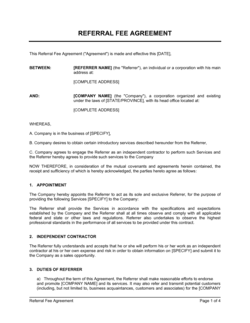
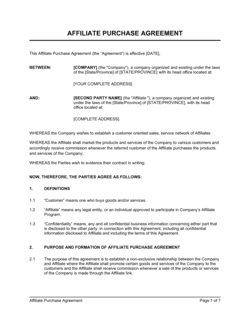
Referral Agreement Template

Free Word download • Edit online • Save & share with Drive • Export to PDF

7 pages25–35 min to fillDifficulty: ComplexSignature requiredLegal review recommended
Learn more ↓
FreeReferral Agreement Template

At a glance

What it is
A Referral Agreement is a legally binding contract between a referring party and a business that defines the terms under which the referrer introduces prospective clients or customers in exchange for a commission or fee. This free Word download gives you a structured, enforceable starting point you can edit online and export as PDF — covering fee structure, referral qualification, payment timing, exclusivity, and termination in a single document.
When you need it
Use it before any referral arrangement begins — when a partner, agent, affiliate, or individual will introduce paying customers to your business in exchange for compensation. It is equally important when you are the party being referred, to limit liability and define exactly which introductions qualify for a fee.
What's inside
Parties and relationship description, referral definition and qualification criteria, commission rate and payment schedule, exclusivity terms, term and termination provisions, confidentiality obligations, and governing law.

What is a Referral Agreement?

A Referral Agreement is a legally binding contract between a company and a referring party that defines the terms under which the referrer introduces prospective customers or clients in exchange for a commission or fee. It establishes exactly which introductions qualify for payment, how the fee is calculated, when it is paid, and what restrictions — on exclusivity, confidentiality, and post-termination conduct — apply to both sides. Without this document, the terms of even the most straightforward referral arrangement exist only in each party's memory, and those memories reliably diverge the moment a significant commission is at stake.

Why You Need This Document

Referral arrangements that start on a handshake frequently end in disputes about whether a specific customer qualifies, what the agreed rate actually was, or whether a fee is still owed after the relationship changes. A missing or vague referral agreement exposes you to open-ended commission claims on customers you may have already been pursuing independently, liability for statements your referral partner makes about your product without authorization, and fee disputes that require expensive litigation to resolve because there is no written standard to apply. In regulated industries — healthcare, financial services, and real estate — operating without a properly structured written agreement can also result in regulatory penalties entirely separate from the commercial dispute. This template gives you a clear, enforceable framework covering every material term before the first introduction is made, so that both parties understand exactly what they agreed to and what they are owed.

Which variant fits your situation?

If your situation is…Use this template
Paying a flat fee per closed deal to a single referring partnerReferral Agreement (Flat Fee)
Paying a percentage commission on recurring subscription revenueReferral Agreement (Percentage Commission)
Running a broad affiliate program with many online partnersAffiliate Marketing Agreement
Engaging a reseller to sell your product or service under their brandReseller Agreement
Appointing an agent with authority to negotiate deals on your behalfSales Agent Agreement
Referring clients between licensed professionals such as attorneys or financial advisorsProfessional Referral Fee Agreement
Rewarding existing customers for sending new customers to your businessCustomer Referral Program Agreement

Common mistakes to avoid

❌ No definition of a qualified referral

Why it matters: Without a written definition, any contact a referrer claims to have mentioned — even casually or years earlier — becomes a potential fee claim. Commission disputes are the most common litigation source in referral relationships.

Fix: Define the introduction method, prospect profile, and the specific triggering event — signed contract, paid invoice, funded account — required before any fee is owed. Add a written-introduction-only requirement.

❌ Paying commission on gross revenue instead of net

Why it matters: On a $50,000 contract with $8,000 in taxes, discounts, and chargebacks, a 10% gross commission overpays by $800 per deal. Multiplied across dozens of referrals, the error becomes material.

Fix: Define the commission base explicitly as net revenue, specifying which deductions apply — taxes, refunds, discounts, processing fees — and include a sample calculation in the agreement.

❌ No tail period on termination

Why it matters: A referrer who introduced a prospect one week before termination loses all compensation if no tail period exists — creating a financial incentive to dispute the termination date and a reputational risk for your business.

Fix: Include a 60–90 day tail period covering any qualified referral introduced in writing before the termination date, payable on the normal schedule if the prospect converts within the tail window.

❌ Omitting the independent contractor declaration

Why it matters: Without explicit independent contractor language, a referrer's unauthorized statements — promising features, quoting prices, implying exclusivity — can be attributed to the company as apparent agency, creating binding obligations and misrepresentation liability.

Fix: Add a clear independent contractor clause stating the referrer has no authority to make representations, incur obligations, or bind the company in any way, and include a no-authority-to-bind warranty in the representations section.

❌ Granting exclusivity without defining its scope

Why it matters: A referrer who holds an exclusive arrangement for an undefined market or territory can block your entire business development strategy, and courts may void an overbroad exclusivity clause — leaving you with no enforceable agreement at all.

Fix: Define exclusivity narrowly: specify the exact industry segment, geographic territory, and customer size that the exclusivity covers, and include a performance threshold the referrer must hit to maintain exclusive status.

❌ No dispute window for commission statements

Why it matters: Without a time limit to dispute payment reports, a referrer can challenge commission calculations years after the fact — when deal records, CRM data, and the employees involved may no longer be available.

Fix: Add a 30-day dispute window: commission statements not challenged within 30 days of delivery are deemed accepted and final, subject to good-faith correction for mathematical errors.

The 10 key clauses, explained

Parties and relationship

In plain language: Identifies the company receiving referrals and the referring party by their full legal names, and explicitly states that the referring party is an independent contractor — not an employee or agent with authority to bind the company.

Sample language
This Referral Agreement ('Agreement') is entered into as of [DATE] between [COMPANY LEGAL NAME], a [STATE/COUNTRY] [ENTITY TYPE] ('Company'), and [REFERRER LEGAL NAME / ENTITY] ('Referrer'). Referrer is an independent contractor and has no authority to bind Company to any contract or obligation.

Common mistake: Omitting the independent contractor declaration. Without it, a referrer's actions — like promising a discount to a prospect — can be attributed to the company as apparent authority, creating binding obligations the company never intended.

Referral definition and qualification criteria

In plain language: Defines precisely what constitutes a qualifying referral — the customer type, the introduction method required, and the action the prospect must take before a fee is owed.

Sample language
A 'Qualified Referral' means a prospective customer (a) identified in writing by Referrer to Company via [EMAIL / CRM ENTRY] prior to any prior contact by Company, (b) who is not already in Company's database as of the date of introduction, and (c) who executes a [CONTRACT / PURCHASE] with Company within [X] days of introduction.

Common mistake: Failing to define when a referral is 'qualified' in writing. Disputes almost always arise from this gap — a referrer claims a customer they mentioned casually months ago entitles them to a fee when that customer eventually signs.

Commission rate and calculation basis

In plain language: States the exact fee or percentage the referrer earns, whether it applies to the first transaction only or on recurring revenue, and the base amount on which the commission is calculated — gross revenue, net revenue, or contract value.

Sample language
Company shall pay Referrer a commission of [X]% of the net revenue received from each Qualified Referral during the first [12] months of that customer's relationship with Company. 'Net revenue' excludes taxes, refunds, and chargebacks.

Common mistake: Saying 'X% of revenue' without specifying gross versus net. A referrer expecting 10% of gross invoice value and a company calculating 10% after discounts, taxes, and chargebacks will produce materially different numbers on the same sale.

Payment schedule and reporting

In plain language: Sets out when commission payments are made — monthly, quarterly, or per-deal — what documentation the company provides to support each payment, and how long the referrer has to dispute a statement.

Sample language
Company shall pay earned commissions within [30] days after the end of each calendar month, accompanied by a summary report of Qualified Referrals, contract values, and commission calculations. Referrer must raise any dispute within [30] days of receiving a report or the statement is deemed accepted.

Common mistake: No dispute window. Without one, a referrer can challenge commission statements years later — long after the underlying deal records may be unavailable or inconsistent.

Exclusivity

In plain language: States whether the referral relationship is exclusive — restricting either party from similar arrangements with competitors — or non-exclusive, allowing both parties to work with others in the same market.

Sample language
This Agreement is [non-exclusive / exclusive within the territory of [TERRITORY]]. During the Term, [Referrer / Company / neither party] shall not enter into a referral or commission arrangement with [COMPETITOR DESCRIPTION] without prior written consent.

Common mistake: Defaulting to exclusivity without defining the scope. An overbroad exclusivity clause can inadvertently prevent a referring partner from earning income in their existing business and may be unenforceable as an unreasonable restraint of trade.

Term and termination

In plain language: Sets the initial term of the agreement, whether it renews automatically, the notice period required to terminate, and which provisions survive termination — particularly the tail period for fees on pending referrals.

Sample language
This Agreement commences on [DATE] and continues for [12] months, renewing automatically for successive [12]-month periods unless either party provides [30] days' written notice of non-renewal. Either party may terminate for material breach on [15] days' written notice with opportunity to cure. Sections [CONFIDENTIALITY, TAIL PERIOD, GOVERNING LAW] survive termination.

Common mistake: No tail period for referrals in progress at termination. A referrer who introduced a prospect one week before termination deserves a fee if that prospect closes — without a tail clause, the company can terminate and pocket the deal without paying.

Confidentiality

In plain language: Restricts the referring party from disclosing or using the company's pricing, customer lists, proprietary processes, or other non-public information accessed through the referral relationship.

Sample language
Referrer shall not disclose or use any Confidential Information of Company for any purpose other than performing under this Agreement. 'Confidential Information' includes pricing, customer data, product roadmaps, and any information designated as confidential by Company in writing.

Common mistake: No confidentiality clause at all. Referrers naturally learn about pricing and deal terms while facilitating introductions — without restrictions, that information can flow directly to competitors or be used to negotiate against the company.

Intellectual property and use of marks

In plain language: Grants the referrer a limited, non-transferable license to use the company's name and logo when making introductions, and restricts any other use of the company's brand without prior written approval.

Sample language
Company grants Referrer a limited, non-exclusive, revocable license to use Company's trade name and logo solely for making introductions under this Agreement. Referrer shall not alter Company's marks or use them in any manner that could imply endorsement beyond the scope of this Agreement.

Common mistake: No IP clause. Referrers sometimes create their own marketing materials using the company's logo or claim an endorsement relationship that does not exist — creating trademark and reputational exposure the company never authorized.

Representations and warranties

In plain language: Each party confirms they have the authority to enter the agreement, that they will comply with applicable laws, and that the referrer will not make representations about the company's products beyond what the company has authorized in writing.

Sample language
Each party represents that it has full authority to enter into this Agreement. Referrer represents that it will not make any representation, warranty, or guarantee about Company's products or services beyond those set out in materials expressly provided by Company.

Common mistake: Referrer makes unauthorized claims about the product to close a referral faster. If the prospect relies on those claims and the product doesn't deliver, the company may face liability for misrepresentation it never authorized.

Governing law and dispute resolution

In plain language: Specifies the jurisdiction whose law governs the agreement and the method for resolving disputes — litigation, arbitration, or mediation first — including the venue and choice of language.

Sample language
This Agreement is governed by the laws of [STATE / PROVINCE / COUNTRY], without regard to conflict-of-law principles. Any dispute shall be resolved by binding arbitration administered by [AAA / JAMS] in [CITY], except either party may seek injunctive relief in a court of competent jurisdiction.

Common mistake: No dispute resolution clause. Without one, every fee disagreement defaults to potentially expensive litigation in a court that may be inconvenient for either party — and small commission disputes rarely justify the cost.

How to fill it out

  1. 1

    Identify both parties with full legal names

    Enter the company's registered legal entity name and the referring party's full legal name or entity name. If the referrer is an individual operating under a trade name, include both.

    💡 Confirm the referrer's entity structure before signing — a sole proprietor, LLC, and corporation have different tax reporting and liability implications for the fee payments you will make.

  2. 2

    Define what counts as a qualified referral

    Write out the exact introduction method required — email, CRM entry, or written introduction — the customer profile that qualifies, and the action the prospect must take (sign a contract, complete a purchase, fund an account) before a fee is owed.

    💡 Add a lookback exclusion: state that prospects already in your CRM or pipeline before the referrer's introduction date do not qualify, and set the date explicitly.

  3. 3

    Set the commission rate and calculation base

    Specify the percentage or flat fee, whether it applies to the first transaction only or on recurring revenue for a defined period, and define the revenue base — net of taxes, refunds, and discounts.

    💡 If you pay on recurring revenue, cap the tail at 12 or 24 months to limit open-ended commission liability on customers who stay for years after the referrer's involvement ends.

  4. 4

    Establish the payment schedule and reporting format

    State the payment frequency (monthly is standard), the number of days after period close you will remit payment, and what commission statement you will provide. Add a 30-day dispute window.

    💡 Name the specific payment method — ACH, wire, check — to avoid later friction. International referrers often need wire details and currency specified upfront.

  5. 5

    Decide on exclusivity and territory

    Choose non-exclusive unless there is a specific commercial reason for exclusivity. If you grant exclusivity, define the territory, industry segment, or customer type it covers — not a blanket market restriction.

    💡 Non-exclusive agreements are easier to enforce and leave you free to build a broader referral network. Exclusive arrangements require higher commission rates to be commercially reasonable.

  6. 6

    Set the term, renewal, and tail period

    Set an initial term (12 months is typical), automatic renewal with written notice to cancel, and a tail period of 60–90 days for referrals already in progress at termination.

    💡 List the clauses that survive termination explicitly — confidentiality, non-solicitation, governing law, and the tail period — rather than relying on a generic 'survival' statement.

  7. 7

    Add a non-solicitation clause proportionate to the relationship

    Restrict the referrer from directly soliciting your customers or employees for a defined period — typically 12 months post-termination — limited to customers they were introduced to through the agreement.

    💡 Tie the non-solicitation to customers the referrer actually met or introduced, not all customers of your business. Overbroad restrictions are challenged and can void the clause entirely.

  8. 8

    Execute before any introductions are made

    Both parties must sign the agreement before the first referral is made. Retroactive agreements covering referrals already made face enforceability challenges and create ambiguity about which introductions qualify.

    💡 Use a dated signature block with the agreement effective date equal to or before the first introduction. If using e-signature, ensure the platform timestamps execution to the minute.

Frequently asked questions

What is a referral agreement?

A referral agreement is a legally binding contract between a company and a referring party that defines the terms under which the referrer introduces prospective customers in exchange for a commission or fee. It specifies what constitutes a qualifying referral, how the fee is calculated, when it is paid, and what restrictions apply to both parties. It is the primary document that prevents commission disputes from escalating into litigation.

What should a referral agreement include?

At minimum, a referral agreement should cover: a precise definition of what counts as a qualifying referral, the commission rate and calculation base, the payment schedule and reporting format, a dispute window for commission statements, the term and termination provisions including a tail period, confidentiality obligations, an independent contractor declaration, and governing law. Missing any of these creates gaps that typically resolve in favor of the referrer in a dispute.

Is a referral agreement legally binding?

Yes — a referral agreement is generally enforceable as a binding contract when it includes an offer, acceptance, and consideration (the commission), and is signed by both parties. Enforceability depends on the jurisdiction and the specific terms. In regulated industries such as real estate, financial services, and healthcare, referral fee arrangements are subject to additional legal requirements that may restrict or prohibit certain fee structures entirely.

What is a typical referral fee or commission rate?

Referral fees vary widely by industry and deal size. Common ranges are 5–15% of the first transaction for professional services and SaaS, 10–25% for one-time product sales, and flat fees of $100–$1,000 per closed deal for lower-value transactions. In real estate, referral fees between licensed agents are typically 20–35% of the receiving agent's commission. Always confirm that the rate is commercially viable over the expected volume before signing.

What is the difference between a referral agreement and an affiliate agreement?

A referral agreement typically involves a known partner making direct introductions — by email, phone, or in-person — to specific prospects. An affiliate agreement covers a broader, often automated online model where the affiliate drives traffic through tracked links, ads, or content, and is paid per click, lead, or sale. Referral agreements tend to cover higher-value, lower-volume B2B introductions; affiliate agreements suit higher-volume, lower-value consumer or SaaS transactions.

Can a referral agreement be exclusive?

Yes, but exclusivity should be granted carefully and defined narrowly. An exclusive referral agreement prevents you from working with other referrers in the same territory or market segment, which is only commercially reasonable if the referrer delivers sufficient volume. Most referral agreements are non-exclusive. If you do grant exclusivity, include a minimum performance threshold — a specific number of qualified referrals per quarter — that the referrer must meet to maintain the exclusive status.

Do I need a referral agreement for an informal arrangement?

Yes — informal referral arrangements are among the most common sources of commercial disputes. When a friend or business contact introduces a client and that client becomes a significant revenue source, the absence of a written agreement creates competing recollections about whether a fee was owed and at what rate. A one-page signed agreement eliminates that risk entirely and costs less than one hour of legal fees to prepare.

What happens to referral fees when the agreement is terminated?

Without a tail period clause, termination ends all fee obligations immediately — including for referrals already introduced but not yet converted. A well-drafted agreement includes a tail period of 60–90 days covering prospects introduced in writing before the termination date, with fees payable on the normal schedule if those prospects convert within the window. Always list the tail period clause as a surviving obligation in the termination section.

How this compares to alternatives

vs Affiliate Marketing Agreement

An affiliate agreement covers high-volume, automated online referral traffic driven through tracked links, ad placements, and content — typically for consumer or SaaS products. A referral agreement covers lower-volume, direct B2B introductions where the referrer personally knows the prospect. The qualifying event, tracking method, and fee structure differ significantly between the two models.

vs Sales Agent Agreement

A sales agent agreement appoints a representative with authority to negotiate prices, close deals, and act on the company's behalf within defined limits. A referral agreement only authorizes introductions — the referrer has no authority to negotiate or bind the company. If your partner will be closing deals, not just making introductions, a sales agent agreement is the correct document.

vs Reseller Agreement

A reseller agreement gives the reseller the right to purchase and sell the company's product or service under their own commercial relationship with the end customer. A referral partner never holds that commercial relationship — they simply introduce the prospect to the company. Reseller margins and referral commissions are calculated on entirely different bases.

vs Non-Disclosure Agreement

An NDA protects confidential information shared between parties during discussions. A referral agreement governs the commercial terms of an ongoing introduction relationship — and should include its own confidentiality clause. If you are still evaluating whether to enter a referral relationship, sign an NDA first; once terms are agreed, replace or supplement it with the full referral agreement.

Industry-specific considerations

Technology / SaaS

Commission on monthly or annual recurring revenue with a 12–24 month revenue tail; integration partner referral programs; tracking via CRM tagging and unique referral codes.

Professional Services

Cross-referral arrangements between accountants, lawyers, and financial advisors; fee-splitting restrictions under professional conduct rules; written introduction requirements to document the qualifying event.

Real Estate

Agent-to-agent referral fees typically 20–35% of the receiving agent's commission; state licensing board disclosure requirements; RESPA compliance for mortgage-related referrals.

Financial Services

Securities law restrictions on referral fees for investment products; registered investment advisor solicitor agreements under SEC rules; Anti-Kickback considerations for insurance and lending referrals.

Healthcare

Federal Anti-Kickback Statute prohibits cash referral fees for federally funded patient referrals; safe harbor provisions govern permitted arrangements; non-monetary referral incentives require careful structuring.

Retail / E-commerce

Affiliate-style referral programs with tracked discount codes; flat fee per converted sale; clawback provisions for returned orders within the refund window.

Jurisdictional notes

United States

Referral fee enforceability varies by state and industry. RESPA prohibits unearned fees in real estate settlement services; the Anti-Kickback Statute restricts healthcare referral payments involving federal programs; SEC rules limit referral fees for investment advisory services to registered solicitors. In unregulated industries, referral agreements are generally enforceable as standard commercial contracts under applicable state law. California, New York, and Texas each have state-specific rules affecting commission-based arrangements.

Canada

Referral fees in Canada are governed by both federal and provincial law. In real estate, provincial real estate acts in Ontario, BC, and Alberta restrict referral fees to licensed registrants. Financial services referral arrangements are subject to IIROC and provincial securities commission rules. For unregulated commercial referral arrangements, agreements are enforceable as contracts under provincial law, and Quebec agreements should be prepared in French for provincially regulated entities.

United Kingdom

UK referral fee rules are industry-specific. The Legal Services Act 2007 and Solicitors Regulation Authority rules restrict solicitor referral fee arrangements. The Financial Conduct Authority regulates introducer arrangements for financial products and requires FCA registration in many cases. In non-regulated commercial contexts, referral agreements are enforceable as standard contracts under English contract law. Post-Brexit, UK rules diverge from EU requirements and should be reviewed independently.

European Union

EU referral arrangements must account for GDPR requirements when personal data about referred prospects is shared between parties — a data processing or data sharing clause may be required. Financial services referral arrangements are subject to MiFID II inducement rules across member states. Labor law characterization risks vary by country: in France and Germany, a long-term exclusive referral arrangement with an individual may be reclassified as an employment relationship. Commercial referral agreements between businesses are generally enforceable under each member state's contract law.

Template vs lawyer — what fits your deal?

PathBest forCostTime
Use the templateStandard B2B referral arrangements in unregulated industries with a single referral partnerFree20–30 minutes
Template + legal reviewArrangements involving exclusivity, multi-year commission tails, or partners in a different jurisdiction$300–$6001–3 days
Custom draftedRegulated industries (healthcare, financial services, real estate), high-value commission arrangements, or multi-party referral networks$1,000–$3,500+1–2 weeks

Glossary

Referral Fee
A one-time or recurring payment made to a referring party in exchange for introducing a customer who completes a qualifying transaction.
Qualified Referral
A prospective customer introduced by the referrer who meets the specific criteria defined in the agreement — such as signing a contract, completing a purchase, or funding an account.
Commission Rate
The percentage of a transaction value or a fixed dollar amount that the referring party earns when a qualified referral converts.
Tail Period
A defined window after the agreement terminates during which the referring party still earns fees on leads they introduced before termination.
Exclusivity
A contractual restriction limiting either party from entering into similar referral arrangements with competitors during the agreement term.
Warm Introduction
A referral in which the referring party personally connects the prospect to the company, as opposed to simply providing a name or contact detail.
Clawback
A provision requiring the referring party to return a previously paid fee if the underlying deal cancels, the customer churns within a defined period, or payment is reversed.
Independent Contractor Status
A clause clarifying that the referring party is not an employee, agent with authority to bind the company, or partner — limiting the company's legal and tax exposure.
Tracking Mechanism
The agreed method — unique referral codes, tracked URLs, written introductions, or CRM tagging — used to attribute a customer to a specific referring party.
Non-Solicitation
A restriction preventing the referring party from directly soliciting the company's customers or employees during or after the agreement term.
Governing Law
The jurisdiction whose laws control interpretation and enforcement of the agreement, typically the state or country where the company is headquartered.

Part of your Business Operating System

This document is one of 3,000+ business & legal templates included in Business in a Box.

  • Fill-in-the-blanks — ready in minutes
  • 100% customizable Word document
  • Compatible with all office suites
  • Export to PDF and share electronically

Create your document in 3 simple steps.

From template to signed document — all inside one Business Operating System.
1
Download or open template

Access over 3,000+ business and legal templates for any business task, project or initiative.

2
Edit and fill in the blanks with AI

Customize your ready-made business document template and save it in the cloud.

3
Save, Share, Send, Sign

Share your files and folders with your team. Create a space of seamless collaboration.

Save time, save money, and create top-quality documents.

★★★★★

"Fantastic value! I'm not sure how I'd do without it. It's worth its weight in gold and paid back for itself many times."

Managing Director · Mall Farm
Robert Whalley
Managing Director, Mall Farm Proprietary Limited
★★★★★

"I have been using Business in a Box for years. It has been the most useful source of templates I have encountered. I recommend it to anyone."

Business Owner · 4+ years
Dr Michael John Freestone
Business Owner
★★★★★

"It has been a life saver so many times I have lost count. Business in a Box has saved me so much time and as you know, time is money."

Owner · Upstate Web
David G. Moore Jr.
Owner, Upstate Web

Run your business with a system — not scattered tools

Stop downloading documents. Start operating with clarity. Business in a Box gives you the Business Operating System used by over 250,000 companies worldwide to structure, run, and grow their business.

Free Forever Plan · No credit card required