1
Identify the parties and classification
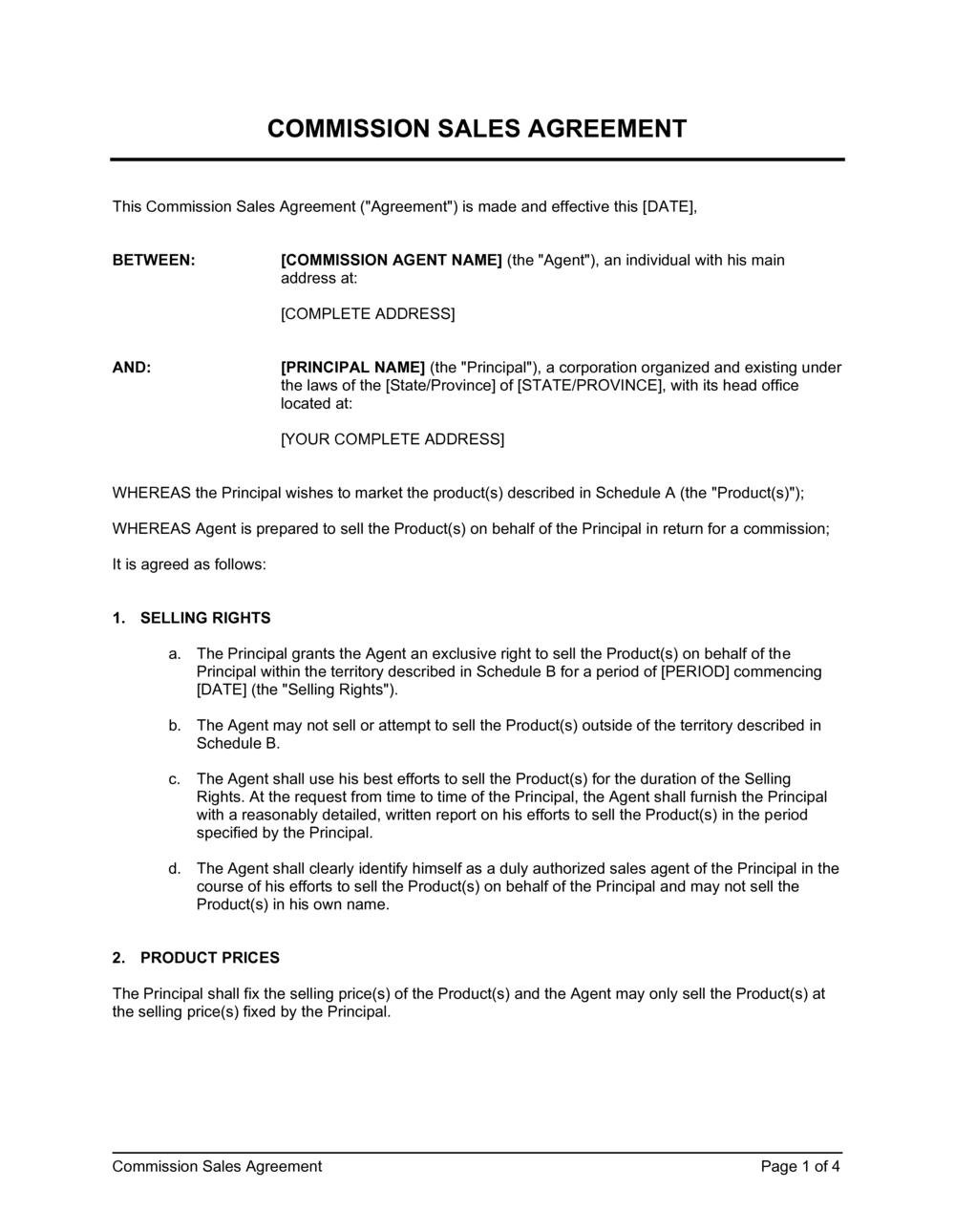
Enter the company's full legal entity name and the sales representative's legal name or business entity name. Select and clearly state whether the rep is an independent contractor or an employee — this single choice affects tax withholding, benefits obligations, and termination rights.
💡 If in doubt about classification, use the IRS 20-factor test or CRA worker classification guidelines before completing this section.
2
Define the territory and product scope
Specify the geographic territory by state, province, country, or postal code range. List the exact products or services the rep is authorized to sell. State whether the territory is exclusive or non-exclusive.
💡 If granting an exclusive territory, add a Schedule A with a minimum quarterly revenue threshold — failure to meet it converts the territory from exclusive to non-exclusive automatically.
3
Set the commission rate and calculation base
Enter the commission percentage or flat rate and define the base it applies to — gross invoice, net invoice after returns and discounts, or collected cash. Add any tiered rate structure triggered by quota attainment.
💡 Define 'Net Sales Price' precisely in the definitions section to prevent disputes when discounts or freight charges are deducted.
4
Define when commission is earned
Choose the earning trigger — order accepted, invoice issued, or customer payment received — and state it explicitly. This single clause determines who bears credit risk if a customer defaults.
💡 Payment-on-receipt is most common for new or untested customers; order-acceptance is appropriate when the company has strong credit controls and invoice financing.
5
Set the payment schedule and statement requirement
State the payment frequency (monthly is most common), the deadline after period close, and the requirement to include an itemized commission statement with each payment.
💡 Build a commission statement template and attach it as Schedule B — this prevents disputes and reduces back-and-forth at each payment cycle.
6
Configure clawback terms and the tail period
Set the clawback trigger (cancellation, chargeback, or non-payment within X days) and the window during which clawback can be exercised. Separately, define the tail period — how long after termination the rep earns commission on pipeline deals.
💡 A 60–90 day clawback window for non-payment is commercially standard; anything beyond 120 days is routinely contested.
7
Draft the non-solicitation and confidentiality scope
Limit the non-solicitation to customers the rep actually contacted, worked with, or had access to. Set a defined duration of 6–12 months. Describe Confidential Information specifically — pricing, customer lists, product roadmaps.
💡 Avoid blanket non-competes unless your jurisdiction permits them and the role genuinely warrants it — courts void them frequently, taking the non-solicitation clause with them.
8
State the term, notice period, and cause definition
Choose at-will with a 30-day notice period or a fixed term with a renewal clause. Define Cause with specific examples (fraud, material breach, competing without consent). State that termination does not forfeit earned but unpaid commissions.
💡 Always include a survival clause confirming that confidentiality, non-solicitation, and commission tail provisions survive termination of the main agreement.