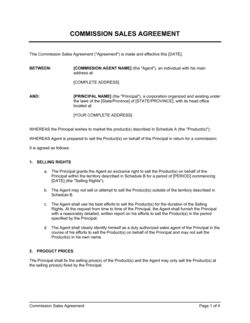
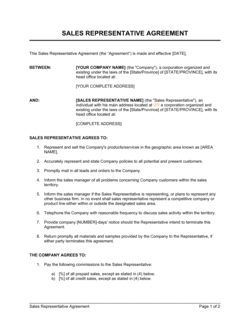
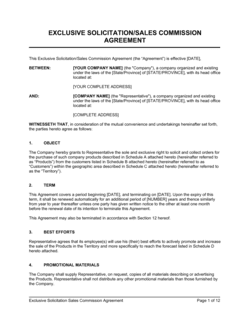
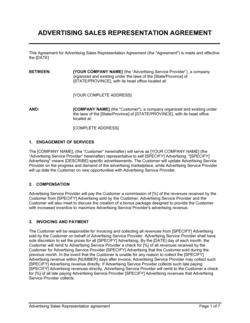
Commission Referral Agreement Template

Free Word download β€’ Edit online β€’ Save & share with Drive β€’ Export to PDF

5 pagesβ€’25–35 min to fillβ€’Difficulty: Complexβ€’Signature requiredβ€’Legal review recommended
Learn more ↓
FreeCommission Referral Agreement Template

At a glance

What it is
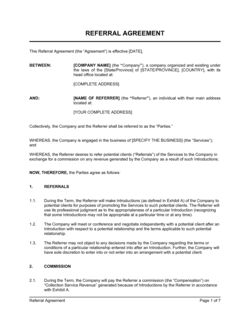
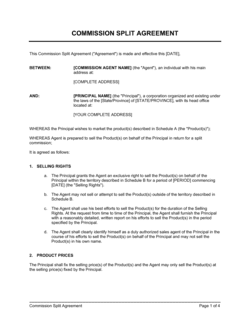
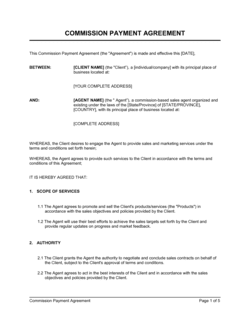
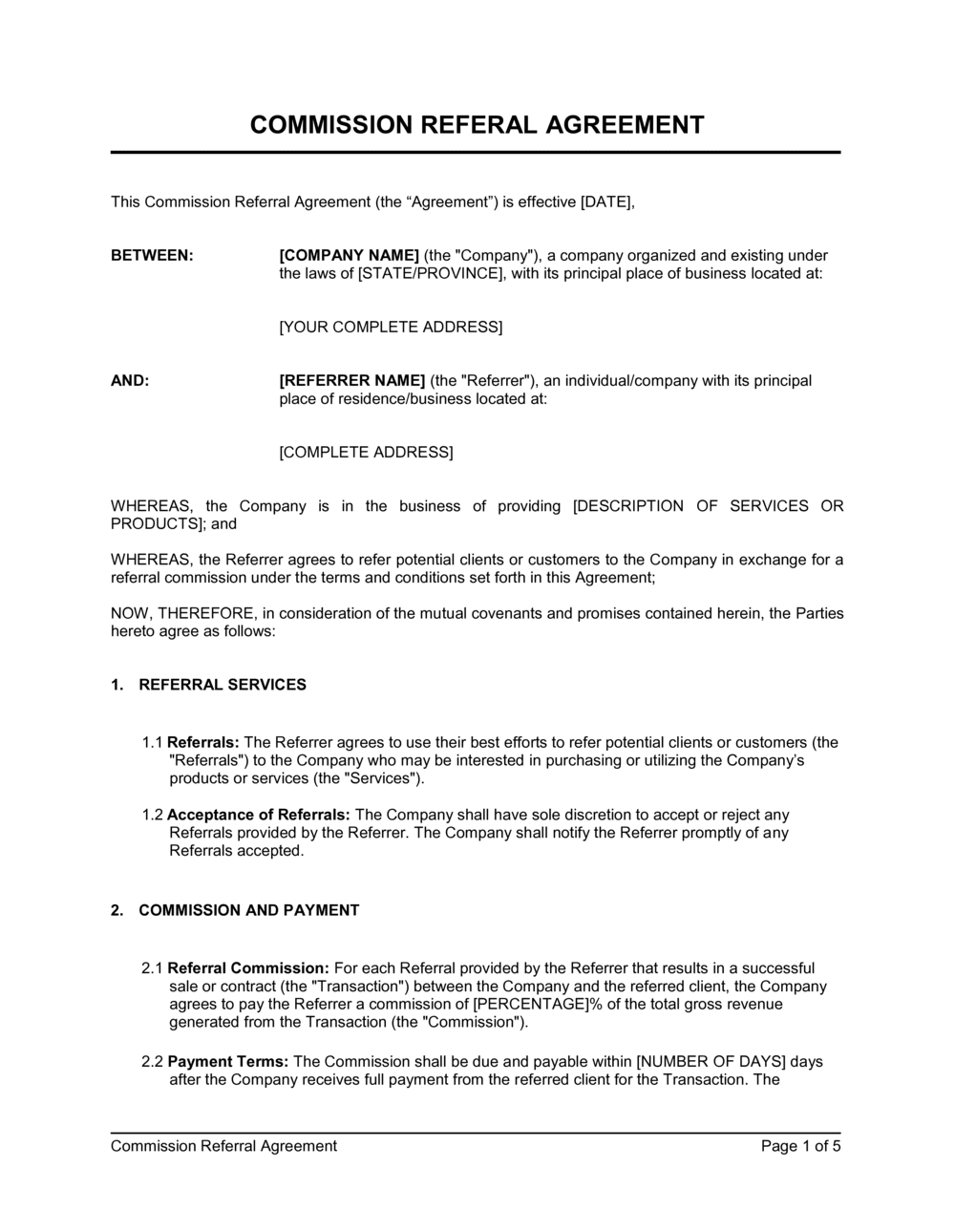
A Commission Referral Agreement is a legally binding contract between a business and a referring party that sets the terms under which the referrer earns a commission for introducing paying customers or clients. This free Word download gives you a structured, attorney-reviewed starting point you can edit online and export as PDF β€” covering referral fee percentage, payment triggers, exclusivity, term, and termination in a single document.
When you need it
Use it when you pay individuals, businesses, or partners a fee for sending customers your way β€” before the first referral is made and before any money changes hands. It protects both parties from disputes over whether a commission is owed, what percentage applies, and when payment is due.
What's inside
Party identification, referral scope and qualifying conditions, commission rate or fee structure, payment timing and method, exclusivity provisions, confidentiality obligations, term and termination clauses, and governing law.

What is a Commission Referral Agreement?

A Commission Referral Agreement is a legally binding contract between a business and a referring party β€” an individual, consultant, or company β€” that defines the terms under which the referrer earns a commission for introducing customers who go on to purchase. It specifies what qualifies as a compensable referral, the commission rate or flat fee, the base on which that rate is calculated, and when and how payment is made. Unlike a handshake arrangement or informal email exchange, a properly drafted agreement creates enforceable obligations on both sides, eliminates ambiguity over whether a specific deal triggers a payment, and confirms that the referrer is an independent contractor rather than an employee.

Why You Need This Document

Without a written commission referral agreement, every deal that traces back to a referred introduction becomes a potential dispute. The referrer believes they are owed a commission; the company disputes whether the introduction met the required conditions, whether the prospect was already in the pipeline, or whether the agreed rate applies to the full contract value or only the first payment. These disputes are expensive to resolve and damage relationships that were built to generate revenue. A signed agreement executed before the first referral is submitted removes every one of those ambiguities β€” defining the qualifying conditions, the rate, the payment timeline, the tail period, and the independent contractor status in a single document. This template gives you a professionally structured starting point that covers the clauses most commonly at issue in referral commission disputes, formatted for immediate use and easy to adapt to your specific commission structure.

Which variant fits your situation?

If your situation is…Use this template
Paying a flat one-time fee per referred customerReferral Fee Agreement (Flat Rate)
Paying a percentage of each sale generated by the referred customerCommission Referral Agreement
Engaging an ongoing sales representative with full commission structureSales Commission Agreement
Appointing an exclusive agent to represent your business in a territoryExclusive Agency Agreement
Partnering with a reseller who purchases and resells your productReseller Agreement
Building a formal affiliate marketing program with multiple partnersAffiliate Agreement
Formalizing an introduction arrangement between professional service firmsBusiness Introduction Agreement

Common mistakes to avoid

❌ No definition of a qualifying referral

Why it matters: Without clear qualifying conditions, the referrer can claim commission on any prospect that eventually converts β€” including leads the company sourced independently, triggering disputes on every deal.

Fix: Define the method of introduction, a conversion window (e.g., 90 days), and an explicit prior-contact exclusion that protects leads already in the company's pipeline.

❌ Commission calculated on gross revenue before refunds

Why it matters: Paying commission on revenue that is later refunded, charged back, or cancelled means the company pays more than the deal is worth, particularly in high-refund industries.

Fix: Define the commission base as net collected revenue β€” gross invoiced amounts actually received, excluding refunds, discounts, taxes, and chargebacks.

❌ No tail period on termination

Why it matters: Without a post-termination tail, the company can terminate the agreement the day before a referral-sourced deal closes and owe nothing β€” a bad-faith tactic that triggers litigation.

Fix: Add a tail period of 60 to 180 days, clearly stating it applies to introductions made before the termination date, regardless of when the deal closes.

❌ Exclusivity with no consideration for the referrer

Why it matters: A clause that restricts the referrer from working with competitors β€” while guaranteeing no minimum payment β€” may be struck down as an unreasonable restraint of trade in several jurisdictions.

Fix: Pair any exclusivity restriction with a monthly minimum commission guarantee or a tiered rate structure that rewards the referrer for honouring the restriction.

❌ No reporting or commission statement obligation

Why it matters: A referrer who cannot verify what revenue was collected from their introductions has no way to confirm commissions are accurate β€” and disputes surface months later when records are incomplete.

Fix: Require a monthly commission statement by a specific date, listing each qualifying referral, associated revenue collected, and commission amount calculated.

❌ Signing after the first referral has already been made

Why it matters: Commission obligations on introductions made before the agreement was signed may be unenforceable β€” the referrer provided no new consideration at the time of signing.

Fix: Execute the agreement before any introduction is submitted. If the relationship predates the written contract, include a specific effective date and list any pre-existing referrals to be covered by name.

The 10 key clauses, explained

Parties and recitals

In plain language: Identifies both parties by their full legal names and entity types, and briefly states the purpose of the agreement.

Sample language
This Commission Referral Agreement ('Agreement') is entered into as of [DATE] between [COMPANY LEGAL NAME], a [STATE] [ENTITY TYPE] ('Company'), and [REFERRER LEGAL NAME], a [STATE] [ENTITY TYPE] ('Referrer').

Common mistake: Using a trade name instead of the registered legal entity name. If the entity name on the agreement doesn't match the party signing, the contract may be difficult to enforce against the right legal person.

Referral scope and qualifying conditions

In plain language: Defines exactly what counts as a qualifying referral β€” how the introduction must be made, what the prospect must do, and which products or services are covered.

Sample language
A 'Qualifying Referral' means a written introduction by Referrer of a prospective customer to Company via [EMAIL / REFERRAL PORTAL] who, within [90] days of introduction, executes a binding agreement with Company for [PRODUCTS / SERVICES].

Common mistake: Leaving 'referral' undefined so that informal verbal mentions or prior contacts the company already knew about generate commission claims. Specify the method of introduction and any prior-contact exclusions.

Commission rate and calculation

In plain language: States the exact commission percentage or flat fee, the base on which it is calculated (net revenue, gross revenue, or contract value), and any caps or tiers.

Sample language
Company shall pay Referrer a commission of [X]% of Net Revenue received from each Qualifying Referral. 'Net Revenue' means gross invoiced amounts actually collected, excluding taxes, refunds, and chargebacks. Commission is capped at $[CAP AMOUNT] per referred customer.

Common mistake: Defining commission on gross revenue without excluding refunds and chargebacks. This forces the company to pay commission on revenue it never retains, creating a recurring financial dispute.

Payment timing and method

In plain language: Sets out when commission is paid after the triggering event, the payment method, the currency, and any minimum threshold before payment is released.

Sample language
Commission shall be paid within [30] days following the end of the calendar month in which the Qualifying Revenue is received by Company. Payment shall be made by [ACH / wire transfer] to the account designated by Referrer. Amounts below $[50] will be carried forward to the next period.

Common mistake: Tying payment to when the company invoices the customer rather than when it actually collects. This delays payment indefinitely on slow-pay accounts and creates ambiguity when invoices are disputed.

Reporting and records

In plain language: Requires the company to provide periodic commission statements and grants the referrer audit rights to verify the amounts reported.

Sample language
Company shall provide Referrer with a monthly commission statement by the [15th] of the following month, showing each Qualifying Referral, the associated revenue collected, and the commission earned. Referrer may, upon [30] days' written notice, audit Company's relevant records no more than once per calendar year.

Common mistake: No reporting obligation at all. Without a statement cadence, the referrer has no way to verify accuracy and disputes arise only months later when patterns are hard to reconstruct.

Exclusivity

In plain language: States whether either party is restricted from entering into similar referral or commission arrangements with competing businesses during the term.

Sample language
During the Term, Referrer shall not enter into a referral or commission arrangement with any Competing Business in [GEOGRAPHIC TERRITORY] without Company's prior written consent. This restriction does not prevent Referrer from operating its own independent business.

Common mistake: Imposing exclusivity on the referrer without providing any minimum commission guarantee or minimum payment in return. Courts in some jurisdictions may find a one-sided exclusivity clause unenforceable for lack of adequate consideration.

Term and termination

In plain language: Specifies how long the agreement runs, how either party may end it early, and what happens to pending commissions on termination.

Sample language
This Agreement commences on [START DATE] and continues for [12] months, renewing automatically for successive [12]-month periods unless either party provides [30] days' written notice of non-renewal. Either party may terminate for cause upon [15] days' written notice if the other party materially breaches and fails to cure within that period.

Common mistake: No tail period on termination. Without one, the company can terminate the agreement the day before a referred deal closes and pay nothing β€” a common source of bad-faith disputes.

Confidentiality

In plain language: Prevents both parties from disclosing each other's confidential business information β€” including commission rates, customer data, and pricing β€” to third parties.

Sample language
Each party agrees to keep confidential all non-public information of the other party received in connection with this Agreement, including commission rates, customer lists, and pricing, and shall not disclose such information to any third party without prior written consent.

Common mistake: A mutual confidentiality clause that doesn't carve out information already in the public domain or independently developed. Overly broad clauses are harder to enforce and can create unintended obligations.

Independent contractor status

In plain language: Confirms the referrer is an independent contractor, not an employee β€” clarifying that no employment benefits, tax withholding, or labor law protections apply.

Sample language
Referrer is an independent contractor and not an employee, agent, partner, or joint venturer of Company. Company shall not withhold taxes on commission payments. Referrer is solely responsible for all applicable taxes on amounts received under this Agreement.

Common mistake: No independent contractor clause at all, leaving the tax treatment ambiguous. Regulators in the US, Canada, and the UK actively scrutinize referral relationships and may reclassify them as employment if the arrangement resembles a sales employee role.

Governing law and dispute resolution

In plain language: Specifies which jurisdiction's law governs the contract and how disputes are resolved β€” whether by negotiation, mediation, arbitration, or court.

Sample language
This Agreement is governed by the laws of [STATE / PROVINCE / COUNTRY]. Any dispute arising under this Agreement shall first be submitted to good-faith negotiation for [30] days, and if unresolved, to binding arbitration administered by [AAA / JAMS] in [CITY], except that either party may seek injunctive relief in any court of competent jurisdiction.

Common mistake: Choosing a governing law that has no connection to where either party operates. Some jurisdictions β€” particularly EU member states β€” apply mandatory local law regardless of the contract's choice-of-law clause.

How to fill it out

  1. 1

    Identify both parties with full legal names

    Enter the company's registered legal name and entity type, and the referrer's legal name β€” whether an individual, LLC, or corporation. Include addresses and any relevant registration numbers.

    πŸ’‘ Verify the referring party's legal name against their business registration or government-issued ID before signing to avoid enforcement issues later.

  2. 2

    Define what counts as a qualifying referral

    Specify the exact method of introduction (email, portal, or signed referral form), the time window in which the referred prospect must convert, and which products or services are in scope.

    πŸ’‘ Add an explicit exclusion for prospects the company already had in its pipeline before the referral was submitted β€” this single clause prevents the majority of commission disputes.

  3. 3

    Set the commission rate and calculation base

    Enter the commission percentage or flat fee, define whether it applies to gross revenue, net revenue, or contract value, and specify any caps, tiers, or minimum thresholds.

    πŸ’‘ For subscription or recurring-revenue businesses, decide upfront whether commission applies to the first payment only or to all renewals β€” leaving this silent creates disputes at the first renewal cycle.

  4. 4

    Define payment timing and method

    Set a specific payment date relative to collection β€” for example, within 30 days after month-end β€” and specify the payment method and currency.

    πŸ’‘ Tying payment to collection rather than invoicing protects the company from paying commission on uncollected revenue and is standard in most B2B referral arrangements.

  5. 5

    Add a tail period for post-termination commissions

    Specify a window β€” typically 60 to 180 days β€” after the agreement ends during which the referrer still earns commission on deals that originated from introductions made before termination.

    πŸ’‘ A tail period of 90 days covers most B2B sales cycles and removes the incentive for either party to time a termination around a pending close.

  6. 6

    Decide on exclusivity terms

    If exclusivity is required, define the geographic territory, the scope of competing businesses, and the duration. If exclusivity is one-sided, consider whether a minimum commission guarantee is appropriate.

    πŸ’‘ Exclusivity without a minimum payment guarantee is routinely challenged β€” add a monthly minimum or a tiered structure so the referrer has a concrete incentive to honour the restriction.

  7. 7

    Confirm independent contractor status and tax obligations

    Include the independent contractor clause and confirm that each party is responsible for its own tax obligations. In the US, note whether a Form 1099-NEC is required for commissions exceeding $600 in a calendar year.

    πŸ’‘ If the referrer operates through a company, collect a completed W-9 or equivalent before the first payment to avoid year-end tax filing issues.

  8. 8

    Execute before the first referral is submitted

    Both parties must sign before any introduction is made. Post-referral signatures create a 'fresh consideration' problem and may render commission obligations unenforceable on earlier introductions.

    πŸ’‘ Use a timestamped e-signature to confirm the execution date unambiguously β€” especially important when disputes arise over whether a particular referral predated the agreement.

Frequently asked questions

What is a commission referral agreement?

A commission referral agreement is a binding contract between a business and a referring party that defines the terms under which the referrer earns a fee for introducing customers who go on to purchase. It specifies what counts as a qualifying referral, the commission rate or flat fee, when and how payment is made, and what happens if the agreement ends before a referred deal closes. It protects both parties from disputes over whether a commission is owed and how much.

What is the difference between a referral fee agreement and a commission referral agreement?

A referral fee agreement typically pays a flat one-time amount per converted introduction β€” for example, $200 per signed customer. A commission referral agreement pays a percentage of the revenue generated by the referred customer β€” for example, 10% of the first year's contract value. The commission structure aligns incentives more closely with deal size, making it common in higher-value B2B sales, professional services, and real estate.

Is a commission referral agreement legally binding?

A commission referral agreement is generally enforceable when it is signed by both parties, contains clear offer and acceptance, identifies the commission structure with enough specificity to calculate what is owed, and is supported by consideration β€” typically the referrer's commitment to make introductions in exchange for payment. Vague agreements with undefined qualifying conditions are harder to enforce and more likely to result in litigation.

What commission rate is standard for a referral agreement?

Standard referral commission rates range from 5% to 25% of the referred deal value, depending on the industry, deal size, and the referrer's level of involvement. Professional services and SaaS companies commonly use 10% to 15% of the first year's contract value. Real estate referral fees are often set at 25% of the receiving agent's commission. Flat fees are more common for lower-value, high-volume consumer transactions.

Does a referral agreement need to be signed before the first referral?

Yes β€” both parties should sign before any introduction is made. In common-law jurisdictions, a contract requires consideration at the time of signing. If the referrer has already made introductions before signing, those referrals may not generate enforceable commission obligations without additional consideration or an explicit clause making the agreement retroactive to a stated effective date.

What is a tail period in a referral agreement?

A tail period is a defined window after the agreement ends β€” typically 60 to 180 days β€” during which the referrer still earns commission on deals that close from introductions made before termination. Without a tail period, the paying company could terminate the agreement the day before a referred deal closes and owe nothing. A 90-day tail covers most B2B sales cycles and is considered standard in commercial referral arrangements.

Can a referral agreement include an exclusivity clause?

Yes, but exclusivity should be paired with meaningful consideration for the referrer β€” typically a monthly minimum commission guarantee or a preferred rate. A one-sided exclusivity clause that restricts the referrer from working with competitors while guaranteeing nothing in return may be challenged as an unreasonable restraint of trade in several jurisdictions, including the UK and EU member states.

Does a commission referral agreement make the referrer an employee?

Not when properly drafted. A well-structured agreement includes an independent contractor clause confirming the referrer is self-employed, responsible for their own taxes, and not entitled to employment benefits. However, regulators in the US, Canada, and the UK look at the substance of the relationship β€” if the referrer is exclusive, directed in how they work, and paid regularly, the arrangement may be reclassified as employment regardless of what the contract says.

What happens to unpaid commissions if the agreement is terminated?

Commissions earned before termination β€” meaning the qualifying revenue was collected β€” remain payable after the agreement ends unless the contract explicitly states otherwise. The tail period clause determines whether commissions on introductions made before termination but not yet converted are also owed. Contracts that attempt to cancel accrued commissions on termination are generally unenforceable in most jurisdictions.

How this compares to alternatives

vs Sales Commission Agreement

A sales commission agreement governs an ongoing, active sales role β€” the sales rep finds, develops, and closes deals on behalf of the company as their primary activity. A commission referral agreement covers a more passive introduction role where the referrer makes an introduction and steps back. The referrer typically has no involvement in negotiating or closing the sale, and the arrangement carries far fewer employment-classification risks.

vs Affiliate Agreement

An affiliate agreement is designed for digital marketing programs where affiliates drive traffic or leads through links, ads, or content β€” often at scale with automated tracking. A commission referral agreement is bilateral and relationship-driven, with individually negotiated rates and a specific qualifying referral definition. Affiliates are typically governed by platform terms; referral partners sign individual contracts.

vs Exclusive Agency Agreement

An exclusive agency agreement appoints the agent as the sole representative for the company in a defined territory or market β€” with authority to negotiate and bind the company contractually. A commission referral agreement limits the referrer to making introductions only, with no authority to negotiate terms or commit the company. The agency relationship carries significantly more liability and requires greater due diligence.

vs Independent Contractor Agreement

An independent contractor agreement governs an ongoing service engagement where the contractor performs defined work for a fee β€” writing, coding, consulting, or similar deliverables. A commission referral agreement is specifically structured around introductions and the conversion of those introductions into paying customers. Both confirm non-employee status, but a referral agreement is narrower in scope and does not create a deliverables or work-product relationship.

Industry-specific considerations

SaaS and Technology

Commission typically calculated on annual contract value; residual commission on subscription renewals addressed separately; referral portals used to timestamp introductions and prevent pipeline overlap disputes.

Professional Services

Referral fees between accountants, lawyers, consultants, and financial advisors are common but may be subject to professional regulatory restrictions β€” particularly for licensed practitioners in law and finance.

Real Estate

Referral fees between licensed agents are regulated by state and provincial real estate commissions; unlicensed parties typically cannot legally receive referral fees on property transactions in the US and Canada.

Retail and E-commerce

Flat referral fees per order or percentage of cart value; clawback provisions critical given high return rates; affiliate networks often used in place of bilateral agreements for scale.

Financial Services

Heavily regulated in most jurisdictions β€” in the UK, FCA rules restrict referral fees for certain financial products; in the US, RESPA prohibits referral fees in most residential mortgage transactions.

Healthcare

Referral fees between healthcare providers are restricted or prohibited in many jurisdictions under anti-kickback statutes β€” the US Stark Law and Anti-Kickback Statute impose strict limits on fee arrangements involving Medicare or Medicaid patients.

Jurisdictional notes

United States

No federal law governs commercial referral fees generally, but industry-specific restrictions apply β€” RESPA prohibits referral fees in residential mortgage transactions, and the Stark Law and Anti-Kickback Statute restrict healthcare referrals involving federal programs. Referrers receiving more than $600 in a calendar year must receive a Form 1099-NEC. Non-compete and exclusivity enforceability varies by state; California restricts post-agreement exclusivity significantly.

Canada

Referral fee arrangements are generally enforceable as commercial contracts under provincial contract law. Real estate referral fees are regulated by provincial real estate councils and require the receiving party to hold a valid licence in most provinces. Quebec contracts should be in French for provincially-regulated businesses. Independent contractor classification is scrutinized by the CRA β€” arrangements resembling employment may be reclassified, triggering payroll tax obligations.

United Kingdom

Commercial referral fees are generally permissible, but the FCA prohibits or restricts referral fees for certain regulated financial services and insurance products under the Financial Services and Markets Act 2000. Personal injury referral fees are banned in England and Wales under the Legal Aid, Sentencing and Punishment of Offenders Act 2012. All referral arrangements should be reviewed against the UK Bribery Act 2010 to ensure payments do not constitute improper inducements.

European Union

EU commercial agency law (Directive 86/653/EEC) provides strong protections for commercial agents β€” if the referral arrangement resembles agency, the referrer may be entitled to statutory compensation on termination regardless of the contract's terms. GDPR applies when customer personal data is shared between the company and referrer in the course of making introductions β€” a data processing clause or separate DPA is typically required. Member state variations are significant, particularly in France, Germany, and Spain.

Template vs lawyer β€” what fits your deal?

PathBest forCostTime
Use the templateStandard domestic referral arrangements between businesses or individuals at commission rates below $50,000 per yearFree20–30 minutes
Template + legal reviewHigher-value arrangements, exclusive referral restrictions, regulated industries, or cross-border partnerships$300–$7002–4 days
Custom draftedComplex multi-party referral networks, regulated financial or healthcare referral arrangements, or international programs with significant commission exposure$1,500–$4,000+1–3 weeks

Glossary

Referral
A formal introduction or lead provided by the referring party that results in the referred company engaging with a prospective customer.
Commission Rate
The percentage of a sale, contract value, or fee that the referrer receives as compensation for a qualifying referral.
Qualifying Referral
A lead or introduction that meets the specific conditions defined in the agreement β€” such as resulting in a signed contract or minimum purchase β€” before a commission is owed.
Referral Fee
A fixed or percentage-based payment made to the referrer in exchange for a successfully converted introduction.
Exclusivity
A clause restricting one or both parties from entering into similar referral arrangements with competitors during the agreement term.
Tail Period
A defined window after the agreement ends during which the referrer still earns commission on deals that originated from their referrals before termination.
Clawback
A provision allowing the paying party to recover commission already paid if the referred customer cancels, defaults, or fails to meet a condition within a specified period.
Competing Business
Any entity that offers products or services substantially similar to those of the paying party, relevant to exclusivity and non-solicitation clauses.
Residual Commission
Ongoing commission paid on recurring revenue β€” such as subscription renewals or repeat orders β€” from a customer originally referred by the referrer.
Independent Contractor
A classification confirming the referrer is not an employee of the paying party, which affects tax treatment, benefits eligibility, and liability.

Part of your Business Operating System

This document is one of 3,000+ business & legal templates included in Business in a Box.

  • Fill-in-the-blanks β€” ready in minutes
  • 100% customizable Word document
  • Compatible with all office suites
  • Export to PDF and share electronically

Create your document in 3 simple steps.

From template to signed document β€” all inside one Business Operating System.
1
Download or open template

Access over 3,000+ business and legal templates for any business task, project or initiative.

2
Edit and fill in the blanks with AI

Customize your ready-made business document template and save it in the cloud.

3
Save, Share, Send, Sign

Share your files and folders with your team. Create a space of seamless collaboration.

Save time, save money, and create top-quality documents.

β˜…β˜…β˜…β˜…β˜…

"Fantastic value! I'm not sure how I'd do without it. It's worth its weight in gold and paid back for itself many times."

Managing Director Β· Mall Farm
Robert Whalley
Managing Director, Mall Farm Proprietary Limited
β˜…β˜…β˜…β˜…β˜…

"I have been using Business in a Box for years. It has been the most useful source of templates I have encountered. I recommend it to anyone."

Business Owner Β· 4+ years
Dr Michael John Freestone
Business Owner
β˜…β˜…β˜…β˜…β˜…

"It has been a life saver so many times I have lost count. Business in a Box has saved me so much time and as you know, time is money."

Owner Β· Upstate Web
David G. Moore Jr.
Owner, Upstate Web

Run your business with a system β€” not scattered tools

Stop downloading documents. Start operating with clarity. Business in a Box gives you the Business Operating System used by over 250,000 companies worldwide to structure, run, and grow their business.

Free Forever PlanΒ Β·Β No credit card required