Referral Fee Agreement Template

Free Word download • Edit online • Save & share with Drive • Export to PDF

4 pages25–30 min to fillDifficulty: ComplexSignature requiredLegal review recommended
Learn more ↓
FreeReferral Fee Agreement Template

At a glance

What it is
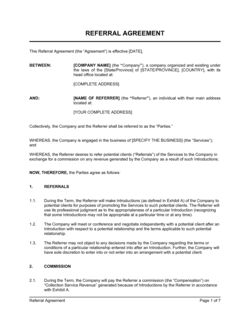
A Referral Fee Agreement is a legally binding contract between a business and a referring party that sets out the terms under which a fee or commission is paid in exchange for a successful client or customer introduction. This free Word download gives you a structured, editable template covering fee calculation, payment timing, qualifying conditions, and term length — ready to export as PDF and sign before any referral relationship begins.
When you need it
Use it whenever you agree to pay — or receive — a fee for introducing a prospective client, customer, or investor to another party. It is especially important before word-of-mouth partnerships, affiliate arrangements, or broker-introduced deals where payment terms would otherwise rest on a verbal understanding.
What's inside
Parties and recitals, definition of a qualifying referral, fee structure and calculation method, payment schedule and conditions, exclusivity and non-circumvention, confidentiality, term and termination, representations and warranties, and governing law and dispute resolution.

What is a Referral Fee Agreement?

A Referral Fee Agreement is a legally binding contract between a business and a referring party that defines the terms under which a fee or commission is paid in exchange for a successful introduction of a prospective client, customer, or investor. It establishes what qualifies as a compensable referral, how the fee is calculated, when payment is due, and how long the arrangement — and any post-termination tail period — remains in force. Without a written agreement, referral arrangements rest on verbal understandings that courts in most jurisdictions treat as difficult to prove and easy to dispute.

Why You Need This Document

Operating a referral program without a signed agreement creates four concrete risks. First, disputes over whether a particular introduction qualifies for a fee have no objective basis for resolution — the referring party claims payment, the company denies it, and neither side can point to agreed criteria. Second, without a non-circumvention clause, the company is legally free to re-engage an introduced contact directly once the relationship ends, paying nothing. Third, in regulated industries — including financial services, real estate, healthcare, and law — undocumented referral payments can trigger professional conduct investigations or statutory penalties. Fourth, without a tail period, pipeline deals that close after the agreement lapses generate no fee obligation, even when the referrer drove the entire opportunity. This template closes all four gaps: it records the exact fee terms, protects the referrer's pipeline, documents compliance, and gives both parties a clear enforcement mechanism if the arrangement breaks down.

Which variant fits your situation?

If your situation is…Use this template
Paying a one-time flat fee for a single client introductionReferral Fee Agreement (Flat Fee)
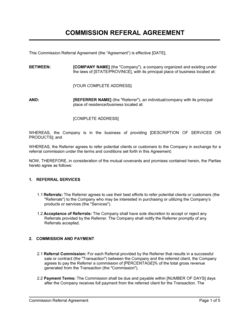
Paying a percentage of each sale generated by the referred clientCommission-Based Referral Agreement
Ongoing affiliate or partner revenue-sharing arrangementAffiliate Agreement
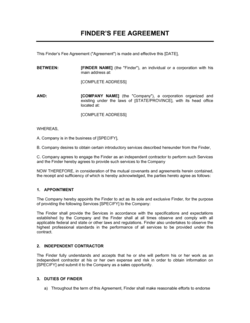
Broker introducing two parties to a business acquisition or investmentFinder's Fee Agreement
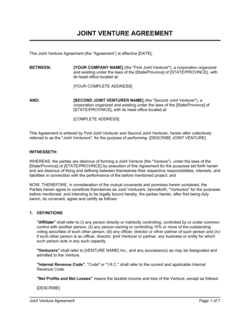
Formal joint-venture arrangement with shared costs and revenueJoint Venture Agreement
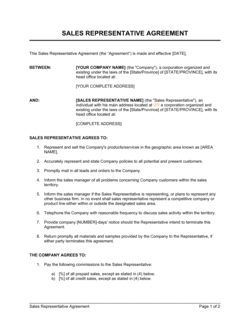
Appointing an exclusive sales representative in a territorySales Representative Agreement
Paying a recurring commission on a multi-year contract valueCommission Agreement

Common mistakes to avoid

❌ No definition of a qualifying referral

Why it matters: Without a clear threshold, the referring party claims fees on introductions that never converted, and the company disputes nearly every payment request. Litigation risk is high.

Fix: Define qualifying referral with at least three criteria: the form of introduction, a new-to-company requirement, and a maximum days-to-close window.

❌ Omitting a tail period clause

Why it matters: If the agreement expires while an introduced contact is still in the sales pipeline, the company can close the deal and owe nothing — even though the referrer drove the opportunity.

Fix: Include a tail period of at least 12 months from the introduction date, surviving termination, with explicit language tying it to the date of introduction rather than the agreement end date.

❌ Basing commission on gross revenue

Why it matters: Paying a percentage of gross revenue means the referrer earns commission on taxes, chargebacks, and pass-through costs the company never keeps — inflating the fee and eroding margins.

Fix: Define the commission base as net contract value, explicitly excluding taxes, refunds, discounts, and third-party costs, with a sample calculation in the agreement.

❌ No non-circumvention clause

Why it matters: Without it, the company can legally re-engage an introduced contact after the tail period — or even during it in jurisdictions where the clause is only implied — and owe no fee.

Fix: Include an explicit non-circumvention clause covering direct and indirect contact with referred parties, with a duration at least equal to the tail period.

❌ Signing the agreement after referral activity has already begun

Why it matters: Pre-agreement introductions create consideration problems in common-law jurisdictions and leave the scope of coverage genuinely ambiguous — courts have gone both ways on whether earlier referrals are included.

Fix: Execute the agreement before the first introduction. If circumstances require backdating coverage, include a specific clause stating that introductions made on or after a named prior date are covered, and document fresh consideration.

❌ No reporting or accounting obligation on the company

Why it matters: Without a contractual obligation to report, the referrer has no way to verify which referrals converted or what fees are owed — disputes about underpayment are almost inevitable.

Fix: Add a clause requiring the company to provide a monthly written statement of qualifying referrals received, deals closed, and fees calculated, within a fixed number of days after each month-end.

The 9 key clauses, explained

Parties and recitals

In plain language: Identifies the referring party and the business receiving referrals, states each party's legal name and status, and describes the purpose of the arrangement.

Sample language
This Referral Fee Agreement ('Agreement') is entered into as of [DATE] by and between [REFERRING PARTY LEGAL NAME] ('Referrer') and [COMPANY LEGAL NAME], a [STATE/PROVINCE] [ENTITY TYPE] ('Company').

Common mistake: Using a trade name instead of the registered legal entity name for either party — this creates enforcement problems if a fee dispute goes to court.

Definition of a qualifying referral

In plain language: Sets out precisely what constitutes a referral that triggers a fee — for example, a named introduction that results in a signed contract within 90 days.

Sample language
A 'Qualifying Referral' means an introduction by Referrer of a prospective customer (a 'Referred Party') who (a) is not already known to the Company as of the Introduction Date, and (b) enters into a written agreement with the Company within [90] days of the Introduction Date.

Common mistake: Leaving 'qualifying referral' undefined or vague — without a clear threshold, both parties dispute whether a particular introduction counts, and the business ends up paying fees on contacts it already knew.

Fee structure and calculation

In plain language: States the exact fee — a flat amount or a percentage of contract value — how it is calculated, and which revenue figure forms the basis for percentage-based fees.

Sample language
Company shall pay Referrer a referral fee of [X]% of the net contract value of any agreement executed with a Referred Party, where 'net contract value' means total fees charged less any taxes, refunds, or third-party pass-through costs.

Common mistake: Basing the commission on gross revenue rather than net — referrers end up being paid on amounts the company never keeps, such as taxes or hard costs, inflating the fee unintentionally.

Payment schedule and conditions

In plain language: Defines when payment is due, what triggers it (e.g., customer payment received), the currency, and the method of payment.

Sample language
Referral fees shall be due and payable within [30] days of Company receiving cleared payment from the Referred Party. Payment shall be made by [ACH / wire transfer / cheque] in [USD / CAD / GBP] to the account details provided by Referrer.

Common mistake: Tying payment to the contract signature date rather than the date funds are actually received — this creates cash-flow exposure if the referred customer pays late or disputes their invoice.

Non-circumvention

In plain language: Prevents the business from working directly with an introduced contact to cut out the referrer and avoid paying the agreed fee.

Sample language
For a period of [24] months from the Introduction Date, Company agrees not to contact, solicit, or transact with any Referred Party except through or with the written consent of Referrer, and shall pay the applicable referral fee on any transaction concluded with a Referred Party during such period.

Common mistake: Omitting the non-circumvention clause entirely — without it, a company can legally re-approach an introduced contact after the tail period and owe nothing, defeating the purpose of the agreement.

Term and termination

In plain language: Sets the initial duration of the agreement, the notice period required to terminate, and whether the tail period survives termination.

Sample language
This Agreement shall commence on [START DATE] and continue for an initial term of [12] months, renewing automatically for successive [12]-month periods unless either party provides [30] days' written notice of non-renewal. Sections 4 (Fees), 5 (Non-Circumvention), and 7 (Confidentiality) shall survive termination for the periods stated therein.

Common mistake: Forgetting to include survival language — without it, fee and non-circumvention obligations may lapse on the termination date, even for referrals already in the pipeline.

Confidentiality

In plain language: Restricts both parties from disclosing the existence or terms of the agreement, as well as any confidential business information exchanged during the referral relationship.

Sample language
Each party agrees to hold the other party's Confidential Information in strict confidence and not to disclose it to any third party without prior written consent. 'Confidential Information' includes the terms of this Agreement, customer lists, pricing, and any proprietary business information disclosed in connection with referral activities.

Common mistake: Omitting a definition of 'Confidential Information' and relying on context — courts apply a reasonableness standard, and an undefined term can render the whole clause unenforceable.

Representations and warranties

In plain language: Each party confirms they have the legal authority to enter the agreement, that referral activities will comply with applicable law, and that the referrer will not make unauthorized representations about the company's products or services.

Sample language
Each party represents that it has full legal authority to enter into this Agreement. Referrer warrants that all referral activities will comply with applicable laws and regulations and that Referrer will not make any representations about Company's products or services beyond those authorized in writing by Company.

Common mistake: No warranty restricting what the referrer can say about the company's offerings — this exposes the business to liability if the referrer makes promises the company cannot keep.

Governing law and dispute resolution

In plain language: Specifies which jurisdiction's law governs the agreement and the mechanism for resolving disputes — arbitration, mediation, or litigation.

Sample language
This Agreement shall be governed by the laws of [STATE / PROVINCE / COUNTRY] without regard to its conflict-of-laws principles. Any dispute arising under this Agreement shall be resolved by binding arbitration administered by [AAA / JAMS / ADR Institute] in [CITY], except that either party may seek injunctive relief in any court of competent jurisdiction.

Common mistake: Choosing a governing law with no connection to either party's place of business — several jurisdictions will refuse to enforce clauses that select a foreign law purely for convenience.

How to fill it out

  1. 1

    Enter the full legal names and details of both parties

    Identify the referring party and the company receiving referrals by their registered legal names, jurisdiction of incorporation or residence, and principal business addresses.

    💡 Cross-check the legal name against the company's certificate of incorporation or business registration — a mismatch between the contract name and the entity's registry name can void enforcement of key clauses.

  2. 2

    Define what counts as a qualifying referral

    Write a precise definition specifying the form the introduction must take (written email, warm call, or completed referral form), whether the referred party must be new to the company, and the time window within which a transaction must close to trigger the fee.

    💡 Include a registration mechanism — a referral submission form or a written introduction email — so there is a timestamped record of each introduction. This eliminates 'who knew them first' disputes.

  3. 3

    Set the fee structure and calculation basis

    Choose between a flat fee per qualifying referral or a percentage of net contract value. If percentage-based, define exactly which revenue figure is used as the base — net of taxes, refunds, and pass-through costs.

    💡 For recurring-revenue businesses, specify whether the commission applies only to the first contract term or to renewals as well. Leaving this ambiguous is the single most common source of referral fee disputes.

  4. 4

    Establish the payment schedule and conditions

    Set a specific payment due date tied to a trigger event — such as 30 days after the company receives cleared funds from the referred customer — the payment method, and the currency.

    💡 Add a reporting obligation: require the company to send a monthly statement of qualifying referrals and fees earned, even if the amount is zero. Silence breeds suspicion.

  5. 5

    Tailor the non-circumvention and tail period

    Set the period during which the company may not bypass the referrer to deal directly with introduced contacts. Standard tail periods run 12–24 months from the introduction date. Align the tail period with your typical sales cycle length.

    💡 For B2B deals with long sales cycles — 6 to 18 months — a 24-month tail period is standard. For transactional B2C referrals, 6 to 12 months is more typical.

  6. 6

    Confirm exclusivity terms if applicable

    Decide whether the arrangement is exclusive — preventing either party from similar referral deals with competitors — or non-exclusive. State this explicitly rather than leaving it implied.

    💡 Exclusivity clauses that are broad in scope and long in duration are routinely challenged or renegotiated. Limit exclusivity to a defined territory, product line, or customer segment to keep it commercially reasonable.

  7. 7

    Add survival and governing law clauses

    List each clause that survives termination (fees for pipeline referrals, non-circumvention, confidentiality) and its survival period. Select the governing law jurisdiction and dispute resolution method.

    💡 If both parties are in different jurisdictions, choose the law of the jurisdiction where the company is incorporated — this is where enforcement is most straightforward and least expensive.

  8. 8

    Execute before any referral activity begins

    Both parties must sign the agreement before any introduction is made. Post-introduction signatures create disputes about whether earlier referrals are covered.

    💡 Use a timestamped electronic signature to establish the exact execution date and prevent either party from later claiming the agreement was signed retroactively.

Frequently asked questions

What is a referral fee agreement?

A referral fee agreement is a legally binding contract between a business and a referring party that sets out the terms under which a fee is paid in exchange for a successful client or customer introduction. It defines what counts as a qualifying referral, how the fee is calculated, when it is paid, and how long the arrangement lasts. Without a written agreement, referral arrangements typically rest on verbal understandings that are difficult to enforce and easy to dispute.

Is a referral fee agreement legally enforceable?

A referral fee agreement is generally enforceable when it meets the basic elements of a valid contract — offer, acceptance, and consideration — and complies with the laws of the governing jurisdiction. However, enforceability depends on the industry: certain regulated sectors, including real estate brokerage, securities, and insurance, impose specific licensing requirements on referral fee arrangements. Parties in those industries should confirm compliance with applicable professional regulations before signing.

What is the difference between a referral fee and a finder's fee?

The terms are often used interchangeably, but a referral fee typically applies to ongoing customer introductions in a commercial context, while a finder's fee is most commonly used in one-time transactions — such as identifying an acquisition target, an investor, or a real estate deal. The underlying contract structure is similar, but a finder's fee agreement often includes deal-specific milestone triggers and is more common in M&A, real estate, and capital-raising contexts.

What percentage is a typical referral fee?

Referral fee rates vary widely by industry and deal size. For professional services and SaaS, fees of 5–15% of the first contract value are common. For real estate agent-to-agent referrals, 20–25% of the receiving agent's gross commission is the widely accepted norm. For high-value B2B transactions, flat fees of $1,000–$10,000 per closed deal may be more appropriate than percentage-based commissions. The rate should reflect the effort involved and the margin available on the referred business.

Do I need a referral fee agreement for informal arrangements?

Yes, especially for informal arrangements. Verbal or implied referral deals are the ones most likely to end in disputes. A short written agreement clarifies what qualifies as a referral, what the fee is, and when it is payable — protecting both sides. For low-value or one-off introductions, a simple one-page agreement is sufficient; for ongoing partner programs with recurring commissions, a more detailed contract is appropriate.

What is a tail period in a referral fee agreement?

A tail period is a defined window of time after the agreement ends during which the referrer is still entitled to a fee if a previously introduced contact converts to a paying customer. For example, a 12-month tail means that if the company closes a deal with a contact the referrer introduced before termination, and that deal closes within 12 months of the introduction date, the referral fee is still owed. Without a tail period, a company can wait for the agreement to lapse and then close a pipeline deal without paying anything.

Can a referral fee agreement include an exclusivity clause?

Yes, and exclusivity clauses are common in partner and reseller referral programs. An exclusivity clause may prevent the referring party from directing similar introductions to competitors, or prevent the company from accepting similar referrals from other partners in a defined territory. Broad exclusivity restrictions should be limited in duration and geographic or market scope to remain commercially reasonable and avoid antitrust concerns.

Are referral fees taxable?

In most jurisdictions, referral fees are treated as taxable business income for the referrer. In the US, companies paying referral fees of $600 or more to a non-employee individual in a calendar year are required to issue a Form 1099-NEC. In Canada, referral fees received by individuals are generally reported as business income. In the UK and EU, referral fees paid to VAT-registered businesses are typically subject to VAT. Both parties should confirm their reporting obligations with a tax advisor.

What happens if the referred customer cancels their contract?

This depends on whether the agreement includes a clawback clause. With a clawback, the referrer must return fees already paid if the referred customer cancels within a specified period — commonly 30 to 90 days after the contract is signed. Without a clawback clause, the referrer keeps the fee regardless of what happens after the introduction converts. Parties should negotiate this point explicitly and reflect the agreed outcome in the written agreement.

How this compares to alternatives

vs Affiliate Agreement

An affiliate agreement governs an ongoing, often technology-enabled marketing relationship where the affiliate promotes a company's products through tracked links and earns commissions on resulting sales. A referral fee agreement is typically a bilateral, relationship-driven arrangement involving personal introductions rather than automated tracking. Use an affiliate agreement for high-volume digital marketing programs; use a referral fee agreement for direct, named-contact introductions.

vs Commission Agreement

A commission agreement typically governs the compensation of a sales representative or employee who actively sells on the company's behalf, including base draw, commission tiers, and territory rules. A referral fee agreement covers a third party whose role is limited to making an introduction — they do not participate in the sales process. If the referrer is also involved in closing deals, a commission agreement or sales representative agreement is more appropriate.

vs Joint Venture Agreement

A joint venture agreement creates a shared-purpose business arrangement where two or more parties contribute resources, share costs, and split profits from a defined activity. A referral fee agreement is a one-directional payment for introductions with no shared ownership, shared liability, or joint operational involvement. Use a joint venture agreement when both parties are materially involved in delivery; use a referral fee agreement when one party's role ends at the introduction.

vs Sales Representative Agreement

A sales representative agreement appoints an individual or firm to actively market and sell the company's products or services within a defined territory, typically on an ongoing basis with territory protection and performance targets. A referral fee agreement imposes no sales obligation — the referrer simply introduces prospects and earns a fee if they convert. Choosing between them depends on how active a role the referring party plays in the sales process.

Industry-specific considerations

Professional Services

Accountants, lawyers, and consultants frequently exchange client referrals; fee-splitting rules vary by profession and must comply with applicable licensing body regulations.

Real Estate

Agent-to-agent referral fees on cross-market transactions are standardized at 20–25% of gross commission and typically require both agents to hold active licenses in their respective jurisdictions.

SaaS and Technology

Partner and reseller referral programs use percentage-of-ARR commissions with tail periods aligned to annual subscription cycles and clawback provisions tied to churn within the first 90 days.

Financial Services

Referral fee arrangements between licensed financial advisors, mortgage brokers, and insurance agents are subject to FINRA, FCA, or provincial securities rules and may require written client disclosure.

Recruitment and Staffing

Agency-to-agency referral fees for candidate or client introductions are typically flat amounts or a percentage of the placement fee, with explicit non-circumvention covering both the candidate and the client.

Healthcare

Patient referral fees between healthcare providers are heavily regulated or prohibited under the US Stark Law and Anti-Kickback Statute; agreements must be limited to non-patient referral contexts and reviewed by a healthcare compliance attorney.

Jurisdictional notes

United States

Referral fee agreements are generally enforceable under contract law in all US states, but certain industries impose strict limitations. The Stark Law and Anti-Kickback Statute prohibit patient referral fees in federally funded healthcare programs. RESPA prohibits unearned referral fees in residential real estate transactions. FINRA rules require disclosure of referral fee arrangements involving securities. Enforceability of non-compete and non-circumvention clauses varies by state — California courts apply especially high scrutiny.

Canada

Referral fees in Canada are regulated by provincial professional bodies in law, accounting, real estate, and financial services — the Law Society rules in Ontario and BC, for example, impose specific consent and disclosure requirements on referral fees between lawyers. Outside regulated professions, referral fee agreements are enforceable under general contract law. Quebec contracts should be in French for provincially regulated parties, and referral fees received by individuals are treated as business income under the Income Tax Act.

United Kingdom

Referral fee agreements are generally enforceable under English contract law, but the Legal Aid, Sentencing and Punishment of Offenders Act 2012 bans referral fees in personal injury cases. FCA-regulated firms must comply with COBS 2.3 rules on inducements, which can restrict or require disclosure of referral fee arrangements in financial services. VAT applies to referral fee payments between VAT-registered businesses, and both parties must account for it correctly.

European Union

Referral fee enforceability varies by member state but is generally recognized under commercial contract law across the EU. MiFID II imposes strict restrictions and disclosure requirements on referral fees involving investment advice or financial instrument distribution. GDPR applies whenever the referral process involves sharing personal data of the referred party — both parties should confirm a lawful basis for any personal data transfer. Professional body rules in law, accounting, and healthcare vary significantly across France, Germany, Spain, and other member states.

Template vs lawyer — what fits your deal?

PathBest forCostTime
Use the templateStandard B2B or professional services referral arrangements with straightforward flat or percentage feesFree20–30 minutes
Template + legal reviewHigh-value referral programs, arrangements in regulated industries, or cross-border introductions$300–$7002–5 days
Custom draftedComplex multi-party referral structures, securities or real estate brokerage arrangements, or agreements with significant exclusivity and non-circumvention exposure$1,000–$3,500+1–3 weeks

Glossary

Referral Fee
A one-time or recurring payment made to a referring party in exchange for introducing a customer or client who subsequently completes a qualifying transaction.
Qualifying Referral
An introduction that meets the specific criteria defined in the agreement — such as the referred party signing a contract, making a purchase, or reaching a defined deal milestone — before a fee is triggered.
Finder's Fee
A fee paid to a third party who identifies and introduces a business opportunity, investor, or acquisition target — functionally similar to a referral fee but commonly used in M&A and real estate contexts.
Non-Circumvention Clause
A contractual provision that prevents the business from bypassing the referrer to deal directly with an introduced party in order to avoid paying the agreed fee.
Commission Rate
The percentage of a transaction value — or a fixed dollar amount — used to calculate the referral fee owed on each qualifying introduction.
Tail Period
A defined window of time after the agreement ends during which the referrer is still entitled to a fee if an introduced contact converts into a paying customer.
Exclusivity
A clause restricting one or both parties from entering into similar referral arrangements with competitors during the term of the agreement.
Clawback
A provision requiring the referrer to return a previously paid fee if the underlying transaction is cancelled, reversed, or the referred customer defaults within a specified period.
Indemnification
A clause requiring one party to compensate the other for losses, claims, or damages arising from their own actions or misrepresentations in connection with the referral activity.
Arm's Length Transaction
A transaction between unrelated parties acting independently and in their own interests, used as a benchmark to confirm that referral terms reflect fair market conditions.

Part of your Business Operating System

This document is one of 3,000+ business & legal templates included in Business in a Box.

  • Fill-in-the-blanks — ready in minutes
  • 100% customizable Word document
  • Compatible with all office suites
  • Export to PDF and share electronically

Create your document in 3 simple steps.

From template to signed document — all inside one Business Operating System.
1
Download or open template

Access over 3,000+ business and legal templates for any business task, project or initiative.

2
Edit and fill in the blanks with AI

Customize your ready-made business document template and save it in the cloud.

3
Save, Share, Send, Sign

Share your files and folders with your team. Create a space of seamless collaboration.

Save time, save money, and create top-quality documents.

★★★★★

"Fantastic value! I'm not sure how I'd do without it. It's worth its weight in gold and paid back for itself many times."

Managing Director · Mall Farm
Robert Whalley
Managing Director, Mall Farm Proprietary Limited
★★★★★

"I have been using Business in a Box for years. It has been the most useful source of templates I have encountered. I recommend it to anyone."

Business Owner · 4+ years
Dr Michael John Freestone
Business Owner
★★★★★

"It has been a life saver so many times I have lost count. Business in a Box has saved me so much time and as you know, time is money."

Owner · Upstate Web
David G. Moore Jr.
Owner, Upstate Web

Run your business with a system — not scattered tools

Stop downloading documents. Start operating with clarity. Business in a Box gives you the Business Operating System used by over 250,000 companies worldwide to structure, run, and grow their business.

Start free · No credit card required