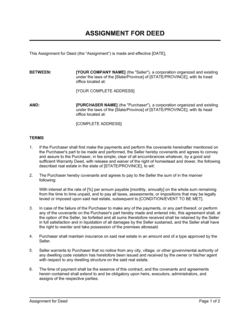
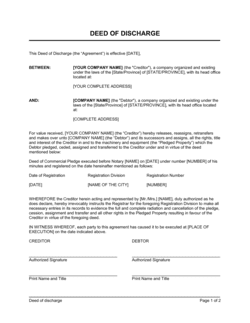
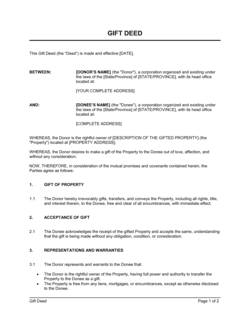
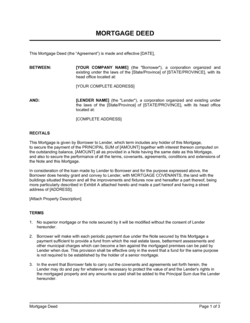
Deed Of Conveyance Template

Free Word download • Edit online • Save & share with Drive • Export to PDF

4 pages20–30 min to fillDifficulty: StandardSignature requiredLegal review recommended
Learn more ↓
FreeDeed Of Conveyance Template

At a glance

What it is
A Deed of Conveyance is the legal instrument that formally transfers title in real property from a grantor (seller or transferor) to a grantee (buyer or transferee). This free Word download gives you a structured, attorney- reviewable starting point covering property description, parties, consideration, covenants of title, and execution requirements — ready to edit online and export as PDF before submission to the relevant land registry or recorder's office.
When you need it
Use it whenever ownership of real property changes hands — sale, gift, inheritance transfer, or intra-family conveyance — and a publicly registered record of that transfer is required. It is also needed when refinancing, clearing a title defect, or correcting a prior deed error.
What's inside
Full legal names and addresses of grantor and grantee, the recital of consideration, a precise legal description of the property, the habendum and tenendum clauses, title covenants (warranty, quitclaim, or covenant for title), encumbrance disclosures, execution and acknowledgment blocks, and a registration/recording instruction page.

What is a Deed of Conveyance?

A Deed of Conveyance is the legal instrument that formally transfers ownership of real property from the grantor — the current title holder — to the grantee — the incoming owner. It names both parties, recites the consideration paid, provides the precise legal description of the parcel being transferred, defines the quality of title being granted through a warranty or quitclaim clause, discloses existing encumbrances, and is executed before a notary public. Once filed with the county recorder, land registry, or titles office, it becomes the authoritative public record of the ownership change and adds a new link to the property's chain of title.

Unlike a purchase and sale agreement — which creates a contractual obligation to transfer — a deed of conveyance is the act of transfer itself. Without it, the sale agreement binds the parties but title never formally moves. The deed is what lenders, title insurers, and future buyers examine when they assess whether the current owner actually has marketable title to sell or mortgage.

Why You Need This Document

Failing to execute and record a proper deed of conveyance creates risks on every side of a property transaction. A buyer who closes without a recorded deed holds an interest that is valid against the seller personally but provides no protection if the same seller later grants another deed to a third party who records first — in race-notice jurisdictions, the first to record wins. An estate executor who transfers inherited property with a handwritten letter instead of a deed leaves beneficiaries holding an unregistrable interest that banks will not lend against and title insurers will not cover. A grantor who uses the wrong warranty clause — a general warranty on an estate deed, for example — creates personal liability for title defects stretching back decades.

This template gives you a correctly structured starting point: full party identification, a legal description placeholder that forces you to copy from the prior recorded deed, the right warranty language options, an encumbrance schedule, and the notary acknowledgment block formatted to meet recorder requirements. Combined with a one-hour attorney review for any transaction with a mortgage, multiple parties, or jurisdictional complexity, it eliminates the document-level errors that cause closings to stall and titles to cloud.

Which variant fits your situation?

If your situation is…Use this template
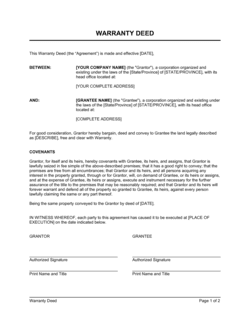
Selling a property with a full guarantee of clear titleGeneral Warranty Deed
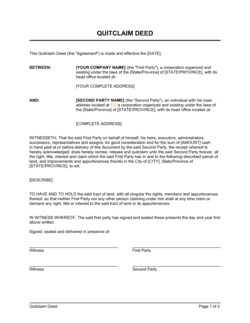
Transferring only the grantor's current interest with no title warrantyQuitclaim Deed
Conveying property with warranty limited to the grantor's ownership periodSpecial Warranty Deed
Transferring property upon the grantor's death without probateTransfer on Death Deed
Conveying property as a gift with no monetary considerationGift Deed
Correcting an error in a previously recorded deedCorrection Deed (Deed of Confirmation)
Transferring property held in trust to a beneficiaryTrustee's Deed

Common mistakes to avoid

❌ Copying the legal description from a tax bill or appraisal

Why it matters: Tax descriptions are abbreviated and often omit easement adjustments or replatting changes, creating a gap between the recorded chain of title and the new deed that requires a correction instrument to cure.

Fix: Pull the legal description from the prior recorded deed instrument number and verify it against any current survey before inserting it into the new deed.

❌ Failing to obtain a releasing spouse's signature

Why it matters: In states with homestead protections or dower rights — including Florida, Texas, and Ohio — a deed signed by only one spouse is voidable by the non-signing spouse, exposing the grantee to a partial title claim.

Fix: Identify the applicable homestead or dower statute before execution and ensure any required co-signature or release appears in the correct block of the deed.

❌ Leaving the notary acknowledgment incomplete

Why it matters: An acknowledgment missing the notary's commission expiry date, seal, or the grantor's name as it appears in the body of the deed will be rejected by the recorder's office and may require full re-execution.

Fix: Have the notary complete every field in the acknowledgment block — including the expiry date and embossed seal — before the grantor leaves the signing appointment.

❌ Using a general warranty on a representative conveyance

Why it matters: An executor, trustee, or corporate officer who signs a general warranty deed creates personal liability for title defects that pre-date their period of ownership — defects they cannot investigate or cure.

Fix: Replace general warranty language with a special or limited warranty clause that restricts the covenant to defects arising during the grantor's ownership period only.

❌ Omitting an existing mortgage from the encumbrance schedule

Why it matters: Conveying title without disclosing an unreleased mortgage leaves the grantee with a cloud on title and may give the title insurer grounds to deny a future claim based on a known but undisclosed lien.

Fix: List every encumbrance revealed by the title search in the exceptions schedule, including mortgages to be discharged at closing, and note whether the grantee assumes or takes subject to each.

❌ Delaying recording after execution

Why it matters: An unrecorded deed is valid between grantor and grantee but provides no protection against a subsequent purchaser or lien creditor who records first — in a race-notice or notice jurisdiction, the grantee with the earlier deed loses if they fail to record promptly.

Fix: Record the deed on or before closing. In a simultaneous closing, submit the deed for recording the same day funds are disbursed.

The 9 key clauses, explained

Parties clause

In plain language: Identifies the grantor and grantee by full legal name, marital status (where relevant to title), and address, and states their capacity — individual, trustee, corporate officer, or executor.

Sample language
[GRANTOR FULL LEGAL NAME], a [single person / married person / trustee of THE [TRUST NAME]], of [ADDRESS] ('Grantor'), hereby conveys to [GRANTEE FULL LEGAL NAME], a [single person / married couple as joint tenants], of [ADDRESS] ('Grantee').

Common mistake: Using a nickname or former name instead of the name on the current title. A name mismatch between the incoming deed and the prior recorded deed creates a break in the chain of title that requires a correction deed to fix.

Recital of consideration

In plain language: States the price or value exchanged for the conveyance, satisfying the legal requirement that a deed be supported by consideration to be enforceable.

Sample language
For and in consideration of the sum of [PURCHASE PRICE IN WORDS] Dollars ($[AMOUNT]), and other good and valuable consideration, the receipt and sufficiency of which are hereby acknowledged, Grantor conveys and warrants to Grantee the following described property.

Common mistake: Leaving the consideration blank or writing only 'love and affection' on a sale deed. In many US states, the stated consideration determines the transfer tax due — an incorrect amount triggers penalties at recording.

Legal description of the property

In plain language: Identifies the specific parcel being transferred using the surveyed metes-and-bounds description, subdivision lot-and-block reference, or government survey system coordinates taken from the prior deed or current survey.

Sample language
Lot [NUMBER], Block [NUMBER], [SUBDIVISION NAME], as recorded in Plat Book [X], Page [X], of the records of [COUNTY] County, [STATE]; also known by street address as [STREET ADDRESS], [CITY], [STATE] [ZIP CODE].

Common mistake: Copying the legal description from a tax bill or appraisal record instead of the prior recorded deed or a current survey. Tax descriptions are abbreviated and routinely omit easements or boundary adjustments, leading to title gaps.

Habendum clause

In plain language: Defines the extent and quality of the ownership interest conveyed — typically fee simple absolute — and must be consistent with the granting clause; any inconsistency will be interpreted against the grantor.

Sample language
TO HAVE AND TO HOLD the above-described property, together with all and singular the rights, privileges, appurtenances, and improvements thereto belonging or in anywise appertaining, to the only proper use, benefit, and behoof of Grantee and Grantee's heirs and assigns forever in fee simple.

Common mistake: Omitting the habendum clause entirely in jurisdictions where it is still required by statute. Some US states — Texas among them — will construe a deed without a habendum as conveying a life estate only, not fee simple.

Covenant of title (warranty clause)

In plain language: The grantor's promise to stand behind the title conveyed — a general warranty covers defects arising from any prior owner, while a special warranty is limited to defects created during the grantor's own period of ownership.

Sample language
Grantor warrants and will forever defend all and singular the said property unto the said Grantee against every person whomsoever lawfully claiming or to claim the same or any part thereof [by, through, or under Grantor only / by, through, or under any person whomsoever].

Common mistake: Using general warranty language when the grantor is an estate executor or trustee with no knowledge of historical title defects. Executors and trustees should use a limited or special warranty to avoid personal liability for pre-existing defects they cannot investigate.

Encumbrance and exception schedule

In plain language: Lists all liens, mortgages, easements, restrictive covenants, and other encumbrances that the conveyance is made subject to, so the grantee takes title with notice of existing burdens.

Sample language
This conveyance is made subject to: (a) all current real property taxes not yet due and payable; (b) easements, restrictions, and conditions of record; and (c) the mortgage in favor of [LENDER NAME] recorded at [BOOK/PAGE or INSTRUMENT NO.], which Grantee assumes [does not assume].

Common mistake: Omitting a mortgage that will not be discharged at closing. Conveying title without noting an existing mortgage means the grantee may later dispute liability for it — and the title insurer may deny a claim on that basis.

Execution and signature block

In plain language: Contains the grantor's wet signature (and spouse's signature where dower or homestead rights require it), the date of execution, and signature lines for any required witnesses.

Sample language
IN WITNESS WHEREOF, Grantor has executed this Deed on [DATE]. ____________________________ [GRANTOR FULL NAME], Grantor ____________________________ [SPOUSE FULL NAME], as to homestead / dower rights only (if applicable) Witness: ____________________________ Name: [WITNESS NAME]

Common mistake: Having the grantor's spouse sign only as a witness rather than in the separate homestead or dower release block. In states with homestead or dower protections, a spouse's signature must appear in the correct capacity to release their statutory interest.

Notary acknowledgment block

In plain language: The notary's certification that the grantor personally appeared, was identified, and voluntarily signed the deed — without this block properly completed, the recorder's office will reject the document.

Sample language
State of [STATE], County of [COUNTY]. Before me, the undersigned authority, personally appeared [GRANTOR FULL NAME], known to me to be the person whose name is subscribed to the foregoing instrument, and acknowledged to me that they executed the same for the purposes and consideration therein expressed. Notary Public: ____________________________ My commission expires: [DATE]

Common mistake: Leaving the notary commission expiry date blank or having the notary seal placed outside the acknowledgment box. Many recorders return deeds with incomplete acknowledgments, and some require re-execution rather than a corrective notarization.

Return-to and recording instruction block

In plain language: States the name and address to which the original recorded deed should be returned after registration, and includes any required tax parcel number, transfer tax computation, or exemption claim for the recorder's use.

Sample language
After recording, return to: [GRANTEE NAME / ATTORNEY NAME], [ADDRESS]. Tax Parcel ID: [NUMBER]. Consideration for transfer tax purposes: $[AMOUNT]. Exemption claimed (if any): [STATUTORY CITATION].

Common mistake: Omitting the parcel ID or leaving the transfer tax calculation blank. Most US county recorders and UK land registries require these fields to be completed before acceptance — an incomplete instrument is returned unfiled, leaving the grantee without a registered title.

How to fill it out

  1. 1

    Gather the current title documents and survey

    Obtain the prior recorded deed, the current title search or abstract, and — if available — a current survey. The legal description and encumbrance schedule in your new deed must match the prior deed exactly.

    💡 Never copy the legal description from a tax bill or listing sheet. Pull it from the prior recorded deed instrument number, then verify it against the survey.

  2. 2

    Enter the grantor's and grantee's full legal details

    Use each party's full legal name as it appears on government-issued ID or corporate registration. Include marital status for individuals in jurisdictions with homestead or dower rights. Add full mailing addresses.

    💡 For married grantors conveying community property or homestead, both spouses must typically be named as grantors and sign — even if only one is on the current title.

  3. 3

    State the consideration accurately

    Enter the actual purchase price in both words and numerals, or the nominal consideration for a gift. Check whether your jurisdiction computes transfer tax on stated consideration — understating it can trigger penalties and re-assessment.

    💡 In gift deeds within a family, confirm whether your jurisdiction exempts intra-family transfers from transfer tax and which statutory citation must appear on the deed to claim the exemption.

  4. 4

    Insert the legal description verbatim from the prior deed

    Paste the full metes-and-bounds, lot-and-block, or government survey description exactly as it appears in the prior recorded instrument. Add the street address as a secondary reference only — never as a substitute for the legal description.

    💡 If the property has been subdivided or replatted since the last deed, obtain a new survey and use the updated legal description from the plat — not the outdated one from the prior deed.

  5. 5

    Select and complete the appropriate warranty clause

    Choose general warranty if you can vouch for title back to the original grant, special warranty if you warrant only your own period of ownership, or quitclaim if you make no warranty at all. Adjust the covenant language to match your selection.

    💡 Estate executors, trustees, and corporate officers acting in a representative capacity should almost always use a special or limited warranty — never a general warranty — to avoid personal exposure for pre-existing defects.

  6. 6

    List all encumbrances and exceptions

    Schedule every lien, easement, restrictive covenant, and unpaid tax that the grantee will take subject to. If a mortgage will be paid off at closing, note that the conveyance is subject to it being discharged simultaneously.

    💡 Cross-reference the title commitment's Schedule B exceptions line by line. Any item listed there should appear in your encumbrance schedule — omissions become title insurance claim disputes later.

  7. 7

    Execute before a notary and required witnesses

    The grantor (and any co-grantor or releasing spouse) must sign in the presence of a commissioned notary public. Some jurisdictions also require one or two witnesses independent of the notary. Check local requirements before execution.

    💡 Remote online notarization (RON) is accepted in over 40 US states as of 2025 and can dramatically speed up execution for parties in different locations — confirm your recorder accepts RON-acknowledged deeds before using it.

  8. 8

    File the executed deed for recording

    Submit the original executed and acknowledged deed to the county recorder, land registry, or titles office with the applicable recording fee and transfer tax. Retain a conformed copy with the recording stamp for your records.

    💡 Record the deed on or before the closing date — an unrecorded deed is valid between the parties but gives the grantee no protection against a subsequent bona fide purchaser who records first.

Frequently asked questions

What is a deed of conveyance?

A deed of conveyance is the legal document that formally transfers ownership of real property from the grantor (current owner) to the grantee (new owner). It identifies both parties, describes the property by its legal description, states the consideration paid, defines the extent of ownership being transferred, and includes execution and acknowledgment blocks required for recording in the public land registry. Once registered, it becomes the official public record of the ownership change.

What is the difference between a deed of conveyance and a sale agreement?

A sale agreement (or purchase and sale agreement) is a contract that obligates the parties to complete a property transaction on agreed terms — it creates a promise to transfer, not the transfer itself. A deed of conveyance is the instrument that actually passes title at closing. The sale agreement is signed weeks before closing; the deed is executed and recorded on closing day. Both documents are needed to complete a residential or commercial property sale.

Does a deed of conveyance need to be notarized?

In most jurisdictions, yes — notarization of the grantor's signature (called an acknowledgment) is required before a deed can be accepted for recording by the county recorder or land registry. Some jurisdictions also require one or two witnesses in addition to the notary. An unnotarized deed may be valid between the parties under contract law principles but cannot be registered and therefore provides no protection against third-party claims.

What is the difference between a general warranty deed and a quitclaim deed?

A general warranty deed contains a promise by the grantor to defend the grantee's title against any claim, from any source, at any point in the property's history. A quitclaim deed transfers only whatever interest the grantor currently holds — with no promise that the title is clear or that the grantor even owns the property. General warranty deeds are standard in arm's-length sales; quitclaim deeds are typically used for intra-family transfers, clearing a clouded title, or correcting a name error on an existing deed.

What must be included in a valid deed of conveyance?

At minimum: full legal names of grantor and grantee, a recital of consideration, a precise legal description of the property, the granting and habendum clauses, any applicable warranty or covenant of title, disclosure of existing encumbrances, the grantor's signature, a notary acknowledgment, and recording information. Missing the legal description or acknowledgment are the two most common reasons recorders reject deeds at filing.

Does a deed of conveyance need to be recorded to be valid?

The deed is generally valid between the grantor and grantee from the moment it is executed and delivered, even without recording. However, an unrecorded deed gives the grantee no protection against a subsequent bona fide purchaser who buys the same property and records first. Most jurisdictions follow a race-notice or notice recording system under which a later purchaser without notice of the prior deed takes priority if they record first. Recording promptly at closing is essential.

How long does it take to record a deed of conveyance?

Processing times vary by jurisdiction. Most US county recorders accept same-day over-the-counter filing and return a conformed copy with a recording stamp within minutes to a few days. Electronic recording (eRecording) is available in most US counties and returns confirmation in under 24 hours. UK Land Registry applications typically take 2–8 weeks for standard transfers, though expedited processing is available for remortgage and new-build completions. Canada and EU member state registries vary by province or country.

Can I prepare a deed of conveyance without a lawyer?

A template provides a sound structural starting point, but real property transactions carry significant financial and legal risk. Errors in the legal description, missing spousal signatures, or an incorrect warranty clause can create title defects that are expensive and slow to cure. Most conveyancers recommend at least a one-hour attorney or licensed conveyancer review before execution — particularly for first-time sellers, estate transfers, or properties with known title complications.

What taxes are due when a deed of conveyance is recorded?

Transfer taxes, stamp duty, or land transfer taxes are typically due at recording, calculated as a percentage of the stated consideration or assessed value. In the US, rates vary by state and county — for example, New York State charges $2 per $500 of consideration plus a mansion tax on sales over $1M. The UK charges Stamp Duty Land Tax on purchases above the nil-rate threshold. Canadian provinces levy land transfer taxes ranging from 0.5% to 2.5% depending on property value. Certain intra-family transfers and estate conveyances qualify for exemptions under specific statutory provisions.

What is a chain of title and why does it matter?

The chain of title is the chronological sequence of recorded deeds tracing ownership of a parcel from its original grant to the present owner. A complete, unbroken chain is essential for a lender to issue a mortgage, a title insurer to issue a policy, and a buyer to be confident they are purchasing from the true owner. Each deed of conveyance adds one link to that chain — which is why the names, legal description, and recording details must match the prior instrument precisely.

How this compares to alternatives

vs Quitclaim Deed

A quitclaim deed transfers whatever interest the grantor holds with no warranty of title — it is used for intra-family transfers, name corrections, or clearing a clouded title where no commercial sale is taking place. A deed of conveyance in a sale context includes a warranty clause and full title covenants that protect the buyer. Use a quitclaim when speed and informality matter more than title assurance; use a deed of conveyance with a warranty clause for any arm's-length purchase.

vs Purchase and Sale Agreement

A purchase and sale agreement creates a contractual obligation to complete the transaction — it governs price, contingencies, closing date, and remedies for breach. A deed of conveyance is the instrument that actually transfers title on closing day. The agreement precedes the deed by weeks; neither document is a substitute for the other. Both are needed to complete a property sale.

vs Mortgage Deed

A mortgage deed grants a lender a security interest in the property as collateral for a loan — it does not transfer ownership. A deed of conveyance transfers full ownership from grantor to grantee. In a standard purchase transaction, both documents are executed on closing day: the conveyance deed passes title to the buyer, and the mortgage deed simultaneously encumbers that title in favour of the lender.

vs Lease Agreement

A lease agreement grants a tenant the right to occupy and use a property for a defined term without transferring ownership. A deed of conveyance permanently transfers title. Leasehold and freehold interests are legally distinct: a long leasehold (99 or 999 years) is itself a registrable property interest that can be conveyed by deed, but the freehold title remains with the landlord unless separately conveyed.

Industry-specific considerations

Residential real estate

Conveyances at closing require spousal homestead releases, transfer tax computation, and same-day recording to satisfy lender and title insurer requirements.

Commercial real estate

Corporate and LLC grantors require authority documentation (board resolution or operating agreement extract) alongside the deed to confirm the signatory's capacity to bind the entity.

Estate and probate administration

Executor's or administrator's deeds must reference the probate court order authorizing the transfer and typically carry a limited warranty only, protecting the estate from claims for defects the executor cannot investigate.

Property investment and development

Portfolio transfers between SPVs or development entities require careful encumbrance scheduling, assignment of easements, and confirmation of planning permission status as conditions precedent to conveyance.

Jurisdictional notes

United States

Deed requirements vary significantly by state. Most states require notarized acknowledgment and a precise legal description; several (including Florida and Texas) also require two witnesses. Transfer taxes are assessed at the state and sometimes county level. California requires a Preliminary Change of Ownership Report alongside the deed. At-will recording systems vary between race, notice, and race-notice — in race-notice states such as New York and California, the first grantee to record without notice of a prior deed takes priority.

Canada

Real property law is provincially regulated in Canada. Ontario uses a Land Transfer Tax affidavit filed with the deed at the Land Registry Office; British Columbia requires a Property Transfer Tax Return. Quebec uses a notarized deed (acte de vente) executed before a notary acting as an impartial officer — a privately drafted deed is insufficient. Alberta and Ontario both operate Torrens title registration systems where the registered certificate of title, not the deed itself, is the definitive evidence of ownership.

United Kingdom

In England and Wales, deeds must be signed as a deed (not merely a contract), witnessed by an independent adult, and delivered — electronic execution with qualified electronic signatures is permitted since the Land Registration Act 2002 as amended. HM Land Registry requires a TR1 form for registered land transfers rather than a free-form deed. Stamp Duty Land Tax is payable within 14 days of completion. Scottish property law is separate: disposition deeds are registered in the Land Register of Scotland, and Scotland operates a different conveyancing procedure including missives and settlement letters.

European Union

Property conveyancing is a member state competence and procedures differ substantially across the EU. France, Germany, Spain, Italy, and most civil-law jurisdictions require a deed (acte authentique or notarielle Urkunde) executed before a licensed notary acting as a public officer — a privately prepared deed is not sufficient for registration. Transfer taxes and notary fees vary: France levies droits de mutation of approximately 5–6% on older properties; Germany charges Grunderwerbsteuer of 3.5–6.5% depending on the Bundesland. GDPR considerations apply to the processing of personal data in cross-border transactions involving EU residents.

Template vs lawyer — what fits your deal?

PathBest forCostTime
Use the templateStraightforward intra-family gift transfers or simple residential conveyances in jurisdictions with well-defined standard formsFree1–2 hours to complete, plus recording time
Template + legal reviewResidential sales, estate transfers, or any conveyance involving an existing mortgage, multiple parties, or a jurisdiction with non-standard requirements$300–$900 for a one-hour attorney or licensed conveyancer review1–3 days
Custom draftedCommercial property transactions, portfolio transfers, trust or LLC conveyances, cross-border transfers, or any property with known title complications$1,500–$5,000+ depending on transaction complexity1–3 weeks

Glossary

Grantor
The current owner of the property who is transferring title to another party.
Grantee
The person or entity receiving title to the property under the deed.
Legal Description
A precise written description of the property's boundaries and location — typically a metes-and-bounds survey, lot-and-block reference, or government survey description — used to identify the parcel in public records.
Consideration
The value exchanged for the property transfer, stated in the deed — commonly the actual purchase price or a nominal amount such as 'ten dollars and other good and valuable consideration.'
Habendum Clause
The 'to have and to hold' clause that defines the extent of the ownership interest being transferred — fee simple absolute, life estate, or otherwise.
Covenant of Warranty
A promise by the grantor to defend the grantee's title against any claims arising from the grantor's own actions or, in a general warranty, from any prior owner.
Quitclaim
A conveyance that transfers only whatever interest the grantor currently holds, with no warranty that the title is clear or that the grantor owns the property at all.
Encumbrance
Any lien, mortgage, easement, covenant, or restriction that limits or burdens the title being transferred — disclosed in the deed or in a title search.
Acknowledgment
A notary public's certification that the grantor personally appeared before them, confirmed their identity, and voluntarily executed the deed — required for valid registration in most jurisdictions.
Recording / Registration
The act of filing the executed deed with the county recorder, land registry, or titles office to give public notice of the ownership change and establish priority over subsequent claims.
Fee Simple
The most complete form of property ownership — the grantee holds the property outright, with no conditions or time limitations, and may sell, mortgage, or devise it freely.
Chain of Title
The chronological sequence of recorded deeds and transfers that establishes continuous ownership of a property from the original grant to the current owner.

Part of your Business Operating System

This document is one of 3,000+ business & legal templates included in Business in a Box.

  • Fill-in-the-blanks — ready in minutes
  • 100% customizable Word document
  • Compatible with all office suites
  • Export to PDF and share electronically

Create your document in 3 simple steps.

From template to signed document — all inside one Business Operating System.
1
Download or open template

Access over 3,000+ business and legal templates for any business task, project or initiative.

2
Edit and fill in the blanks with AI

Customize your ready-made business document template and save it in the cloud.

3
Save, Share, Send, Sign

Share your files and folders with your team. Create a space of seamless collaboration.

Save time, save money, and create top-quality documents.

★★★★★

"Fantastic value! I'm not sure how I'd do without it. It's worth its weight in gold and paid back for itself many times."

Managing Director · Mall Farm
Robert Whalley
Managing Director, Mall Farm Proprietary Limited
★★★★★

"I have been using Business in a Box for years. It has been the most useful source of templates I have encountered. I recommend it to anyone."

Business Owner · 4+ years
Dr Michael John Freestone
Business Owner
★★★★★

"It has been a life saver so many times I have lost count. Business in a Box has saved me so much time and as you know, time is money."

Owner · Upstate Web
David G. Moore Jr.
Owner, Upstate Web

Run your business with a system — not scattered tools

Stop downloading documents. Start operating with clarity. Business in a Box gives you the Business Operating System used by over 250,000 companies worldwide to structure, run, and grow their business.

Start free · No credit card required