Quality Assurance Plan Template

Free Word download β€’ Edit online β€’ Save & share with Drive β€’ Export to PDF

15 pagesβ€’30–40 min to fillβ€’Difficulty: Complex
Learn more ↓
FreeQuality Assurance Plan Template

At a glance

What it is
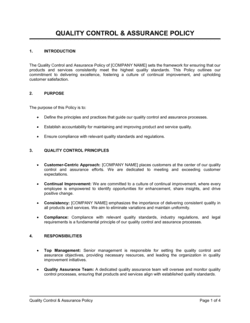
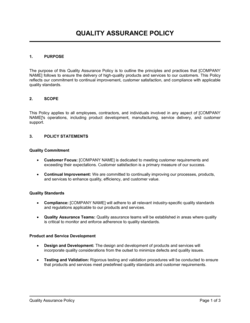
A Quality Assurance Plan is a structured operational document that defines how a project, product, or process will meet established quality standards. It records QA objectives, roles and responsibilities, testing methods, acceptance criteria, and corrective action procedures in a single reference document. This free Word download gives teams a ready-to-edit framework they can customize and export as PDF for client delivery, regulatory submissions, or internal governance.
When you need it
Use it at the start of a project or production cycle β€” before work begins β€” to align stakeholders on quality expectations. It is also required whenever a client contract, ISO certification process, or regulatory body demands written evidence of a quality management approach.
What's inside
Scope and quality objectives, roles and responsibilities, documentation standards, process and product quality controls, testing and inspection procedures, defect tracking and corrective action protocols, and a review and approval log.

What is a Quality Assurance Plan?

A Quality Assurance Plan is a structured operational document that defines the standards, processes, roles, and controls a team will apply to ensure a project, product, or service meets specified quality requirements. It translates broad quality objectives β€” defect rates, test coverage thresholds, acceptance criteria β€” into concrete activities, checkpoints, and responsibilities that the team follows throughout the project lifecycle. Unlike informal quality commitments made in a kickoff meeting, a written QA plan creates a shared, auditable record of what good looks like and who is accountable for achieving it.

Why You Need This Document

Without a written quality assurance plan, quality management defaults to individual judgment β€” each team member decides for themselves what "done" means, what constitutes a defect, and when something is good enough to release. The result is inconsistent outputs, missed defects, and no systematic way to prevent the same problems from recurring. Clients and auditors who request evidence of your QA process need a documented plan, not a verbal description of your usual approach. For teams pursuing ISO 9001 certification, a QA plan directly supports the operational planning and corrective action clauses that certification bodies examine. This template gives you a complete, field-tested framework that you can customize in hours β€” replacing improvised quality practices with a repeatable process that holds up to scrutiny.

Which variant fits your situation?

If your situation is…Use this template
Managing quality across an entire organization under ISO 9001Quality Management Plan
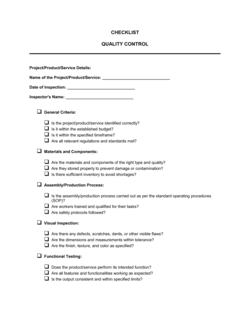
Documenting inspection and testing steps for a manufactured productQuality Control Checklist
Defining test cases and test coverage for a software releaseSoftware Test Plan
Tracking defects and resolution status during a projectDefect Tracking Log
Auditing an existing process against quality standardsInternal Audit Report
Documenting corrective and preventive actions after a quality failureCorrective Action Report
Onboarding a new supplier with defined quality requirementsSupplier Quality Agreement

Common mistakes to avoid

❌ Objectives with no measurable targets

Why it matters: A plan that says 'ensure high quality' gives the team nothing to aim for and gives auditors nothing to verify. At review time, everyone can claim the objective was met.

Fix: Express every objective as a number β€” defect escape rate, test coverage percentage, or maximum open severity-2 defects at release β€” and record the target before work begins.

❌ No exit criteria for test phases

Why it matters: Without defined exit criteria, teams ship when they run out of time rather than when quality thresholds are met β€” and release with an unknown defect profile.

Fix: Write explicit exit criteria for every test phase: the pass rate required, the maximum open defects by severity, and who has authority to grant an exception.

❌ Treating the plan as a one-time deliverable

Why it matters: A QA plan written at kickoff and never updated becomes misleading β€” it describes a process the team no longer follows and gives stakeholders false confidence.

Fix: Schedule a plan review at each major milestone and trigger an unscheduled review whenever project scope, timeline, or team composition changes significantly.

❌ Generic role assignments with no named owners

Why it matters: When a defect escapes or a checkpoint is missed, 'the QA team' cannot be held accountable β€” accountability requires a named individual.

Fix: Replace every generic role label with a specific name or team identifier, and assign a backup for each critical QA function.

The 10 key sections, explained

Purpose and scope

Quality objectives

Roles and responsibilities

Documentation and configuration standards

QA activities and checkpoints

Testing approach and methods

Defect management

Corrective and preventive action (CAPA)

Metrics and reporting

Plan review and approval

How to fill it out

  1. 1

    Define the scope and link it to the project charter

    Write a one-paragraph scope statement that names the project, the deliverables covered, and any explicit exclusions. Reference the project charter or statement of work so the QA plan and project documents are aligned.

    πŸ’‘ If you cannot write the scope in one paragraph, the project scope itself may not be clearly defined β€” resolve that first.

  2. 2

    Set numeric quality objectives

    Convert every quality goal into a measurable target: defect escape rate, test coverage percentage, or maximum open defects at release. Record the baseline or industry benchmark next to each target so reviewers understand the standard.

    πŸ’‘ Three to five well-chosen metrics are more actionable than ten vague ones.

  3. 3

    Assign named owners to every QA role

    Replace generic role titles with the actual names or team identifiers responsible for each QA activity. Include a backup owner for critical roles to avoid single points of failure.

    πŸ’‘ Use a RACI table (Responsible, Accountable, Consulted, Informed) if the project involves more than five stakeholders.

  4. 4

    Map QA checkpoints to the project schedule

    Pull your project timeline and insert each QA gate β€” requirements review, design walkthrough, UAT β€” as a named milestone with a target date. Flag which checkpoints are hard gates (project cannot proceed without passing) versus advisory reviews.

    πŸ’‘ Hard gates prevent defects from accumulating across phases; if every checkpoint is advisory, the plan has no real enforcement mechanism.

  5. 5

    Define entry and exit criteria for each test phase

    For each testing type (unit, integration, UAT), write explicit criteria that must be met before testing begins and before it is considered complete. Include the defect severity thresholds that block release.

    πŸ’‘ Exit criteria that include a maximum number of open lower-severity defects are more realistic than requiring zero defects at all levels.

  6. 6

    Configure your defect tracking tool and log structure

    Set up your defect log in your chosen tool β€” Jira, Azure DevOps, or even a shared spreadsheet β€” using the severity classification and fields defined in the plan. Confirm all team members have access and understand the workflow before testing begins.

    πŸ’‘ Run a five-minute walkthrough with the team on how to log a defect correctly; inconsistent logging undermines every metric you track.

  7. 7

    Get sign-off from the project sponsor and client before work begins

    Circulate the completed plan to all approvers listed in the plan review section and collect signatures or documented approvals before the first QA activity executes.

    πŸ’‘ Document approvals in writing β€” email confirmation is acceptable if a formal signature block is impractical, but save it with the plan.

  8. 8

    Schedule the first plan review at the midpoint milestone

    Add a calendar event now for the first scheduled plan review, tied to a project milestone rather than a calendar date. Include the QA manager and project sponsor as required attendees.

    πŸ’‘ A plan review takes 30–60 minutes and prevents the document from drifting out of sync with actual project conditions.

Frequently asked questions

What is a quality assurance plan?

A quality assurance plan is a document that defines how a project, product, or process will be managed to meet specified quality standards. It records quality objectives, roles, testing methods, defect management procedures, and reporting requirements. It is written before work begins and used throughout the project to ensure quality activities are planned rather than improvised.

What is the difference between quality assurance and quality control?

Quality assurance (QA) is a process-oriented discipline focused on preventing defects by establishing standards and procedures before work is done. Quality control (QC) is the inspection-oriented discipline of detecting defects in outputs after they are produced. A QA plan governs both β€” it defines the processes (QA) and the inspection and testing methods (QC) used to achieve quality objectives.

When should a quality assurance plan be created?

A QA plan should be created before work begins β€” typically during project initiation or planning. Creating it after work is underway means quality checkpoints have already been missed and defects may have accumulated without a tracking mechanism. For ongoing operations, review and update the plan at the start of each major production cycle or fiscal year.

Is a quality assurance plan required for ISO 9001 certification?

ISO 9001 requires organizations to plan and implement processes for achieving quality objectives, which in practice means documented quality plans are expected. A formal QA plan that covers objectives, responsibilities, processes, and corrective action directly supports ISO 9001 clause 8.1 (operational planning and control) and clause 10.2 (nonconformity and corrective action). Consider consulting a certified quality consultant to confirm your plan meets the specific requirements of your certification body.

How is a quality assurance plan different from a test plan?

A test plan covers one specific aspect of QA β€” the scope, approach, tools, environments, and schedule for testing activities. A quality assurance plan is the broader governing document that includes quality objectives, roles, documentation standards, the full range of QA activities (not just testing), defect management, corrective action, and reporting. A test plan is typically a sub-document referenced within the QA plan.

How long should a quality assurance plan be?

For most projects, 8–15 pages is sufficient. A concise plan that team members actually reference is more effective than a 50-page document that sits unread. Complex programs β€” large construction projects, regulated healthcare devices, or multi-vendor software integrations β€” may require longer plans with appendices for specific test procedures or supplier quality requirements.

Who should approve a quality assurance plan?

At minimum, the QA manager or quality lead and the project sponsor or senior stakeholder should formally approve the plan before work begins. For client-facing projects, the client's designated representative should also sign off. In regulated industries β€” medical devices, defense, aerospace β€” regulatory or compliance reviewers may be required approvers as well.

Can a quality assurance plan template be reused across projects?

Yes β€” a template provides a consistent structure that reduces setup time on every new project. The sections, role definitions, and defect severity classifications stay largely the same; what changes are the specific quality objectives, named owners, test environments, and schedule milestones. Reusing a template also makes cross-project audits easier because plans follow a predictable format.

What metrics should a quality assurance plan track?

The most actionable QA metrics are defect escape rate (defects found post-release per 1,000 units or transactions), test case pass rate, defect backlog by severity, defect age (average days open), and open corrective action count. Tracking these weekly gives early warning of a deteriorating quality trend before it affects the release date or client satisfaction.

How this compares to alternatives

vs Quality Management Plan

A quality management plan covers the entire organization's or program's quality framework β€” policies, standards, and governance across all projects. A quality assurance plan is project-specific, defining QA activities, checkpoints, and metrics for a single project or product. Use the management plan to set organizational standards; use the QA plan to implement them on a specific engagement.

vs Test Plan

A test plan is scoped exclusively to testing activities β€” test cases, environments, tools, and schedules. A quality assurance plan is broader, covering the full quality lifecycle including documentation standards, roles, defect management, corrective action, and reporting. A test plan is typically a referenced sub-document within a complete QA plan.

vs Standard Operating Procedure (SOP)

An SOP documents the step-by-step instructions for performing a specific recurring task. A QA plan documents the overarching framework β€” objectives, roles, checkpoints, and controls β€” that governs quality across a project or process. SOPs for individual inspection or testing tasks are often referenced as appendices within a QA plan.

vs Project Plan

A project plan defines the full scope, schedule, budget, and resource allocation for a project. A quality assurance plan is a sub-plan focused solely on quality objectives, testing activities, and defect management. The two documents should reference each other β€” QA checkpoints in the QA plan must appear as milestones in the project plan to be enforceable.

Industry-specific considerations

Software and SaaS

Test coverage targets, automated regression suite requirements, release exit criteria, and integration with CI/CD pipeline gates.

Manufacturing

Inspection sampling plans, defect tolerance thresholds per production run, supplier incoming quality standards, and ISO 9001 or IATF 16949 alignment.

Construction and Engineering

Material inspection checkpoints, subcontractor quality obligations, regulatory hold points requiring third-party inspection, and as-built documentation standards.

Healthcare and Medical Devices

FDA 21 CFR Part 820 or ISO 13485 compliance requirements, design verification and validation testing protocols, and traceability from requirements to test evidence.

Template vs pro β€” what fits your needs?

PathBest forCostTime
Use the templateProject managers and QA leads at small to mid-size organizations managing standard projects without regulatory obligationsFree2–4 hours to customize and complete
Template + professional reviewTeams pursuing ISO 9001 certification or delivering to clients who require a contractually compliant QA plan$500–$2,000 for a quality consultant review1–3 days
Custom draftedRegulated industries (medical devices, aerospace, defense) where QA plans must satisfy statutory or contractual audit requirements$3,000–$10,000+ for a certified quality engineer or consulting firm2–6 weeks

Glossary

Quality Assurance (QA)
A systematic process of verifying that products or services meet defined standards before they reach the end user.
Quality Control (QC)
The operational techniques used to inspect and test outputs against quality criteria β€” a subset of the broader QA function.
Acceptance Criteria
The specific, measurable conditions a deliverable must satisfy before it is considered complete and approved.
Defect
Any deviation from a specified requirement or expected outcome identified during testing, inspection, or review.
Corrective Action
A documented response to a detected defect or nonconformance that identifies the root cause and the steps taken to prevent recurrence.
ISO 9001
An internationally recognized standard that specifies requirements for a quality management system, used across industries to demonstrate consistent product and service quality.
Nonconformance
A condition in which a product, process, or deliverable fails to meet one or more specified requirements.
Test Plan
A document describing the scope, approach, resources, and schedule of testing activities for a specific product or release.
Traceability Matrix
A grid that maps requirements to corresponding test cases, ensuring every requirement has been tested and every test case has a business justification.
Root Cause Analysis (RCA)
A structured investigation method used to identify the underlying cause of a defect or failure rather than treating only its symptoms.

Part of your Business Operating System

This document is one of 3,000+ business & legal templates included in Business in a Box.

  • Fill-in-the-blanks β€” ready in minutes
  • 100% customizable Word document
  • Compatible with all office suites
  • Export to PDF and share electronically

Create your document in 3 simple steps.

From template to signed document β€” all inside one Business Operating System.
1
Download or open template

Access over 3,000+ business and legal templates for any business task, project or initiative.

2
Edit and fill in the blanks with AI

Customize your ready-made business document template and save it in the cloud.

3
Save, Share, Send, Sign

Share your files and folders with your team. Create a space of seamless collaboration.

Save time, save money, and create top-quality documents.

β˜…β˜…β˜…β˜…β˜…

"Fantastic value! I'm not sure how I'd do without it. It's worth its weight in gold and paid back for itself many times."

Managing Director Β· Mall Farm
Robert Whalley
Managing Director, Mall Farm Proprietary Limited
β˜…β˜…β˜…β˜…β˜…

"I have been using Business in a Box for years. It has been the most useful source of templates I have encountered. I recommend it to anyone."

Business Owner Β· 4+ years
Dr Michael John Freestone
Business Owner
β˜…β˜…β˜…β˜…β˜…

"It has been a life saver so many times I have lost count. Business in a Box has saved me so much time and as you know, time is money."

Owner Β· Upstate Web
David G. Moore Jr.
Owner, Upstate Web

Run your business with a system β€” not scattered tools

Stop downloading documents. Start operating with clarity. Business in a Box gives you the Business Operating System used by over 250,000 companies worldwide to structure, run, and grow their business.

Free Forever PlanΒ Β·Β No credit card required