Quality Scale Survey Template

Free Word download β€’ Edit online β€’ Save & share with Drive β€’ Export to PDF

1 pageβ€’20–30 min to fillβ€’Difficulty: Standardβ€’Signature requiredβ€’Legal review recommended
Learn more ↓
FreeQuality Scale Survey Template

At a glance

What it is
A Quality Scale Survey is a structured evaluation instrument used to formally measure and document the quality of products, services, or processes against defined performance standards. This free Word download gives you a ready-to-use template you can edit online and export as PDF β€” covering rating scales, evaluation criteria, scoring methodology, and respondent acknowledgment in a single binding document.
When you need it
Use it when conducting vendor assessments, internal process audits, customer satisfaction reviews, or supplier qualification checks where quality measurements need to be recorded, compared over time, and referenced in contractual or compliance contexts.
What's inside
Survey purpose and scope, defined rating scale and scoring key, evaluation criteria across quality dimensions, weighted scoring methodology, respondent identification and certification, findings summary, and corrective action requirements.

What is a Quality Scale Survey?

A Quality Scale Survey is a structured evaluation instrument that uses a defined numeric or descriptive rating scale to measure specific attributes of a product, service, or process against established quality standards. Each attribute is assigned a weight reflecting its relative importance, scores are multiplied by those weights, and the results are aggregated into a single quality score that is compared against a predetermined acceptance threshold. Unlike a simple checklist, a quality scale survey captures degrees of quality β€” not just pass or fail β€” producing quantified evidence that can be tracked over time, compared across suppliers or periods, and referenced in contractual enforcement or regulatory compliance contexts.

Why You Need This Document

Without a documented, scored quality survey, quality disputes between buyers and suppliers come down to competing subjective claims β€” and the party without written evidence almost always loses. A properly completed quality scale survey creates the audit trail that supports corrective action notices, payment holds, contract termination decisions, and ISO or regulatory compliance filings. It also protects you from the opposite problem: a supplier challenging a non-conformance finding you cannot substantiate. Ambiguous quality language in a contract β€” "acceptable quality," "industry standard," "fit for purpose" β€” only has teeth when there is a calibrated, signed survey on file that translates those words into measurable scores. This template gives you a ready-to-use instrument with defined criteria, weighted scoring, respondent certification, and dispute resolution provisions β€” so quality outcomes are documented, defensible, and actionable from the first evaluation forward.

Which variant fits your situation?

If your situation is…Use this template
Evaluating a supplier's product quality against contract specificationsVendor Quality Evaluation Form
Measuring customer satisfaction with delivered servicesCustomer Satisfaction Survey
Auditing internal production processes for ISO complianceInternal Quality Audit Checklist
Assessing employee performance quality for HR reviewsEmployee Performance Review
Documenting quality findings in a formal inspection reportQuality Inspection Report
Gathering multi-respondent quality ratings for a new product launchProduct Feedback Survey
Conducting a post-project quality review with a clientProject Completion Checklist

Common mistakes to avoid

❌ No behavioral anchors on the rating scale

Why it matters: Without defined anchors, two evaluators assessing the same supplier will assign different scores to identical performance, making results impossible to compare and legally unreliable.

Fix: Add a one-sentence behavioral description to each scale point before distributing the survey. For example, '3 = Meets expectations: all contractual specifications are met with no documented deviations.'

❌ Accepting unsupported scores below the threshold

Why it matters: A non-conformance finding with no attached evidence cannot be enforced contractually and exposes the evaluating party to a successful legal challenge from the subject party.

Fix: Require evaluators to attach a numbered exhibit for every criterion scored 2 or below, and reject survey submissions that include unsupported low scores.

❌ Setting the acceptance threshold after results are known

Why it matters: A threshold established retroactively is a textbook grounds for a dispute or bad-faith claim, particularly in supplier contract enforcement or regulatory audit contexts.

Fix: Lock the acceptance threshold in the survey document before any scores are recorded, and store the pre-signed original to establish the timeline.

❌ Omitting the dispute resolution clause

Why it matters: Without a structured challenge process, a subject party that disagrees with a non-conformance finding has no option other than litigation, which is costly for both sides.

Fix: Include a 10-business-day challenge window, a named neutral reviewer, and a 15-day resolution timeline that references the master contract's dispute escalation path.

❌ Using the same survey instrument across incompatible contexts

Why it matters: A quality scale designed for manufacturing defect rates will produce meaningless scores when applied to a professional services engagement, because the criteria and evidence types are entirely different.

Fix: Maintain separate survey instruments calibrated to each product or service category, with criteria drawn from the applicable specification or service level agreement.

❌ Failing to obtain countersignatures when required

Why it matters: In procurement, regulatory, and ISO audit contexts, a survey signed only by the evaluator may be inadmissible as evidence or insufficient to trigger contractual remedies.

Fix: Identify at the outset whether the survey context requires a single-party signature or a countersignature from the subject party, and build the signature block accordingly.

The 10 key clauses, explained

Survey Purpose and Scope

In plain language: States the objective of the quality assessment, identifies what is being evaluated (product, service, or process), and defines the boundaries of the survey.

Sample language
This Quality Scale Survey is conducted by [EVALUATING PARTY] to assess the quality of [PRODUCT/SERVICE/PROCESS] provided by [SUBJECT PARTY] during the period [START DATE] to [END DATE], in accordance with [CONTRACT/STANDARD REFERENCE].

Common mistake: Defining scope so broadly that evaluators interpret the criteria differently β€” for example, listing 'overall quality' without specifying which product lines or service touchpoints are included β€” leading to inconsistent scores that cannot be compared or relied upon.

Rating Scale Definition and Key

In plain language: Establishes the numeric or descriptive scoring range used throughout the survey and assigns a precise meaning to each point on the scale.

Sample language
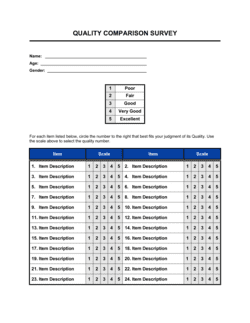
All criteria shall be rated on a scale of 1 to 5, where: 1 = Unacceptable (fails to meet minimum standards), 2 = Below expectations, 3 = Meets expectations, 4 = Exceeds expectations, 5 = Exceptional. Half-point scores are not permitted.

Common mistake: Leaving scale labels ambiguous β€” for example, using 'good' and 'very good' without behavioral anchors β€” so two evaluators assign different scores to the same observed performance, destroying inter-rater reliability.

Evaluation Criteria and Scoring Matrix

In plain language: Lists each quality attribute to be assessed, assigns it a weight reflecting its relative importance, and provides space to record the raw score and weighted score for each criterion.

Sample language
Criterion: [CRITERION NAME] | Weight: [X]% | Rating (1–5): [SCORE] | Weighted Score: [SCORE Γ— WEIGHT]. The sum of all criterion weights shall equal 100%.

Common mistake: Assigning equal weights to all criteria regardless of their actual importance to the contract or outcome β€” this gives trivial attributes the same influence as critical quality dimensions and produces misleading aggregate scores.

Evidence and Supporting Documentation

In plain language: Requires the evaluator to reference objective evidence β€” test results, inspection records, photographs, or delivery logs β€” supporting each score assigned.

Sample language
For each criterion rated 2 or below, the evaluator shall attach supporting evidence including [TEST REPORTS / INSPECTION RECORDS / PHOTOGRAPHS] as Exhibit [X]. Unsupported low scores may be challenged by [SUBJECT PARTY] within [X] business days.

Common mistake: Accepting scores without requiring any supporting evidence, which makes the survey legally vulnerable to challenge and renders corrective action requests unenforceable if disputed.

Aggregate Score Calculation and Acceptance Threshold

In plain language: Specifies how the overall quality score is calculated from weighted criterion scores and states the minimum aggregate score required to meet acceptance standards.

Sample language
The Aggregate Quality Score is the sum of all weighted criterion scores, expressed as a percentage of the maximum possible score. An Aggregate Quality Score of [X]% or above constitutes Acceptable Quality. A score below [X]% constitutes Non-Conformance and triggers Section [X] remediation obligations.

Common mistake: Failing to define the acceptance threshold in advance, leaving parties to dispute what score constitutes 'acceptable' after results are known β€” a common source of vendor disputes and contract claims.

Non-Conformance and Corrective Action Requirements

In plain language: Defines what happens when the survey identifies a quality failure β€” who is notified, what corrective actions are required, and the timeline for remediation and re-assessment.

Sample language
In the event of Non-Conformance, [EVALUATING PARTY] shall issue a Corrective Action Notice to [SUBJECT PARTY] within [X] business days. [SUBJECT PARTY] shall submit a written Corrective Action Plan within [X] days and complete remediation by [DATE / within X days]. A re-assessment survey shall be conducted within [X] days of remediation completion.

Common mistake: Omitting a specific remediation timeline, which allows a non-conforming vendor to delay corrective action indefinitely while remaining on approved-supplier lists and continuing to supply substandard goods or services.

Respondent Identification and Certification

In plain language: Requires the evaluator to identify themselves, state their qualifications to assess the subject matter, and certify that scores reflect their honest, independent judgment based on observed evidence.

Sample language
I, [EVALUATOR NAME], [TITLE], certify that I have personally reviewed the evidence referenced herein and that the ratings recorded in this survey reflect my independent, good-faith assessment. I have no undisclosed conflict of interest with [SUBJECT PARTY].

Common mistake: Allowing anonymous survey completion in contexts where results will be used in contractual enforcement or regulatory filings β€” anonymous scores carry little legal weight and cannot be cross-examined if disputed.

Confidentiality of Survey Results

In plain language: Restricts disclosure of survey scores, findings, and supporting evidence to authorized parties and prohibits use of results for purposes outside the stated scope.

Sample language
Survey results, scores, and supporting documentation are confidential to [EVALUATING PARTY] and [SUBJECT PARTY] and shall not be disclosed to third parties without prior written consent, except as required by law, regulation, or a valid court order.

Common mistake: Not including a confidentiality clause at all β€” quality scores shared outside authorized channels can damage supplier relationships, create defamation exposure, or compromise competitive information if disclosed to competitors.

Dispute Resolution

In plain language: Establishes the process for challenging survey scores, who adjudicates disputes, and the timeline for resolution before escalation to formal legal proceedings.

Sample language
[SUBJECT PARTY] may formally dispute any criterion score by submitting written notice to [EVALUATING PARTY] within [X] business days of receiving results. Disputed scores shall be reviewed by [NEUTRAL REVIEWER / PANEL] within [X] days. If unresolved, disputes shall be escalated in accordance with the dispute resolution provisions of [MASTER CONTRACT REFERENCE].

Common mistake: Omitting a dispute window entirely, which leaves the subject party no formal mechanism to challenge a score they believe is inaccurate β€” increasing the likelihood of litigation rather than structured resolution.

Governing Standards and Reference Documents

In plain language: Identifies the quality standards, industry specifications, or contractual requirements against which the survey criteria are benchmarked.

Sample language
This survey is conducted in accordance with [ISO 9001:2015 / ASTM [STANDARD] / CONTRACT CLAUSE X / INTERNAL QUALITY POLICY REF]. In the event of conflict between this survey instrument and the referenced standard, the referenced standard shall prevail.

Common mistake: Referencing outdated versions of standards without a clause confirming which version applies β€” if a standard has been revised since the contract was signed, parties may disagree about which version governs the evaluation.

How to fill it out

  1. 1

    Define the survey purpose and scope

    Enter the name of the evaluating party, the subject being evaluated (product line, service category, or process), the evaluation period, and the contract or standard it references. Be specific enough that any qualified evaluator would assess the same items.

    πŸ’‘ Attach or reference the product specification, service level agreement, or quality standard document so scope is defined by objective criteria, not memory.

  2. 2

    Confirm the rating scale and anchor labels

    Review the default 1–5 scale and replace any labels that don't match your industry's terminology. Add behavioral anchors β€” specific descriptions of what observable evidence justifies each score β€” before distributing to evaluators.

    πŸ’‘ Run a calibration session with two or three evaluators scoring the same sample before using the survey in production, to confirm inter-rater reliability.

  3. 3

    Build the evaluation criteria matrix

    List every quality attribute to be measured. Assign each a weight (all weights must total 100%). Order criteria from highest to lowest weight so evaluators understand their relative importance.

    πŸ’‘ Limit the criteria list to 8–12 items. More than 15 criteria in a single survey session produces evaluator fatigue and less reliable scores.

  4. 4

    Set the acceptance threshold

    Enter the minimum aggregate weighted score that constitutes acceptable quality β€” for example, 70% or 3.5 out of 5. Confirm this threshold is consistent with what your contract or standard requires before the survey is administered.

    πŸ’‘ Set the threshold in advance and record it here before scoring begins. Thresholds set after scores are known are legally vulnerable to challenge.

  5. 5

    Conduct the evaluation and attach evidence

    Score each criterion based on direct observation, test data, or documented records. For any criterion rated 2 or below, attach the supporting evidence as a numbered exhibit. Do not assign low scores based on memory alone.

    πŸ’‘ Photograph or screenshot supporting evidence at the time of evaluation. Post-hoc evidence collection is harder to defend in a dispute.

  6. 6

    Calculate the aggregate score and determine conformance

    Multiply each criterion score by its weight, sum the results, and express the total as a percentage of the maximum possible score. Compare to the acceptance threshold and record the conformance finding.

    πŸ’‘ Use the template's built-in scoring table rather than a separate spreadsheet β€” keeping the calculation in the document maintains a single auditable record.

  7. 7

    Complete the respondent certification block

    Enter the evaluator's full name, title, and the date of assessment. Both evaluator and an authorized representative of the evaluating organization should sign where required. For surveys used in regulatory contexts, obtain the subject party's countersignature.

    πŸ’‘ If the survey will be used as evidence in a procurement decision or dispute, sign in front of a witness and retain the original signed copy β€” not just a PDF scan.

  8. 8

    Issue findings and corrective action notices

    Distribute results to authorized parties only. For any non-conformance finding, issue a formal Corrective Action Notice referencing the specific criteria, scores, and required remediation steps within the timeline defined in the survey.

    πŸ’‘ Track corrective action deadlines in your quality management system and calendar a re-assessment date immediately upon issuing the notice, so the follow-up doesn't get lost.

Frequently asked questions

What is a quality scale survey?

A quality scale survey is a structured evaluation document that uses a defined rating scale to measure specific attributes of a product, service, or process against established standards. It records scores for each criterion, calculates a weighted aggregate result, and documents whether the subject meets a defined acceptance threshold. In business contexts, it is used to support vendor management, compliance reporting, and contractual quality enforcement.

When should I use a quality scale survey?

Use a quality scale survey when you need a documented, repeatable record of quality performance β€” particularly in supplier audits, customer acceptance testing, ISO compliance checks, or any situation where quality findings may be referenced in a contract dispute or regulatory review. It is most valuable when the same product, service, or process is evaluated repeatedly over time, allowing scores to be compared across periods.

What is the difference between a quality scale survey and a standard checklist?

A checklist records binary pass/fail observations β€” each item is either present or absent. A quality scale survey assigns a numeric rating to each attribute, enabling degrees of quality to be measured and weighted. This produces a richer, quantified picture of performance and allows aggregate scores to be compared across suppliers, periods, or locations. Checklists are faster; quality scale surveys produce more actionable data.

Does a quality scale survey need to be signed?

When a quality scale survey is used to support a contractual decision β€” such as approving a vendor payment, triggering a corrective action clause, or qualifying a supplier β€” it should be signed by the evaluator and, where the contract requires it, countersigned by the subject party. An unsigned survey carries reduced evidentiary weight if findings are disputed. For internal benchmarking purposes only, a formal signature may not be required.

How do I set the acceptance threshold?

The acceptance threshold should be set before any evaluation takes place, based on the requirements of the applicable contract, quality standard, or regulatory framework. A common starting point is 70–80% of the maximum possible weighted score for general vendor assessments, or higher (85–95%) for safety-critical or regulated applications. The threshold must be documented in the survey instrument prior to scoring to be defensible.

Can I use this survey for ISO 9001 compliance purposes?

A quality scale survey aligned to ISO 9001:2015 criteria can support compliance documentation, particularly for supplier evaluation and monitoring requirements under clause 8.4. However, ISO certification itself requires a formal audit conducted by an accredited certification body. This template provides a structured evidence-gathering tool that supplements β€” but does not replace β€” a formal certification audit. Consider having your quality manager review the survey criteria against your ISO scope before use.

What rating scale format works best?

A 5-point scale is the most widely used format for quality surveys and produces sufficient granularity for most business applications. A 7-point scale offers finer discrimination for complex professional services evaluations. Binary (pass/fail) scales are appropriate only for safety-critical criteria where no degree of non-conformance is acceptable. Whatever scale you choose, every point must have a written behavioral anchor before the survey is administered.

How often should a quality scale survey be conducted?

Frequency depends on the risk profile of what is being evaluated. For critical suppliers or high-risk processes, quarterly assessments are typical. For standard vendors, an annual survey is common. For customer satisfaction quality assessments, a post-delivery or post-project cadence works well. Regulated industries such as pharmaceuticals, aerospace, and food manufacturing often have mandatory minimum audit frequencies set by applicable standards.

What happens when a supplier scores below the acceptance threshold?

A score below the acceptance threshold constitutes a Non-Conformance and typically triggers the corrective action provisions in your supplier agreement or quality management system. The evaluating party issues a Corrective Action Notice specifying what must be remediated and by when. The supplier submits a Corrective Action Plan, completes remediation, and is re-assessed. Persistent non-conformance may trigger contract suspension, removal from the approved supplier list, or financial penalties, depending on the governing contract terms.

How this compares to alternatives

vs Customer Satisfaction Survey

A customer satisfaction survey collects subjective perception data from end users about their experience. A quality scale survey evaluates objective, measurable attributes of a product or process against defined specifications. Customer satisfaction surveys measure how customers feel; quality scale surveys measure whether standards are met. Both are useful but serve different audiences and produce different types of evidence.

vs Quality Audit Checklist

A quality audit checklist records binary pass/fail observations for each item β€” something is either present or it is not. A quality scale survey assigns a numeric rating to each criterion, enabling degrees of quality to be measured and weighted. Checklists are faster to complete; quality scale surveys produce richer quantified data that supports trend analysis and contractual enforcement.

vs Vendor Evaluation Form

A vendor evaluation form assesses a supplier across multiple dimensions β€” financial stability, delivery performance, pricing, and service β€” with quality as just one factor. A quality scale survey focuses exclusively on quality attributes, using a calibrated rating scale and weighted scoring methodology. Use a vendor evaluation form for holistic supplier decisions and a quality scale survey specifically for quality performance measurement.

vs Employee Performance Review

An employee performance review measures an individual's work output, competencies, and behaviors against role expectations. A quality scale survey assesses the quality of a product, service, or process β€” not a person. When quality outcomes are tied to team performance, both documents may be used in parallel, but they serve different accountability purposes and should not be conflated.

Industry-specific considerations

Manufacturing

Incoming material inspection, in-process quality checks, and finished-goods acceptance testing tied to dimensional tolerances, defect rates, and production yield targets.

Healthcare

Supplier qualification under FDA 21 CFR Part 820 or ISO 13485, clinical service quality assessments, and patient care process audits where documented evidence is a regulatory requirement.

Professional Services

Post-engagement client quality reviews scoring deliverable accuracy, timeliness, communication, and responsiveness β€” used to support contract renewal decisions and performance-based fee adjustments.

Food and Beverage

Supplier audit scoring against HACCP, SQF, or BRC standards, raw material quality assessments, and production hygiene evaluations required for retail and foodservice chain compliance.

Jurisdictional notes

United States

Quality survey results used to support contractual remedies β€” payment holds, supplier termination, or damages claims β€” should be retained as business records under applicable state evidentiary rules. Industries regulated by the FDA (medical devices, food, pharmaceuticals) face mandatory quality documentation requirements under 21 CFR Parts 820 and 110. State contract law governs enforceability of corrective action and acceptance provisions; ensure survey language aligns with the governing state's standards for commercial reasonableness.

Canada

Federal and provincial procurement frameworks β€” including PSPC supply arrangements β€” often require documented supplier quality evaluations as part of vendor qualification and ongoing monitoring. In Quebec, survey instruments and results shared with francophone suppliers in a business context should be available in French under the Charter of the French Language. Quality survey results used in dispute resolution proceedings are subject to provincial evidence acts governing business records.

United Kingdom

Quality survey instruments used in supplier contracts governed by the Sale of Goods Act 1979 and the Supply of Goods and Services Act 1982 should align acceptance criteria with the statutory 'satisfactory quality' and 'fit for purpose' standards. Post-Brexit, UK Conformity Assessment (UKCA) marking requirements apply to regulated products, and quality surveys used for compliance purposes should reference current UK-specific standards rather than EU CE-marked equivalents where they have diverged.

European Union

Quality surveys collecting personal data about named evaluators or respondents are subject to GDPR. Ensure a lawful basis for processing and include appropriate data retention and deletion provisions. For products subject to CE marking or EU harmonized standards, quality survey criteria should reference the applicable directive and harmonized standard. ISO 9001 is widely used as the baseline quality management framework across EU member states and is referenced in many public procurement frameworks.

Template vs lawyer β€” what fits your deal?

PathBest forCostTime
Use the templateInternal quality benchmarking, standard supplier assessments, and customer satisfaction reviews not tied to formal contract enforcementFree30–60 minutes to customize and administer
Template + legal reviewSupplier audits tied to contractual corrective action clauses, ISO compliance documentation, or regulated industry quality programs$300–$800 (quality consultant or legal review)2–5 business days
Custom draftedSurveys embedded in high-value supply contracts, regulated industries (pharmaceutical, aerospace, medical device) with mandatory audit requirements, or multi-party quality frameworks$1,500–$5,000+1–3 weeks

Glossary

Rating Scale
A defined numeric or descriptive range β€” such as 1 to 5 or 'unacceptable' to 'excellent' β€” used to score each quality criterion consistently across respondents.
Evaluation Criterion
A specific measurable attribute of a product, service, or process being assessed, such as defect rate, response time, or dimensional accuracy.
Weighted Score
A quality score adjusted by the relative importance of each criterion, so that higher-priority attributes have greater influence on the overall result.
Benchmarking
Comparing measured quality scores against a predetermined standard, historical baseline, or industry reference point to determine performance gaps.
Corrective Action
A documented remedial step required when a quality score falls below a defined threshold, specifying what must be changed and by when.
Respondent Certification
A signed statement by the person completing the survey confirming that the information provided is accurate and complete to the best of their knowledge.
Likert Scale
A psychometric rating scale β€” typically 5 or 7 points β€” that measures agreement or quality perception from a strongly negative to a strongly positive pole.
Acceptance Threshold
The minimum aggregate quality score a product, service, or process must achieve to be accepted, approved, or passed to the next stage.
Non-Conformance
A documented instance where a measured attribute fails to meet the defined quality standard or specification.
Audit Trail
A chronological record of quality survey completions, scores, and corrective actions that supports compliance reporting and dispute resolution.
Inter-Rater Reliability
The degree of agreement between multiple evaluators scoring the same subject, indicating whether the survey instrument produces consistent results.

Part of your Business Operating System

This document is one of 3,000+ business & legal templates included in Business in a Box.

  • Fill-in-the-blanks β€” ready in minutes
  • 100% customizable Word document
  • Compatible with all office suites
  • Export to PDF and share electronically

Create your document in 3 simple steps.

From template to signed document β€” all inside one Business Operating System.
1
Download or open template

Access over 3,000+ business and legal templates for any business task, project or initiative.

2
Edit and fill in the blanks with AI

Customize your ready-made business document template and save it in the cloud.

3
Save, Share, Send, Sign

Share your files and folders with your team. Create a space of seamless collaboration.

Save time, save money, and create top-quality documents.

β˜…β˜…β˜…β˜…β˜…

"Fantastic value! I'm not sure how I'd do without it. It's worth its weight in gold and paid back for itself many times."

Managing Director Β· Mall Farm
Robert Whalley
Managing Director, Mall Farm Proprietary Limited
β˜…β˜…β˜…β˜…β˜…

"I have been using Business in a Box for years. It has been the most useful source of templates I have encountered. I recommend it to anyone."

Business Owner Β· 4+ years
Dr Michael John Freestone
Business Owner
β˜…β˜…β˜…β˜…β˜…

"It has been a life saver so many times I have lost count. Business in a Box has saved me so much time and as you know, time is money."

Owner Β· Upstate Web
David G. Moore Jr.
Owner, Upstate Web

Run your business with a system β€” not scattered tools

Stop downloading documents. Start operating with clarity. Business in a Box gives you the Business Operating System used by over 250,000 companies worldwide to structure, run, and grow their business.

Start freeΒ Β·Β No credit card required