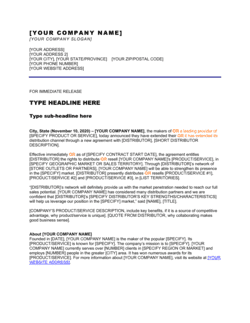
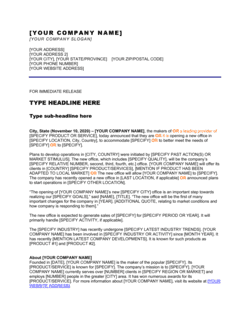
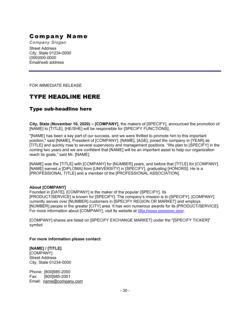
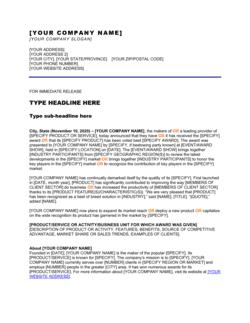
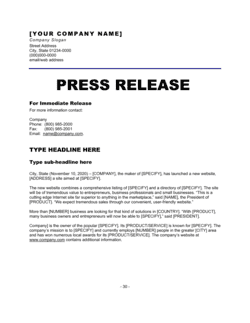
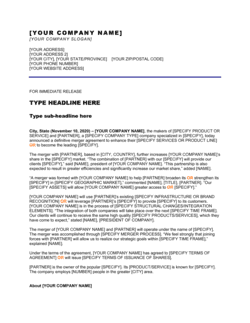
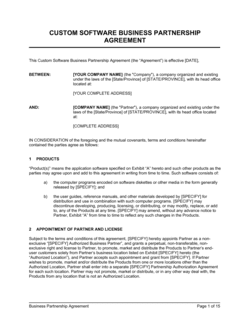
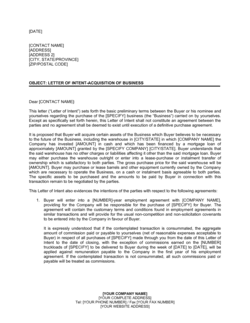
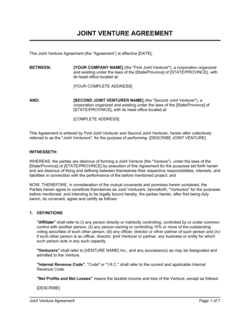
Press Release New Partnership-Collaboration Template

Free Word download β€’ Edit online β€’ Save & share with Drive β€’ Export to PDF

2 pagesβ€’25–30 min to fillβ€’Difficulty: Standardβ€’Signature requiredβ€’Legal review recommended
Learn more ↓
FreePress Release New Partnership-Collaboration Template

At a glance

What it is
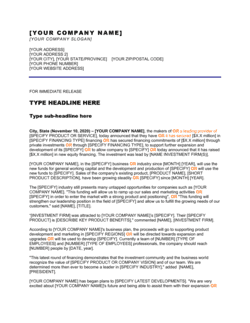
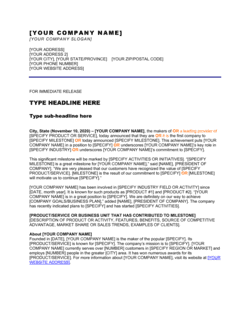
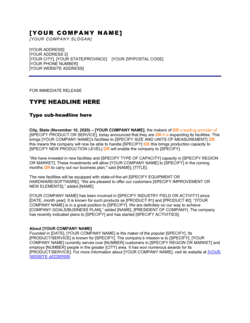
A Press Release New Partnership Collaboration is a formal written announcement issued jointly by two or more organizations to inform media, stakeholders, and the public of a newly formed business partnership or collaboration. This free Word download gives you a structured, publication-ready template you can edit online and export as PDF β€” covering all essential announcement elements from headline to boilerplate.
When you need it
Issue it when two or more organizations have finalized a partnership, strategic alliance, joint venture, or formal collaboration agreement and are ready to announce the arrangement to external audiences. Timing is typically coordinated with the signing of the underlying partnership agreement.
What's inside
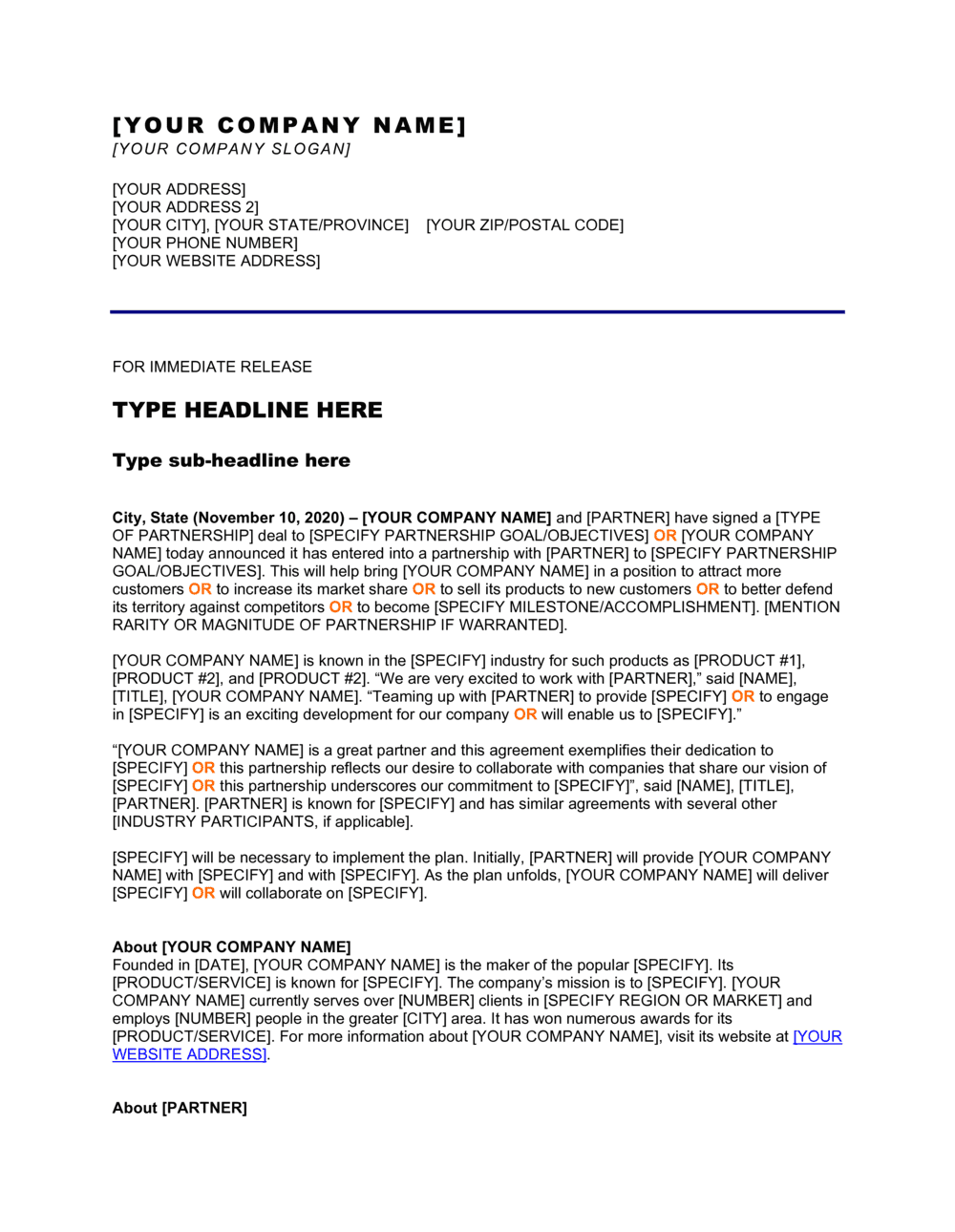
Headline and dateline, lead paragraph summarizing the partnership, supporting body paragraphs with deal context and strategic rationale, attributed executive quotes from both organizations, details of the collaboration's scope and benefits, call to action, media contact information, and boilerplate descriptions for each organization.

What is a Press Release New Partnership Collaboration?

A Press Release New Partnership Collaboration is a formal, jointly issued written announcement that two or more organizations distribute to media outlets, newswires, and stakeholders to publicly communicate the formation of a new business partnership or strategic collaboration. It identifies both organizations, describes the nature and scope of the collaboration, provides attributed executive quotes from each party, and directs media and readers to contact points for follow-up. Unlike the underlying partnership agreement β€” which is a binding legal contract β€” the press release itself carries no contractual obligations, but it is governed by mutual approval clauses in the agreement and must be consistent with the disclosed terms both parties have authorized for public release.

Why You Need This Document

A partnership that is never announced publicly delivers only a fraction of its potential business value. Without a coordinated press release, the collaboration may be mischaracterized by third parties, reported prematurely by one partner without the other's consent, or simply go unnoticed by the customers and media it was designed to reach. The absence of a formal release also creates legal exposure: distributing an announcement without both parties' documented written approval can breach mutual disclosure clauses in the partnership agreement and expose the issuing organization to claims. A properly drafted and jointly approved press release protects both organizations by ensuring the public narrative matches the agreed terms, excludes confidential commercial details, and meets any regulatory disclosure requirements applicable in the industries or jurisdictions involved. This template gives you the structure to draft, coordinate, and distribute a publication-ready announcement in hours rather than days β€” with the right legal checkpoints built into the process.

Which variant fits your situation?

If your situation is…Use this template
Announcing a formal joint venture with shared equity and governancePress Release Joint Venture Announcement
Publicizing a technology integration or API partnershipPress Release Technology Partnership
Announcing a nonprofit or community collaborationPress Release Nonprofit Partnership
Announcing a distribution or reseller agreementPress Release Distribution Agreement
Announcing a merger or acquisition alongside a partnershipPress Release Merger and Acquisition
Announcing a new product launch co-developed with a partnerPress Release New Product
Announcing an executive appointment resulting from a partnership dealPress Release Executive Appointment

Common mistakes to avoid

❌ Issuing the release before the partnership agreement is signed

Why it matters: Announcing a partnership that has not yet been formally executed creates legal and reputational risk if the deal subsequently falls through. Media corrections and partner disputes are both difficult to manage after publication.

Fix: Establish a firm policy that no partnership press release is distributed until both parties have executed the underlying agreement. Use the signing date as the earliest possible release date.

❌ Disclosing confidential commercial terms in the release

Why it matters: Revenue-share percentages, exclusivity provisions, or minimum purchase commitments published in a press release become public record, potentially alerting competitors and creating obligations neither party intended to disclose.

Fix: Have legal review the final draft against the signed partnership agreement to confirm that every dollar figure, percentage, and commercial term in the release is either publicly known or explicitly approved for disclosure.

❌ Omitting the partner's media contact from the release

Why it matters: Journalists who cannot reach a contact at one of the two announcing organizations often publish only one side of the story, which can damage the omitted partner's relationship with both media and the other organization.

Fix: Include a named, reachable media contact β€” name, direct phone, and email β€” for each organization in the release, and confirm both contacts are available to respond on the day of distribution.

❌ Using generic executive quotes that add no news value

Why it matters: Quotes like 'We are thrilled to partner with an industry leader' are cut by virtually every editor because they provide no information. A release stripped of its quotes loses credibility and reads like a product brochure.

Fix: Require each quote to reference a specific capability, customer outcome, or market opportunity. If an executive cannot provide a specific quote, draft a specific one for their approval rather than accepting a generic placeholder.

❌ Failing to obtain written approval from both organizations before distribution

Why it matters: Distributing a release without documented sign-off from both parties leaves the issuing organization exposed to breach of the partnership agreement if the announcement deviates from agreed messaging.

Fix: Use an email confirmation thread or eSign workflow to capture approval from the authorized representative at each organization. Retain this documentation for the life of the partnership.

❌ Publishing the release without coordinating internal and partner communications

Why it matters: Employees, customers, or investors who learn about the partnership from a media article before receiving any internal communication lose confidence in the organization's transparency and planning.

Fix: Send internal communications and partner-facing notifications at least one hour before the wire release goes live so stakeholders hear the news directly rather than through a third-party outlet.

The 10 key clauses, explained

Headline

In plain language: The single-line title of the press release that conveys the announcement in plain language, names both organizations, and signals the nature of the partnership.

Sample language
[COMPANY A] and [COMPANY B] Announce Strategic Partnership to [DELIVER OUTCOME] for [TARGET MARKET]

Common mistake: Writing a headline that names only one organization. Omitting the partner's name reduces pickup by media covering the other company and can create goodwill issues between partners.

Dateline and release status

In plain language: States the city of origin, the release date, and whether the announcement is for immediate release or under embargo until a specified date and time.

Sample language
FOR IMMEDIATE RELEASE β€” [CITY], [STATE/COUNTRY], [DATE] β€” [COMPANY A], a leading provider of [DESCRIPTION], today announced a new partnership with [COMPANY B]...

Common mistake: Omitting the embargo date when one is in effect. A release distributed to media without a clear embargo notation risks premature publication, which can violate the underlying partnership agreement and damage press relationships.

Lead paragraph

In plain language: The opening paragraph that summarizes the who, what, when, where, and why of the partnership in two to three sentences β€” written so it could stand alone as a complete announcement.

Sample language
[COMPANY A] and [COMPANY B] today announced a [TYPE OF PARTNERSHIP] designed to [STATED GOAL]. The partnership will [DESCRIBE PRIMARY ACTIVITY OR BENEFIT], effective [DATE], and is expected to serve [TARGET CUSTOMER SEGMENT] across [GEOGRAPHIC SCOPE].

Common mistake: Burying the partnership type or benefit in the third paragraph. Journalists read only the lead; if the core news is not in the first three sentences, the release rarely generates coverage.

Strategic rationale and background

In plain language: One or two paragraphs explaining why the partnership was formed, what market need it addresses, and what each organization contributes to the collaboration.

Sample language
The partnership combines [COMPANY A]'s expertise in [CAPABILITY] with [COMPANY B]'s established [ASSET OR CHANNEL], enabling both organizations to [OUTCOME]. This collaboration responds to growing demand for [MARKET TREND OR CUSTOMER NEED] in the [INDUSTRY] sector.

Common mistake: Filling this section with promotional language about each company's products rather than explaining the partnership's purpose. Editors cut promotional copy; strategic context is what survives to publication.

Executive quotes

In plain language: Attributed statements from a senior representative at each organization β€” typically CEO or VP level β€” that provide a human perspective on the partnership's significance and goals.

Sample language
'This partnership reflects our commitment to [STRATEGIC PRIORITY],' said [NAME], [TITLE] of [COMPANY A]. 'By combining our strengths with [COMPANY B], we can [SPECIFIC BENEFIT] for our customers.' Added [NAME], [TITLE] of [COMPANY B]: '[COMPLEMENTARY STATEMENT ABOUT PARTNERSHIP VALUE].'

Common mistake: Using generic quotes like 'We are excited to partner with this industry leader.' Quotes that could apply to any partnership are routinely cut by editors. Quotes should reference a specific capability, outcome, or customer group.

Partnership scope and deliverables

In plain language: Describes the specific activities, products, services, or markets covered by the collaboration, including timelines or milestones where appropriate.

Sample language
Under the agreement, [COMPANY A] will [SPECIFIC CONTRIBUTION OR ACTIVITY] while [COMPANY B] will [SPECIFIC CONTRIBUTION OR ACTIVITY]. The partnership will initially focus on [GEOGRAPHIC MARKET OR CUSTOMER SEGMENT], with plans to expand to [FUTURE SCOPE] by [DATE OR MILESTONE].

Common mistake: Disclosing confidential commercial terms β€” revenue shares, minimum purchase commitments, or exclusivity provisions β€” in the press release. These terms should remain in the underlying partnership agreement and be omitted from any public announcement.

Customer and market benefits

In plain language: A short paragraph articulating what the partnership means for customers, end users, or the broader market β€” concrete outcomes rather than organizational benefits.

Sample language
Customers of [COMPANY A] and [COMPANY B] will now have access to [COMBINED OFFERING OR INTEGRATED SERVICE], reducing [PAIN POINT] and enabling [POSITIVE OUTCOME]. The combined solution is available [DESCRIBE AVAILABILITY β€” via both platforms / through authorized resellers / starting DATE].

Common mistake: Describing benefits only from the organizations' perspective ('both companies will benefit from increased market reach') rather than from the customer's perspective. Media and readers care about the end-user impact, not the firms' revenue ambitions.

Call to action and additional information

In plain language: Directs interested readers, customers, or media contacts to a URL, event, or contact point for more information about the partnership.

Sample language
For more information about the partnership and its offerings, visit [URL] or contact [MEDIA CONTACT NAME] at [EMAIL]. [Optional: Both companies will jointly present at [EVENT NAME] on [DATE] at [LOCATION].]

Common mistake: Linking to a generic homepage rather than a dedicated partnership landing page or press kit. Journalists who cannot find specific information within 30 seconds typically abandon the story.

Media contact block

In plain language: Provides the full name, title, phone number, and email address of the PR or communications contact at each organization who is authorized to respond to media inquiries.

Sample language
Media Contact β€” [COMPANY A]: [CONTACT NAME], [TITLE] | [PHONE] | [EMAIL] Media Contact β€” [COMPANY B]: [CONTACT NAME], [TITLE] | [PHONE] | [EMAIL]

Common mistake: Listing only one organization's media contact. Journalists covering both companies need a direct point of contact at each organization; a single contact creates a bottleneck and risks delayed or unbalanced coverage.

Boilerplate descriptions

In plain language: A standardized two-to-four sentence description of each organization β€” their industry, what they do, who they serve, and a relevant credential β€” placed at the end of the release under an 'About' heading.

Sample language
About [COMPANY A]: [COMPANY A] is a [LOCATION]-based [DESCRIPTION OF BUSINESS] serving [CUSTOMER SEGMENT]. Founded in [YEAR], the company [KEY CREDENTIAL OR ACHIEVEMENT]. More information is available at [URL]. About [COMPANY B]: [COMPANY B] is a [LOCATION]-based [DESCRIPTION OF BUSINESS]...

Common mistake: Pasting the company's full marketing bio into the boilerplate. Boilerplates should be four sentences maximum and focus on facts β€” size, founding year, customer base, and one verifiable credential β€” not promotional claims.

How to fill it out

  1. 1

    Agree on key messages with your partner before drafting

    Align with the partner organization on the core announcement β€” partnership type, primary benefit, target audience, and any details that are off-limits for public disclosure. Document this alignment in writing before a single word is drafted.

    πŸ’‘ A shared one-page brief with agreed talking points signed off by both PR teams eliminates revision cycles caused by one partner objecting to framing after the fact.

  2. 2

    Draft the headline with both organization names

    Write a headline that names both companies, states the type of partnership, and hints at the customer benefit. Keep it under 12 words for media use.

    πŸ’‘ Test the headline by sending it to someone unfamiliar with the deal β€” if they cannot identify what was announced after reading it once, rewrite it.

  3. 3

    Write the lead paragraph to stand alone

    Answer who, what, when, where, and why in the first three sentences. Write it so that a journalist could publish just the lead paragraph and the story would still make sense.

    πŸ’‘ Read trade publications in your industry to calibrate the tone β€” B2B tech announcements read differently from manufacturing or healthcare partnership releases.

  4. 4

    Collect and approve executive quotes from both sides

    Request a quote from a named senior executive at each organization. Each quote should reference a specific aspect of the collaboration β€” not a generic expression of enthusiasm. Obtain written approval from each executive before the release is distributed.

    πŸ’‘ Draft a suggested quote for each executive to react to rather than asking for a quote from scratch β€” executives approve and refine much faster than they originate.

  5. 5

    Define scope without disclosing confidential terms

    Describe what each party will contribute and what the collaboration covers geographically and by customer segment. Explicitly exclude any financial terms, revenue arrangements, or exclusivity provisions that are governed by the underlying agreement.

    πŸ’‘ Have legal review the scope paragraph before distribution to confirm no confidential terms from the partnership agreement have been inadvertently included.

  6. 6

    Update both organizations' boilerplate descriptions

    Use the most current approved boilerplate for each organization β€” confirm with each partner's communications team that the version in the template is up to date. Boilerplates often lag product pivots or rebrandings by months.

    πŸ’‘ Store approved boilerplate text in a shared document that both teams update quarterly so it is always current for announcement use.

  7. 7

    Set the release status and distribution date

    Decide whether the release is for immediate distribution or under embargo. If embargoed, state the exact date and time (including time zone) prominently at the top. Distribute to wire services and media contacts no earlier than the agreed date.

    πŸ’‘ Coordinate the wire distribution time with both organizations' social media teams so announcement posts go live within 15 minutes of the wire pickup.

  8. 8

    Obtain final sign-off from both organizations before distribution

    Route the final draft to authorized approvers at both organizations β€” typically the communications lead and a legal or compliance reviewer. Document approvals by email or eSign before any distribution occurs.

    πŸ’‘ Build a 48-hour review window into the project timeline. Last-minute changes to quotes or scope language after wire submission trigger costly corrections.

Frequently asked questions

What is a press release for a new partnership or collaboration?

A press release for a new partnership is a formal, jointly issued announcement that informs media, customers, and stakeholders that two or more organizations have entered a business collaboration or strategic alliance. It summarizes the partnership's purpose, scope, and customer benefits, includes attributed quotes from executives at both organizations, and provides contact information for media follow-up. It is typically distributed via newswire and direct media outreach simultaneously.

When should a partnership press release be issued?

Issue the press release on or after the date the underlying partnership agreement is fully executed β€” not before. Timing is typically coordinated with both organizations' PR teams to maximize media pickup, often targeting Tuesday through Thursday mornings in the primary market's time zone. If an industry event or trade show is relevant, timing the release to coincide with it increases earned media exposure significantly.

What should a partnership press release not include?

Do not include financial terms such as revenue shares, deal values, or minimum purchase commitments unless both parties have explicitly agreed to disclose them. Avoid exclusivity provisions, non-compete language, or termination conditions β€” these are governed by the underlying agreement and should remain confidential. Generic promotional claims and unverifiable superlatives should also be removed before distribution.

How long should a partnership press release be?

Standard practice is 400 to 600 words, or roughly one to one-and-a-half pages. Releases exceeding 800 words are rarely read in full by journalists and should be condensed. Supporting detail β€” product specifications, executive bios, and background data β€” belongs in an attached press kit or linked media page, not in the release body itself.

Who should sign off on a partnership press release?

At minimum, the authorized communications lead and a legal or compliance reviewer from each organization should approve the final draft in writing before any distribution. For publicly traded companies, the investor relations and general counsel teams are typically required approvers. Document all approvals by email or eSign and retain them for the life of the partnership.

What is the difference between a partnership press release and a joint venture announcement?

A partnership press release announces a formal collaboration between two independent organizations that remain legally separate. A joint venture announcement describes the creation of a new, separate legal entity owned by two or more parent organizations. Joint venture announcements typically require more detailed legal disclosure, may trigger regulatory reporting obligations, and often involve securities counsel review before distribution.

Can a press release announcing a partnership be issued by only one party?

Technically yes, but it is poor practice without the other party's written consent. Issuing a partnership announcement unilaterally can violate a confidentiality or mutual announcement clause in the partnership agreement, damage the relationship with the partner, and expose the issuing organization to breach of contract claims. Always issue partnership announcements jointly or with documented written consent from the other party.

How does a partnership press release differ from a partnership agreement?

A partnership press release is an external communication document β€” it announces the collaboration to the public and media but creates no legal obligations between the parties. A partnership agreement is a binding contract that defines each party's rights, duties, financial arrangements, IP ownership, termination rights, and dispute resolution. The press release is derived from the agreement; the agreement governs the actual relationship.

How this compares to alternatives

vs Press Release Merger and Acquisition

A merger and acquisition press release announces a structural change in ownership β€” one entity acquiring or merging with another β€” which typically triggers securities disclosure obligations and regulatory review. A partnership press release announces a collaboration between organizations that remain legally independent. M&A releases involve securities counsel; partnership releases typically require only legal and communications review.

vs Partnership Agreement

A partnership agreement is the binding legal contract that creates enforceable obligations between the parties β€” covering contributions, profit sharing, IP ownership, and termination rights. A press release is a public communication document with no contractual force. The press release is issued after the agreement is signed and must not contradict or disclose the agreement's confidential terms.

vs Letter of Intent (LOI)

A letter of intent signals preliminary agreement on partnership terms before a binding agreement is finalized. It is a private, pre-execution document β€” issuing a press release at the LOI stage is premature and risky because the deal has not closed. The press release belongs after the binding agreement is signed, not after the LOI.

vs Press Release New Product

A new product press release announces a single organization's product launch β€” it has one issuing party, one boilerplate, and one media contact. A partnership press release has two issuing organizations, requires coordinated approvals from both, and must balance each party's messaging and brand voice. The coordination and approval complexity is significantly higher for a partnership announcement.

Industry-specific considerations

Technology / SaaS

Technology partnership releases commonly announce API integrations, co-selling agreements, or platform ecosystem expansions, and must avoid disclosing proprietary technical architecture or pricing API tiers.

Healthcare and Life Sciences

Healthcare partnership announcements require compliance review against FDA, HIPAA, and advertising regulations, and must avoid implying clinical efficacy claims not supported by published evidence.

Financial Services

Financial services releases must comply with SEC, FCA, or equivalent disclosure rules for material partnerships, and publicly traded companies may be required to file the release as a Form 8-K or regulatory equivalent.

Manufacturing and Supply Chain

Manufacturing partnership announcements often involve supply exclusivity or distribution territory details that must be carefully omitted from the public release while still communicating the scope of the collaboration.

Jurisdictional notes

United States

Publicly traded companies must assess whether a partnership constitutes a material event requiring an 8-K filing with the SEC before or alongside the press release. FTC guidelines govern deceptive advertising claims in releases promoting joint products. State-level trade secret laws β€” notably the Defend Trade Secrets Act β€” mean any scope language describing proprietary technology should be reviewed before publication.

Canada

Canadian publicly traded companies are subject to National Instrument 51-102 continuous disclosure obligations, which may require filing a material change report concurrently with the press release. Quebec's language laws (Bill 101) require that any press release distributed to Quebec media be available in French. Privacy considerations under PIPEDA apply if the release references customer data or user counts.

United Kingdom

Companies listed on the London Stock Exchange must comply with the UK Market Abuse Regulation (UK MAR) and the FCA's Disclosure Guidance and Transparency Rules when announcing partnerships that could constitute inside information. The UK Advertising Standards Authority (ASA) guidelines apply to any comparative claims made about competing products in the release body.

European Union

EU Market Abuse Regulation (EU MAR) requires listed companies to disclose inside information β€” including material partnerships β€” publicly as soon as possible. GDPR applies if the release references personal data, customer identifiers, or user statistics. Competition law considerations under Articles 101 and 102 TFEU may be relevant for partnerships involving market-share-sensitive scope or exclusivity arrangements.

Template vs lawyer β€” what fits your deal?

PathBest forCostTime
Use the templateStandard commercial partnerships between private companies where no regulated industry obligations applyFree2–4 hours to draft and collect approvals
Template + legal reviewPartnerships involving publicly traded companies, regulated industries, or exclusivity and IP considerations$300–$800 for a legal and communications review1–3 days
Custom draftedJoint ventures with a new legal entity, cross-border partnerships with multi-jurisdiction disclosure requirements, or deals with material securities disclosure obligations$1,500–$5,000+1–2 weeks

Glossary

Dateline
The city and date appearing at the start of the press release body that establishes when and where the announcement originates.
Lead Paragraph
The opening paragraph of a press release that answers the five Ws β€” who, what, when, where, and why β€” in two to three sentences.
Boilerplate
A standardized paragraph at the end of a press release that provides a brief, approved description of each organization and is reused across all releases.
Quote Attribution
A named executive statement included in the release to add credibility and a human voice β€” both partners typically provide one attributed quote.
For Immediate Release
A header phrase indicating the press release may be published by media outlets as soon as it is received, with no embargo in effect.
Embargo
A mutual agreement between the issuing organizations and media contacts that the release will not be published before a specified date and time.
Call to Action (CTA)
A sentence or short paragraph directing readers to a website, contact, or event for more information about the announced partnership.
Media Contact Block
The section listing the name, phone number, and email address of the PR representative at each organization who can field media inquiries.
Strategic Alliance
A formal arrangement between two or more independent organizations to pursue a defined set of shared objectives while remaining legally separate entities.
Joint Venture
A business arrangement in which two or more parties create a separate legal entity or project to share resources, risks, and profits for a specific purpose.
Mutual Non-Disclosure Agreement (MNDA)
A bilateral confidentiality agreement often executed alongside or prior to a partnership announcement to protect each party's proprietary information.

Part of your Business Operating System

This document is one of 3,000+ business & legal templates included in Business in a Box.

  • Fill-in-the-blanks β€” ready in minutes
  • 100% customizable Word document
  • Compatible with all office suites
  • Export to PDF and share electronically

Create your document in 3 simple steps.

From template to signed document β€” all inside one Business Operating System.
1
Download or open template

Access over 3,000+ business and legal templates for any business task, project or initiative.

2
Edit and fill in the blanks with AI

Customize your ready-made business document template and save it in the cloud.

3
Save, Share, Send, Sign

Share your files and folders with your team. Create a space of seamless collaboration.

Save time, save money, and create top-quality documents.

β˜…β˜…β˜…β˜…β˜…

"Fantastic value! I'm not sure how I'd do without it. It's worth its weight in gold and paid back for itself many times."

Managing Director Β· Mall Farm
Robert Whalley
Managing Director, Mall Farm Proprietary Limited
β˜…β˜…β˜…β˜…β˜…

"I have been using Business in a Box for years. It has been the most useful source of templates I have encountered. I recommend it to anyone."

Business Owner Β· 4+ years
Dr Michael John Freestone
Business Owner
β˜…β˜…β˜…β˜…β˜…

"It has been a life saver so many times I have lost count. Business in a Box has saved me so much time and as you know, time is money."

Owner Β· Upstate Web
David G. Moore Jr.
Owner, Upstate Web

Run your business with a system β€” not scattered tools

Stop downloading documents. Start operating with clarity. Business in a Box gives you the Business Operating System used by over 250,000 companies worldwide to structure, run, and grow their business.

Start freeΒ Β·Β No credit card required