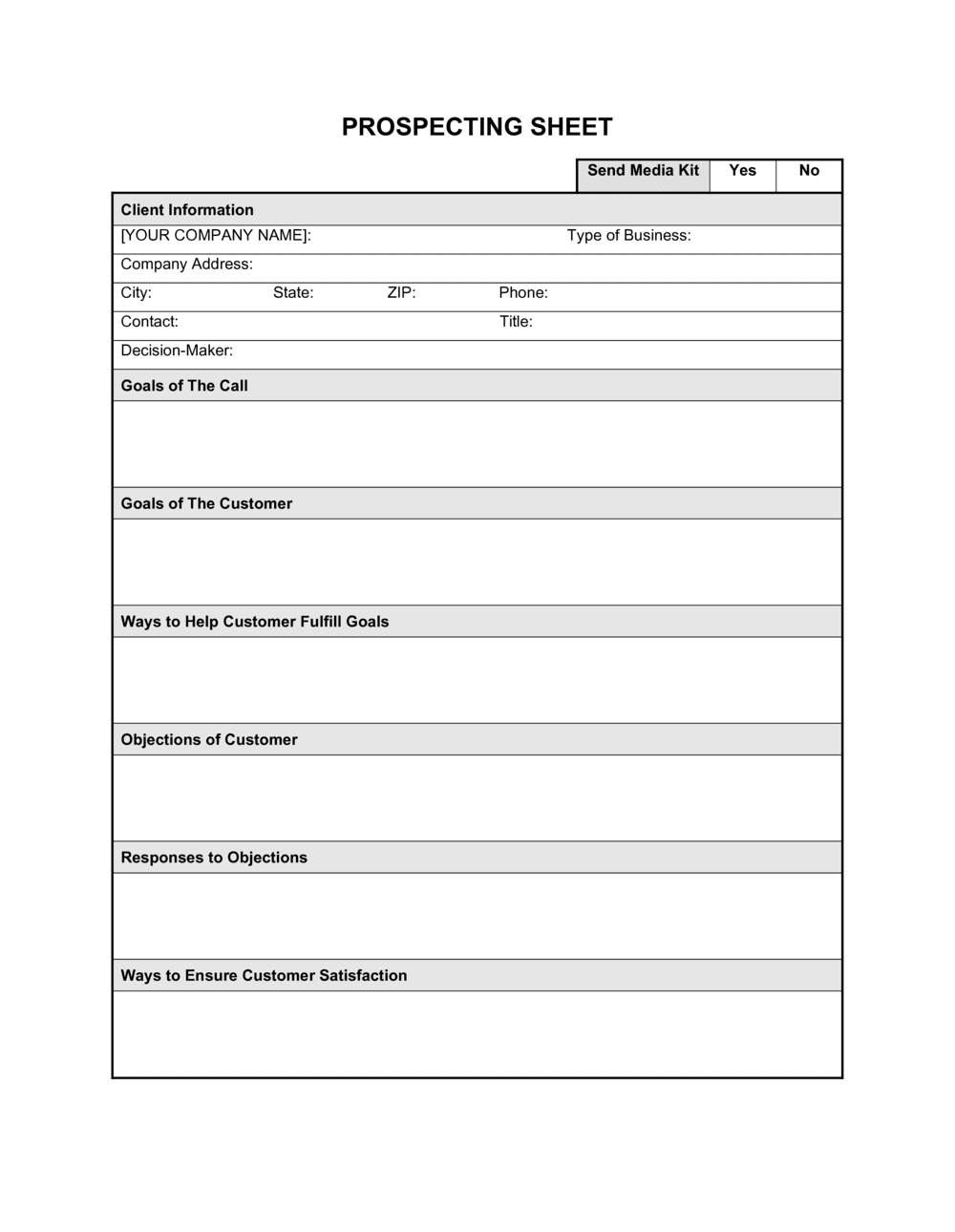
Prospecting Sheet Template

Free download • Use as a template • Print or share

1 page15–20 min to useDifficulty: Standard
Learn more ↓
FreeProspecting Sheet Template

At a glance

What it is
A Prospecting Sheet is a structured worksheet sales reps use to record prospect details, qualification criteria, contact history, next steps, and deal disposition in a single document. This free Word download gives you a consistent format you can fill in per prospect, export as PDF, and feed directly into CRM entry or pipeline review meetings.
When you need it
Use it whenever a rep begins working a new prospect — before the first outreach call or email — so qualification data, contact attempts, and outcomes are captured in one place from day one.
What's inside
Prospect and company identification fields, qualification criteria scored against your ideal customer profile, a contact attempt log with dates and outcomes, next-step actions with owners and due dates, and a final disposition status for pipeline reporting.

What is a Prospecting Sheet?

A Prospecting Sheet is a structured worksheet that sales reps use to capture everything relevant to a single prospect in one document — company and contact details, qualification scores, a log of every contact attempt, discovery call notes, next steps with due dates, and final pipeline disposition. It functions as the working record a rep maintains throughout the early stages of the sales process, before or alongside CRM entry, ensuring that no qualification data or interaction history falls through the cracks. By standardizing what gets captured and how, it feeds cleaner data into pipeline reviews, forecast calls, and CRM records.

Why You Need This Document

Without a consistent prospecting sheet, reps rely on memory and scattered notes — qualification gaps go unnoticed, contact attempts go undocumented, and next steps exist only in someone's inbox. The result is a bloated pipeline full of unqualified or stalled prospects that distorts forecasts and wastes manager time in one-on-ones. When a rep leaves, their prospect knowledge leaves with them. A completed prospecting sheet for every active prospect means managers can audit pipeline quality in seconds, reps can pick up where they left off after any interruption, and the CRM reflects real data rather than optimistic guesswork. This template gives your team a consistent format they can start using today — no CRM customization or technical setup required.

Which variant fits your situation?

If your situation is…Use this template
Tracking multiple prospects across a full territory or named account listSales Pipeline Tracker
Logging calls and outcomes for a high-volume cold-calling campaignCall Log Sheet
Qualifying inbound leads against a formal scoring modelLead Qualification Form
Planning and tracking a complete sales cycle from discovery to closeSales Action Plan
Reporting weekly prospecting activity metrics to a sales managerSales Activity Report
Structuring a discovery conversation with a new prospectSales Discovery Questionnaire

Common mistakes to avoid

❌ Optimistic qualification scoring

Why it matters: Marking budget or authority as confirmed before a real conversation inflates pipeline quality scores and produces forecasts that miss consistently.

Fix: Restrict confirmed status to facts stated explicitly by the prospect on a call or in writing. Flag everything else as unknown.

❌ Logging only successful contacts

Why it matters: Omitting voicemails and no-answers hides true outreach volume and makes it impossible to identify when a prospect has gone cold.

Fix: Record every attempt regardless of outcome. Six no-answers in 10 days is actionable data; zero entries is not.

❌ Vague next steps

Why it matters: Writing 'follow up' with no specific action or date means the prospect sits idle. Stalled prospects lose momentum and rarely self-advance.

Fix: Every next step must name a specific action, a responsible owner, and a calendar due date before the sheet is saved.

❌ Never updating disposition

Why it matters: Prospects that should be disqualified or moved to nurture stay 'active,' bloating pipeline numbers and making forecast calls unreliable.

Fix: Review and update every prospect's disposition at a fixed weekly cadence — flag anything with no activity in the past 14 days.

The 8 key fields, explained

Prospect and company identification

Contact information

Source and date added

Qualification criteria

Contact attempt log

Discovery notes

Next step and owner

Disposition and pipeline stage

How to fill it out

  1. 1

    Complete the identification block before first outreach

    Fill in the prospect's name, title, company, industry, headcount, and website. Confirm these details from LinkedIn or a data provider — do not rely on memory or assumptions.

    💡 Adding company size and industry before first contact forces you to confirm ICP fit before investing outreach time.

  2. 2

    Record the source and date added

    Enter exactly where this prospect came from and today's date. If from a list, name the list or vendor. If a referral, name the referrer.

    💡 Consistent source tagging is the only way to know which channels produce your best prospects at review time.

  3. 3

    Score qualification criteria with confirmed data only

    Complete each BANT field only after you have confirmed it on a call or through research. Mark unknowns as 'unknown' rather than leaving fields blank or guessing.

    💡 A prospect with three 'unknowns' in qualification is a research task, not a pipeline opportunity — treat it accordingly.

  4. 4

    Log every contact attempt, including no-answers

    After each outreach action, record the date, channel, and outcome in the contact attempt log. A voicemail and a no-answer are both valid entries.

    💡 Six documented attempts with no response is a clear signal to pause or reassign — you cannot see that pattern without logging every attempt.

  5. 5

    Capture discovery notes in structured format

    Immediately after a discovery conversation, write a brief structured summary: current situation, pain points, goals, and objections. Do not reconstruct from memory hours later.

    💡 Use the prospect's exact words for pain points — quoting them back in a follow-up email significantly increases response rates.

  6. 6

    Define the next step before closing the sheet

    Every time you update the sheet, set a specific next action, assign an owner, and enter a due date. Never leave the next step field blank after an interaction.

    💡 If you cannot define a next step, the prospect is likely stalled — escalate or update disposition to nurture.

  7. 7

    Update disposition at each review cycle

    At least weekly, review every prospect on your sheet and update their status and pipeline stage. Move genuinely stalled or unresponsive prospects to nurture or disqualify them.

    💡 A clean sheet with 20 active prospects outperforms a bloated sheet with 80 — accurate pipeline stages produce accurate forecasts.

Frequently asked questions

What is a prospecting sheet?

A prospecting sheet is a structured worksheet a sales rep uses to document everything relevant to a single prospect — contact details, qualification scores, outreach history, discovery findings, next steps, and final disposition. It keeps all prospect information in one place, improves CRM data quality, and gives sales managers visibility into pipeline activity at a glance.

How is a prospecting sheet different from a CRM record?

A CRM record is a digital entry in a software system. A prospecting sheet is a working document reps use during the early stages of outreach — often before a prospect is formally entered in the CRM. It serves as a structured capture tool that ensures the CRM is populated with complete, qualified data rather than raw names and guesses.

What qualification criteria should a prospecting sheet include?

At minimum, include BANT — Budget, Authority, Need, and Timeline. More sophisticated teams add ICP fit score, competitive situation, and urgency rating. The key is that each criterion is confirmed from a real conversation or credible research source, not assumed from a job title or company size alone.

How many contact attempts should be logged before disqualifying a prospect?

Industry benchmarks suggest six to eight attempts across at least two channels before pausing active outreach. Documenting all attempts on the prospecting sheet makes this assessment objective — reps and managers can see the full history rather than relying on memory.

Can a prospecting sheet replace a CRM?

For a solo rep or very small team working fewer than 50 prospects at a time, a prospecting sheet can function as a lightweight pipeline tool. Beyond that scale, a CRM is necessary for reporting, automation, and collaboration. The prospecting sheet works best as a daily working document that feeds accurate data into the CRM, not as a permanent replacement for one.

How often should a prospecting sheet be updated?

After every contact attempt or interaction — ideally within 30 minutes of the activity while details are fresh. Disposition and next steps should be reviewed at a minimum weekly, typically aligned to a pipeline review or one-on-one with a sales manager.

What should go in the discovery notes field?

A structured summary of the prospect's current situation, the specific pain points they described in their own words, their stated goals, and any objections raised. Avoid transcribing the conversation verbatim — bullet-point summaries are faster to write and easier to act on during follow-up preparation.

How does a prospecting sheet improve forecast accuracy?

Accurate qualification scores and current disposition statuses mean the pipeline reflects real opportunities, not wishful entries. When every rep maintains a clean prospecting sheet with confirmed BANT data and up-to-date stages, the aggregate pipeline roll-up produces forecasts that are grounded in verified facts rather than rep optimism.

How this compares to alternatives

vs Call Log Sheet

A call log records outbound call activity — number dialed, duration, and outcome — across all calls in a session. A prospecting sheet is prospect-centric, capturing the full profile, qualification status, and next steps for a single contact across all channels and interactions. Use a call log for high-volume dialing metrics; use a prospecting sheet when you need a complete record of one prospect's journey.

vs Sales Action Plan

A sales action plan defines a rep's or team's overall activities, targets, and tactics for a period. A prospecting sheet operates at the individual prospect level, capturing the specific details needed to qualify and advance a single opportunity. The action plan sets the strategy; the prospecting sheet executes it contact by contact.

vs Sales Report

A sales report aggregates activity and pipeline metrics across a rep or team for a reporting period — calls made, opportunities created, revenue closed. A prospecting sheet is the source data that feeds those reports. Accurate prospecting sheets produce reliable sales reports; sloppy ones produce numbers that mislead managers and misallocate resources.

vs Lead Qualification Form

A lead qualification form is typically a structured intake document used to score inbound leads at the point of inquiry. A prospecting sheet is used throughout the outbound sales process — from first identification through disposition — and includes contact history and next steps that a qualification form does not. Use a qualification form for inbound leads; use a prospecting sheet for active outbound pursuit.

Industry-specific considerations

Technology / SaaS

Qualification fields track product-fit criteria like current tech stack, contract renewal date, and number of seats alongside standard BANT scoring.

Financial Services

Regulatory and compliance fit must be confirmed early; prospecting sheets include fields for AUM, entity type, and regulatory jurisdiction.

Professional Services

Discovery notes emphasize current provider, contract expiry, and project trigger events that signal near-term buying intent.

Manufacturing and Wholesale

Qualification captures order volume, current supplier, lead-time requirements, and preferred delivery terms alongside standard contact fields.

Template vs pro — what fits your needs?

PathBest forCostTime
Use the templateIndividual sales reps, small teams, and businesses without a CRM or with a CRM that lacks structured prospecting workflowsFree5 minutes to set up per prospect
Template + professional reviewSales managers who want to customize qualification criteria to match a formal ICP or internal scoring model$0–$100 (internal review with sales ops or a senior rep)1–2 hours to adapt fields
Custom draftedEnterprise teams building a prospecting sheet natively inside a CRM or sales engagement platform with automation$500–$2,000 (sales ops or CRM consultant)1–2 weeks

Glossary

Prospect
A potential buyer who has been identified as a possible fit but has not yet been qualified or entered a formal sales stage.
Ideal Customer Profile (ICP)
A description of the company type, size, industry, and characteristics that historically close fastest and retain longest.
Qualification Criteria
Specific factors — budget, authority, need, and timing — used to determine whether a prospect is worth pursuing further.
BANT
A common qualification framework: Budget, Authority, Need, and Timeline — used to score whether a prospect is sales-ready.
Disposition
The final recorded outcome for a prospect — qualified, disqualified, nurture, or closed — used to update pipeline and reporting.
Contact Attempt
Any documented outreach action — call, email, LinkedIn message, or voicemail — made to reach a prospect, logged with date and result.
Next Step
The specific action agreed upon or planned to advance the prospect, with an owner and a due date.
Pipeline Stage
The current position of a prospect in the sales process — typically prospecting, discovery, proposal, negotiation, or closed.
CRM Hygiene
The practice of keeping CRM records accurate, complete, and up to date so pipeline reports and forecasts reflect reality.
Touchpoint
Any interaction between a sales rep and a prospect, whether outbound or inbound, that advances or informs the relationship.

Part of your Business Operating System

This document is one of 3,000+ business & legal templates included in Business in a Box.

  • Fill-in-the-blanks — ready in minutes
  • 100% customizable Word document
  • Compatible with all office suites
  • Export to PDF and share electronically

Create your document in 3 simple steps.

From template to signed document — all inside one Business Operating System.
1
Download or open template

Access over 3,000+ business and legal templates for any business task, project or initiative.

2
Edit and fill in the blanks with AI

Customize your ready-made business document template and save it in the cloud.

3
Save, Share, Send, Sign

Share your files and folders with your team. Create a space of seamless collaboration.

Save time, save money, and create top-quality documents.

★★★★★

"Fantastic value! I'm not sure how I'd do without it. It's worth its weight in gold and paid back for itself many times."

Managing Director · Mall Farm
Robert Whalley
Managing Director, Mall Farm Proprietary Limited
★★★★★

"I have been using Business in a Box for years. It has been the most useful source of templates I have encountered. I recommend it to anyone."

Business Owner · 4+ years
Dr Michael John Freestone
Business Owner
★★★★★

"It has been a life saver so many times I have lost count. Business in a Box has saved me so much time and as you know, time is money."

Owner · Upstate Web
David G. Moore Jr.
Owner, Upstate Web

Run your business with a system — not scattered tools

Stop downloading documents. Start operating with clarity. Business in a Box gives you the Business Operating System used by over 250,000 companies worldwide to structure, run, and grow their business.

Free Forever Plan · No credit card required