Sales and Marketing Policy Template

Free Word download β€’ Edit online β€’ Save & share with Drive β€’ Export to PDF

3 pagesβ€’20–25 min to fillβ€’Difficulty: Standard
Learn more ↓
FreeSales and Marketing Policy Template

At a glance

What it is
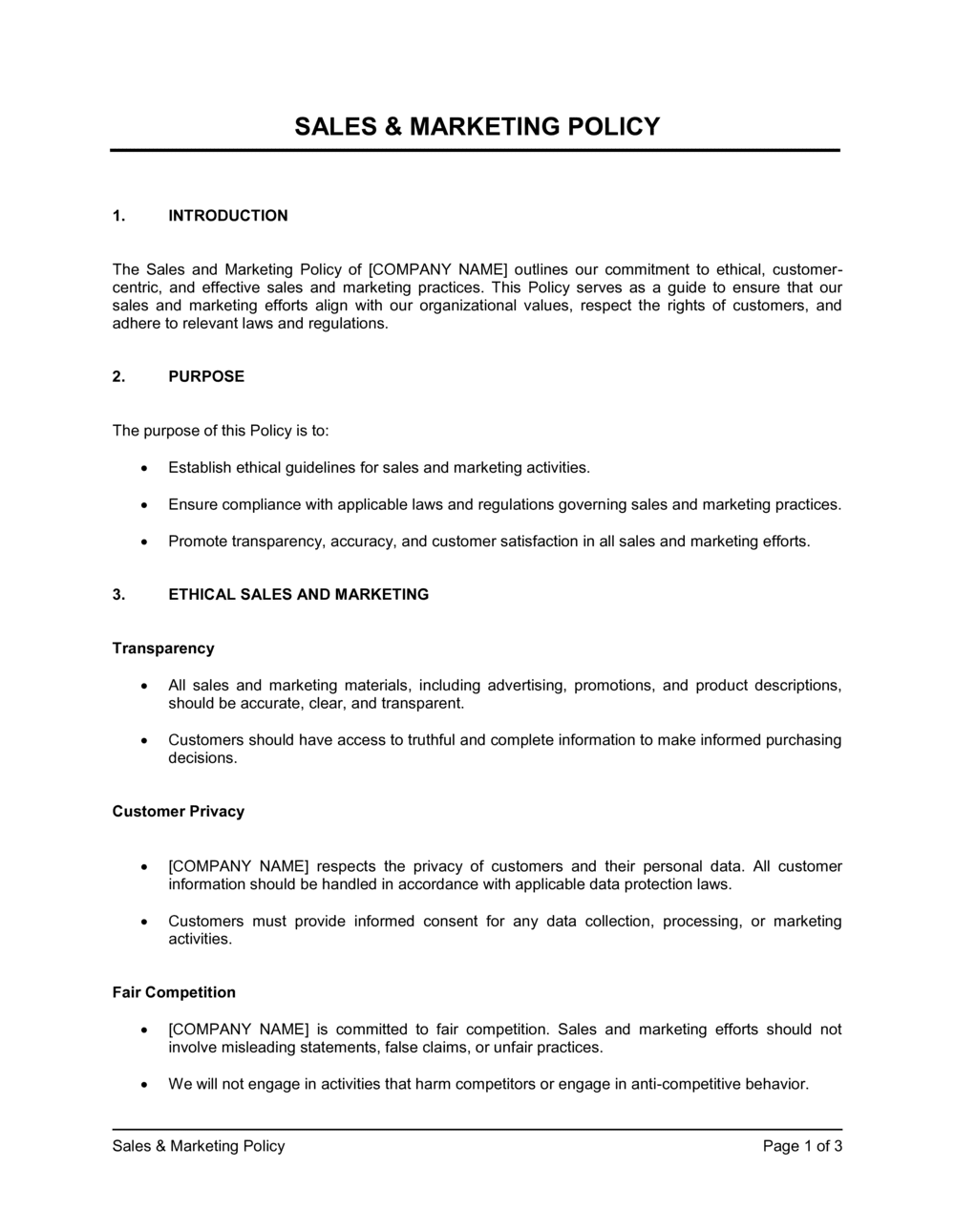
A Sales and Marketing Policy is a formal internal document that sets the rules governing how your company prices products and services, who can authorize discounts, which channels are approved for selling and promoting, how brand and messaging standards are maintained, and what ethical conduct is expected of sales and marketing staff. This free Word download gives you a structured, editable policy you can adapt to your business and distribute to your team immediately.
When you need it
Use it when your sales team is growing and informal pricing norms are creating margin inconsistency, when marketing spend is escalating without a clear approval chain, or when a compliance audit or board review requires documented governance over commercial activities.
What's inside
Purpose and scope, pricing and discount authority, channel and territory rules, promotional and campaign approval, brand and messaging standards, marketing spend authority, lead management and CRM requirements, and ethics and conflicts of interest β€” each section with clear ownership and escalation thresholds.

What is a Sales and Marketing Policy?

A Sales and Marketing Policy is a formal internal governance document that defines the rules under which a company's commercial activities must operate. It covers who can approve pricing changes and discounts at what thresholds, which channels and territories are authorized for selling, how promotions and campaigns must be reviewed before launch, what brand and messaging standards apply to all customer-facing materials, how marketing spend is authorized and tracked, and what ethical conduct is required of everyone in a sales or marketing role. Unlike a marketing plan or a sales playbook, this policy does not describe what to do β€” it establishes the boundaries within which all commercial activity must occur.

Why You Need This Document

Without a documented sales and marketing policy, pricing discipline erodes quietly. Reps under quota pressure extend discounts beyond any agreed limit, promotions go live without margin review, and marketing commits budget that finance cannot see until the invoice arrives. The consequences accumulate: average selling price drifts downward quarter by quarter, brand materials fragment across regions and teams, and channel partners operate under conflicting expectations until a territory dispute forces a conversation no one is prepared for. A written policy closes these gaps before they become expensive β€” it gives managers an enforcement tool, gives finance visibility into commitments, and gives auditors or investors evidence that your revenue is generated through a disciplined, repeatable process rather than ad hoc deal-making. This template gives you a complete, editable starting point you can distribute to your team in hours.

Which variant fits your situation?

If your situation is…Use this template
Company needs a policy focused only on discount and pricing authorityPricing Policy
Formalizing brand voice and visual identity rules for the whole organizationBrand Style Guide
Governing how channel partners and resellers represent the brandChannel Partner Agreement
Setting rules for how the sales team engages and closes prospectsSales Process SOP
Documenting marketing budget allocation and ROI tracking requirementsMarketing Plan
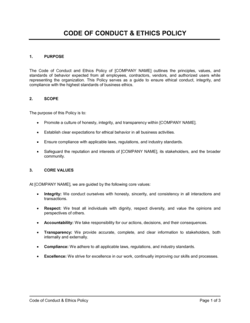
Creating a company-wide code of conduct covering all departmentsCode of Business Conduct and Ethics
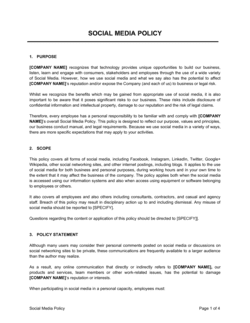
Governing online advertising and digital channel rules specificallySocial Media Policy

Common mistakes to avoid

❌ Discount matrix not enforced in the quoting tool

Why it matters: Reps who can manually override discount limits in the CRM or CPQ tool will do so under deal pressure, making the written matrix irrelevant and average deal margin unpredictable.

Fix: Configure approval workflows in the quoting system to mirror the policy matrix exactly β€” deals above a rep's authority level should require a manager's electronic approval before the quote can be sent.

❌ Promotional approvals not covering verbal offers

Why it matters: A formal campaign approval process that ignores one-off concessions made verbally by reps creates two pricing realities β€” the official one and the one customers actually receive.

Fix: Add a clause requiring any non-standard pricing communicated to a customer β€” even verbally β€” to be logged in the CRM and approved within 24 hours, or withdrawn.

❌ Marketing spend commitments logged at invoice rather than at commitment

Why it matters: Finance cannot manage budget exposure it cannot see β€” commitments made in month one that are invoiced in month three cause surprise overruns with no time to offset them.

Fix: Require budget entries at the point of commitment (signed contract, verbal agreement, or PO) and make this a condition of approval for any spend above the manager-level threshold.

❌ MQL criteria defined in the policy but not replicated in the CRM

Why it matters: When the written qualification criteria and the system scoring model diverge, marketing and sales measure pipeline health differently β€” creating recurring attribution disputes and inaccurate forecasts.

Fix: Review the CRM lead-scoring configuration alongside the policy at least once per year and update both simultaneously when either changes.

The 9 key sections, explained

Purpose, scope, and ownership

Pricing authority and list price maintenance

Discount authority matrix

Channel and territory rules

Promotional and campaign approval

Brand and messaging standards

Marketing spend authority and budget management

Lead management and CRM requirements

Ethics, conflicts of interest, and anti-bribery

How to fill it out

  1. 1

    Define the scope and assign an owner

    Identify every role and department covered by the policy. Assign a single named owner β€” typically the VP of Sales or CMO β€” who is accountable for enforcement and annual review.

    πŸ’‘ Include executives and founders explicitly in the scope clause. Policies that implicitly exclude leadership are rarely respected by the teams they govern.

  2. 2

    Set list prices and document the change process

    Enter the current list prices or reference where they are stored (price book, CPQ tool, or website). Define the form and sign-off chain required before any price is changed.

    πŸ’‘ Link this section directly to your quoting tool β€” if the tool does not enforce list price as a floor, the policy has no teeth.

  3. 3

    Build the discount authority matrix

    Assign a maximum discount percentage to each sales role and manager level. Define the joint-approval process for deals that exceed the highest individual threshold.

    πŸ’‘ Build the same thresholds into your CRM or CPQ system so the policy is enforced automatically at quote creation, not retrospectively at deal review.

  4. 4

    Map and document sales channels and territories

    List every approved channel (direct, reseller, e-commerce, distributor). Assign geographic or vertical territories and document the lead-routing procedure for each channel.

    πŸ’‘ Create a one-page territory map as an appendix β€” visual assignments reduce disputes more effectively than textual descriptions.

  5. 5

    Define the promotional approval workflow

    Identify who must approve each category of promotion (time-limited offer, bundle, volume discount) and set minimum lead times. Include a brief template that captures margin impact before approval.

    πŸ’‘ Require a margin-impact calculation on every promotional request β€” promotions that look inexpensive in absolute dollars can destroy gross margin at scale.

  6. 6

    Document marketing spend thresholds and tracking requirements

    Enter the dollar amounts at each approval level and name the budget tracking system where all commitments must be recorded. Specify the deadline for logging commitments.

    πŸ’‘ Set the logging deadline at commitment, not at invoice receipt β€” this is the only way finance can see exposure before it becomes a liability.

  7. 7

    Set MQL and SQL criteria and CRM requirements

    Define the specific attributes (job title, company size, budget confirmed, behavior score) that qualify a lead as an MQL and then an SQL. State the response time standard for each stage.

    πŸ’‘ Align the written criteria exactly with the scoring model in your CRM β€” a policy that says one thing and a system that does another produces neither accountability nor useful data.

  8. 8

    Publish, communicate, and schedule the annual review

    Share the finalized policy with all covered roles, obtain acknowledgment signatures, and calendar the next annual review date. Archive prior versions with their effective and superseded dates.

    πŸ’‘ A policy no one has read is unenforceable β€” build acknowledgment into your onboarding checklist so new hires receive and confirm it on day one.

Frequently asked questions

What is a sales and marketing policy?

A sales and marketing policy is a formal internal document that defines the rules governing how a company prices its products, authorizes discounts, manages sales channels, approves promotions and campaigns, enforces brand standards, controls marketing spend, and ensures ethical conduct across commercial teams. It creates consistent, documented standards that replace informal norms and verbal agreements.

Who should a sales and marketing policy apply to?

The policy should apply to everyone who influences a commercial decision β€” sales representatives, account managers, marketing staff, channel managers, and any executive who approves pricing, deals, or spend. Excluding founders or senior leaders from the policy scope is a common mistake that undermines its authority from day one.

How detailed should a discount authority matrix be?

It should specify a maximum discount percentage for every sales role from individual contributor through to the executive approver, and define a joint-approval process for deals that exceed the highest individual threshold. Most companies use three to four tiers: rep, manager, VP, and CFO or CEO. The matrix is most effective when it is also enforced in the quoting or CRM system, not just documented on paper.

What is the difference between a sales policy and a sales process SOP?

A sales policy sets the rules β€” what is permitted, who can authorize it, and what thresholds apply. A sales process SOP describes the steps β€” how a rep works a lead from first contact to closed deal. Both documents are complementary: the policy provides the governance guardrails and the SOP provides the execution playbook. Teams that have one but not the other typically either lack accountability or lack consistency.

How often should a sales and marketing policy be reviewed?

Annual review is the standard for most businesses, timed to coincide with the start of the fiscal year or annual budgeting cycle. Trigger an off-cycle review when you enter a new channel or market, change your pricing model, experience a significant pricing or discount dispute, or prepare for a compliance audit or investor due diligence process.

How do I enforce a sales and marketing policy once it is published?

Enforcement requires three components: acknowledgment (every covered employee confirms they have read and understood the policy), system configuration (quoting tools and CRM workflows enforce the key thresholds automatically), and consequence (the policy states what happens when a violation occurs). A policy with no acknowledgment process and no system enforcement is aspirational, not operational.

What should the ethics section of a sales and marketing policy cover?

At minimum, the ethics section should address gift and entertainment limits, the prohibition on deceptive or misleading sales practices, the process for disclosing conflicts of interest, and anti-bribery obligations. For companies operating internationally, references to the US Foreign Corrupt Practices Act or the UK Bribery Act may be appropriate depending on where sales activities occur.

Can a sales and marketing policy help with investor due diligence?

Yes. Investors conducting commercial due diligence look for evidence that a company's revenue is generated through disciplined, repeatable processes rather than ad hoc deal-making. A documented pricing and discount policy, an approval workflow for promotions, and a stated ethics standard all signal that revenue quality is manageable and scalable β€” reducing perceived risk in the commercial function.

How this compares to alternatives

vs Code of Business Conduct and Ethics

A code of conduct is a company-wide document covering ethical behavior across all functions β€” finance, HR, operations, and commercial teams. A sales and marketing policy is narrower, focusing specifically on commercial governance: pricing, discounts, channels, promotions, and marketing spend. Most organizations need both; the code of conduct sets the ethical framework and the sales and marketing policy operationalizes it for the revenue function.

vs Marketing Plan

A marketing plan defines what campaigns, channels, and budgets will be used to achieve revenue targets in a given period. A sales and marketing policy defines the rules under which all marketing activity must operate regardless of the plan β€” approval thresholds, brand standards, and spend authority. The plan changes annually; the policy remains stable and governs every plan it supersedes.

vs Channel Partner Agreement

A channel partner agreement is a bilateral contract between the company and a specific reseller or distributor, covering pricing tiers, territory rights, and performance obligations. A sales and marketing policy is an internal document that governs how the company's own staff manage those channel relationships β€” including how leads are routed and how co-op funds are approved. Both are needed when a channel program exists.

vs Social Media Policy

A social media policy focuses specifically on how employees use social platforms β€” personal conduct, approval of branded content, and response protocols. A sales and marketing policy covers all commercial channels and activities, with social media as one sub-component. For companies with active social selling or influencer programs, both policies should be in place and cross-referenced.

Industry-specific considerations

SaaS / Technology

Discount authority is particularly critical in SaaS where end-of-quarter deal pressure leads reps to offer multi-year discounts that damage net revenue retention and ARR predictability.

Manufacturing and Distribution

Channel and territory rules govern distributor exclusivity, minimum order quantities, and co-op marketing fund eligibility β€” all of which require documented policy to manage reseller relationships.

Professional Services

Rate card governance and project-level discount authority are central concerns; the policy must address both published rates and the negotiated discounts common in proposal-based selling.

Retail / E-commerce

Promotional approval workflows must account for the speed of digital campaigns β€” a 48-hour approval cycle that works for print fails for social media promotions that go live in hours.

Template vs pro β€” what fits your needs?

PathBest forCostTime
Use the templateSmall to mid-size businesses formalizing informal norms or preparing for their first compliance or board reviewFree2–4 hours to customize and distribute
Template + professional reviewCompanies entering regulated industries, adding a channel partner program, or operating across multiple countries$300–$800 for a legal or compliance advisor review3–5 business days
Custom draftedEnterprise commercial teams with complex multi-tier channel programs, international anti-bribery obligations, or pending M&A due diligence$2,000–$6,000 for custom legal and compliance drafting2–4 weeks

Glossary

Discount Authority
The maximum percentage price reduction a staff member or manager is permitted to approve without escalating to a higher level.
List Price
The published standard price for a product or service before any negotiated adjustments or promotional discounts are applied.
Channel Conflict
A situation where two or more sales channels β€” such as a direct sales team and a reseller β€” compete for the same customer or territory.
Marketing Spend Authority
The dollar threshold up to which a marketing role can commit budget without requiring approval from finance or senior leadership.
Promotional Approval
The internal sign-off process confirming that a campaign, offer, or incentive meets legal, brand, and margin requirements before it is launched.
Brand Standards
Rules governing the consistent use of logos, colors, typography, tone of voice, and messaging across all customer-facing materials.
Lead Qualification Criteria
The agreed-upon set of conditions β€” typically firmographic, behavioral, or budget-based β€” that determine when a prospect is ready to be passed from marketing to sales.
CRM (Customer Relationship Management)
Software used to record, track, and manage all prospect and customer interactions, pipeline stages, and deal values.
MQL / SQL
Marketing Qualified Lead and Sales Qualified Lead β€” the two pipeline stages that mark when marketing hands off a lead to sales and when sales accepts it.
Ethics Conflict of Interest
A situation where a sales or marketing employee has a personal financial or relational interest that could improperly influence a business decision.

Part of your Business Operating System

This document is one of 3,000+ business & legal templates included in Business in a Box.

  • Fill-in-the-blanks β€” ready in minutes
  • 100% customizable Word document
  • Compatible with all office suites
  • Export to PDF and share electronically

Create your document in 3 simple steps.

From template to signed document β€” all inside one Business Operating System.
1
Download or open template

Access over 3,000+ business and legal templates for any business task, project or initiative.

2
Edit and fill in the blanks with AI

Customize your ready-made business document template and save it in the cloud.

3
Save, Share, Send, Sign

Share your files and folders with your team. Create a space of seamless collaboration.

Save time, save money, and create top-quality documents.

β˜…β˜…β˜…β˜…β˜…

"Fantastic value! I'm not sure how I'd do without it. It's worth its weight in gold and paid back for itself many times."

Managing Director Β· Mall Farm
Robert Whalley
Managing Director, Mall Farm Proprietary Limited
β˜…β˜…β˜…β˜…β˜…

"I have been using Business in a Box for years. It has been the most useful source of templates I have encountered. I recommend it to anyone."

Business Owner Β· 4+ years
Dr Michael John Freestone
Business Owner
β˜…β˜…β˜…β˜…β˜…

"It has been a life saver so many times I have lost count. Business in a Box has saved me so much time and as you know, time is money."

Owner Β· Upstate Web
David G. Moore Jr.
Owner, Upstate Web

Run your business with a system β€” not scattered tools

Stop downloading documents. Start operating with clarity. Business in a Box gives you the Business Operating System used by over 250,000 companies worldwide to structure, run, and grow their business.

Start freeΒ Β·Β No credit card required