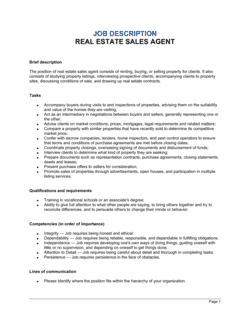
Property Manager Job Description Template

Free Word download • Edit online • Save & share with Drive • Export to PDF

2 pages20–30 min to fillDifficulty: StandardSignature requiredLegal review recommended
Learn more ↓
FreeProperty Manager Job Description Template

At a glance

What it is
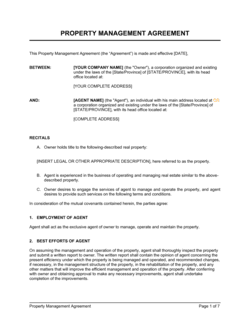
A Property Manager Job Description is a binding document that defines the scope of authority, duties, compensation structure, and termination terms for an individual or company engaged to manage real property on behalf of an owner. This free Word download gives you a professionally structured template you can edit online and export as PDF — covering everything from leasing authority and maintenance thresholds to reporting obligations and fee schedules.
When you need it
Use it when hiring a property manager — whether an in-house employee or a third-party management company — to oversee residential units, commercial buildings, or mixed-use assets. It is also essential when formalizing an existing informal arrangement or when a lender or co-owner requires documented management authority.
What's inside
The template covers the property description and management scope, the manager's specific duties and spending authority, compensation and fee structure, reporting requirements, insurance and licensing obligations, and the conditions under which either party may terminate the arrangement.

What is a Property Manager Job Description?

A Property Manager Job Description is a formal binding document that defines the duties, authority, compensation structure, reporting obligations, and termination conditions for an individual or company engaged to manage real property on behalf of an owner. It goes well beyond a standard job posting — establishing the legal parameters within which the manager may act independently, the spending thresholds that require owner approval, the financial records that must be maintained, and the conditions under which the arrangement may be ended. Whether the manager is a direct employee or a third-party management firm, a properly executed job description creates an enforceable record of what was agreed, protecting both the owner's asset and the manager's professional standing.

Why You Need This Document

Without a written, signed property manager job description, a property owner has no contractual basis to enforce performance standards, cap unauthorized spending, require trust account compliance, or compel the return of keys and records on termination. Disputes between owners and managers over undocumented authority — an unauthorized $8,000 roof repair, a three-year lease signed without consent, a security deposit held in the wrong account — are among the most litigated issues in residential real estate, and the owner almost always loses when there is no written agreement to point to. A properly drafted job description also satisfies licensing authority requirements in most US states and Canadian provinces, which mandate a written management agreement as a condition of a valid management relationship. This template gives you a professionally structured starting point that covers every material term — closing the gaps that create liability before the manager ever sets foot on the property.

Which variant fits your situation?

If your situation is…Use this template
Hiring a salaried in-house property manager as a direct employeeProperty Manager Employment Contract
Engaging a third-party property management company under a fee agreementProperty Management Agreement
Defining management duties for a residential rental portfolioResidential Property Manager Job Description
Hiring a manager specifically for commercial or retail propertiesCommercial Property Manager Job Description
Delegating management of a homeowners association or condo complexHOA Property Manager Job Description
Bringing on a short-term or interim manager for a transitional periodFixed-Term Property Management Agreement
Creating a general job posting for recruitment platformsProperty Manager Job Posting Template

Common mistakes to avoid

❌ No defined spending threshold

Why it matters: Without a documented cap, a manager can authorize any repair expense and invoice the owner — courts have upheld five-figure unauthorized expenditures when no threshold was set in writing.

Fix: Insert a specific per-incident dollar limit and require written owner approval for any single expenditure above that amount, and for all capital expenditures regardless of size.

❌ Using 'gross scheduled rent' as the management fee base

Why it matters: If a unit sits vacant or a tenant stops paying, the owner still owes the management fee on income that was never collected — directly misaligning the manager's financial incentive.

Fix: Replace 'scheduled rent' with 'collected rent' throughout the fee clause so the manager is compensated only on revenue the owner actually receives.

❌ Omitting trust account and commingling prohibition

Why it matters: Commingling owner funds with the manager's operating account violates licensing laws in most US states and Canadian provinces, risking license revocation and leaving the owner with no practical recourse to recover funds.

Fix: Require a named, segregated trust account, prohibit commingling in explicit terms, and give the owner the right to audit account records on reasonable notice.

❌ No hold-over obligations on termination

Why it matters: A terminated manager with no documented transition duties may refuse to hand over keys, tenant files, or security deposit records — leaving the owner unable to manage or re-let the property for weeks.

Fix: Add a termination clause requiring the manager to deliver all keys, tenant files, lease originals, financial records, and security deposit balances within a specific number of business days after notice.

❌ Selecting governing law from the owner's state rather than the property's state

Why it matters: Landlord-tenant law, security deposit rules, and property manager licensing requirements are based on the state or province where the property sits — not where the owner lives or does business.

Fix: Set governing law as the jurisdiction in which the managed property is located and confirm the manager holds a license issued by that same jurisdiction.

❌ No leasing authority limit on term or rental rate

Why it matters: A manager with unlimited leasing authority can execute a multi-year below-market lease that legally binds the owner — often discovered only at refinancing or sale.

Fix: Cap the manager's unilateral leasing authority to 12-month terms within a defined percentage range of market rate, and require written owner approval for any deviation.

The 10 key clauses, explained

Property identification and management scope

In plain language: Identifies the specific property or portfolio being managed, the type of management engagement (residential, commercial, or mixed-use), and any properties or functions explicitly excluded from the manager's authority.

Sample language
Owner hereby engages Manager to manage the real property located at [PROPERTY ADDRESS], consisting of [NUMBER] residential/commercial units ('Property'). The following properties or functions are excluded from this engagement: [LIST EXCLUSIONS OR 'None'].

Common mistake: Describing the property only by street address without listing unit numbers or parcel IDs. Vague property identification creates disputes when the manager claims authority over adjacent parcels or additional units.

Duties and responsibilities

In plain language: Lists the specific tasks the manager is obligated to perform — tenant screening, rent collection, maintenance coordination, lease execution, inspections, and owner reporting — so that performance can be objectively measured.

Sample language
Manager shall perform the following duties: (a) market vacant units and screen prospective tenants using the criteria in Schedule A; (b) collect rent and issue receipts by the [5th] of each month; (c) coordinate repairs up to the Spending Threshold; (d) conduct property inspections no less than [quarterly]; (e) provide monthly financial reports to Owner by the [10th] of each month.

Common mistake: Listing duties at such a high level that 'manage the property' is the effective standard. Without itemized duties, the manager can claim almost anything falls within scope — or dispute responsibility for anything that goes wrong.

Spending authority and approval thresholds

In plain language: Sets the dollar amount the manager may spend on repairs and maintenance without advance owner approval, and clarifies that capital expenditures always require separate written authorization regardless of amount.

Sample language
Manager is authorized to approve individual repair and maintenance expenditures not exceeding $[500] per incident without prior Owner approval. Any single expenditure exceeding $[500], and all capital expenditures regardless of amount, require Owner's written approval before commitment.

Common mistake: Setting the spending threshold in the body of the contract without a clear definition of what counts as a 'capital expenditure.' Managers and owners routinely disagree on whether a roof repair is maintenance or CapEx — costing thousands in unauthorized spending.

Compensation, fees, and payment schedule

In plain language: States the management fee percentage or fixed amount, any leasing or renewal fees, when and how the manager is paid, and whether the manager may deduct fees directly from collected rent before remitting to the owner.

Sample language
Owner shall pay Manager a monthly management fee equal to [X]% of gross collected rent. Manager shall also receive a leasing fee of [one-half month's rent] per new tenancy placed. Fees shall be deducted from collected rents prior to remittance to Owner. Owner remittance shall occur no later than the [15th] of each month.

Common mistake: Using 'gross scheduled rent' rather than 'gross collected rent' as the fee base. If units are vacant or tenants fail to pay, the owner ends up paying management fees on income that was never received.

Leasing authority and tenant relations

In plain language: Defines whether the manager has authority to sign leases on the owner's behalf, the maximum lease term permitted without owner approval, and the tenant screening standards the manager must apply.

Sample language
Manager is authorized to execute residential leases on Owner's behalf for terms not exceeding [12] months, at rental rates within [5]% of the market rate established in Schedule B. Tenant screening shall comply with fair housing laws and the criteria set out in Schedule A. Leases exceeding [12] months require Owner's prior written approval.

Common mistake: Granting unlimited leasing authority without a cap on term length or rental rate deviation. A manager who locks the owner into a 3-year below-market lease may not have violated the contract if no limits were set.

Trust accounting and financial reporting

In plain language: Requires the manager to maintain a segregated trust account for owner funds and tenant deposits, produce monthly financial statements, and provide access to records on reasonable notice.

Sample language
Manager shall maintain all Owner funds and tenant security deposits in a separate trust account at [BANK NAME], designated 'Property Trust Account — [PROPERTY ADDRESS].' Manager shall provide Owner with a monthly income and expense statement, copies of all invoices over $[100], and full access to property financial records within [5] business days of written request.

Common mistake: Omitting the trust account requirement entirely and allowing commingling of owner and manager funds. Commingling violates licensing laws in most US states and Canadian provinces and can trigger immediate license revocation.

Insurance and licensing obligations

In plain language: Requires the manager to hold and maintain a valid property manager license, carry general liability and errors-and-omissions insurance at specified minimum limits, and name the owner as an additional insured.

Sample language
Manager represents and warrants that it holds a valid property management license in [STATE/PROVINCE] (License No. [NUMBER]). Manager shall maintain general liability insurance of no less than $[1,000,000] per occurrence and errors-and-omissions insurance of no less than $[500,000], naming Owner as an additional insured. Certificates of insurance shall be provided to Owner annually.

Common mistake: Accepting the manager's verbal assurance of insurance coverage without requiring a certificate of insurance. If an uninsured manager causes a liability event, the owner's own policy — and personal assets — may be the only recourse.

Term and termination

In plain language: Sets the initial term of the engagement, the notice period required for either party to terminate without cause, the conditions that permit immediate termination for cause, and the manager's obligations during the hold-over transition period.

Sample language
This Agreement shall commence on [START DATE] and continue for an initial term of [12] months, renewing automatically on a month-to-month basis thereafter. Either party may terminate without cause upon [30] days' written notice. Owner may terminate immediately for cause upon written notice citing Manager's material breach, fraud, or gross negligence. Upon termination, Manager shall deliver all keys, tenant files, and financial records to Owner within [10] business days.

Common mistake: No termination-for-cause definition and no hold-over transition obligations. Without them, a fired manager has no documented duty to hand over records — leaving the owner unable to manage the property or contact tenants.

Indemnification and liability limitation

In plain language: Allocates responsibility for losses between owner and manager — typically protecting the manager from liability for owner-directed decisions and limiting the manager's total exposure to fees paid in the prior 12 months.

Sample language
Owner shall indemnify and hold Manager harmless from claims arising out of (a) Owner's failure to disclose known property defects, or (b) Owner's written instructions that Manager followed in good faith. Manager's total liability for any claim under this Agreement shall not exceed the management fees paid in the [12] months preceding the claim.

Common mistake: A one-sided indemnification clause that protects only one party. Courts scrutinize unilateral indemnification provisions, and several jurisdictions will not enforce indemnification for a party's own negligence.

Governing law and dispute resolution

In plain language: Specifies which jurisdiction's law governs the agreement and how disputes are resolved — typically mediation before arbitration, with a carve-out for injunctive relief.

Sample language
This Agreement shall be governed by the laws of [STATE/PROVINCE/COUNTRY]. Any dispute shall first be submitted to mediation administered by [MEDIATION PROVIDER] in [CITY]. If unresolved within [45] days, the dispute shall proceed to binding arbitration under the rules of [AAA/JAMS/ADR INSTITUTE]. Either party may seek injunctive relief from a court of competent jurisdiction without first mediating.

Common mistake: Selecting governing law of the owner's home state when the property is located in a different state. Most jurisdictions apply landlord-tenant and property management licensing law based on where the property sits, not where the parties are domiciled.

How to fill it out

  1. 1

    Identify the parties and the property

    Enter the owner's full legal name (or entity name and state of formation) and the manager's full legal name or company name and license number. List the property address with unit numbers and parcel ID to avoid boundary disputes.

    💡 If the owner is an LLC or trust, use the entity's exact registered name — not a trade name — to ensure the contract binds the actual property-owning entity.

  2. 2

    Define the manager's duties in specific, measurable terms

    List every task the manager is expected to perform, including frequency — weekly, monthly, quarterly — and the standard to which each must be performed. Attach a Schedule A for detailed tenant screening criteria.

    💡 Include a duty to conduct move-in and move-out inspections with written documentation. This single clause prevents the majority of security-deposit disputes.

  3. 3

    Set the spending threshold and CapEx approval process

    Enter a specific dollar amount per incident for routine repairs, and explicitly state that all capital expenditures require separate written owner approval regardless of amount. Define what qualifies as a capital expenditure.

    💡 A threshold of $300–$500 is the industry standard for single-family and small multifamily properties. For large commercial properties, $1,000–$2,500 is common.

  4. 4

    Complete the compensation and fee schedule

    Enter the management fee percentage, the leasing fee formula, any renewal or inspection fees, and confirm whether fees are deducted from collected rent or invoiced separately. Specify the remittance date.

    💡 Use 'gross collected rent' — not 'gross scheduled rent' — as the fee base. This aligns the manager's incentive with actual collection performance.

  5. 5

    Define leasing authority and rental rate parameters

    State the maximum lease term the manager may execute without owner approval, the acceptable rental rate range, and the tenant qualification criteria by reference to Schedule A.

    💡 Include a 'fair housing compliance' clause confirming the screening criteria were reviewed against federal, state, and local fair housing law before adoption.

  6. 6

    Specify trust accounting and reporting requirements

    Name the bank and account type for the trust account, set the monthly reporting deadline, and list the specific reports required — income statement, rent roll, maintenance log, and copies of invoices above a stated threshold.

    💡 Require the manager to provide online read-only access to property management software if they use one — this eliminates the need to request reports and reduces disputes.

  7. 7

    Confirm insurance and licensing requirements

    Enter the minimum coverage amounts for general liability and E&O insurance, require the manager to name the owner as an additional insured, and set a deadline for providing the first certificate of insurance.

    💡 Request certificates directly from the manager's insurer, not from the manager — insurers cannot issue backdated or altered certificates.

  8. 8

    Execute the agreement before the manager begins work

    Both parties must sign before the manager takes any action on the property. In most jurisdictions, a manager who acts without a signed agreement may still be entitled to compensation under quantum meruit — but the owner loses all contractual protections.

    💡 Date the agreement to coincide with or precede the manager's first day of activity. A gap between the execution date and the first management action can create ambiguity about which version of the agreement applies.

Frequently asked questions

What is a property manager job description?

A property manager job description is a formal document — often part of a binding management agreement — that defines the scope of duties, authority, compensation, reporting requirements, and termination conditions for an individual or company hired to manage real property on behalf of an owner. Unlike a simple job posting, it creates enforceable obligations on both sides and specifies the boundaries within which the manager may act independently.

Does a property manager need to be licensed?

In most US states and Canadian provinces, yes — individuals and companies who manage residential or commercial property for compensation on behalf of a third party must hold a state- or province-issued property manager or real estate broker license. Requirements vary: some states require a full broker's license, others issue a dedicated property manager license, and a few impose no licensing requirement at all. Always verify the applicable requirement in the jurisdiction where the property is located before engaging a manager.

What is a reasonable management fee?

For residential properties, management fees typically range from 8% to 12% of gross collected monthly rent, with 10% being the most common benchmark for single-family and small multifamily properties. Commercial and HOA management fees are often structured as a flat monthly fee rather than a percentage. Leasing fees — charged when a new tenant is placed — commonly equal one-half to one full month's rent and are separate from the ongoing management fee.

What authority should a property manager have to spend money on repairs?

Industry practice sets per-incident spending authority at $300–$500 for residential properties and $500–$2,500 for commercial assets. Any single expenditure above the threshold, and all capital expenditures regardless of amount, should require prior written owner approval. The spending threshold should be stated as a specific dollar figure in the management agreement — vague language like "reasonable repairs" creates disputes and unauthorized bills.

What is the difference between a property manager job description and a property management agreement?

A property manager job description defines role-level duties, authority, and qualifications — it is most commonly used when hiring an individual as an employee or creating a recruitment document for internal use. A property management agreement is the full contract between a property owner and a management company or independent contractor, covering all terms of the commercial relationship including fees, liability, and termination. For third-party management companies, you need the agreement; for in-house employees, you need both the job description and an employment contract.

How much notice is required to terminate a property manager?

Thirty days' written notice is the standard for termination without cause in most residential management arrangements. Commercial management agreements often require 60 to 90 days. Either party may typically terminate immediately for cause — defined as fraud, material breach, or gross negligence — without a notice period. Always specify a hold-over transition period in which the manager continues to perform duties and transfer records after notice is given.

Can a property manager sign leases on the owner's behalf?

Yes, if the management agreement explicitly grants that authority. Most agreements authorize the manager to execute standard residential leases up to 12 months at market-rate rents without seeking prior owner approval. Leases exceeding the authorized term or deviating materially from agreed rental rate parameters should require written owner consent. An owner who grants unlimited leasing authority without term or rate caps can find themselves bound to unfavorable long-term tenancies.

What financial records must a property manager maintain?

At minimum, a property manager should maintain a monthly income and expense statement, a rent roll showing occupancy and payment status for each unit, copies of all vendor invoices, a security deposit ledger by tenant, and bank statements for the trust account. Most states with licensing requirements mandate that trust account records be retained for a minimum of three years and be available for inspection by the licensing authority on request.

Do I need a lawyer to prepare a property manager job description?

For straightforward residential arrangements, a high-quality template reviewed by a real estate attorney is typically sufficient. Engaging a lawyer is advisable when the property is commercial, when the portfolio involves multiple properties across different jurisdictions, when the manager will hold significant financial authority, or when the owner's entity structure (LLC, trust, partnership) creates layered authorization requirements. A one-hour attorney review typically costs $200–$500 and is worthwhile whenever the managed property represents a significant asset.

What happens if a property manager commingles funds?

Commingling tenant security deposits or collected rent with the manager's own operating funds is a licensing violation in most US states and Canadian provinces — triggering immediate license suspension or revocation, civil liability to the owner and tenants, and potential criminal exposure in jurisdictions where security deposit misappropriation is a statutory offense. The management agreement should explicitly prohibit commingling and require a named, segregated trust account from day one.

How this compares to alternatives

vs Property Management Agreement

A property management agreement is the full commercial contract between a property owner and a management company — covering fees, liability, insurance, and termination in binding legal terms. A property manager job description focuses on role-level duties and authority and is used when the manager is an employee or when a detailed scope of work document is needed alongside the agreement. For third-party management companies, use both.

vs Employment Contract

An employment contract governs the full employer-employee relationship — compensation, benefits, IP, non-compete, and termination — for any hire. A property manager job description is a role-specific document defining property management duties and authority, used as an exhibit to or in conjunction with an employment contract when the manager is a direct employee. Neither document alone is sufficient for an employed property manager.

vs Independent Contractor Agreement

An independent contractor agreement defines the commercial terms under which a self-employed manager is engaged — without creating an employment relationship. A property manager job description defines what the manager must do, while the contractor agreement defines how the engagement is structured, paid, and ended. Misclassifying an employee property manager as an independent contractor triggers payroll tax liability and benefit obligations.

vs Real Estate Agent Agreement

A real estate agent agreement governs the relationship between a broker and an agent for the purpose of buying and selling property. A property manager job description governs ongoing asset management — leasing, maintenance, and tenant relations — for property the owner intends to hold. Both may require the same state license in some jurisdictions, but they cover fundamentally different scopes of work and compensation structures.

Industry-specific considerations

Residential real estate

Unit-level rent collection, tenant screening under fair housing law, security deposit handling, and 24-hour maintenance response expectations are the core operational standards.

Commercial real estate

Triple-net lease administration, tenant improvement oversight, CAM reconciliation, and higher per-incident spending thresholds distinguish commercial management from residential.

Homeowners associations

HOA managers operate under CC&Rs and governing bylaws that constrain authority independently of the management agreement — the job description must be reconciled with those documents.

Hospitality and short-term rentals

Short-term rental managers face platform-specific licensing requirements, dynamic pricing authority, and guest-turnover standards not present in traditional leasing management.

Jurisdictional notes

United States

Licensing requirements vary sharply by state — California, Florida, and Texas require a real estate broker license to manage property for others, while a small number of states impose no licensing requirement. Security deposit handling is governed by state statute, with trust account requirements and tenant return deadlines ranging from 14 to 45 days. Fair housing obligations under the federal Fair Housing Act apply to all residential managers, and several states add protected classes beyond the federal seven.

Canada

Most provinces require property managers to be licensed under real estate legislation — Ontario under RECA, British Columbia under BPCPA and the Real Estate Services Act, and Alberta under RECA. Trust account requirements are mandatory and strictly enforced, with commingling treated as a disciplinary offense. Quebec residential management is also subject to the Civil Code of Quebec, which imposes additional tenant-protection obligations that must be reflected in any management arrangement.

United Kingdom

Property managers in England and Wales are not currently required to hold a government license, but letting agents handling client money must belong to a government-approved client money protection scheme and an independent redress scheme. Scotland has a more structured licensing regime under the Housing (Scotland) Act 2014. All residential managers must comply with the Tenant Fees Act 2019 and the Renters (Reform) Bill provisions as they come into force.

European Union

Property management licensing and trust account requirements vary significantly by member state — Germany, France, and the Netherlands each impose distinct professional certification and client-fund segregation requirements. GDPR applies to all tenant personal data processed by the manager, requiring a documented data processing basis and retention limits. Commercial property managers in France must hold a carte professionnelle issued under the Loi Hoguet, while Spanish administradores de fincas operate under a professional association framework.

Template vs lawyer — what fits your deal?

PathBest forCostTime
Use the templateResidential landlords hiring a single property manager for a small portfolio in one jurisdictionFree30 minutes
Template + legal reviewOwners with multiple properties, commercial assets, or managers holding significant financial authority$200–$500 for a one-hour real estate attorney review1–3 days
Custom draftedLarge portfolios, multi-jurisdiction assets, HOA management companies, or arrangements involving equity or co-ownership structures$1,000–$3,500+1–2 weeks

Glossary

Management Authority
The defined scope of decisions a property manager may make independently on behalf of the owner, without requiring prior written approval.
Spending Threshold
The maximum dollar amount a property manager may authorize for repairs or maintenance without obtaining explicit owner consent — commonly set at $300–$500 per incident.
Fiduciary Duty
The legal obligation of a property manager to act in the best financial and legal interests of the property owner at all times.
Management Fee
The compensation paid to a property manager, typically expressed as a percentage of collected monthly rent — commonly 8–12% for residential properties.
Leasing Fee
A one-time fee charged by the manager each time a new tenant is placed, often equivalent to one-half to one full month's rent.
Trust Account
A segregated bank account in which tenant security deposits and collected rents are held separately from the manager's own funds, as required by most state and provincial licensing laws.
Property Manager License
A government-issued credential required in most US states and Canadian provinces before an individual or company may legally manage property for compensation on behalf of a third party.
Vacancy Rate
The percentage of rentable units or space that is unoccupied during a given period, used as a key performance metric for property managers.
Capital Expenditure (CapEx)
Spending on improvements or replacements that extend the useful life of the property — distinct from routine maintenance — typically requiring owner pre-approval regardless of spending threshold.
Termination for Cause
Ending the management arrangement immediately due to documented misconduct, negligence, fraud, or material breach of the manager's duties — without notice or severance.
Hold-Over Period
The transition window — typically 30 to 90 days — following notice of termination during which the manager continues duties while handing over records, keys, and tenant files.

Part of your Business Operating System

This document is one of 3,000+ business & legal templates included in Business in a Box.

  • Fill-in-the-blanks — ready in minutes
  • 100% customizable Word document
  • Compatible with all office suites
  • Export to PDF and share electronically

Create your document in 3 simple steps.

From template to signed document — all inside one Business Operating System.
1
Download or open template

Access over 3,000+ business and legal templates for any business task, project or initiative.

2
Edit and fill in the blanks with AI

Customize your ready-made business document template and save it in the cloud.

3
Save, Share, Send, Sign

Share your files and folders with your team. Create a space of seamless collaboration.

Save time, save money, and create top-quality documents.

★★★★★

"Fantastic value! I'm not sure how I'd do without it. It's worth its weight in gold and paid back for itself many times."

Managing Director · Mall Farm
Robert Whalley
Managing Director, Mall Farm Proprietary Limited
★★★★★

"I have been using Business in a Box for years. It has been the most useful source of templates I have encountered. I recommend it to anyone."

Business Owner · 4+ years
Dr Michael John Freestone
Business Owner
★★★★★

"It has been a life saver so many times I have lost count. Business in a Box has saved me so much time and as you know, time is money."

Owner · Upstate Web
David G. Moore Jr.
Owner, Upstate Web

Run your business with a system — not scattered tools

Stop downloading documents. Start operating with clarity. Business in a Box gives you the Business Operating System used by over 250,000 companies worldwide to structure, run, and grow their business.

Start free · No credit card required