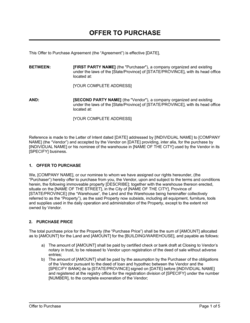
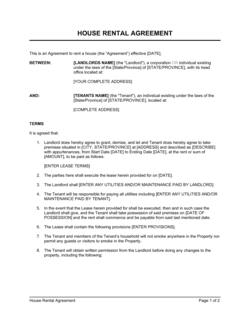
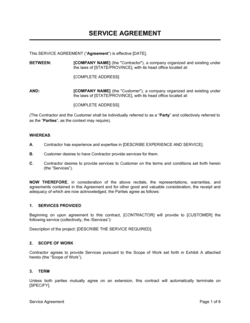
Property Management Agreement Template

Free Word download β€’ Edit online β€’ Save & share with Drive β€’ Export to PDF

7 pagesβ€’30–40 min to fillβ€’Difficulty: Complexβ€’Signature requiredβ€’Legal review recommended
Learn more ↓
FreeProperty Management Agreement Template

At a glance

What it is
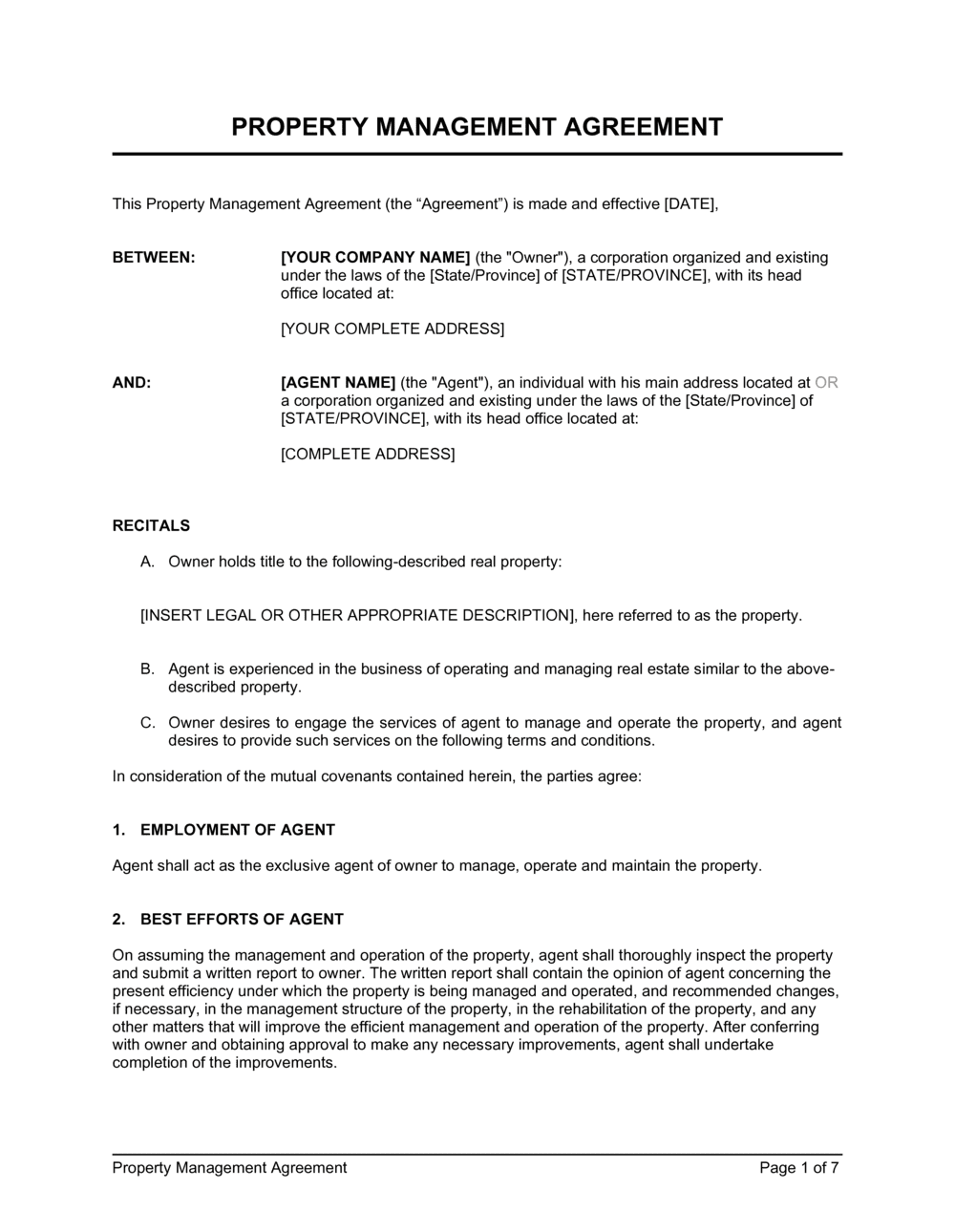
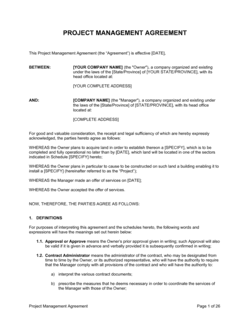
A Property Management Agreement is a legally binding contract between a property owner and a property manager that defines the scope of the manager's authority, compensation structure, maintenance obligations, and termination conditions. This free Word download gives you a structured, attorney-reviewed starting point you can edit online and export as PDF for execution before management duties begin.
When you need it
Use it whenever you hire an individual or company to manage residential or commercial rental properties on your behalf β€” including tenant sourcing, rent collection, maintenance coordination, and lease enforcement. It is equally necessary when you are the manager taking on a new property owner as a client.
What's inside
The agreement covers the parties and property description, scope of management authority, fee schedule, maintenance and repair limits, tenant relations and leasing authority, insurance requirements, accounting and reporting obligations, liability and indemnification, and termination conditions with notice periods.

What is a Property Management Agreement?

A Property Management Agreement is a legally binding contract between a property owner and a property manager that defines the full scope of the manager's authority, duties, compensation, and obligations in managing residential or commercial rental property on the owner's behalf. It establishes the manager as the owner's authorized agent β€” empowered to advertise vacancies, screen tenants, execute leases, collect rents, coordinate maintenance, and enforce lease terms β€” within the boundaries the agreement sets. Beyond delegating operational authority, the agreement governs how owner funds are held, what records and reports the manager must produce, how risk is allocated between the parties, and on what terms either party can exit the relationship.

Why You Need This Document

Operating a managed rental property without a written property management agreement exposes both parties to compounding risks. For the owner, an undocumented management relationship means no enforceable limits on the manager's spending authority, no requirement to maintain separate trust accounts for rental income and deposits, and no clear standard of care against which to measure β€” or litigate β€” poor performance. For the manager, operating without a written agreement risks claims that fees were never agreed, that actions taken were unauthorized, or that the manager is operating outside the scope of their real estate license. Security deposits are a particular flashpoint: most jurisdictions impose strict statutory requirements on deposit handling, and without a written agreement specifying trust account obligations, both the owner and manager face regulatory exposure. A properly executed property management agreement, signed before management duties begin, establishes clear authority, protects both parties' financial interests, and creates the documentary foundation needed to resolve disputes quickly β€” or avoid them entirely.

Which variant fits your situation?

If your situation is…Use this template
Managing a single-family home or small residential portfolioResidential Property Management Agreement
Managing office buildings, retail centers, or industrial propertyCommercial Property Management Agreement
Short-term vacation or Airbnb rental managementVacation Rental Management Agreement
HOA or condominium complex operational managementHOA Management Agreement
Leasing-only services without ongoing management dutiesLeasing Agent Agreement
Multi-family apartment complex with on-site staffApartment Management Agreement
Temporary or interim property management during owner transitionInterim Property Management Agreement

Common mistakes to avoid

❌ No defined repair authorization limit

Why it matters: Without a dollar threshold, managers can commit owners to significant unplanned expenditures without notice, or stall urgent repairs waiting for approvals that allow damage to worsen.

Fix: Set a specific per-occurrence repair limit β€” $300–$500 is typical for residential β€” and include an emergency exception for habitability-threatening conditions.

❌ Calculating management fees on scheduled rather than collected rent

Why it matters: The manager earns a fee on income the owner never received, creating a financial incentive to tolerate delinquent tenants rather than pursue collection or eviction.

Fix: Define the fee base explicitly as 'gross rents actually collected and received' in the payment period, not the rent roll or scheduled amounts.

❌ No transition or handover protocol on termination

Why it matters: Without a documented obligation to return keys, tenant files, security deposits, and reserve funds within a set timeframe, departing managers frequently delay handover β€” leaving owners unable to engage a replacement manager promptly.

Fix: Include a specific handover checklist and a 5-business-day deadline for delivering all property files, access credentials, deposits, and funds to the owner upon termination.

❌ Failing to require the manager to carry errors and omissions insurance

Why it matters: A leasing or maintenance error that causes the owner a measurable loss becomes uncollectible if the manager has no E&O coverage and insufficient personal assets to satisfy a judgment.

Fix: Require a minimum E&O coverage amount β€” $500,000 is a common residential baseline β€” and make delivery of a current certificate of insurance a condition precedent to the agreement's effectiveness.

❌ No tenant screening criteria attached as a schedule

Why it matters: Without documented criteria applied consistently, the owner is exposed to fair housing claims based on the manager's undocumented screening decisions β€” and the owner, as principal, bears the legal liability for the agent's actions.

Fix: Draft and attach tenant screening criteria as Schedule A before execution, and have them reviewed for fair housing compliance before use.

❌ Granting the manager unlimited leasing authority without a term cap

Why it matters: A manager authorized to execute leases 'of any term' could sign a multi-year commercial lease that binds the owner well beyond what they intended β€” limiting flexibility to sell or redevelop the property.

Fix: Cap leasing authority at a specific maximum term β€” typically 12 months for residential and 24–36 months for commercial β€” and require owner approval in writing for any lease exceeding the cap.

The 10 key clauses, explained

Parties, property description, and appointment

In plain language: Identifies the owner and manager as legal entities, describes the managed property by address and parcel number, and formally appoints the manager as the owner's authorized agent.

Sample language
This Property Management Agreement is entered into as of [DATE] between [OWNER LEGAL NAME] ('Owner') and [MANAGER LEGAL NAME], a licensed property management company ('Manager'). Owner hereby appoints Manager as the exclusive managing agent for the property located at [FULL PROPERTY ADDRESS], APN [PARCEL NUMBER].

Common mistake: Using an individual's name instead of the registered legal entity for the manager. If the manager operates as an LLC, the LLC β€” not the individual β€” must be the contracting party to limit personal liability and maintain license compliance.

Scope of authority and manager duties

In plain language: Defines what the manager is authorized to do independently β€” advertising vacancies, executing leases, collecting rent, ordering repairs β€” and what requires prior owner approval.

Sample language
Manager is authorized to: (a) advertise and lease the property; (b) collect rents and issue receipts; (c) authorize repairs up to $[REPAIR LIMIT] per occurrence without prior Owner approval; and (d) enforce lease terms, including initiating eviction proceedings with prior written Owner consent.

Common mistake: Omitting a repair authorization limit. Without a defined dollar threshold, the manager may commit the owner to large expenditures without notice, or conversely stall urgent repairs waiting for approvals that delay damage mitigation.

Term and renewal

In plain language: States the start date, initial contract length, and whether the agreement auto-renews or requires affirmative renewal β€” and how either party can prevent auto-renewal.

Sample language
This Agreement commences on [START DATE] and continues for an initial term of [12] months. Thereafter, it shall automatically renew for successive [12]-month terms unless either party provides written notice of non-renewal at least [60] days prior to the end of the then-current term.

Common mistake: No auto-renewal provision at all, leaving the agreement with an uncertain status after the initial term. Both parties operate without a governing document, which creates liability gaps until a new agreement is signed.

Management fees and leasing commissions

In plain language: States the ongoing management fee as a percentage of gross rents collected, the leasing commission for new tenants, and any additional fees for lease renewals, eviction coordination, or project oversight.

Sample language
Owner shall pay Manager: (a) a monthly management fee equal to [X]% of gross rents collected; (b) a leasing commission of [ONE MONTH'S RENT / $X] for each new lease executed; (c) a lease renewal fee of [$X / X% of annual rent]; and (d) a project management fee of [X]% of total cost for capital improvements exceeding $[THRESHOLD].

Common mistake: Defining the fee as a percentage of scheduled rent rather than collected rent. If tenants pay late or partially, the manager collects a fee on income the owner never received β€” creating a misaligned incentive to tolerate chronic late payment.

Maintenance, repairs, and reserve fund

In plain language: Establishes the owner's obligation to fund a maintenance reserve, the manager's authority to draw on it for routine repairs, and the process for requesting owner approval for expenditures above the repair limit.

Sample language
Owner shall maintain a reserve fund of no less than $[AMOUNT] in a dedicated trust account. Manager may draw on the reserve for repairs up to $[REPAIR LIMIT] per occurrence. For expenditures exceeding this limit, Manager shall obtain Owner's written approval within [X] business days before proceeding, except in emergencies threatening tenant safety.

Common mistake: No emergency exception to the approval requirement. Without one, a burst pipe or heating failure in a jurisdiction with habitability laws forces the manager to delay urgent repairs while seeking approval β€” exposing the owner to tenant claims and code violations.

Tenant relations and leasing authority

In plain language: Authorizes the manager to screen tenants using defined criteria, execute leases not exceeding a specified term, and handle security deposits in compliance with local law.

Sample language
Manager is authorized to screen applicants using criteria set out in Schedule A, execute leases with a term not exceeding [12] months on Owner's behalf, and collect and hold security deposits in a trust account maintained in accordance with [STATE/PROVINCE] law.

Common mistake: Failing to attach tenant screening criteria as a schedule. Without documented criteria applied consistently, the owner faces fair housing liability for decisions that appear discriminatory even when made in good faith.

Insurance requirements

In plain language: Specifies the types and minimum coverage amounts of insurance each party must carry β€” property and liability for the owner, errors and omissions and general liability for the manager.

Sample language
Owner shall maintain property insurance of at least $[COVERAGE AMOUNT] and commercial general liability insurance of at least $[LIABILITY AMOUNT]. Manager shall maintain errors and omissions (professional liability) insurance of at least $[E&O AMOUNT] and shall name Owner as an additional insured on its general liability policy.

Common mistake: No requirement for the manager to carry errors and omissions insurance. If the manager makes a leasing or maintenance error that causes the owner a loss, an uninsured manager may have no means to satisfy a judgment β€” leaving the owner with an uncollectible claim.

Accounting, reporting, and trust accounts

In plain language: Requires the manager to maintain separate trust accounts for owner funds, provide monthly income and expense statements, and remit net proceeds to the owner by a defined date each month.

Sample language
Manager shall maintain all Owner funds in a trust account separate from Manager's operating funds. Manager shall provide Owner with a monthly statement of income and disbursements within [X] days of month-end and remit net proceeds to Owner by the [Xth] day of each month.

Common mistake: No requirement to keep owner funds in a separate trust account. Commingling owner funds with the manager's operating account is a fiduciary breach, violates most state licensing laws, and leaves the owner exposed if the manager faces insolvency or creditor claims.

Liability and indemnification

In plain language: Allocates risk between the parties β€” typically the manager is indemnified by the owner for good-faith acts within the scope of authority, while the manager indemnifies the owner for gross negligence or willful misconduct.

Sample language
Owner shall indemnify and hold harmless Manager from claims arising from the condition of the property, Owner's instructions, or actions taken by Manager in good faith within the scope of this Agreement. Manager shall indemnify Owner for losses resulting from Manager's gross negligence, fraud, or willful misconduct.

Common mistake: Indemnifying the manager for all acts, including grossly negligent ones. A blanket indemnification clause can prevent the owner from recovering losses caused by the manager's own serious failures β€” making it effectively unenforceable in many jurisdictions.

Termination, notice, and transition

In plain language: States the notice period required to terminate without cause, the conditions permitting immediate termination for cause, and the manager's obligations to transfer records, keys, and funds upon termination.

Sample language
Either party may terminate this Agreement without cause upon [60] days' written notice. Either party may terminate immediately for material breach that remains uncured [10] days after written notice. Upon termination, Manager shall deliver to Owner all keys, tenant files, security deposits, and reserve funds within [5] business days.

Common mistake: No transition protocol on termination. Without a documented handover obligation, departing managers have delayed returning security deposits and records β€” exposing the owner to tenant claims and regulatory penalties for deposit non-return.

How to fill it out

  1. 1

    Enter the parties' legal names and property details

    Use the owner's full legal name (or trust/LLC name if applicable) and the manager's registered legal entity name. Describe the property by full street address and parcel identification number.

    πŸ’‘ Confirm the manager's license status and entity name against your state's real estate licensing database before executing β€” an unlicensed manager may void the agreement.

  2. 2

    Define the scope of authority and repair limit

    List every duty the manager is authorized to perform without prior approval, and set a specific dollar threshold β€” typically $300–$500 for residential β€” above which the manager must seek owner consent before proceeding.

    πŸ’‘ Set the repair limit slightly above typical monthly maintenance costs so routine items move quickly but capital decisions stay with the owner.

  3. 3

    Set the term, renewal conditions, and non-renewal notice period

    Enter the start date, initial term length (12 months is standard), and the notice period required to prevent auto-renewal. Sixty days is the most common non-renewal notice window.

    πŸ’‘ Calendar a reminder 90 days before the renewal date so you have time to evaluate performance before the 60-day non-renewal window closes.

  4. 4

    Complete the fee schedule with all compensation types

    Enter the monthly management fee percentage, leasing commission, lease renewal fee, and any project management or eviction coordination fees. Ensure all fees are calculated on collected β€” not scheduled β€” rent.

    πŸ’‘ Get fee quotes from two to three competing managers in your market before finalizing β€” residential management fees typically range from 8–12% of collected rents depending on property size and location.

  5. 5

    Establish the reserve fund amount and draw procedures

    Set the minimum reserve balance based on the property's age and deferred maintenance profile. One to two months of gross rent is a common baseline. Define the emergency exception that allows the manager to exceed the repair limit without prior approval.

    πŸ’‘ Require the manager to document all reserve draws with receipts and vendor invoices submitted with the monthly statement β€” this is your primary cost-control mechanism.

  6. 6

    Attach tenant screening criteria as Schedule A

    Document minimum credit score, income-to-rent ratio, rental history requirements, and any criminal background screening criteria. These criteria must comply with federal Fair Housing Act rules and applicable state law.

    πŸ’‘ Have a fair housing attorney review your screening criteria before attaching them β€” inconsistent or illegal criteria expose the owner, not just the manager, to discrimination claims.

  7. 7

    Confirm insurance requirements and request certificates

    Enter the minimum coverage amounts for each insurance type. Before the agreement becomes effective, collect certificates of insurance from the manager showing current E&O and general liability coverage with the owner named as additional insured.

    πŸ’‘ Set a calendar reminder to request updated certificates annually β€” E&O policies renew annually and gaps in coverage are common if you rely on the manager to notify you proactively.

  8. 8

    Sign before the manager takes any action on the property

    Both parties must execute the agreement before the manager begins advertising, showing, or leasing the property. Actions taken before execution are not covered by the agreement's indemnification and liability provisions.

    πŸ’‘ Use a timestamped eSign platform so the execution date is automatically documented β€” this date is the baseline for fee accrual and term calculations.

Frequently asked questions

What is a property management agreement?

A property management agreement is a legally binding contract between a property owner and a property manager that governs the management of residential or commercial rental property. It defines the manager's authority, compensation, duties, and obligations β€” covering tenant screening, rent collection, maintenance, accounting, and termination conditions. Without one, both parties operate without clear legal boundaries, creating significant liability exposure for each.

What should a property management agreement include?

A complete agreement covers the parties and property description, scope of authority with a repair authorization limit, management fees and leasing commissions, maintenance and reserve fund terms, tenant screening and leasing authority, insurance requirements, accounting and trust account obligations, liability and indemnification allocation, and termination notice periods with a handover protocol. Missing any of these creates operational gaps that commonly lead to disputes.

How much does a property manager typically charge?

Residential property managers typically charge 8–12% of monthly gross rents collected, plus a leasing commission of one month's rent for each new tenancy placed. Additional fees for lease renewals ($100–$300), eviction coordination ($200–$500), and project management (5–10% of project cost) are common. Commercial management fees vary more widely β€” typically 3–6% of collected rents β€” reflecting the higher rents and longer lease terms involved.

Is a property management agreement required by law?

No federal or uniform law mandates a written property management agreement, but most state real estate licensing laws require licensed property managers to have a written agreement with property owners before performing management services. Without a written agreement, the manager may be operating outside their license terms. In Canada and the UK, written agency agreements are similarly required by regulatory bodies governing real estate professionals.

Can I terminate a property management agreement early?

Typically yes, with notice β€” most agreements allow termination without cause on 30–90 days' written notice, sometimes with an early termination fee equal to a specified number of months' management fees. Termination for cause β€” such as commingling of funds, abandonment, or material breach β€” generally allows immediate termination without penalty. Review the specific termination clause carefully before signing, as some agreements include automatic renewal provisions that make early exit costly.

What is the difference between a property management agreement and a lease agreement?

A property management agreement governs the relationship between the property owner and the manager β€” it defines the manager's authority, duties, and compensation. A lease agreement governs the relationship between the landlord (or manager acting on the landlord's behalf) and the tenant β€” it sets rent, term, rules, and occupancy conditions. Both documents are necessary for a managed rental property; they operate independently and serve entirely different legal functions.

Who owns the tenant relationship β€” the owner or the property manager?

Legally, the owner owns the landlord-tenant relationship because the manager acts as the owner's authorized agent. The owner bears ultimate liability for lease compliance, habitability obligations, and fair housing requirements β€” even when the manager makes the day-to-day decisions. This is why the indemnification and scope-of-authority clauses are critical: they allocate risk between the owner and manager for decisions made within or outside the agreed authority.

Do I need a lawyer to draft a property management agreement?

For standard residential management of one to four units, a well-structured template is generally sufficient if you review it carefully and adapt it to your state's specific requirements. Engage a real estate attorney when managing commercial property, high-value residential portfolios, HOA or condo associations, or properties in jurisdictions with complex landlord-tenant regulations β€” California, New York, Ontario, and the UK being notable examples. A one-hour attorney review typically costs $200–$400 and is worthwhile for any agreement covering property worth over $500,000.

What happens to security deposits when a property manager is terminated?

The departing manager is typically required to transfer all security deposits held in trust to the owner or the successor manager within a short window β€” 5 business days is a common contractual requirement. Most jurisdictions have statutory rules governing security deposit handling that apply regardless of what the management agreement says. Failure to transfer deposits promptly can expose the manager to regulatory penalties and the owner to tenant claims for non-compliance with deposit protection laws.

How this compares to alternatives

vs Lease Agreement

A lease agreement governs the landlord-tenant relationship β€” rent, term, occupancy rules, and tenant obligations. A property management agreement governs the owner-manager relationship β€” authority, fees, and duties. Managed rental properties require both documents; they address entirely different legal relationships and neither substitutes for the other.

vs Independent Contractor Agreement

An independent contractor agreement covers a wide range of service relationships without the specific agency authority, trust account obligations, and licensing requirements of property management. Property managers in most jurisdictions must hold a real estate license and operate under a property management agreement β€” using a generic contractor agreement in place of one may constitute unlicensed practice and void the contract's enforceability.

vs Real Estate Agency Agreement

A real estate agency agreement covers the listing and sale of property, authorizing an agent to market and negotiate a transaction on the owner's behalf for a one-time commission. A property management agreement is an ongoing operational contract covering day-to-day rental management with recurring fees. The two serve entirely different purposes and are not interchangeable.

vs Service Agreement

A general service agreement covers the delivery of defined services for a fee but lacks the agent authority, trust account provisions, fiduciary duty language, and regulatory compliance clauses specific to property management. Using a generic service agreement exposes both parties to gaps in liability allocation, deposit handling obligations, and licensing compliance that a purpose-built property management agreement addresses.

Industry-specific considerations

Residential real estate

Single-family homes, duplexes, and small multi-family properties where owners live remotely or lack time for daily operations β€” leasing authority capped at 12-month terms and repair limits set at $300–$500 are standard.

Commercial real estate

Office, retail, and industrial properties require CAM (common area maintenance) reconciliation clauses, longer lease authority (24–36 months), and project management fee provisions for tenant improvement buildouts.

Hospitality and short-term rentals

Vacation rental and Airbnb management agreements incorporate dynamic pricing authority, platform account access terms, housekeeping coordination fees, and booking revenue remittance schedules replacing traditional monthly rent.

HOA and community associations

HOA management agreements define authority over common area maintenance, vendor contracting within board-approved budgets, assessment collection, and compliance enforcement β€” with governance subject to the association's CC&Rs and state HOA statutes.

Jurisdictional notes

United States

Most states require property managers to hold a real estate broker's or property manager's license and operate under a written management agreement. California (BRE), Florida (DBPR), and Texas (TREC) have particularly detailed requirements. Non-compete and exclusivity clauses in management agreements are subject to state contract law. Security deposit trust account requirements vary by state β€” California mandates a separate trust account; other states permit commingling with notice.

Canada

Property management licensing requirements vary by province β€” Ontario (RECO), British Columbia (BCFSA), and Alberta (RECA) all regulate property managers under their respective real estate acts. Agreements in Quebec must be in French for provincially regulated transactions. Security deposit rules differ sharply by province: BC permits a half-month deposit, Ontario prohibits deposits exceeding one month's rent, and Alberta permits one month.

United Kingdom

Property managers in England and Wales are not currently required to hold a license, though the Renters (Reform) Bill and proposed regulation may change this. Managers handling client money must be members of a government-approved Client Money Protection scheme and belong to a redress scheme (Property Redress Scheme or The Property Ombudsman). Scotland has additional licensing requirements under the Letting Agent Code of Practice.

European Union

Property management regulation varies significantly across EU member states β€” Germany, France, and the Netherlands each have distinct licensing and trust account requirements. GDPR applies to the processing of tenant personal data collected during screening and tenancy, requiring a compliant data processing addendum if the manager processes data on the owner's behalf. Fixed-term management agreements in several member states carry statutory notice requirements that contractual terms cannot waive.

Template vs lawyer β€” what fits your deal?

PathBest forCostTime
Use the templateIndividual landlords engaging a manager for standard residential rental properties in straightforward jurisdictionsFree30–45 minutes
Template + legal reviewOwners with multi-unit portfolios, commercial properties, or properties in California, New York, Ontario, or the UK$200–$400 for a one-hour real estate attorney review2–5 days
Custom draftedHOA or condo association management, large commercial portfolios, or agreements with complex fee structures and equity participation$800–$2,500+ for a real estate attorney1–3 weeks

Glossary

Management Fee
The recurring compensation paid to the property manager, typically expressed as a percentage of monthly gross rents collected β€” commonly 8–12% for residential properties.
Scope of Authority
The defined boundary of decisions the manager may make independently on the owner's behalf, such as authorizing repairs up to a specified dollar amount without prior approval.
Leasing Commission
A one-time fee paid to the manager for finding and placing a new tenant, often equal to one month's rent or a flat dollar amount per lease executed.
Reserve Fund
A maintenance escrow account funded by the owner and held by the manager to cover routine repairs without requiring owner approval for each expenditure.
Fiduciary Duty
The legal obligation of the property manager to act in the owner's best financial interest, keep owner funds separate from operating funds, and disclose all material conflicts of interest.
Gross Rents Collected
The actual rental payments received from tenants in a given period β€” the base on which percentage management fees are calculated, excluding security deposits.
Indemnification
A contractual obligation by one party to compensate the other for specified losses, claims, or damages β€” typically the owner indemnifying the manager for actions taken in good faith within the scope of authority.
Termination for Cause
The right to end the agreement immediately without notice or penalty when the other party materially breaches the contract β€” such as commingling funds or abandoning management duties.
Estoppel Certificate
A signed statement by a tenant confirming the current lease terms, rent amount, and any known disputes β€” often required by lenders or buyers during a property sale.
Net Operating Income (NOI)
Gross rental income minus operating expenses (excluding mortgage debt service and income taxes) β€” a key performance metric reported to the owner by the manager.

Part of your Business Operating System

This document is one of 3,000+ business & legal templates included in Business in a Box.

  • Fill-in-the-blanks β€” ready in minutes
  • 100% customizable Word document
  • Compatible with all office suites
  • Export to PDF and share electronically

Create your document in 3 simple steps.

From template to signed document β€” all inside one Business Operating System.
1
Download or open template

Access over 3,000+ business and legal templates for any business task, project or initiative.

2
Edit and fill in the blanks with AI

Customize your ready-made business document template and save it in the cloud.

3
Save, Share, Send, Sign

Share your files and folders with your team. Create a space of seamless collaboration.

Save time, save money, and create top-quality documents.

β˜…β˜…β˜…β˜…β˜…

"Fantastic value! I'm not sure how I'd do without it. It's worth its weight in gold and paid back for itself many times."

Managing Director Β· Mall Farm
Robert Whalley
Managing Director, Mall Farm Proprietary Limited
β˜…β˜…β˜…β˜…β˜…

"I have been using Business in a Box for years. It has been the most useful source of templates I have encountered. I recommend it to anyone."

Business Owner Β· 4+ years
Dr Michael John Freestone
Business Owner
β˜…β˜…β˜…β˜…β˜…

"It has been a life saver so many times I have lost count. Business in a Box has saved me so much time and as you know, time is money."

Owner Β· Upstate Web
David G. Moore Jr.
Owner, Upstate Web

Run your business with a system β€” not scattered tools

Stop downloading documents. Start operating with clarity. Business in a Box gives you the Business Operating System used by over 250,000 companies worldwide to structure, run, and grow their business.

Free Forever PlanΒ Β·Β No credit card required