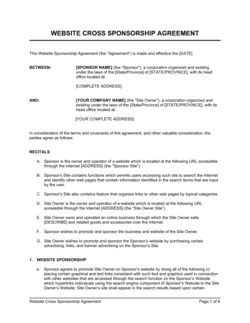
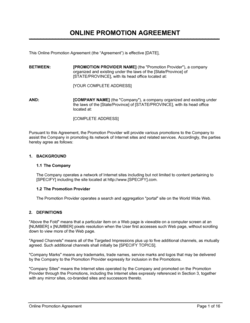
Cross-Promotion Agreement Template

Free Word download • Edit online • Save & share with Drive • Export to PDF

5 pages25–30 min to fillDifficulty: ComplexSignature requiredLegal review recommended
Learn more ↓
FreeCross-Promotion Agreement Template

At a glance

What it is
A Cross Promotion Agreement is a legally binding contract between two or more businesses that agree to market each other's products or services to their respective audiences. This free Word download covers promotional obligations, IP licensing, approval rights, cost allocation, revenue sharing, and termination in a single document you can edit online and export as PDF.
When you need it
Use it before launching any joint marketing campaign, co-branded content series, bundled offer, or audience-sharing initiative where two brands exchange promotional commitments. It is especially important when one or both parties will use the other's trademarks, customer data, or paid media budget.
What's inside
Parties and recitals, scope of promotional activities, brand and IP license terms, approval and quality-control procedures, cost and revenue allocation, performance obligations and metrics, confidentiality, term and termination, and governing law.

What is a Cross Promotion Agreement?

A Cross Promotion Agreement is a legally binding contract between two businesses that commit to promoting each other's products or services to their respective audiences under defined terms. It governs every material dimension of the joint marketing relationship: what each party will produce and distribute, how each party's brand and trademarks may be used, who approves co-branded materials before publication, how shared costs are split, how revenue generated by the campaign is tracked and divided, and what happens when the partnership ends. Unlike an informal email exchange or a handshake deal, a signed cross promotion agreement creates enforceable obligations on both sides and gives each party clear recourse if the other fails to deliver.

Why You Need This Document

Running a co-marketing campaign without a written agreement is a reliable way to end a business relationship. The most common outcomes of undocumented cross promotions are cost disputes when one party spends more than anticipated on shared media, attribution disagreements when both parties claim credit for the same conversions, and brand damage when one party publishes content featuring the other's logo in a context or format they never approved. Beyond the commercial risks, sharing customer email lists or behavioral data without a formal data-use agreement can expose both parties to regulatory liability under GDPR, CASL, and US state privacy laws. A well-drafted cross promotion agreement closes all of these gaps before the first asset goes live — protecting the brand, the budget, and the business relationship itself.

Which variant fits your situation?

If your situation is…Use this template
Two brands sharing audiences via email and social media onlyCross Promotion Agreement (Digital)
Co-branded physical product sold by both partiesCo-Branding Agreement
Affiliate relationship where one party earns a commission per saleAffiliate Marketing Agreement
Formal joint venture with shared revenue and a new entityJoint Venture Agreement
One brand sponsoring another brand's event or contentSponsorship Agreement
Reseller promoting a vendor's product in exchange for marginReseller Agreement
Influencer or content creator promoting both brands jointlyInfluencer Marketing Agreement

Common mistakes to avoid

❌ Vague promotional obligations

Why it matters: Phrases like 'reasonable promotional support' give neither party a measurable commitment to hold the other to, making it impossible to determine whether a breach has occurred.

Fix: Replace vague language with specific deliverables: channel, format, audience size, frequency, and publication date. Attach these as a Schedule so they can be updated without redrafting the main agreement.

❌ No approval clause for co-branded materials

Why it matters: Without review rights, one party can publish content featuring the other's logo in incorrect colors, alongside inappropriate messaging, or in channels excluded from the deal — all of which can cause brand and reputational damage.

Fix: Add a written approval clause with a defined review period (3–5 business days) and a deemed-approval default. Require re-submission if materials are materially altered after approval.

❌ Undefined attribution method for revenue sharing

Why it matters: Without a specified tracking mechanism, both parties will calculate conversions differently — especially when customers touch multiple channels — and disagreements become impossible to resolve objectively.

Fix: Agree on the attribution tool (UTM parameters, unique promo codes, or a third-party platform) before signing and document it in the agreement. Test it before the campaign goes live.

❌ Omitting a wind-down clause for co-branded materials

Why it matters: When the agreement ends, either by expiry or termination, co-branded assets — emails, landing pages, social bios, packaging — may remain live indefinitely unless a removal deadline is specified.

Fix: Include a clause requiring both parties to remove or de-brand all co-branded materials within 15 days of termination, with a written confirmation requirement.

❌ Sharing audience data without explicit data-use terms

Why it matters: Passing customer email lists or behavioral data to a third party without defined use restrictions and post-campaign deletion requirements may violate GDPR, CASL, or CAN-SPAM, exposing both parties to regulatory fines.

Fix: Add a data-use rider or clause specifying permitted uses of shared data, prohibiting onward sharing, requiring data security standards, and mandating deletion or return of data within a set period after campaign conclusion.

❌ Over-broad mutual exclusivity

Why it matters: A symmetrical exclusivity clause that prevents both parties from working with any competitor — rather than direct competitors in the same product category and geography — can block significant legitimate revenue for both businesses.

Fix: Limit exclusivity to the specific product category and geographic market relevant to the joint campaign, define 'Direct Competitor' precisely, and cap the exclusivity period to match the active campaign window.

The 10 key clauses, explained

Parties, recitals, and purpose

In plain language: Identifies each business by legal entity name, describes their respective businesses, and states the mutual goal of the promotional partnership.

Sample language
This Cross Promotion Agreement is entered into as of [DATE] between [PARTY A LEGAL NAME], a [STATE/PROVINCE] [ENTITY TYPE] ('Party A'), and [PARTY B LEGAL NAME], a [STATE/PROVINCE] [ENTITY TYPE] ('Party B'), to jointly promote each other's [PRODUCTS/SERVICES] as set out herein.

Common mistake: Using trade names or DBA names instead of registered legal entity names. If a dispute arises, the contract may be difficult to enforce against the correct legal entity.

Scope of promotional activities

In plain language: Lists every specific promotional activity each party agrees to perform — email sends, social posts, co-branded pages, events, in-package inserts — with audience size, frequency, and channel.

Sample language
Party A shall: (a) send [X] dedicated email promotions to its subscriber list of no fewer than [NUMBER] contacts; (b) publish [X] social media posts on [PLATFORMS] tagging Party B; and (c) feature Party B's [PRODUCT/SERVICE] on its homepage for [X] days. Party B shall perform the reciprocal activities set out in Schedule A.

Common mistake: Describing obligations vaguely as 'reasonable promotional efforts.' Without specific deliverables, audience sizes, and frequencies, neither party can hold the other accountable.

Brand and IP license

In plain language: Grants each party a limited, non-exclusive, revocable license to use the other's trademarks, logos, and brand assets solely for the agreed promotional activities.

Sample language
Each party grants the other a limited, non-exclusive, royalty-free license to display its trademarks and brand assets ('Licensed Marks') solely in connection with the Promotional Activities described herein. Each party shall use the Licensed Marks in accordance with the licensor's then-current brand guidelines, available at [URL/ATTACHMENT].

Common mistake: Omitting a reference to the licensor's brand guidelines. Without this, the other party may use logos in colors, sizes, or contexts that dilute or damage the brand.

Approval and quality control

In plain language: Requires each party to submit promotional materials featuring the other's brand for written approval before publication, with a defined review period and a deemed-approval default if no response is received.

Sample language
Each party shall submit all materials featuring the other party's Licensed Marks for written approval at least [X] business days prior to publication. If the reviewing party does not respond within [X] business days, approval is deemed granted. Approved materials may not be materially altered without re-submission.

Common mistake: No approval clause at all — or an open-ended review period with no deemed-approval default. Either allows one party to block or indefinitely delay publication of the other's content.

Cost allocation and budget

In plain language: States which party pays for which promotional costs — paid media spend, design, printing, event fees — and how shared costs are split and invoiced.

Sample language
Each party shall bear its own costs for producing and distributing its respective Promotional Deliverables. Shared costs, including [SPECIFY — e.g., paid social advertising budget of $[AMOUNT]], shall be split [X]%/[Y]% between Party A and Party B respectively and invoiced monthly.

Common mistake: No cost-allocation clause, leaving both parties to assume the other will cover shared spend. This is one of the most common sources of post-campaign disputes.

Revenue sharing and attribution

In plain language: Defines whether and how sales or leads generated by the joint promotion are tracked and shared, including the attribution methodology, reporting cadence, and payment terms.

Sample language
Conversions attributable to the Promotional Activities shall be tracked via [UTM PARAMETERS / AFFILIATE LINKS / PROMO CODE '[CODE]']. Party A shall pay Party B [X]% of Net Revenue from attributed conversions, calculated monthly and remitted within [30] days of the close of each calendar month, accompanied by a transaction report.

Common mistake: Agreeing to revenue sharing without specifying the attribution method. Without a defined tracking mechanism, both parties will calculate different numbers and disputes are inevitable.

Exclusivity and non-compete

In plain language: Specifies whether either party is restricted from running the same type of promotion with a direct competitor during the agreement term, and defines what constitutes a direct competitor.

Sample language
During the Term, [Party A / Party B / both parties] shall not enter into a Cross Promotion Agreement with any Direct Competitor of the other party. 'Direct Competitor' means any entity that derives more than [X]% of its revenue from [DESCRIPTION OF COMPETING PRODUCTS/SERVICES] in [GEOGRAPHIC MARKET].

Common mistake: Applying exclusivity symmetrically when only one party is at meaningful competitive risk. Over-broad mutual exclusivity can block legitimate business development for both parties.

Confidentiality

In plain language: Prohibits each party from disclosing the other's customer data, campaign performance metrics, pricing, and business information obtained during the partnership.

Sample language
Each party agrees to keep confidential all non-public information disclosed by the other party in connection with this Agreement, including but not limited to customer data, campaign metrics, pricing, and product roadmaps ('Confidential Information'), and shall not disclose such information to any third party without prior written consent.

Common mistake: Treating customer email lists or audience data as automatically licensed under the promotion. Without explicit terms governing data use and deletion post-campaign, sharing audience data may violate GDPR, CASL, or CAN-SPAM.

Term, termination, and wind-down

In plain language: States the agreement's start and end dates, the notice period required to terminate early, grounds for immediate termination for cause, and the parties' obligations after termination — including removal of co-branded materials.

Sample language
This Agreement commences on [START DATE] and continues for [X] months ('Initial Term'), renewing automatically for successive [X]-month periods unless either party provides [30] days' written notice of non-renewal. Either party may terminate immediately for cause upon written notice if the other materially breaches this Agreement and fails to cure within [10] business days. Upon termination, each party shall remove all co-branded materials within [15] days.

Common mistake: No wind-down obligations after termination. Without them, one party's logo or campaign materials may remain live on the other's website or email flows indefinitely after the partnership ends.

Representations, warranties, indemnification, and governing law

In plain language: Each party warrants it has the authority to enter the agreement and that its brand assets don't infringe third-party IP. Each party indemnifies the other for breaches of these warranties. Governing law and dispute resolution are stated.

Sample language
Each party represents and warrants that it has the right to grant the licenses herein and that its Licensed Marks do not infringe any third-party IP rights. Each party shall indemnify, defend, and hold harmless the other from claims arising from its own breach of the foregoing representations. This Agreement is governed by the laws of [STATE/PROVINCE/COUNTRY].

Common mistake: No indemnification clause for IP infringement. If one party's logo or content turns out to infringe a third party's trademark, the other party can be named in the resulting lawsuit without recourse.

How to fill it out

  1. 1

    Identify both parties by their legal entity names

    Enter each business's full registered name, entity type (LLC, Inc., Ltd.), and registered address. Confirm you are signing with the correct legal entity, not a trade name.

    💡 Search your state or provincial corporate registry to confirm the exact registered name before you draft — mismatches cause enforcement problems later.

  2. 2

    Define the scope of promotional activities in Schedule A

    List every specific deliverable each party will produce: email sends with minimum list size, social posts with platform and frequency, landing page placements, event appearances, or in-package inserts. Attach this as Schedule A so it can be updated without amending the main contract body.

    💡 Express quantities and audience sizes as minimums, not targets — 'no fewer than 50,000 email recipients' is enforceable; 'approximately 50,000' is not.

  3. 3

    Attach brand guidelines and define approval timelines

    Reference each party's brand guidelines by URL or attachment. Set a review window of 3–5 business days and include a deemed-approval default so neither party can hold up the campaign indefinitely.

    💡 If either party's brand guidelines change frequently, reference a live URL rather than attaching a static PDF to avoid version conflicts.

  4. 4

    Agree on cost allocation and document it explicitly

    List every category of shared cost — paid media, design, printing, event fees — and assign a percentage to each party. State the invoicing cadence and payment terms (e.g., Net 15 from invoice date).

    💡 Estimate total shared costs before signing and confirm both parties have budgeted for their share — cost disputes are the most common reason cross-promotion campaigns stall mid-flight.

  5. 5

    Set up the attribution and revenue-share mechanism

    Choose a tracking method — UTM parameters, unique promo codes, or affiliate links — and document it in the agreement. Specify the revenue share percentage, the definition of 'Net Revenue,' the reporting cadence, and the payment remittance window.

    💡 Test the tracking setup before the campaign launches. A broken UTM or promo code on day one creates attribution disputes that are nearly impossible to resolve retroactively.

  6. 6

    Tailor the exclusivity clause to actual competitive risk

    Determine whether exclusivity is genuinely necessary and, if so, whether it should be mutual or one-directional. Define 'Direct Competitor' narrowly using revenue percentage and product category so the clause doesn't block unrelated business activities.

    💡 Time-limited exclusivity — e.g., exclusivity only for the campaign's active 90-day window — is easier to agree on and less disruptive than a multi-year restriction.

  7. 7

    State the governing law and dispute-resolution method

    Choose the jurisdiction whose law governs the agreement and decide between arbitration, mediation, or court litigation for disputes. Both parties should be in agreement on this before signing.

    💡 If the parties are in different states or countries, choose a neutral jurisdiction with well-developed commercial contract law — Delaware, New York, Ontario, or England and Wales are common choices.

  8. 8

    Execute before any promotional activity begins

    Both authorized signatories must sign the agreement — and any attached Schedules — before the first co-branded asset is published or shared. Note the execution date explicitly.

    💡 Use electronic signature to timestamp execution and create an immutable audit trail. Store the fully executed copy in a shared document repository accessible to both parties.

Frequently asked questions

What is a cross promotion agreement?

A cross promotion agreement is a legally binding contract between two or more businesses that commit to promoting each other's products or services to their respective audiences. It defines each party's promotional obligations, the license to use each other's brand assets, how costs and revenue are shared, and what happens when the arrangement ends. It differs from a handshake deal by creating enforceable obligations and protecting both parties' IP and data.

When do I need a cross promotion agreement?

You need one before any joint marketing activity that involves using another company's logo, sharing audience data, committing to specific promotional deliverables, or splitting revenue generated by the campaign. If either party is investing meaningful time, budget, or brand exposure, a written agreement prevents disputes over what was promised and who owes what if the partnership underperforms or ends early.

What is the difference between a cross promotion agreement and an affiliate agreement?

An affiliate agreement is a one-directional arrangement where one party (the affiliate) promotes another party's products in exchange for a commission on sales. A cross promotion agreement is typically mutual — both parties promote each other — and may or may not include revenue sharing. Affiliates are usually paid per conversion; cross promotion partners may exchange promotional value without any monetary transfer at all if the audience sizes and campaign values are roughly equivalent.

Does a cross promotion agreement need to be signed by a lawyer?

A lawyer's signature is not required for the agreement to be legally valid. However, having a lawyer review the agreement is advisable when the partnership involves significant media spend, revenue sharing above a material threshold, sharing of customer data, or use of trademarks registered in multiple jurisdictions. For straightforward digital campaigns between small businesses, a well-drafted template is generally sufficient.

How should revenue sharing be structured in a cross promotion agreement?

Revenue sharing should specify the percentage split, the definition of the revenue base (gross revenue, net revenue after refunds and chargebacks, or gross profit), the attribution method that determines which conversions count, the reporting cadence (typically monthly), and the payment remittance window (commonly Net 30 from end of month). Both parties should agree on the tracking technology — UTM parameters, promo codes, or an affiliate platform — before signing and test it before the campaign launches.

Can a cross promotion agreement include an exclusivity clause?

Yes, and exclusivity clauses are common when one or both parties want to prevent the other from running the same type of promotion with a direct competitor during the campaign period. Enforceability generally requires the clause to be reasonable in duration, geographic scope, and product category. Overly broad exclusivity — covering all competitors in any industry for multiple years — is regularly challenged and should be narrowed to the specific competitive context of the deal.

What data protection considerations apply to a cross promotion agreement?

If either party shares customer email lists, behavioral data, or any personal information with the other, the agreement must address data protection compliance. In the EU, this typically requires a Data Processing Agreement or GDPR-compliant data-sharing addendum. In Canada, CASL governs the use of email lists. In the US, CAN-SPAM applies to commercial emails. At minimum, the agreement should specify permitted uses of shared data, prohibit onward disclosure, require adequate security measures, and mandate deletion or return of data after the campaign ends.

What happens if one party fails to deliver their promotional obligations?

If the agreement specifies deliverables clearly — channel, format, audience size, and timeline — a failure to perform constitutes a material breach. The non-breaching party is typically entitled to written notice of breach and a cure period (commonly 10 business days), and may terminate the agreement and seek damages or a refund of any shared costs already advanced if the breach is not cured. Vague obligations make it much harder to establish that a breach occurred at all, which is why specificity in Schedule A is critical.

How long should a cross promotion agreement last?

Most cross promotion agreements run for the duration of a specific campaign — typically 30 to 90 days — or for a defined period such as one year with automatic renewal. Campaign-specific agreements should include a clear start and end date tied to the campaign calendar. Longer-term partnership agreements should include a notice period for non-renewal (commonly 30 days) and a wind-down clause requiring removal of co-branded materials within 15 days of expiry or termination.

How this compares to alternatives

vs Joint Venture Agreement

A joint venture agreement creates a shared business entity or ongoing commercial enterprise between two parties, often involving capital contributions, shared liability, and profit distribution from a new operation. A cross promotion agreement is limited to a defined marketing campaign or promotional period and does not create a new legal entity or shared liability beyond the promotional scope. Use a joint venture agreement when the collaboration goes beyond marketing into shared revenue operations or co-ownership of assets.

vs Affiliate Agreement

An affiliate agreement is one-directional: one party promotes the other's products in exchange for a per-conversion commission, with no reciprocal obligation. A cross promotion agreement is typically mutual, with both parties committing to specific promotional activities for each other. If only one party is promoting the other, and the compensation is purely commission-based, an affiliate agreement is the more appropriate structure.

vs Sponsorship Agreement

A sponsorship agreement involves one party paying another for brand exposure — typically at an event, on a platform, or in content. The sponsor receives visibility; the sponsored party receives funds. A cross promotion agreement involves mutual, reciprocal promotional obligations without a sponsorship fee structure. Use a sponsorship agreement when the arrangement is one-directional and involves a cash payment for brand placement.

vs Reseller Agreement

A reseller agreement authorizes one party to sell another party's products or services to end customers, typically at a margin. A cross promotion agreement does not transfer selling rights — each party sells its own products and simply promotes the other's to its audience. Use a reseller agreement when the partner will actually conduct sales transactions on behalf of the product owner.

Industry-specific considerations

SaaS / Technology

Integration partnerships where two complementary tools promote each other in-app, via email, and in co-authored content — attribution tracked by unique in-app referral codes.

E-commerce and Retail

Bundled-product promotions and in-package insert campaigns between non-competing product brands sharing a target demographic, with conversion tracked by promo codes.

Food and Beverage

Restaurant and supplier co-branding on menus, packaging, and social media, with strict brand-standards compliance and locality-specific exclusivity clauses.

Professional Services

Referral-based cross promotion between complementary service firms — such as accountants and financial advisors — where audience data is not shared but warm introductions and co-branded content are.

Health and Wellness

Co-marketing between fitness brands, nutritional supplement companies, and wellness apps, with morality clauses and regulatory compliance warranties given the sensitivity of health claims.

Media and Entertainment

Cross-promotion between content creators, streaming platforms, or events brands — often involving co-branded content, audience newsletter swaps, and ticket or subscription bundle offers.

Jurisdictional notes

United States

US cross promotion agreements are governed by state contract law, which is generally permissive. Non-compete and exclusivity clauses are enforceable in most states but subject to reasonableness review in California, Minnesota, and others. If customer email data is shared, CAN-SPAM and applicable state privacy laws (CCPA in California, for example) impose consent and opt-out requirements. Trademark licenses must include adequate quality-control provisions to avoid a 'naked license' finding that could invalidate the trademark.

Canada

Canadian cross promotion agreements must address CASL (Canada's Anti-Spam Legislation) when sharing or using commercial email lists — consent requirements are stricter than CAN-SPAM. Quebec's Charter of the French Language may require French-language marketing materials for campaigns targeting Quebec consumers. Non-compete and exclusivity clauses are enforceable if reasonable in scope and duration. PIPEDA and provincial privacy laws govern the transfer of personal data between parties.

United Kingdom

UK cross promotion agreements involving personal data sharing require compliance with the UK GDPR and the Data Protection Act 2018, including a documented lawful basis for sharing and a data processing agreement if one party acts as a data processor for the other. The ASA (Advertising Standards Authority) Codes apply to co-branded advertising content. Post-Brexit, the UK operates its own data adequacy framework, so data transfers to EU partners require separate consideration.

European Union

GDPR is the primary concern for EU cross promotion agreements: sharing subscriber lists or behavioral data across entities typically requires either explicit consent from each data subject or a legitimate-interest assessment, and a Data Processing Agreement or controller-to-controller data sharing agreement is required. The EU's Unfair Commercial Practices Directive limits certain promotional representations. Non-compete and exclusivity clauses must be proportionate — excessively broad restrictions may violate EU competition law (Article 101 TFEU).

Template vs lawyer — what fits your deal?

PathBest forCostTime
Use the templateSmall businesses and startups running digital co-marketing campaigns with limited shared budget and no customer data exchangeFree30–60 minutes
Template + legal reviewCampaigns involving revenue sharing above $10,000, customer data exchange, or multi-jurisdiction brand licensing$300–$8002–4 days
Custom draftedEnterprise co-branding with registered trademark licensing, significant paid-media investment, or cross-border data sharing requiring GDPR compliance$1,500–$5,000+1–3 weeks

Glossary

Cross Promotion
A marketing arrangement in which two or more businesses promote each other's products or services to their respective customer bases.
Co-Branding
The use of two or more brand names, trademarks, or logos together on a product, service, or marketing material.
IP License
A grant of permission from one party to another to use specific intellectual property — such as a trademark, logo, or copyrighted content — under defined conditions.
Promotional Deliverable
A specific, agreed marketing output — such as a social media post, email blast, or landing page — that a party is obligated to produce and distribute.
Approval Right
A contractual right allowing one party to review and approve any marketing material that features their brand or IP before it is published.
Revenue Share
A mechanism by which two parties split income generated by a joint promotion, typically expressed as a percentage of net or gross revenue attributable to the campaign.
Attribution
The process of determining which party's promotional activity caused a customer conversion, used to calculate revenue share and measure performance.
Exclusivity
A clause preventing one or both parties from running a similar promotion with a direct competitor during the agreement term.
Indemnification
A contractual obligation by one party to compensate the other for losses, damages, or legal costs arising from a specified breach or act.
Term and Renewal
The defined start and end date of the agreement and whether it renews automatically unless either party gives notice of non-renewal.
Morality Clause
A provision allowing either party to terminate the agreement immediately if the other engages in conduct that damages the terminating party's brand reputation.

Part of your Business Operating System

This document is one of 3,000+ business & legal templates included in Business in a Box.

  • Fill-in-the-blanks — ready in minutes
  • 100% customizable Word document
  • Compatible with all office suites
  • Export to PDF and share electronically

Create your document in 3 simple steps.

From template to signed document — all inside one Business Operating System.
1
Download or open template

Access over 3,000+ business and legal templates for any business task, project or initiative.

2
Edit and fill in the blanks with AI

Customize your ready-made business document template and save it in the cloud.

3
Save, Share, Send, Sign

Share your files and folders with your team. Create a space of seamless collaboration.

Save time, save money, and create top-quality documents.

★★★★★

"Fantastic value! I'm not sure how I'd do without it. It's worth its weight in gold and paid back for itself many times."

Managing Director · Mall Farm
Robert Whalley
Managing Director, Mall Farm Proprietary Limited
★★★★★

"I have been using Business in a Box for years. It has been the most useful source of templates I have encountered. I recommend it to anyone."

Business Owner · 4+ years
Dr Michael John Freestone
Business Owner
★★★★★

"It has been a life saver so many times I have lost count. Business in a Box has saved me so much time and as you know, time is money."

Owner · Upstate Web
David G. Moore Jr.
Owner, Upstate Web

Run your business with a system — not scattered tools

Stop downloading documents. Start operating with clarity. Business in a Box gives you the Business Operating System used by over 250,000 companies worldwide to structure, run, and grow their business.

Free Forever Plan · No credit card required