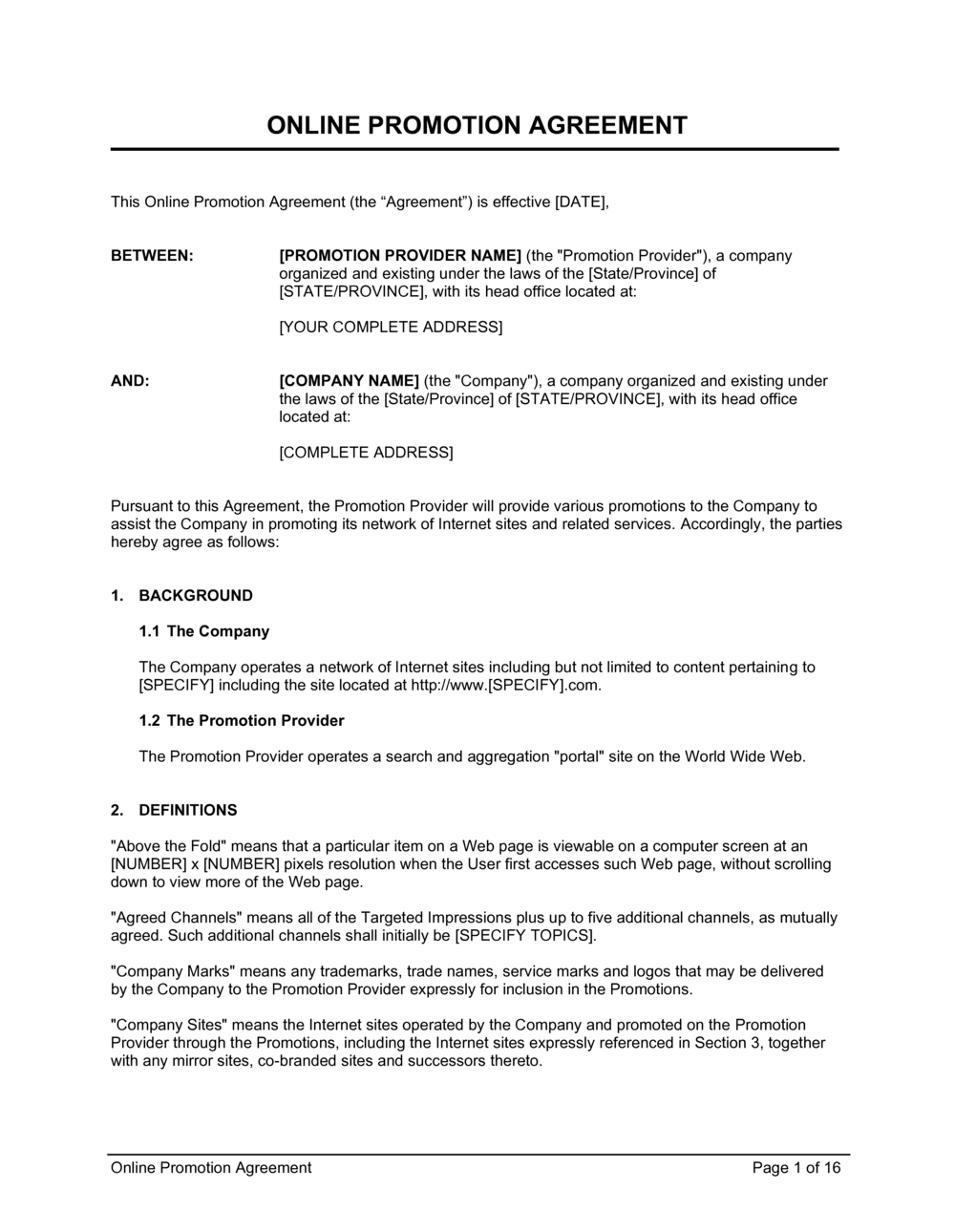
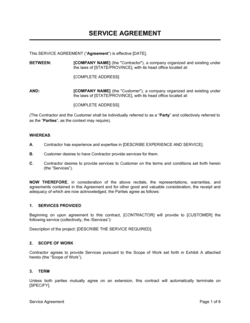
Online Promotion Agreement Template

Free Word download β€’ Edit online β€’ Save & share with Drive β€’ Export to PDF

16 pagesβ€’30–45 min to fillβ€’Difficulty: Complexβ€’Signature requiredβ€’Legal review recommended
Learn more ↓
FreeOnline Promotion Agreement Template

At a glance

What it is
An Online Promotion Agreement is a legally binding contract between a brand or company and a promoter β€” such as an influencer, affiliate, publisher, or content creator β€” that governs the terms of a paid digital marketing campaign. This free Word download covers deliverables, compensation, content approval rights, FTC disclosure obligations, intellectual property, and termination in a single document you can edit online and export as PDF.
When you need it
Use it before engaging any individual or business to promote your brand, product, or service on digital channels β€” including social media, blogs, email newsletters, podcasts, or streaming platforms. It is equally relevant whether you are the brand commissioning the promotion or the creator accepting the engagement.
What's inside
Campaign scope and deliverables, compensation and payment schedule, content approval and revision rights, FTC and platform disclosure requirements, intellectual property ownership, exclusivity restrictions, representations and warranties, and termination conditions including morality clauses.

What is an Online Promotion Agreement?

An Online Promotion Agreement is a legally binding contract between a brand and a promoter β€” which may be an influencer, content creator, affiliate publisher, or media partner β€” governing the terms of a paid digital marketing engagement. It defines exactly what content the promoter must produce and on which platforms, how and when the brand pays, who owns the resulting content, what disclosures must accompany each post, and under what conditions either party may exit the arrangement. Unlike an informal email exchange or DM negotiation, a signed online promotion agreement creates enforceable obligations on both sides and establishes the documentary record needed to resolve payment disputes, intellectual property conflicts, and regulatory compliance questions if they arise.

Why You Need This Document

Without a written online promotion agreement, both brands and promoters are exposed to consequences that a single document prevents. Brands that rely on verbal arrangements routinely discover that promoters have posted undisclosed sponsored content β€” triggering FTC or ASA enforcement actions that name both parties. Promoters who work without a contract face unpaid invoices with no contractual basis to demand payment, and brands who commission content without a clear IP license find creators demanding takedowns months later when the relationship sours. A single vague deliverable β€” "a few posts" β€” becomes a dispute over whether two posts or five were agreed. Adding a kill fee clause, a content approval window, and an explicit disclosure requirement to this template takes under 30 minutes and closes the four most common failure modes before the first piece of content is created.

Which variant fits your situation?

If your situation is…Use this template
Engaging a social media influencer for a one-time sponsored postOnline Promotion Agreement (Influencer)
Setting up an ongoing affiliate or referral commission programAffiliate Marketing Agreement
Licensing a creator's existing content for use in paid adsContent Licensing Agreement
Engaging a marketing agency for ongoing digital campaign managementDigital Marketing Services Agreement
Appointing a long-term brand ambassador with exclusivityBrand Ambassador Agreement
Sponsoring a podcast or YouTube channel for a defined seriesSponsorship Agreement
Commissioning a ghostwriter or copywriter to produce promotional contentContent Creation Agreement

Common mistakes to avoid

❌ No FTC disclosure clause

Why it matters: Both the brand and the promoter can face FTC enforcement action, civil penalties, and reputational damage if sponsored content is not clearly labeled. The FTC has issued warning letters to both parties simultaneously.

Fix: Include a standalone disclosure clause naming the specific required labels β€” '#ad', '#sponsored', or platform-native labels β€” and make the promoter solely responsible for compliance on every piece of content.

❌ Vague deliverables with no platform or format specified

Why it matters: A deliverable described only as 'three posts' is unenforceable. The promoter may publish on a low-reach secondary account, in a format the brand did not intend, or remove content after one day.

Fix: Enumerate every deliverable by platform, format, quantity, minimum live duration, and deadline. Include required links, promo codes, and calls to action in the same clause.

❌ Perpetual IP license granted for a flat one-time fee

Why it matters: Most creators do not intend to grant perpetual rights for a campaign fee. When they discover the brand is still using their content years later β€” including in paid ads β€” disputes and takedown demands follow.

Fix: Limit the IP license to a defined term (typically 6–12 months) and list permitted uses explicitly. Add a whitelisting addendum with a separate fee if paid amplification is needed.

❌ No kill fee for brand-initiated cancellation

Why it matters: Promoters who have invested time in drafting, shooting, and editing content are left with no compensation if the brand cancels last-minute without a kill fee clause.

Fix: Set a kill fee of 25–50% of the unpaid balance triggered when the brand cancels after the promoter has begun substantive work, defined as submission of a first draft or completion of a shoot.

❌ Exclusivity clause with no additional compensation

Why it matters: Requiring a creator to turn down competing brand work during the exclusivity period without paying a premium is a significant economic imposition. Courts have voided exclusivity clauses found to be one-sided without consideration.

Fix: Either limit exclusivity to the active campaign period only and price it into the base fee, or add an explicit exclusivity fee for any restriction extending beyond the campaign end date.

❌ No morality clause benchmark or standard

Why it matters: A morality clause that lets the brand terminate for any conduct 'Brand finds objectionable' with no further definition gives the brand an unconditional exit right β€” courts may treat this as illusory consideration, voiding the entire contract.

Fix: Anchor the morality clause to objectively identifiable conduct β€” criminal charges, hate speech, harassment, or specific categories of behavior listed in a Schedule β€” and tie the termination right to reasonable determination, not sole discretion.

The 10 key clauses, explained

Parties, campaign description, and term

In plain language: Identifies the brand and the promoter as legal entities, summarizes the campaign being promoted, and sets the start and end dates of the engagement.

Sample language
This Online Promotion Agreement is entered into on [DATE] between [BRAND LEGAL NAME], a [STATE/COUNTRY] [ENTITY TYPE] ('Brand'), and [PROMOTER FULL NAME / ENTITY NAME] ('Promoter'). The Promoter agrees to promote [PRODUCT/SERVICE NAME] ('Campaign') from [START DATE] through [END DATE].

Common mistake: Identifying the promoter by their social media handle instead of their legal name or entity. If a payment dispute arises, a handle is not an enforceable party in court.

Deliverables and posting schedule

In plain language: Lists each required content piece by format, platform, quantity, and due date, and specifies any minimum engagement or posting-window requirements.

Sample language
Promoter shall publish: (a) [X] Instagram feed posts by [DATE]; (b) [X] Instagram Stories by [DATE]; (c) [X] TikTok videos by [DATE]. Each post must remain live for a minimum of [30] days. Stories must include a swipe-up link to [URL].

Common mistake: Specifying deliverables only by number of posts without naming the platform, format, or minimum live duration. Platforms differ materially in reach and permanence β€” vague deliverables are impossible to enforce.

Compensation and payment schedule

In plain language: States the total fee, any performance bonuses, the payment schedule, the currency, and the method of payment β€” and distinguishes flat fees from affiliate commissions.

Sample language
Brand shall pay Promoter a flat fee of $[AMOUNT] [CURRENCY], payable as follows: 50% upon execution of this Agreement and 50% within [14] days of all deliverables being published and approved. Affiliate commissions, if applicable, shall be paid monthly at [X]% of verified net sales tracked via [TRACKING PLATFORM].

Common mistake: Omitting a payment trigger tied to deliverable completion. Brands that pay 100% upfront have no leverage to enforce content revisions or posting deadlines.

Content approval and revision rights

In plain language: Establishes the brand's right to review draft content before publication, sets the review window, limits the number of revision rounds, and defines what happens if the brand does not respond in time.

Sample language
Promoter shall submit draft content to Brand at [EMAIL/PLATFORM] at least [72] hours before the scheduled posting date. Brand shall provide written approval or revision requests within [48] hours. If Brand does not respond within this window, content is deemed approved. Brand may request a maximum of [2] rounds of revisions.

Common mistake: No deemed-approval clause. Without one, a brand can withhold approval indefinitely while the promoter misses their window β€” creating a deadlock that neither party intended.

Disclosure and platform compliance

In plain language: Requires the promoter to include all legally mandated disclosures β€” FTC in the US, ASA in the UK, platform-specific labels β€” and places responsibility for compliance on the promoter.

Sample language
Promoter shall clearly and conspicuously disclose the commercial nature of all content by including '#ad' or '#sponsored' as the first or second hashtag, or equivalent labeling required by [FTC Endorsement Guides / ASA CAP Code / applicable platform policy]. Promoter is solely responsible for ensuring compliance with all applicable advertising disclosure laws.

Common mistake: Burying the disclosure obligation in a general warranties clause instead of making it an explicit, standalone requirement. Regulators hold both brands and promoters liable β€” a vague clause offers neither party real protection.

Intellectual property ownership and license

In plain language: Allocates ownership of the created content and grants the brand a defined license to reuse, repurpose, or boost the content across its own channels.

Sample language
Promoter retains ownership of all content created under this Agreement. Promoter hereby grants Brand a non-exclusive, royalty-free license to repost, repurpose, and use the content across Brand's owned channels for a period of [12] months from publication. Paid amplification (whitelisting) requires a separate written addendum.

Common mistake: Granting a perpetual, irrevocable license by default. Most creators do not agree to perpetual rights for a flat fee β€” this mismatch causes disputes and can void the entire IP clause.

Exclusivity and non-compete

In plain language: Restricts the promoter from promoting named competitor brands or products during and, optionally, after the campaign period, in exchange for an exclusivity fee if applicable.

Sample language
During the Term and for [30] days thereafter, Promoter shall not create or publish promotional content for any of the following competing brands: [LIST OF COMPETITORS]. If Brand requires exclusivity beyond the Term, a separate exclusivity fee of $[AMOUNT] per [month/quarter] shall apply.

Common mistake: Requiring exclusivity with no corresponding additional compensation, or defining competitors so broadly that the promoter cannot work in their entire niche. Courts and arbitrators treat these as unreasonable restraints and may void the clause.

Morality clause and reputational standards

In plain language: Allows the brand to terminate the agreement immediately and without a kill fee if the promoter engages in conduct β€” including past conduct that comes to light β€” that could damage the brand's reputation.

Sample language
Brand may terminate this Agreement immediately, with no further payment obligation, if Promoter engages in conduct β€” including but not limited to statements, posts, or actions β€” that Brand reasonably determines to be dishonest, offensive, discriminatory, or materially inconsistent with Brand's values as stated in Schedule A.

Common mistake: Using a morality clause with no objective standard β€” 'conduct Brand finds objectionable' with no further definition. Without a benchmark, a promoter has no way to assess risk and a court may treat the clause as an unconscionable power imbalance.

Termination, kill fee, and wind-down

In plain language: Sets the notice period for termination by either party, defines the kill fee owed if Brand cancels after work has begun, and specifies takedown obligations upon termination.

Sample language
Either party may terminate this Agreement with [14] days' written notice. If Brand terminates after Promoter has begun work but before content is published, Brand shall pay a kill fee of [50]% of the unpaid balance. Upon termination, Promoter shall remove all Campaign content within [30] days unless otherwise agreed in writing.

Common mistake: No takedown obligation on termination. Without it, a promoter who ends the relationship on bad terms has no contractual obligation to remove branded content β€” which may continue to appear on their channels indefinitely.

Governing law, dispute resolution, and entire agreement

In plain language: Specifies the jurisdiction whose law governs the contract, how disputes are resolved, and confirms that the written agreement supersedes all prior verbal or email arrangements.

Sample language
This Agreement is governed by the laws of [STATE/PROVINCE/COUNTRY]. Any dispute shall be resolved by [binding arbitration / mediation / courts of competent jurisdiction] in [CITY]. This Agreement constitutes the entire agreement between the parties and supersedes all prior discussions, representations, and understandings.

Common mistake: Choosing governing law based on where the brand is incorporated without considering where the promoter operates. Certain consumer-protection and creator-protection statutes in the promoter's jurisdiction may override the chosen law regardless.

How to fill it out

  1. 1

    Identify both parties with legal names

    Enter the brand's registered legal entity name and the promoter's legal name or business entity β€” not a social media handle or brand alias. Include addresses and contact emails for both parties.

    πŸ’‘ Ask the promoter to confirm whether they operate as an individual or through an LLC or corporation β€” it affects tax reporting (W-9 vs. W-8BEN in the US) and the enforceability of IP clauses.

  2. 2

    Define the campaign and term precisely

    Describe the product or service being promoted, the platforms in scope, and the exact start and end dates. If the campaign is evergreen, set a defined renewal process rather than leaving the term open-ended.

    πŸ’‘ A specific campaign description limits scope creep β€” without it, promoters may argue that follow-up posts or Stories were outside the agreed deliverables.

  3. 3

    List deliverables with platform, format, quantity, and deadline

    Enumerate every required content piece by format (post, Reel, Story, video, newsletter), platform, quantity, and due date. Include minimum live-duration requirements and any required links, codes, or calls to action.

    πŸ’‘ Specify the exact tracking link or promo code in the deliverables section β€” waiting to share it separately after signing causes posting delays.

  4. 4

    Set the compensation structure and payment triggers

    Enter the flat fee, commission rate, or hybrid structure. Tie payment tranches to deliverable milestones: 50% on signing, 50% on verified publication. For affiliate arrangements, specify the commission platform and reporting cycle.

    πŸ’‘ State the currency explicitly β€” USD, CAD, GBP β€” on every monetary figure, especially for cross-border engagements where promoters and brands are in different countries.

  5. 5

    Establish the content approval workflow

    Set the draft submission deadline, the brand's review window (typically 48–72 hours), the maximum number of revision rounds, and a deemed-approval clause if the brand does not respond in time.

    πŸ’‘ Name the specific email address or platform (e.g., a shared Google Drive folder) for draft submissions β€” vague submission instructions cause avoidable disputes over whether drafts were received.

  6. 6

    Specify disclosure requirements by jurisdiction

    Insert the applicable disclosure standard for each platform and jurisdiction β€” FTC '#ad' requirements for US audiences, ASA CAP Code for UK audiences, platform-native paid partnership labels where required. Make the promoter responsible for compliance.

    πŸ’‘ Reference the current FTC Endorsement Guides or ASA guidance by name so the clause automatically incorporates future regulatory updates without needing an amendment.

  7. 7

    Define IP ownership, license scope, and whitelisting terms

    Confirm the promoter retains ownership, then specify the brand's license duration, permitted uses (organic reposting, paid ads, email), and geographic scope. If whitelisting is needed, add an addendum or a separate line item.

    πŸ’‘ Whitelisting typically commands a 15–25% fee premium over a standard organic post license β€” build this into your budget before finalizing the agreement.

  8. 8

    Sign before any content is created or published

    Both parties must execute the agreement before the promoter begins drafting content. Post-execution changes require a written amendment signed by both parties.

    πŸ’‘ Use a timestamped e-signature tool so you have a clear record of when consent was given β€” important if an FTC investigation or payment dispute arises later.

Frequently asked questions

What is an online promotion agreement?

An online promotion agreement is a legally binding contract between a brand and a promoter β€” such as an influencer, affiliate, content creator, or publisher β€” that defines the terms of a paid digital marketing engagement. It covers deliverables, compensation, content approval, FTC disclosure obligations, IP rights, exclusivity, and termination. It replaces informal DM or email arrangements with an enforceable document that protects both sides.

When do I need an online promotion agreement?

Any time money or free product changes hands in exchange for promotional content, a written agreement is necessary. This applies to one-time sponsored posts, ongoing ambassador relationships, affiliate programs, sponsored podcast episodes, and newsletter placements. Brands and creators who rely on verbal or email arrangements regularly face payment disputes, IP conflicts, and FTC compliance exposure that a signed contract would have prevented.

Who should sign an online promotion agreement?

Both the brand (or its authorized representative) and the promoter must sign. If the promoter operates through an LLC or corporation, the entity should be named as the contracting party and the individual should sign as an authorized officer. If a talent agency is involved, clarify whether the agency signs on behalf of the creator or whether the creator signs directly.

Are FTC disclosure requirements part of this contract?

Yes β€” and they should be. The FTC Endorsement Guides require clear and conspicuous disclosure of material connections between brands and promoters. Including a standalone disclosure clause in the agreement assigns responsibility to the promoter and creates a contractual basis to terminate or seek damages if the promoter fails to disclose. Both the brand and the promoter can face FTC action regardless of what the contract says, so explicit obligations matter.

Who owns the content created under an online promotion agreement?

By default, the creator owns the content they produce. A promotion agreement should confirm this and then grant the brand a limited license β€” specifying the permitted uses (organic repost, paid ads, email), platforms, geographic scope, and duration. Without an explicit license, the brand may have no right to repurpose content it paid for. Perpetual, unlimited licenses should command a higher fee and are rarely agreed to by professional creators.

What is a morality clause in a promotion agreement?

A morality clause allows the brand to terminate the agreement and withhold payment if the promoter engages in conduct that could damage the brand's reputation β€” such as making discriminatory statements, being charged with a crime, or publicly promoting conflicting values. To be enforceable, the clause should define the triggering conduct with reasonable specificity rather than relying solely on the brand's subjective judgment.

What happens if the brand cancels the campaign after work has started?

If the agreement includes a kill fee clause, the brand owes a defined partial payment β€” typically 25–50% of the unpaid balance β€” to compensate the creator for time already invested. Without a kill fee clause, the creator's only remedy is a breach-of-contract claim for the full contract value, which requires litigation to recover. A kill fee is a commercially reasonable middle ground that both sides should insist on.

Is an online promotion agreement enforceable internationally?

Generally yes, but enforceability depends on the governing law clause and whether the chosen jurisdiction's courts will recognize and enforce the agreement. Cross-border campaigns involving EU creators trigger GDPR data handling obligations and potential ASA or national advertising authority oversight. UK campaigns must comply with ASA CAP Code disclosure rules. Canadian creators are subject to provincial consumer protection laws. A governing law and jurisdiction clause does not override mandatory consumer or advertising laws in the promoter's home country.

Can I use a promotion agreement for affiliate marketing arrangements?

A standard promotion agreement covers sponsored content and flat-fee engagements. For pure affiliate or commission-based relationships β€” where the promoter earns a percentage of tracked sales rather than a flat fee β€” a dedicated affiliate marketing agreement is more appropriate. It covers tracking platforms, commission calculation, cookie windows, chargeback policies, and payment thresholds that a generic promotion agreement typically does not address in sufficient detail.

How this compares to alternatives

vs Affiliate Marketing Agreement

An affiliate marketing agreement governs a performance-based relationship where the promoter earns a commission on tracked sales rather than a flat fee. It addresses cookie windows, chargeback policies, tracking platforms, and minimum payment thresholds in detail that a promotion agreement does not. Use a promotion agreement for flat-fee sponsored content and an affiliate agreement when the entire compensation model is commission-based.

vs Brand Ambassador Agreement

A brand ambassador agreement covers an ongoing, long-term representation relationship β€” often with exclusivity, appearance obligations, and equity or royalty components. An online promotion agreement is scoped to a defined campaign period and a specific deliverable set. Use the ambassador agreement when the relationship is a sustained identity partnership, not a campaign-by-campaign engagement.

vs Sponsorship Agreement

A sponsorship agreement governs a brand's financial support of an event, channel, or series in exchange for logo placement, mentions, and audience access β€” without specifying individual content deliverables. An online promotion agreement governs specific content outputs. Use a sponsorship agreement for channel-level or event-level arrangements and a promotion agreement when each piece of content is individually specified and approved.

vs Independent Contractor Agreement

An independent contractor agreement establishes a general services relationship β€” covering payment, IP, confidentiality, and tax classification β€” but does not address campaign-specific needs like content approval, FTC disclosures, morality clauses, or platform compliance. A promotion agreement is purpose-built for digital marketing engagements. The two documents can be used together when a creator is engaged as an ongoing contractor with campaign-specific agreements layered on top.

Industry-specific considerations

E-commerce and retail

Product seeding arrangements, affiliate commission structures tied to unique discount codes, and seasonal campaign deliverables with strict posting windows aligned to sale dates.

SaaS and technology

Software review and tutorial content requiring technical accuracy approval rights, affiliate links tracked through SaaS platforms, and data privacy obligations when promoters access trial accounts.

Health, wellness, and beauty

FTC and FDA compliance on health claims embedded in the deliverables clause, before-and-after content restrictions, and heightened reputational risk driving stricter morality clause standards.

Entertainment and media

Whitelisting and paid amplification rights for music, film, or streaming launches, union talent considerations for SAG-AFTRA members, and synchronization rights where music is featured in creator content.

Food and beverage

Alcohol advertising restrictions by platform and jurisdiction, nutrient and ingredient claim compliance, and embargoed posting schedules tied to product launch dates.

Financial services and fintech

SEC and FINRA regulations on investment product promotions requiring specific risk disclosures in every piece of content, heightened approval rights, and outright bans on certain creator categories promoting securities.

Jurisdictional notes

United States

The FTC Endorsement Guides require clear and conspicuous disclosure of material connections in all sponsored content. The FTC updated its guidelines in 2023 to address social media specifically, including requirements for video and audio disclosures. Some states β€” including California and New York β€” have additional consumer protection statutes that may apply to advertising claims made in promotional content. Promoters who are LLCs or S-corps require a W-9 for tax reporting; non-US creators require a W-8BEN.

Canada

The Competition Bureau of Canada requires that paid endorsements and testimonials be clearly identified as such under the Competition Act. CASL (Canada's Anti-Spam Legislation) applies if promotional content includes commercial electronic messages such as newsletter placements or email promotions. Quebec requires consumer-facing advertising materials to be available in French. Provincial consumer protection laws may impose additional disclosure obligations depending on the product category.

United Kingdom

The ASA (Advertising Standards Authority) and CAP Code require that all paid-for promotions be obviously identifiable as advertising before the audience engages with the content. The ASA has issued enforcement notices against influencers who labeled posts only with brand tags without '#ad'. The CMA (Competition and Markets Authority) has also conducted enforcement investigations into undisclosed influencer relationships. The Online Safety Act 2023 introduces new obligations for platforms hosting promotional content relevant to larger creators.

European Union

The EU Unfair Commercial Practices Directive requires that commercial intent be disclosed in promotional content β€” implemented differently across member states but uniformly prohibiting hidden advertising. GDPR applies when personal data of EU residents is collected through tracking links, affiliate pixels, or competition entries embedded in promotional content, requiring a lawful basis and a privacy notice. Germany's UWG (Act Against Unfair Competition) has been used to fine influencers for inadequate disclosures, and French ARPP rules impose additional standards on beauty and health-adjacent content.

Template vs lawyer β€” what fits your deal?

PathBest forCostTime
Use the templateMicro-influencer campaigns, one-off sponsored posts, and flat-fee engagements under $5,000 with domestic creatorsFree20–30 minutes
Template + legal reviewCampaigns over $5,000, creators with a large audience, exclusivity requirements, or cross-border engagements$300–$7002–4 days
Custom draftedCelebrity or mega-influencer partnerships, long-term ambassador deals with equity components, or regulated industries such as finance and pharmaceuticals$1,500–$5,000+1–3 weeks

Glossary

Promoter
The individual or entity β€” influencer, affiliate, publisher, or creator β€” contracted to publish promotional content on behalf of the brand.
Deliverables
The specific content outputs required under the agreement, such as two Instagram posts, one YouTube video, and three Stories, defined by format, platform, and deadline.
FTC Disclosure
A clear and conspicuous statement required by the US Federal Trade Commission indicating that content is paid or sponsored β€” commonly '#ad', '#sponsored', or a verbal disclosure.
Content Approval
A contractual right allowing the brand to review and approve promotional content before it is published, typically within a defined window of 48–72 hours.
Exclusivity
A restriction preventing the promoter from working with named competitors or promoting competing products during and sometimes after the campaign period.
Morality Clause
A provision allowing the brand to terminate the agreement if the promoter engages in conduct β€” online or offline β€” that could damage the brand's reputation.
Intellectual Property (IP) License
The grant of rights allowing the brand to use, repurpose, or redistribute the promoter's content across its own channels for a defined period.
Affiliate Commission
A performance-based fee paid to the promoter as a percentage of sales or a flat amount per conversion attributable to their unique tracking link.
Kill Fee
A partial payment owed to the promoter if the brand cancels the campaign after work has begun but before the content goes live.
Whitelisting
Permission granted by the promoter for the brand to run paid advertising directly through the promoter's social media account or handle.
Engagement Rate
The percentage of a promoter's audience that actively interacts with a piece of content β€” calculated as likes, comments, and shares divided by total followers or impressions.

Part of your Business Operating System

This document is one of 3,000+ business & legal templates included in Business in a Box.

  • Fill-in-the-blanks β€” ready in minutes
  • 100% customizable Word document
  • Compatible with all office suites
  • Export to PDF and share electronically

Create your document in 3 simple steps.

From template to signed document β€” all inside one Business Operating System.
1
Download or open template

Access over 3,000+ business and legal templates for any business task, project or initiative.

2
Edit and fill in the blanks with AI

Customize your ready-made business document template and save it in the cloud.

3
Save, Share, Send, Sign

Share your files and folders with your team. Create a space of seamless collaboration.

Save time, save money, and create top-quality documents.

β˜…β˜…β˜…β˜…β˜…

"Fantastic value! I'm not sure how I'd do without it. It's worth its weight in gold and paid back for itself many times."

Managing Director Β· Mall Farm
Robert Whalley
Managing Director, Mall Farm Proprietary Limited
β˜…β˜…β˜…β˜…β˜…

"I have been using Business in a Box for years. It has been the most useful source of templates I have encountered. I recommend it to anyone."

Business Owner Β· 4+ years
Dr Michael John Freestone
Business Owner
β˜…β˜…β˜…β˜…β˜…

"It has been a life saver so many times I have lost count. Business in a Box has saved me so much time and as you know, time is money."

Owner Β· Upstate Web
David G. Moore Jr.
Owner, Upstate Web

Run your business with a system β€” not scattered tools

Stop downloading documents. Start operating with clarity. Business in a Box gives you the Business Operating System used by over 250,000 companies worldwide to structure, run, and grow their business.

Start freeΒ Β·Β No credit card required