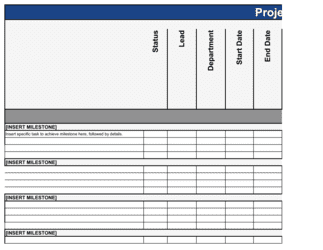
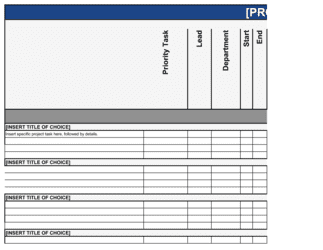
Project Timeline Template

Free Excel download β€’ Edit online β€’ Save & share with Drive β€’ Export to PDF

6 pagesβ€’25–35 min to fillβ€’Difficulty: Complexβ€’Signature requiredβ€’Legal review recommended
Learn more ↓
FreeXLSProject Timeline Template

At a glance

What it is
A Project Timeline is a binding schedule document attached to or incorporated into a project contract that sets out every milestone, deliverable, deadline, and responsible party across the life of a project. This free Word download gives you a structured, professionally formatted starting point you can edit online and export as PDF to attach to client contracts, vendor agreements, or internal project charters.
When you need it
Use it whenever a project involves multiple phases, handoffs between parties, or contractual deadlines β€” particularly when late delivery triggers penalties, payment holds, or termination rights. It is especially critical when the timeline is incorporated by reference into a services agreement or construction contract.
What's inside
Project identification and parties, a phased milestone schedule with start and end dates, deliverable definitions for each phase, responsibility assignments, change-order procedures, delay and force majeure provisions, and signatures confirming both parties' acceptance of the schedule as binding.

What is a Project Timeline?

A Project Timeline is a binding schedule document β€” typically executed as a signed exhibit to a services agreement, construction contract, or vendor agreement β€” that maps every project phase, milestone, deliverable, and deadline to specific calendar dates and assigns responsibility for each to the client or the provider. Unlike an informal Gantt chart or internal task list, a properly executed project timeline creates enforceable obligations: missed deadlines can trigger liquidated damages, withheld payments, or termination rights, while documented client delays can entitle the provider to schedule relief. It functions as the contractual backbone that connects a project's scope of work to its real-world delivery calendar.

Why You Need This Document

Without a signed project timeline, every deadline in a contract is a matter of interpretation rather than obligation. Clients dispute what "completion" means; providers claim delays were client-caused; invoices stall because no one agreed what triggers payment. The cost of this ambiguity is concrete β€” missed milestones go unpenalized, payment cycles stretch indefinitely, and termination rights are unclear when a project goes sideways. A signed, detailed project timeline eliminates these disputes before they start: it defines acceptance criteria so both parties know when a deliverable is done, documents client obligations so providers can invoke schedule relief when warranted, and sets a pre-agreed liquidated damages rate that survives a court challenge because it was calculated β€” not guessed β€” at the time of signing. This template gives you a professionally structured starting point that takes 1–2 hours to complete and protects both parties across the entire project lifecycle.

Which variant fits your situation?

If your situation is…Use this template
Construction or renovation project with multiple subcontractorsConstruction Project Timeline
Software or IT development project with sprint-based deliverySoftware Development Timeline
Marketing campaign or creative project with client review gatesCampaign Project Timeline
Simple internal task tracking with no contractual obligationsProject Action Plan
Long-term program with multiple sub-projects and governanceProgram Management Plan
Product launch requiring cross-functional department coordinationProduct Launch Plan
Event planning with vendor, venue, and logistics deadlinesEvent Planning Timeline

Common mistakes to avoid

❌ Using relative dates throughout the schedule

Why it matters: A timeline built entirely on 'X days after phase completion' cascades silently β€” one missed handoff shifts every downstream date, and neither party has a clear record of the original agreed dates.

Fix: Anchor the schedule to fixed calendar dates for at least the first milestone and any payment trigger. Use relative offsets only for internal phase steps, and include a baseline date table as an exhibit.

❌ No deemed-acceptance clause for deliverables

Why it matters: Without a defined review window, clients can withhold formal acceptance indefinitely, blocking the provider's right to invoice the next phase and stalling the entire project.

Fix: Include a clause stating that deliverables are deemed accepted if the client does not provide written rejection specifying the unmet acceptance criteria within 10 business days of submission.

❌ Leaving client obligations out of the responsibility matrix

Why it matters: When a client delays providing approvals, data, or site access, the provider has no contractual basis for schedule relief unless the client's obligations are explicitly documented.

Fix: List every client action required to keep the schedule on track β€” with specific lead-time requirements β€” in a signed responsibility matrix attached as an exhibit.

❌ Relying on informal emails to extend milestone dates

Why it matters: Courts in multiple jurisdictions have found that a series of agreed email extensions constitutes a modification of the original schedule, eliminating the client's right to claim liquidated damages for the original deadline.

Fix: Include a no-oral-modification clause and enforce it: every schedule change must be documented in a signed change order that references the original baseline dates.

❌ Setting liquidated damages at a punitive rather than compensatory level

Why it matters: A daily LD rate that bears no relationship to the client's actual loss will be struck down as a penalty clause in most jurisdictions, leaving the client with no pre-agreed remedy.

Fix: Calculate the LD rate from identifiable client costs β€” carrying costs, rental rates, lost revenue per day β€” and document the calculation in the contract recitals so a court can assess reasonableness.

❌ Treating the timeline as an attachment rather than a signed exhibit

Why it matters: An unsigned schedule attached to a contract is not a binding commitment β€” milestone penalties, acceptance triggers, and schedule-relief provisions are unenforceable without signatures from both parties.

Fix: Have both parties execute the timeline separately as a signed exhibit, and ensure the master contract expressly incorporates it by reference with the exhibit number.

The 10 key clauses, explained

Project identification and parties

In plain language: Names the client and service provider as legal entities, identifies the project by name and location or system, and cross-references the master services agreement or contract this timeline is attached to.

Sample language
This Project Timeline ('Schedule') is incorporated into and forms part of the Agreement dated [DATE] between [CLIENT LEGAL NAME] ('Client') and [PROVIDER LEGAL NAME] ('Provider') for the [PROJECT NAME] project located at [PROJECT ADDRESS / SYSTEM DESCRIPTION].

Common mistake: Using trade names instead of registered legal entity names. If the party named in the timeline differs from the party named in the main contract, enforcing milestone penalties or withholding payments becomes legally complicated.

Effective date and notice to proceed

In plain language: States when the timeline takes effect and what triggers the start of work β€” typically either the contract execution date or receipt of a formal notice to proceed.

Sample language
This Schedule takes effect on [DATE] ('Effective Date'). Work shall commence within [X] business days of Client issuing a written Notice to Proceed. All milestone dates run from the Notice to Proceed date unless otherwise stated.

Common mistake: Omitting the notice-to-proceed mechanism and treating contract signing as automatic commencement. If the client delays issuing the notice, the provider bears the schedule risk for a delay they did not cause.

Phase schedule and milestone dates

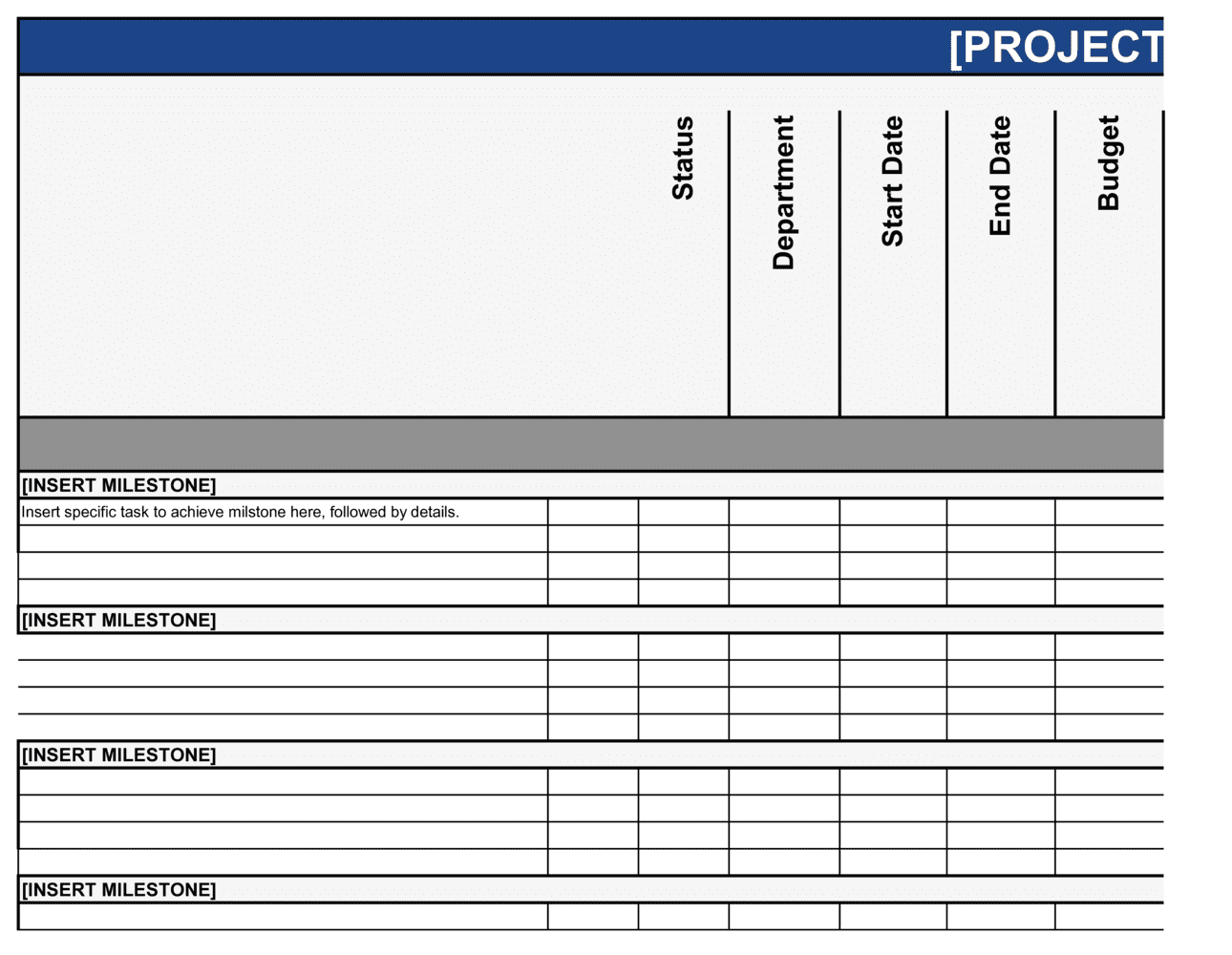
In plain language: Sets out each project phase with its name, planned start date, planned completion date, and key deliverable, in a table or numbered list that both parties can track against.

Sample language
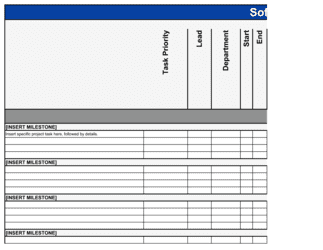
Phase 1 β€” Discovery: [START DATE] to [END DATE]. Deliverable: Completed requirements document. Phase 2 β€” Design: [START DATE] to [END DATE]. Deliverable: Approved design specifications. Phase 3 β€” Build: [START DATE] to [END DATE]. Deliverable: Tested and deployed system.

Common mistake: Using relative dates ('30 days after Phase 1 completion') throughout without anchoring any phase to a fixed calendar date. If Phase 1 slips, every downstream date shifts automatically, making the schedule unenforceable as written.

Deliverable definitions and acceptance criteria

In plain language: Defines each deliverable precisely β€” format, content, measurable quality standard β€” and specifies the number of business days the client has to accept or reject it in writing.

Sample language
Each Deliverable shall be deemed accepted if Client does not provide written rejection with specific deficiencies within [10] business days of delivery. Rejection must identify the specific acceptance criteria not met. Client may not unreasonably withhold acceptance.

Common mistake: No defined acceptance window. Without a deemed-acceptance clause, clients can delay formal sign-off indefinitely, blocking the provider's right to invoice and stalling the next phase.

Responsibility matrix

In plain language: Assigns each task and milestone to either the client or the provider, including client obligations such as providing access, data, approvals, or feedback within defined timeframes.

Sample language
Provider is responsible for tasks marked 'P' in Exhibit A. Client is responsible for tasks marked 'C', including providing [MATERIALS / ACCESS / APPROVALS] no later than [X] business days before the dependent milestone date.

Common mistake: Listing provider responsibilities in detail while leaving client obligations vague. When client delays cause the provider to miss milestones, a vague responsibility matrix prevents the provider from invoking the schedule-relief clause.

Schedule change and change-order procedure

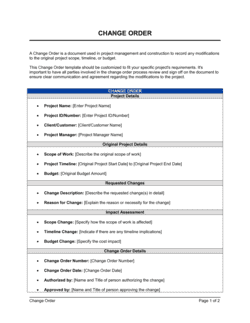
In plain language: Defines the process for requesting, evaluating, and approving changes to milestone dates or deliverable scope, and states that no change is binding without a signed change order.

Sample language
Either party may request a schedule change by submitting a written Change Order Request identifying the affected milestones, the proposed new dates, and the reason. Changes take effect only upon both parties' written approval. Verbal instructions do not modify this Schedule.

Common mistake: Allowing informal schedule adjustments by email without a formal change order. Courts have found that a series of agreed email extensions modified the original schedule β€” eliminating the client's right to claim liquidated damages for the original deadline.

Delay notification and schedule relief

In plain language: Requires the party experiencing a delay to notify the other party in writing within a defined number of days, and grants schedule relief only when the delay is caused by the other party or by an excused event.

Sample language
If Provider anticipates a delay to any milestone, Provider shall notify Client in writing within [5] business days of becoming aware. Delays caused by Client's failure to meet obligations in the Responsibility Matrix shall extend the affected milestone date by the equivalent number of calendar days.

Common mistake: No written notice requirement for delays. Without it, the delaying party cannot claim schedule relief retroactively, and the client cannot exercise step-in rights or engage replacement contractors in time.

Force majeure

In plain language: Excuses both parties from milestone obligations caused by events genuinely outside their control, lists specific qualifying events, and caps the extension period before either party may terminate.

Sample language
Neither party shall be in default for delays caused by Force Majeure Events including fire, flood, earthquake, epidemic, war, government-mandated shutdowns, or labor strikes not involving the affected party's own workforce. The affected party shall notify the other within [3] business days. If a Force Majeure Event extends beyond [60] consecutive days, either party may terminate on [15] days' written notice.

Common mistake: A force majeure clause that lists only natural disasters and omits government orders or supply-chain disruptions. Post-pandemic, courts have scrutinized clauses narrowly β€” an exhaustive list beats a vague 'acts of God' catch-all.

Liquidated damages and delay penalties

In plain language: States the pre-agreed daily or weekly sum the provider owes for missing a contractual completion deadline, and caps the total exposure at a percentage of the contract value.

Sample language
If Provider fails to achieve Substantial Completion by [DATE] for reasons other than excused delay, Provider shall pay liquidated damages of $[AMOUNT] per calendar day, up to a maximum of [X]% of the total contract value. These amounts represent a genuine pre-estimate of Client's loss and are not a penalty.

Common mistake: Setting liquidated damages so high that a court would void them as a penalty. In most jurisdictions, the sum must be a reasonable pre-estimate of actual loss β€” not a deterrent. Document the basis for the rate in the contract recitals.

Signatures and governing law

In plain language: Both parties sign to confirm acceptance of the schedule as a binding contract exhibit, and the clause specifies which jurisdiction's law governs any dispute arising from the timeline.

Sample language
The parties confirm that this Schedule is incorporated into the Agreement and is binding on both parties as of the Effective Date. This Schedule is governed by the laws of [STATE / PROVINCE / COUNTRY]. IN WITNESS WHEREOF the parties have executed this Schedule as of the date first written above.

Common mistake: Treating the timeline as an informational attachment rather than a signed exhibit. An unsigned schedule is not contractually binding β€” milestone penalties and acceptance triggers are unenforceable without execution by both parties.

How to fill it out

  1. 1

    Enter the parties' legal names and cross-reference the master contract

    Use each party's full registered entity name and insert the date and reference number of the main services agreement or construction contract this timeline supports. This anchors the schedule as a binding exhibit.

    πŸ’‘ Confirm the entity names match those in the master contract exactly β€” a mismatch between the timeline and the main agreement can create an enforcement gap.

  2. 2

    Set the effective date and notice-to-proceed trigger

    Decide whether the schedule starts on the contract execution date or on a formal notice to proceed. If the client controls when work begins, use a notice-to-proceed trigger and state the number of business days the provider has to mobilize.

    πŸ’‘ For construction and IT projects, always use a notice to proceed β€” it protects the provider from bearing schedule risk for a client-caused mobilization delay.

  3. 3

    Build the phase schedule with fixed calendar dates

    List every project phase with a name, planned start date, planned end date, and primary deliverable. Anchor at least Phase 1 to a fixed calendar date; subsequent phases may run from the prior completion date but must state the assumed prior-completion date explicitly.

    πŸ’‘ Add a 10–15% buffer to each phase duration before presenting to the client β€” it is easier to deliver early than to negotiate schedule relief after the fact.

  4. 4

    Define acceptance criteria for each deliverable

    Write measurable acceptance criteria for every deliverable β€” format, content standard, performance threshold, or test result. State the number of business days the client has to accept or reject in writing.

    πŸ’‘ A deemed-acceptance clause (acceptance if no written rejection within 10 business days) is one of the most valuable protections a provider can include.

  5. 5

    Complete the responsibility matrix

    List every task, decision, and approval in a table and mark it as the client's or provider's obligation. Include client deliverables β€” such as providing site access, data files, or design approvals β€” with the number of business days lead time required before the dependent milestone.

    πŸ’‘ Client obligations are often the primary cause of provider delays. A detailed responsibility matrix is your evidence if you need to invoke schedule relief.

  6. 6

    Set the change-order and delay notification procedures

    State that no schedule change is effective without a signed change order. Set the written notification window for anticipated delays β€” typically 3–5 business days from when the delaying party becomes aware.

    πŸ’‘ A short notification window (3 days) incentivizes early communication and prevents parties from sitting on delay claims until they become crises.

  7. 7

    Insert liquidated damages and the force majeure cap

    Enter the daily liquidated damages rate and total cap as a percentage of contract value. List specific force majeure events and state the maximum extension period before termination rights arise.

    πŸ’‘ Document the basis for the liquidated damages rate in the recitals (e.g., 'representing estimated daily carrying costs of $X'). This evidence helps courts uphold the clause rather than void it as a penalty.

  8. 8

    Execute as a signed exhibit before work begins

    Both parties must sign the timeline before the notice to proceed is issued. Have each signatory confirm their authority to bind the entity. Attach the executed schedule to the master contract as Exhibit A or Schedule 1.

    πŸ’‘ Use a dated signature block β€” not just a signature line β€” so the execution date is unambiguous if a later dispute arises over which version of the schedule governs.

Frequently asked questions

What is a project timeline?

A project timeline is a structured schedule document that maps every phase, milestone, and deliverable of a project to specific dates and responsible parties. When incorporated into a contract, it becomes a binding exhibit that governs delivery obligations, triggers payment releases, and establishes the basis for delay claims or liquidated damages. It is distinct from an informal Gantt chart or task list because it carries contractual weight.

What should a project timeline include?

At minimum: the parties' legal names and reference to the master contract, an effective date and notice-to-proceed mechanism, a phased milestone schedule with fixed calendar dates, deliverable definitions with acceptance criteria, a responsibility matrix, a change-order procedure, delay notification requirements, force majeure provisions, and signatures from both parties. Missing any of these turns the schedule from a binding document into an unenforceable list.

Is a project timeline legally binding?

A project timeline is generally binding when it is executed as a signed exhibit to a contract and expressly incorporated by reference. An unsigned attachment, an emailed schedule, or a project management tool export is typically not sufficient to enforce milestone penalties or trigger acceptance obligations. The binding effect depends on proper execution and clear incorporation language in the master agreement.

What are liquidated damages in a project timeline?

Liquidated damages are a pre-agreed daily or weekly sum the provider owes for missing a contractual completion deadline, specified in the timeline rather than left to a court to calculate. They are enforceable in most jurisdictions when the amount represents a genuine pre-estimate of the client's loss β€” not a deterrent. Rates that are disproportionate to actual harm are often struck down as unenforceable penalty clauses.

What is the difference between a project timeline and a project plan?

A project plan is a broader operational document covering scope, resources, budget, risk management, and communication protocols β€” often used internally. A project timeline is the schedule-specific exhibit that defines dates, milestones, and deadlines in a legally binding format. The timeline is typically an exhibit to a contract; the project plan is a management tool. Both may be used on the same project, but only the signed timeline creates enforceable deadline obligations.

What happens if a client causes a delay in the project timeline?

If the timeline includes a responsibility matrix documenting client obligations β€” approvals, data delivery, site access β€” and the client fails to meet those obligations on time, the provider is typically entitled to extend the affected milestone dates by the equivalent number of days. This schedule-relief right applies only if the provider notifies the client in writing within the notice period specified in the delay clause β€” typically 3 to 5 business days of becoming aware of the delay.

Can a project timeline be changed after signing?

Yes, but changes should only take effect through a signed change order that references the original baseline dates and the new agreed dates. Relying on informal email exchanges or verbal agreements to extend deadlines creates significant legal risk β€” courts have found that a series of agreed email extensions modified the original schedule and eliminated the client's right to claim liquidated damages.

Do I need a lawyer to create a project timeline?

For standard project engagements, a professionally drafted template is generally sufficient. Consider engaging a lawyer when the project value exceeds $250,000, when liquidated damages provisions are material to the deal, when the project crosses jurisdictions with different construction or procurement laws, or when government or institutional clients impose their own standard form contracts that require negotiation.

What is substantial completion in a project timeline?

Substantial completion is the point at which the project is sufficiently complete to be used for its intended purpose, even if minor punch-list items remain. It is typically the trigger for final payment release and the starting point for warranty periods. Defining substantial completion precisely in the timeline β€” rather than leaving it to interpretation β€” prevents disputes about whether the provider has met the completion milestone.

How this compares to alternatives

vs Project Action Plan

A project action plan is an internal task-management document listing who does what and by when, without the contractual provisions β€” acceptance criteria, liquidated damages, force majeure β€” that make a project timeline legally binding. Use an action plan for internal team coordination and a signed project timeline for client-facing or vendor-facing obligations where enforceable deadlines matter.

vs Statement of Work

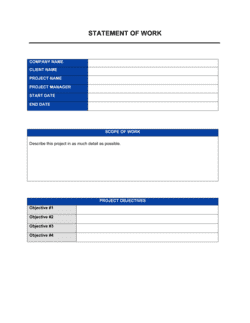
A statement of work defines the scope, objectives, and deliverables of a project engagement. A project timeline translates that scope into a dated, phase-by-phase schedule with enforceable deadlines and delay mechanisms. The two documents are complementary β€” the SOW answers what will be done; the timeline answers when and by whom β€” and are often executed together as exhibits to a master services agreement.

vs Service Agreement

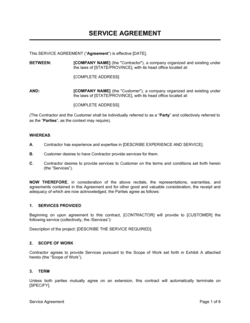
A service agreement governs the overall commercial relationship β€” fees, IP ownership, liability, warranties, and termination rights. A project timeline is a schedule exhibit that feeds into the service agreement, specifying the delivery obligations that the agreement's payment and termination clauses depend on. A service agreement without a signed timeline leaves delivery obligations dangerously vague.

vs Product Launch Plan

A product launch plan is a strategic operational document mapping go-to-market activities, team responsibilities, and launch readiness criteria β€” used internally across marketing, product, and sales. A project timeline is a contractually binding schedule between two parties with enforceable milestones and delay consequences. The launch plan drives internal execution; the project timeline governs external obligations to clients or vendors.

Industry-specific considerations

Construction and engineering

Progress-payment milestones tied to phase completion percentages, subcontractor coordination dates, permit and inspection gates, and substantial completion as the final payment trigger.

Technology and software development

Sprint and release milestones linked to client acceptance testing, UAT windows with defined pass/fail criteria, and go-live dates tied to infrastructure readiness obligations.

Professional services and consulting

Interim deliverable dates for reports, analyses, or recommendations with defined review periods, and phased billing tied to accepted deliverable submissions.

Creative and marketing agencies

Client review and approval gates built into the schedule, revision rounds capped at a defined number to prevent scope creep, and campaign launch dates linked to client asset delivery obligations.

Jurisdictional notes

United States

Liquidated damages clauses are enforceable when the sum represents a reasonable pre-estimate of actual loss and is not a penalty β€” the standard varies slightly by state, with California applying stricter scrutiny. Force majeure interpretation is narrow under most US common law; only expressly listed events qualify. Federal projects are governed by the FAR, which imposes specific schedule-submission and delay-notification requirements.

Canada

Canadian courts apply the same reasonable pre-estimate test for liquidated damages and will void punitive clauses. Construction projects in Ontario, Alberta, and British Columbia are subject to prompt-payment legislation requiring milestone-linked payment timelines; project schedules must align with these statutory deadlines. Quebec contracts must be in French for provincially regulated projects, and Civil Code provisions may affect force majeure interpretation differently from common-law provinces.

United Kingdom

The UK Supreme Court's Cavendish Square decision broadened the test for liquidated damages beyond simple pre-estimate to include legitimate business interests, making well-drafted LD clauses more defensible. The Housing Grants, Construction and Regeneration Act 1996 imposes adjudication rights on construction contracts, meaning disputed milestone payments can be referred to adjudication within 28 days. Force majeure has no default statutory meaning in English law β€” the clause must be drafted explicitly.

European Union

EU member states vary significantly in their treatment of contractual penalties β€” French law permits courts to reduce excessive penalty clauses rather than void them, while German law requires penalties to be proportionate under BGB Β§343. The Late Payment Directive (2011/7/EU) sets maximum payment terms and interest rates that interact with milestone-linked payment schedules. Cross-border projects should specify governing law explicitly, as default rules differ materially between civil-law jurisdictions.

Template vs lawyer β€” what fits your deal?

PathBest forCostTime
Use the templateStandard client or vendor projects under $250,000 with straightforward phases and deliverablesFree1–2 hours to complete and attach to a contract
Template + legal reviewProjects over $250,000, government contracts, or engagements with material liquidated damages exposure$300–$800 for a lawyer review of the schedule and LD provisions1–3 days
Custom draftedComplex construction projects, multi-party engineering contracts, or cross-border technology implementations with regulatory milestones$2,000–$8,000+1–3 weeks

Glossary

Milestone
A defined point in the project schedule β€” typically the completion of a phase or delivery of a major output β€” that triggers a review, payment, or next-phase authorization.
Deliverable
A specific, tangible output that must be produced and accepted by a defined date, such as a completed design, compiled software build, or signed-off report.
Critical Path
The sequence of dependent tasks that determines the minimum total duration of the project β€” any delay on the critical path delays the final completion date.
Float (Slack)
The amount of time a task can be delayed without pushing back the project's overall completion date or the next dependent milestone.
Baseline Schedule
The original, agreed-upon project timeline at contract execution, preserved as a reference point against which all subsequent changes and delays are measured.
Change Order
A written amendment to the project scope, schedule, or budget agreed by both parties, which may extend milestone dates or add new deliverables.
Liquidated Damages
A pre-agreed sum the contractor or service provider pays for each day the project runs past a contractual completion date, set in advance as an estimate of the owner's loss.
Force Majeure
A clause excusing a party from performance obligations when an unforeseeable event beyond their control β€” such as a natural disaster or government order β€” prevents timely completion.
Substantial Completion
The stage at which a project is sufficiently complete for its intended use, even if minor punch-list items remain β€” often the trigger for final payment release.
Notice to Proceed
A formal written instruction from the project owner or client authorizing the contractor or service provider to begin work, typically starting the clock on the first milestone.
Acceptance Criteria
The specific, measurable conditions a deliverable must satisfy before the client is obligated to formally approve it and release the associated payment.

Part of your Business Operating System

This document is one of 3,000+ business & legal templates included in Business in a Box.

  • Fill-in-the-blanks β€” ready in minutes
  • 100% customizable Word document
  • Compatible with all office suites
  • Export to PDF and share electronically

Create your document in 3 simple steps.

From template to signed document β€” all inside one Business Operating System.
1
Download or open template

Access over 3,000+ business and legal templates for any business task, project or initiative.

2
Edit and fill in the blanks with AI

Customize your ready-made business document template and save it in the cloud.

3
Save, Share, Send, Sign

Share your files and folders with your team. Create a space of seamless collaboration.

Save time, save money, and create top-quality documents.

β˜…β˜…β˜…β˜…β˜…

"Fantastic value! I'm not sure how I'd do without it. It's worth its weight in gold and paid back for itself many times."

Managing Director Β· Mall Farm
Robert Whalley
Managing Director, Mall Farm Proprietary Limited
β˜…β˜…β˜…β˜…β˜…

"I have been using Business in a Box for years. It has been the most useful source of templates I have encountered. I recommend it to anyone."

Business Owner Β· 4+ years
Dr Michael John Freestone
Business Owner
β˜…β˜…β˜…β˜…β˜…

"It has been a life saver so many times I have lost count. Business in a Box has saved me so much time and as you know, time is money."

Owner Β· Upstate Web
David G. Moore Jr.
Owner, Upstate Web

Run your business with a system β€” not scattered tools

Stop downloading documents. Start operating with clarity. Business in a Box gives you the Business Operating System used by over 250,000 companies worldwide to structure, run, and grow their business.

Free Forever PlanΒ Β·Β No credit card required