Project Management Agreement Template

Free Word download β€’ Edit online β€’ Save & share with Drive β€’ Export to PDF

26 pagesβ€’35–50 min to fillβ€’Difficulty: Complexβ€’Signature requiredβ€’Legal review recommended
Learn more ↓
FreeProject Management Agreement Template

At a glance

What it is
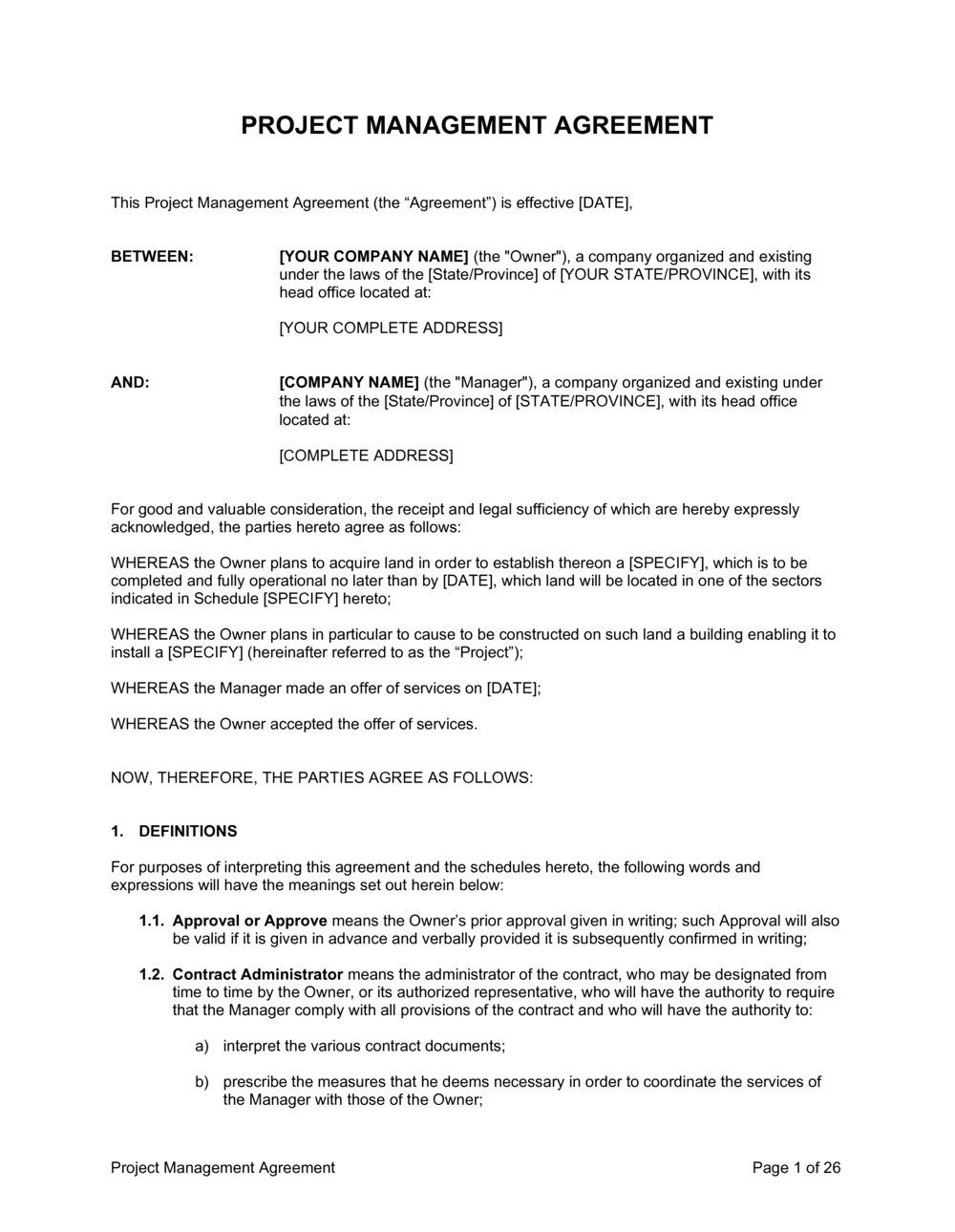
A Project Management Agreement is a legally binding contract between a client and a project manager β€” typically an external consultancy or independent PM β€” that governs the delivery of a defined project. This free Word download covers scope, deliverables, fees, decision-making authority, change control, intellectual property, and termination in a single professionally structured document you can edit online and export as PDF.
When you need it
Use it whenever you engage an external project manager or PM firm to lead a defined initiative β€” a construction build, software implementation, office relocation, or organizational transformation β€” where you need enforceable accountability for scope, budget, and timeline.
What's inside
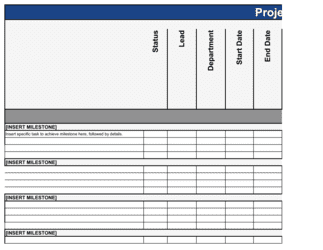
Project scope and deliverables, fee structure and payment milestones, decision authority and reporting obligations, change control procedures, intellectual property assignment, confidentiality, liability limitations, and termination conditions β€” plus a project schedule as an attached exhibit.

What is a Project Management Agreement?

A Project Management Agreement is a legally binding contract between a client and a project manager β€” typically an external consultancy or independent PM professional β€” that governs the delivery of a defined project. It establishes who is responsible for what, how far the PM's authority extends, how scope changes are handled, who owns the work product produced, and what happens if either party needs to exit early. Unlike a general consulting or contractor agreement, a project management agreement is structured around a specific project with binding deliverables, a project schedule, milestone-based payments, and a formal change control process that keeps scope, budget, and timeline under documented control throughout the engagement.

Why You Need This Document

Without a signed project management agreement, the most common and costly project disputes have no contractual framework to resolve them. Scope creep β€” additional work performed on verbal instructions β€” becomes a fee dispute with no paper trail. Decision authority gaps cause delays when both the client and PM assume the other is responsible for a critical approval. IP ownership of project plans, reports, and designs defaults to the PM under copyright law in most common-law jurisdictions, meaning the client may not have full rights to modify or reuse their own deliverables. And a termination without a wind-down clause leaves the client rebuilding project knowledge from nothing. A properly executed project management agreement closes all of these gaps before the first kickoff meeting β€” protecting the client's budget and outcomes and giving the PM the authority framework they need to deliver without constant interruption.

Which variant fits your situation?

If your situation is…Use this template
Engaging an individual freelance project managerIndependent Contractor Agreement
Managing a construction or infrastructure projectConstruction Project Management Agreement
Delivering a fixed-scope software or IT projectSoftware Development Agreement
Retaining a PM firm for ongoing programme managementManagement Consulting Agreement
Engaging a consultant for a specific short-term deliverableConsulting Agreement
Subcontracting project delivery to a third-party firmSubcontractor Agreement
Defining responsibilities between two co-managing partiesJoint Venture Agreement

Common mistakes to avoid

❌ Vague scope with no exclusions listed

Why it matters: Without explicit exclusions, the PM and client interpret responsibilities differently β€” leading to disputed change orders, fee claims, and stalled projects mid-delivery.

Fix: Write a two-column scope table: column one lists what the PM does, column two lists what remains the client's responsibility. Both parties initial it at signing.

❌ No signed change order before out-of-scope work begins

Why it matters: Verbal instructions to proceed on additional work create fee disputes that are almost impossible to resolve without written evidence of authorization.

Fix: Enforce the change control clause without exception β€” no PM should begin out-of-scope work without a signed change order, even for small additions.

❌ Missing IP assignment clause

Why it matters: In most common-law jurisdictions, an independent contractor owns copyright in the work they create unless there is an explicit written assignment β€” leaving the client without full rights to their own project deliverables.

Fix: Include a work product assignment clause that transfers all project-specific IP to the client upon full payment, with a clear carve-out for the PM's pre-existing tools and methodologies.

❌ No liability cap on the project manager

Why it matters: A scheduling error or budget overrun that cascades into third-party contractor penalties can expose the PM to claims many times larger than their total fee, creating uninsurable risk.

Fix: Cap the PM's aggregate liability at total fees paid under the agreement and add a mutual exclusion of consequential damages.

❌ No wind-down obligations on termination

Why it matters: Without a structured handover obligation, a terminated PM has no contractual duty to transfer files, introduce contacts, or complete in-progress approvals β€” leaving the client to rebuild project knowledge from zero.

Fix: Include a termination clause requiring the PM to provide all project files, a transition summary, and up to [10] hours of handover support within [5] business days of termination.

❌ Executing the agreement after the PM starts work

Why it matters: In common-law jurisdictions, IP assignment, confidentiality, and non-solicitation clauses signed after work has begun may be unenforceable without fresh consideration, leaving early-project deliverables in a legal grey zone.

Fix: Execute the agreement before the PM performs any billable work. If circumstances require a late signature, document a specific additional benefit β€” bonus payment or extended notice period β€” as fresh consideration.

The 10 key clauses, explained

Parties, recitals, and effective date

In plain language: Identifies the client and the project manager as legal entities, states the purpose of the engagement, and fixes the date the agreement takes effect.

Sample language
This Project Management Agreement ('Agreement') is entered into as of [DATE] between [CLIENT LEGAL NAME], a [STATE/JURISDICTION] [ENTITY TYPE] ('Client'), and [PM FIRM LEGAL NAME], a [STATE/JURISDICTION] [ENTITY TYPE] ('Project Manager').

Common mistake: Using a trading name instead of the registered legal entity name for either party β€” this creates problems enforcing IP assignment or liability clauses against the correct legal person.

Scope of services and project description

In plain language: Defines the project the PM is engaged to manage, the specific services they will perform, and what is explicitly excluded from their responsibilities.

Sample language
Project Manager shall perform the project management services described in Exhibit A ('Services') in connection with the [PROJECT NAME] project ('Project'). Services expressly exclude [EXCLUDED ACTIVITIES], which remain the responsibility of Client.

Common mistake: Describing the scope in broad terms like 'manage the project' without listing specific responsibilities β€” this makes it impossible to assess whether the PM has performed or whether a change order is warranted.

Deliverables and project schedule

In plain language: Lists the specific outputs the PM must produce and the agreed dates by which each must be completed, typically attached as an exhibit.

Sample language
Project Manager shall deliver each Deliverable set out in Exhibit B by the date specified therein. If a Deliverable date is missed by more than [10] business days through no fault of Client, Client may issue a written cure notice requiring delivery within [5] business days.

Common mistake: Attaching a project schedule but not making it a contractual exhibit β€” schedule slippage then has no contractual consequence because the dates were never binding obligations.

Fees, payment schedule, and expenses

In plain language: States the total fee or rate, the payment milestones or invoicing cadence, any retainage, and the policy for reimbursing out-of-pocket expenses.

Sample language
Client shall pay Project Manager a fixed fee of $[AMOUNT], payable according to the milestone schedule in Exhibit C. Client shall reimburse pre-approved out-of-pocket expenses within [30] days of submission with receipts. Invoices unpaid after [30] days accrue interest at [1.5]% per month.

Common mistake: Agreeing to a time-and-materials structure with no fee cap β€” without a cap, the client has no budget certainty and the PM has no incentive to manage hours efficiently.

Decision authority and client approvals

In plain language: Defines the spending and decision limits within which the PM can act independently and specifies which decisions require the client's written approval before the PM can proceed.

Sample language
Project Manager may approve expenditures of up to $[AMOUNT] per line item without prior Client approval. Any single expenditure exceeding $[AMOUNT], or any change that affects the Project schedule by more than [5] business days, requires Client's prior written approval.

Common mistake: Leaving decision authority undefined β€” when both parties assume they have authority over the same decision, it creates delays, duplicate commitments, and disputes with third-party contractors.

Change control procedure

In plain language: Establishes how changes to the project scope, timeline, or budget are requested, evaluated, priced, and approved before any additional work begins.

Sample language
Either party may request a change to the Services or Project schedule by submitting a written Change Order Request. Project Manager shall provide a written impact assessment within [5] business days. No change is effective until both parties have signed a written Change Order.

Common mistake: Allowing the PM to begin out-of-scope work on a verbal instruction and billing for it later β€” without a signed change order, the client disputes the charge and the PM bears the cost of the extra work.

Intellectual property and work product ownership

In plain language: Assigns ownership of all project deliverables and work product to the client upon full payment, while allowing the PM to retain pre-existing tools and methodologies.

Sample language
Upon receipt of full payment, all Work Product created specifically for the Project is hereby assigned to and becomes the sole property of Client. Project Manager retains all rights to its pre-existing tools, templates, methodologies, and know-how ('PM Background IP'), which are licensed to Client on a non-exclusive basis solely to use the Work Product.

Common mistake: No IP clause at all β€” by default, in most common-law jurisdictions, independent contractors own the copyright to work they create, meaning the client may not have the right to use or modify their own project deliverables.

Confidentiality

In plain language: Prohibits both parties from disclosing the other's confidential information β€” project details, financial data, proprietary processes β€” during and after the engagement.

Sample language
Each party agrees to hold the other's Confidential Information in strict confidence and not to disclose or use it for any purpose outside the Project without prior written consent. This obligation survives termination of this Agreement for a period of [3] years.

Common mistake: A one-sided confidentiality clause that only binds the PM β€” the PM also discloses proprietary methodologies and pricing to the client, and symmetrical protection is both fairer and more likely to be enforced.

Limitation of liability and indemnification

In plain language: Caps the PM's total financial exposure and allocates responsibility between the parties for third-party claims, negligence, and consequential damages.

Sample language
Project Manager's total liability under this Agreement shall not exceed the total fees paid by Client in the [12] months preceding the claim. Neither party shall be liable for indirect, incidental, or consequential damages. Each party shall indemnify the other against third-party claims arising from its own gross negligence or willful misconduct.

Common mistake: No liability cap on the PM side β€” a single scheduling error that cascades into contractor delays and liquidated damages can expose the PM to claims far exceeding their fee, making the engagement economically irrational.

Termination, notice, and wind-down obligations

In plain language: Sets out the conditions and notice period for termination β€” for convenience, for cause, or for non-payment β€” and specifies what happens to deliverables, fees, and ongoing work at termination.

Sample language
Either party may terminate this Agreement for convenience on [30] days' written notice. Client may terminate for cause immediately if Project Manager materially breaches this Agreement and fails to cure within [10] business days of written notice. Upon termination, Project Manager shall deliver all completed Work Product and Client shall pay fees earned through the termination date.

Common mistake: No wind-down clause β€” without it, the PM has no obligation to transfer files, introduce successor teams, or complete in-progress approvals, leaving the client to rebuild project knowledge from scratch.

How to fill it out

  1. 1

    Identify both parties with their full legal entity names

    Enter the client's and PM firm's registered legal names, entity types, and jurisdictions of formation. Add the principal place of business address for each.

    πŸ’‘ Cross-check the PM firm's name against their corporate registration before signing β€” mismatches in entity names make enforcement difficult.

  2. 2

    Define the project and scope of services in Exhibit A

    Write a specific, bounded description of the project and list every service the PM will perform. Separately list exclusions β€” services that remain the client's responsibility or will be covered by other contracts.

    πŸ’‘ If you cannot list the exclusions in two sentences or fewer, the scope is probably too vague and will generate change-order disputes.

  3. 3

    Attach the deliverables and project schedule as Exhibit B

    List every required deliverable with a specific due date or milestone trigger. Include interim deliverables like weekly status reports, not just final outputs.

    πŸ’‘ Make Exhibit B a binding contractual schedule β€” reference it explicitly in the main agreement as a document that creates enforceable obligations.

  4. 4

    Complete the fee schedule and payment milestones in Exhibit C

    Choose between fixed fee, time-and-materials with a cap, or a hybrid model. Map each payment installment to a specific deliverable or project milestone, and state the retainage percentage if applicable.

    πŸ’‘ Front-loading more than 30% of the fee in the first payment weakens your leverage if the PM underperforms on later milestones.

  5. 5

    Set the decision authority thresholds

    Enter the dollar and schedule thresholds above which the PM must obtain written client approval before proceeding. Be specific β€” a $5,000 threshold for individual expenditures and a 5-business-day threshold for schedule impacts are typical starting points.

    πŸ’‘ If the PM will be managing third-party contractors directly, also define the approval process for hiring and paying those subcontractors.

  6. 6

    Confirm the IP assignment and background IP carve-out

    Ensure the work product assignment clause covers all deliverables created for the project. List the PM's background IP β€” templates, software tools, proprietary methodologies β€” that they retain and license to you.

    πŸ’‘ Ask the PM to identify their background IP tools before signing so neither party is surprised when the clause is applied.

  7. 7

    Set the liability cap and insurance requirements

    Enter the liability cap amount β€” typically total fees paid in the prior 12 months. Add a clause requiring the PM to maintain professional indemnity insurance at a minimum coverage level throughout the engagement.

    πŸ’‘ Request a certificate of insurance before work begins. A liability cap is meaningless if the PM carries no insurance to back it.

  8. 8

    Review governing law and sign before work begins

    Select the governing jurisdiction based on where the project is located or where the client's principal office sits. Both parties must sign before the PM performs any billable work.

    πŸ’‘ Execution before day one is essential for the IP assignment and confidentiality clauses to cover all work produced during the engagement.

Frequently asked questions

What is a project management agreement?

A project management agreement is a contract between a client and a project manager β€” typically an external PM firm or independent consultant β€” that defines the scope of the project, the PM's services and deliverables, the fee structure, decision-making authority, change control procedures, IP ownership, and termination conditions. It creates enforceable accountability for scope, budget, and timeline on both sides.

When do I need a project management agreement?

You need one whenever you engage an external party to manage a defined project on your behalf β€” a construction build, software implementation, office relocation, or organizational transformation. Without a written agreement, disputes over scope creep, decision authority, IP ownership, and fee escalation have no contractual framework to resolve them. Even for shorter engagements, a signed agreement is standard practice.

What is the difference between a project management agreement and an independent contractor agreement?

An independent contractor agreement is a general-purpose engagement contract covering the working relationship between a client and a self-employed individual. A project management agreement is a specialized contract that adds project-specific clauses β€” deliverables, change control, decision authority thresholds, milestone payments, and project schedule exhibits β€” that a general contractor agreement typically omits. Use the PM agreement when the engagement is defined by a specific project with deliverables rather than ongoing services.

Who owns the deliverables and work product created during the project?

Ownership depends entirely on what the contract says. In most common-law jurisdictions, an independent contractor retains copyright in work they create unless there is an explicit written assignment. A properly drafted project management agreement assigns all project-specific work product to the client upon full payment, while carving out the PM's pre-existing tools, templates, and methodologies. Without this clause, the client may not have the right to modify or reuse their own project deliverables.

What should a change control clause include?

An effective change control clause should require that any change to scope, timeline, or budget is submitted as a written Change Order Request, that the PM provides a written impact assessment within a defined number of business days, and that no additional work begins until both parties have signed a Change Order. It should also state that verbal instructions do not constitute authorization and that unauthorized work is performed at the PM's risk.

How should project management fees be structured?

The three most common structures are fixed fee tied to project milestones, time-and-materials with a defined cap, and a hybrid (fixed fee for core services, T&M for additional scope). Fixed-fee structures with milestone payments give clients budget certainty and incentivize the PM to manage hours efficiently. If you use time-and-materials, always include a not-to- exceed cap β€” open-ended T&M arrangements rarely end within budget.

What liability protections should a project management agreement include?

At minimum, the agreement should cap the PM's aggregate liability at total fees paid in the prior 12 months, exclude indirect and consequential damages for both parties, and require the PM to maintain professional indemnity insurance at a stated minimum coverage level throughout the engagement. The client should request a certificate of insurance before work begins β€” a contractual liability cap is only as good as the insurance behind it.

Is a project management agreement enforceable if signed after work begins?

In common-law jurisdictions including the US, Canada, and the UK, a contract requires consideration from both parties to be enforceable. If the PM has already begun performing services, they have given up nothing new by signing, which can render IP assignment, confidentiality, and restrictive covenants unenforceable. Always execute the agreement before any billable work begins. If circumstances require a post-start signature, provide documented additional compensation as fresh consideration.

Do I need a lawyer to draft a project management agreement?

For straightforward domestic engagements with a PM firm of comparable size, a high-quality template is typically sufficient. Engage a lawyer when the project involves significant capital (generally above $500K), when the PM will manage third-party contractors creating liability exposure, when the engagement crosses international jurisdictions, or when the IP being created is core to your competitive position. A 1–2 hour template review typically costs $400–$800 and is worthwhile for any engagement above $100K in fees.

How this compares to alternatives

vs Independent Contractor Agreement

An independent contractor agreement governs an ongoing service relationship without project-specific structure. A project management agreement adds deliverables, milestone schedules, change control, and decision authority thresholds built around a defined project. Use the contractor agreement for general ongoing engagements and the PM agreement when the work is bounded by a specific scope, budget, and timeline.

vs Consulting Agreement

A consulting agreement covers the provision of expert advice or analysis without necessarily managing execution. A project management agreement places the PM in an active delivery role with authority over budget, schedule, and third-party contractors. If the engagement involves directing resources and producing defined project outputs, a PM agreement provides the appropriate framework.

vs Management Consulting Agreement

A management consulting agreement typically covers strategic advisory services delivered on a retainer or hourly basis over time. A project management agreement is output-oriented, with contractually binding deliverables, milestone payment triggers, and a change control process. Choose the management consulting agreement for ongoing advisory relationships and the PM agreement for defined, time-bounded projects.

vs Software Development Agreement

A software development agreement governs the design and build of a software product, with detailed IP, acceptance testing, and warranty clauses specific to software delivery. A project management agreement governs the management layer above delivery β€” scope oversight, budget control, stakeholder reporting β€” and can be used alongside a software development agreement when an external PM is overseeing an in-house or third-party development team.

Industry-specific considerations

Construction and real estate

Owner's representative engagements require decision authority thresholds tied to contractor payment applications, lien-waiver coordination, and practical-completion milestones with retainage release conditions.

Technology and software

ERP and platform-migration PMs need change control clauses that distinguish between scope changes and bug fixes, and IP assignment clauses that cover code, data models, and configuration documentation.

Professional services

Consulting firm PMs managing client transformation programmes typically require non-solicitation clauses protecting both the client's employees and the PM's team from cross-poaching during and after the engagement.

Healthcare and life sciences

Facility build-outs and clinical system implementations require confidentiality clauses that reference HIPAA obligations, regulatory milestone sign-offs as contractual deliverables, and insurance minimums that reflect the heightened liability environment.

Jurisdictional notes

United States

Project management agreements are governed by state contract law; there is no single federal framework. IP assignment clauses should reference 17 U.S.C. Β§ 101 work-made-for-hire provisions β€” works created by independent contractors generally do not qualify as works for hire unless the contract expressly assigns copyright. Non-compete provisions within PM agreements are subject to the same state-by-state enforceability rules that apply to employment contracts, with California effectively prohibiting them.

Canada

Canadian common law requires fresh consideration for post-engagement restrictive covenants to be enforceable β€” execute before work begins. Provincial consumer protection and construction lien legislation can affect payment timing and retainage practices in construction PM engagements, particularly in Ontario and British Columbia. Quebec engagements should ensure the agreement is available in French for provincially regulated contexts.

United Kingdom

UK construction PM engagements are subject to the Housing Grants, Construction and Regeneration Act 1996, which imposes mandatory payment notice and adjudication rights that override contractual terms. IP created by an independent contractor vests in the contractor by default under the Copyright, Designs and Patents Act 1988, making an explicit written assignment essential. IR35 rules may apply when the PM operates through a personal service company.

European Union

GDPR obligations apply where the PM processes personal data on behalf of the client β€” a data processing addendum or clause is typically required alongside the main agreement. IP assignment requirements vary by member state; in Germany and France, moral rights cannot be fully waived, which affects the scope of work product ownership clauses. Payment terms in B2B contracts are subject to the Late Payment Directive, which limits payment periods and mandates statutory interest on overdue invoices.

Template vs lawyer β€” what fits your deal?

PathBest forCostTime
Use the templateStandard domestic PM engagements below $250K where the PM firm is not managing third-party contractors independentlyFree30–60 minutes
Template + legal reviewEngagements above $250K, multi-contractor projects, or cross-border arrangements where liability exposure is material$400–$9002–4 days
Custom draftedLarge infrastructure or technology programmes above $1M, heavily regulated industries, or engagements with complex IP and multi-jurisdiction subcontracting$2,000–$7,500+1–3 weeks

Glossary

Scope of Services
The precise tasks, responsibilities, and boundaries of what the project manager is engaged to do β€” anything outside this boundary requires a change order.
Deliverable
A defined, tangible output the project manager must produce by a specified date, such as a project schedule, status report, or completed phase.
Change Order
A written amendment to the agreement authorizing a change to the project scope, timeline, or budget β€” it must be signed by both parties before additional work begins.
Decision Authority
The documented spending and approval limits within which the project manager can act independently, versus decisions that require the client's prior written approval.
Milestone Payment
A fee installment tied to the achievement of a specific project stage or deliverable rather than to the passage of time.
Limitation of Liability
A clause capping the maximum financial exposure of one or both parties β€” typically limiting the PM's liability to total fees paid under the agreement.
Force Majeure
An event beyond either party's reasonable control β€” such as a natural disaster, government action, or supply chain disruption β€” that excuses delay or non-performance.
Work Product
Any document, plan, report, design, or other output created by the project manager in the course of performing the services.
Retainage
A percentage of fees withheld by the client until project completion or a final milestone is achieved, providing financial leverage to ensure satisfactory delivery.
Indemnification
An obligation by one party to compensate the other for losses, damages, or legal costs arising from a specified act, omission, or breach.
Practical Completion
The point at which the project is substantially finished and fit for its intended purpose, even if minor outstanding items remain β€” commonly used in construction PM agreements.

Part of your Business Operating System

This document is one of 3,000+ business & legal templates included in Business in a Box.

  • Fill-in-the-blanks β€” ready in minutes
  • 100% customizable Word document
  • Compatible with all office suites
  • Export to PDF and share electronically

Create your document in 3 simple steps.

From template to signed document β€” all inside one Business Operating System.
1
Download or open template

Access over 3,000+ business and legal templates for any business task, project or initiative.

2
Edit and fill in the blanks with AI

Customize your ready-made business document template and save it in the cloud.

3
Save, Share, Send, Sign

Share your files and folders with your team. Create a space of seamless collaboration.

Save time, save money, and create top-quality documents.

β˜…β˜…β˜…β˜…β˜…

"Fantastic value! I'm not sure how I'd do without it. It's worth its weight in gold and paid back for itself many times."

Managing Director Β· Mall Farm
Robert Whalley
Managing Director, Mall Farm Proprietary Limited
β˜…β˜…β˜…β˜…β˜…

"I have been using Business in a Box for years. It has been the most useful source of templates I have encountered. I recommend it to anyone."

Business Owner Β· 4+ years
Dr Michael John Freestone
Business Owner
β˜…β˜…β˜…β˜…β˜…

"It has been a life saver so many times I have lost count. Business in a Box has saved me so much time and as you know, time is money."

Owner Β· Upstate Web
David G. Moore Jr.
Owner, Upstate Web

Run your business with a system β€” not scattered tools

Stop downloading documents. Start operating with clarity. Business in a Box gives you the Business Operating System used by over 250,000 companies worldwide to structure, run, and grow their business.

Start freeΒ Β·Β No credit card required